Lance Corporal Beaudry checks the perimeter's empty foxhole. The comm wire pulls back: a signal from no one.
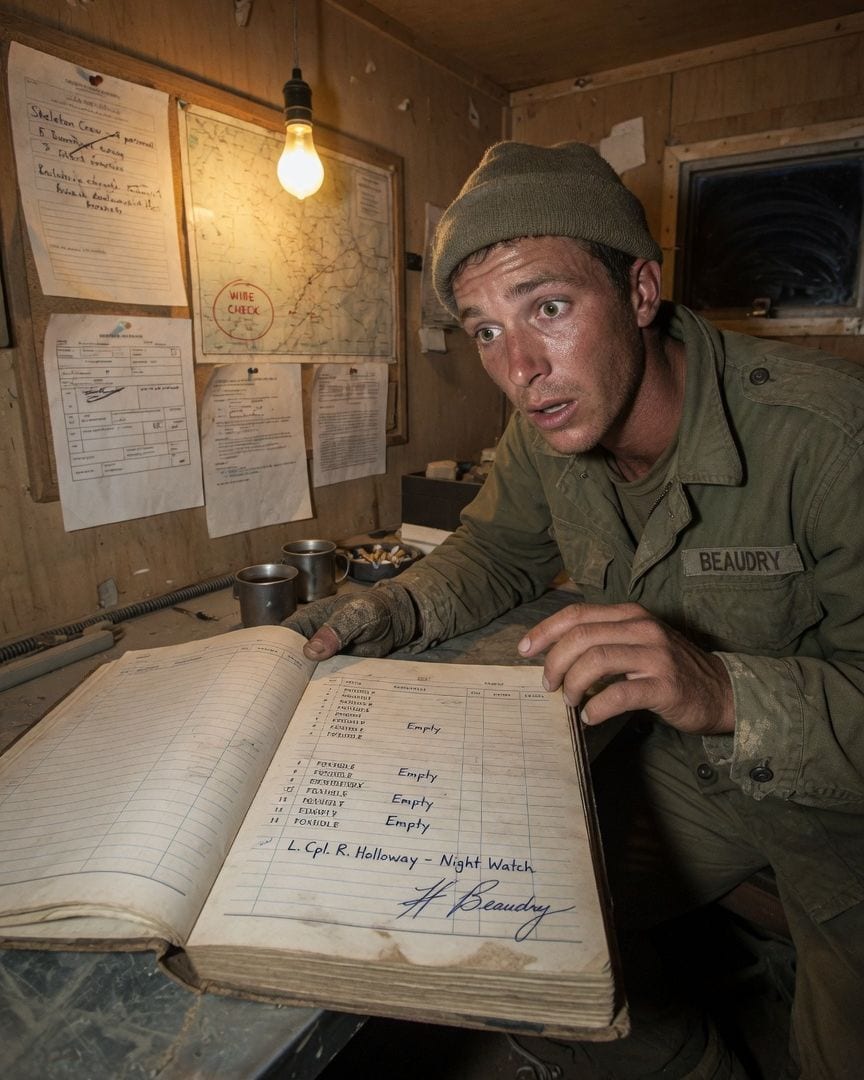
Lance Corporal Hugo Beaudry, bundled against the desert chill, moved along the perimeter of Firebase Kettle, the wind a low moan through the empty watchtowers.
The outpost, a ring of sandbagged foxholes atop a bald, windswept hill, was in its final stages of draw-down. Most of the men were gone, pulled back to larger bases, leaving only a skeleton crew to manage the final decommissioning.
Tonight, Beaudry had the wire-check, a routine, solitary task.
He had to tug the comm wire that snaked along the ground, linking each position, feeling for the answering pull from the next foxhole, a simple confirmation that the line was intact.
He reached the third hole out, a position that had stood empty for a week. Its sandbags sagged, worn by sun and wind, and its radio equipment had been removed days ago.
There was no one assigned to it, no one left to occupy it. Beaudry gave the comm wire a firm tug.
A moment later, two distinct pulls came back down the line, the standard all-clear signal, sharp and unmistakable against the taut wire.
Beaudry froze, his gloved hand still grasping the wire. He stared at the empty, gaping foxhole, the wind whistling faintly through its vacant space. He tugged again, harder this time, a deliberate, questioning pull.
Again, two pulls answered, distinct and strong. He pulled a third time, counting the seconds, waiting for an echo, a fluke. Two pulls. Always two.
He slowly moved back, mentally ticking off the men left on the hill – four, including himself. He counted the answering tugs down the line again, starting from the first occupied position, each one a solid, expected confirmation.
When he reached the third foxhole’s signal, he knew. He had one more answering tug than there were actual men. The cold that had started in his fingers now spread through his chest.
The wire, connecting every point on the perimeter, connected him to something impossible.
Beaudry tried to rationalize it. An echo? A loose connection somewhere further down the line? Maybe the wind, pulling the wire against a rock? Fatigue, playing tricks on him in the isolated quiet?
He shook his head, the possibilities flimsy against the concrete reality of the sharp, responsive tugs. The signals had been too precise, too deliberate.
The dread wasn't fear of a ghost, not yet, but the unsettling certainty of an observed fact that simply did not fit.
He finished his check, the extra pull from the empty hole an itch under his skin, a discordant note in the silence of the desert night, and headed for the small ops shack.
Inside, the air was thick with the smell of old coffee, stale tobacco, and dust that seemed to have settled into every surface. A single bare bulb hummed overhead, casting a yellow glow.
He pulled open the heavy, metal-bound daily duty logbook for the foxhole assignments. His manifest for the skeleton crew was already thin; he knew every name by heart.
He scanned the entries for the past week, focusing on the third foxhole. Each day, it was marked ‘Empty.’ Just as it should be.
He double-checked the official manifest pinned to the bulletin board, then leafed through the supply requisitions for the past week. No Raymond Holloway.
No one by that name had been assigned to Firebase Kettle, not in his rotation, not in the records he had access to.
He was about to close the logbook, convinced it was just an anomaly of the comm wire, a freak occurrence he couldn't explain but didn't need to document, when his eye caught something small, almost hidden.
At the bottom of the page, for that very day’s entry, squeezed in below the official 'Empty' designation for the third foxhole, was a small, handwritten insertion. It read: 'L. Cpl. R. Holloway - Night Watch.'
And beneath it, a signature. Beaudry stared. It was his own, precise, unmistakable signature. Every loop, every angle, every distinct flourish of his 'H' and his 'B' was perfectly replicated.
He knew his own hand better than anyone. He had signed dozens of logs, hundreds of forms, every day of his deployment. This was his signature, no doubt, a perfect replication.
But he had never signed for a Lance Corporal Raymond Holloway. He had never even heard the name, let alone seen the man.
The ink on the entry for Holloway was dry, faded like the rest of the page, perfectly aged with the surrounding text.
He traced the familiar loops of his 'H' and the sharp, decisive angle of his 'B' with a trembling finger, not quite touching the paper. A perfect forgery, or something worse.
He felt a cold dread, not the raw, primal fear of a ghost or some malevolent entity, but the cold, rational dread of paper lying, of an official record swearing to a man who did not exist, authenticated by his own unquestionable hand.
The logbook lay open, demanding he acknowledge the impossible.
The next morning, Beaudry found Staff Sergeant Ethan Ellsworth in the main ops building, hunched over a stack of decommissioning paperwork.
Ellsworth, a grizzled NCO with decades in the field, his face a map of sun-baked lines, barely looked up from the forms when Beaudry approached.
Beaudry, still rattled, quickly explained the wire-check from the night before, the impossible extra tug, then the logbook entry for Holloway, holding the book out for Ellsworth to see.
Ellsworth listened, his expression unreadable, his eyes distant as Beaudry recounted the facts. Then he waved a dismissive hand, a slow, tired gesture. “Fatigue, Beaudry. Or some of the younger privates having a laugh before they ship out.
It’s an empty hole. Nothing out there but sand and silence.”
But Ellsworth’s calm dismissal, the way he didn't even bother to examine the signature, only sharpened Beaudry’s unease. It felt too easy, too pat.
He returned to the smaller ops shack, driven by a growing, nagging need to prove the impossibility, to find a pattern, something. He couldn't shake the image of his own handwriting legitimizing a ghost.
He pulled out older logbooks, their covers stiff with disuse, and began cross-referencing manifests and supply requisitions for the third foxhole, and other 'empty' positions during previous draw-downs or periods of low personnel at Kettle.
The air in the shack seemed to grow heavy around him, the dust motes dancing in the shaft of light from the single window. He found other subtle discrepancies, tiny anomalies, but always consistent.
A requisition for extra rations for a phantom name, recorded for an empty foxhole two rotations ago. A fuel expenditure for a vehicle that had been non-operational for months, signed off by an NCO who had already been transferred.
Each discrepancy was small, easily overlooked, but always consistently adding up to an extra man, or an impossible expense, always tied to a position that should have been empty.
The errors were too perfect, too consistent, spread across weeks, months, even years in the older logs.
He felt a prickling sensation on his neck, as if the cold desert air had suddenly condensed behind him. He looked up, his gaze drawn to the end of the narrow corridor outside the shack.
Ellsworth was standing there, watching him. A shadow in the dim light, his presence unannounced, unnerving. He wasn't doing anything, just watching. His face gave away nothing.
The next morning, Beaudry returned to the ops shack to find the door ajar, despite having locked it securely the night before. He’d distinctly heard the click of the latch. He pushed it open slowly, scanning the cramped space.
Nothing seemed disturbed, no papers scattered, no equipment obviously out of place. But the logbooks he’d been examining, which he’d left stacked haphazardly, were now neatly aligned on the small desk, their spines perfectly parallel.
He felt a growing certainty that he wasn't just investigating a clerical error, not anymore. He was being observed, and whatever was watching him had access to everywhere he went.
The air in the room felt colder than it should have been.
Later, while checking the perimeter again, a routine that now felt loaded with unseen eyes, he saw Ellsworth.
The Staff Sergeant was standing by the old water tower, a skeletal structure of rusted metal against the rising sun, simply watching him from a distance.
No wave, no call out, just a silent, unnerving observation that lasted until Beaudry was out of sight behind the sandbagged walls. Ellsworth seemed to be everywhere Beaudry went, a quiet, unblinking presence on the fringes of his vision.
At lunch, in the mess tent, Ellsworth approached his table. The clatter of mess kits and low chatter of the remaining crew seemed to fade around them. Ellsworth’s voice was low and even, pitched only for Beaudry. “Loose ends, Beaudry.
Always loose ends, when you decommission a place like this. But things need to be kept in order, you understand? The old ways.” He offered a small smile, a thin, humorless line that didn't reach his eyes.
Beaudry felt his stomach clench, not from fear of physical harm, but from the unsettling weight of the words.
It wasn't a threat, but a statement of fact, a warning delivered with the calm certainty of a man who understood a truth Beaudry was only beginning to glimpse.
Ellsworth knew he was digging, and he knew what Beaudry was looking for. The air around them seemed to grow colder, even under the desert sun, filled with an unspoken implication.
The calm in Ellsworth’s eyes was like ice, ancient and unyielding.
The quiet menace of Ellsworth’s gaze had cemented Beaudry’s resolve. He found the Staff Sergeant in the main ops building after the last of the daily reports had been filed.
Beaudry approached, the logbook open to Holloway's entry in his hands, its pages feeling heavy, almost alive with the weight of the lie they contained. “This,” Beaudry said, his voice tight, barely controlled, “is my signature.
For a man who doesn’t exist, in a foxhole that’s empty. Explain it, Staff Sergeant.”
Ellsworth took the logbook from Beaudry, his fingers brushing the page, lingering briefly on the phantom entry, unconcerned. He didn't deny it, didn’t even glance at the signature.
His gaze was steady, placid, as if Beaudry had asked him to explain the rising of the desert sun.
“Firebase Kettle,” Ellsworth began, his voice low and steady, stripped of any emotion, “has always had a particular way of keeping its count. It needs to be full. Always.”
He didn't wait for Beaudry to respond, moving with a quiet efficiency. He led Beaudry to a locked metal cabinet, its steel gray and dented with age, and pulled out several more logbooks, older, dustier than the one Beaudry held.
Their bindings were cracked, their pages yellowed and brittle. He flipped through them with practiced ease, like a librarian retrieving a familiar volume, pointing out entries strikingly similar to Holloway’s. “See? Not just Holloway. Other names. Phantom names, every one.
Always during a draw-down, when personnel thinned. Always an empty position filled on paper. Always signed by the NCO on duty for that rotation.”
He paused, closing one of the older books, the faint smell of old paper and dust clinging to the air around him. His gaze met Beaudry’s, unwavering, deep-set, and strangely knowing. “It’s about maintaining the integrity of the roster, Beaudry.
Preventing worse discrepancies. This place… it doesn’t like gaps. It fills them. It has always done so. For decades.”
He spoke of it as one might speak of a peculiar, but predictable, weather pattern, or a fundamental, unchangeable function of the very landscape itself.
The 'presence' wasn't malicious, he asserted, not in any human sense, but an inherent function of the outpost, a silent, ancient hunger for order, a need to ensure the numbers always added up, that the count was always balanced.
Beaudry felt the blood drain from his face, his skin suddenly cold, the air thin and sharp. The earlier clues, the disparate wrongness he had encountered, now snapped into a horrifying, coherent picture, a system of dread.
The extra tug on the comm wire, signaling a presence where there was none. The impossible supply requests for phantom soldiers, dutifully filled and recorded.
The perfectly consistent ‘errors’ across decades, each one a meticulous, undeniable record of an intrinsic anomaly. It wasn’t a prank, not a mistake, not fatigue playing tricks. It was real, and it was written down, meticulously, in the official records.
Every single, impossible detail now fit.
Ellsworth closed the logbook on Holloway’s entry, placing it back on the stack with a soft thud that echoed in the sudden silence of the office.
Then, without a word, he pulled another, even older, from the bottom of the cabinet. Its cover was faded to an indistinct gray, its binding worn smooth at the edges, the paper itself brittle and fragile in his hands.
The smell of decades of dust and dried ink rose from it. “Sometimes,” Ellsworth said, his voice flat, devoid of inflection, a whisper in the dusty air of the office, “it accounts for those who will come.
Those who are meant to pass through.”
He opened the book to a specific page, dated decades ago, a precise month and year that flashed by Beaudry’s eyes.
It was a time when Firebase Kettle was also thinning out, preparing for a temporary closure before its next rotation of personnel.
He ran a finger down a column of names for the third foxhole, the very same position Beaudry had checked just nights before, the source of the impossible tug, the place that had started this entire, horrifying investigation.
The familiar number, ‘3’, seemed to burn into Beaudry’s vision.
Then Ellsworth stopped, his finger resting on a single line, holding it there with an almost gentle pressure.
Beaudry leaned closer, his breath catching in his throat, a cold knot tightening in his stomach, a sudden, dizzying sense of vertigo washing over him. The entry, clearly legible despite the faded ink, read: 'L. Cpl. Hugo Beaudry, Foxhole 3.'
It was signed beneath by a Staff Sergeant Coleman, whose scrawl was distinct and official. The date stamped next to it was years before Hugo was even deployed to this region, years before he was even born.
It was an impossible entry, a pre-written destiny. Ellsworth looked up from the page, his eyes meeting Hugo’s, placid, knowing, utterly calm.
The calm in Ellsworth’s gaze was terrifying, a silent confirmation that Hugo Beaudry was never just an observer here.
Ellsworth’s explanation was delivered with the dispassionate clarity of a man describing a maintenance schedule, or the predictable ebb and flow of tides that govern the desert landscape. He spoke without judgment, without emotion.
“The presence at Kettle requires a full complement, Beaudry. It doesn’t tolerate empty spaces, not on the ground, and certainly not in the records. When the human numbers drop below a certain threshold, it simply fills the gap.
Sometimes with a phantom, like Holloway, a name it invents to balance the count, a placeholder.
Sometimes, and this is rarer, it takes a name from those who are yet to serve here, those who are destined to pass through these gates, holding a place for them in advance, writing them into the roster.”
He gestured to the entry with Hugo’s name, the yellowed page a stark, undeniable testament to a pre-ordained fate. “Your name, Lance Corporal. Years ago. Pre-ordained, you might say.
A place held for you in the roster, long before you arrived, long before you even existed as a soldier, waiting for you.”
Ellsworth explained his own role, not as a warden or a willing participant in some grand conspiracy, but as a custodian, a steward.
He meticulously ensured the 'records' were kept straight, that the anomaly’s needs for a full roster were met.
He believed, with an unsettling conviction, that to disrupt the 'count' would invite something far worse than a few anomalous entries, something he refused to speculate upon, but whose implications hung heavy in the stale air of the ops building.
He saw it as a duty, a necessary peace-keeping, a way to maintain a fragile, unseen balance.
The coherence of it all was horrifying: every planted clue Beaudry had stumbled upon, every impossible discrepancy he had unearthed, now clicked into place, fitting into this terrifying, rational system.
The dread was not in the unknown, but in the awful, undeniable knowing.
It wasn't evil, not in the human sense, but an ancient, impersonal hunger for order, for a full roster, written into the very ground of Firebase Kettle, ingrained in its purpose, as fundamental as its sandbagged walls.
The outpost itself was a living ledger, a meticulous chronicler of lives, real and imagined.
Hugo Beaudry felt a cold, existential dread settle over him, colder and deeper than any desert night.
He wasn't just a soldier on a temporary assignment; he was a pre-written character in Firebase Kettle’s ledger, his presence here accounted for decades ago, his future already logged.
The very idea of agency, of free will, seemed to crumble around him, reduced to a hollow illusion.
He stood, pushing away from the desk with a jolt, away from the weight of the old logbooks that contained not just historical data, but a chilling prophecy of his own life.
Ellsworth watched him, unmoving, a statue of quiet, knowing understanding. “I’m out of here,” Beaudry said, his voice rough, thick with an emotion he couldn't name, a mixture of terror and disgust. “I’m done. I want off this rock, now.”
Ellsworth simply nodded, his eyes unblinking, betraying no surprise or protest. “The last transport leaves at zero-six-hundred. Don’t miss it.”
He offered no resistance, no argument, no attempt to hold Beaudry back, only a calm, unsettling certainty, as if stating an immutable law of nature.
His placid demeanor was the final, chilling confirmation that this was simply the way things were. “The count always balances, Beaudry. It always does. One way or another. It just is.”
As Hugo packed his gear in his barracks, the image of his name in that ancient logbook burned in his mind’s eye, a brand on his perception of reality.
The scent of dust and old paper seemed to cling to his clothes, an invisible shroud.
He wasn't escaping a physical threat, no one had laid a hand on him, but a truth that warped his own history, his own agency, rendering his life a pre-scripted part of an unseen mechanism.
He had believed in a world of order, of manifests and head counts, where every man was accounted for by living men, where dates meant chronology, not destiny.
But Firebase Kettle had shown him an order far older, far more absolute, where the numbers would always be right, even if it meant writing him into existence before he was.
His escape was not from danger, but from understanding the true nature of the system, and his pre-ordained place within it.
He was leaving, but he would carry the weight of that pre-written entry forever, a ghost of his own future.
Hugo Beaudry left Firebase Kettle on the last transport. The firebase was officially decommissioned and abandoned. Staff Sergeant Ellsworth remained behind, ostensibly for final administrative duties, a solitary figure among the empty buildings.
Hugo's service record remained impeccable, a testament to a flawless career, with no mention of any irregularities or phantom personnel. He received his next assignment, a transfer to a quiet stateside base, and tried to put Firebase Kettle behind him.
He tried to believe the records, after all, showed nothing amiss.
Years later, a new forward operating base was being established on the site of old Firebase Kettle. Lieutenant Laura Sutton, a young engineer, was sifting through archived construction manifests in a newly erected prefab.
She found a requisition for a new perimeter comm wire system, dated a month ago.
Among the listed personnel for the initial survey team, she saw her own name, signed by a Staff Sergeant Ellsworth, for a date two years in the future. She stared at the line.
He wondered briefly if the ink was still wet.
If this one got to you
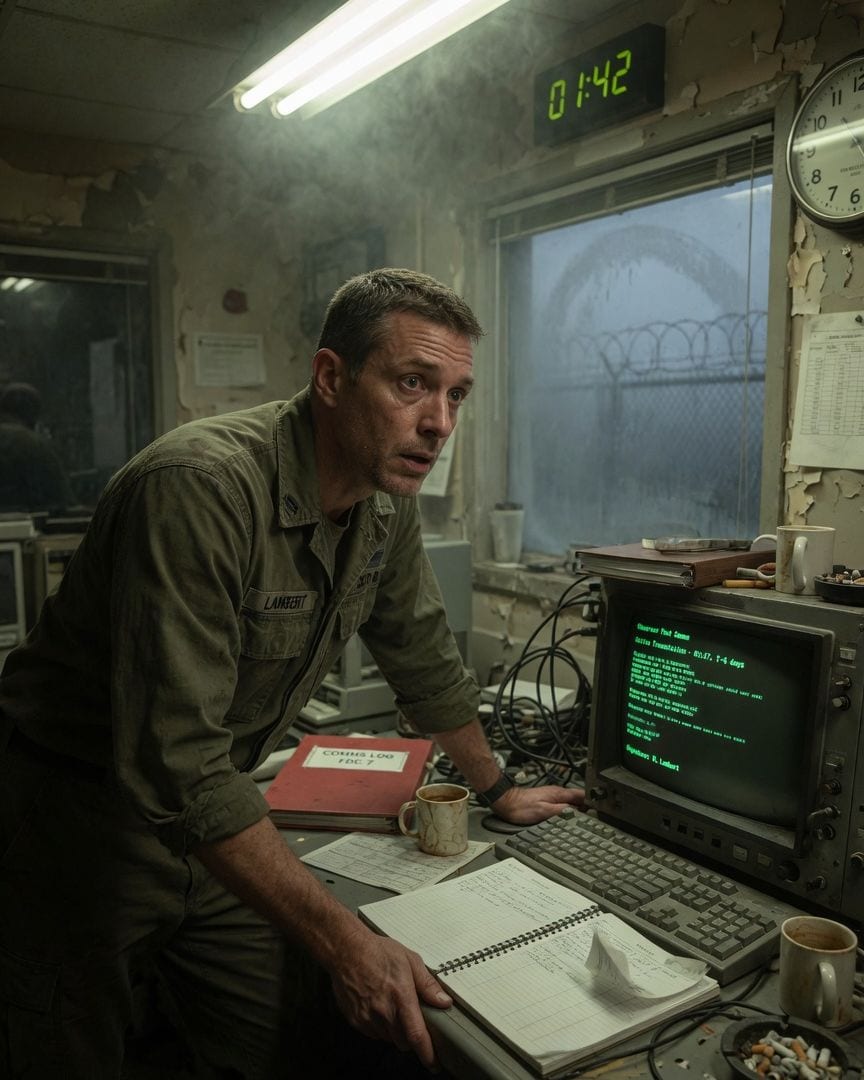
With Firebase 7 days from demolition, a dispatch specialist found his own signature on a log entry from a lost outpost. Then, a dead soldier's name appeared.
Specialist Robert Lambert hunched over the radio console in Firebase 7, the mountain fog pressing in as the base counted down its final days before demolition. His quiet shift shattered when urgent calls began arriving from outposts officially declared silent a week ago. His sergeant calmly informed him that he’d been speaking to no one, as all comms with those posts had been lost for hours. Later, Robert found a log entry for an active transmission, dated days after a post went dark, bearing his own signature. What chilling truth lay beneath the paper, revealing a dead soldier's name reporting from the grave?
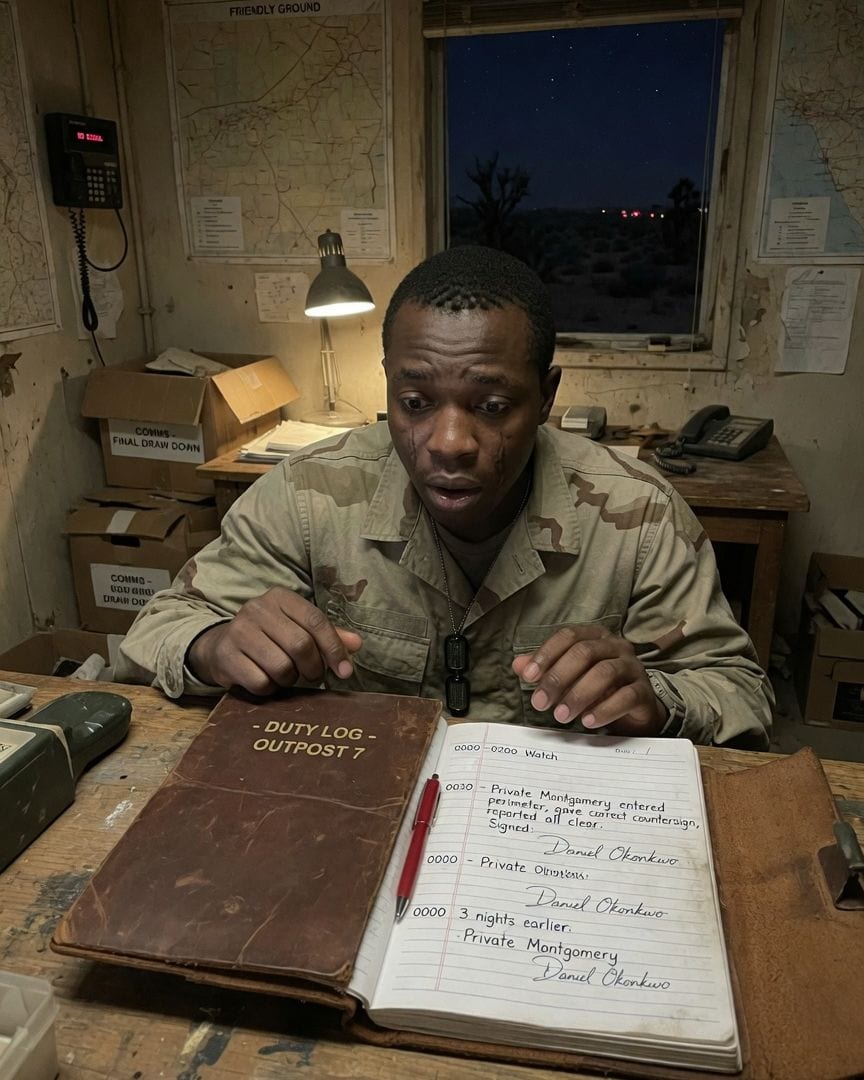
On Private Okonkwo's last desert watch, a soldier with an unnatural smile appeared. Then the duty log showed his own signature, confirming an entry he never made.
Private Daniel Okonkwo was counting minutes on his final watch at desolate Outpost 7, eager for dawn and a long-awaited trip home before the base closed for good. The familiar desert night offered little comfort, its vast emptiness usually reassuring, but tonight held an unsettling quiet. As his starlight scope swept the sparse treeline, a figure in their uniform stepped from the absolute dark, raising a hand with the correct recognition signal—and an unnatural, wide smile. Later, Private Okonkwo found his own unmistakable signature in the outpost's duty log, confirming a 'Private Montgomery' had entered the wire during his shift, an event he knew never happened. With the last convoy disappearing, who—or what—had signed his name to a lie, and why?
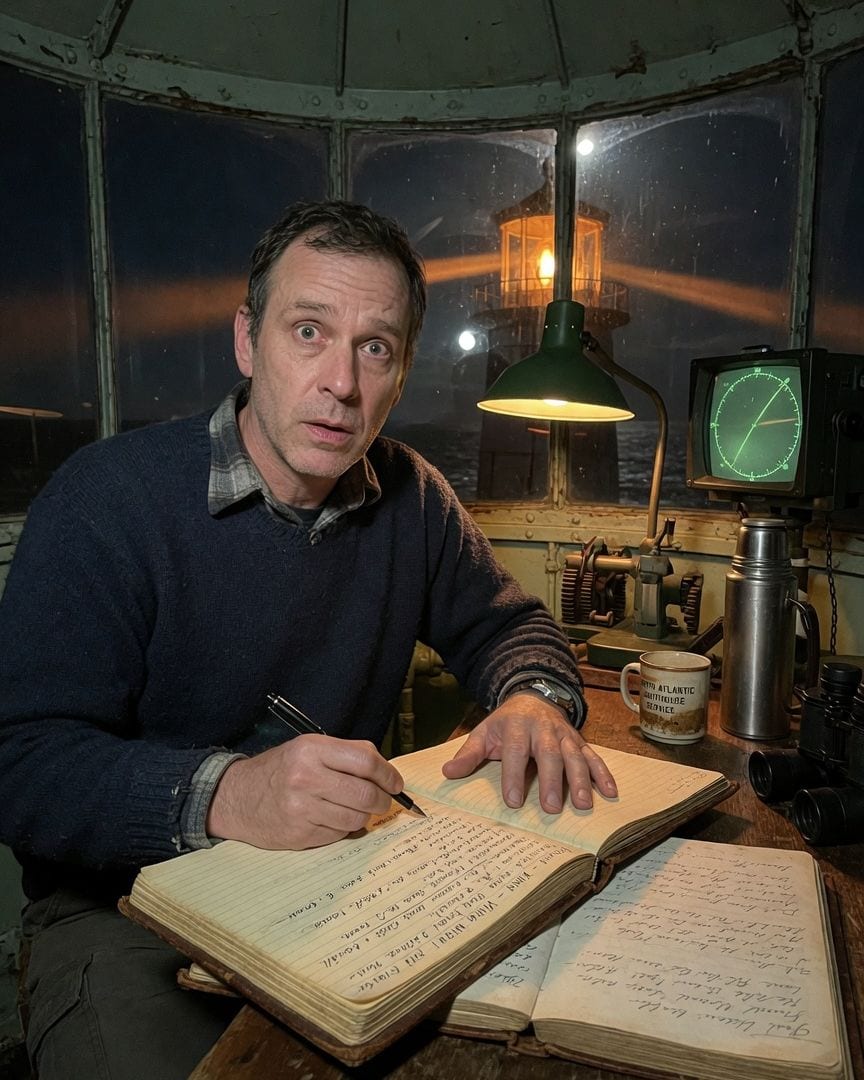
My lighthouse log has my own 3 AM entry for a phantom ship. I was alone in the tower, and I wrote no such thing.
Perched in the lantern room for my usual 2-6 AM watch, I reached for the thick logbook. But the 3:00 AM entry, under my own name, detailed a vessel I never saw. The words were in my own ink, yet I had never written them.
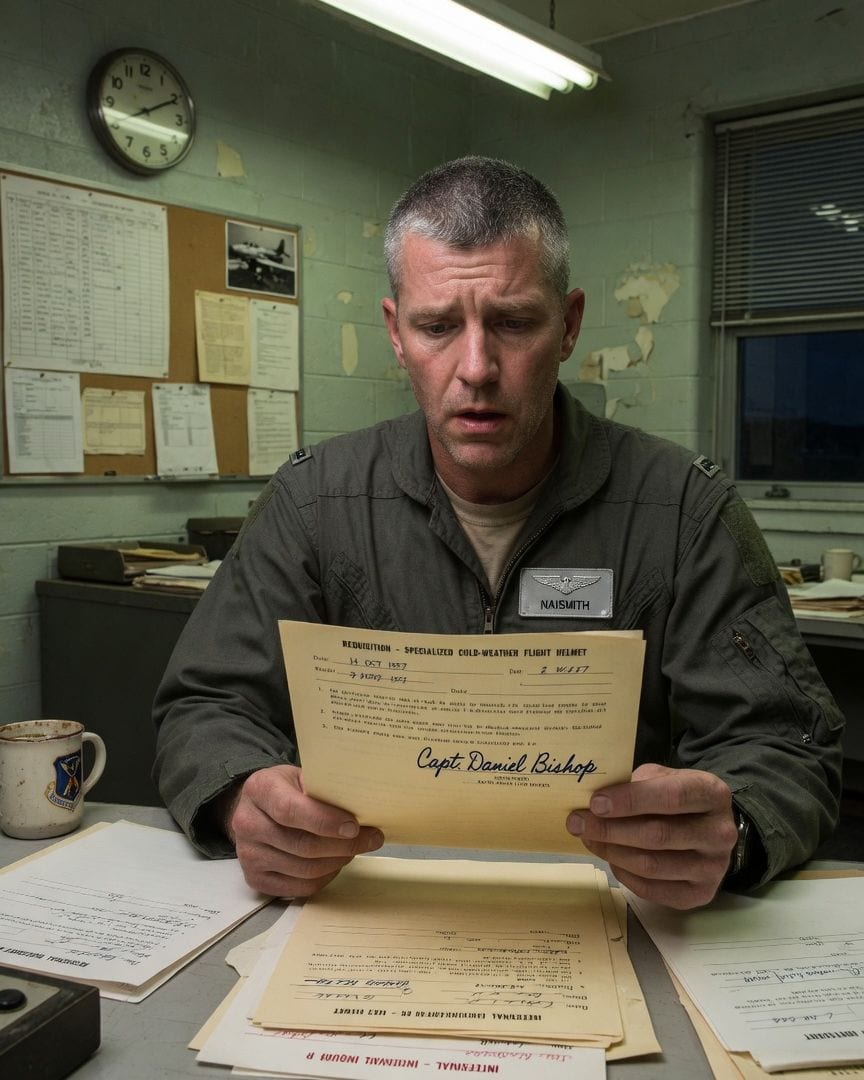
A Cold War Colonel reviews a missing pilot's file and finds Captain Bishop's signature on a form dated weeks after he vanished.
Colonel Ward Naismith faced the grim task of reviewing Captain Daniel Bishop’s personnel file, a routine chore for a man listed as Missing in Action. Bishop had vanished days after he and Naismith chased an impossible, silent disc over Lake Superior, leaving only an empty patch of air and a knot of unease in Ward's gut. Sifting through commendations, Ward found a requisition for flight gear and a maintenance sign-off, both dated *after* Bishop’s disappearance. The true chill came with the requisition for a specialized flight helmet, bearing Captain Bishop’s unmistakable signature, weeks after he was presumed lost. How could a man presumed lost have signed anything?
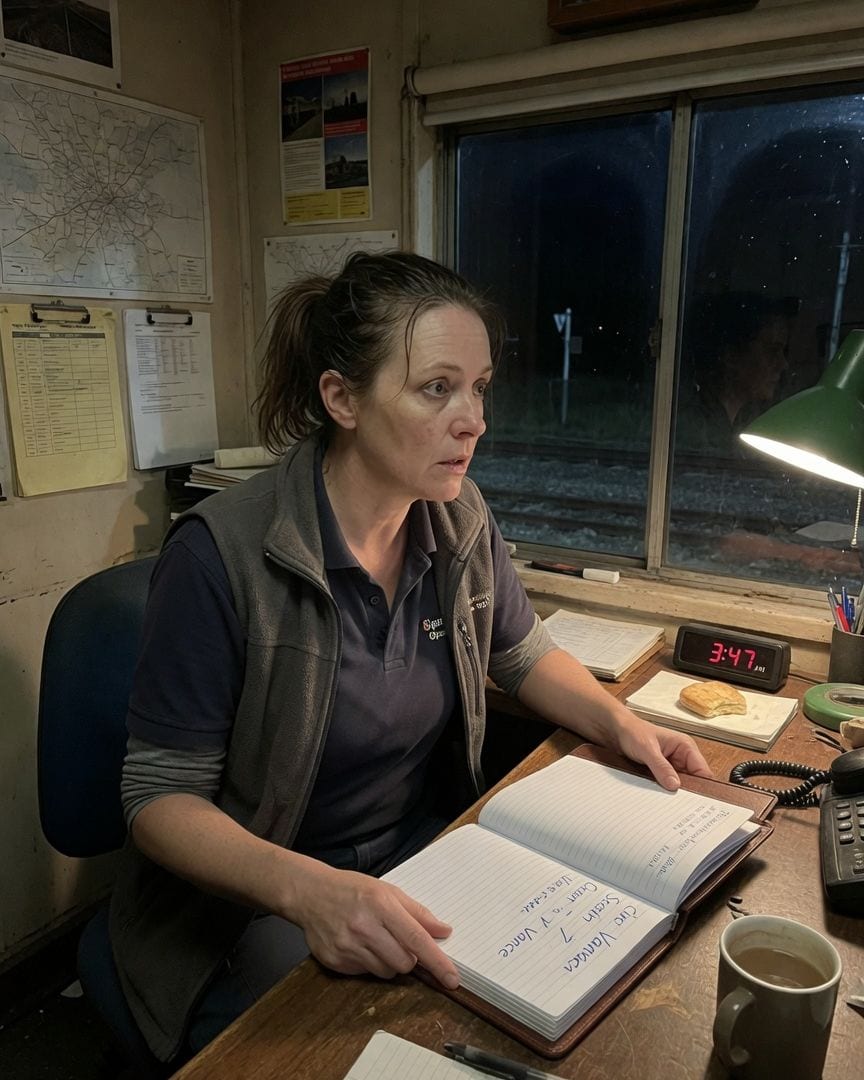
My linesman taps twice on my window at 3 AM. Control says he retired and passed years ago.
My routine at the rural signal cabin was regular: the linesman's double tap on the window at 3 AM. But then my supervisor called, revealing the linesman I knew, Warren Vance, had died five years ago. Now, an impossible entry in my official logbook, with his signature and timestamped from my shift, proves someone else was there.
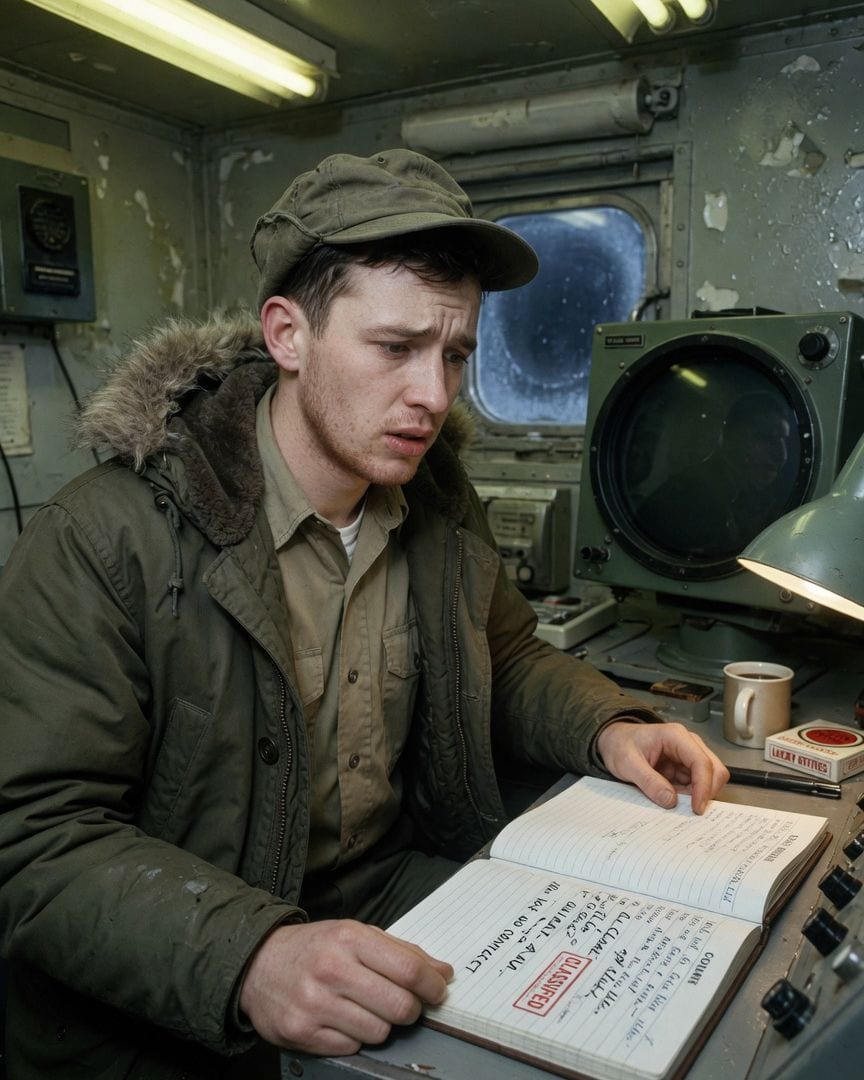
A Cold War airman logs an impossible radar contact on his last sweep. But his official logbook entry is stamped 'CLASSIFIED' and then contradicted by a hastily scrawled 'ALL CLEAR' dated moments before it.
Airman Ordway Vance, 22, manned the radar dome at Site Pellin in the biting North Atlantic dark of January 1962, running the last calibration sweep before its decommissioning. His scope picked up a faint, impossible return, growing closer with each pass, though the ocean remained empty to the eye. When Vance detailed the contact in his official logbook, a 'CLASSIFIED' stamp appeared, followed by a hastily scrawled 'ALL CLEAR' dated moments before his own entry, contradicting his every word. Commander Hartley dismissed it as equipment malfunction, but Vance sensed a chilling, official erasure behind the lie. He soon found a locked cabinet marked 'SITE PELLIN ANOMALIES,' hinting at a deeper truth buried within the base's final days.