My lighthouse log has my own 3 AM entry for a phantom ship. I was alone in the tower, and I wrote no such thing.
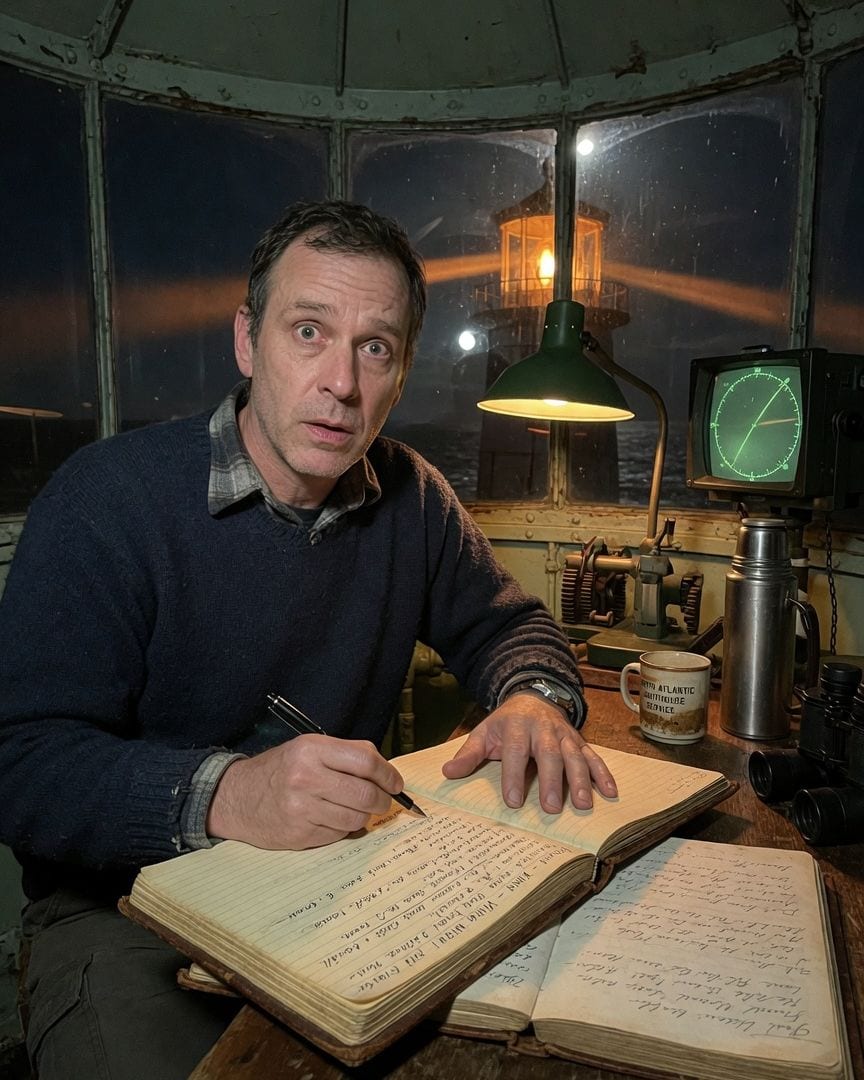
The wind always had a voice out here, a low, constant howl that wrapped itself around the rock like a shroud.
I was on the 2-6 AM watch, same as every Tuesday, perched up in the lantern room, the beam of light sweeping its slow, deliberate arc across the churning blackness of the North Atlantic.
My only company was the rhythmic grind of the gears and the distant roar of the surf far below.
At 4:00 AM, just as the moon was thinking about slipping behind the horizon, I reached for the logbook, a thick, leather-bound volume I’d grown to respect in my years as a keeper. My pen hovered over the fresh page.
That’s when I saw it. The entry above the one I was about to make, the 3:00 AM line.
It read: "3:00 AM, Vessel lights bearing WNW, Paul Kowalski."
My hand froze. I stared at the words, at my own name, appended to an observation I hadn't made. I remembered writing the 2:00 AM entry perfectly clearly.
I remembered the silence, the utter emptiness of the sea, just the dark waves and the endless horizon. There had been no vessel. No lights. And I had written no such thing.
Yet, there it was, in ink identical to the pen still clutched in my hand.
I blinked, hard, then rubbed my eyes with the heel of my palm. Late shift delirium, maybe? A momentary lapse?
I checked my pen, then my fingers, turning them over, searching for an ink smudge, any tell-tale sign that I might have scrawled something unconsciously, sleepwalking through my own shift. Nothing. My hands were clean.
I ran through the last hour in my head, a mental playback: the methodical check of the lamp, the sweep of the binoculars across the black water, the small thermos of coffee I’d poured at 2:30.
Every detail was sharp, clear. There was no blank spot, no missing memory.
I re-read the 2:00 AM entry, then the 4:00 AM slot where I’d finally noted the change in wind speed. My handwriting, that same familiar, slightly cramped script, was unmistakably consistent.
But the 3:00 AM entry, sandwiched between them, was a ghost.
My heart gave a slow, deliberate thud against my ribs. A prickle of cold dread started to replace the initial confusion. I leaned over the radar screen, its green sweep showing nothing but the lighthouse's own echo.
Then I grabbed the binoculars again, training them on the precise bearing of WNW, scouring the dark expanse of ocean. Miles of nothing. The only light out there was my own.
I knew, logically, that it had to be a prank. Some new relief keeper, maybe Annika, trying to get a rise out of the old man. But the thought didn't sit right. It was too precise, too… personal.
And the ink was my ink.
I pulled out one of the older, public logbooks from the metal shelving unit, telling myself it was just curiosity. I flipped through the brittle, yellowed pages, seeking any similar anomaly, any proof of a recurring joke among keepers.
I skipped through decades of meticulous records, the names of forgotten men and women blurring together, each entry a testament to lonely, ordered lives. Most were mundane: "Heavy fog," "Repaired wick mechanism," "Supply boat arrived." Then, my finger snagged.
Paul’s finger traced a faded entry in a logbook from exactly fifty years ago. The date was a Tuesday in autumn, long before he was born.
The writing was different, a looping, elegant script belonging to a keeper named Franklin Norwood. But the entry at 3:00 AM read: "Vessel lights bearing WNW, Paul Kowalski."
The impossible entry, my name staring back at me from half a century in the past, rattled me to my core. I couldn't shake it. As soon as my shift ended, I called Harold Montgomery.
Harold was seventy-six now, retired for almost two decades, but he’d spent forty years out here. He knew every crack in the rock, every creak in the old tower, and every story passed down through the generations of keepers.
"Phantom vessels?" Harold’s voice, raspy from years of shouting over gales, initially held a gruff dismissiveness. "Paul, you've been working too many doubles. Probably just a stray beam of light, or a reflection off the clouds. Happens."
"No, Harold, it's more than that," I pressed, my voice low. "My name. Fifty years ago. In the log, next to a 3 AM vessel entry. By Franklin Norwood."
There was a silence on the line, heavier than the usual crackle of a bad connection. Harold cleared his throat, a wet, rattling sound. "Franklin… yeah. Good man. Kept a tight log." He paused again.
"Look, Paul, some things are best left undisturbed. You hear stories out there, you always will. Just… don’t go poking around in the dark, alright? Some things are best left alone."
His tone had shifted, a subtle but distinct note of evasion. He ended the call shortly after, muttering about having to check his prize-winning dahlias.
Undeterred, Harold’s warning echoing unpleasantly in my head, I began a meticulous, systematic search through every old logbook in the tower. There were dozens, shelved and forgotten, going back to the late 1800s.
I wasn't just looking for my name now; I was looking for the pattern. I cross-referenced names, dates, and specifically, those isolated 3:00 AM entries mentioning a "vessel."
I found more. Not my name again, but other impossible details. A keeper named Thomas Finch noted a vessel at 3:00 AM on April 12th, 1937.
Then, an entry for the exact same time the very next night, April 13th, but by a different keeper, Robert Davies, noting the exact same vessel, same bearing. But Thomas Finch was still on duty that night.
His entry was clear for April 13th, 2 AM to 6 AM: "Clear skies. No shipping." Yet, Davies's entry, from the relief log kept in the lower office, existed.
It was as if two realities had bled together on the page. The unease tightened its grip, each new discrepancy confirming a pattern that shouldn't exist.
As I dug deeper into the history of the logs, a chill seemed to settle over the lighthouse itself. Not the biting sea cold, but something deeper, clinging.
I started hearing faint, metallic scrapes from the lower levels, sounds that echoed strangely in the empty stone shaft of the tower, like fingernails dragging across iron.
I’d check the security cameras – a recent addition, mostly for insurance – but they’d show nothing but dust motes dancing in the beam of the service light.
One morning, a small, unmarked package arrived by supply boat. No sender listed, just my name handwritten on the plain brown paper. Inside, wrapped simply, was an old, weathered nautical chart of the local waters.
It was yellowed and brittle, smelling faintly of salt and something else… something cold and deep. A specific, very deep trench offshore, one I knew was miles deep, was circled in red.
And a faint, hand-drawn 'X' marked the lighthouse itself. No note, no explanation. Just the chart. I felt a prickle of certainty: someone knew I was looking. Someone had sent this.
Later that day, Harold Montgomery called, his voice strained and agitated. It wasn't the usual gruffness; there was genuine fear in his tone. "Someone's been asking about you, Paul," he rasped, the words tumbling out. "Asking about the logs.
Tall man, quiet. Said he was with the historical society. But he knew things. Things only a keeper would know. He described the rotating shifts, the types of pens we use… things the public wouldn't know."
Harold's voice dropped to a near whisper. "He told me to tell you… to stop looking."
I drove straight to Harold’s house, the old chart lying crumpled on my passenger seat. His small cottage, usually neat as a pin, looked disheveled. Curtains were drawn, and a faint smell of stale pipe tobacco hung in the air.
"What do you know, Harold?" I demanded, standing in his living room. "What is this? The log entries, the chart… who was that man?"
Harold flinched, his eyes darting to the window, as if he expected to see the 'tall man' standing on his lawn. Finally, he sighed, a deep, shuddering breath that seemed to deflate him.
"It's not just a log, Paul," he said, his voice barely audible. "Not really. Not for everything."
He sat down heavily in his armchair, leaning forward, his elbows on his knees. "Those 3:00 AM entries," he began, his gaze fixed on the worn carpet. "They're... different. They’re a record of us. The keepers."
He recounted a hushed legend, one passed down among a few, older keepers who understood. The lighthouse, he explained, isn't just guiding ships, it’s also a witness. And sometimes, it’s a recorder.
The 'vessel' isn't a ship at all, but a manifestation, a deep, ancient presence from that trench marked on your chart.
"When it passes," Harold explained, his voice barely a whisper, "it marks the keeper who is on watch. Your name… it means you've been seen. Logged."
Harold then pulled a worn, personal logbook from beneath a stack of old magazines on his side table. Its cover was soft, faded green leather.
He opened it to a page from decades ago, pointing a trembling finger to a 3:00 AM entry, clearly written in his own hand: 'Vessel lights bearing WNW.' Below it, just like mine, was his own name: 'Harold Montgomery.'
"It happened to me too," he admitted, his face pale and drawn. "Years ago. Once your name is in that specific entry, Paul, you're part of it. It knows you."
Harold's confession hung heavy in the air, a cold, suffocating weight. "There's more," he said, his voice barely audible. He fumbled with a hidden catch on the side of his old desk, a small brass lever I hadn't noticed before.
With a soft click, a secret drawer sprang open. From it, he carefully extracted a small, leather-bound volume, ancient and brittle, its pages yellowed to parchment. It looked even older than the oldest public logs in the tower.
"This isn't for public eyes," he whispered, his hands trembling as he laid it on the desk. "This is the true log. Passed down, hidden from the others. Only a few of us ever knew it existed."
He opened it, his finger shaking as he pointed to a page filled with a long, unbroken sequence of dates and names, each entry meticulously recorded at 3:00 AM, each describing the "vessel bearing west-northwest," and each with a keeper's name appended.
It was a precise, horrifying pattern across dates and names, stretching back centuries. He pointed to the last name: Franklin Norwood, the keeper Paul saw in the public log, fifty years ago.
But beneath Franklin's final entry, scrawled in an ancient, flowing hand that was not Franklin's, nor Harold's, was Paul's own name, "Paul Kowalski," followed by a series of future dates, some stretching years ahead.
And the very next date in the sequence, the one immediately following Franklin Norwood's last entry, was tonight's date.
I stared at the ancient logbook, my own name a cold brand on the page, stretched into a terrifying future. Harold's voice, now strangely calm, filled the silence.
This wasn't merely a record, he explained; it was a schedule, a prophecy. The 'vessel' wasn't a ship, but the passage of an entity, a monstrous intelligence from the deep trench marked on the chart I’d received.
It used the lighthouse, and its keepers, as a beacon, a point of contact, and a means of marking its own passage through time. The names were the keepers chosen to witness it, to be logged into its ongoing existence.
Harold recounted the hushed stories he’d heard from his own predecessors – tales of keepers whose names appeared in this hidden log. Some vanished entirely, leaving behind only their completed log entries.
Others returned irrevocably changed, distant, their eyes holding an ancient, terrible knowledge that emptied them of their former selves.
He pointed again to the chart, emphasizing that the marked trench was where the 'vessel' emerged, its 'lights' merely the first, faint hint of its presence, not an actual ship.
The 3:00 AM entry I found in my own log was the initiation, the start of my own personal sequence in this horrifying, predestined cycle.
I was never just an observer; I was always inside it, my name written into the pattern long before my birth.
Tonight. Tonight was the date marked in the ancient log, the next scheduled 'logging' for Paul Kowalski. I was alone in the lighthouse, the wind howling outside like a banshee, rattling the thick glass of the lantern room.
As 3:00 AM approached, a low, resonant thrumming began, not from the familiar machinery of the lamp, but from deep within the solid rock beneath the tower.
It vibrated up through the floor, a deep, unsettling hum that settled in my teeth. The lighthouse lamp itself, usually a steady, unwavering beam, began to pulse.
It wasn't flickering like a faulty bulb; it was a slow, deliberate dimming and brightening, a respiration that seemed to draw in the vast darkness outside, then push it away, only to pull it back again.
I felt a profound, ancient cold, a presence that filled the watch room, making the air heavy and still despite the raging storm outside. It was like standing at the bottom of the ocean.
I tried to switch off the light, to break the connection, to stop whatever was happening. I heaved on the heavy iron levers that controlled the lamp, but they resisted me, as if held by an unseen, immovable force.
They would not budge. The light continued its slow, deliberate pulse.
I pressed my face to the cold glass, peering into the inky blackness that stretched to the horizon. Far out, in the direction of the marked trench, a faint, impossible light glowed beneath the surface of the sea.
It was not a ship’s lamp. It was vast, like a city submerged, growing steadily, moving slowly, deliberately, toward the lighthouse. The thrumming intensified, resonating through my bones.
I felt a terrible, inevitable pull, an acceptance settling over me, like sinking into an endless sleep. I knew I could not escape. I was here, on my shift, and I had an entry to make.
Paul Kowalski continued his shifts at the lighthouse. He was always on time, always meticulous with his entries. His colleagues and the supply boat crew noticed his quietness, his distant gaze fixed perpetually on the sea.
He never spoke of Harold Montgomery, who had since gone completely silent, his phone disconnected, his cottage abandoned. The old, hidden logbook disappeared from Harold's desk, its secrets returning to whatever dark place it had been kept.
Paul kept the lighthouse light burning, a silent, unwavering vigil over the deep.
I sat at the log desk, the familiar pen in my hand. I made the 2:00 AM entry, my handwriting steady and precise. Then, I waited. I knew what would happen at 3:00 AM. I knew what I would write.
The fear was gone, replaced by a quiet, profound compliance. I looked out at the dark, silent sea, the light sweeping over the waves, revealing nothing, yet I felt the vast, ancient presence.
I wrote the entry, my own name following the phantom vessel, my hand unwavering.
The new relief keeper, Annika Delaney, found Paul's logbook open on the desk. All entries were meticulous. She noticed the repeating 3:00 AM line, always the same impossible vessel, always Paul's name.
She frowned, then looked up at Paul, who stood by the window, staring out at the dawn sea. 'Everything okay, Paul?' she asked. He turned, a faint, wrong little smile on his face. 'Yes,' he said.
'Just waiting for the next shift to be logged.'
If this one got to you
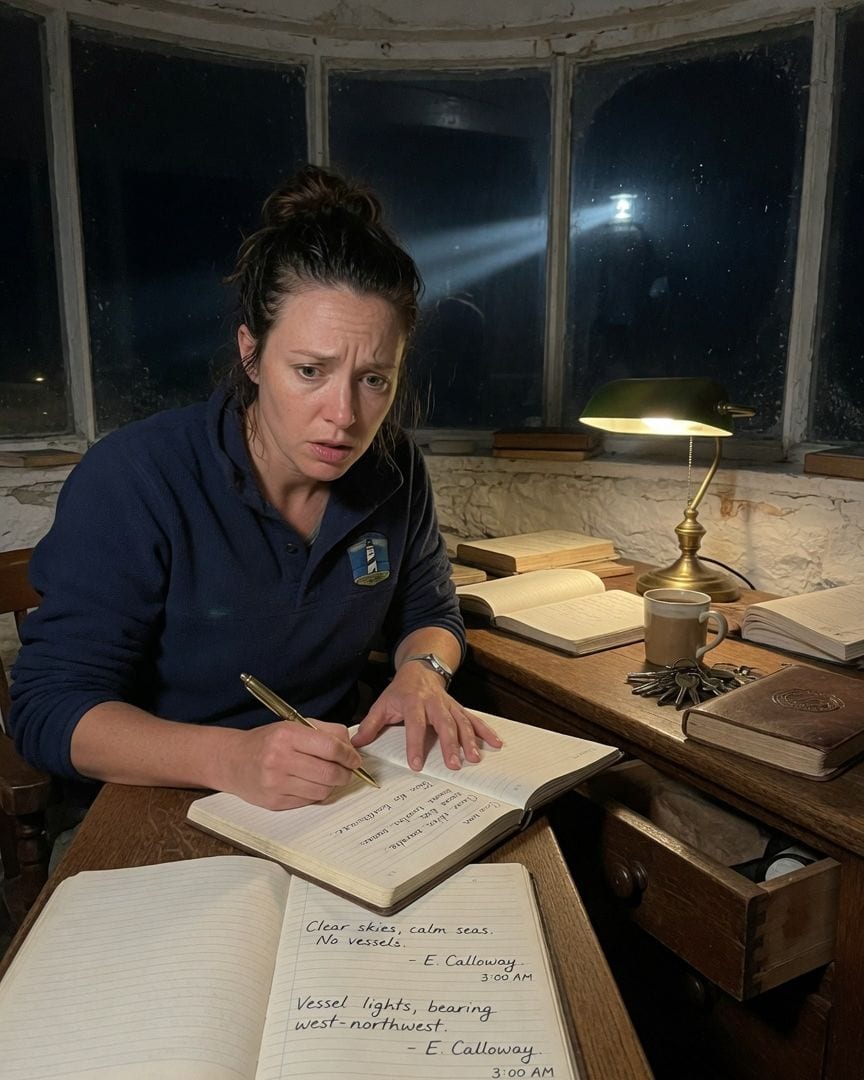
My logbook had a 3 AM entry, in my own precise hand, that I never wrote. Then I found an impossibly cold, hidden book with my name signed to an identical entry from last night.
My routine lighthouse shift was quiet until I noticed a new entry in the official logbook. Dated 3:00 AM, it described a vessel I never saw, written in my exact handwriting, and signed with my name. But I hadn't penned a single word.
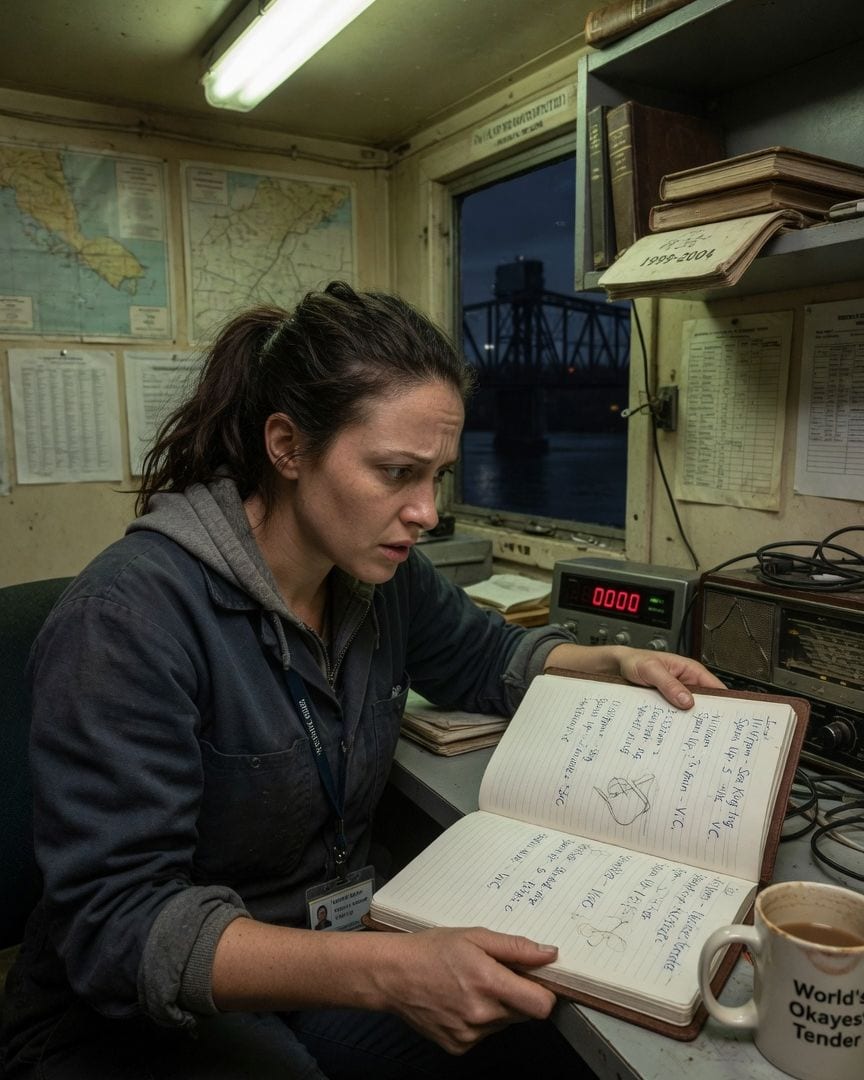
My drawbridge log shows a 2:33am lift I didn't make. The span counter never moved.
As a drawbridge tender, my midnight to dawn shift is usually quiet, a routine of monitoring traffic and logging lifts. But tonight, my own logbook shows an impossible entry for a bridge lift I have no memory of making. My initials and handwriting are there, yet the span counter above my panel reads a steady zero. No boat called, no span ever went up.
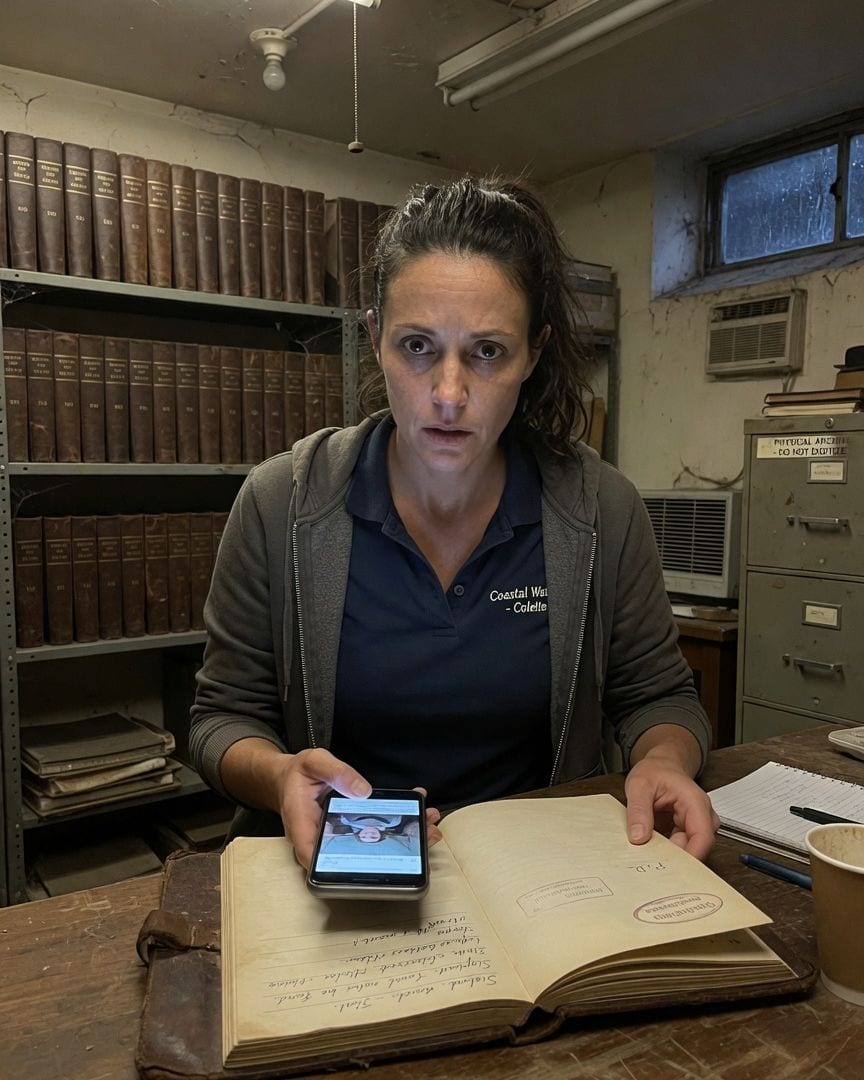
My coastguard log noted Sighting 9 again tonight, a light where no vessel showed. The old logs carry Sighting 9 off Skerry Point at 3:14am every tenth year since 1954, always 'nothing found,' always 'send no boat.'
On my watchtower night shift, the radar screen glowed green and the ocean was quiet. Then, a familiar light appeared off Skerry Point, exactly on cue, just as it had every tenth year for decades. But digging deeper, I found a hidden stamp in an old logbook: 'Operation Skerry. Status: Complete.' It left me with a chilling sense of finality.
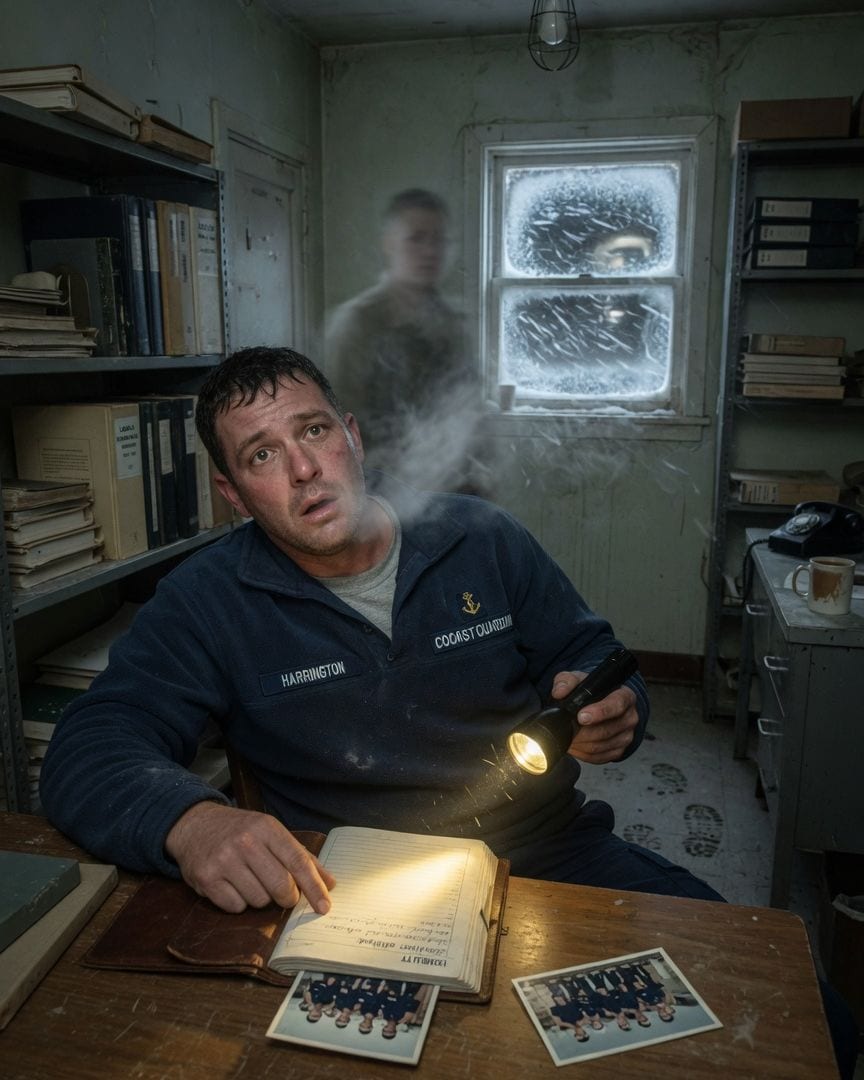
Coast Guardsman Victor Harrington was alone, but his own log entry read: 'Visitor arrived. Not yet departed.' The ink was wet.
Coast Guardsman Victor Harrington endured the nor'easter's crushing weight against the remote LORAN station's windows during his last lonely watch. Exhaustion claimed him for an hour, but when he jolted awake, the station's logbook held a chilling surprise: his own handwriting recorded, '0300. Visitor arrived. Not yet departed.' The ink was still glistening wet, and soon after, Victor discovered fresh, wet boot prints across the floor — not his, and leading to a dead end with no sign of entry. Every door remained locked, every window unbroken, yet the prints had simply materialized, leaving the guardsman with a suffocating sense of impossible dread. Who or what had left its mark in a sealed, storm-battered station, and how?
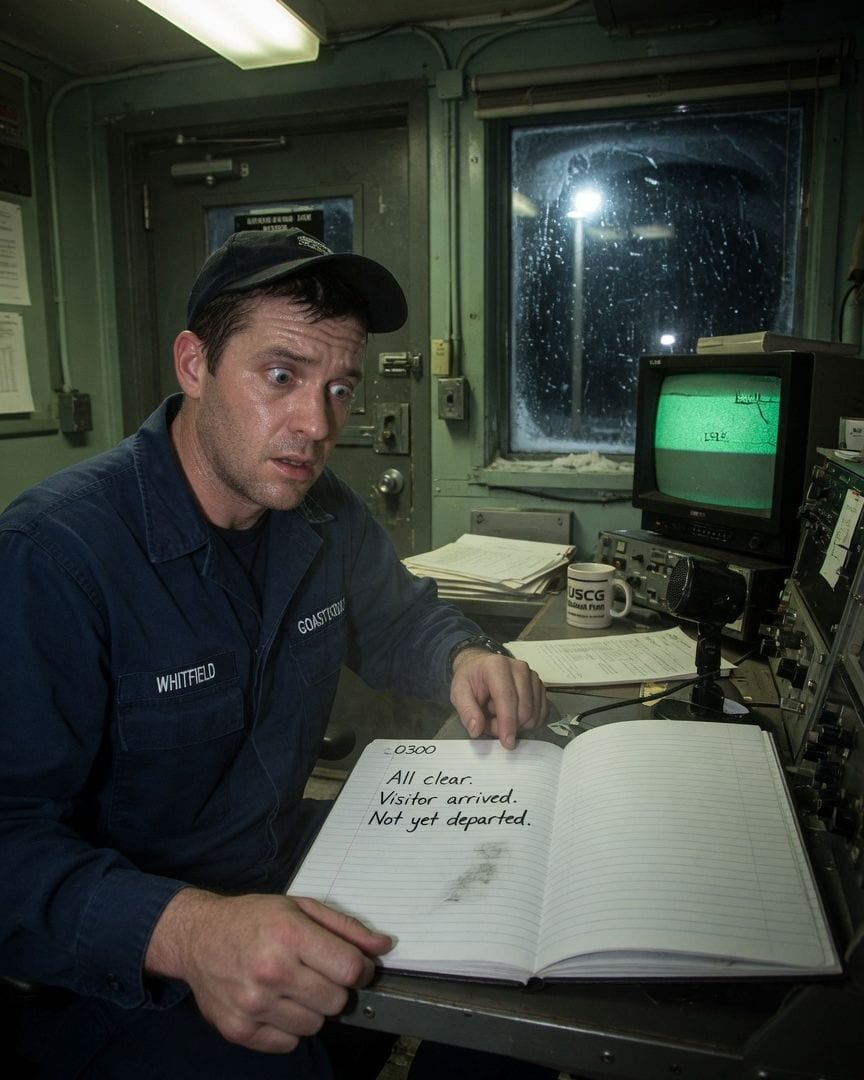
A lone Coast Guardsman found his own log entry: 'Visitor arrived. Not yet departed.' The ink was wet, and a strange boot print waited upstairs.
Coast Guardsman Nathan Whitfield was isolated for days by a banshee-howling nor'easter at Blackrock Point Light Station, the constant storm drone wearing his nerves thin. After an hour of illicit sleep, he returned to his logbook to find a chilling entry at 0300, in his own precise hand, that read: 'Visitor arrived. Not yet departed.' The ink was still glossy and damp to his touch, a fresh entry he knew he hadn't made. Every door was locked from the inside, every window latched, yet a single, strange boot print waited upstairs in the lantern room. Nathan Whitfield, utterly alone on the point, faced the profound certainty that someone else was, impossibly, still there.
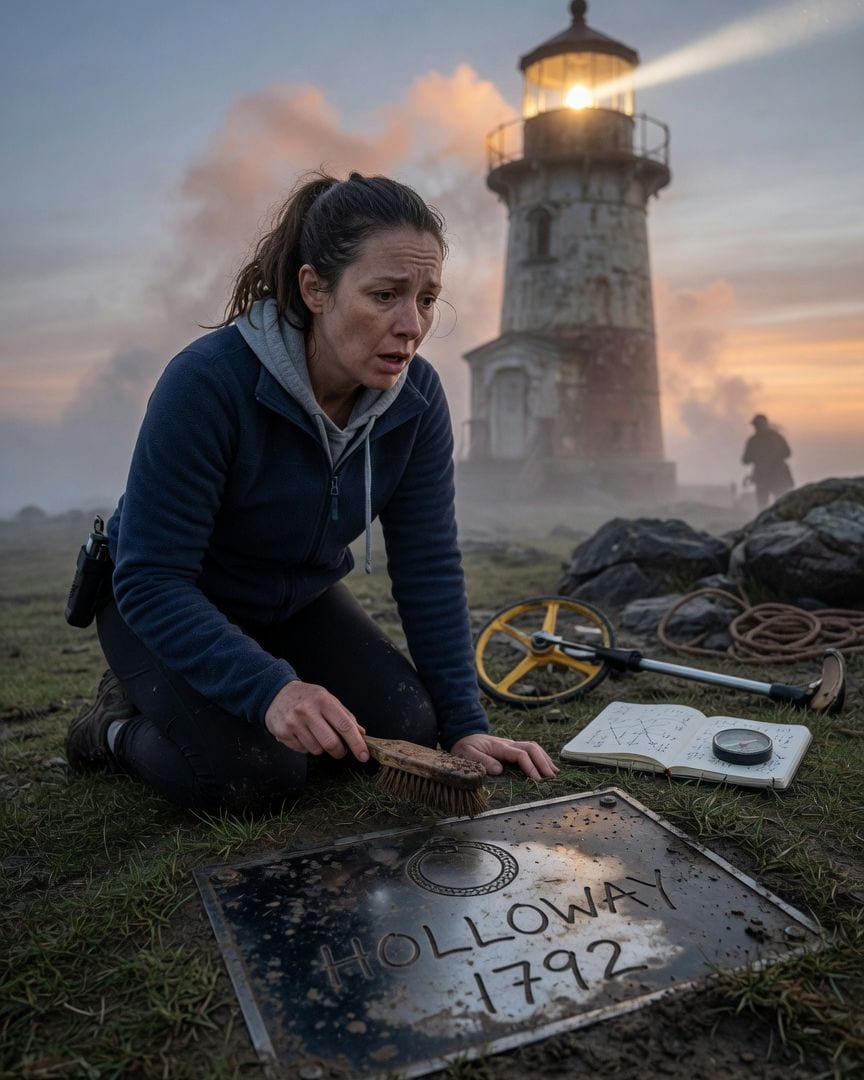
My coastal path just kept curving me back to the lighthouse. Nine miles walked, the same fisherman coiling rope, but I never left.
My morning ritual is a brisk walk along the coastal path. But last Tuesday, after what felt like an hour, I found myself back at the lighthouse, having walked miles to nowhere. My step-counter read 4.5 miles, yet the same fisherman was still coiling the same rope right where I started.