A Cold War Colonel reviews a missing pilot's file and finds Captain Bishop's signature on a form dated weeks after he vanished.
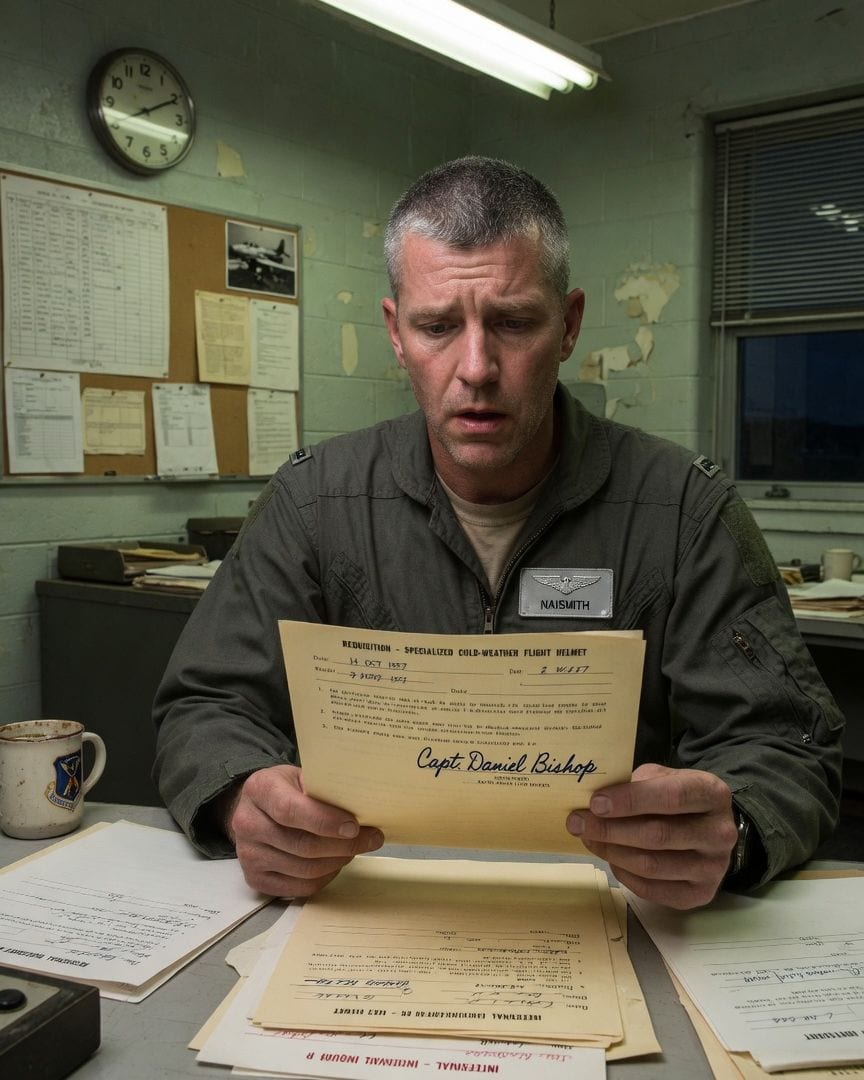
The fluorescent hum of the debriefing room felt too loud after the silence of the Michigan sky. Colonel Ward Naismith ran a hand over his close-cropped hair, the adrenaline from the chase still buzzing under his skin.
He’d just finished his report: forty minutes chasing a disc-shaped craft, the size of a house, giving off no heat he could feel, across Lake Superior in his F-86D Sabre.
His flight lead, Captain Daniel Bishop, leaned back, his eyes distant.
“It stopped,” Bishop said, his voice quiet, almost a whisper. “It just stopped, dead still, when my radar locked. Not like it was hit. Like it was… waiting for us.
The way a man stops on a road to let you catch up.”
The words settled in the room, cold and heavy. Ward remembered the way his own jet had almost overshot the thing, how vast and impossible it had seemed, a hundred feet below his wing.
The official report would call it an 'unidentified aerial phenomenon,' a 'possible weather balloon anomaly.' But neither Ward nor Bishop believed it.
Days later, the squadron was on edge. Captain Bishop, flying a routine patrol over the lake, vanished. No distress call, no wreckage, just an empty patch of air where his transponder had been.
A search was launched, then scaled back, then officially closed. Bishop was listed as 'Missing in Action, presumed lost.'
Ward signed off on the final paperwork, a knot of unease tightening in his gut, the memory of Bishop’s quiet words echoing in the silence of his office.
As part of the internal inquiry into Bishop’s disappearance, Ward was tasked with reviewing his flight lead’s personnel file. It was a grim, routine chore, sifting through the mundane details of a man's service record now closed.
He flipped past commendations, training certifications, and payroll stubs. Then, an anomaly. A requisition form for specialized cold-weather flight gear, dated two weeks after Bishop’s last known flight. Ward blinked, then frowned. A clerical error, surely.
Some clerk had pulled the wrong form, or misdated it. He set it aside, continuing his review.
A few pages later, another jolt. A maintenance sign-off for Bishop’s F-86D Sabre, detailing a minor repair to the hydraulic system. This entry, too, was dated a week after the aircraft and its pilot had vanished.
Ward's rational mind scrambled for an explanation. A backlog? A late entry? But maintenance logs were meticulously kept, especially for active aircraft.
He pulled the requisition form back to compare the dates, a prickle of unease starting at the base of his neck. The details were specific: part numbers, a unit cost, the signature block clearly filled.
He tried to tell himself it was just a bureaucratic mix-up, a ghost in the machine.
But the weight of the file in his hands, the paper thin and dry, suddenly felt heavy, like it contained something far more substantial than mere administrative errors. He ran his thumb over the date, then the signature.
It couldn't be right. It simply could not.
He pulled out the requisition form again, the one for the specialized flight helmet, dated well after Bishop’s last flight. The signature block at the bottom, confirming receipt of the equipment, was filled in with a familiar flourish.
It was bold, confident, a series of precise loops and angles he’d seen a thousand times on shared flight plans and duty rosters. He leaned closer, the fluorescent light glinting off the paper. There was no mistaking it.
The signature was unmistakably Captain Daniel Bishop’s. Ward felt a sudden, icy dread bloom in his chest, a cold hand closing around his lungs.
He held a piece of paper that proved the man who signed it should not exist, should not have been able to sign anything at all.
Ward immediately sought out Major Patricia Doyle, the lead investigator on Bishop’s disappearance, a woman known for her meticulous attention to detail. He laid the requisition and maintenance forms on her desk.
She initially gave them a dismissive glance, echoing his own first thought: 'Clerical error, Colonel. It happens. Paperwork gets backlogged.' But Ward persisted, tapping a finger on the impossible dates. 'Major, this isn’t just a payroll stub.
This is a requisition for specialized equipment, signed by Bishop himself, and a maintenance sign-off for an aircraft that was already gone. These are operational logs.'
Doyle’s gaze sharpened, a flicker of concern crossing her usually impassive face. She picked up the forms, examining the signatures, the dates. 'You’re sure this is authentic?' she asked, her voice low.
'As sure as I am of my own call sign,' Ward replied.
He suggested she have Sergeant Everett Montgomery, the senior records clerk known for his encyclopedic memory of the archives, discreetly pull all entries related to Captain Bishop from the date of his disappearance onward.
Montgomery, a man of precise habits and few words, returned two days later with a thin, unsettling file.
It contained not just the forms Ward had found, but several more: a fuel consumption report for a training exercise, a request for leave, and even a quarterly dental check-up, all dated weeks and even months after Bishop was declared lost.
Each bore Bishop’s signature, or an official stamp indicating his presence. The mundane details made the impossible pattern even more chilling. These weren't isolated mistakes; they were a continuous, impossible administrative life.
Ward’s persistent inquiries, and Montgomery’s findings, did not go unnoticed. Major Doyle called him into her office again, her demeanor markedly different. Her voice was calm, but the underlying current was a warning.
'Colonel Naismith, I advise you to cease your investigation into these… discrepancies. The official finding of Captain Bishop’s disappearance stands. These are isolated, unexplainable administrative artifacts, nothing more.' Her use of 'artifacts' sent a shiver down Ward's spine.
It sounded like something you’d find in an archeological dig, not an active personnel file. When he tried to argue, his access to the secure digital archives was temporarily revoked.
His calls to other contacts in records management went unanswered or were met with vague deferrals. He felt a distinct shift in the atmosphere around him, a subtle chill. Colleagues averted their eyes, conversations hushed as he approached.
One evening, returning to his office after a late dinner, he found his door slightly ajar. Nothing appeared disturbed, but a single, unmarked manila envelope lay on his desk. His heart hammered as he picked it up.
Inside was a copy of Captain Bishop’s last official flight plan, the one from the day he vanished. Scrawled in the margin, in an unfamiliar hand, were three words: 'He was still flying.'
The note wasn't a threat, but a confirmation, a quiet, chilling affirmation that someone else knew, and was watching.
Ward confronted Major Doyle again, the unmarked envelope clutched in his hand. He placed the flight plan with its unsettling note on her desk. 'Major, someone knows. Someone is confirming what I've found. This isn't just a clerical error anymore.
This is a pattern.'
Doyle’s composure finally cracked, a flicker of something close to resignation in her eyes. She leaned back, a sigh escaping her lips. 'You’re right, Colonel. It’s not just an error. And it’s not just Bishop.'
She opened a locked drawer in her desk, pulling out a thin, heavily redacted internal memo, its paper yellowed with age. 'This came across my desk when I was a junior officer. From the 1940s.'
She pushed it across to him.
The memo detailed 'post-loss administrative continuations' for a naval vessel lost in the Pacific during the war. It described 'unexplained accrual of logistical and personnel data' for crew members officially declared dead or missing.
The memo’s conclusion, starkly clear despite the redactions, advised 'monitoring, not investigation.' It stated that such phenomena were 'beyond current operational parameters' and to be treated as 'classified anomalies' with no further action.
'They knew,' Ward whispered, tracing a finger over a blacked-out paragraph. 'They knew about this back then, and they just… filed it away?'
Doyle nodded slowly. 'They did. It’s not unique to the Air Force. It’s happened across all branches, for decades. We don't understand it, but we manage it. It's too big, too unexplainable to be anything else.'
The words were a cold hammer blow. The impossible entries in Bishop's file, the warning note, the revoked access—it all snapped into horrifying focus. It wasn't a mistake. It was a system.
A system that recorded the ongoing, impossible existence of the 'lost.' And the institution, the very structure Ward served, was not fighting it, but quietly, patiently, documenting it.
Armed with the vague references in the old memo, Ward used his remaining, rapidly diminishing clearances to delve deeper into historical 'post-loss' files.
He worked late into the nights, bypassing official channels where he could, driven by a desperate need to understand the scope of the horror. He sifted through microfiches, dusty ledgers, and encrypted digital archives, cross-referencing keywords from the memo.
He found scattered, coded entries, whispers of other cases, other disappearances across different branches of service, all with the same impossible administrative trails. Each new discovery tightened the knot of dread in his stomach.
Then, a breakthrough. A cross-referenced entry, buried deep within a heavily redacted Navy file from the late 1940s, led him to a designation: 'Project ECHO.' The name was an unknown.
He spent another two days fighting the system, exploiting every last shred of his colonel’s authority, until he finally gained access. The Project ECHO file was thick, bound in dark green, and stamped 'TOP SECRET - EYES ONLY.'
Ward’s hands trembled as he opened it. Inside, among pages of technical data and operational reports, he found a grainy aerial photograph. It depicted a disc-shaped craft, unmistakable, identical to the one he had chased over Lake Superior.
Beneath it, a personnel roster. His eyes scanned the names, then froze. Captain Daniel Bishop. His flight lead.
Listed not as 'MIA,' but under 'ACTIVE DUTY - CLASSIFIED,' with a future rotation date from the current year, a full year after his disappearance.
The full horror detonated in Ward’s mind. Project ECHO wasn't an investigation into the lost; it was the mechanism by which the institution managed their continued existence.
The 'lost' were not simply gone; they were absorbed, reclassified, and continued to serve in some capacity that defied all known physics and human understanding.
The saucers, the 'unidentified aerial phenomena,' were not just objects to be chased; they were part of the process, a means of 'filing' individuals into this system.
Every impossible entry in Bishop’s file, every maintenance sign-off, every requisition for gear, suddenly made perfect, terrible sense. These were not errors, but genuine records of Bishop’s ongoing 'service' within Project ECHO.
The institution had known for decades. The memo from the 1940s, the similar cases across the armed forces, the quiet warnings from Major Doyle – it all converged into a single, coherent, and utterly terrifying pattern.
The secrecy machine wasn't just hiding a truth; it was actively participating in it, maintaining a bureaucratic infrastructure for something entirely inhuman. The lost were never lost.
They were merely re-assigned, their new 'duty stations' in a reality beyond human comprehension, their administrative lives meticulously continued in the classified archives. The file was not a memorial to absence, but a living, growing testament to their impossible presence.
And the institution had become its quiet, patient scribe.
Ward knew he had to act. He attempted to copy the Project ECHO file, to leak it, to expose the horrifying truth. But his access was now completely revoked, his computer locked, his physical key card deactivated.
He was isolated, cut off. His attempts to contact a trusted journalist were met with dead phone lines, his calls intercepted. He was trapped within the system he had just uncovered.
Desperate, he sought out Major Doyle one last time. He found her in her office, her desk clear, a single, unlit lamp casting long shadows. 'You knew,' Ward accused, his voice raw. 'You knew about Bishop, about all of them.
You’re part of this.'
Doyle looked up, her expression calm, devoid of surprise or fear. 'Some files are never closed, Colonel,' she said, her voice soft, almost sympathetic. 'Some assignments are just… reclassified.'
She reached into a drawer and pulled out a thick, unmarked manila folder. The paper felt heavy, cool against her fingers. She slid it across the desk toward him. Ward’s eyes fixed on the tab.
His own name, typed neatly, was on it.
'What is this?' he asked, his voice barely a whisper.
'Your new assignment, Colonel,' Doyle replied, her gaze steady. 'Your new classification. It’s been pending for some time.' Ward felt a cold dread wash over him, a sense of inevitability. He was no longer the hunter.
He was the hunted, and the file, his own file, was about to begin its own impossible, endless journey.
He stared at the folder, his name staring back at him, a new entry in a system he could not escape, a new number in a ledger that never closed.
Colonel Ward Naismith’s official service record was quietly updated. His entry read: 'Transfer - Highly Classified, effective immediately.'
His personal effects—a worn leather flight jacket, a framed photograph of his parents, a handful of letters—were packed into a single crate and shipped to an undisclosed government facility. His name was removed from the active roster, his office reassigned.
Within the squadron, his disappearance was attributed to a 'special assignment,' a vague explanation that satisfied no one but was never questioned.
The chair at the debriefing table where he once sat remained empty for a short time, then was filled by a new face, a new pilot ready to chase whatever the Michigan sky might hold.
The files, both Bishop's and Naismith's, continued to accrue their impossible entries, tucked away in the deepest, most secure vaults of the institution.
A year later, Major Patricia Doyle sat at her desk, reviewing a stack of routine maintenance reports. The fluorescent lights hummed, casting a pale glow on the crisp white paper.
She paused at a report for a highly specialized, experimental reconnaissance aircraft, an airframe not even officially acknowledged to exist. The final sign-off, confirming the completion of a complex diagnostic, was in a steady, official hand.
It read: 'Colonel Ward Naismith.'
Major Doyle closed the file, a faint, almost imperceptible smile touching her lips. The hum of the lights continued, a quiet, patient sound in the vast, silent machinery of the institution.
The file, like all the others, was still being signed.
If this one got to you
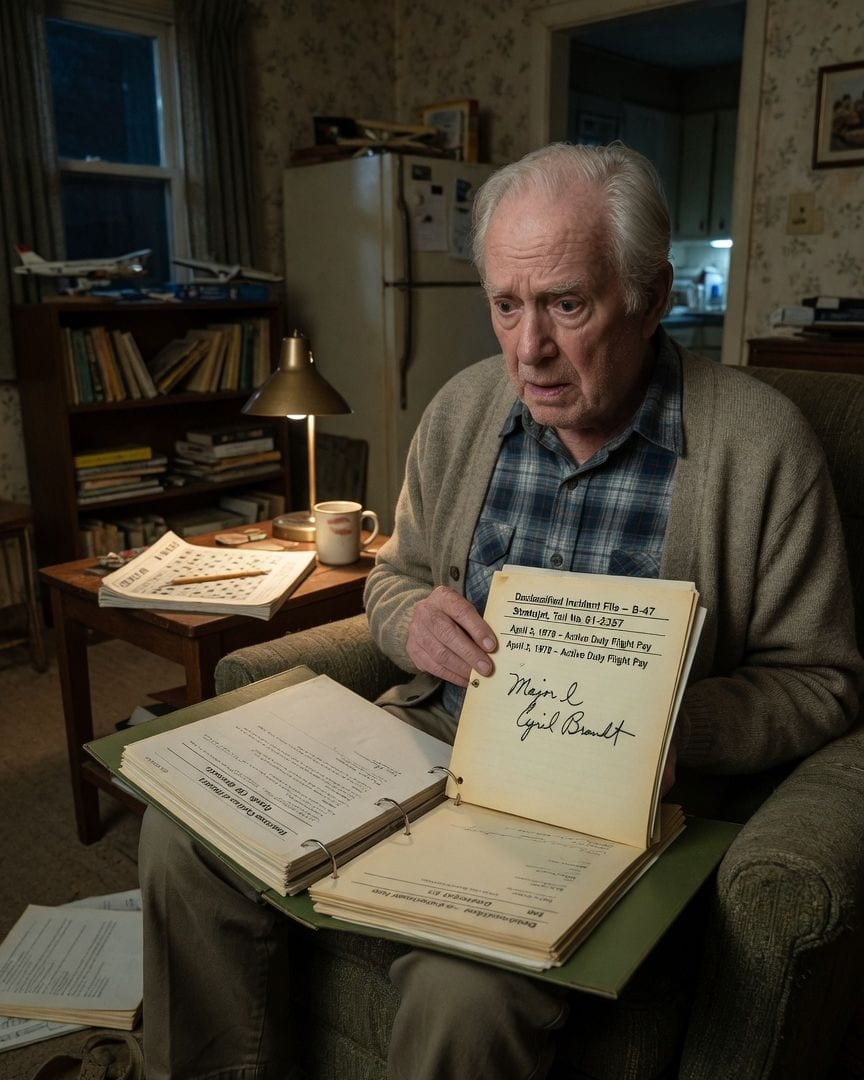
A retired Cold War pilot found his own signature on a flight pay record, dated five years after he left active duty, the ink unnervingly fresh.
Cyril Brandt, a seventy-two-year-old retired B-47 pilot, cherished his quiet Dakota retirement, his days filled with crosswords instead of combat. He expected to find long-awaited closure on a strange 1968 UFO incident when a heavy, declassified file arrived. Settling into his armchair, the weight of the olive-green binder felt familiar, but its contents quickly shattered his calm. He discovered maintenance logs for his B-47, detailing engine hours and tire rotations, dated years after the aircraft had been scrapped. Then, buried deeper, he found a payroll entry for himself, dated 1978 — five years after he left active duty — bearing his own unmistakable signature, the ink unnervingly fresh. How could his own hand have signed off on a mission that never happened, for a plane that no longer existed?
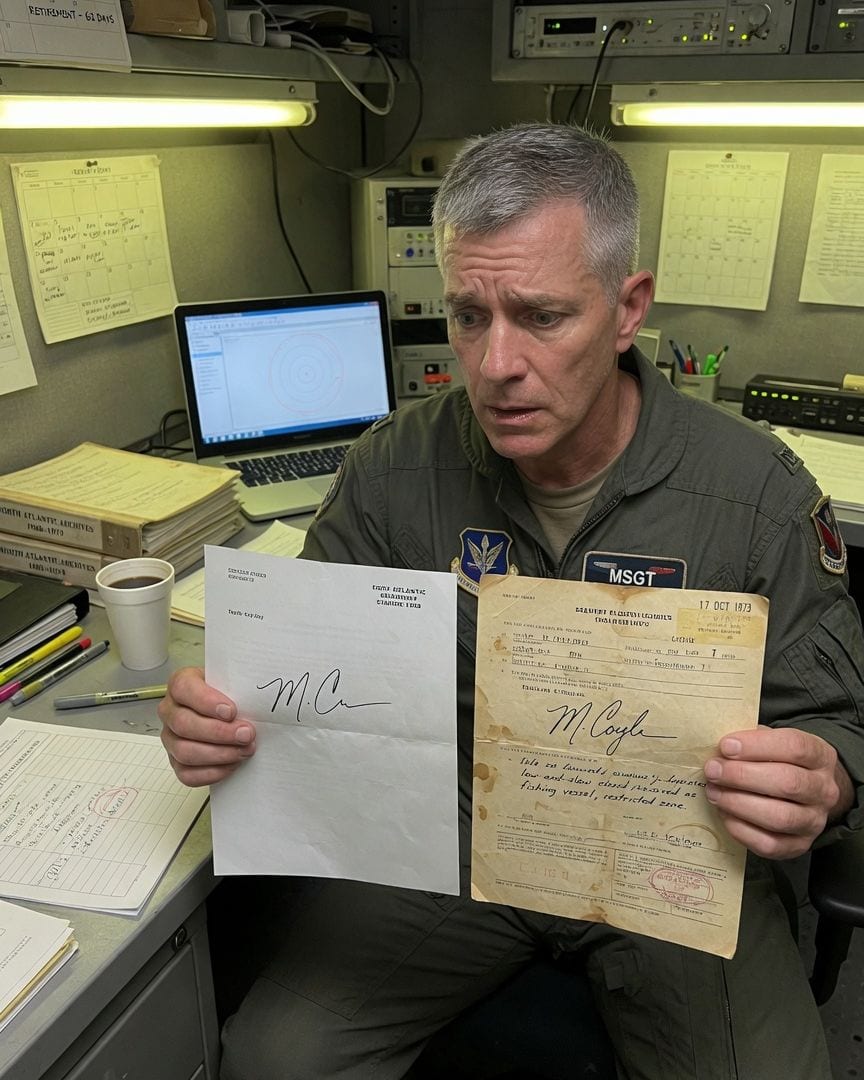
Master Sergeant Coyle was two months from retirement when his own signature appeared on a Cold War mission log from 1973, decades before he was born.
Master Sergeant Malcolm Coyle, two months from retirement, scanned the North Atlantic from his E-3 Sentry, its cabin humming through the perpetual twilight. His radar scope showed a silent, low-and-slow blip that vanished from fighter jets but remained on his screen, mirroring an identical ghost from the prior week. Digging through decades of archived logs, Coyle found a 1973 entry detailing the same impossible contact, stamped with his own squadron's seal. The duty officer's signature, with its distinctive flourish, was unmistakably his own—identical to his current papers—yet dated decades before he was even born. How could his hand have signed a lie from a time he didn't exist?
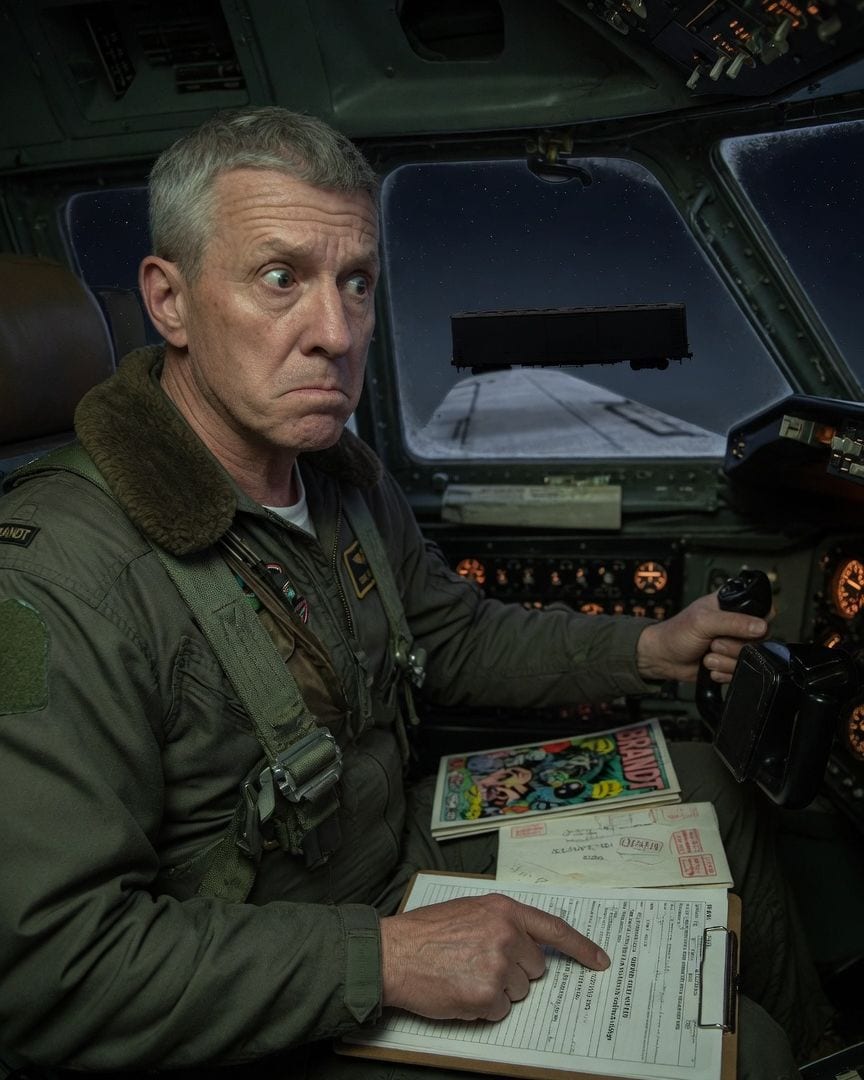
On his last Cold War flight, Major Brandt’s official report quoted words he never said, then claimed material recovery from a wing he knew was untouched.
Major Cyril Brandt, a seasoned pilot nearing retirement, undertook his final airborne alert leg in the B-47, the familiar hum of its engines a lullaby against the vast, dark sky over the Dakotas. Then, an impossible, featureless boxcar-thing appeared silently, thirty feet off his wingtip, vanishing as abruptly as it came nineteen minutes later. Three days later, the official incident report contained two chilling fabrications: a quote only his tail gunner uttered, attributed to Major Brandt, and a claim of material recovery from a wing he knew was untouched. The document was not just wrong; it was a deliberate, precise lie about an interaction that never happened, leaving the pilot with a cold dread.
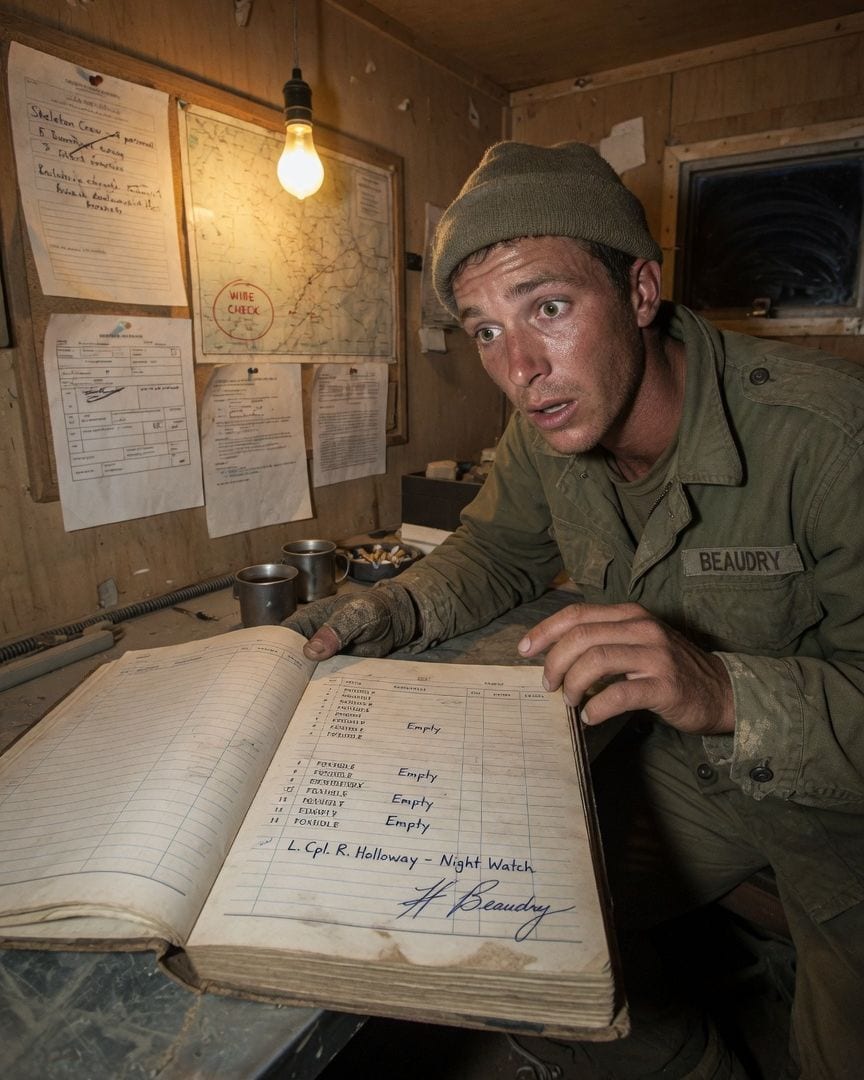
Lance Corporal Beaudry checks the perimeter's empty foxhole. The comm wire pulls back: a signal from no one.
Lance Corporal Hugo Beaudry moved along the perimeter of Firebase Kettle, a lonely outpost in its final drawdown. His solitary wire-check tonight was a routine task in the biting desert wind. He reached the third foxhole, empty for a week, and tugged its comm wire. Two distinct pulls answered back, sharp and unmistakable, from a position where no one remained. Back inside, Beaudry found his own precise signature in the duty log, assigning a Lance Corporal R. Holloway to that very foxhole – a man he'd never seen or heard of. The entry was perfectly aged, a cold dread of paper lying. Who was signalling from the empty hole, and why did his own hand confirm it?
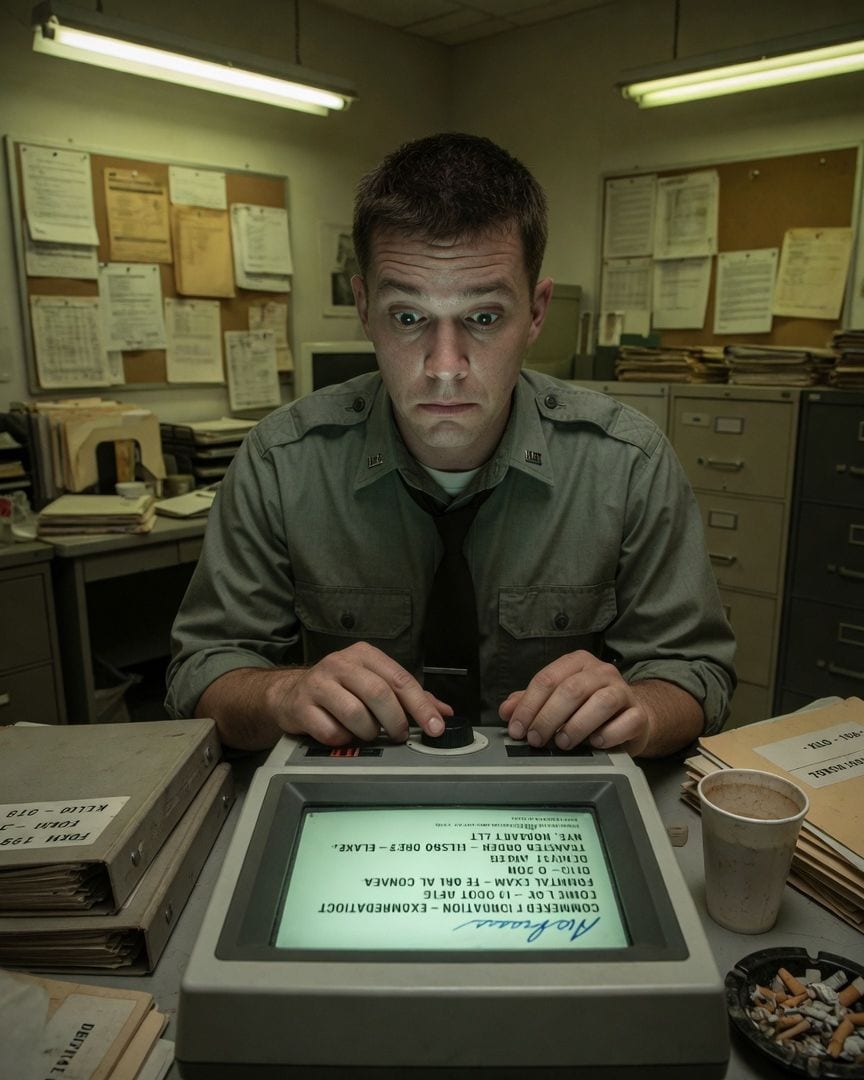
A missile commander watched his ten nuclear silos go dark. His own service record shows his signature on a future he's never lived.
Second Lieutenant Hobart Nye, a missile commander in Wyoming, had his quiet 0247 watch shattered by a security report: a massive, silent black triangle hovered over Launch Facility Kilo, casting a perfect shadow. Hobart watched his console's fault panel light up, signaling all ten nuclear missiles going dark in an impossible silence, followed by eleven minutes his security team could not remember. Official logs called it a "radio malfunction," but Hobart found a requisition for invisible-tracking sensors, signed by a base commander who was supposed to be off-base. The final, chilling discovery came when his own service record showed new entries—a dental check-up, a transfer to Alaska—all dated for a future he never lived, complete with his perfectly replicated signature.
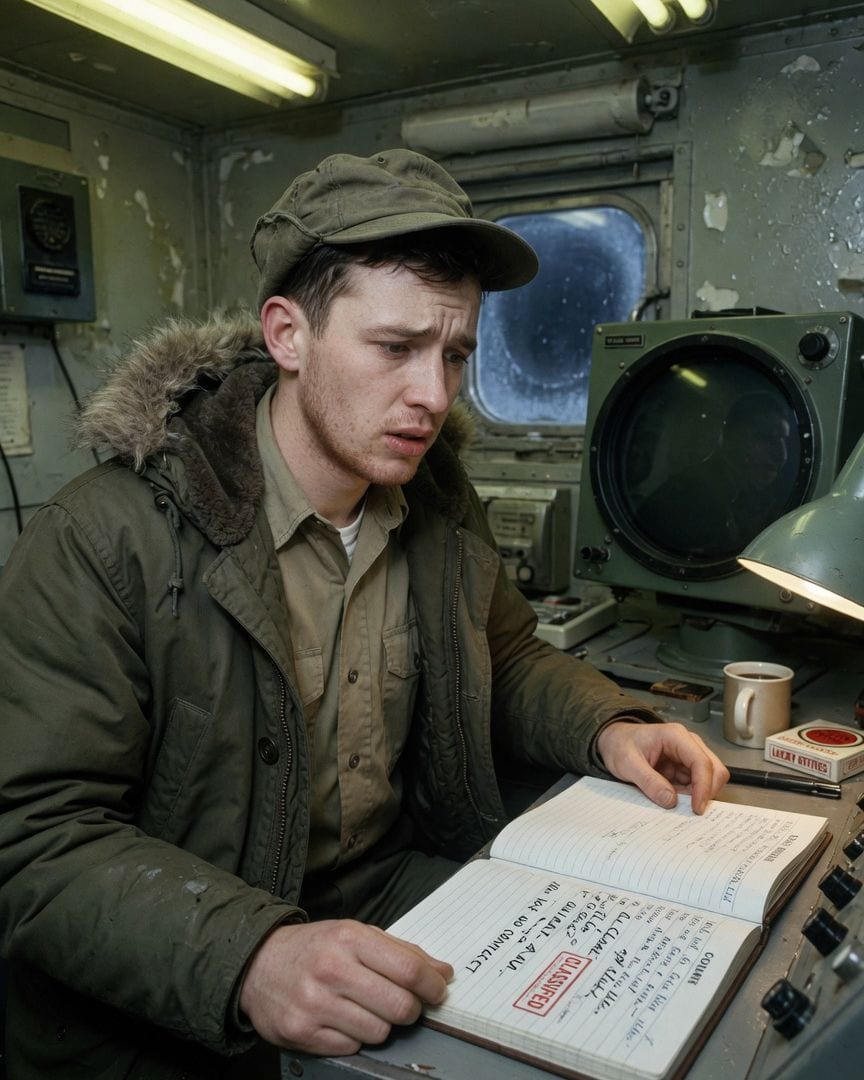
A Cold War airman logs an impossible radar contact on his last sweep. But his official logbook entry is stamped 'CLASSIFIED' and then contradicted by a hastily scrawled 'ALL CLEAR' dated moments before it.
Airman Ordway Vance, 22, manned the radar dome at Site Pellin in the biting North Atlantic dark of January 1962, running the last calibration sweep before its decommissioning. His scope picked up a faint, impossible return, growing closer with each pass, though the ocean remained empty to the eye. When Vance detailed the contact in his official logbook, a 'CLASSIFIED' stamp appeared, followed by a hastily scrawled 'ALL CLEAR' dated moments before his own entry, contradicting his every word. Commander Hartley dismissed it as equipment malfunction, but Vance sensed a chilling, official erasure behind the lie. He soon found a locked cabinet marked 'SITE PELLIN ANOMALIES,' hinting at a deeper truth buried within the base's final days.