On his last Cold War flight, Major Brandt’s official report quoted words he never said, then claimed material recovery from a wing he knew was untouched.
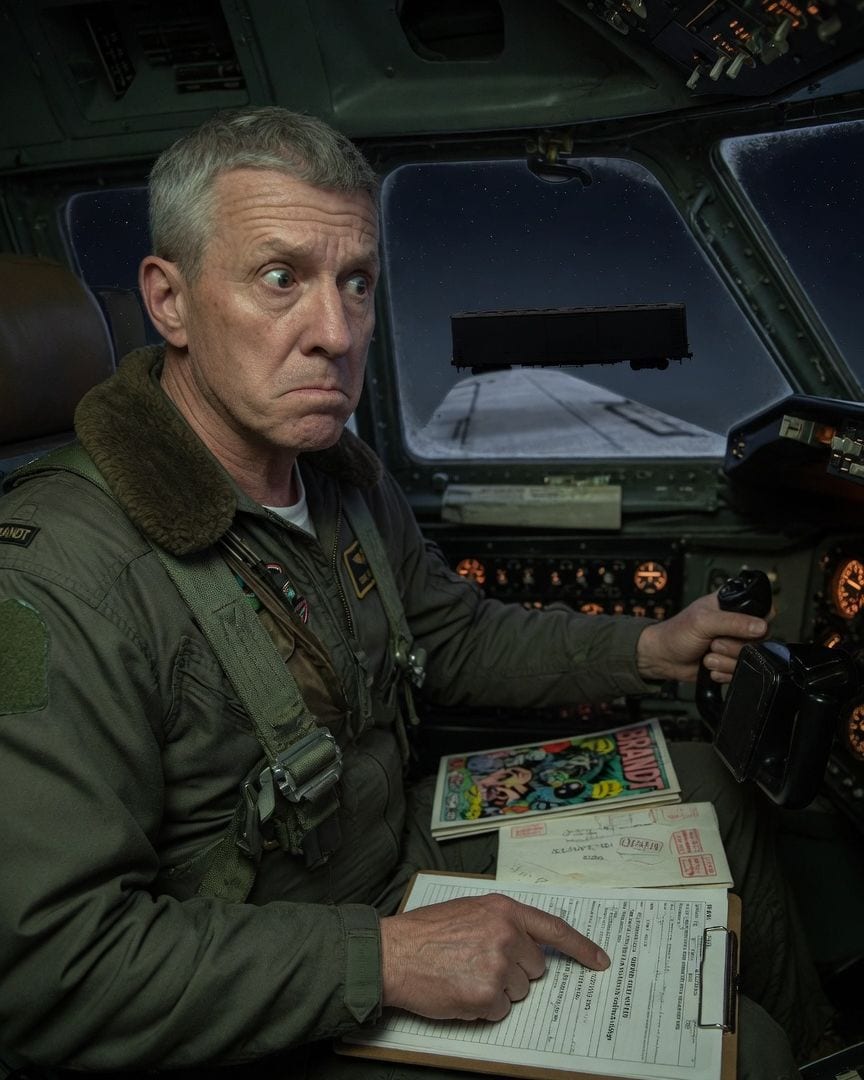
The hum of instruments filled the cockpit of the B-47, a familiar lullaby against the vast, cold darkness outside.
Major Cyril Brandt, fifty-eight years old, gripped the yoke with a steady hand, the controls responding with the practiced obedience of a lifetime’s worth of flying.
This was his last airborne alert leg, a final, routine stretch before a quiet retirement he’d earned. Beside him, Co-Pilot Everett Patterson, a fresh-faced twenty-eight, was engrossed in a comic book, its pages glowing faintly in the dim light.
Then, it was simply there.
No flicker on the radar, no whisper of air disturbance, no lurch or shift in the heavy bomber’s flight path. One moment the empty night, the next, thirty feet off their right wingtip, station-keeping, was a dull, featureless boxcar-thing.
It had no lights, no visible exhaust, no discernible method of propulsion. The object was utterly black against the faint starlight, the length of a freight car, and utterly, unnervingly silent.
Thirty years of flying experience offered Cyril no explanation, only the instinct to hold course, his eyes fixed on the impossible companion.
He reached for the interphone, his voice a low, controlled rumble, betraying nothing of the ice in his stomach.
"Hughes, tail gunner, confirm visual on right wing."
A moment of static crackled in his headset. Then Roland Hughes, twenty-five, his voice raw and barely a whisper, came through. "Sir… it’s a… a silent, waiting coffin. Just… there. It didn’t arrive."
For nineteen minutes, it stayed, an impossible companion in the dark sky over the Dakotas. The only sound in the cockpit was the steady drone of the engines and Hughes’s ongoing, terrified, whispered descriptions, punctuated by long, breathless silences.
The moment the object dropped away, vanishing as silently and abruptly as it had appeared, Cyril logged the event.
His hand, though still steady, pressed the buttons with the precision of a man who had seen too much to doubt his own senses, but whose mind already worked to contain the impossible.
Back on base, the debriefing was terse, standard procedure, as if the air force had a ready-made box for events beyond comprehension.
Cyril, methodical to a fault, filled out Form 19-A, his personal incident report, with painstaking detail: the exact time it appeared, the nineteen-minute duration, the object's dimensions, the utter lack of radar signature or energy output.
He even included Hughes’s precise description, noting it as a direct quote from the tail gunner. He made no guesses, offered no theories, merely presented the facts as he had observed them.
He expected skepticism, perhaps even a gentle suggestion of fatigue from the command, but nothing more.
What he received three days later was a sealed envelope containing Form 19-B, the official incident report, for his review and final signature.
The document was an almost perfect echo of his own, meticulous and thorough, but for two crucial discrepancies. First, a line caught his eye: "Pilot observed a dull, featureless mass, like a silent, waiting coffin, station-keeping."
The phrase, "silent, waiting coffin," was exactly what Roland Hughes had whispered, trembling, over the interphone—words Cyril had consciously omitted from his own meticulous account, deeming them too emotional, too subjective for an official record. The report attributed them to him.
Second, a brief addendum, tucked away in the technical notes section, mentioned "minor material recovery from starboard leading edge, consistent with atmospheric sampling." Cyril’s blood ran cold. He had personally inspected the B-47's starboard wing himself after landing.
Not a scratch, not a dent. There had been no recovery. Nothing had touched their plane.
He stared at the words, his finger tracing the phrase "material recovery."
The official report was not just wrong; it contained information that could not possibly exist, details that implied an interaction that never took place, and attributed a phrase to him that only his tail gunner had uttered.
This wasn't a clerical error or a misunderstanding. This was a deliberate, precise fabrication. It felt less like a record of an event and more like a carefully constructed narrative, folding an impossible, unstated truth into the official history.
Major Brandt felt a cold dread settle in his gut. The file was lying, and it was lying about something that hadn't happened, yet was now officially documented as if it had.
He knew, with chilling certainty, that this official document was not just a record of the encounter, but something that had come back from it, fundamentally altered, impossible.
Cyril refused to sign Form 19-B. His protests were met with polite, firm resistance from Captain Malcolm Caldwell, a SAC intelligence officer whose placid demeanor and unblinking gaze unnerved Cyril more than any outright aggression.
Caldwell, a man of forty-five, explained away the 'coffin' phrase as a "composite recollection" and the 'material recovery' as a "minor administrative pre-fill error." Yet, he pressed Cyril to sign, emphasizing the importance of "closing the file."
The words hung in the air, heavy with unspoken implication.
Cyril, however, had a copy of his own Form 19-A, and a growing unease that transcended administrative annoyance. He started quietly asking around, ostensibly about "archival procedures" for his upcoming retirement. He sought out Everett Patterson and Roland Hughes, too.
Patterson remembered the silence, the impossible appearance, but not the specific phrase. Hughes, however, confirmed his exact words. When Cyril tried to access the original radar logs for his flight, he found them "redacted for security protocols."
The explanation was boilerplate, but the timing felt like a door slamming shut. His inquiries led him to the base's records department, a cavernous, dusty space that smelled of old paper and forgotten secrets.
He began to cross-reference other "unexplained" aerial incidents from the past decade, using his security clearance before it expired. He found several files, declassified but still heavily censored, that contained similar, inexplicable entries: "unaccounted for mass" or "environmental sampling anomalies."
The patterns were too precise, too consistent to be random errors, echoing the impossible details in his own Form 19-B.
The dread deepened; it wasn't just his file that was wrong, but a whole library of them, each one whispering the same impossible lie.
Cyril's quiet digging didn't go unnoticed. One afternoon, he found his office door ajar, though he distinctly remembered locking it before lunch.
Nothing appeared disturbed, but the subtle shift of a pen on his desk, now angled slightly differently, and the faint, unfamiliar scent of a different aftershave told him someone had been there.
The air in the room felt colder, as if it had just exhaled a silent warning. Later, Caldwell caught him leaving the records department, a stack of heavily redacted files under his arm. "Still chasing ghosts, Major?"
Caldwell's smile didn't reach his eyes. "Some files are best left closed, especially those close to the end of a long career." The warning was thinly veiled, a smooth, almost gentle threat.
That evening, his home phone rang. He picked up to a dead line, not even static, just the hollow sound of nothing. A few days later, a package arrived at his house. Inside was a single, unmarked audio reel.
Playing it, Cyril heard a distorted, crackling voice—Roland Hughes’s whispered description of the "silent, waiting coffin." It was undeniably Hughes, but then, the voice continued, echoing, "It's taking… it's taking…" before cutting out with a sharp click.
The reel was clearly from an official recording, an extended version, edited to remove the raw terror that had permeated Hughes’s original interphone call.
Someone was watching him, listening, and actively trying to warn him off, or perhaps to show him how deeply they could reach into the "truth" he was pursuing.
The sound of his own breath felt too loud in the silent house. He realized the danger was no longer abstract; it was personal, breathing down his neck.
Driven by the chilling audio reel and Caldwell's thinly veiled threat, Cyril redoubled his efforts. He knew his time was short.
He focused on the "material recovery" entries, cross-referencing them with missing persons reports from nearby Air Force bases during similar timeframes. He spent long nights poring over dusty ledgers and microfiche.
He found a disturbing trend: small, isolated incidents of personnel disappearing without a trace, often pilots or radar operators, coinciding with these "unexplained" aerial phenomena. These weren't just isolated accidents or desertions; they were patterns.
He discovered a declassified, heavily redacted report from 1957 detailing the disappearance of an airman named Edmund Novak from a remote radar station in Nevada.
Novak's file, like Brandt's Form 19-B, contained a "material recovery" note, and a strange, almost poetic phrase attributed to Novak in the official summary: "the sky opened its dark ledger."
The phrase was hauntingly similar to Roland Hughes’s "silent, waiting coffin," a descriptor of an object that didn’t just appear, but revealed itself.
It wasn't just a cover-up; it was a pattern. The "material recovery" wasn't about equipment; it was about people. The files weren't just recording events; they were documenting a process of acquisition.
The institution, the "secrecy machine," wasn't just burying records; it was creating them, shaping them to fit this ongoing, horrifying collection. Cyril realized the files were not errors, but a precise, bureaucratic language for something unspeakable.
The missing were not lost; they were simply… filed. And the records were being carefully curated to reflect this truth, but in a way that only those looking for the impossible would ever truly see.
The air in the records room, once stagnant, now felt like a pressurized chamber, humming with a terrible, hidden current.
Cyril knew his time was running out. His retirement papers were being processed, his security clearance soon to be revoked. He made one last, desperate attempt to confirm his growing dread.
He pulled strings, called in favors with old colleagues still holding rank, to access his own full, declassified service record, thinking it would offer a clean, untainted account of his career.
It arrived in a plain, sealed envelope, official but discreet. Inside, the familiar forms, commendations, medical records. Everything as it should be, a perfectly ordinary life laid out on paper, until he reached the very last page.
Tucked neatly into the back, an addendum sheet, brittle with age, yet dated 1988—twenty-five years after the B-47 incident, long after his retirement.
The paper was clearly a later addition, its typeface slightly different from the rest of the file, its ink still a deep, unsettling black. A single, typewritten line, underlined in stark red, jumped out at him. It read: "STATUS: FILED.
LOCATION: UNKNOWN, INTEGRATED SECTOR 7." Cyril felt the floor fall away beneath him. His own name. His own file. Still being written, long after he'd left the service, documenting not his career, but his "status."
The dread was no longer abstract; it was his own future, already recorded, already decided.
The line "STATUS: FILED. LOCATION: UNKNOWN, INTEGRATED SECTOR 7." burned itself into Cyril’s mind, each word a brand. He understood now. The "material recovery," the "composite recollections," the "environmental sampling anomalies"—they weren't just cover-ups.
They were the bureaucratic language of a vast, unseen system that was actively collecting, archiving, and integrating human beings.
Roland Hughes’s terrified whisper of a "silent, waiting coffin" now resonated with a horrifying new meaning: the object itself was a collection vessel, and the human filing system was a crude, mirroring mechanism for whatever it did.
The "pattern across decades and classifications" wasn't about what was lost, but what was gained by this entity. He remembered the dead phone line, the altered audio reel, Caldwell's placid threats.
They weren't just trying to silence him; they were subtly guiding him, perhaps even preparing him, for his own "integration."
His service record wasn't just a historical document; it was a living file, still being updated by unseen hands, a pre-written epitaph for a life that was about to be reclassified.
The "secrecy machine" wasn't merely an institution; it was a grotesque, institutionalized mirror of the alien process, a bureaucratic black hole that consumed and recorded, and which had now claimed him.
The air in his study seemed to thin, each breath a conscious effort.
Cyril knew he couldn't fight the system directly. He couldn't expose what he'd found through official channels; they were the very mechanism of the horror. His only option was to escape its grasp, to disappear before his "status" became permanent.
He meticulously copied the addendum to his service record, along with every piece of corroborating evidence he had collected—the other "filed" reports, the redacted radar logs, the altered Form 19-B.
He sealed it all in a waterproof packet, addressed to a trusted, retired journalist he knew, a man whose career had been built on chasing the uncomfortable truths the government tried to bury.
His plan was simple: mail the packet, then vanish.
But as he left his house in the pre-dawn dark, the streetlights seemed to hum with an unnatural intensity, casting long, wavering shadows.
He heard a faint, rhythmic clicking sound, like a distant Geiger counter, or perhaps a typewriter, coming from the direction of his mailbox.
A black sedan, unmarked, was parked down the street, its engine idling, a silent, waiting presence in the gloom. He felt a cold certainty that went beyond mere suspicion: they knew. They were waiting.
He gripped the packet tighter, its edges pressing into his palm, his heart hammering against his ribs. He had to reach the mailbox. He moved quickly, his senses hyper-alert, every muscle tensed.
The clicking sound grew louder, closer, an insistent, mechanical pulse. He could almost feel eyes on him, not human eyes, but something vast and cold, auditing his movements.
He reached the mailbox, fumbled with the slot, and pushed the packet inside. The moment it dropped with a dull thud, the clicking stopped. The black sedan's headlights flared, then went dark.
A profound silence fell over the street, broken only by the distant hum of the city. He had mailed it. He had proof.
But the silence felt less like victory and more like a closing door, sealing him outside of a world he no longer fully belonged to. He was free, but the cost was absolute.
Major Cyril Brandt disappeared from public life. His retirement benefits ceased, his name quietly scrubbed from certain records. The journalist he sent the packet to received it, but the story never ran.
The evidence, though compelling, was too outlandish, too easily dismissed as the ramblings of a troubled veteran. Caldwell, the placid intelligence officer, continued his work, his smile unchanging, his gaze as unblinking as ever.
The black sedan was never seen on Cyril's street again. The world, oblivious, spun on. The official files, the ones documenting the "filed" individuals, remained, undisturbed, in their archives, occasionally updated by unseen hands.
Years later, a new archivist, a young woman named Nina Barlow, stumbled upon a curious discrepancy in a declassified file from the 1960s. An incident report, heavily redacted, bearing the name Major Cyril Brandt.
And attached to it, a small, brittle addendum sheet, dated 1988, with a single, underlined line: "STATUS: FILED. LOCATION: UNKNOWN, INTEGRATED SECTOR 7." Nina frowned, confused.
She cross-referenced the name, finding no further trace of a Major Brandt after his official retirement. She leaned closer, noticing a faint, almost invisible watermark on the addendum sheet: a tiny, abstract symbol, like two interlocking, incomplete circles.
It was the same symbol she'd seen on a few other, equally perplexing, "declassified" files. She closed the folder slowly, a chill creeping up her spine, as if a cold, unseen breath had just passed over her.
The silence on the line was the sound of a file closing, decades later, on a name that was still being written.
If this one got to you
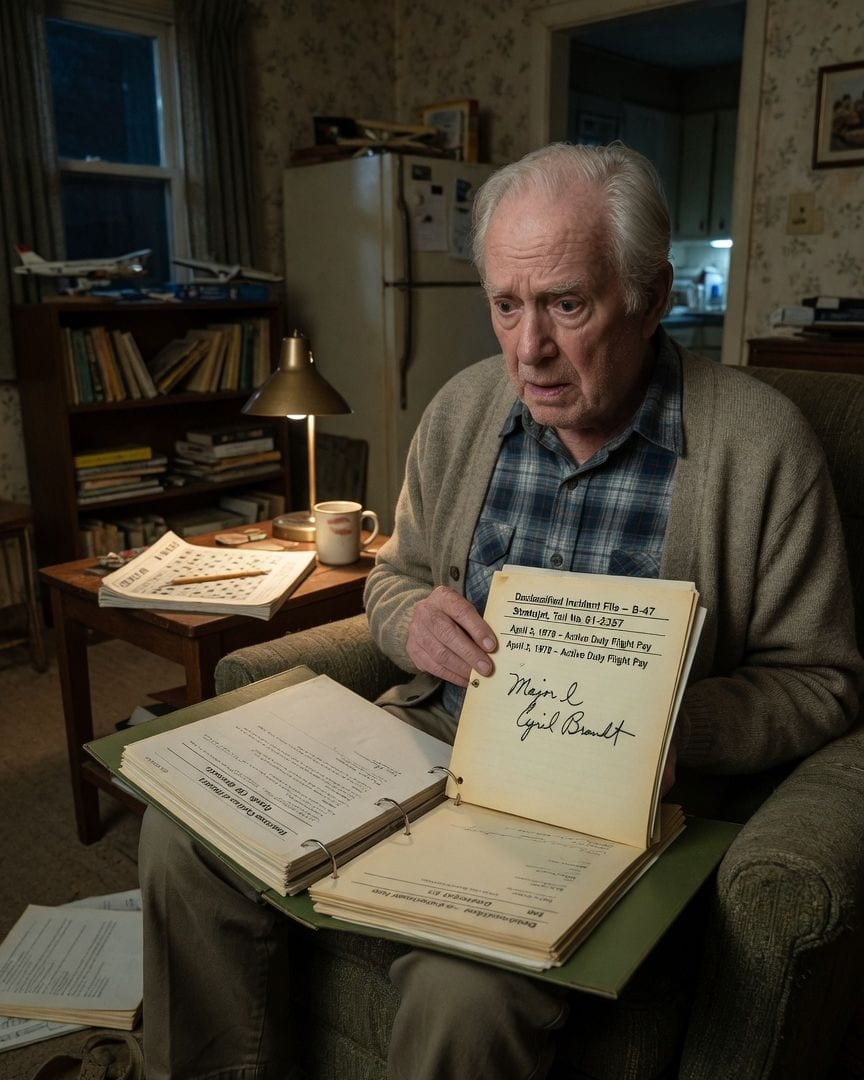
A retired Cold War pilot found his own signature on a flight pay record, dated five years after he left active duty, the ink unnervingly fresh.
Cyril Brandt, a seventy-two-year-old retired B-47 pilot, cherished his quiet Dakota retirement, his days filled with crosswords instead of combat. He expected to find long-awaited closure on a strange 1968 UFO incident when a heavy, declassified file arrived. Settling into his armchair, the weight of the olive-green binder felt familiar, but its contents quickly shattered his calm. He discovered maintenance logs for his B-47, detailing engine hours and tire rotations, dated years after the aircraft had been scrapped. Then, buried deeper, he found a payroll entry for himself, dated 1978 — five years after he left active duty — bearing his own unmistakable signature, the ink unnervingly fresh. How could his own hand have signed off on a mission that never happened, for a plane that no longer existed?
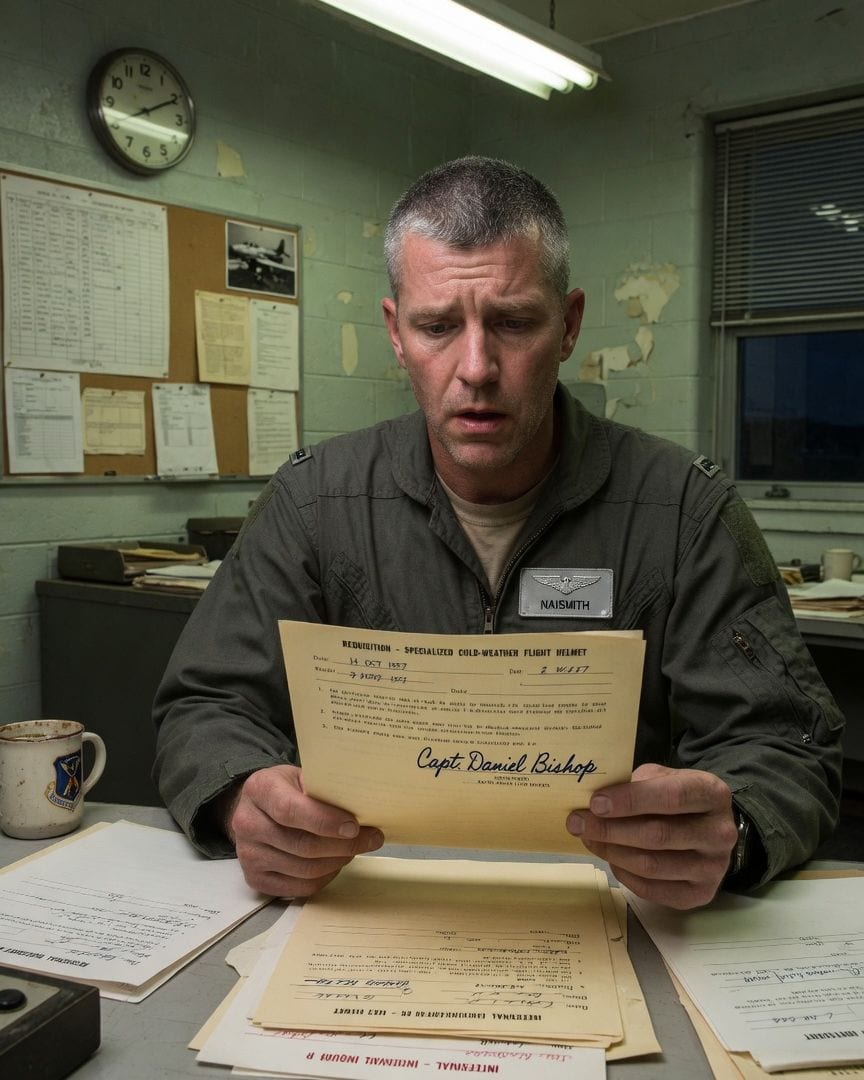
A Cold War Colonel reviews a missing pilot's file and finds Captain Bishop's signature on a form dated weeks after he vanished.
Colonel Ward Naismith faced the grim task of reviewing Captain Daniel Bishop’s personnel file, a routine chore for a man listed as Missing in Action. Bishop had vanished days after he and Naismith chased an impossible, silent disc over Lake Superior, leaving only an empty patch of air and a knot of unease in Ward's gut. Sifting through commendations, Ward found a requisition for flight gear and a maintenance sign-off, both dated *after* Bishop’s disappearance. The true chill came with the requisition for a specialized flight helmet, bearing Captain Bishop’s unmistakable signature, weeks after he was presumed lost. How could a man presumed lost have signed anything?
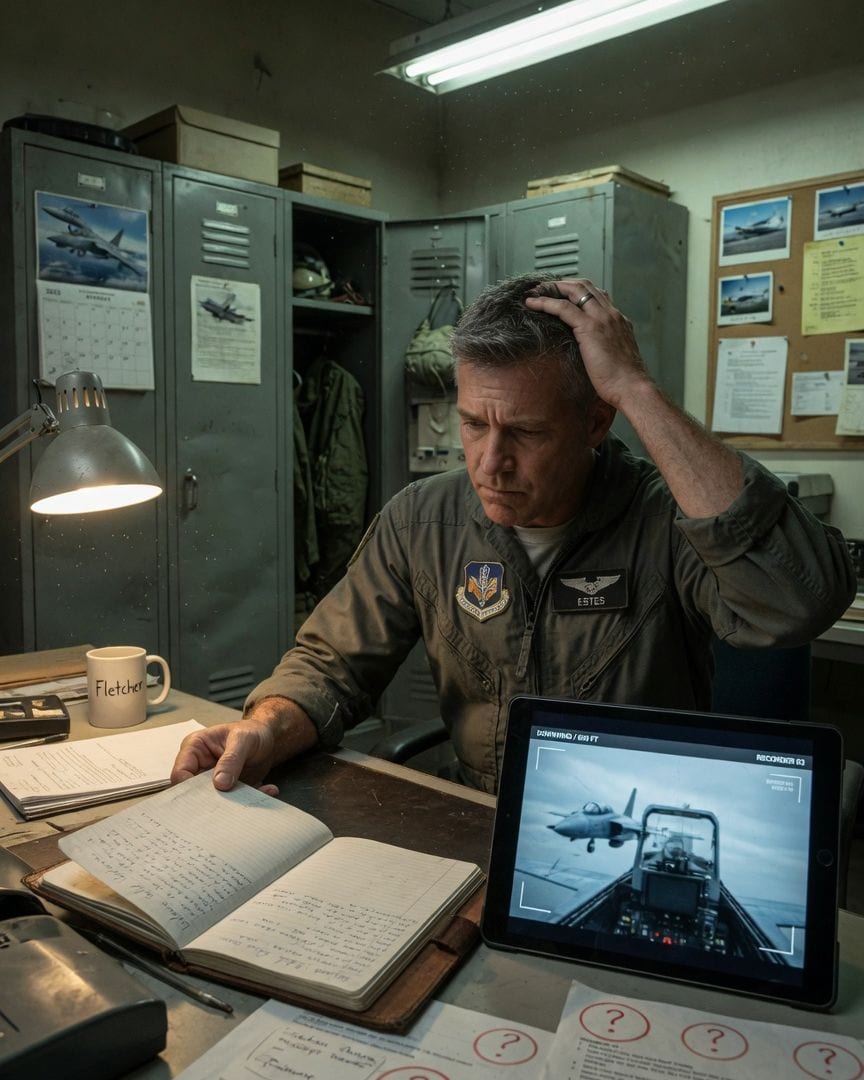
A Chief Warrant Officer's HUD tape shows a phantom jet, impossibly close, off his wing. Forty years ago, another Cold War pilot logged the same impossible sight.
Chief Warrant Officer Nathaniel Estes, a pilot whose career hinged on absolute precision, was under evaluation for a critical promotion. His nightly review of HUD tapes from routine Mojave test flights was a meticulous habit, but for a week, it revealed an impossible detail. At precisely 800 feet, one frame showed a sleek, experimental jet tucked impossibly close off his left wing—a craft ground radar never detected. When his maintenance chief found no equipment fault, Estes unearthed a dusty, decades-old logbook detailing identical phantom sightings from 1978. What unseen presence shadowed the desert skies?
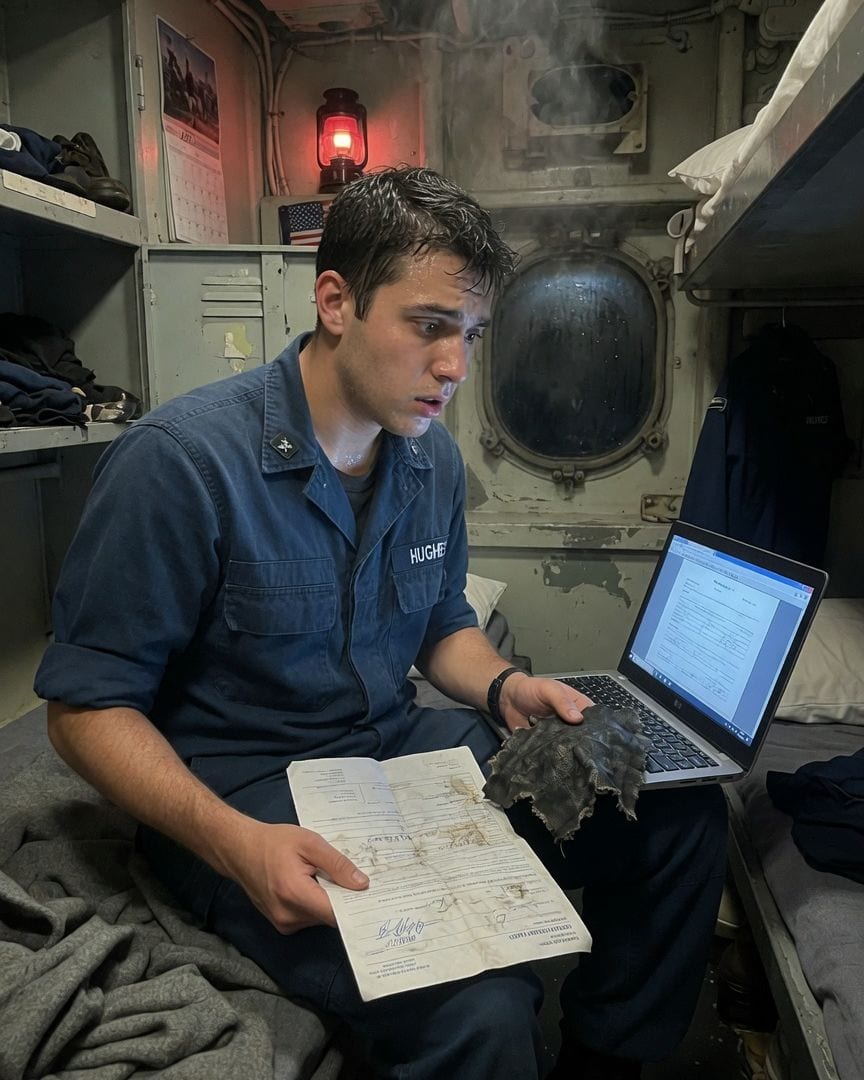
A Navy lookout's own signature appeared on a damage report he didn't write, describing damage he never saw.
Seaman Benjamin Hughes stood watch on the USS Vigilance, scanning the dark Pacific. At 0215, he reported a swimmer keeping an impossible pace with the destroyer, a contact the bridge immediately dismissed. Yet, below his post, the man-overboard netting showed undeniable signs of being climbed, with a strange, slick residue clinging to the ropes. Later, Hughes discovered a small, rough piece of fabric tucked deep into a frayed knot, unlike anything on the ship. But the real dread landed when he found a damage report, filed under his own name, detailing a tear he hadn't witnessed and bearing his perfectly forged signature. How could his own hand betray him?
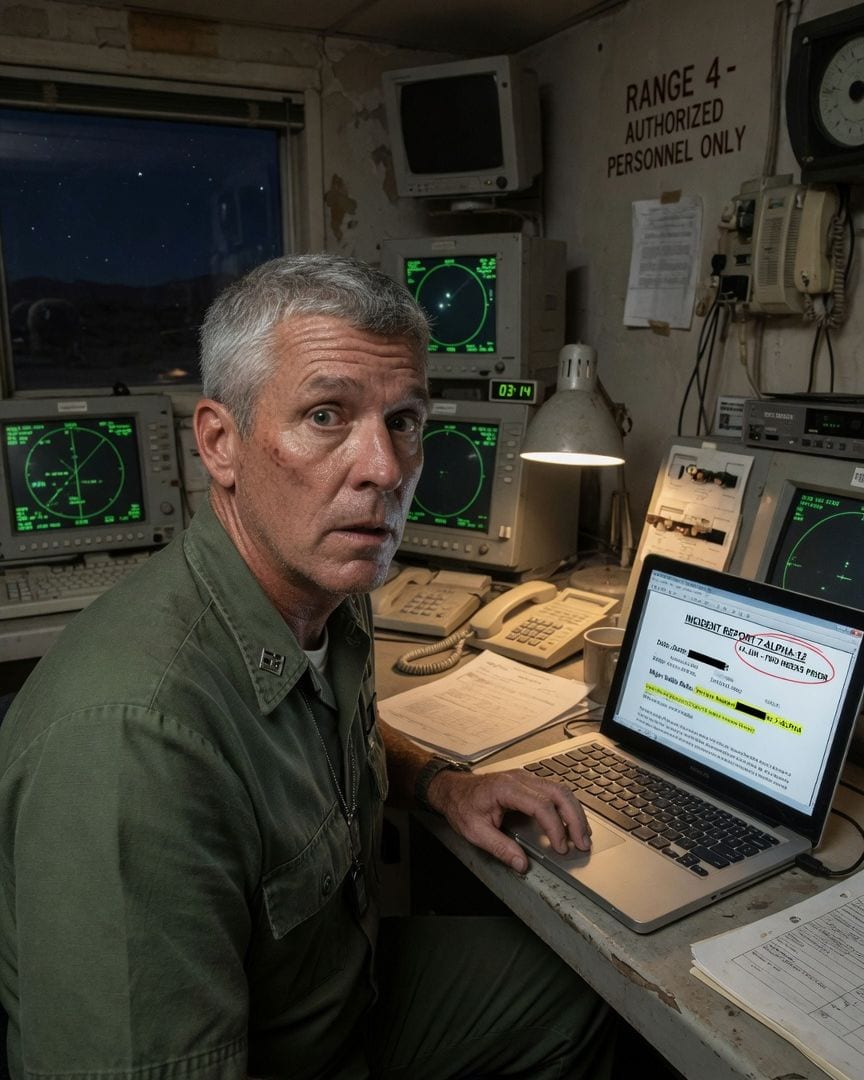
Major Hollis Rake, two weeks from retirement, reported a silent desert disc. His own report was already filed, dated two weeks before it appeared.
Major Hollis Rake, just two weeks from retirement after thirty-five years on a New Mexico desert range, found his predictable world upended. A silent, featureless disc, defying all known phenomena, appeared over the sled rail, its impossible presence confirmed by every instrument on the range. But the true unease began when Major Rake filed his meticulous incident report: it was already in the system, dated two weeks *before* the event even happened. His own name and service number were later found linked to the incident's code in his transfer disposition. Was his retirement just a clerical error, or something far more sinister?
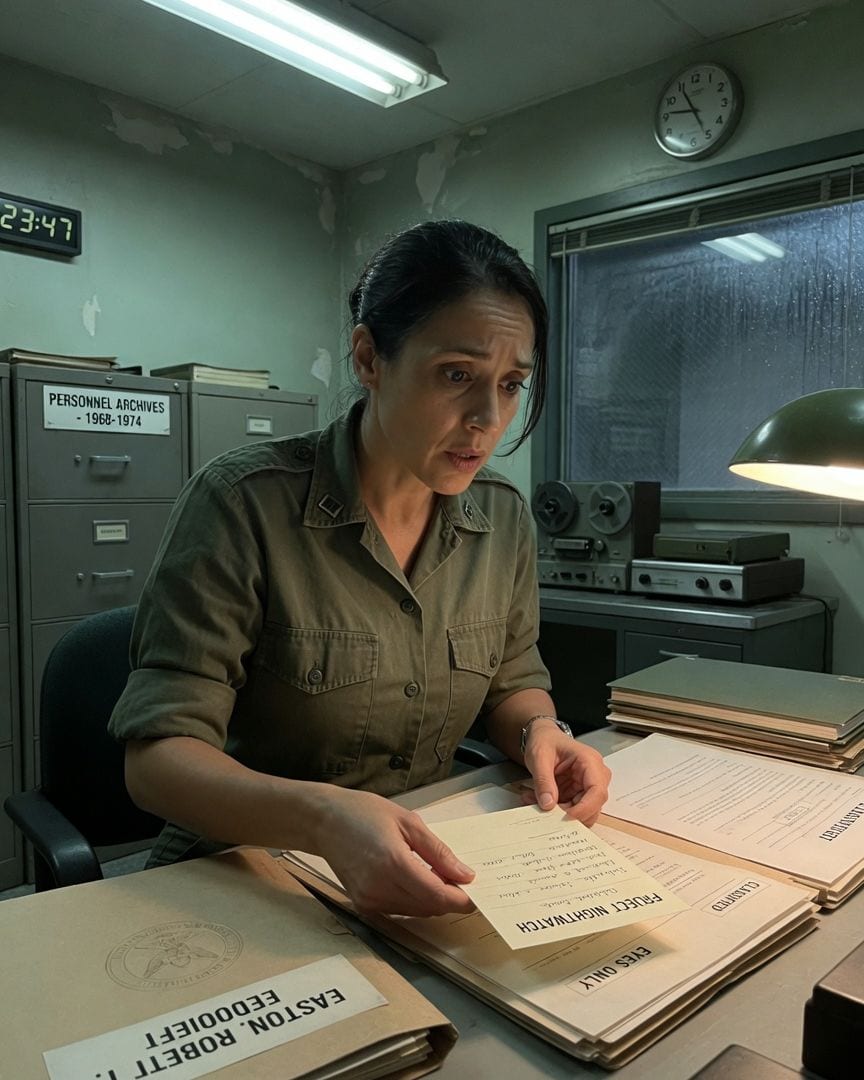
A Cold War tower controller logs an object vanish from radar, then hears the pilot scream it’s filling his windscreen. Her own name, 'Bardolph, Ines', now marked 'Observed' in a secret file.
Captain Ines Bardolph, a tower controller, was counting down the months until her transfer to Langley and the decommissioning of her base, hoping to leave behind the unsettling incidents of her final posting. But one night, her radar scope showed an impossible blip, solid and unwavering, 40 miles north of the Danube, only to vanish in less than a second, leaving a pilot screaming in terror. Despite the clear evidence, the official report blamed "atmospheric inversions," while the terrified pilot received a glowing review and promotion, his file meticulously scrubbed of any anomaly. As Captain Bardolph reviewed the pilot's pristine record, she found a hidden slip of paper, revealing a chilling truth: 'Subject: Bardolph, Ines. Status: Observed.' Was she merely an observer of the impossible, or was she now part of something far more sinister?