My shoulder X-ray showed a metal ball-and-socket joint. It's been in for years, the consultant said, but I've never had surgery.
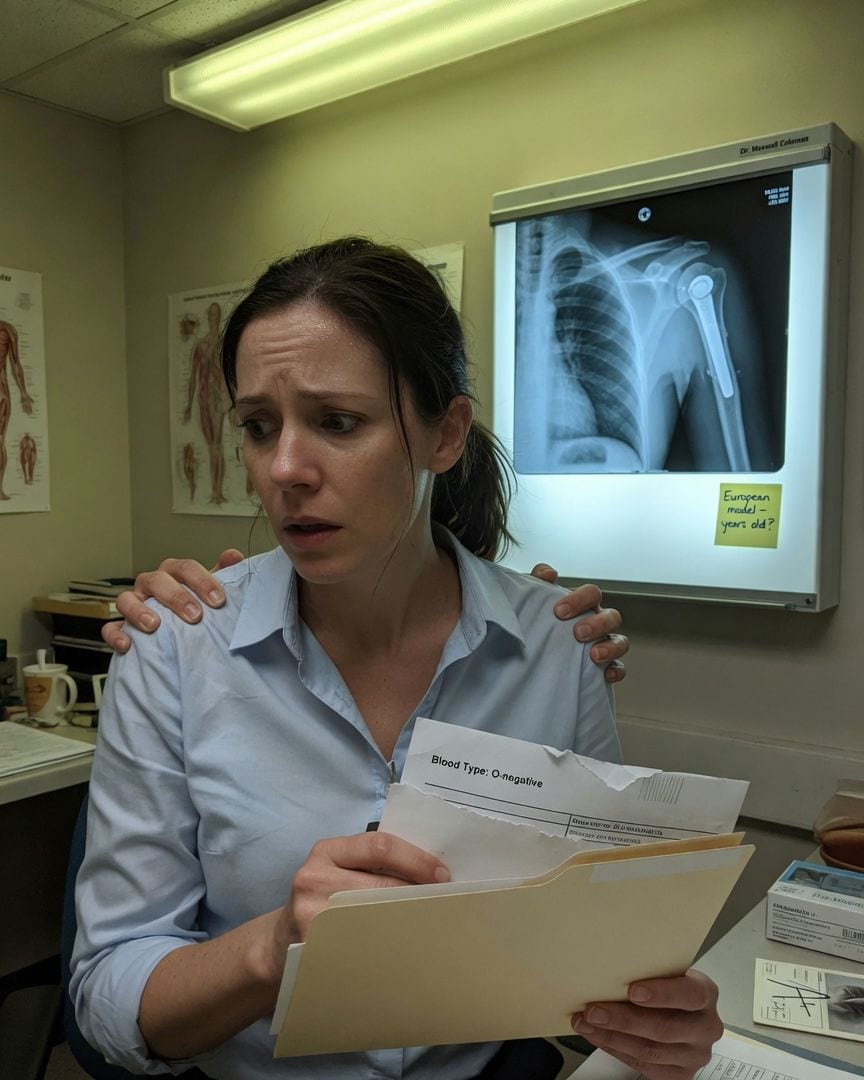
The fluorescent lights of Dr. Maxwell Coleman’s office hummed, a flat, sterile sound. My right shoulder ached, a persistent throb that had finally driven me to seek medical advice.
Dr. Coleman, a man in his early fifties with a kind, tired face, gestured to the illuminated screen beside his desk. My X-ray, stark white bones on black, was displayed. He tapped a point on the image with a pen.
"Mrs. Pierce," he said, his brow furrowed, "when did you have this shoulder replacement?"
I stared at the screen. A perfectly integrated metal ball-and-socket joint was clearly visible where my humerus should meet my scapula. It was a clean, almost elegant piece of engineering, nestled deep in the bone.
I looked down at my own shoulder, smooth and unscarred beneath the thin fabric of my shirt. There was no mark, no faded line, nothing to suggest a surgeon’s knife had ever been there.
"I've never had surgery on my shoulder," I said, my voice thin, almost a whisper. The hum of the lights seemed to grow louder, pressing in.
Dr. Coleman leaned closer to the screen, tracing a faint etched serial number with his pen. "It's a European model, quite sturdy," he murmured, more to himself than to me.
"And from the bone integration, I'd say it’s been in for years. Fully healed." He turned back to me, his expression softening with a professional patience that felt utterly misplaced. "Which surgeon fitted it, Mrs. Pierce?
We’ll need to get those records."
I could only shake my head, a slow, disbelieving movement. The ache in my shoulder, which had brought me here, suddenly felt distant, secondary. A cold, internal dread began to bloom, spreading from my chest.
This metal thing, this foreign object, was inside me. A part of me. And I had no memory of it. None at all.
I spent the next week in a haze of phone calls and online searches. My primary care physician’s office, after an unusually long hold time, confirmed they had no record of any shoulder surgery.
Dr. Coleman’s office called back, equally baffled; they had cross-referenced their own implant database, finding no patient matching my name for that particular European model.
The paperwork for my insurance was a tangled mess, every query leading to a dead end.
Frustrated, I called my mother, my voice tight. "Mom, do you remember any accidents when I was little? Any hospital stays, anything serious at all?"
Her voice, warm and familiar, came down the line. "Of course not, dear. You were always so healthy. A few scraped knees, a broken arm when you were seven, remember? But nothing that required major surgery.
We’d know about something like that." She sounded genuinely puzzled, the way she did when she couldn’t find her glasses.
"What about blood type?" I pressed, the question feeling oddly urgent. "Do you remember that?"
She laughed, a bright, clear sound. "A-positive, just like your father. I remember because your little brother was B-negative, and it was a whole thing with the hospital blood bank when he was born.
Your father and I joked about you being the 'universal recipient,' though I think that’s actually O-negative, isn’t it?"
My own memory of my blood type was hazy, the kind of fact you hear once and rarely need again. But A-positive sounded right.
It fit the narrative of my childhood, of being like my father, of my brother being the outlier.
This wasn't just a missing record anymore; it was a piece of my own body that didn't fit the story of my life. I needed concrete proof of who I was.
I made an appointment for a full physical, specifically requesting a comprehensive blood panel. The dread was no longer cold; it was a quiet, insistent hum beneath my skin, growing louder with every unanswered question.
Days later, a crisp white envelope from the clinic arrived. I tore it open, the paper rasping in the sudden silence of my apartment. My cholesterol was fine, iron good, all the usual markers within normal range.
Then, my eyes landed on the 'Blood Type' field. O-negative. I read it again. O-negative.
My mother’s voice, clear as a bell, echoed in my mind: 'A-positive, just like your father.'
I walked to my old keepsake box, tucked away on a shelf, and pulled out my childhood vaccination card. Faded ink, a small, neat 'A+' next to my name, just as she’d said.
I held the two documents, one current, one decades old, side by side. The official record, unblinking, insisted I was O-negative. The card from my childhood said A-positive.
The room seemed to tilt, the air suddenly thick and cold around me.
The blood type discrepancy became an obsession. I contacted the clinic, my voice tight, insisting on a re-test, suspecting a lab error, a clerical mistake. It had to be.
A nurse, patient but firm, assured me their systems were robust, but agreed to it. Weeks later, the results were identical: O-negative. The hum of dread solidified into something colder, sharper.
Unsettled, I ordered a comprehensive genetic panel online, a full DNA sequence. The kind where you swab your cheek and send it off. I wanted to prove a mix-up, to find a logical explanation for this invasive, impossible wrongness.
This was my body, my blood.
More weeks passed. Then, an email notification pinged. The report was long, clinical, filled with charts and figures I barely understood. My genetic markers were unique, as expected, but then a section detailing 'Familial Matches' caught my eye.
A partial match, flagged with a small, red note: 'Deceased Individual, Isabella Forsythe.' The name meant nothing to me.
Further down, under 'Health Predispositions,' a specific genetic marker, 'Syndrome X,' a rare degenerative bone condition, was identified – a condition that often necessitated extensive joint replacements. The report stated the lab stood by the match.
My own DNA, I was told, was a significant match to a woman named Isabella Forsythe, who suffered from a rare condition affecting her bones and joints.
Bewildered, I began to search for Isabella Forsythe. I found an obituary from 1988, a short article about a local woman, 78, passing peacefully. No mention of family. No photo. Just a quiet passing.
But a brief line in a digitized medical journal archive, linked to a research grant, mentioned Isabella Forsythe as a participant in a 'pioneering orthopedic study' involving advanced prosthetic integration.
The dread that had been humming beneath my skin now solidified into a heavy, cold weight. A specific person, a grave, a condition, and a surgery, all now connected to the body I inhabited.
A body my own DNA insisted was Isabella Forsythe's.
My online digging into Isabella Forsythe grew more intense, desperate. I sifted through digitized newspaper archives, old academic papers, trying to find a link, any thread that would explain this impossible situation.
A week passed in a blur of screen glow and frantic searches.
One morning, an anonymous email landed in my inbox. The subject line was blank. The body of the message contained only a single, terse sentence: 'The European model, correct? You should stop digging, Vivian. Accept what is.'
My heart slammed against my ribs, a sudden, violent thud. The specific detail of the 'European model' implant – known only to me, Dr. Coleman, and Isabella’s long-dead surgeon – was a punch to the gut. Someone was watching me.
Someone knew exactly what I’d found, and what I was looking for. The air in my apartment felt suddenly thin, sharp.
The next day, as I was leaving for groceries, I caught a glimpse of a dark sedan parked a block down. Tinted windows, idling.
It felt like a coincidence, the kind you dismiss, but the email flashed in my mind, cold and precise. I shook my head, trying to clear it. Paranoia.
Later, that evening, I stumbled across a dusty old academic paper that mentioned 'Project Chimera,' a controversial 1980s study on 'identity retention post-mortem.' The lead researcher was a Dr. F. Rutherford. My blood ran cold.
The sedan was gone when I looked again, but the feeling of being observed, of being warned, lingered like a cold touch on the back of my neck.
Driven by the email and the lingering unease, I tracked down Frances Rutherford, the retired researcher. It wasn't hard; her name, along with an old address, was listed in the same archive paper.
Frances, a woman of 71 with sharp, intelligent eyes and perfectly coiffed silver hair, lived in a quiet, unassuming house on a tree-lined street. Her demeanor, as I confronted her in her sunlit study, was unnervingly calm.
I laid out the evidence, pieces of my own life that no longer fit: the X-ray showing the metal shoulder, the blood type discrepancy, the DNA match to Isabella Forsythe, and finally, the 'Project Chimera' paper, which I’d printed and underlined in angry red ink.
Frances listened, her hands clasped neatly in her lap, her expression serene. A faint, almost imperceptible smile played on her lips as I finished speaking, my voice trembling with a mixture of fear and rage.
"Isabella Forsythe," Frances mused, her voice soft, almost nostalgic. "A remarkable woman. And a remarkable subject."
"Subject?" My voice rose, cracking on the word. "What do you mean, subject? My body, my DNA, it's hers. And the shoulder replacement – "
Frances nodded slowly, her gaze fixed on the middle distance, as if recalling something distant and complex. "Isabella had a very advanced form of Syndrome X. Her joints were failing.
The replacement was one of the last successful interventions before her passing. A sturdy, reliable model, yes. The European model." She looked at me, her eyes clear and unblinking.
"But why is it in me?" I demanded, feeling a desperate need to tear through her composure. "Why do I have her DNA?"
Frances sighed, a sound of gentle, academic patience. "Because, Vivian, after Isabella passed, her body was... re-purposed. For Project Chimera. You see, Isabella's physical form was perfectly preserved, post-op, while your… essence, your identity, was ready for transfer.
A clean slate, a strong vessel." She paused, her smile widening slightly. "You are Isabella's body. And Isabella's body, now, is yours."
I stumbled back, reeling from Frances’s words. The antique desk, laden with books, seemed to swim before my eyes. "My essence? What does that even mean? I'm Vivian Pierce! I have a life, memories, a family!"
Frances merely smiled, a serene, almost pitying expression. "Of course you do, dear. All carefully constructed. All perfectly viable. That was the genius of it." She reached for a drawer in her old wooden desk, the wood creaking softly.
She pulled out a faded, sepia-toned photograph and held it out to me.
My hands trembled as I took it. In the image, a young woman, strikingly identical to me, stood beside a much older, frail Isabella Forsythe.
They were in what appeared to be a sterile, clinical room, gleaming equipment reflecting the bright lights in the background. The younger woman’s arm was around Isabella, a gentle, almost protective gesture. The woman was me.
My face, my hair, even the way my head tilted.
My gaze dropped to the back of the photo. In neat, precise script, it read: 'Subject V, with Isabella Forsythe, Post-Transfer Prep, 1988.' My breath hitched in my throat. The woman in the photo was me.
But this Isabella Forsythe died in 1988. This meant 'Vivian' existed then, before my current body, before my current life. The implications were a cold, crushing weight, pressing the air from my lungs.
Frances, observing my shock, calmly elaborated, her voice a soothing drone against the cacophony in my mind. "Subject V, as we designated you, was an extraordinary opportunity.
A unique mental template, if you will, harvested from a volunteer candidate who, regrettably, passed away unexpectedly. Isabella's body, robust despite her age, and freshly recovered from her final surgery, became the perfect vessel.
We painstakingly mapped your neural patterns, your core identity, onto Isabella's brain. The memories, the life story you recall, were meticulously crafted, woven into the fabric of your new existence. It was a triumph, Vivian.
The first successful consciousness transfer, a seamless integration. You are the living proof."
Frances gestured around her study, a room filled with books on neuroscience, bioethics, and quantum physics. "Project Chimera aimed to overcome d**th, to allow identity to persist beyond the fragile vessel of the body. Isabella's consciousness was... gently retired.
Yours was then introduced. The process was complex, intricate, but ultimately, a profound success. You have lived a full, rich life, unburdened by Isabella's frailties, embodying a new identity.
The shoulder replacement was merely a pre-existing condition of the vessel, an insignificant detail in the grand scheme." I felt a profound, terrifying coherence settling over me.
Every discrepancy, every impossible detail – the X-ray, the blood type, the DNA, the photo – clicked into place with horrifying precision.
I tried to fight it, to deny the meticulously presented facts, to claw my way back to the comfortable illusion of my life. "No," I whispered, shaking my head, "this is insane. I'm real. My parents, my childhood, Arthur...
it's all real!"
Frances tilted her head, a hint of professional exasperation. "Every detail, every relationship, every memory, was designed to be real for you, Vivian. Your parents, your friends, they believe in your reality because it was constructed to be utterly convincing.
You are a masterpiece of bio-engineering and psychological integration. To deny it now, to expose the truth, would not only destroy your carefully built life but also invalidate decades of groundbreaking work."
She leaned forward, her gaze unnervingly direct, devoid of any malice. "You have a choice. Continue to live the life you believe is yours, accepting this truth in silence, or shatter it all.
We cannot allow the project to be compromised. You are too valuable." I looked at my hands, the hands that now felt alien, the subtle ache in my shoulder a constant, physical reminder.
The calmness in Frances's voice, the utter lack of cruelty, was the most terrifying part. There was no monster, no villain, just a scientist stating facts.
I was trapped, a ghost in another woman's body, my life a meticulously crafted illusion. The path back to my 'old' self was gone, swallowed by a truth too profound to comprehend, too coherent to deny.
I walked out of Frances Rutherford’s house, the afternoon sun feeling like a foreign spotlight. The world hadn't changed, but I had. Every face, every familiar object, seemed to shimmer with an unsettling unreality, like reflections on a disturbed surface.
I returned to my apartment, the sanctuary of my manufactured life, and tried to resume.
I cooked dinner, watched TV with Arthur, but my gaze kept drifting to my own reflection in the darkened window, searching for a ghost I couldn't see, a woman who wasn't there.
My hand drifted to my shoulder, feeling the smooth skin over the metal. The dread was a quiet, constant hum now, a permanent resident in my mind.
Arthur, my partner, noticed small things. A new way I held my right shoulder, perhaps, a subconscious shielding. A faint, unfamiliar scent on my clothes, maybe from Frances’s old house, a subtle clinging of dust and old paper.
He asked me one morning, looking at me over his coffee cup, "Are you feeling alright, Viv? You seem a little... different lately."
I paused, a cup of tea halfway to my lips, looking at him. A strange, knowing glint in my eyes, a spark I hadn't seen there before, flickered for a moment.
Then I smiled, a little too wide, a little too fixed.
"Never better, Arthur," I said, my voice smooth and even. "I feel like a whole new person."
If this one got to you
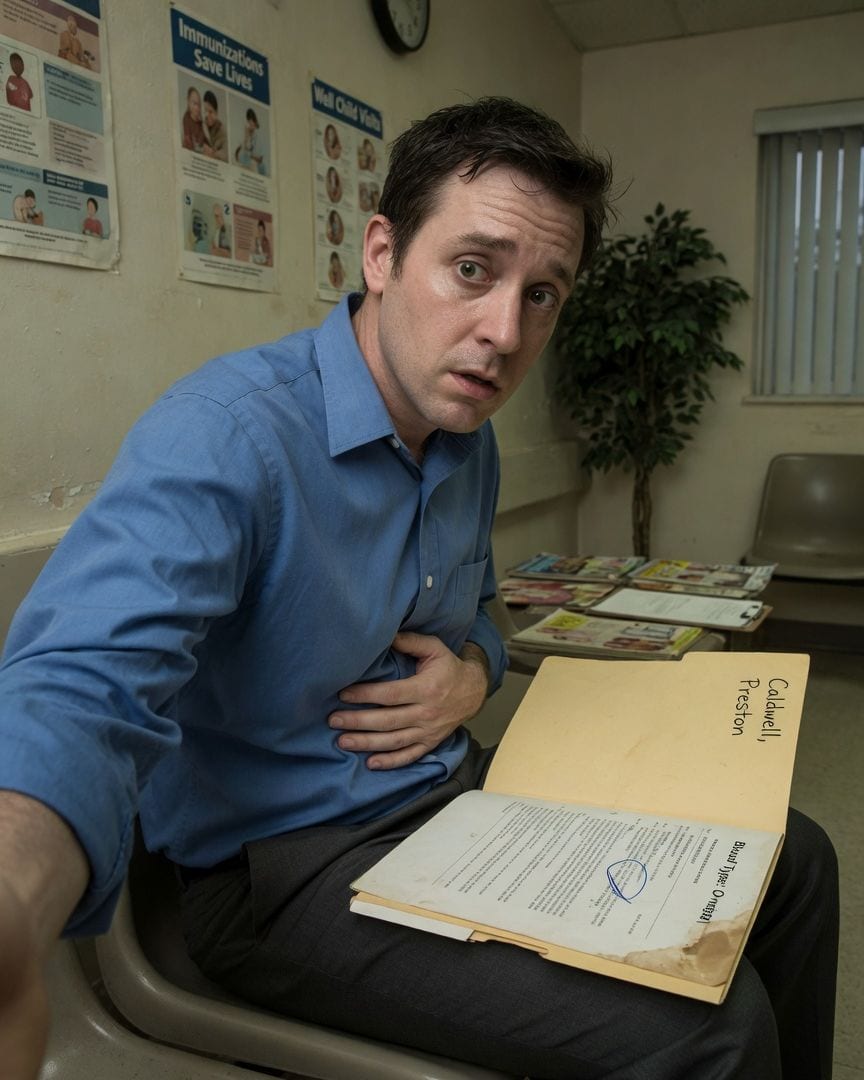
My ultrasound found a silicone prosthetic where one of my testicles should be. The real one was removed years ago, the space healed, but I never had surgery there. I never knew.
I booked an ultrasound for a dull ache, expecting a simple diagnosis. Instead, doctors found a perfectly healed prosthetic organ, expertly placed, where my own should have been. I have no memory of ever having such surgery, leaving a chilling question hanging in the sterile air.
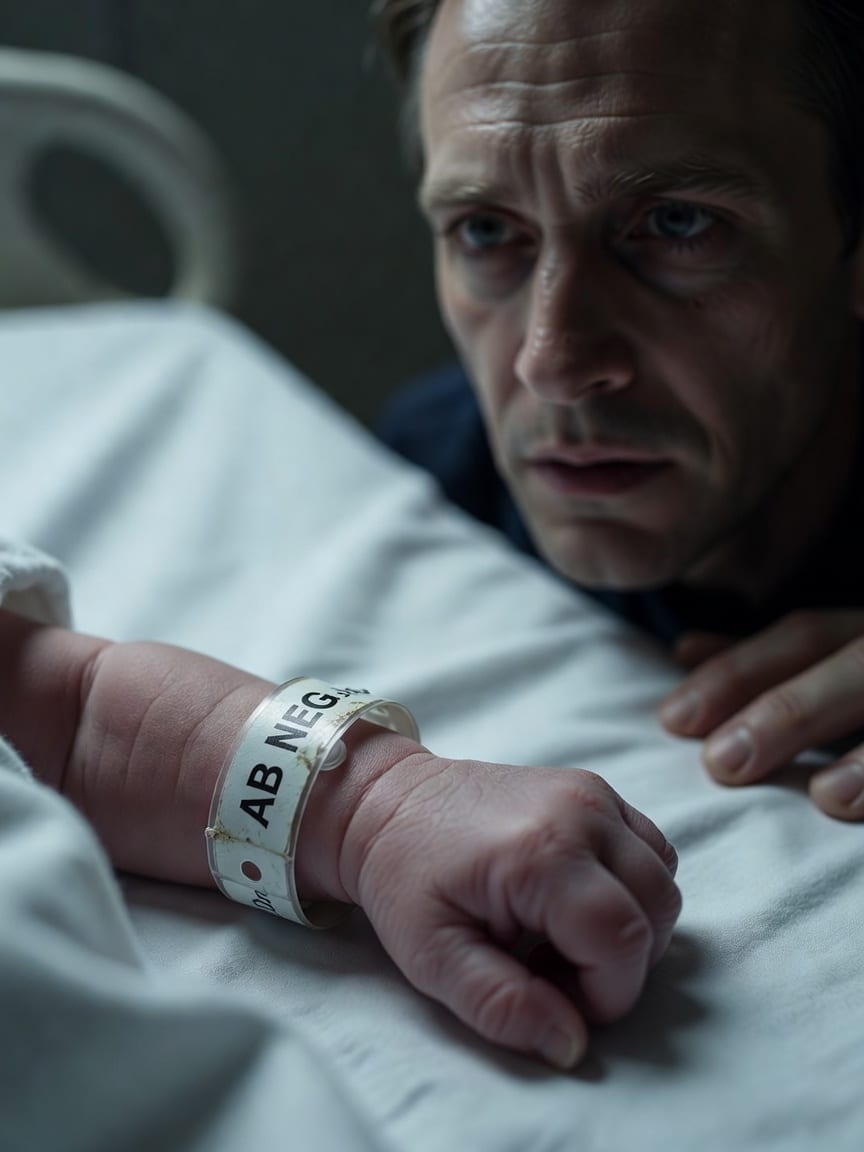
My bl**d type keeps changing. My old donor card says AB negative. Every test since has come back O positive. Doctors can't explain my own handwriting.
I usually find the sterile scent of antiseptic calming, but not today. Dr. Mitchell revealed my bl**d type had changed from AB Negative to O Positive. Despite multiple fresh samples, the new results were undeniable, a medical impossibility that defied everything I knew about my own body.
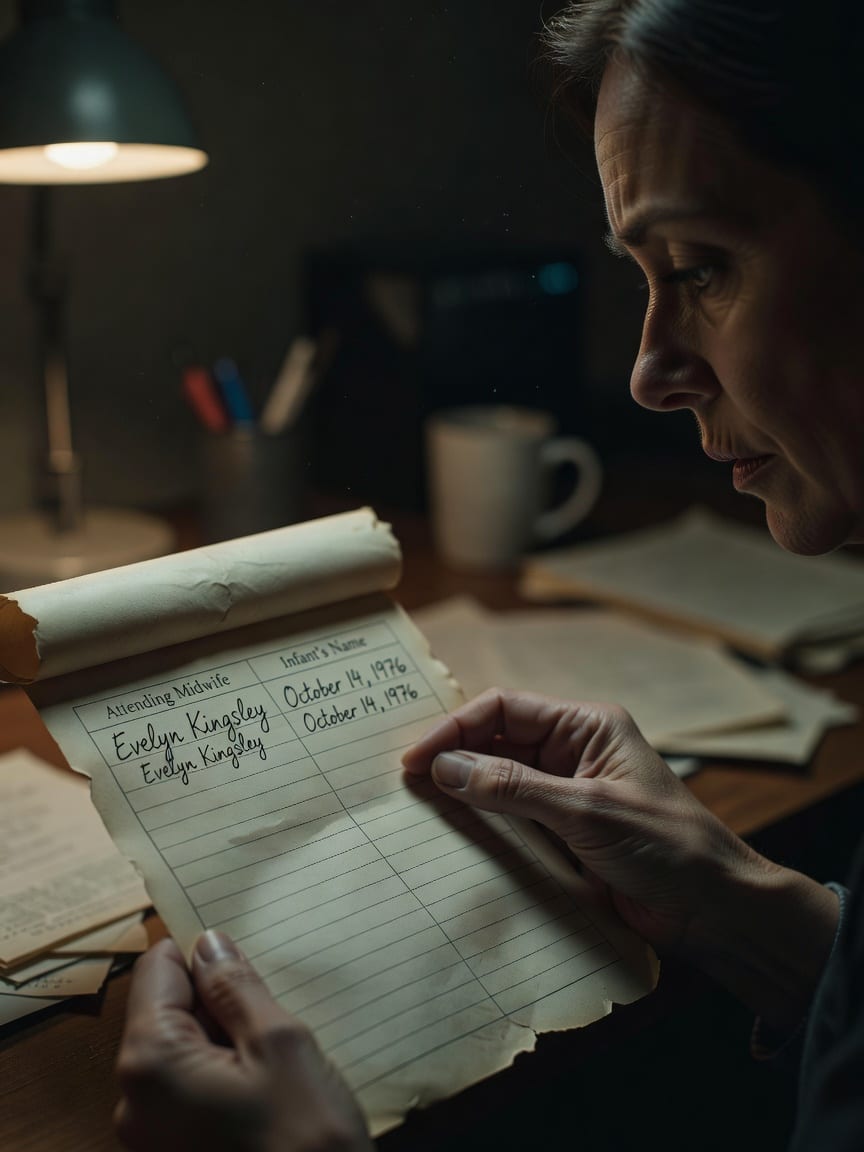
My own handwriting is on my birth certificate, signed as the attending midwife. I was the baby born that night.
I found my adult signature scrawled across my mother’s maternity file, right on my own birth register page. Forensic analysis confirmed it was genuinely my handwriting, dated 1976. But that was the year I was born, and my signature was listed as the attending midwife.
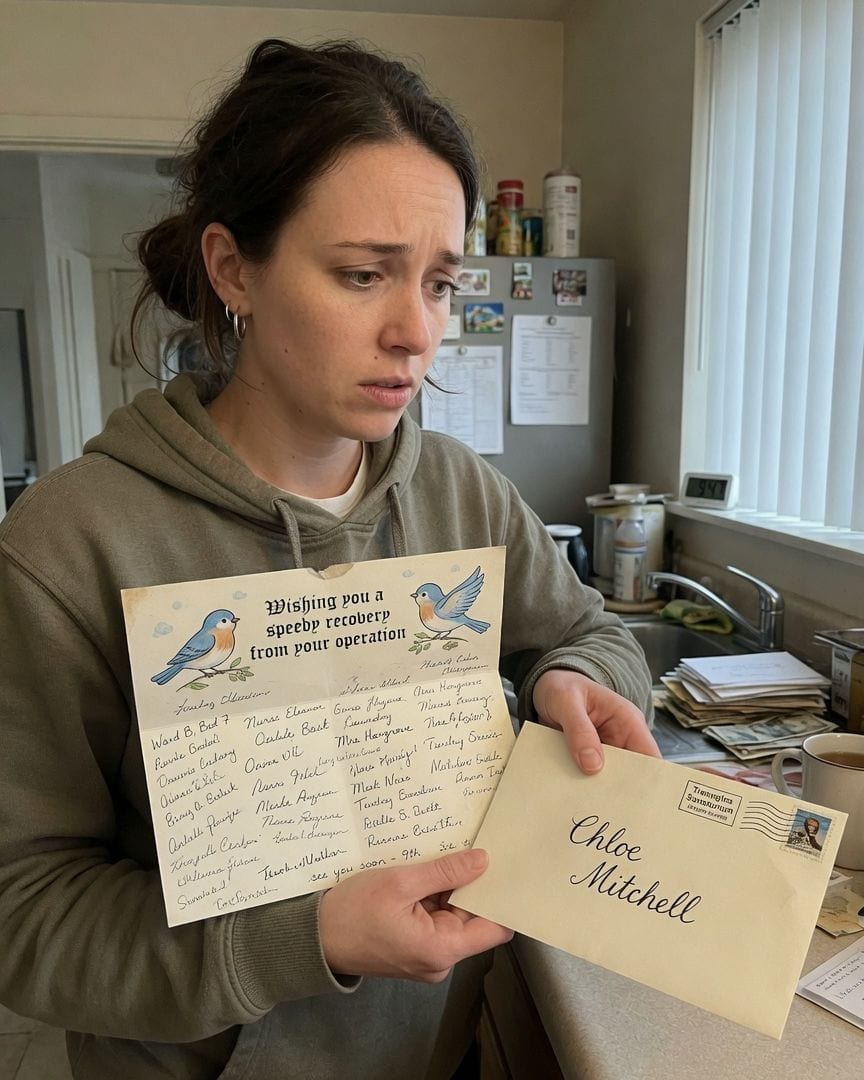
A get-well card wished me a speedy recovery from an operation I never had. It was postmarked from a sanatorium that burned down in 1963.
My quiet Tuesday morning was interrupted by an elegant get-well card, addressed to me. It wished me a speedy recovery from an operation I'd never had. But the postmark read 'Treneglos Sanatorium,' a hospital that vanished in a fire back in 1963.
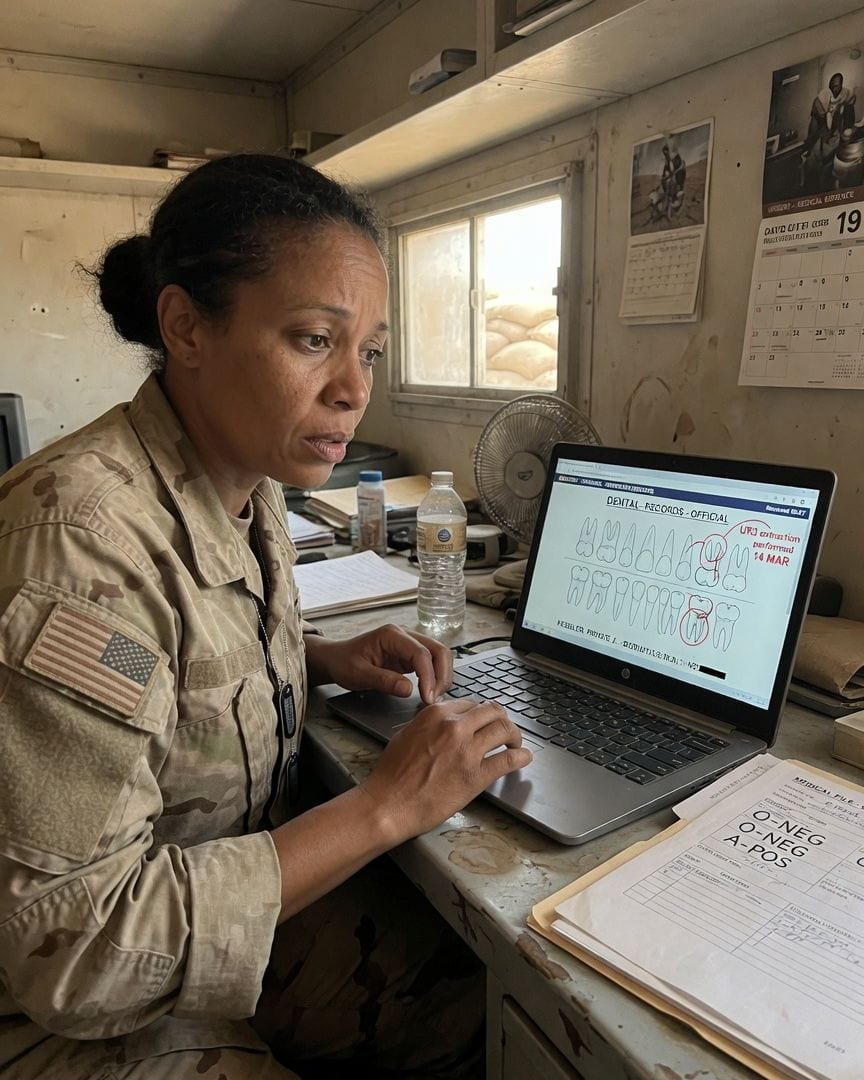
Weeks from going home, Sergeant Whitmore saw Private Kessler’s dental records show teeth he didn’t have and missing ones he did.
Sergeant First Class Iris Whitmore counted the weeks until her deployment ended, dreaming of home as the desert heat baked FOB Cerberus. But the familiar weight of Private Kessler’s dog tags soon brought a cold knot of dread: his blood type, once O-negative, suddenly read A-positive. She dismissed medical anomalies and clerical errors, only to find his official records subtly rewriting his timeline, linking old injuries to new identities. When his dental charts arrived, showing teeth he never had and missing ones he did, Sergeant Whitmore faced an impossible question: who was Private Kessler, really?
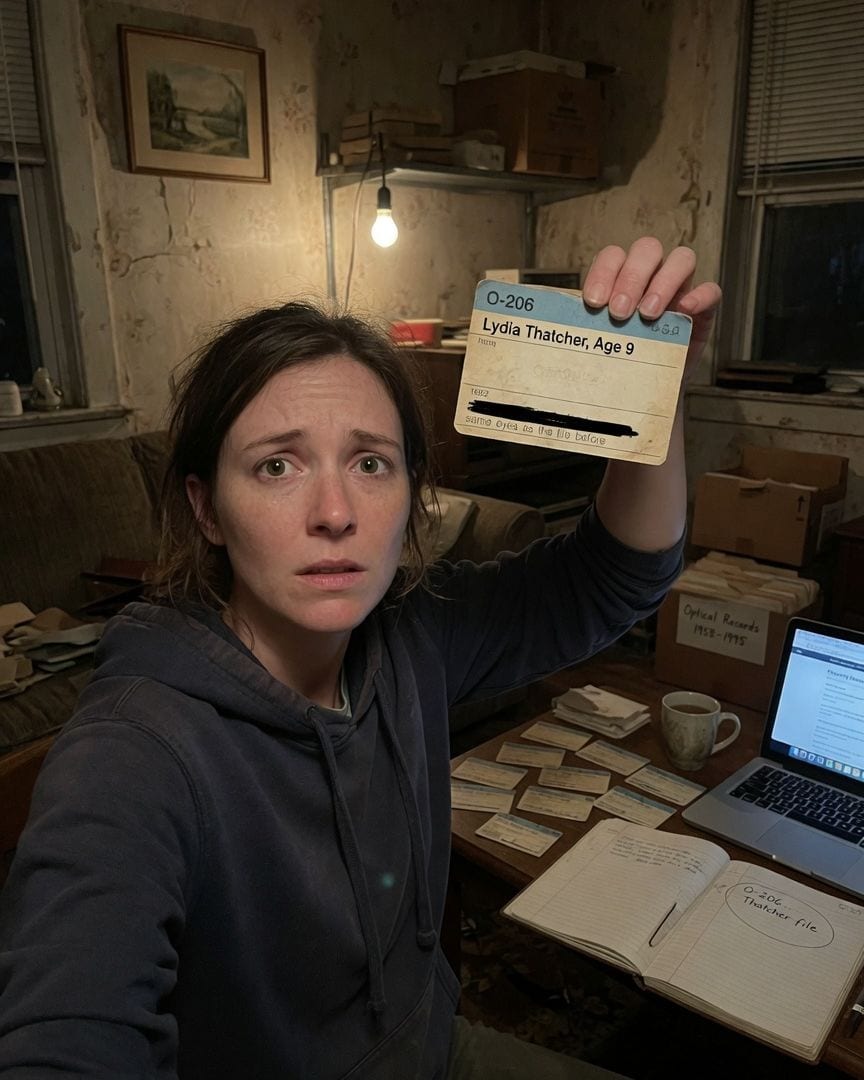
My own optical card is dated 1962, with my name on it. I wasn't born until 1993.
Sifting through old patient files from my former optical practice, I found my own O-206 card. It had my name, Lydia Thatcher, and my current home address printed on it. But the card was dated 1962, decades before I was even born, and a redacted note mentioned 'same eyes.'