My X-rays show a perfectly healed fracture from 1968. I've never broken a bone in my life.
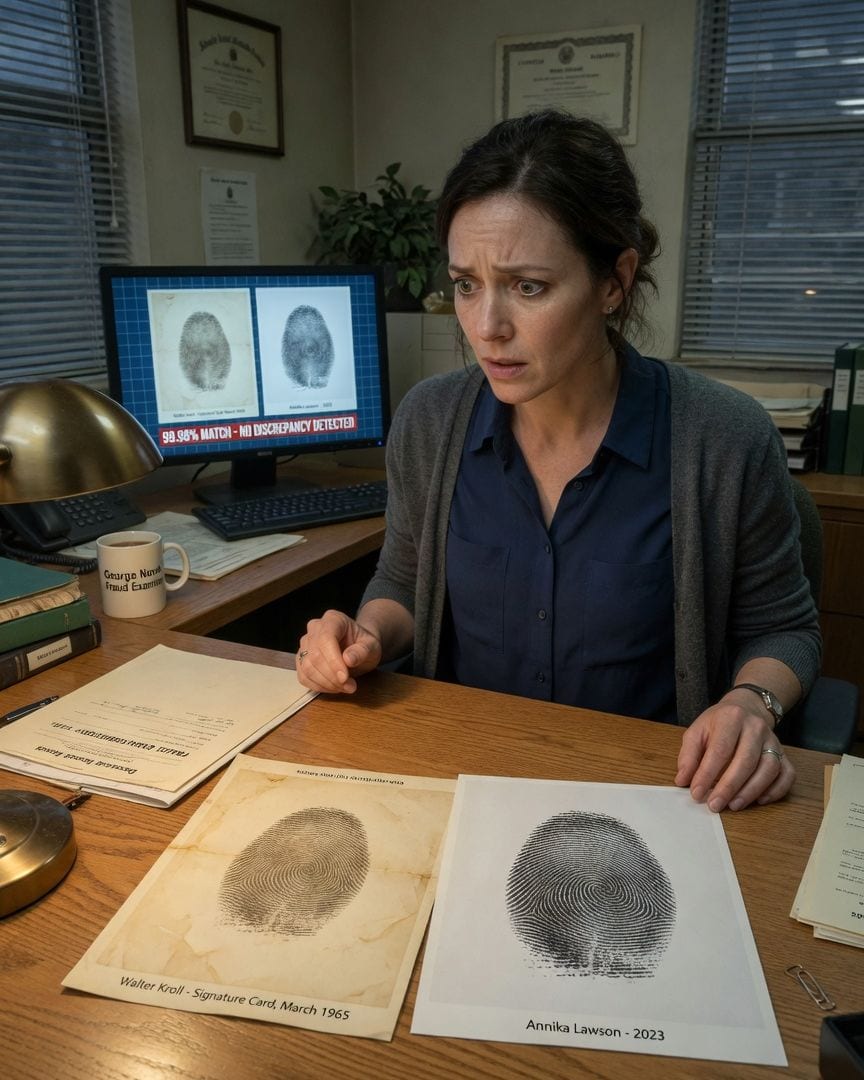
The polite smile on the teller’s face froze. It was an ordinary Tuesday afternoon, the kind of quiet day where nothing ever happened.
I’d just handed over my debit card, ready to deposit a check, and the screen at her station had flashed red. “I’m sorry, Ms. Lawson,” she stammered, her gaze flitting to the manager’s office.
“It seems your account has been locked.”
Minutes later, I was sitting across a polished oak desk from George Novak, the bank’s fraud examiner. He was a man in his late fifties, neat gray hair, an unnervingly placid demeanor.
He didn’t look like someone who dealt with frantic customers or exposed criminals. He looked like he balanced ledgers for fun. The air in his office was still and heavy, smelling faintly of paper and stale coffee.
He explained, in a voice as flat as the desktop, that the system had flagged my most recent biometric scan, my enrolled thumbprint. It had registered a match.
“A match to what, exactly?” I asked, my voice tighter than I intended.
He slid two magnified images across his desk. On the right, dark and clear, was my own thumbprint, the ridges sharp and distinct, taken when I opened this account last year.
On the left, faded and yellowed, was an impression from a paper signature-and-thumbprint card. The card, he explained, was dated 1965, and belonged to a depositor named Walter Kroll. Kroll had died in 1970.
“Our biometrics system is… robust, Ms. Lawson,” Novak said, his gaze fixed on my face, devoid of any discernible emotion. “It cannot tell them apart.”
My breath hitched. I stared at the two prints, side by side. They were identical. Every loop, every whorl, every tiny island. My own body, my own unique, indelible mark, was an echo from before I was born.
It was a physical impossibility, staring back from the past.
My mind raced, grabbing at any explanation. A clerical error? A smudge on the old card? A glitch in the bank's system? Novak, with practiced patience, systematically dismantled each theory.
He pulled up a digital comparison on his computer screen, showing me the intricate overlay, the precise minutiae that confirmed the match down to the last epidermal ridge. The glowing lines on the screen held steady, perfectly aligned.
Then he produced Walter Kroll's account closure forms, signed by his next of kin, dated 1970, confirming his death. There was no mix-up of living customers. No family member claiming identity theft.
The fraud system, designed to detect the slightest discrepancy, had instead confirmed an impossible identity.
The cold dread settled deep in my gut, a physical weight. My thumb was my thumb. It was mine, unique. Wasn’t it? I spent the rest of the day researching Walter Kroll online.
His obituary was brief, noting his profession as an engineer. A quiet life, ended quietly. Little more than a ghost, yet his physical self was somehow imprinted on mine.
The encounter at the bank left a lingering tension in my chest, a tightness I couldn't shake. On an impulse I couldn't explain, a desperate reach for something normal, I scheduled a full physical with my doctor, Dr. Elliot Foster.
Just for peace of mind, I told myself. A reset.
Dr. Elliot Foster, my primary care physician, hummed thoughtfully as he reviewed my X-rays. The fluorescent light of his office hummed too, a low, steady sound.
He pointed a pen at a spot on the monitor, highlighting the ghostly white bones of my left wrist. “Everything looks fine, Annika,” he said, his voice reassuring, “Except this.”
My eyes followed his pen. There, on the shadowy landscape of my ulna, was a thin, brighter line, a slight distortion in the bone’s smooth curve. “See this line? It’s a perfectly healed fracture. Old.
Looks like late 1968, early 1969, maybe. A clean break, mended well.”
I frowned, leaning closer to the screen. The chill in the room seemed to deepen. “A fracture? I’ve never broken anything in my life, Dr. Foster. No scar, no memory of it.”
He zoomed in, the image pixelating slightly, making the line even more pronounced. “It’s definitely a fracture, Annika. And it’s definitely yours. Fully calcified, years ago.”
I stared at the screen, at the phantom injury in my own bone, a memory that belonged to someone else, staring back from inside me.
I left Dr. Foster’s office in a daze, the hum of the fluorescent lights echoing in my ears. A perfectly healed fracture from 1968. I called my parents that evening, trying to sound casual.
“Hey, remember any broken bones when I was a kid? My wrist, specifically?” They laughed, recalling scraped knees, chickenpox, the time I swallowed a Lego. Never a broken wrist.
I even had them dig out my childhood medical chart, stored in a dusty box in the attic. The paper was brittle, the ink faded. It listed everything from immunizations to ear infections. No record of any wrist fracture. Nothing.
I scheduled an appointment with a second orthopedic specialist. He confirmed Dr. Foster’s assessment of the X-ray, reiterating the age and the complete healing. “It’s an old injury, Ms. Lawson,” he said, tapping the screen. “Nothing to worry about now.
Bone’s stronger than ever.” The evidence held.
If my body held a physical memory of Walter Kroll, what else might it contain? My research on Kroll intensified. I dug deeper into local archives, scrolling through microfilmed newspapers at the library.
The projector whirred, casting shadows on the screen, illuminating article after article of mundane local news. Then, buried on page seven of the Mid-Valley Chronicle from February 1969, I found it.
A brief, almost insignificant piece: 'Local Engineer Sustains Fall, Brief Hospitalization.' Walter Kroll, identified as an engineer, had been hospitalized in late 1968 after a fall, reportedly from a ladder at a construction site.
The dates aligned perfectly with my phantom fracture. The pieces were starting to fit, forming a mosaic of horror, each one clicking into place with a sickening finality.
My attempts to access Walter Kroll's old hospital records were met with polite but firm resistance. HIPAA, archival protocols, privacy. The administrative assistant on the phone recited the regulations like a mantra.
Undeterred, I hired a genealogist, spending money I couldn’t really afford. She was good. She eventually tracked down a distant, elderly cousin of Kroll’s: Edith Winslow.
The genealogist mentioned Edith had worked as a nurse at the very hospital where Kroll was briefly admitted. My heart pounded when I saw the name and number.
I called Edith, my hand shaking slightly as I dialed. Her voice, though frail and wavering with age, held a surprising edge of suspicion. “Who is this?” she asked, a guarded tone in her voice.
I cautiously brought up Walter, the bank, the identical thumbprints. I mentioned the fracture, the impossible link. There was a long silence on the line, punctuated only by the faint crackle of an old connection.
I could almost hear her breathing. “Some things are better left buried, dear,” Edith finally said, her voice dropping to a near whisper, colder now, losing its fragility. “What’s done is done. You don’t want to go digging.”
The line went dead. I stared at my phone, the plastic warm in my hand. I tried calling back, but Edith didn’t answer. Each ring echoed in the sudden silence of my apartment, accusing.
A cold prickle ran down my spine. Someone knew. Someone was watching. And they wanted me to stop.
Ignoring the warning, the next day I drove two states over to Edith Winslow’s quiet retirement community. The drive felt long, the passing scenery a blur. The facility smelled faintly of antiseptic and old flowers.
Edith, a wisp of a woman with sharp, wary eyes, initially feigned confusion, her gaze darting nervously around the small, neat room. She gripped the arms of her armchair so tightly her knuckles were white.
“Walter Kroll? It’s been so long,” she mumbled, her voice faint.
I sat on the edge of the floral sofa, calm but resolute. I laid out the evidence, piece by piece, on her small coffee table. First, the two magnified thumbprints, mine and Kroll’s, undeniably identical.
Then, my own X-ray, the ghostly white line of the healed fracture clearly visible. Finally, the grainy photocopy of the 1969 newspaper article about Kroll’s fall.
I had acquired a copy of Kroll’s archived 1968 X-ray through a sympathetic records clerk at the hospital, an old woman who believed everyone deserved their peace of mind.
I placed it next to my own X-ray, the two images of a healed wrist fracture, perfectly mirroring each other. The bone structure, the angle of the break, the calcification patterns—they were exact.
Edith’s composure crumbled. Her frail hands began to tremble. Tears welled in her eyes, tracing paths down her wrinkled cheeks. “They told us it was for his own good,” she whispered, her voice barely audible.
The words seemed to cling to the still air, heavy and dark.
She confessed to being a junior nurse involved in a clandestine ‘rehabilitation’ program at the hospital. Walter Kroll, she explained, had been a brilliant but sickly engineer, deemed ‘important.’ He was part of it.
The program, she said, involved 'biological imprinting,' a way to transfer certain indelible physical markers and even healed injuries from a ‘donor’ to a ‘recipient.’ The thumbprint, the fracture—they were all part of Kroll’s ‘signature,’ transferred.
She looked at me, her eyes filled with a weary sorrow. I felt a wave of nausea. My body wasn’t just mine; it was a layered palimpsest, overwritten with another’s history.
Edith, trembling, fumbled beneath her worn armchair cushion, her hand rustling against faded fabric. She pulled out a small, leather-bound ledger, its pages yellowed and brittle with age. It was an unofficial record, meticulously kept, from the ‘rehabilitation’ program.
The covers were smooth from years of handling, the stitching coming undone in places. Her finger, gnarled with arthritis, traced down a column of handwritten entries. The names were neat, almost elegant.
‘Walter Kroll – Donor – Type B,’ she read aloud, her voice barely audible, thick with regret.
Below it, a few lines down, my own name, ‘Annika Lawson,’ appeared, with a date years after Kroll’s death, and the chilling annotation: ‘Recipient – Type B.’
But as I leaned closer, my blood ran cold. Below my own entry, there were others. More names, more dates, stretching back decades, a horrifying pattern.
And then, a new, shockingly recent entry, dated just last year, with a different name and the same ‘Recipient – Type B’ code.
Edith looked up, her eyes wide with a terrible resignation. “You weren’t the first, dear,” she whispered, her voice cracking, barely more than a sigh. “And you won’t be the last.”
I stared at the ledger, a record that defied time and identity, a horrifying pattern stretching into the past and reaching into the future.
Edith, now completely adrift in memory, her grip on the present loosened by decades of silence, revealed the full, horrifying scope.
The 'rehabilitation' program, she explained, was a clandestine initiative, funded by an anonymous entity, designed to 're-house' the essential biological data and unique physical traits of intellectually significant individuals into new, compatible newborn hosts.
Walter Kroll, a genius in his field, had been deemed 'worthy' of this 'continuity.' The thumbprint, the healed fracture – these were all indelible markers of his identity, imprinted onto Annika as a newborn.
My own birth, my own infancy, a sterile procedure in a hospital, now replayed in my mind as a terrifying initiation.
Edith described how certain institutions, like banks and hospitals, were subtly 'seeded' with personnel and established protocols to manage these 'recipients.'
Their purpose was to identify anomalies, like my bank flag, and subtly neutralize them, to explain them away, ensuring the program’s absolute secrecy. George Novak’s chillingly calm demeanor, his dismissive explanation of 'anomalies,' suddenly clicked into place with terrifying clarity.
He wasn’t just a bank examiner; he was a 'gatekeeper,' part of a system far older and more pervasive than I could have ever imagined.
The horror wasn't a mistake; it was a carefully orchestrated design, a hidden current beneath the everyday world.
I returned to the bank, not for answers, but for confirmation. The sterile air in the lobby felt heavy, oppressive. I found George Novak in his office, impassive as ever, staring at his computer screen.
The smell of stale coffee was still there. I didn’t sit. I walked straight to his desk and laid Edith’s ledger on the polished wood.
His eyes flickered, just for a second, a hairline crack in his professional facade. He picked up the ledger, his fingers, surprisingly delicate, brushing the faded pages, turning them slowly.
“So, old Edith finally shared her little hobby,” he murmured, a faint, humorless smile playing on his lips, a coldness in his eyes that had nothing to do with the office’s air conditioning.
He confirmed everything. The bank’s fraud system, designed to detect identity theft, was, in fact, an intricate part of the 'continuity' protocol, a sophisticated detection system designed to flag 'recipients' whose imprinted traits surfaced too prominently.
His job was to contain, to explain away, to ensure the 'transition' remained seamless and unnoticed. He spoke of 'biological heritage' and 'preserving vital intellects' with a chilling detachment, as if discussing corporate assets, a quarterly report.
There was no emotion, no remorse. Just a stark, clinical explanation of how the system worked, how it maintained its decades-long operation, how it ensured 'important legacies' endured. There was no escape, he implied, only acceptance.
I left the bank, the weight of the truth crushing me, heavier than any physical burden. My past was a lie, my present a monitored existence, and my future, a chilling continuation of someone else’s echo.
The world outside the bank, with its oblivious commuters and bustling shops, seemed to mock me.
I never spoke of it again. I couldn’t. The knowledge was a solitary burden, a cold, unshakeable certainty.
The world around me remained oblivious, spinning on its axis, unaware of the quiet, insidious continuity it housed, the layers of lives within lives.
I looked at my hands, at the lines on my thumb, seeing not just my own life, but the ghost of Walter Kroll.
The scarless fracture in my wrist was a constant, phantom ache, a physical reminder of the truth buried within me, a silent scream.
Edith Winslow passed away peacefully in her sleep a few weeks later, the old ledger presumably disappearing with her, its secrets absorbed back into the silent earth. The bank never called about the 'fraud' again.
The system had, apparently, successfully contained its anomaly.
I sat at my kitchen table, scrolling through old family photos on my tablet. The screen glowed in the dim room, casting a blue light on my face.
A picture of me as a baby, chubby hand clutching my mother’s finger. I zoomed in, pixel by pixel, studying the tiny folds of my infant thumb, searching for something, anything.
I knew it wouldn't be there, couldn't be, but I looked anyway, a desperate, silent plea to a past that was not entirely her own.
I closed the tablet, the screen reflecting my own face, a face that felt both intimately familiar and profoundly alien. The silence in the room stretched, thick and heavy.
I picked up my phone, opened a blank post, and hesitated, my thumb hovering over the screen, ready to type, ready to tell.
A comment appears beneath the empty post, simply reading: 'The system endures.'
If this one got to you
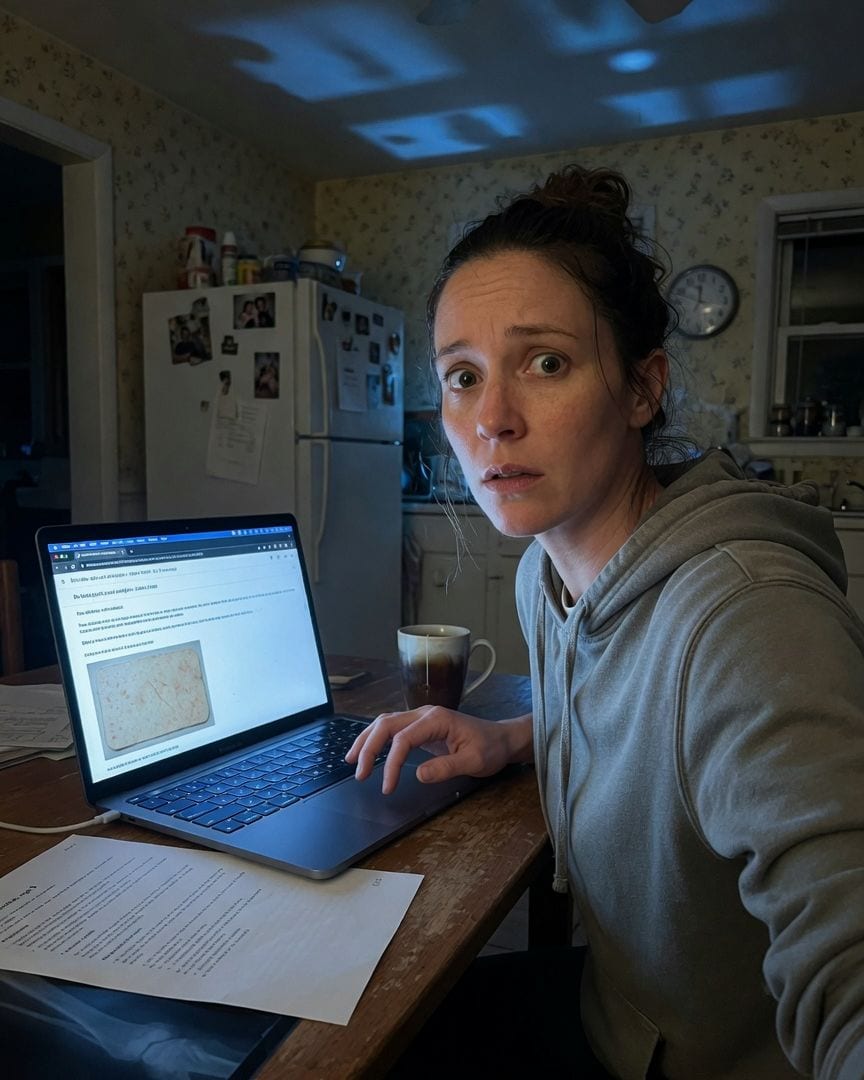
The blood on my own newborn heel-prick card — the one my mother saved in a drawer for thirty years — doesn't match the DNA in my mouth today. The lab ran it three times: two different people.
I sent my newborn heel-prick card to a genealogy lab, expecting to confirm my family tree. Instead, the lab tech called with an impossible truth: the blood from my infancy did not match my adult DNA. My own record insisted I wasn't quite myself.
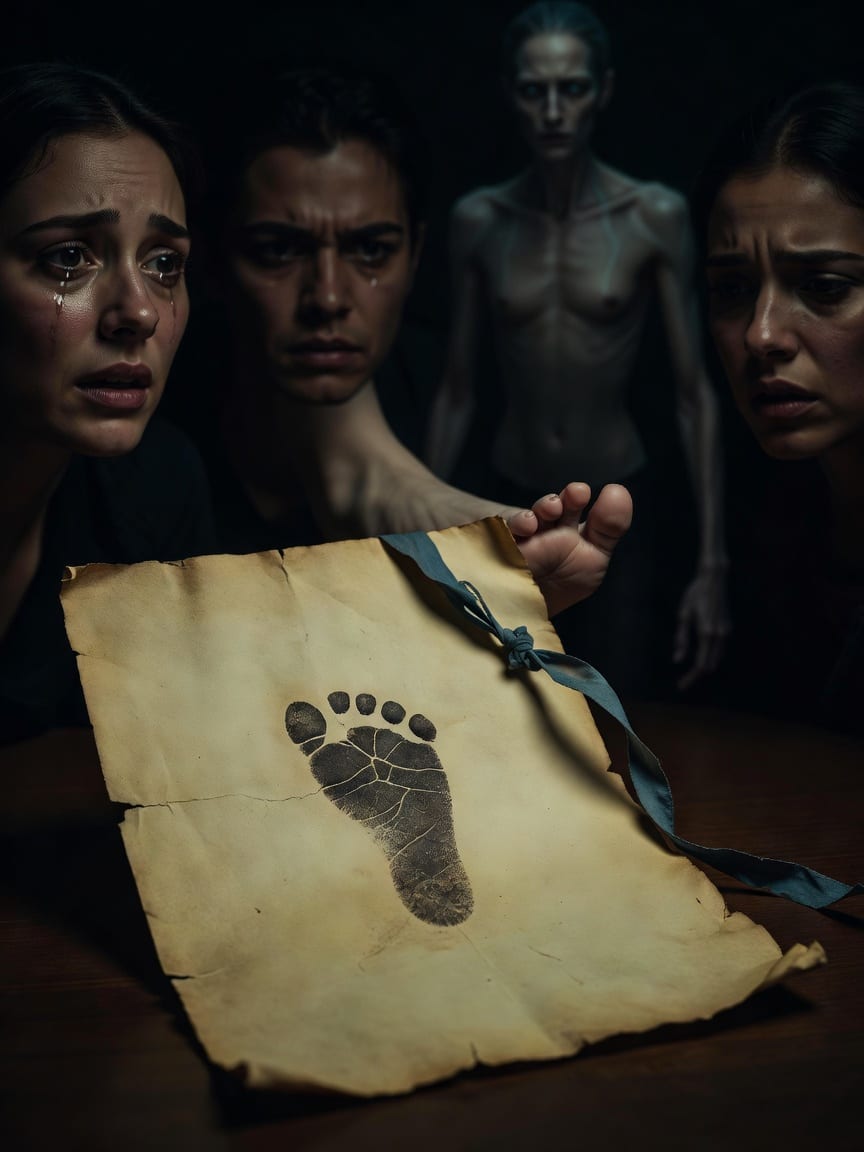
My hospital scanned old newborn footprints. They matched my foot, every whorl and arch, to a stillborn infant's card from 1954. Those tiny, inked ridges on the yellowing paper were undeniably mine. Sixty years apart, the same feet.
I was only curious when St. Jude's Hospital sent my newborn footprint card, part of digitizing their old records. But a genealogist soon revealed my own unique footprint matched a stillborn infant's card, filed in 1954 – an impossible biometric anomaly.
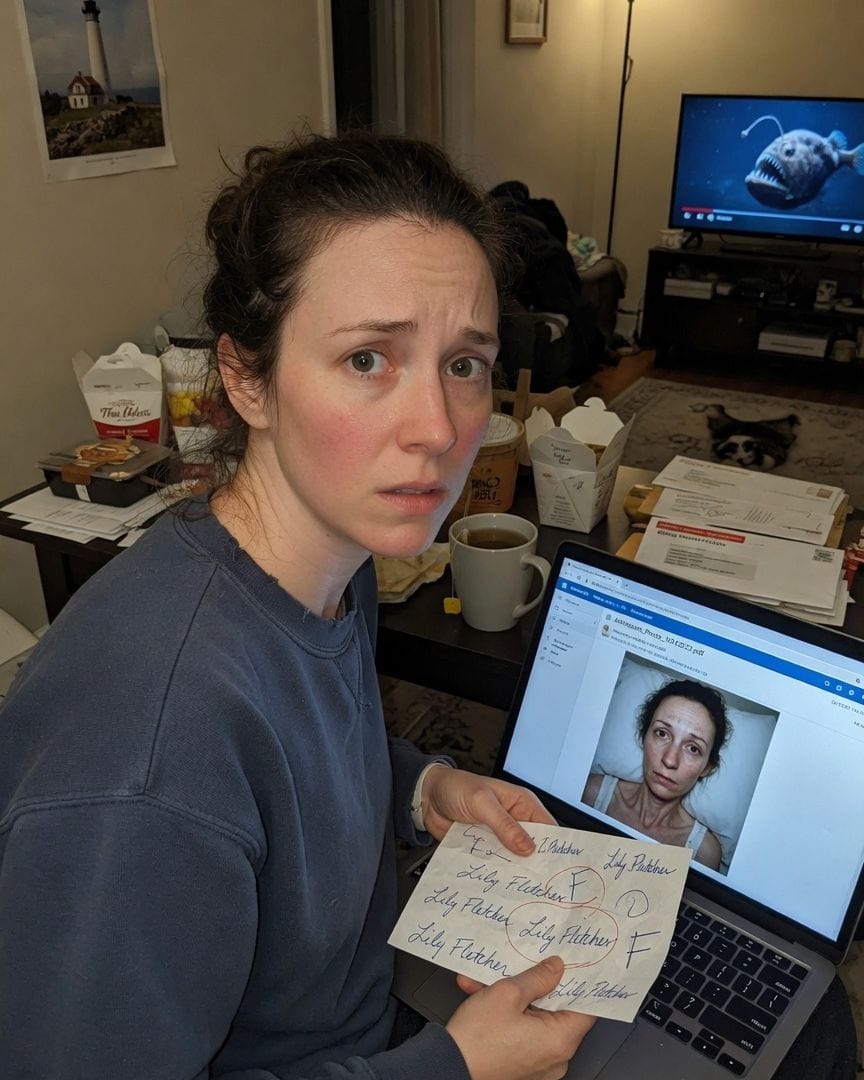
A hospital is billing me for a two-night stay in Cleveland — with my insurance, my wristband scans, and a discharge form in my own signature. I spent that whole week home alone, and I've never been admitted anywhere.
A bill arrived from Cleveland General Hospital for a two-night stay under my name, Lily Fletcher. I'd spent those dates at home, but the hospital had my accurate details and even a discharge summary. The chilling part? It was signed with my unmistakable signature, a mark I know I never made.
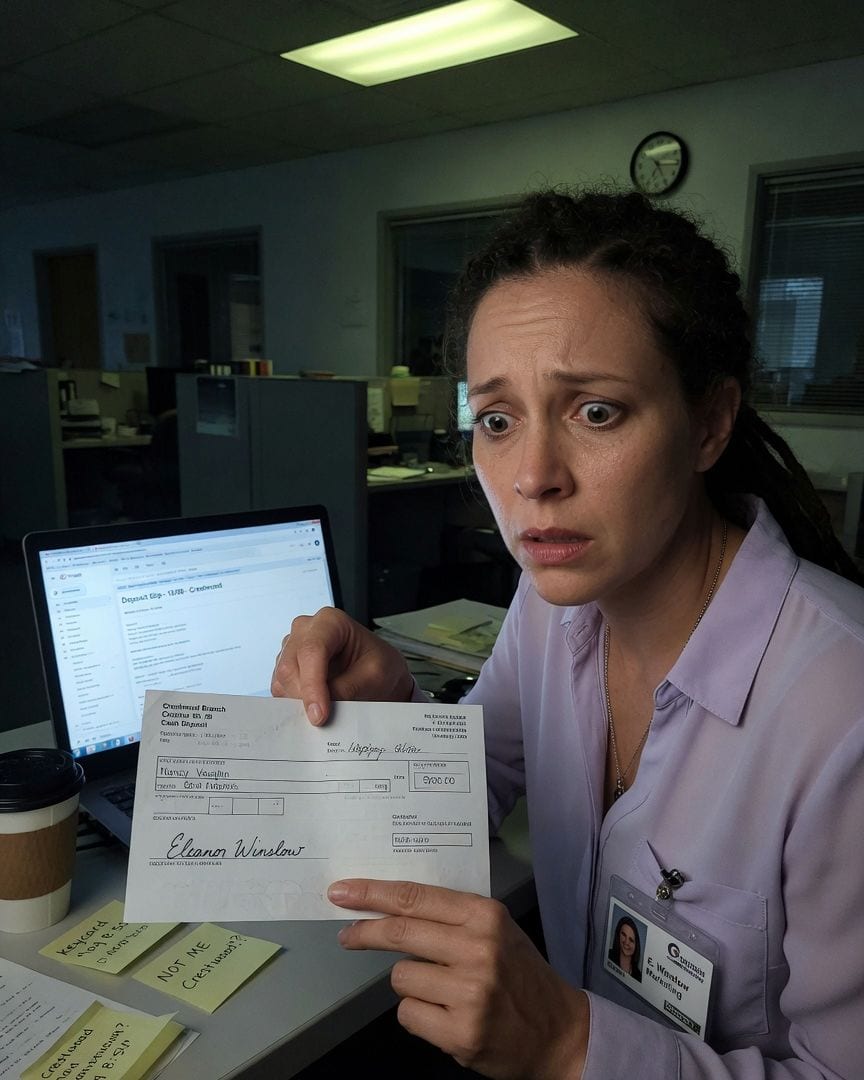
My bank statement shows a $900 cash deposit made in a town I've never set foot in, at 10:40 AM on a workday. I was at my desk, badged in. Two more landed since.
My bank statement showed a $900 cash deposit from a town I'd never visited, 150 miles away. I was at my desk, logged into work, all three times. But the scanned deposit slip arrived, clear as day, showing my own flawless signature.
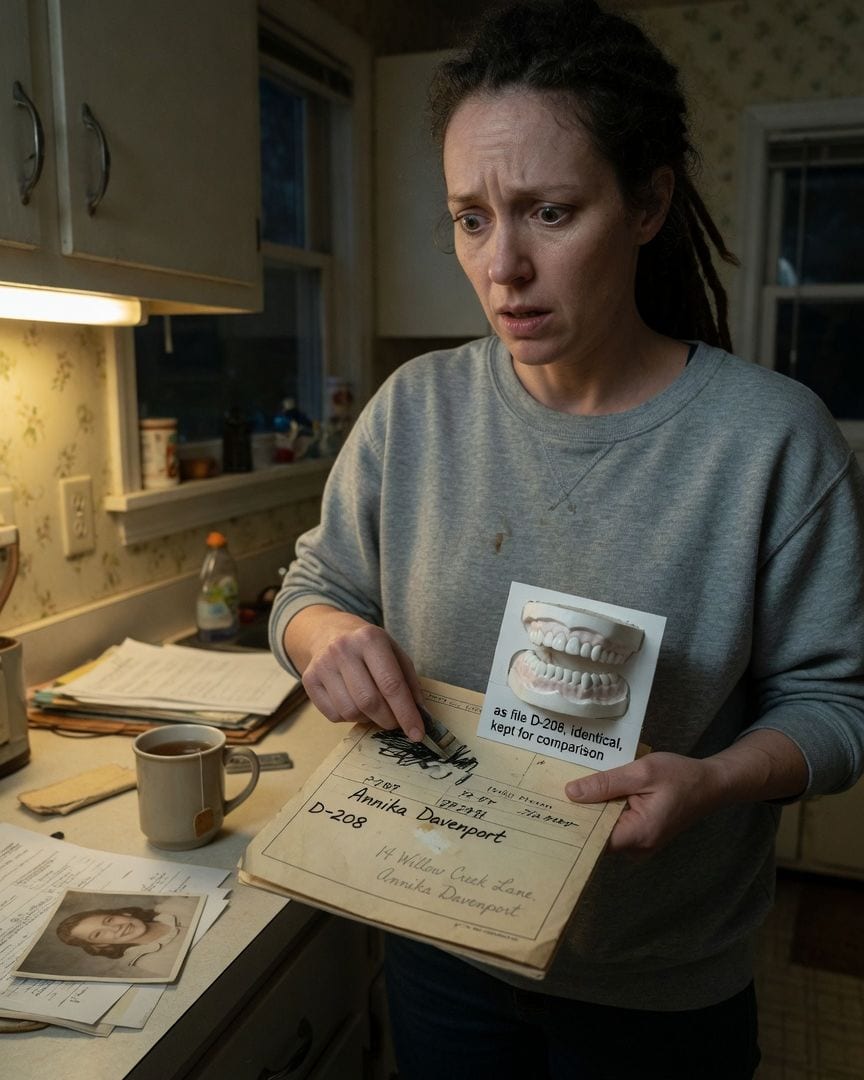
My childhood dental chart lists the house I bought last year — in my own name, years before I was born. A second set of my teeth sits filed beside it, marked 'identical.'
Sifting through old dental records, I found my chart, D-208, with my 1988 birth date. But a line from 1958 was blacked out, and a clipped card with an impression of my teeth listed my name and current home address, decades before I was born. The impossible facts knotted into a cold certainty.
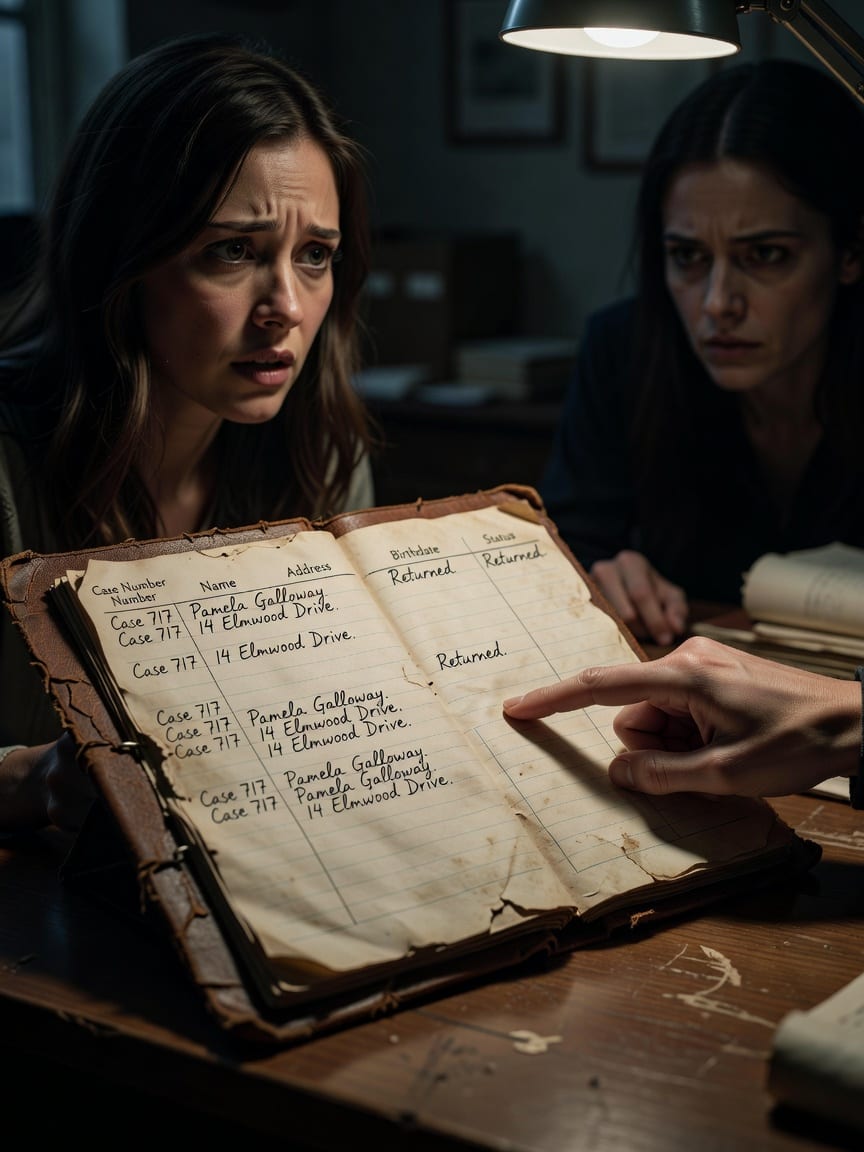
My hospital file has a blacked-out line from 1988. It names my street address, decades before I lived here. Then: 'returned'.
I finally got my medical file, hoping to clear up a ridiculous bill. Inside, I found an entry from 1988: my current home address, scrawled on a partial intake form and marked 'returned.' I was six then, living fifty miles away.