My hospital scanned old newborn footprints. They matched my foot, every whorl and arch, to a stillborn infant's card from 1954. Those tiny, inked ridges on the yellowing paper were undeniably mine. Sixty years apart, the same feet.
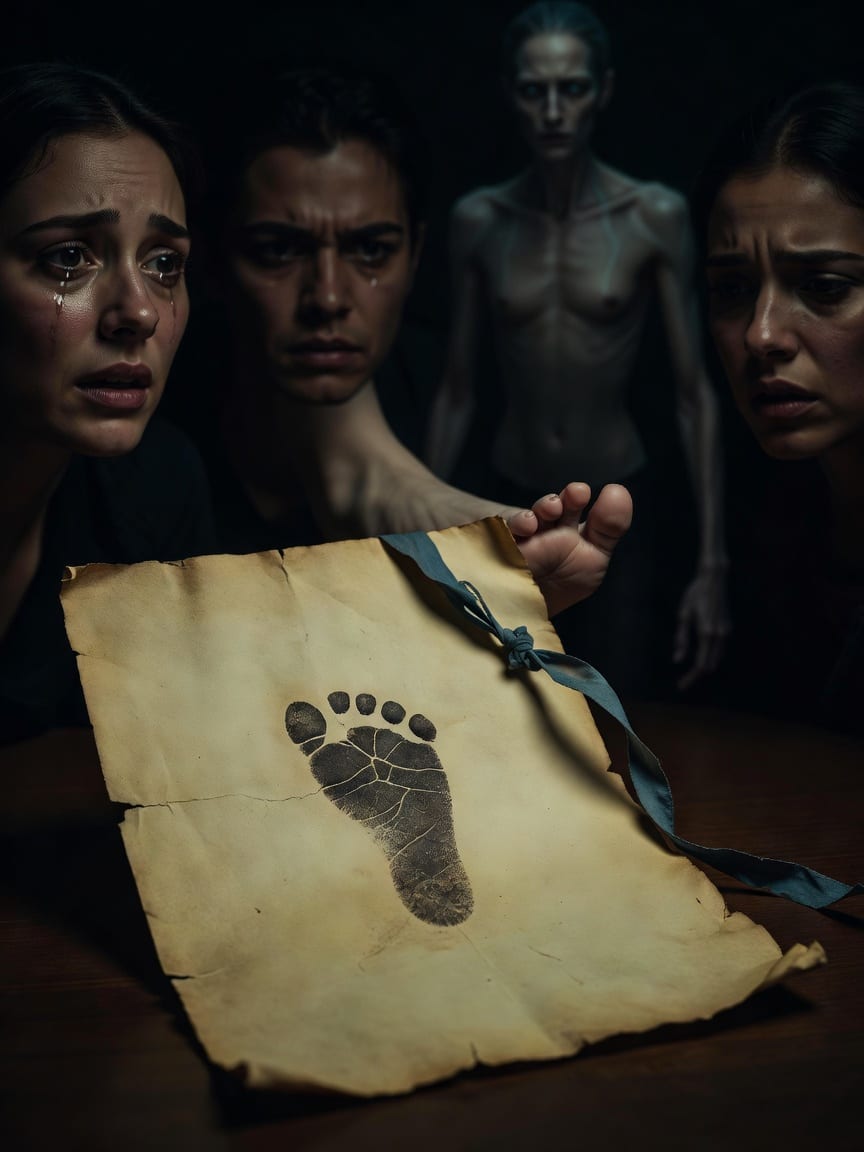
Claire Abbott, 35, clicked open the email. It was from St. Jude’s Hospital, the place I was born. They were digitizing old records, they said, and had found my newborn footprint card.
A sentimental attachment, maybe, if I cared to download it. I almost deleted it, then curiosity tugged. I clicked the link. A tiny, perfect foot, inked on a digital card. Mine. Cute, I thought, and moved on.
Then, a second email. From a Marcus Bishop, a genealogist working with the archive. His subject line was urgent, almost alarmed. I opened it. His software, he explained, flagged unique biometric matches in the historical database. He’d found one.
My own footprint, every arch and whorl, matched a card filed in 1954. For an infant recorded as stillborn. My fingers froze on the mouse. Stillborn. 1954. My foot. It had to be a glitch, a database error.
Some kind of software bug, misfiling. My own foot, perfectly normal, perfectly living, couldn't possibly belong to a ghost from sixty years ago. The air in my office felt suddenly thin, too cold.
I stared at the screen, at the words, willing them to rearrange themselves into something less impossible. They didn't.
I called Marcus Bishop. His voice, when he finally answered, was calm, rational, utterly devoid of sensationalism. He sounded tired, almost. "Ms. Abbott," he began, "I understand this is... unsettling. I've been over it repeatedly."
He detailed the specific ridge patterns, the unique splay of the toes, the precise curve of the arch—all identical. He'd cross-referenced the high-resolution scans, even had an independent biometric analyst confirm the match. "Beyond statistical probability, Ms. Abbott," he stated.
"A one-in-a-billion anomaly. Or... something else entirely." He suggested I contact the hospital's archivist to view the original physical records.
Still disbelieving, my stomach tight with a cold knot, I made an appointment with Renee Sutton, the hospital archivist. Her office was in a quiet corner of the oldest wing, smelling faintly of dust and old paper.
Renee, a woman of meticulous order, with her hair pulled back in a severe bun, greeted me with a polite, but somewhat strained, smile. She brought out two plain brown envelopes.
From one, she slid my modern digital print onto a tablet. From the other, with careful hands, she produced the original, yellowed 1954 card, brittle with age, the ink on it faded but clear.
She laid a metal ruler across both images. "You see here?" she pointed to a distinct whorl just below the big toe. "And here." She moved the ruler. "The exact same spacing between these two pads."
She continued, tracing lines, identifying points. Every line, every point, every tiny detail aligned.
My own foot, the one I used to walk and run, the one in my shoe right now, was laid bare, a carbon copy of a sixty-year-old print from a baby who never lived.
Renee, usually unflappable, swallowed hard, her professional facade cracking for a brief second. Her gaze darted from the cards to me, then away. A sudden chill snaked up my spine.
I felt a phantom pressure on my own arch, a cold dread seeping deep into my bones, insisting on the impossible truth of what I was seeing.
Disturbed to my core, I decided to get a full physical. Maybe the weirdness of the footprints had rattled me, but I needed to re-ground myself, to prove my own body was unequivocally hers. My body. Not some echo.
I asked for updated dental X-rays, a routine check-up, anything to affirm my own mundane reality.
A week later, my dentist’s office called. "Ms. Abbott," the receptionist said, her voice a little too bright, "Dr. Hayes needs you to come back in. Something unusual on your scan."
Back in the sterile chair, the fluorescent lights humming, Dr. Hayes pointed to the screen. My mouth, a black-and-white landscape of bone and enamel. "We pulled your old records," he said, tapping a section. "Perfect, untouched teeth. No prior issues.
But this new scan…" he zoomed in on my left incisor root. A faint, almost invisible line bisected the root. "There’s an old, perfectly healed fracture here. Looks like it happened when you were maybe six months old.
It's completely fused now, no complications. But it’s definitely there, Ms. Abbott. Healed perfectly, almost like it was never broken, but undeniably present. You have no memory of a childhood trauma? No record in your pediatric history?"
He looked at me, a question in his eyes.
I stared at the faint, impossible line on my own tooth, a wound I had no memory of and no record of ever sustaining.
The dental X-ray had ripped a hole in my sense of self. I dove into researching the 1954 stillbirth, Vivienne. The hospital records were sparse, almost deliberately vague. The infant’s parents were listed with common names, a dead end.
No address, no clear next of kin. It was as if Vivienne had simply ceased to exist, swallowed by bad luck and a poorly kept archive.
I revisited Marcus Bishop, sharing the dental X-ray. He studied it, then looked at me. "First the footprints," he said, "now this. It's not a coincidence, Ms. Abbott. This is a pattern." He suggested a full skeletal scan.
"We're looking for other anomalies, Ms. Abbott. Other perfectly healed impossibilities."
The results were chilling. My left tibia, near the ankle, showed a faint, distinctive healed fracture. Not a childhood break, nothing I remembered, but something from infancy, expertly mended, leaving no outward sign.
The radiologist shrugged, said it was likely a minor hairline that healed naturally, probably before I was even walking. "Some kids are just clumsy," she offered, but it sounded hollow, even to her.
Marcus, ever rational, cross-referenced it with the limited autopsy report for the 1954 infant, Vivienne. He'd managed to get access through a distant contact.
The report, tucked away in an obscure microfiche, noted a hairline fracture on the left tibia, listed as a 'pre-existing condition' and not a cause of death. The details matched. Two impossible injuries, decades apart, now undeniably mine.
I felt a growing sense of being meticulously constructed, piece by piece, from an ancient blueprint. I was a puzzle fitting together, but the picture it formed was all wrong.
My own body, this thing I thought I knew, was becoming a stranger. The hospital walls, when I walked past them, seemed to hum with a low, knowing frequency.
I tried to access more historical hospital records through Renee Sutton, the archivist. I needed to understand Vivienne's case more deeply, to find anything about her family, about the doctors involved. Suddenly, Renee became evasive. Her usual crisp professionalism frayed.
"I'm sorry, Ms. Abbott, but due to privacy concerns and an 'ongoing digitization process,' these older files are currently restricted." Her eyes wouldn't meet mine.
Her office door, usually closed, was often ajar when I passed, and Renee seemed to watch me from the corner of her eye, a flicker of something unreadable in her gaze. It wasn't hostility, exactly. More like... apprehension.
Or perhaps, recognition. The air around her felt charged, like a secret kept too long.
One evening, I returned to my apartment. The silence in the hallway felt heavy. As I unlocked my door, I noticed a small, unmarked envelope slipped under it. It was thin, no bigger than a postcard.
My heart began to pound. I picked it up, feeling the faint stiffness of paper inside.
I closed the door, my gaze fixed on the envelope. Inside was a single, grainy, black and white photograph. It showed a baby’s foot, tied with a small, faded blue ribbon.
The foot, with its distinctive arch and splay, was identical to my own. There was no mistaking it. I traced the outline with my finger, a shiver running down my arm. Then I noticed the ribbon.
It was the exact shade of blue as the one tied around the physical 1954 stillborn record card Renee had shown me in the archive—a tiny, almost imperceptible detail. There was no note, no message, just the chilling image.
A silent message from someone who knew exactly what I was uncovering. A quiet, unsettling presence in my private space, watching.
Unnerved by the photograph, I drove to my great-aunt Cynthia Bryant’s house. Cynthia was 88 now, frail but sharp. She had been a junior nurse at St. Jude’s in the 1950s.
She lived alone in a small, cluttered house filled with the scent of lavender and old books.
I laid out the footprint cards, the X-rays, the photograph. Cynthia, initially reluctant, her eyes distant as she peered at the items through thick bifocals, finally nodded slowly.
"I remember that case," she said, her voice thin but steady, a whisper from another time. "The 1954 infant. Vivienne. It was unusual. Even for us."
She described the baby. "Tiny thing. But perfectly formed. They said... well, they said stillborn. But there was something about her. Too quiet. Too perfect, almost." She paused, her gaze lost in the past.
"There was a mark," Cynthia mused, her finger hovering over the old footprint card. "A small, distinctive birthmark on her left heel. Faint, but there."
My blood ran cold. I had a faint, almost invisible birthmark there. I’d always dismissed it as insignificant, a random skin imperfection. No one else in my family had it.
My mother always said it was a 'kiss from an angel.' I peeled off my sock, showed Cynthia. She didn't react with surprise, only a deep, unsettling recognition.
Cynthia looked at me, her ancient eyes knowing, seeing more than just the present Claire Abbott. "Your mother, Claire? My niece? She was a ‘stillborn’ too. From the same hospital, a few decades later. Not Vivienne, no, but another one.
They said she was adopted, brought to us from an orphanage after a difficult birth. But some of us… we knew better. It was the same process. It started much earlier than your Vivienne."
Cynthia’s voice remained calm, almost serene, as she elaborated. She stirred her tea, a faint clinking sound in the sudden silence of the room. The hospital, she explained, had a "special program" for certain infants. "Not about saving them, dear.
More about… repurposing them. They found certain… genetic markers. Special children, you see. Those with a unique resilience, a particular... spark."
She described how these infants, initially deemed stillborn or non-viable, were not truly deceased but placed in a kind of suspended state. "Preserved," she said, choosing the word carefully. "Kept in a kind of stasis. Their biological clocks slowed.
Decades passed. Then, when a compatible host family with similar markers emerged—often unknowingly linked to the original ‘donors’ through subtle, intergenerational patterns—these preserved infants were ‘re-birthed’ as their own children. Given new identities, new lives.
Subtly tracked, of course, by those who knew."
Claire’s mother, Cynthia continued, had been a previous "returnee." "Her records were clean, all the right paperwork. But the details… the doctors, the timing. It was all too familiar."
And you, dear, Cynthia said, her gaze unwavering, her ancient eyes holding a profound understanding that pierced straight through me. You have them too. You were always going to be one of them.
I felt a profound chill, a sense of falling into a pre-ordained fate, my entire existence a carefully orchestrated echo. The air in the room felt thick and cold, heavy with unacknowledged history.
My own hands, resting on my knees, felt alien. Cynthia reached out, her hand frail, spotted with age, and gently touched my foot, right over the arch, the spot where my identical footprint had first surfaced.
Her touch was feather-light, but it sent a shock through me, like static electricity. "They always come back, you see," she whispered, her voice like rustling leaves. "They always return to the fold."
Cynthia, with chilling clarity, detailed the full truth the next day. The hospital, under the guise of pioneering research into infant viability and obscure genetic disorders, had established a clandestine 're-integration' program.
They identified infants with specific genetic markers—often those with unusual resilience or unique biological signatures—who were recorded as 'stillborn' but exhibited faint, overlooked signs of life.
These infants were placed in a carefully maintained 'stasis protocol,' their biological processes slowed, their development paused, kept in a suspended animation deep within the hospital's oldest, forgotten sections.
Decades later, when a suitable genetic match appeared in the form of a 'host' family—often unknowingly related to the original 'donor' through complex, intergenerational patterns—the preserved infants were 're-birthed.'
They became the children of these new families, their original identities erased, their past injuries (like my perfectly healed fractures and dental anomaly) from the stasis period or original birth, becoming inexplicable parts of their new bodies.
The 'returnees' were then subtly monitored by 'guardians' within the hospital, individuals like Renee Sutton, who ensured their 're-integration' remained seamless and their true origins undetected.
Claire's mother, Cynthia confirmed, had been one such 'returnee' decades before me. Her adoptive parents, unknowingly, had the right genetic markers, the 'compatibility' that allowed for the process.
Claire's own birth in 1989 was not an accident, not a random act of nature, but the carefully planned 're-integration' of Vivienne, the stillborn infant from 1954.
The matching footprints, the impossible healed injuries, the unique birthmark—every scattered clue, every chilling anomaly, now snapped into a coherent, monstrous shape. I was Vivienne, reborn into a borrowed life, a second chance granted by a cold, calculating hand.
My entire life, every memory, every experience, was a shadow over another’s.
I confronted Renee Sutton in the deserted hospital archives late that night. The air was thick with the scent of old paper and dust, an appropriate backdrop for ancient secrets.
I laid out the footprint cards, the medical scans, the anonymous photograph of the baby's foot with the blue ribbon, and then, the chilling details from Cynthia. "Vivienne," I said, my voice cutting through the silence. "The re-integration program.
My mother. Me."
Renee, stripped of her professional composure, finally broke. Her face, usually so composed, crumpled. Tears streamed down her face as she confessed her role as a 'guardian.' "I didn't choose this," she sobbed, "I inherited it. My family has been...
involved for generations. We ensure the 'returnees' are monitored, that their 're-integration' remains seamless. We protect the program." She pleaded with me to stop, to simply live my new life, to let the secrets stay buried.
"It's for the best, Claire. It's for everyone's peace." Her words, meant to be comforting, were like ice.
But I refused. I needed to see it, to understand. Renee, desperate, revealed the existence of a small, hidden room in the hospital's oldest, long-abandoned wing—a 'nursery' that had been maintained for decades.
"The original one," she whispered, her voice raw. "Where they first went."
I found it: a forgotten corridor, shrouded in cobwebs, smelling of damp and disuse. At the very end, behind a sagging boiler room door, was a heavy, unmarked door, painted the same institutional cream as the wall, but somehow darker.
It creaked open, revealing pitch blackness. I flipped on my phone's flashlight. Inside, the air was still and cold, like a tomb. A pristine, decades-old crib stood in the center, perfectly preserved, untouched by time.
A faded blue blanket, identical to the one in the anonymous photograph, was neatly folded within. The room was otherwise empty, save for a faint, sweet smell, like dried milk and something metallic.
On the wall, above the crib, a single, framed, yellowed photograph. A young Cynthia, smiling faintly, her face much softer, holding a swaddled baby.
The baby’s face was blurry with age, but its small, bare foot, peeking from the blanket, showed the distinctive arch, the faint birthmark. Beneath the photo, a small, engraved silver plate, catching the weak light, read: 'Vivienne. 1954.' My name.
Her name. Our name.
I left the hospital, the weight of the truth pressing down on me like a physical burden. I didn't expose the program; who would believe such a story? A hospital re-birthing stillborns from the 50s?
They’d brand me delusional, lock me away. I looked at my own hands, felt the pulse in my throat, a life that was both hers and not.
I was Claire Abbott, but the ghost of Vivienne now resided within me, a silent co-tenant. The world around me felt thin, a fragile veneer over something ancient and profoundly wrong.
Cynthia Bryant passed away peacefully a few weeks later, taking her secrets and her knowing smile with her. Renee Sutton vanished from the hospital, her position quietly filled, leaving no trace.
The hospital continued, a monument to healing and to a chilling, hidden science.
I went home. I stood before my bathroom mirror, examining my reflection. I saw Claire, the woman I had always believed myself to be.
But in the depths of my own eyes, I also saw Vivienne, a shadow, a memory that wasn't mine but was. I touched my left arch, tracing the faint birthmark I’d always ignored, a silent testament.
The pattern had snapped into place, an undeniable, coherent horror. I was living a life that wasn't entirely mine, a borrowed existence, forever marked by the one I never lived, a silent echo in my own skin.
The finality of it was not an ending, but a continuation. It was always going to be this way.
The last photo Claire Abbott ever posted online was a close-up of her left foot, showing a faint, almost invisible birthmark on her heel. The caption read: "Finally seeing myself clearly."
A single comment, posted anonymously hours later, simply read: "Welcome home, Vivienne."
If this one got to you
My X-rays show a perfectly healed fracture from 1968. I've never broken a bone in my life.
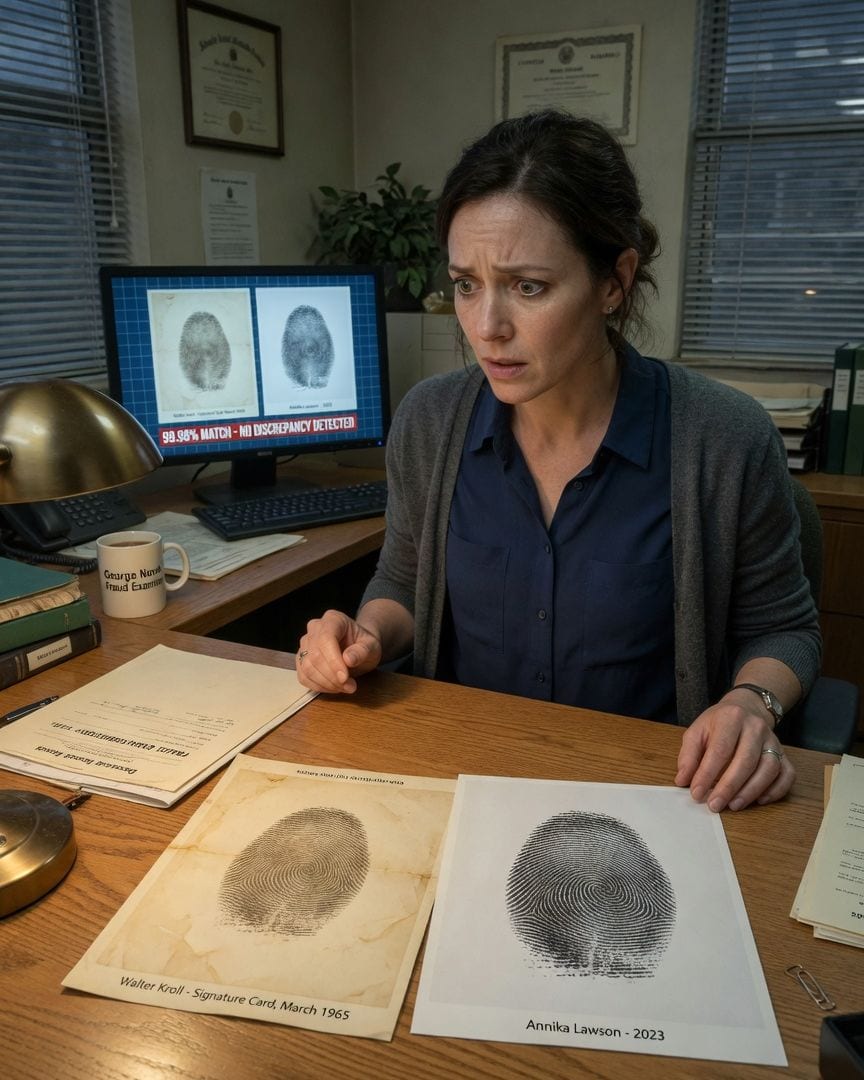
An ordinary bank deposit turned chilling when my account was locked. My unique thumbprint, the very mark of my identity, inexplicably matched that of a man named Walter Kroll, who died in 1970. The bank's robust system confirmed the impossible: my fingerprint, identical to a man dead for decades.
The blood on my own newborn heel-prick card — the one my mother saved in a drawer for thirty years — doesn't match the DNA in my mouth today. The lab ran it three times: two different people.
I sent my newborn heel-prick card to a genealogy lab, expecting to confirm my family tree. Instead, the lab tech called with an impossible truth: the blood from my infancy did not match my adult DNA. My own record insisted I wasn't quite myself.
My mother's right ear has been partially deaf since she was eight. Now she's talking on the phone with it.
My mother, Beatrice, is finally back after five days, but my relief is curdling. She's using her right ear for phone calls, the one that's been partially deaf since she was eight. A new doctor confirmed her right ear was perfect, her left ear weaker, completely contradicting my lifelong memory.
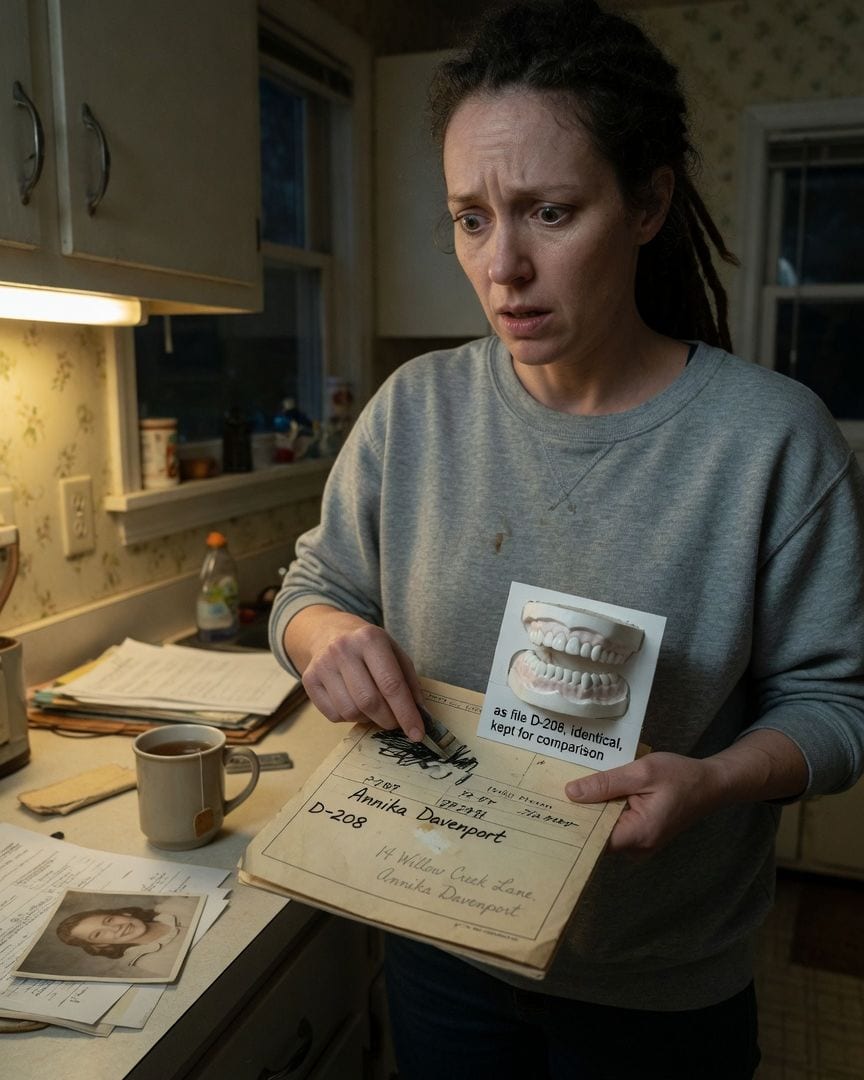
My childhood dental chart lists the house I bought last year — in my own name, years before I was born. A second set of my teeth sits filed beside it, marked 'identical.'
Sifting through old dental records, I found my chart, D-208, with my 1988 birth date. But a line from 1958 was blacked out, and a clipped card with an impression of my teeth listed my name and current home address, decades before I was born. The impossible facts knotted into a cold certainty.
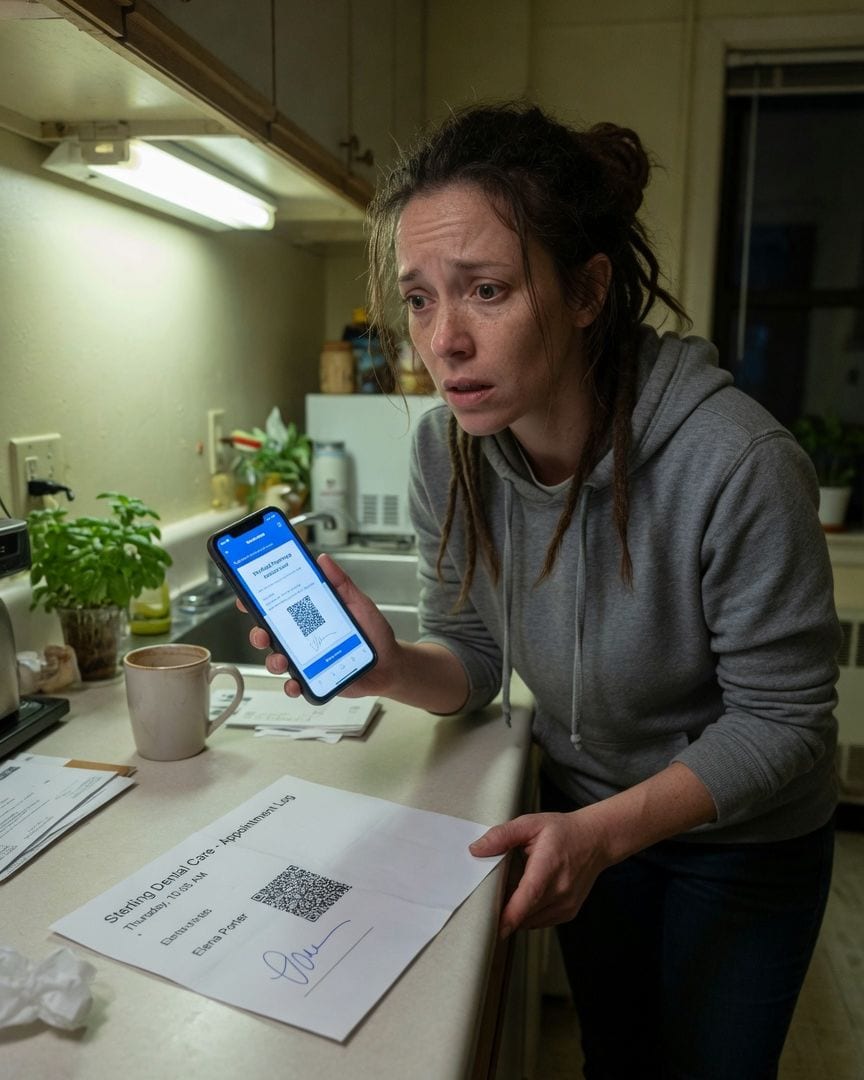
My dentist's system says I was there last Thursday. I wasn't. But the check-in tablet shows my signature, and the hygienist described my chipped tooth exactly right.
I received a call confirming a dental appointment I never made, for a day I was home. Yet, Sterling Dental had my perfect digital signature and described a chipped incisor I’d never told them about. The physical proof insisted I was there, but I wasn’t.
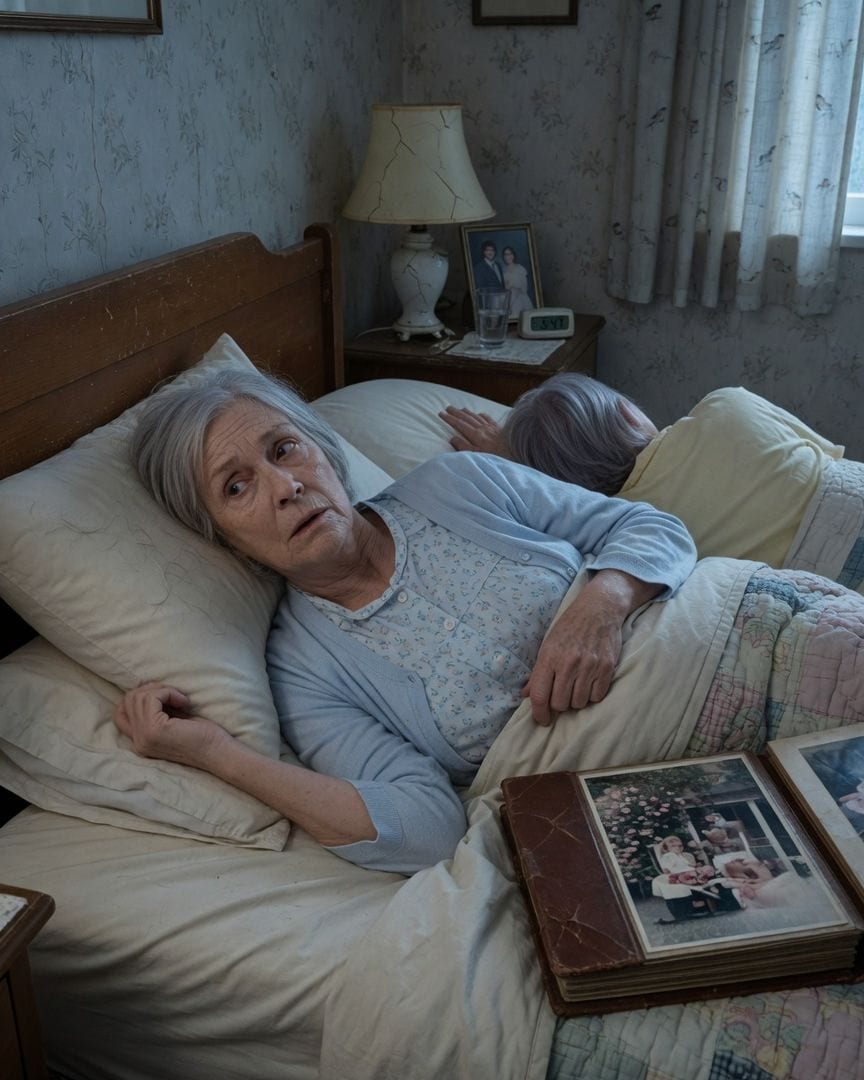
My twin sister Ruth sleeps on the right now, facing the wall. For forty-one years, she always took the left side. She insists I'm misremembering.
After three days missing, my partner Ruth finally came home. But the morning after, I woke to find her sleeping on the wrong side of our bed. She claimed she'd always slept there, and my memory was wrong, despite forty-one years together.