My antique locket held my maiden name, unused in eleven years, engraved 'until the ninth.' The dealer said it was 'for her, when she comes.'
The small, intricate locket Maxwell bought me at Truro market felt cool against my palm. He’d gifted it to me after a particularly gruelling week at work, a thoughtful, unexpected gesture, a distraction from the spreadsheets and endless meetings.
I remembered the way the afternoon light had caught its delicate filigree when he handed it to me.
Later that night, after Maxwell had fallen asleep beside me, his breathing even and deep, I found myself drawn to the locket again.
I slipped out of bed, careful not to wake him, and retrieved his jeweler’s loupe from his desk drawer.
The metal was faintly tarnished, hinting at its age. I brought the loupe to my eye, focusing on the tiny catch. It sprang open with a soft click. Inside, etched with impossible precision, was my maiden name: 'Sheppard.'
My breath hitched. Below it, in the same minuscule, perfect script, were the words, 'until the ninth.'
I hadn't used that name in eleven years, not since I became Hannah Coleman. It was a common enough surname, Sheppard, I told myself, a rational explanation trying to surface. Maybe a coincidence. But 'until the ninth'?
What could that possibly mean? My mind raced, trying to conjure a mundane explanation. Had Maxwell had it engraved? No, he would have used Coleman, and besides, he’d bought it pre-owned from Gary Merritt, the antique dealer.
Gary had sworn it was a genuine antique from a recent house clearance. My fingers traced the tiny, perfect letters, a chill spreading from the metal, far colder than the room's evening air.
It felt like a message, impossibly precise, perfectly addressed, waiting just for me.
The next morning, I drove back to Truro, the locket heavy in my pocket, pressing a cool circle against my thigh.
Gary Merritt, a man in his late fifties with kind, crinkled eyes that disappeared when he smiled, remembered Maxwell and the locket immediately.
He was polishing a dusty brass telescope when I walked in, and the scent of metal polish hung faintly in the air.
'Ah, the little silver piece! Lovely, isn’t it?' he said, setting the telescope down. 'Came in a job lot, didn't think it would last long.'
I pulled the locket from my pocket, the silver catching the dim shop light. 'Mr. Merritt, do you remember where you got this? The engraving inside…'
He took it from me, his movements careful, and peered at it through his own thick spectacles, pulling them to the end of his nose. He squinted. 'Sheppard, you say? And 'until the ninth'? Well, I'll be.
Didn't notice that myself, always a good sign of an old piece, the detail. I got that from a house clearance, out near Penwith. Old Margaret Prescott’s place.
She'd passed, you see, a few months back, and her niece was clearing out the estate.' He scratched his chin, a raspy sound. 'Funny thing, she had it wrapped in a note. Just a scrap of paper, really.
Said, 'For her, when she comes.' Margaret was a bit of an eccentric, bless her heart, kept meticulous records of everything she owned, but that note was all it said about the locket.'
My pulse quickened, a frantic bird trapped in my chest. 'Margaret Prescott. Do you know anything about her?'
Gary shrugged, his shoulders rising and falling. 'Quiet old bird. Lived alone, mostly. Had a grand-niece, Nora, I think. She was the one handling the estate. But that’s all I know.
The house was full of curiosities, everything from broken porcelain dolls to taxidermied birds, but that locket, she'd kept it separate, almost… reverent. Like it was waiting for someone specific, you know? Not just another trinket to be sold off.'
My rational mind struggled to connect the dots. A deceased woman I’d never heard of, an antique locket with my specific maiden name, a vague, unsettling note. It was too specific for coincidence, too many impossible threads weaving together.
I thanked Gary and left, the name Margaret Prescott now firmly lodged in my thoughts, a cold, sharp pebble in my shoe.
My search for Margaret Prescott led me to the local historical society, a quiet building that smelled of dust and forgotten things. They had old community records, ledgers detailing local events, donations, and notable residents.
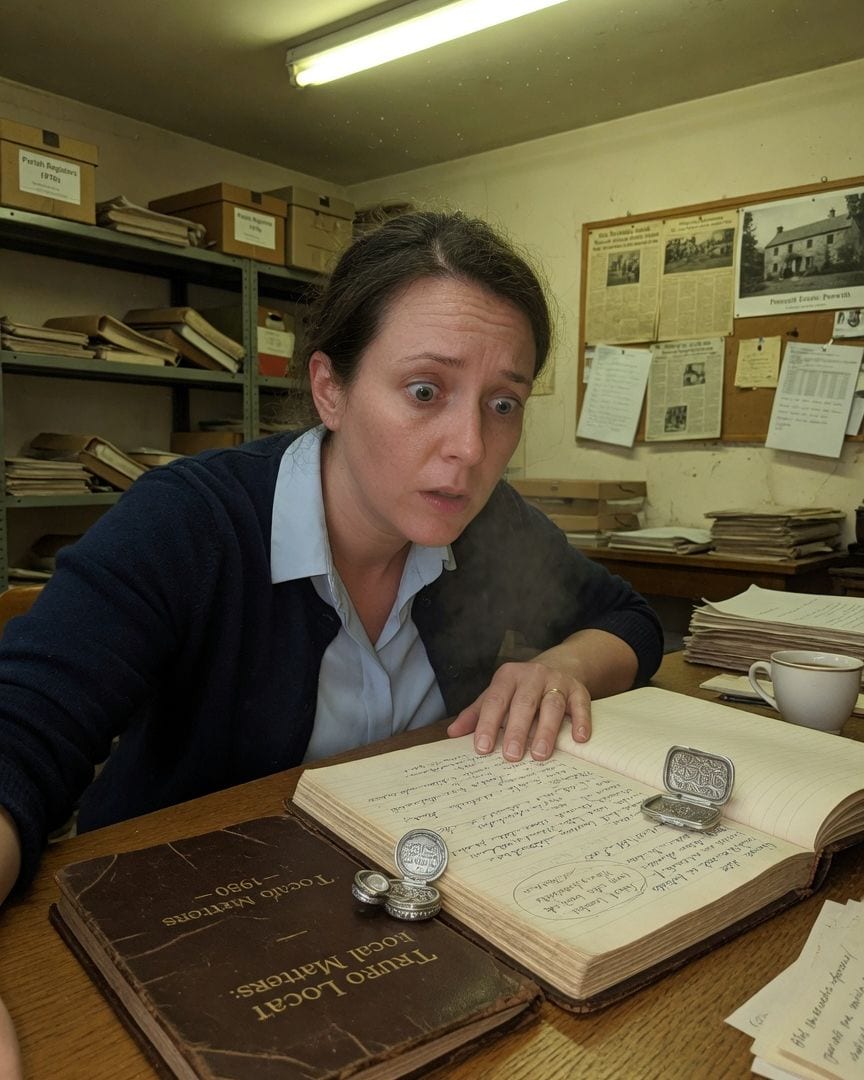
I spent hours sifting through dusty volumes, my fingers growing gritty, looking for anything connected to Margaret. The overhead fluorescent lights hummed, making my eyes ache.
Finally, in a leather-bound ledger titled 'Truro Local Matters: 1980-1990,' its cover cracked with age, I found her name.
An entry from 1988, written in a spidery, precise hand that sloped slightly to the right, detailed a donation to the society from 'Margaret Prescott.'
Beneath it, in the same distinctive hand, was a separate, almost casual note, appended almost as an afterthought: 'And the locket for Hannah Sheppard’s ninth.'
My own maiden name. Hannah Sheppard. Staring back at me from a page dated 35 years ago. Before I was even a flicker in my parents' eyes. Before I was born.
My hand froze, hovering over the page, the impossible words searing into my vision, burning hotter than any fever.
The ledger entry was a cold, hard fact that shattered any remaining rational explanations. Hannah Sheppard, decades before I existed. It wasn't a coincidence, it wasn't a prank, it wasn't even a vague premonition. It was me. Identified. Marked.
I spent the next few days in a fog, the world feeling slightly out of sync. My research on Margaret Prescott became more intense, more desperate.
I found an obituary that confirmed she had a grand-niece, Nora Prescott, living in an old, isolated cottage on the outskirts of Penzance. The address was vague, a whispered turn off a forgotten country lane.
One afternoon, while buying groceries at the local market, the scent of fresh bread and ripe fruit suddenly felt cloying.
A man I’d never seen before, perhaps in his forties, stepped in front of me as I reached for a loaf, blocking my path.
He had kind, tired eyes, lined at the corners, and he looked at me with an unnerving intensity, as if he knew something terrible about me that I didn't.
'Hannah Coleman?' he asked, his voice soft, almost a murmur against the market chatter.
I confirmed it, wary, my grip tightening on the grocery basket.
'I’m Desmond Carter,' he said, then hesitated, his gaze falling to my left hand, where I still wore my wedding ring. He seemed to take it in, hold it. 'I’m… truly sorry. For what’s about to happen.
Please, don’t try to fight it.'
Before I could react, before I could even formulate a question, he turned and walked away, melting into the crowd, leaving behind only the ghost of his words.
His apology for something that hadn't happened yet chilled me more profoundly than the locket. It was as if someone, or something, was already setting the stage, moving pieces into place.
I tried to dismiss it as a disturbed stranger, a bizarre encounter, but the man’s sincerity, the way he’d known my full married name, clung to me like a shroud. My focus shifted entirely to Nora Prescott.
She was the only living link to Margaret and this impossible ledger entry. I decided I had to find her, to demand answers, even if I was terrified of what they might be.
The dread was no longer a quiet hum; it was a tightening vise, crushing the air from my lungs.
My drive to Nora Prescott's cottage was unnervingly quiet, the silence in the car pressing in on me, broken only by the crunch of tires on gravel.
The lanes grew narrower, the hedgerows denser, until the old stone house appeared, almost swallowed by overgrown ivy, a dark eye peering out from beneath a shaggy brow.
It felt ancient, watchful, as if the very stones were aware of my presence. I knocked, a loud rap that echoed in the stillness, but no one answered.
The windows were dark, like blind eyes, the air around the place still and heavy, carrying the faint, sweet smell of decay and damp earth.
As I turned to leave, a small, almost imperceptible detail caught my eye: a single white feather, impossibly clean and perfectly formed, resting on my car’s windshield, directly over the driver's side.
I live nowhere near birds that shed such pure white feathers, not in this region. It felt like a deliberate mark, a precise placement, a sign that my presence had been noted.
That evening, back at home, the phone rang. Maxwell was still at work, finishing a late shift. I answered, but there was only static, a faint, rhythmic pulse like a distant heartbeat.
Then, a whisper, barely audible, yet perfectly clear, so close it felt like someone was breathing into my ear: 'Sheppard.' My maiden name. Again. The line went dead.
The apology from Desmond Carter echoed in my mind, a chilling premonition now layered with a direct, personal contact.
The next day, it happened. A series of small, unsettling 'accidents.' My car tires were inexplicably deflated overnight; not punctured, just flat, as if someone had slowly let the air out of each one.
My house alarm, which had never malfunctioned in the five years we’d lived there, blared at 3 AM for no reason, its piercing shriek echoing through the empty house.
Each incident was minor, easily dismissed as coincidence by a rational mind, but collectively they felt like a targeted harassment, a subtle tightening of the noose. Someone knew I was digging. Someone wanted me to stop.
Or, worse, someone was making sure I couldn't escape what was coming.
The next day, driven by a desperate need for answers that overshadowed any fear, I returned to Nora Prescott’s cottage.
This time, a thin wisp of smoke curled lazily from the chimney, painting a faint grey line against the pale sky.
Nora answered the door, a small, bird-like woman with eyes that seemed to hold centuries of quiet knowledge, deep-set and surprisingly piercing. She didn't look surprised to see me. No greeting, just a calm, knowing gaze.
'Hannah Coleman, isn't it?' she said, her voice soft, almost serene, yet with an underlying firmness. 'Or should I say, Sheppard?'
I pushed the locket, warm from my frantic grip, into her hand. 'This. And the ledger. Margaret Prescott, my name, dated before I was born. What is this?'
Nora examined the locket, her fingers, gnarled with age, tracing the delicate engraving. 'Ah, the locket. A fine piece. A marker, you see. For the chosen.'
My blood ran cold. 'Chosen for what?' My voice was thin, ragged.
She led me inside, to a small, cluttered living room filled with antique books stacked precariously on every surface, and strange, delicate instruments I couldn't identify, glinting in the dim light.
The air in here was even heavier, saturated with the smell of old paper and something else, something metallic and faint, like ozone. 'For the cycle. Margaret was a custodian, as was her mother before her. And I, after Margaret.
We watch. We record. We prepare.' She pointed a slender finger to a shelf filled with similar leather-bound ledgers, far more than I had seen at the historical society. 'The pattern is quite clear, across dates and names.
Certain families, certain lineages, are… marked. Not a curse, not a blessing. Simply a truth. And when the time comes, when 'she comes,' as Margaret's note said, we facilitate the transition.'
'Transition?' My voice was barely a whisper now, lost in the overwhelming quiet of the room. 'Desmond Carter… he apologized to me.'
Nora nodded slowly, a faint, almost imperceptible movement. 'Desmond is another. He knows the inevitability of it. He felt the pull, too, years ago, but he was not chosen. He watches, and he warns those who are.'
She smiled faintly, a serene, unsettling curve of her lips that didn't quite reach her eyes. 'You have been watched, Hannah Sheppard, since before your birth. The locket is merely confirmation. The ledger, a record.
The channel that uses your name is merely the way the entity confirms its intention, once the chosen begins to seek.' She gestured vaguely towards an old, dusty computer in the corner, its screen dark, its cables a tangle.
'Sometimes it is a whisper, sometimes a dream. Sometimes, an old community noticeboard, left to gather digital dust. The entity finds its way.'
Nora's calm explanation left me reeling. An entity. A cycle. A chosen lineage. It was all too much, yet it all fit, horrifyingly.
She spoke of the entity's patient, ancient pull, how it tracked and guided its chosen, how it knew their names even before they uttered them.
She mentioned the 'channel' again, a way for the entity to confirm its intention once the chosen began to seek.
She didn't elaborate further, just a vague wave towards the ancient desktop computer in her cluttered room, a machine that looked like it hadn't been turned on in a decade.
I fled Nora’s cottage, the dread now a palpable, suffocating weight that pressed in on me, stealing my breath. My car felt like a coffin, its metal shell offering no protection. Back home, the quiet of the house was unbearable.
I couldn't shake Nora's words, or the memory of the whispering 'Sheppard' on the phone. The 'channel.' What if it wasn't just a general concept? What if it was a specific place, a specific communication, a literal channel?
I remembered the vague mention of an old community noticeboard, 'left to gather digital dust.' My hands trembled as I sat at my laptop, searching online, fingers flying across the keyboard.
'Truro community noticeboard,' 'Penzance local history forum,' 'Cornwall old messages.' I stumbled upon a defunct local history site, its forum rarely updated, a relic from the early days of the internet. I clicked on the 'Community Notices' section.
Most posts were years old, forgotten, timestamped in the early 2000s. But then, a new entry, dated just hours ago, blinked at the top, a startling beacon of fresh white text against the faded green background. The username was 'M.P.'
My heart hammered against my ribs, a desperate drum. I clicked, and the message unfolded. It was addressed to me, by name, my full maiden name, the letters seeming to throb with an unnatural light.
'Hannah Sheppard. You are expected. The ninth approaches. Do not resist.'
The screen flickered once, then went dark.
I returned to Nora Prescott’s cottage, the printed message from 'M.P.' clutched in my hand, its crisp edges digging into my palm. My fear had solidified into a cold, hard resolve. I needed to understand every last, horrifying detail.
Nora was waiting for me, the front door already ajar, a pot of herbal tea steaming on a small, unsteady table by the window. She didn't ask why I was back.
'So, you received the confirmation,' she said, her eyes calm and unblinking, utterly devoid of surprise. 'From Margaret, it seems. Even in passing, the custodians ensure the message reaches its recipient. A contingency for every eventuality.'
I slammed the printout onto the table, the sound sharp in the quiet room. 'What is the ninth? What is this entity? What do you mean, 'expected'?'
Nora sipped her tea, her movements slow, deliberate, as if she had all the time in the world. 'The ninth is not merely a date, Hannah. It is a cycle. An iteration.
A time when the veil thins, and the entity requires a new channel. A host, if you will. It is ancient, not malevolent, but simply… is. It sustains itself, renews itself, through a carefully cultivated lineage. Your lineage, Hannah Sheppard.'
She gestured vaguely around the room, encompassing the old ledgers, the strange instruments, the very dust motes dancing in the light.
'The locket, the ledgers, the notes, the watchers like Desmond, even the whispers and the 'accidents'—they are all part of the process of guiding the chosen. To ensure they are ready.
To ensure they find their way to us, to the truth, before the ninth comes.'
She explained how Margaret, even after her death, had set up the 'M.P.' message, a dormant program on the forgotten website, to trigger once the 'chosen' began actively seeking answers, keying specific search terms, visiting particular local history sites.
'The apology from Desmond Carter was for the loss of self that comes with becoming the channel. Not death, Hannah. A transformation. A joining. A merging of awareness.'
Every impossible clue now clicked into place, forming a horrifyingly coherent picture, a meticulous trap laid across decades, patiently waiting. I wasn't just a random woman with a strange locket.
I was the next in line, meticulously tracked, quietly summoned, for a purpose I couldn't begin to comprehend, a purpose that would erase me.
Nora stood, her movements slow and deliberate, the faint clatter of her teacup against its saucer echoing loudly in the suddenly heavy air. 'The ninth approaches, Hannah. It is time.'
The air in the room grew heavy, almost viscous, making it hard to draw a full breath. The scent of damp earth and old paper intensified, growing sharper, almost acrid.
I tried to stand, to run, but my limbs felt weighted, impossibly heavy, as if resisting my will. Nora didn't physically block me, but her calm, knowing gaze was a wall, an insurmountable barrier. 'There is no escape, Hannah.
Only acceptance. The entity calls, and you are its chosen channel.'
A low hum began to emanate from the walls, a deep, resonant vibration that seemed to settle directly in my bones, making my teeth ache. The ancient books on the shelves trembled faintly, their spines rattling against each other.
Nora moved towards a large, ornate armchair in the center of the room, draped in a moth-eaten tapestry depicting faded woodland scenes. 'Sit,' she instructed, her voice soft but absolute, like an ancient decree.
I found myself moving, against my will, drawn towards the chair by an unseen force. The locket in my pocket grew warm, then hot, almost searing, pressing against my skin through my jeans.
As I sank into the tapestry-covered seat, the hum intensified, vibrating through the very floorboards, rising in pitch until it was a tangible pressure in the air.
Nora stood before me, her hands clasped, a faint, almost serene smile on her lips. Her eyes, those ancient, knowing eyes, seemed to pierce through me, not at me, but through to something beyond.
The light in the room dimmed, not from a fading sun, but from an unseen presence gathering, coalescing, drawing inward.
I felt a cold pressure behind my eyes, a sense of something vast and ancient reaching, not for my body, but for the very core of my being, the spark that made me me.
My last conscious thought was of Maxwell, and the life I was leaving behind, a life that was already slipping away, dissolving into the pervasive hum.
The humming intensified, and the pressure built, pushing against the inside of my skull, trying to pry it open.
Days later, Maxwell Pierce returned home to an unsettling quiet. Hannah was there, moving through the house with a strange, almost ethereal grace. She cooked, she cleaned, she smiled.
But her eyes held a distant, unreadable quality, and her voice, though soft, lacked the familiar warmth. He couldn't shake the feeling that a vital piece of her was simply… gone. Her laughter didn't quite reach her eyes.
The house felt colder, larger, despite her presence. He found himself watching her, a gnawing unease settling deep in his gut. The locket was gone from her pocket, from her dresser. He never saw it again.
He tried to talk to her, to ask about her trip, about her strange mood, but her answers were always vague, unconcerned. It was as if she was present, yet entirely elsewhere, a beautiful, empty vessel.
Maxwell sat across from her at the dinner table, the clinking of cutlery unnaturally loud in the silence that stretched between them. He cleared his throat. 'Hannah,' he began gently, his voice almost a plea, 'you've been… quiet lately.
Is everything alright? That locket, did you ever figure out what it meant?'
She looked up, her eyes meeting his, but there was no recognition in their depths, only a vast, serene emptiness. Her lips curved into a faint, unearthly smile. 'The locket?'
she repeated, her voice flat, devoid of inflection, a whisper that seemed to echo from far away. 'Oh, that was just a beginning, Maxwell. A small key.'
He felt a shiver trace down his spine, a cold premonition that stole his breath. 'A key to what?' he asked, his voice barely a whisper, almost afraid of the answer.
She simply held his gaze, her smile widening, just a fraction, just enough to be wrong.
Maxwell Pierce often wondered what had truly happened to his wife that month. She was still there, in body, performing all the motions of their life together. But something vital had shifted, replaced by a quiet, watchful presence.
He would sometimes ask her simple questions, just to hear her voice. 'Did you have a good day, love?' he'd ask. 'Is that so?' she replied, a faint, wrong little smile playing on her lips.
If this one got to you
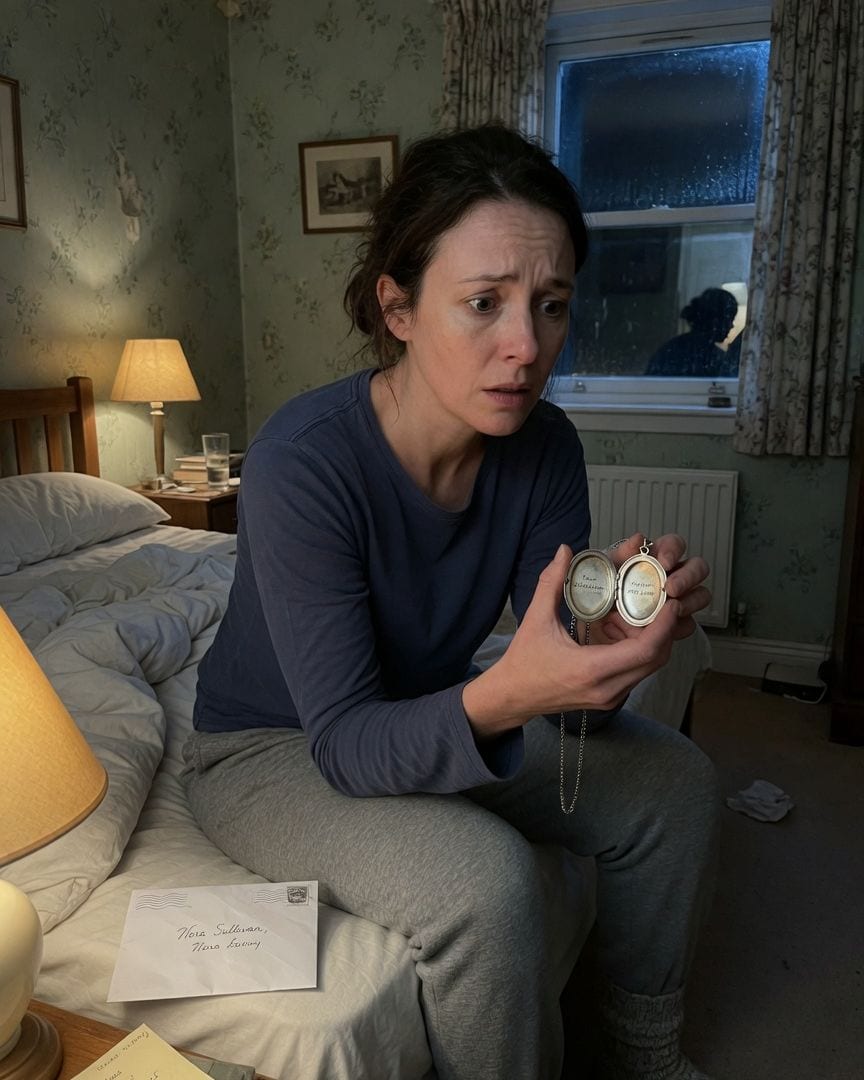
My antique locket held my maiden name, engraved with 'until the ninth.' The dealer said the woman who owned it left a note: 'for her, when she comes.'
My husband Scott, always finding unusual things, gave me an antique silver locket. Inside, engraved beneath my maiden name, Nora Sullivan, were three chilling words: 'until the ninth.' It felt like a direct, personal address, even though I hadn't used that name in years.
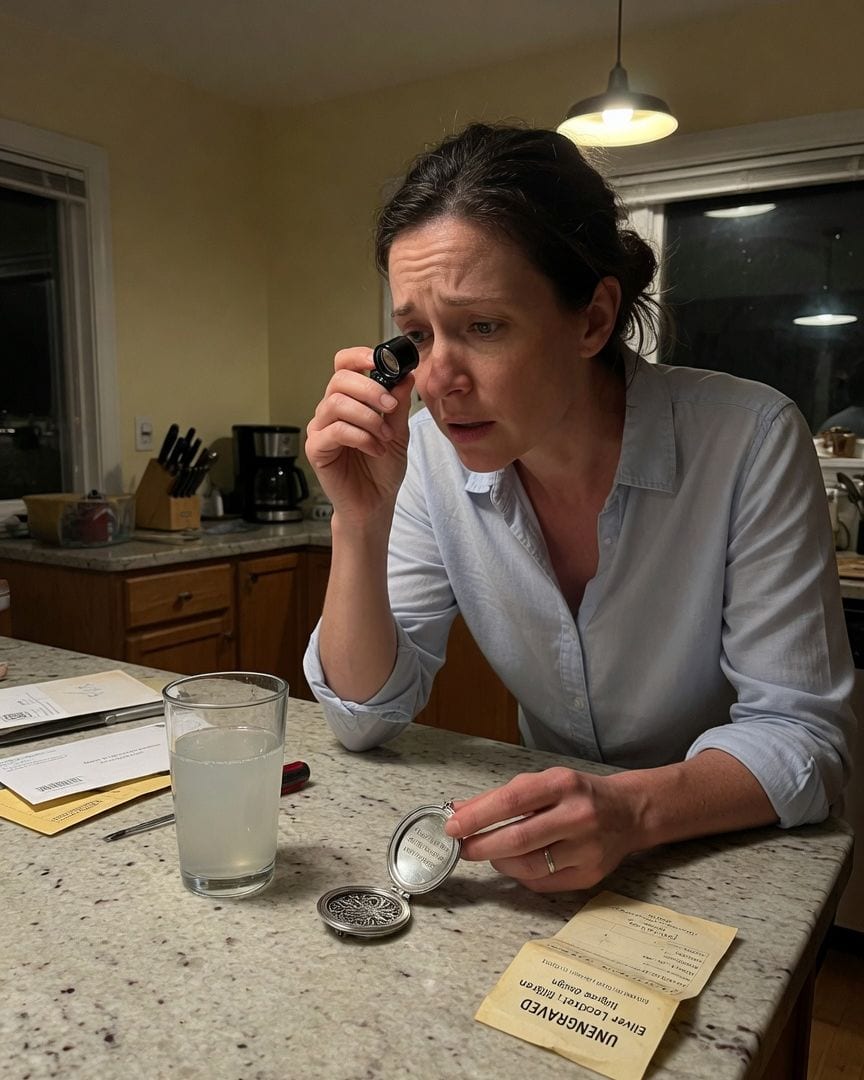
This locket was sold 'unengraved' five years ago. Now it's etched with my maiden name, unused for eleven years, and 'until the ninth'.
My husband gave me a beautiful antique locket, a heavy silver oval. Inside, etched in microscopic script, I found my maiden name 'Marsh' – unused in eleven years – and the chilling phrase 'until the ninth.' But the dealer later confirmed this very locket was sold just five years ago, explicitly marked 'unengraved'.
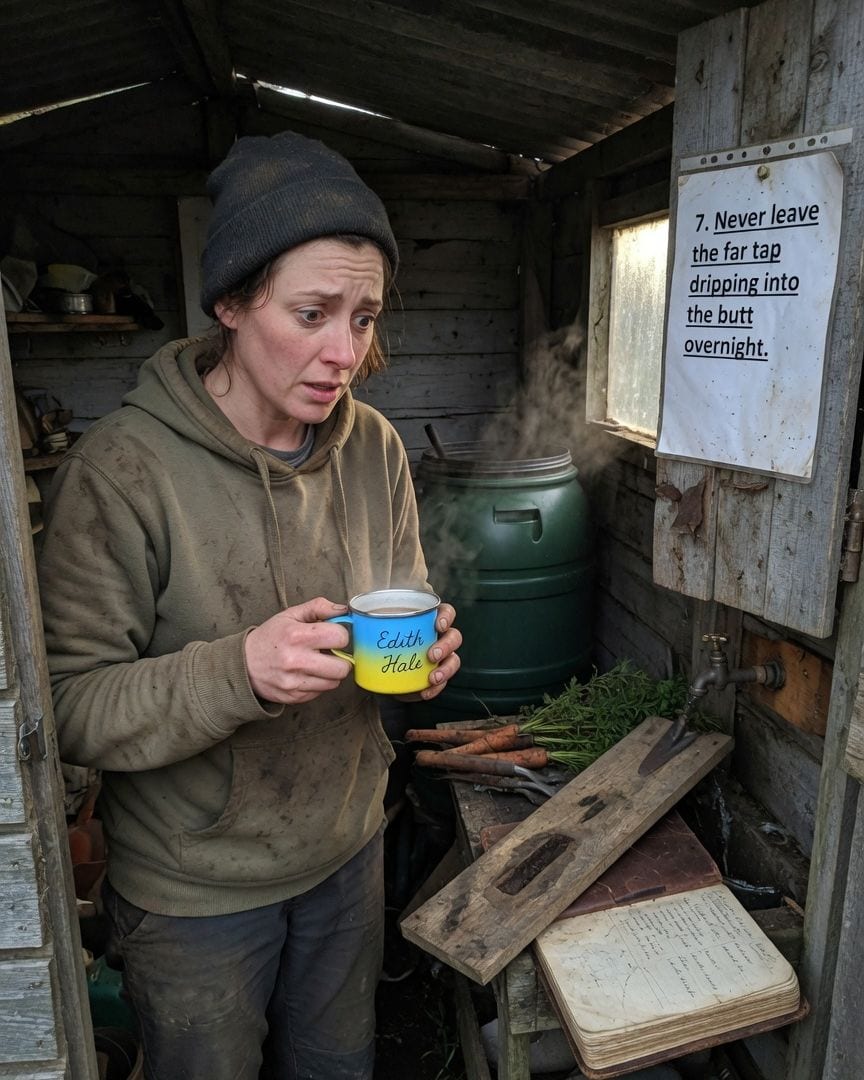
The one night I left the tap dripping, my allotment water butt was full to the brim and warm to the touch — with a child's unrusted tin cup floating on top.
Moving to Blackwood, I hoped my allotment would be a fresh start. But the shed's rulebook warned, 'Never leave the far tap dripping.' One morning, my water butt was full and steaming, an unnerving warmth rising from it. Inside, a child's tin cup floated, unrusted, etched with the name 'Edith Hale'.
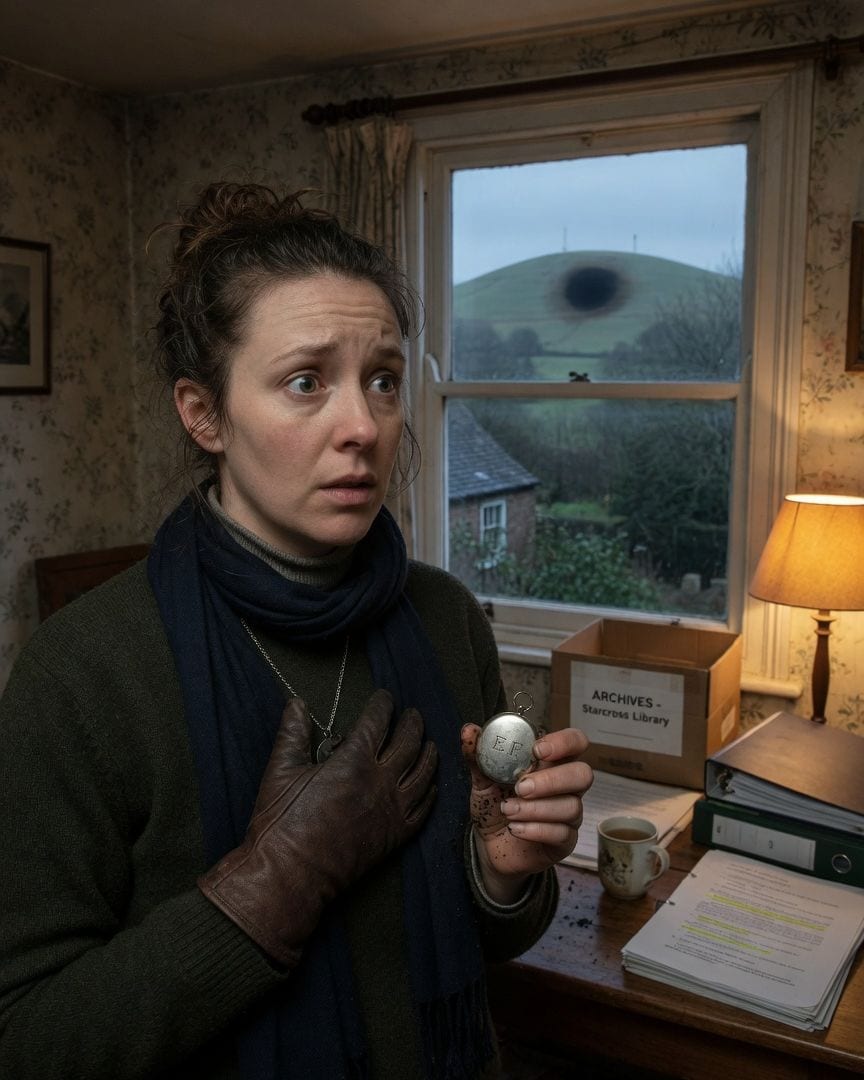
The hill behind Starcross village is scorched black every seven years. No fire brigade ever logs a call.
After moving to Starcross, I became fixated on Beacon Hill's peculiar, perfectly black scorch mark, which had no explanation in local fire records. While exploring the strange, glassy earth of the burn site, I unearthed a small, tarnished silver locket. It was later identified as belonging to Eileen Fairfax, a child who vanished decades ago and was officially presumed drowned in the local lake.
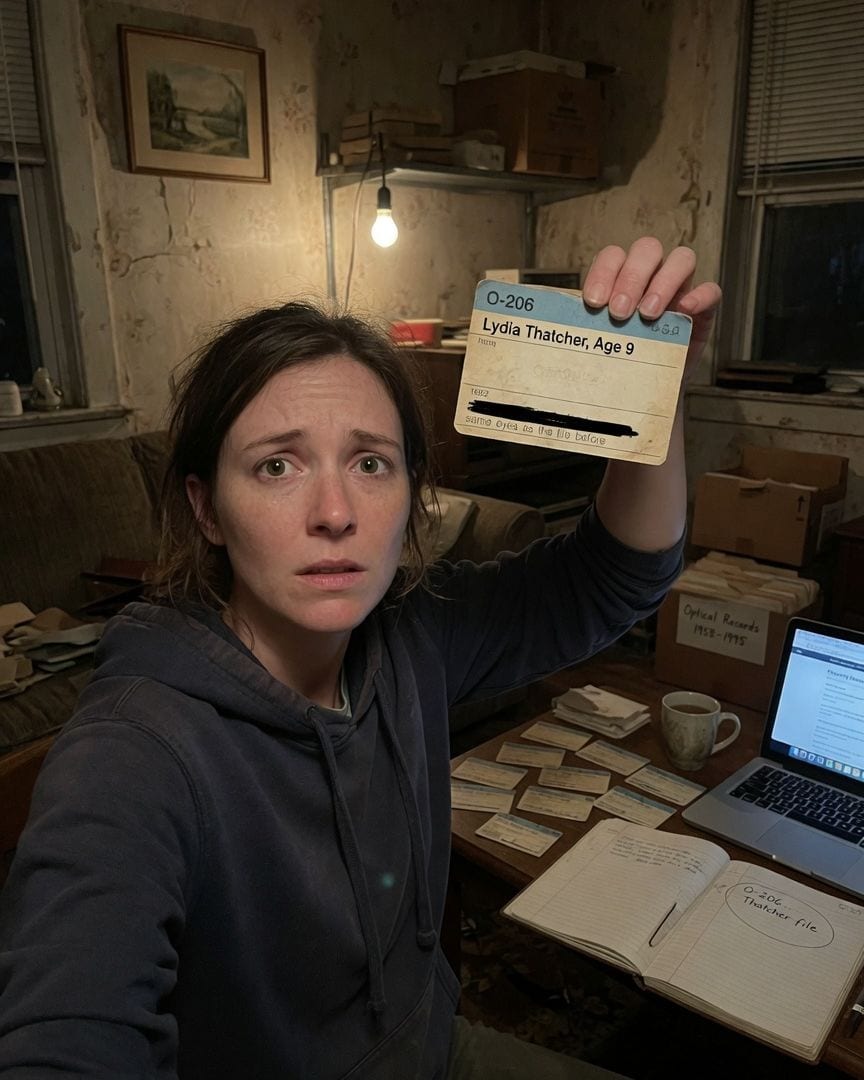
My own optical card is dated 1962, with my name on it. I wasn't born until 1993.
Sifting through old patient files from my former optical practice, I found my own O-206 card. It had my name, Lydia Thatcher, and my current home address printed on it. But the card was dated 1962, decades before I was even born, and a redacted note mentioned 'same eyes.'
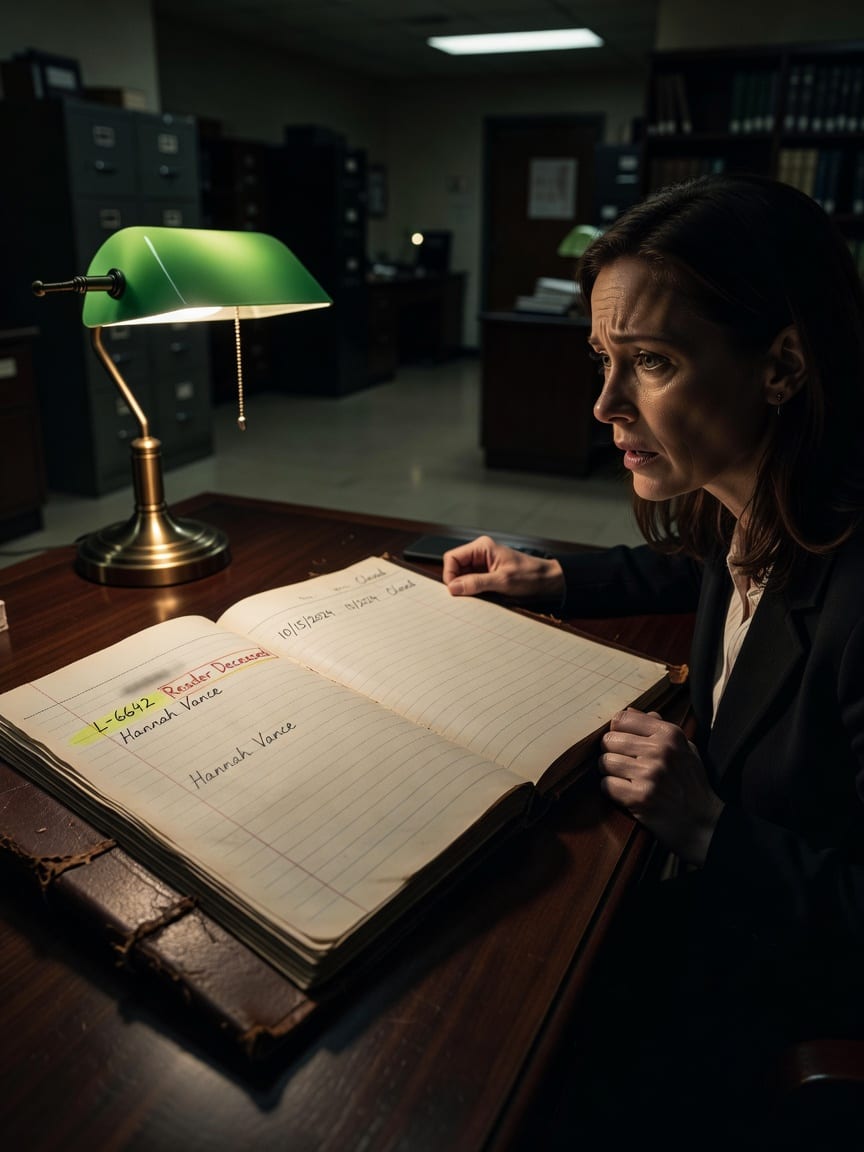
My library card number L-6642 was issued to me at seven — and the ledger shows that number has marked a reader 'deceased' every twelve years since 1949.
Returning my late father's library card to the old town library felt like a small act of closure. But the senior librarian's ancient ledger revealed a chilling pattern of 'reader deceased' entries tied to specific card numbers and borrowed books. My unease turned to cold dread when I secretly found my own name penciled in, marked for a future 'reader deceased' entry.