My boarded-up door opens onto a vanished balcony, a woman watching a street that isn't there.
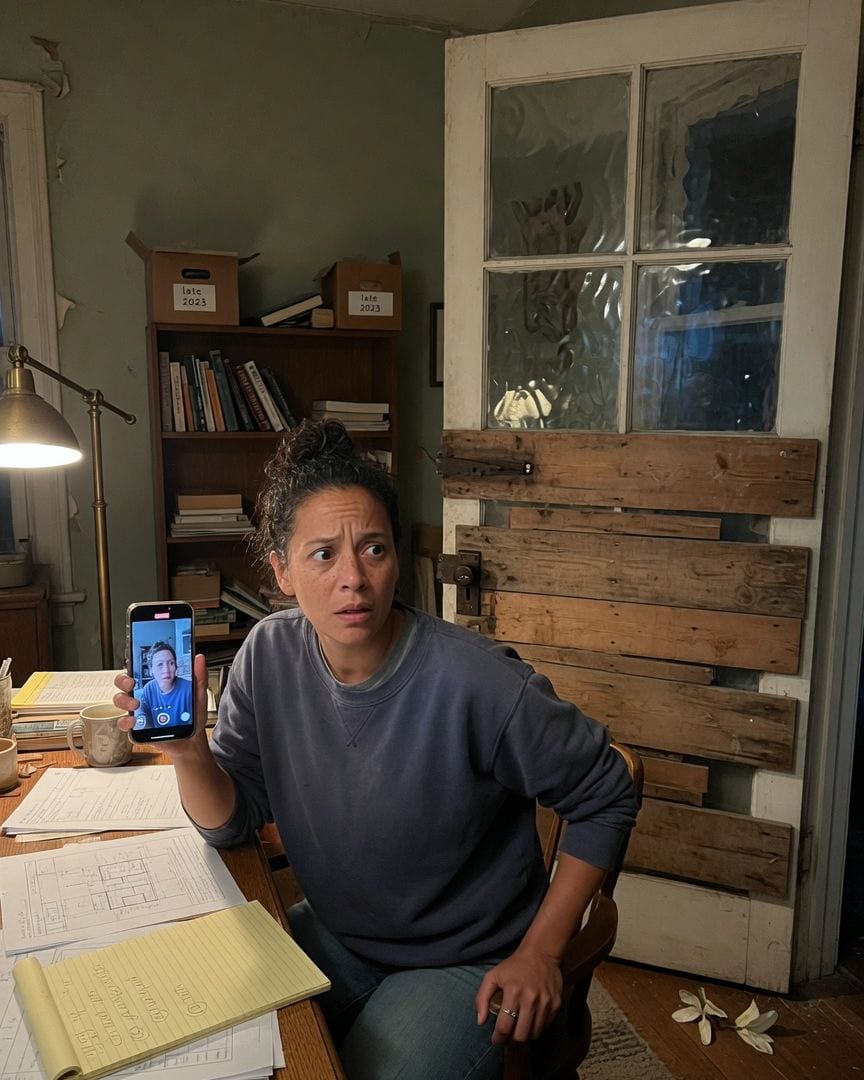
The study in my new house has this old French door. It leads to nowhere, really.
The lower half is boarded up with rough, unpainted planks, and I know from the seller that the balcony it once opened onto was removed decades ago after some sort of incident. A tragic incident, the listing vaguely mentioned.
I bought the place in late 2023, and I’ve been trying to make it mine, paint away the ghosts, you know? But some things cling.
For the second night in a row now, precisely at 11:03 PM, something impossible has happened. I was at my desk, trying to make sense of some spreadsheets, when the air in the room just… sharpened.
Not cold, exactly, but taut, like a string pulled tight. And then the door, the boarded-up, solid door, wasn't boarded anymore.
It had opened, silently, inward.
Beyond it, not the solid brick wall I knew was there, but a balcony. It was narrow, with intricate iron railings twisted into floral patterns, and a stone urn, dark with age, sat in one corner. And the view.
Oh, God, the view. Not the ugly modern tower blocks of 2024, but a street I didn’t recognize, cobblestones glinting under gaslight, horse-drawn carriages, and houses with pitched roofs and chimneys that breathed smoke.
It was like looking through a perfectly clear window into another century.
A woman stood at the rail, her back to me. She was wearing a long, dark dress, the fabric heavy and old-fashioned. Her posture was stiff, perfectly still, as if carved from the same dark stone as the urn.
She gazed down, unmoving, at that street that wasn’t there, a street that hasn't existed in that configuration for a hundred years or more. My heart was pounding, a desperate drum against my ribs.
I tried to rationalize it – exhaustion, a trick of the dim lamplight, a shadow. But the detail was too crisp, too real.
The precise curve of the iron, the texture of the stone, the subtle ripple of the woman's dress in a breeze I couldn't feel. I closed my eyes, squeezed them tight, willing it away.
When I opened them again, the door was solid, the rough planks back in place. The impossible view was gone. But a faint, sweet scent, like lilies, lingered in the air, a ghost of a perfume.
The next day, I went over that French door like a forensic expert. My rational brain was screaming for an explanation. I ran my hands over the rough boards, testing for looseness, for a hidden seam. Nothing.
The wood was solid, nailed tight. The lock, an old-fashioned bolt, was secure.
I even got down on my hands and knees, peering at the threshold for any sign of a mechanism, a loose floorboard, anything that could suggest a hidden panel or a clever trick.
I checked the wall behind it, tapped it, listened for hollow spots. It was just a wall. A normal, brick-and-mortar wall.
I ended up calling Marco Sinclair, a local handyman I’d used before for smaller jobs. He came over, a gruff but kind man who’d seen every kind of old house quirk.
He looked at the boarded-up door, scratched his head, and gave it a thorough once-over. "Solid as a rock, Nancy," he said, tapping a plank. "Looks like it's been boarded up for ages. No weaknesses I can see."
He checked the framing, the hinges, even the wall on the other side. Nothing. He left, looking slightly confused, but convinced the door was just... a door.
Later, I decided to tackle the history angle. If there was a balcony, and it was removed after a tragic incident, there had to be records. I spent hours online, digging through digitized local archives.
I found an old blueprint of the house, dated 1905, clearly showing the balcony jutting out from what was now my study. Bingo.
Then, digging deeper, I found a brief mention in a local newspaper from 1909: "Balcony removed from Holloway Residence after tragic incident. Structural integrity concerns cited." Frustratingly vague, but it confirmed the balcony’s existence and its sudden removal.
I tried to find more about the 'tragic incident' itself, but the archives around that specific period were strangely sparse, full of gaps, as if pages had been torn out. It was a dead end.
That evening, as 11:03 PM approached, I felt a knot of dread in my stomach, but also a fierce determination. I wasn't imagining this. I positioned myself in the study chair, directly facing the boarded-up French door.
I pulled out my phone, turned on the camera, and set it to record, focusing squarely on the planks. The air in the room grew cold again, a subtle drop in temperature that pricked at my skin.
And then, faintly at first, the sweet, cloying scent of lilies returned, stronger than before.
At 11:03 PM, the French door didn't creak or groan. It shimmered, a ripple of distortion across the boarded planks, like heat haze off asphalt.
Then, with an audible click that seemed to echo in the sudden silence of the room, it silently swung inward. There it was again: the restored balcony, the ornate iron railings, the ancient stone urn, and the woman.
She was there, her back to me, unmoving, a dark silhouette against the impossible, gaslit street. I held my breath, phone recording, my hand trembling so badly I almost dropped it.
She remained still for a long moment, a statue in a world that shouldn't exist. Then, almost imperceptibly, her left hand moved, a flicker of silver at her fingertips as her fingers relaxed.
And a small, intricate locket slipped from her grasp, tumbling in slow motion onto the illusory stone floor of the balcony. The door shimmered again, the edges of the vision blurring.
Slowly, inexorably, it began to close, the boards reforming, the impossible world receding. I lunged forward, a choked gasp escaping my lips, my heart hammering like a trapped bird.
The door clicked shut, solid, boarded, the planks rough under my hands. But on the rug, directly in front of where the illusory balcony had been, a small, tarnished silver locket lay there, reflecting the dim lamplight.
I knelt, my hands shaking so violently I could barely pick up the locket. It was real. Cold to the touch, heavy, and intricately wrought in antique silver.
On its front, a delicate, cursive 'V' was engraved, softened by time and wear. My fingers fumbled with the clasp. It opened with a faint click, revealing two faded sepia photographs inside.
One was of a serious-faced young woman, her hair pulled back tightly, her eyes holding a faint sadness.
The other was a blurred image of what looked like a street scene from another era—cobblestones, gas lamps, the precise details of the impossible view I'd witnessed.
Crucially, on the back of the locket, almost imperceptible to the naked eye, a tiny inscription read: 'V.D. 1908.'
1908. That was the 'wrong year' my house had shown me. The date hit me like a physical blow. My hands trembled, not with cold this time, but with a profound, terrifying certainty.
This wasn't a trick of light, or exhaustion, or some elaborate hidden mechanism. This was impossible.
I spent the next few days in a blur of research, fueled by adrenaline and a growing dread. I drove to the local historical society, the locket clutched tight in my pocket.
I poured over dusty ledgers and brittle microfiche, cross-referencing names and addresses from the early 20th century. My house, I discovered, had indeed been owned by the Delaney family in the early 1900s.
And a quick search for 'V.D.' led me to a name that sent a chill straight to my bones: Vera Delaney.
I found a brief, almost forgotten newspaper article from late 1908. It reported Vera Delaney's mysterious disappearance from her family residence. She had last been seen, the article stated, on her balcony.
There was no mention of a body, no trace, just a void where a young woman had been. The article then casually noted the subsequent removal of the balcony in 1909, citing "architectural adjustments." The pieces were clicking together, horrifyingly.
The house wasn't just showing me a memory; it was replaying a specific, tragic event. Vera Delaney, 28 years old, vanished from that balcony in 1908.
And the locket, with her initial and the exact year, was proof it had happened. I wondered if anyone else in town knew. I thought of my elderly neighbor, Walter Vance, whose family had owned the house before the Delaneys.
He’d lived here his whole life. I decided to visit him.
The walk next door to Walter Vance's house felt like walking through treacle. Every step felt heavy, deliberate. As I approached his place, I noticed him sitting on his porch swing, as he often did in the afternoons.
But today, he wasn't reading, or even just looking out at the street. He was watching me. His gaze was steady, unblinking. He didn't wave, didn't offer a polite smile. Just watched.
When I reached his gate, he called out, his voice dry, "Morning, Nancy. Doing a lot of digging, are we?"
His tone was calm, almost conversational, but his eyes, sharp and clear behind his spectacles, seemed to bore right through me.
I swallowed, my carefully rehearsed explanation feeling thin and flimsy in the face of his knowing gaze. "Good morning, Mr. Vance," I replied, trying to sound casual. "Yes, just researching the house's history.
It's fascinating, all the different families who've lived there."
Walter chuckled, a dry, rustling sound like autumn leaves. "Fascinating, indeed. That old place has a long memory, dear. Some things, they just keep coming around." He shifted on the swing, the chains groaning softly.
He avoided my direct questions about Vera Delaney, despite my attempts to steer the conversation that way. Instead, he offered vague warnings, his eyes never leaving mine. "You start poking at the past, sometimes the past pokes back.
Best to let sleeping dogs lie." His evasiveness and those knowing glances made my skin crawl. It wasn't just old man eccentricity. He knew something.
Later that week, I started noticing subtle shifts in my own routine. Small things, easily dismissed at first, but they accumulated. A teacup I’d left on the kitchen counter was later found neatly placed in the sink.
A book I was reading, left open on my nightstand, was found face down on a different page. I’d rationalize it: I must have done it absentmindedly, I was just tired.
But then one evening, I walked into the hallway and found my study door – the French door – firmly closed. I always leave it ajar, especially since I'd boarded it. I never close it.
That's when a prickle of genuine unease spread through me. The house wasn't just a passive observer, a silent recorder of past events. It was active. It knew I was digging, and it seemed to be gently, subtly, asserting itself.
Reminding me who was really in charge.
The next day, I couldn't stand it anymore. I walked straight back to Walter Vance's house, the locket heavy in my pocket. This time, I didn't bother with pleasantries.
I pulled the locket out, placing it in his outstretched, gnarled hand.
"Mr. Vance," I began, my voice steady despite the tremor in my hands. "This locket belonged to Vera Delaney. It has her initial, 'V,' and it's dated 1908.
I found it in my study, right there on the rug, directly in front of where the old balcony used to be. You know something about this, don't you?"
Walter's calm facade finally cracked. It wasn’t a dramatic break, but a subtle shift, a flicker of old pain in his eyes that he couldn't quite hide.
He sighed, a long, weary sound, and gestured for me to sit on the porch swing beside him. He kept looking at the locket, turning it over in his fingers.
"My grandmother," he began, his voice softer now, "she was just a girl when Vera lived there. She saw things. Heard things. Vera was... lonely. Always out on that balcony, waiting for someone who never came."
He paused, his gaze distant. "My grandmother said the air went still, the day Vera vanished. Like the whole street held its breath. They found her locket on the ground below, but no Vera.
The family sealed up the door, took down the balcony. Said it was bad luck. A black spot on the house."
He closed the locket, his thumb tracing the 'V'. "My grandmother always believed Vera was still there, somehow. Stuck in that moment. Waiting. The house remembers, Nancy. It keeps what it loves. Or what it loses."
Walter confirmed that Vera had been waiting for a suitor, a young man who was supposed to arrive from out of town that fateful day, but never did.
The scene I’d witnessed – Vera standing perfectly still, watching the street below – was her final, endless vigil. The locket, he explained, had been a gift from this suitor, meant to be a promise.
I clutched the locket, the pieces clicking into place with a horrifying precision. The woman, the date, the vanished street, the impossible artifact – it all fit. It wasn't a ghost, not in the traditional sense.
It was something far more chilling: a fixed, looping moment of profound loss, preserved by the very fabric of the house itself.
Walter, seeing the dawning horror in my eyes, leaned closer. "Vera wasn't the first, you know."
My breath hitched. "What do you mean?"
"My great-aunt," he continued, his voice barely a whisper, "she lived in that house in the 1870s. Had a similar... experience. Vanished without a trace too, they said. Always around the same time of year.
Always when the lilies were in bloom." He pointed a gnarled finger towards a dusty, neglected corner of his study, where an old, heavy chest sat. "There's an old ledger down at the historical society.
My grandmother kept it hidden, but I think it mentions her. A quiet family secret, you understand. A shame the archives are so... incomplete around certain dates."
My blood ran cold. Not just Vera. This wasn't a unique tragedy; it was a pattern. A cycle. The house wasn't just remembering a single loss; it was a collector of them. I barely registered saying goodbye to Walter.
I stumbled out of his house, my mind reeling, and practically ran back to the historical society, my heart pounding a frantic rhythm against my ribs.
I found the ledger Walter mentioned. It was tucked away in a back room, a thick, leather-bound book, its pages brittle with age. My fingers shook as I flipped through them, searching for the 1870s.
And there it was, a faint, almost illegible entry from 1875. It detailed a 'Miss Eleanor Hayes, disappeared from her residence, believed to have gone west, though no travel was arranged.'
A small, almost invisible annotation in the margin, scrawled in faded ink, caught my eye: 'The balcony, again.'
And then, beneath it, a chilling, almost faded note, scrawled in a different, more agitated hand: '...and then, just like the others, she was simply gone, leaving only the scent of lilies and the turning of the season.'
As I read the final line, a faint, sweet floral scent, unmistakably like lilies, wafted through the quiet historical society, seeming to emanate from the closed French door in my own mind.
The scent of lilies was no longer faint; it filled my study, heavy and cloying, a suffocating perfume.
I stared at the locket in my hand, dated 1908, then at the image of the ledger entry from 1875 burned into my mind. The house wasn't merely replaying a single, tragic event.
It was a predatory entity, a temporal trap, drawing its occupants into a recurring cycle of disappearance. The Door Onto The Wrong Year wasn't just a window to the past; it was the mechanism, the maw.
Vera Delaney, Eleanor Hayes, and how many others, had been pulled into that fixed moment, forever waiting.
I realized with a sickening lurch that the 'scent of lilies' wasn't just a memory of the past, or a residual trace. It was a preamble, a signature of the house's activation, a warning.
The subtle shifts in my own routine – the teacup moved, the book page changed, the study door closing itself – they weren’t just minor annoyances. The house was preparing me, making me a part of its 'memory.'
I understood now what Walter meant by 'the way things come around.' I was the next one.
The coherence of it all was terrifying: every detail, every trace, every vague warning from Walter, now snapped into a horrifyingly clear picture of a house that consumed its residents, trapping them in a loop of waiting and loss.
The locket wasn't just from the past; it was a physical anchor, a piece of 'impossible' evidence that proved the house's power was real and immediate. And it was proof that I was already caught.
I clutched the locket in my hand, its cool silver a small comfort against the rising panic.
The French door was no longer just a boarded-up wall; it was glowing faintly with an internal light, a soft, ethereal luminescence seeping through the cracks in the planks.
The scent of lilies was overpowering now, thick and sweet, making my head swim. I knew, with a certainty that chilled me to the bone, what I had to do.
I held the locket up, examining the inscription: 'V.D. 1908.' It was real, undeniably physical, an artifact from a moment that should not be able to interact with my present. This was the proof that shattered all mundane explanations.
This was the anchor, the point of connection. I walked towards the door, the light intensifying with every step, the scent of lilies growing heavier, almost suffocating.
I could see the faint outline of the restored balcony, shimmering through the boards, the stone urn, the intricate iron railings. And the woman, Vera, was there, her back still turned, a dark, silent silhouette.
I raised the locket, my hand trembling. It hummed faintly in my palm, a low vibration that resonated through my bones. My intention was clear: to throw it.
To break the cycle, to return it to Vera, to sever the impossible connection that held her, and now me, hostage. I reached for the shimmering threshold, for the place where the boards gave way to the spectral balcony.
But as my fingertips brushed against the shifting air, a cold, unseen force gently but firmly took hold of my wrist. My fingers went numb.
The locket slipped from my grasp, falling not into the past, not onto the illusory balcony, but onto the very edge of the present-day rug, just inside the study. The force didn't yank me, didn't shove.
It simply pulled me forward, a gentle, inexorable draw, through the shimmering door, towards the waiting figure on the balcony. There was no struggle, no pain, only a profound sense of release, like being drawn into a warm, familiar dream.
My last conscious thought was the overwhelming scent of lilies, and the silent, still back of Vera Delaney, waiting.
Days later, Walter Vance noticed Nancy’s mail piling up. He knocked on her front door, then, receiving no answer, let himself in with the spare key Nancy had given him.
The house was quiet, meticulously tidy, as if no one lived there. In the study, he found the French door, its lower panels still boarded. On the rug, a small, tarnished silver locket lay open, reflecting the dim lamplight.
He recognized it instantly. He closed the locket, the faint 'V.D. 1908' visible on the back. He placed it carefully on the mantelpiece, beside a small, framed photograph of Nancy.
The house was silent, save for the faint ticking of a clock.
Walter Vance returned to his porch swing, settling in, watching Nancy Holloway's quiet, empty house. He knew what had happened. He felt a familiar ache, a resignation that comes with age and too many cycles witnessed.
He knew the scent of lilies would eventually fade, replaced by the quiet dust of time, until the house was ready for its next occupant. He wondered how long it would be this time, before the door opened again.
Years later, a young couple buys the Holloway residence. On their first night, the husband asks his wife, 'Did you leave that study door open, dear? I could swear I closed it.'
From the study, a faint, sweet scent of lilies drifts through the air, and a woman's voice answers, 'Is that so?' with a faint, wrong little smile.
If this one got to you
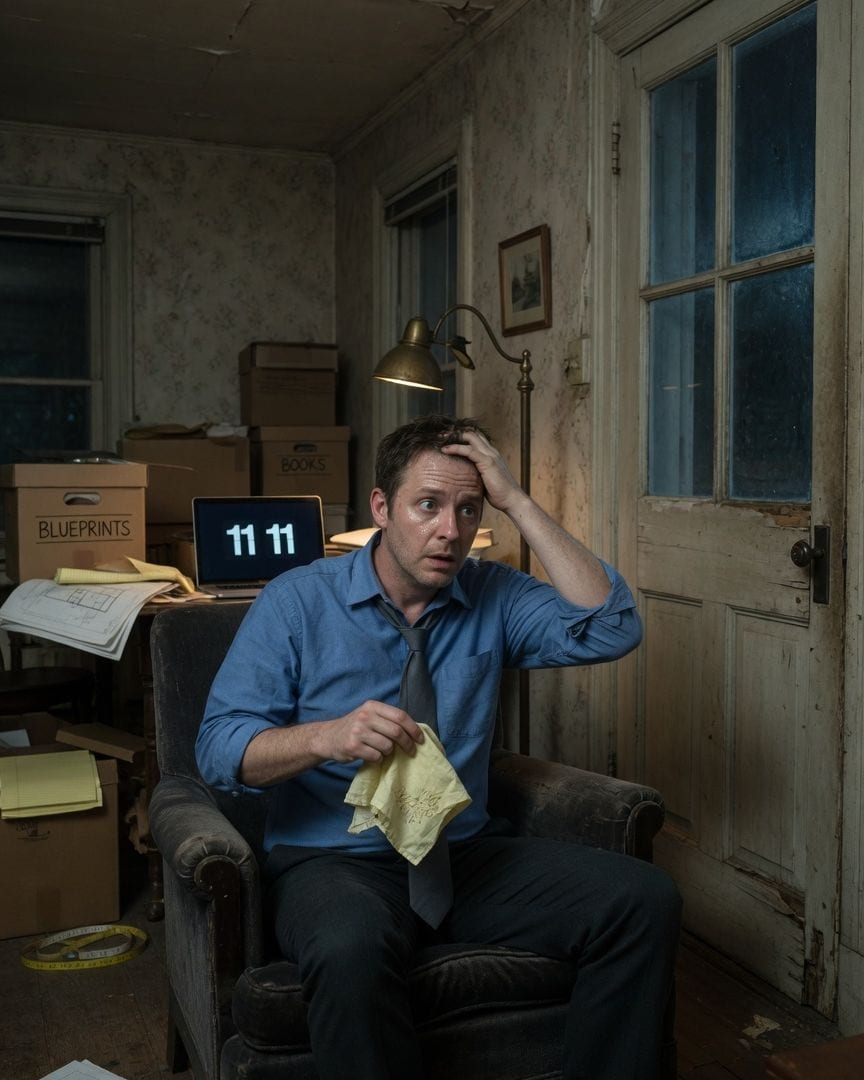
The boarded-up door in my study has twice swung open onto the balcony that was torn off this house years ago — iron railings back, and a woman at the rail with her back to me, watching a street that no longer runs below.
As an architect, I approach my great-aunt's inherited house with a rational eye, seeing its potential, not its ghosts. I knew the charming French door was boarded up because its balcony was removed back in 1953. But for two nights now, at 11:11 PM, those boards simply vanish, revealing the balcony restored and a silent woman watching an impossible street.
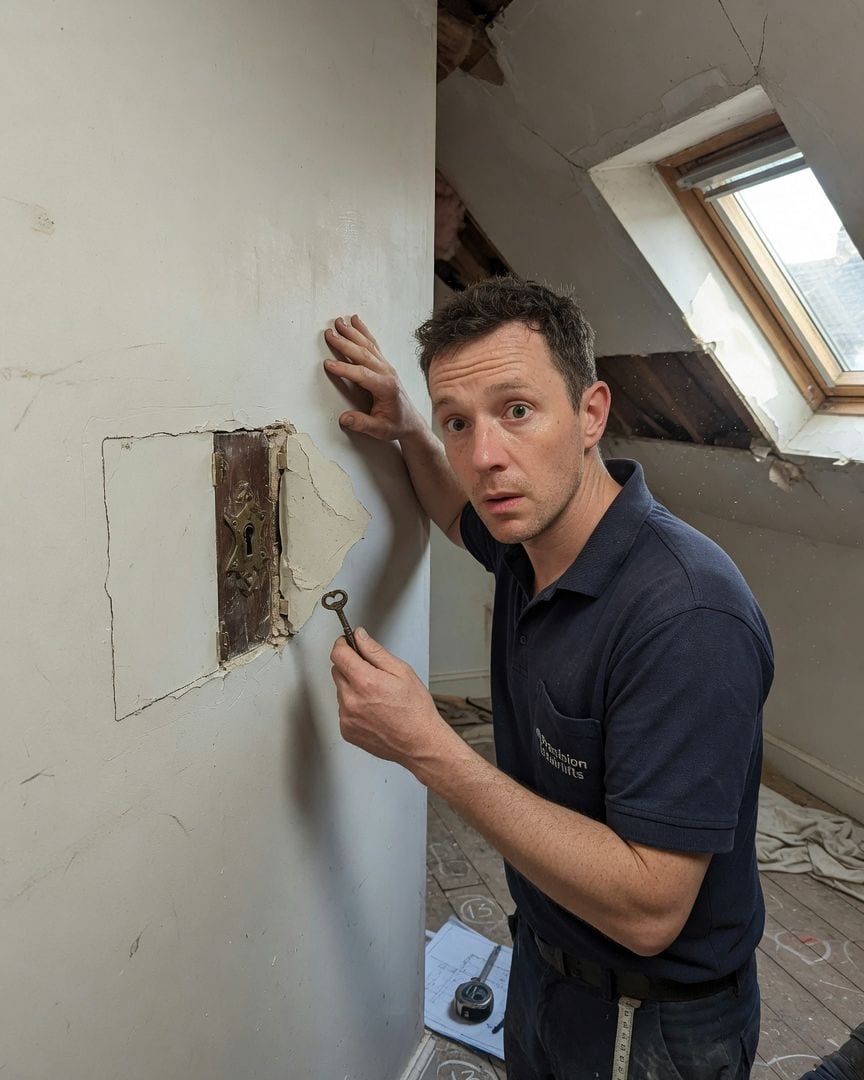
My stairlift tape measures thirteen steps, but my own feet always find a fourteenth — to a door that isn't there.
As a meticulous fitter, I measured my client's new loft stairs, confirming thirteen solid steps. But my foot found a shallow, impossible half-step, leading to a plain wooden door that shouldn't exist. Now the door is gone, leaving only a ghost outline.
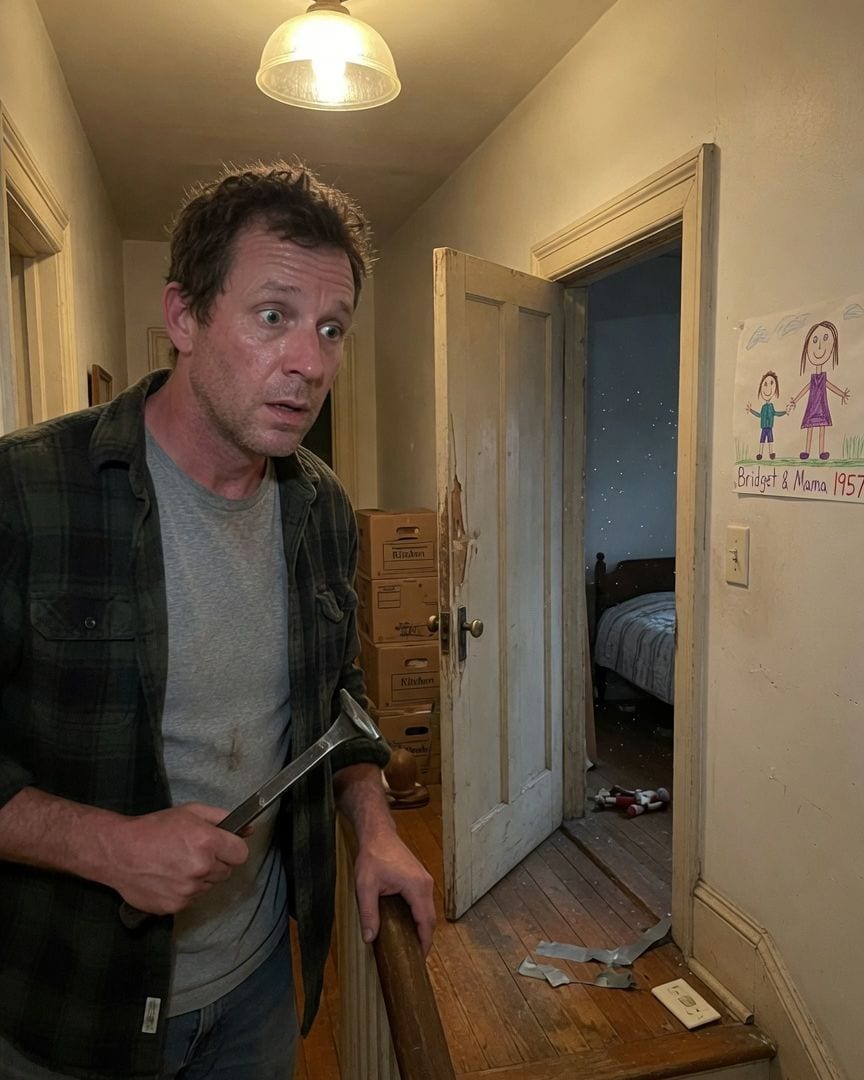
My landing light switches itself off at 9:40 every night. I've watched the switch flick down under nothing, the tape peeled back. The house holds its breath.
My great-uncle's old house was a quiet gift, a place to finally settle. But as I unpacked, a strange worn path on the floorboards led me to a small, barely visible door, perfectly blended into the wall. It was undeniably locked, and felt like a deliberately obscured secret.
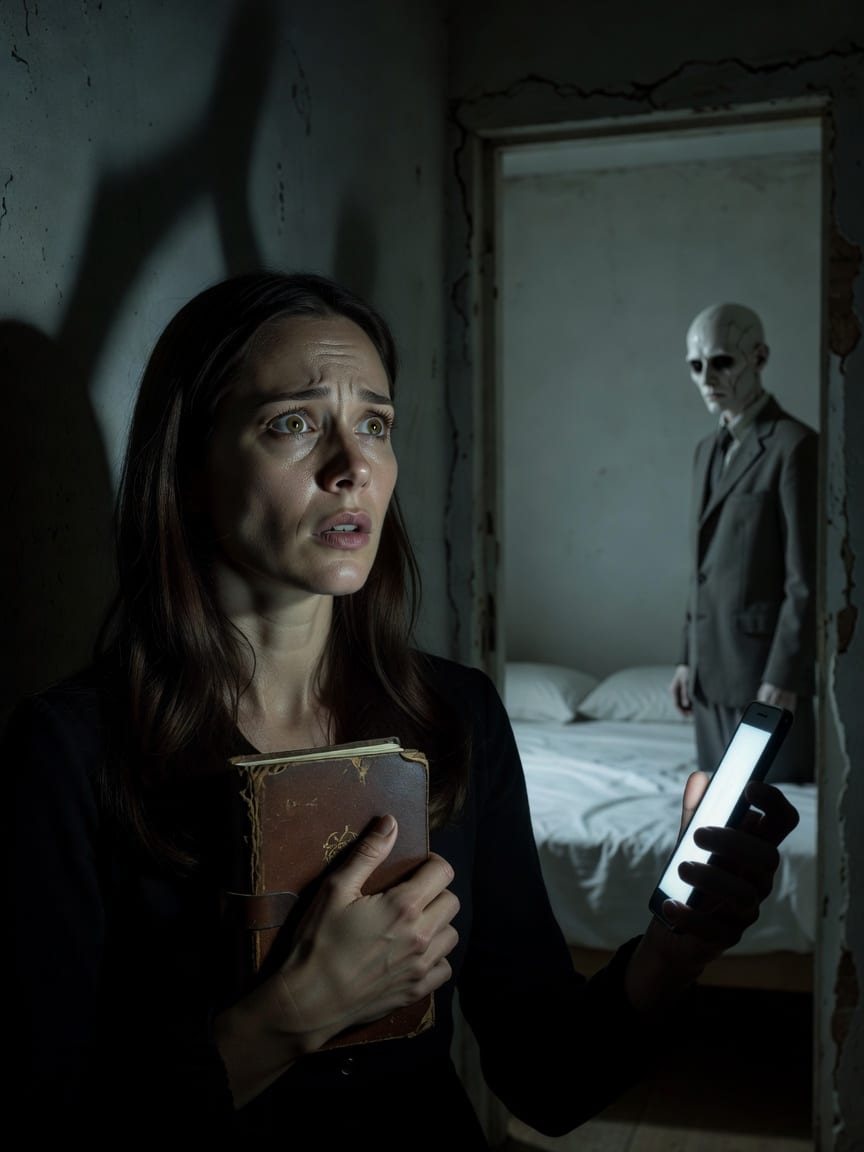
Behind a plastered-over doorway, I found a room. Papered, carpeted, and furnished with a made bed, sealed for decades. The air was dead still, but the bed wasn't dusty. My council tax bill only lists five rooms.
I'm Claire, an architect, meticulously planning my new Victorian terrace renovation. But when I uncovered a hidden room behind a wall, everything I knew about time and decay shattered. The bed was perfectly made, the air still, yet there was no dust, only an unnerving cold.
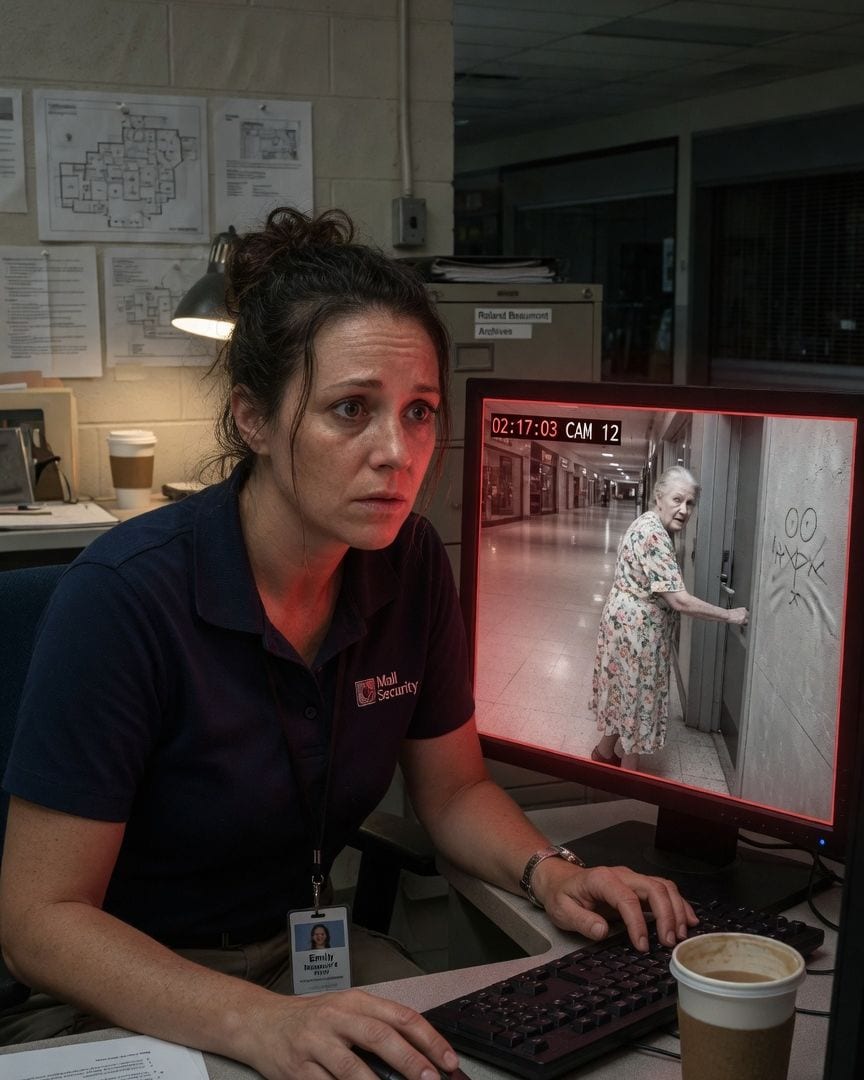
Mall security footage caught an old woman walking the concourse after closing. Every camera filmed her, but no single frame shows how she got in.
Working the overnight shift, I monitor my locked mall's security footage. It was 2:17 AM, five hours after closing, when an old woman in a floral dress simply appeared on Camera 7. She was never seen entering the frame, only *present*, walking slowly across the deserted concourse.
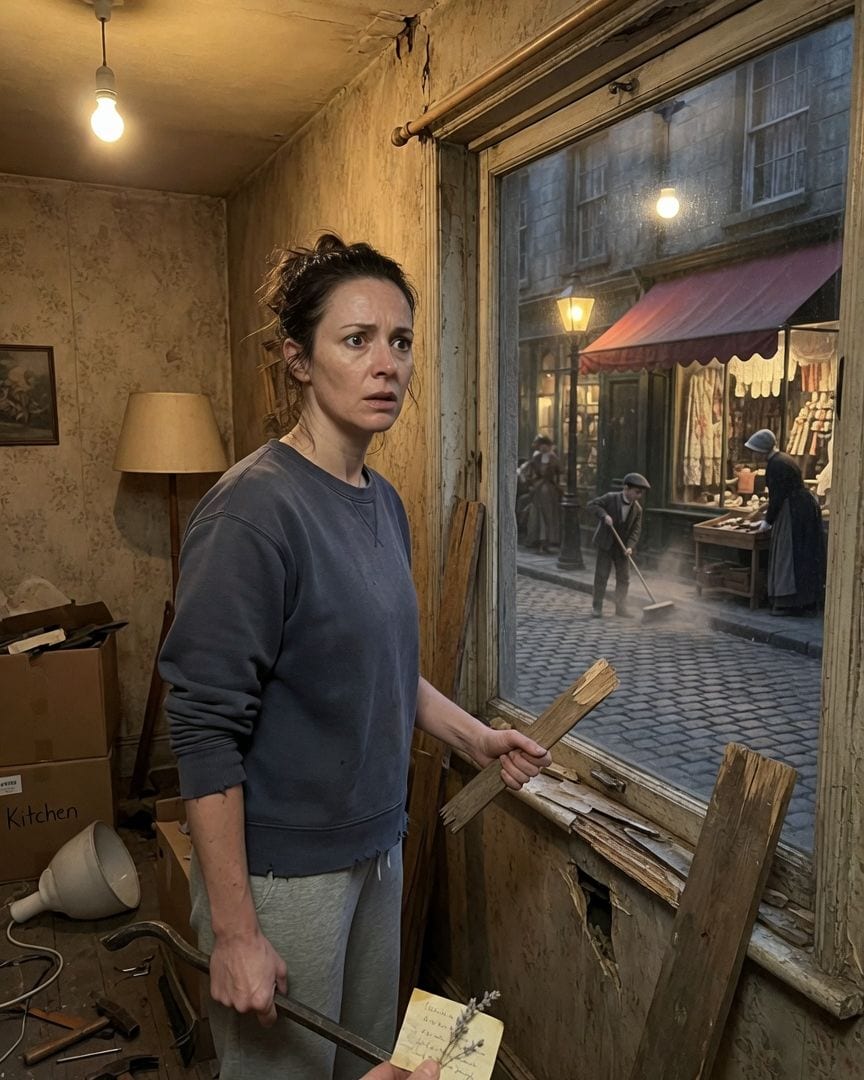
My boarded window showed a gaslit Victorian street. Across my flat, only a brick shaft. The wood felt soft, new when I nailed it back.
Moving into my new flat, I expected to find a grimy brick lightwell behind the boarded-up window. But as the last plank came free, my view wasn't a shaft at all. Instead, a bustling Victorian street, complete with gaslight and a boy sweeping, stretched out before me – a vibrant, living scene that simply shouldn't exist.