A boy of about seven cycled up to me at the playground and said, 'Sorry about your car, Mr. Doyle.' My car sat untouched — and I've never told any child my name.
My daughter, Lily, was on the swings, pumping her legs with all the wild abandon only a six-year-old can muster. The late afternoon sun cast long shadows across the Cedar Close playground.
I was leaning against the fence, idly scrolling through my phone, just enjoying the quiet hum of a Tuesday afternoon. That's when he showed up.
A small boy, no older than seven, pedaled his bright red bike directly towards me. He stopped abruptly, handlebars askew, and just stared. His eyes, a striking blue, were utterly devoid of any childhood mischief or shyness.
He just looked at me. I braced myself for some child's question about a lost toy or a scraped knee. Instead, his voice came out flat, uninflected, like he was reciting something he’d memorized.
"Sorry about your car, Mr. Doyle."
He didn't wait for me to react. Didn't even blink. He just turned the bike around and pedaled off, disappearing behind the slide as quickly as he’d arrived.
My car, my old blue sedan, was parked twenty feet away, clearly visible, gleaming innocently in the setting sun. Untouched. I glanced at it, then back at the spot where the boy had been.
A prickle of unease started in my gut. I didn't know the kid. Never seen him before, never spoken to him. And I certainly hadn't told him my name.
I looked around at the other parents. Mrs. Carter, from down the street, was watching her twins on the monkey bars. I walked over. "Hey, did you see that kid just now?" I asked, trying to sound casual.
"Said something weird about my car, and knew my name."
She looked up, brushing a strand of hair from her eyes. "Kids say the darndest things, Sean. Probably just heard someone call you. Don't worry about it." She gave a dismissive shrug and went back to her twins.
I tried to shake it off, told myself it was just a random kid being odd. But the specifics gnawed at me. My name. My car. I walked over to my sedan, did a slow, full circle inspection.
Checked the paintwork, the tires, the mirrors. Everything was perfectly normal. Not a scratch, not a dent. Yet, the boy's words, his eerie certainty, echoed in the sudden quiet of the evening, a flat, impossible prediction.
Three days later, I found my car in the parking lot at work. The driver's side mirror was shattered.
Not cleanly broken, like someone had snapped it off, but as if struck by something small and hard, leaving a starburst pattern radiating from a single impact point.
It was exactly the kind of specific, minor damage that had flashed through my mind after the boy's bizarre apology. Not a major accident, not a total write-off, just a targeted, unnerving inconvenience. Like a warning.
I stood there for a long moment, staring at the spiderwebbed glass. The prickle of unease from the playground solidified into a cold, hard knot in my stomach.
I reported it to my insurance, explaining it was "vandalism," but the incident report felt hollow, a lie by omission. I couldn't shake the connection, couldn’t ignore the boy’s words.
I started searching online that evening. "Children predicting car damage." "Playground apologies." "Precognitive kids." Nothing. Just forums about psychic children or anecdotes of innocent coincidences. My browser history started to look like something out of a conspiracy theorist's playbook.
Eventually, I widened my search to 'local pre-emptive warnings' or 'apologies in advance.' That’s when I stumbled upon it: an obscure local history forum, buried deep in some old regional archive.
A thread from years ago discussing strange occurrences in the Cedar Close area.
One post, barely legible, its text faded and interspersed with broken image links, mentioned a "pattern of apologies" preceding minor misfortunes. And then, a chilling detail: "...just like what happened to Mr. Doyle back in '78, with his bicycle."
The year and the object were different, but the name, 'Mr. Doyle,' sent a fresh wave of dread through me. It couldn't be me, obviously. I wasn't even born in '78.
But the specificity, the name, a Mr. Doyle, receiving an apology in advance for a misfortune… it was too much to ignore. I needed to find out who this other Mr. Doyle was.
I needed answers, something concrete, anything to make sense of this impossible chain of events.
Driven by a growing, desperate need for answers, I found myself at the local historical society the next morning.
It was a quiet building, smelling distinctly of old paper and dust, and a faint, sweet mustiness that seemed to cling to everything.
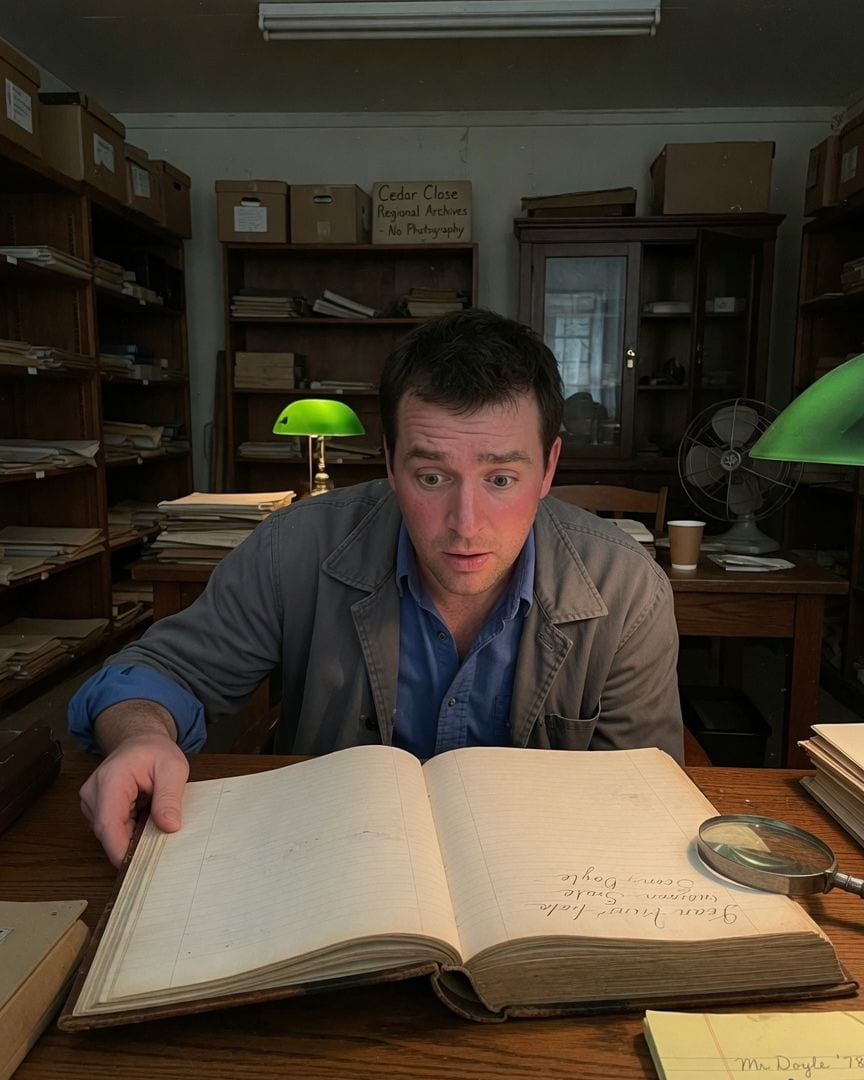
I found the elderly archivist, a man named Bernard Barlow, behind a towering desk, meticulously cataloging what looked like tax records from the 19th century.
I explained, as calmly as I could, what had happened. The boy, the apology, my car, the forum post.
I watched his face carefully as I spoke about the "pattern of apologies" and the specific mention of a "Mr. Doyle" from '78.
Barlow, initially dismissive, his gaze fixed on his papers, paused at the mention of the specific phrase, 'apology in advance.' His eyes, surprisingly sharp behind thick spectacles, narrowed slightly.
He slowly rose, his movements stiff, and shuffled towards a locked glass cabinet against the far wall.
He fumbled with a small brass key, the click echoing in the hushed room, and extracted a large, leather-bound ledger from the shelf. Its cover was worn smooth, almost polished, from years of handling, its pages brittle with age.
Barlow placed it on a heavy oak table, the thud resonating through the silent room, and carefully, almost reverently, opened it.
I leaned closer, my heart thumping a frantic rhythm against my ribs. In faded, elegant script, on a page that appeared almost blank, I saw it. My full name. 'Sean Doyle.'
Followed by a date from decades before my own birth.
I stared at the name, my name, frozen there on the brittle page. The air in the room felt suddenly thin, hard to breathe. "What is this?" I demanded, my voice tight, a raw mixture of fear and disbelief.
"This isn't possible. That date... I wasn't even born."
Barlow, his face grim, ran a gnarled finger down the page, past my name to others I didn't recognize. "It's a record," he said, his voice a low, raspy whisper. "Of those marked by the pattern.
A deep-seated resonance in the land, particularly around Cedar Close." He looked up, his eyes holding an ancient weariness. "It's not a curse, Mr. Doyle. Not a hex. It's more like a pre-ordained designation.
The land, or whatever intelligence lies beneath it, simply… marks certain individuals. Their names appear in this ledger."
He explained that the 'Apology In Advance' wasn't just a warning, but an echo. "Perhaps," he mused, "a facet of the pattern itself, delivered through those already pulled in. A kind of psychic residue.
Or maybe, a final, desperate warning from their fragmented consciousnesses, before they're fully… integrated."
He pointed to other names in the ledger, some with cryptic notes scribbled beside them in different hands, faded over time. 'Faded,' 'integrated,' 'lost.'
He flipped to a page near the back, revealing another name: 'Rosemary Holloway,' written beside a date from the 1970s.
"She was another," Barlow murmured, his gaze distant, "one of the last I ever really looked into, before I stopped trying to understand it all." I traced Rosemary's name, a cold certainty settling over me.
This wasn't some isolated incident, not a coincidence. This was a process.
"Has anyone ever escaped?" I asked, my voice barely a whisper.
Barlow shook his head slowly, his eyes fixed on the ledger. "Once marked, Mr. Doyle, the process begins. It's subtle at first. Intrusions. Then more direct engagement." He paused. "There's a channel. An old local radio frequency, long abandoned.
It activates sometimes. With whispers." He looked at me, a flicker of something like pity in his eyes. "Investigating only accelerates the process. It draws you in."
I left the historical society in a daze, the ledger's impossible entry burned into my mind. The weight of my own name, 'Sean Doyle,' suddenly felt suffocating, no longer just a label but a target.
Barlow’s warning about acceleration proved chillingly accurate. I started to feel an invisible pressure, a constant sense of being observed, a prickle on the back of my neck even when alone in my own home.
It began with small, unsettling 'confirmations': a window in the living room that I distinctly remembered latching before leaving for work, now slightly ajar when I returned; a book I’d been reading, left on my bedside table, now lying open on the living room floor.
I dismissed them as forgetfulness at first, the stress of the past few days playing tricks on me. But the pattern grew, becoming too precise, too frequent to ignore.
My phone would sometimes ring with no caller ID, just static on the other end. Or I'd hear faint whispers when no one was around, like a radio playing just out of earshot.
I tried to convince myself I was overtired, overthinking. But then, one morning, I found an anonymous note tucked into my mailbox, handwritten on a scrap of paper. It said: 'Have the apologies begun, Mr. Doyle?'
The specificity, the use of my name, the chilling implication that someone, or something, knew exactly what was happening, sent a jolt of pure terror through me. My hands shook as I crumpled the note.
I tried to call Barlow, desperate for his explanation, for any anchor in this madness. His landline rang unanswered, again and again. I drove past his house later that day.
All the lights were off, curtains drawn tight, the place looking utterly deserted. A cold knot tightened in my stomach. The net was closing.
That evening, as I tried to distract myself with television, my attempt at normalcy shattered. The screen flickered, not just a momentary glitch, but a full, abrupt disruption.
For a split second, an image flashed across the screen: the Cedar Close playground, distorted and grainy, like an old, damaged photograph, before snapping back to the normal broadcast.
I jumped, my heart hammering against my ribs, the blood roaring in my ears. I wasn't just investigating for answers anymore. I was no longer hunting; I was being hunted.
The next morning, I drove directly to Bernard Barlow’s house. Desperate, unnerved, I didn't even bother with the doorbell. I knocked repeatedly, a frantic rap, then tried the handle. To my surprise, the door was unlocked.
It swung inward with a soft creak. "Barlow?" I called, my voice trembling slightly, the sound echoing in the silent house.
The place was still, dusty, filled with the faint, cloying scent of mildew and something else—something metallic, like old electronics left running too long.
I found him in his study, a room even more packed with books and papers than the historical society. He was slumped in his armchair, a look of profound exhaustion etched on his face, eyes wide and haunted.
An old reel-to-reel tape recorder sat on the desk beside him, its spools stationary.
"Barlow, what's happening?" I demanded, the words spilling out, raw with my terror. "It's getting worse. The notes, the… the TV."
He looked up, his gaze unfocused for a moment, then it sharpened on me. "It's the channel," he whispered, his voice hoarse, "it's getting stronger. It knows you're looking, Sean. It knows you're marked."
He gestured weakly to the recorder, his hand shaking. "I've been trying to capture it, to understand its frequency. To hear what it says."
He reluctantly admitted the full extent of the pattern. "The 'channel' isn't merely a radio frequency," he explained, "it's a conduit. A resonance. It amplifies the echoes of those who have been 'integrated' into the pattern." He paused, breathing heavily.
"They are not dead, not exactly. But their individual identities... they dissolve. Their minds absorbed into a larger, unseen 'source' that permeates the land around Cedar Close. The apologies are fragments, residual warnings from their consciousnesses, trapped within the pattern.
Struggling to break through."
"Rosemary Holloway," I prompted, remembering the name from the ledger, a cold shard of ice in my chest.
Barlow nodded, his gaze distant, fixed on some unseen point in the dusty room. "Yes. She was one of the clearest. Before the silence. Before she was… taken entirely."
He fumbled with the reel-to-reel recorder, his movements slow and laboured, threading a worn tape onto the spools. "I recorded this decades ago. Just static, mostly. But sometimes…" He pressed play.
Static filled the room, a loud, sibilant hiss of white noise that made the air feel electric. I leaned in, straining to hear, my heart thumping a frantic drum. Then, faint but distinct, a disembodied voice broke through the static.
It was a slow, mournful whisper, almost a sigh: 'Rosemary Holloway.'
The sound was chilling, undeniably real. My breath caught in my throat. It confirmed everything Barlow had said, the impossible ledger, the channel, the pattern. All connected.
The child's apology, the damaged car, the anonymous note, the flickering TV, and now, this voice speaking a name from the past, a name already marked for silence. A profound chill, colder than any air conditioning, settled over me.
Still reeling from hearing Rosemary's name from the 'channel,' a shiver running down my spine, I insisted Barlow play more. "Anything else?" I urged, my voice tight, bordering on desperate. "Anything connected to me?"
Barlow, visibly distressed, his face etched with a deeper weariness, hesitated. His gaze flickered towards another dusty box on a shelf, filled with more reels of tape.
He slowly retrieved one, his hands trembling as he threaded it onto the machine. "This one," he mumbled, almost to himself, "I've never played for anyone. I shouldn't… it’s too close."
But I wouldn't let him stop. "Play it!"
He pressed play. More static filled the room, louder this time, almost a roar. It scraped at my nerves, a furious, chaotic sound that seemed to press in on my skull.
I leaned in even closer, straining to hear over the hiss, my ears aching. I heard a faint, distant murmuring, like a crowd of whispers just beyond comprehension, a cacophony of silent voices, all struggling to be heard.
Then, for a terrifying split second, the static briefly cleared. The same disembodied voice, the one that had spoken Rosemary's name, cut through the white noise with unnerving, terrifying clarity. It said, distinctly and intimately, 'Sean Doyle.'
My breath caught in my throat, a gasp I couldn't suppress. My entire body went rigid. The voice paused, a pregnant silence that stretched on for what felt like an eternity, the only sound the faint hiss of the tape.
Then it continued, softer now, a chilling whisper that seemed to echo inside my very bones: 'Sorry about the silence, Mr. Doyle. It's hard to speak from here.'
The machine clicked off, the sudden silence in the room deafening, absolute. The apology, delivered directly to me, by my name, for a 'silence' that hadn't happened yet, hung heavy in the air. A terrifying, impossible promise.
I stared at Barlow, unable to speak, the voice from the recorder still echoing in my mind, its impossible message searing into my consciousness. "What does that mean?" I finally managed, my voice raw, a threadbare whisper. "'From here'?"
Barlow, his face ashen, leaned back in his chair, seemingly depleted.
"The 'channel' is not just an echo, Sean," he explained, his voice low, "it's a direct link to the collective consciousness of those who have been 'integrated' into the pattern."
He closed his eyes for a moment, as if the vision was too much to bear.
"They are not dead, not truly, but their individual identities have dissolved, their minds absorbed into a larger, unseen 'source' that permeates the land around Cedar Close.
The apologies are indeed fragments of their former selves, struggling to warn, or perhaps just to fulfill the pattern's own strange, internal logic before their individuality is completely erased."
He ran his hand over the worn cover of the ledger. "This isn't just a record of victims, Sean. It's a list of those whose names resonate with the pattern's unique frequency, marking them as candidates for eventual absorption.
The damage to your car, the feeling of being watched, the anonymous notes, the impossible calls – all are steps in a process. They are designed to sever the marked from their normal reality, to prepare them for 'integration'."
Barlow flipped the ledger open, landing on Rosemary Holloway's entry. Beneath her name, in the same faded script, was a single, chilling word: 'Integrated.'
He then pointed to my own entry, my name, 'Sean Doyle,' and below it, a blank space. A space waiting to be filled. The dread solidified into a cold, hard certainty that settled deep in my bones: he was next.
I was next.
I refused to accept this fate. "There has to be a way out," I insisted, my voice edged with desperation, rising sharply in the quiet room. "Has anyone ever escaped?"
Barlow shook his head slowly, his gaze heavy with resignation. "The only escape is to never be marked. Once the apology is delivered, the process begins. It's a resonance, Sean, not something you can fight with force.
It's part of the land itself."
My gaze fell on the ancient ledger, its pages brittle, its secrets damning. A wild, desperate idea formed in my mind. "What if we destroy it?" I asked, my voice barely controlled. "It's the anchor, isn't it?
The record that cannot be, the thing that holds it all together?"
Barlow's eyes widened in alarm, a flicker of genuine fear in their depths. He pushed himself partially out of his chair, reaching for the book. "No! It's not an anchor, Sean, it's a record!
You don't understand the pattern; it's not a physical thing you can burn away!" His voice, usually raspy, rose to an unfamiliar shout.
But I was beyond reason, beyond hearing. The cold promise of 'silence' echoed louder than his warnings. I snatched the heavy ledger from the table, its old leather surprisingly dense in my hands.
Barlow weakly protested, a strangled sound in his throat, but I pushed past him, bursting out of the study and into the cool, indifferent night.
I drove wildly, my mind fixed on Cedar Close, the place where it all began, where Lily had swung so innocently in the sun.
I pulled up to the deserted playground, the swings swaying faintly in the breeze, a ghostly movement in the moonlight. My hands shook so violently I could barely hold the book.
I tore pages from the ledger, the brittle paper crackling like dry leaves, and fumbled with a lighter.
As the first brittle page singed and curled, a tiny flame catching on the ancient ink, the whispers from the 'channel' intensified in my mind.
They were no longer distant, no longer on a recorder, but a deafening cacophony of voices, all murmuring apologies, growing louder, closer, pressing in from all sides.
The playground around me seemed to twist, familiar shapes blurring at the edges of my vision.
The faint sounds of children's laughter from earlier in the day were replaced by the distinct, terrifying whisper of my own name, 'Sean Doyle,' coming from all directions, from the trees, from the empty slide, from the very air itself.
A cold, unseen presence pressed in on me, suffocating.
The ledger, or what was left of it, eventually burned to ash on the damp ground of Cedar Close playground. I survived the night, physically unharmed, but the silence that followed wasn't normal.
The cacophony of whispers didn't vanish entirely; they receded, becoming a persistent hum at the edge of my hearing, a constant, low-level static in my mind. It was always there, a phantom limb of sound.
I moved away from Cedar Close, far from the influence of the pattern, hoping to outrun the resonance. I sold my house, changed my phone number, severed ties with anyone who knew my old address, my old life.
But the name, my name, still felt heavy, a target etched into something deeper than memory. I knew I was still marked, just temporarily delayed.
The silence I had heard an apology for had not come, not yet, but it lingered, a constant, unsettling promise.
I live a quiet, isolated life now, hundreds of miles from Cedar Close. I avoid playgrounds, old ledgers, and any unusual calls or static on the radio.
I sometimes wonder if the boy, the one who first apologized, is still there, a perpetual messenger, delivering warnings to the next marked name. I know I survived, but I was not saved.
The hum of the 'channel' is a permanent fixture in my peripheral awareness, a soft, almost imperceptible whisper that only I can hear.
I hear my name sometimes, faintly, on the wind, a whisper of an apology for something that has yet to happen, for a silence I know will eventually come for him.
He has learned to live with the dread, the terrible intimacy of being singled out, knowing that his name, like so many others, waits for its final entry. He simply waits.
If this one got to you
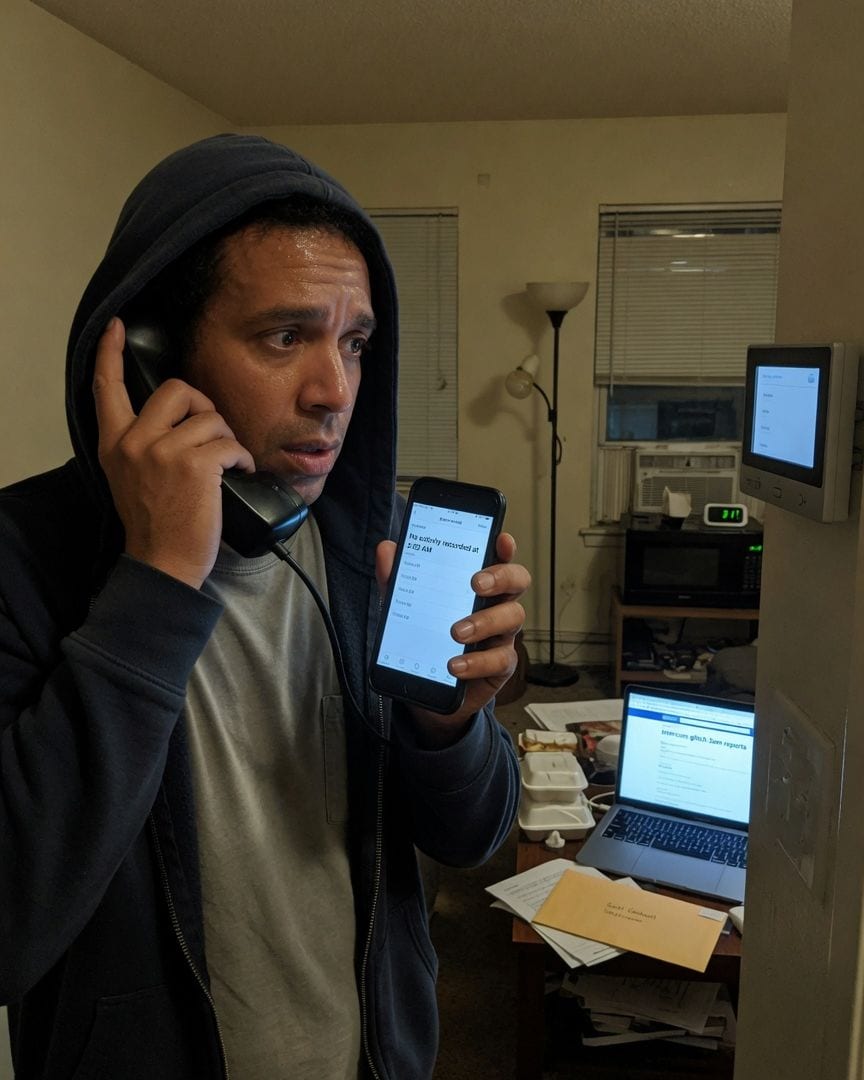
A calm voice apologized for Thursday at 3:03 AM. My intercom screen was blank. The next day, a man stopped me to repeat the apology.
My intercom buzzed at 3:03 AM, startling me awake. A calm voice apologized, "it's about Thursday," but the screen was blank. When I checked the building's entry log, there was no record of any call, not even a ghost. It was like a message delivered from nowhere, meant only for me.
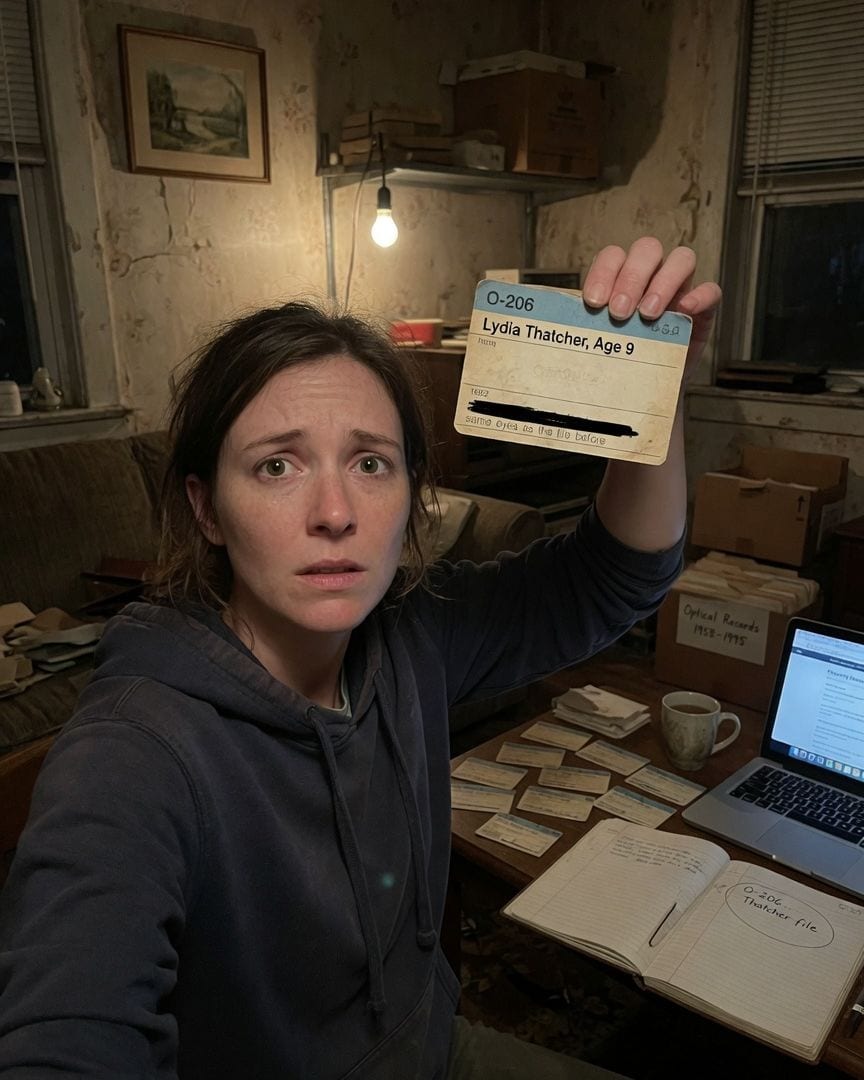
My own optical card is dated 1962, with my name on it. I wasn't born until 1993.
Sifting through old patient files from my former optical practice, I found my own O-206 card. It had my name, Lydia Thatcher, and my current home address printed on it. But the card was dated 1962, decades before I was even born, and a redacted note mentioned 'same eyes.'
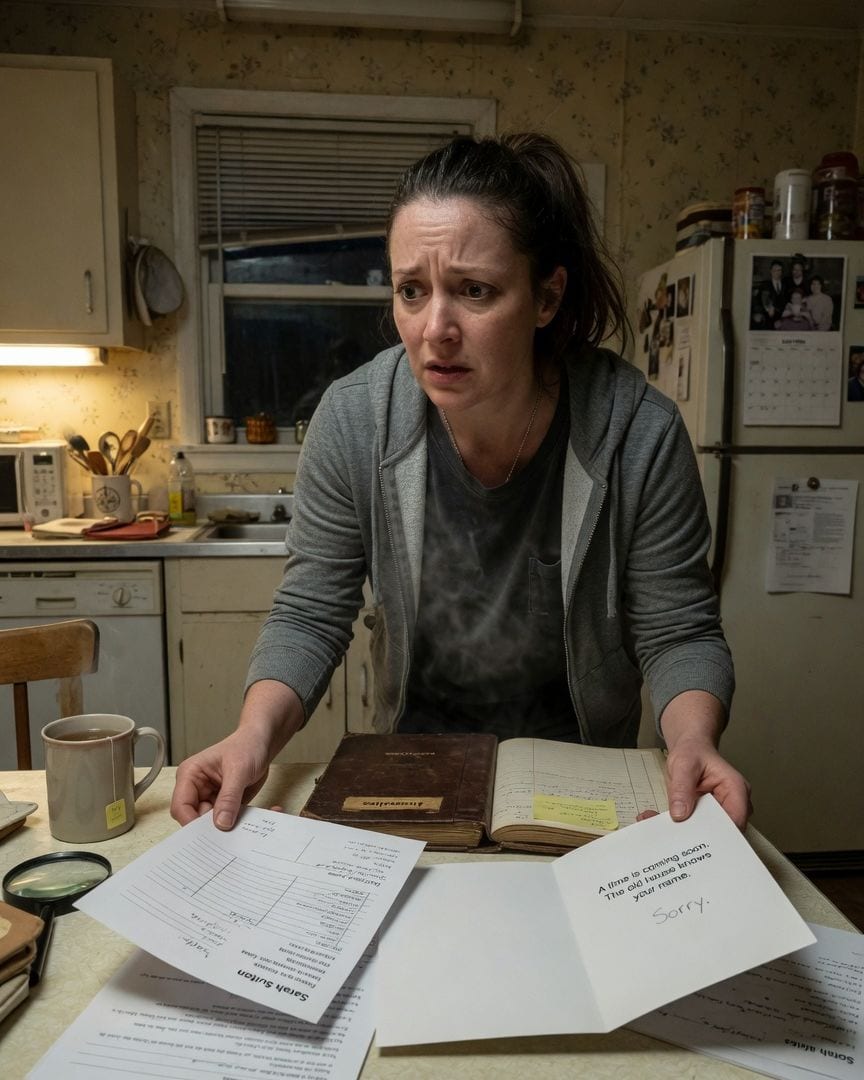
My name sits in the 1966 electoral register. My house, my exact name. Someone pencilled 'sorry' in the margin.
I was sifting through dusty microfiche, tracing my family line for my childhood home, when I found it. The 1966 electoral register for my address listed my exact name: Sarah Sutton. My heart hammered. I wasn't born until 1988; this was thirty-five years before I existed.
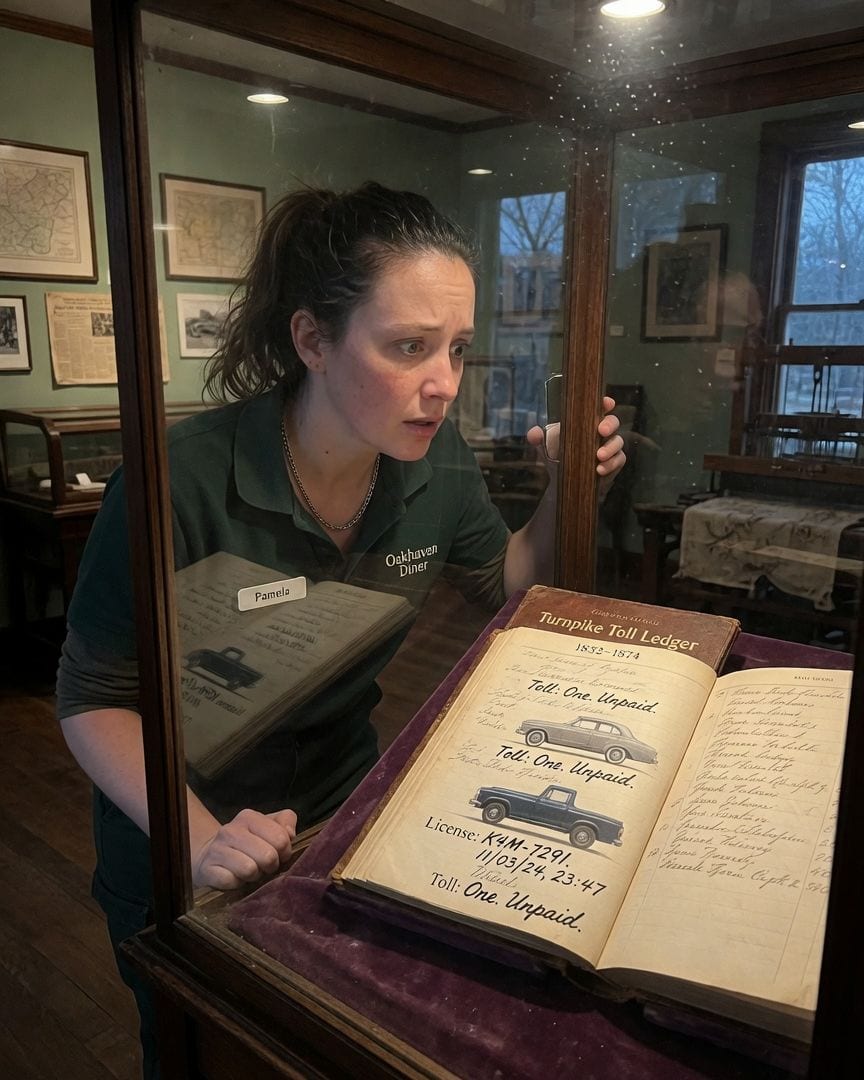
My car stalled at the old turnpike milestone, after dark. The toll ledger, closed in 1874, then listed my car, my stall time, and a toll of one, unpaid.
I had just moved to Oakhaven when my old sedan died on a dark, winding road by an infamous turnpike milestone. The next day, I found my car's exact registration and stall time written in fresh ink in a 150-year-old, locked museum ledger, marked 'Toll: One. Unpaid.' The curator dismissed it as a prank, but her white knuckles and strained voice hinted at something far more unsettling.
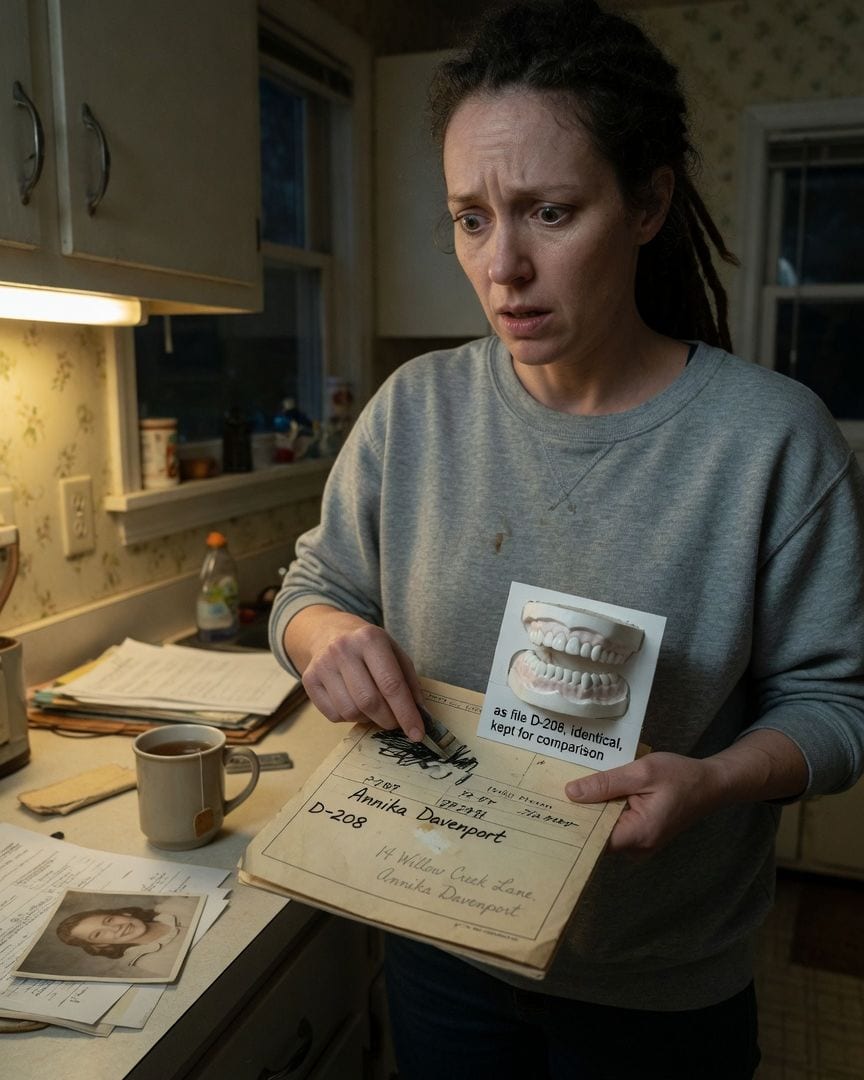
My childhood dental chart lists the house I bought last year — in my own name, years before I was born. A second set of my teeth sits filed beside it, marked 'identical.'
Sifting through old dental records, I found my chart, D-208, with my 1988 birth date. But a line from 1958 was blacked out, and a clipped card with an impression of my teeth listed my name and current home address, decades before I was born. The impossible facts knotted into a cold certainty.
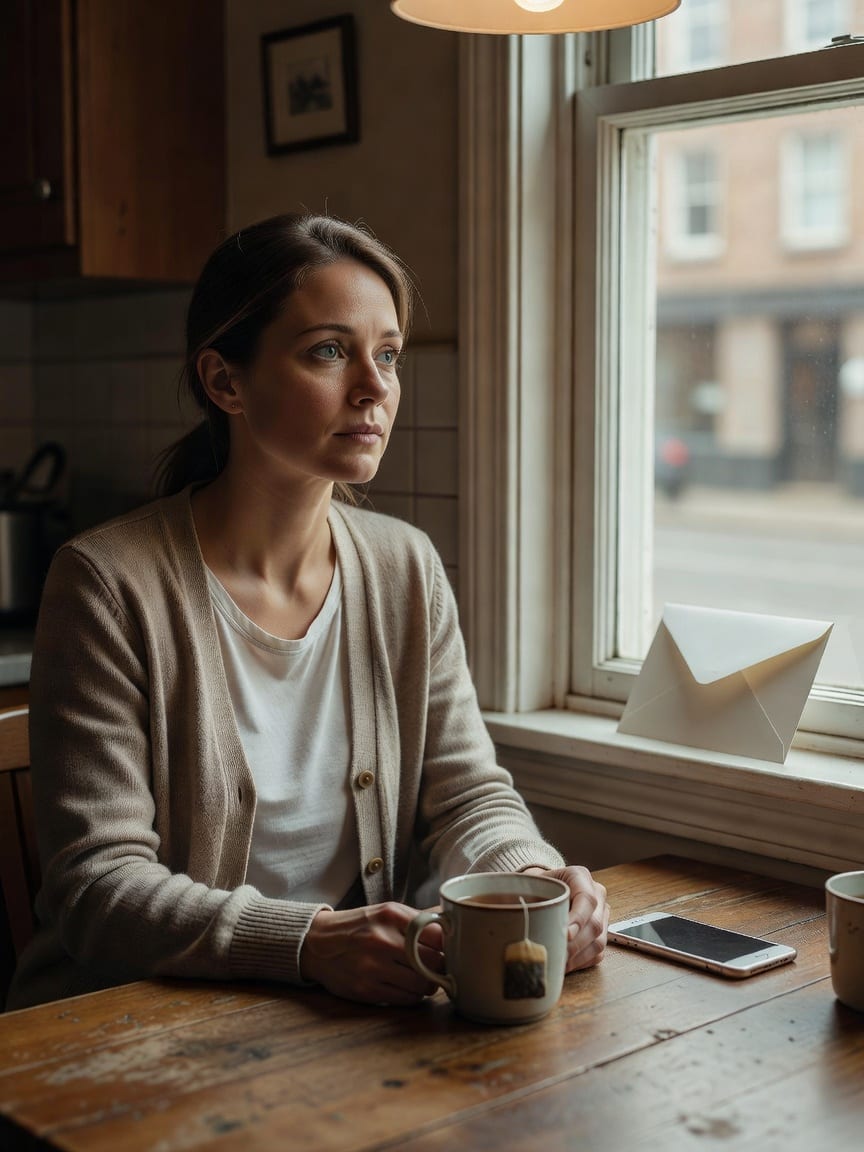
My taxi driver knew my name before I spoke, then apologized for the flight I was going to miss. I was arriving. The cab's plate was scrapped four years ago.
After a strange taxi ride, I received an unsettling birthday card addressed to me. Its return address listed 'Old Mill Road Field,' an empty lot where a mill once stood, and it was postmarked locally. The card arrived four months before my actual birthday, sparking a cold dread I couldn't ignore.