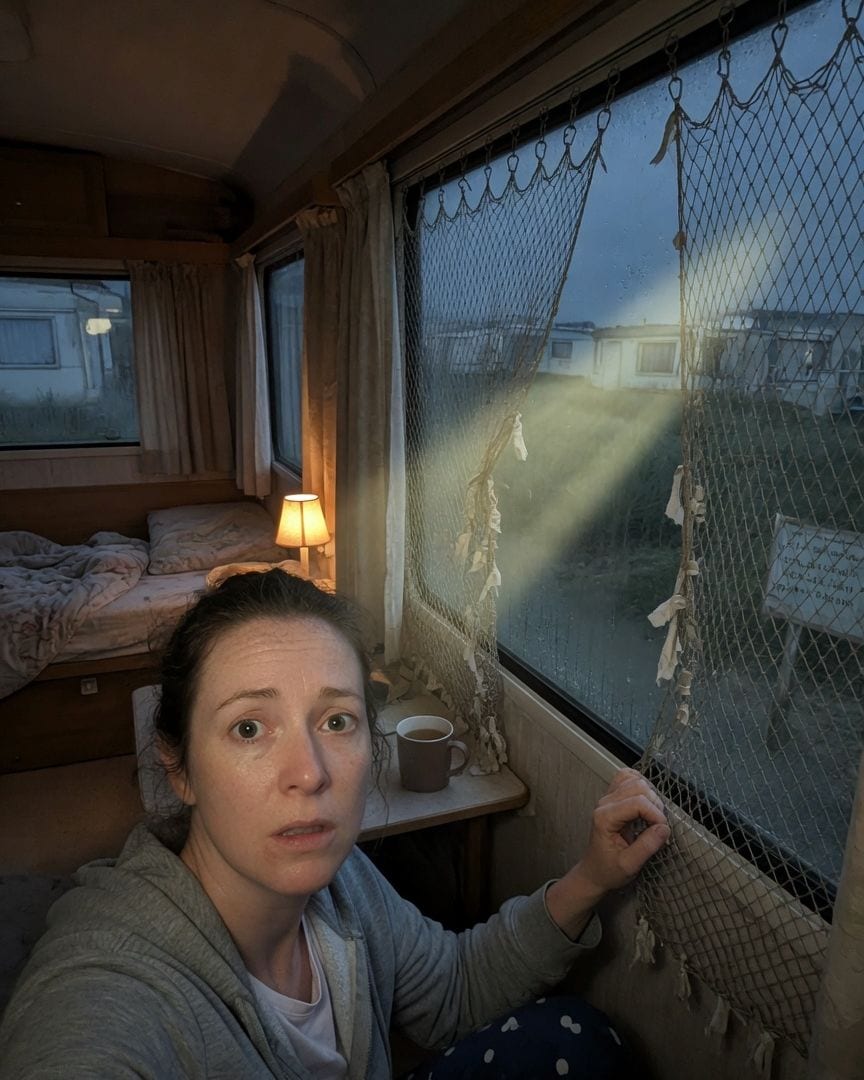
My caravan's seaward curtain was wide open. Fifteen minutes later, it was drawn tight, the hooks ripped outwards from the sea.
The first week at Seawall Sands Caravan Park was exactly what I’d hoped for: quiet, salty air, and the distant murmur of the sea. My little caravan, number 14, was in the seaward-most row, facing directly onto the low dunes.
A prime spot, I thought.
I’d seen a faded, hand-painted sign on the shared standpipe near my pitch, the kind of local quirk you find in these sleepy coastal towns: 'Last van in the row draws the curtain on the seaward side by nine.'
I’d smiled, imagining some fussy old-timer enforcing a neighbourly courtesy. Old habits die hard, I suppose. Being the last arrival in my row, I was, by the unwritten rule, 'the last van.'
But that first evening, after a long drive and setting up, I was simply too tired to remember. I drifted off around 9:15, the seaward window of my caravan wide open, just a thin net curtain for privacy.
I woke with a start around 9:30. Not a noise, but a distinct shift in the light. A slow, sweeping beam, broad and low, was gliding across the caravan park.
It wasn't the focused beam of a car, nor the intermittent flash of a fishing vessel. It was something else entirely, too diffuse and deliberate, moving with a silent, unnatural grace.
I sat up, a prickle of unease on my skin. This stretch of coast didn't have a lighthouse, I’d checked. There was nothing out there that should be emitting such a light.
As it passed, I noticed the other vans in my row. Every single one of their seaward curtains was already drawn tight, a uniform line against the gathering gloom. A wave of cold, unreasoning dread washed over me.
I turned to my own window, and my breath hitched. The curtain, the thin net one I’d left open, was now closed. Drawn tight against the glass. And the metal hooks that held it to the rail?
They were bent outwards, twisted sharply, as if something had ripped them from their eyelets from the outside, then smoothed the fabric shut.
I tried to be rational. The wind, maybe. A sudden gust, though there hadn’t been a breath of air that night. Or perhaps a local kid, playing a prank, enforcing their 'curtain rule' with an overly enthusiastic shove.
But the hooks were bent outwards. Not pulled in, but forced from the sea side. I got out of bed, my feet cold on the lino, and tried to re-hang the curtain.
The hooks were too badly twisted, warped into useless metal pretzels. I swore under my breath, stuffing them into a drawer.
The next morning, over coffee, I spotted Oscar Prescott, the site manager, a man in his sixties with kind eyes usually.
I tried to make light of it, mentioned the 'quirky' standpipe rule, and how my curtain had been 'pulled shut' last night. I expected a chuckle, a knowing shrug about local eccentricities. Instead, Oscar’s face tightened.
His gaze, usually so open, flickered away. 'Ah, yes, Miss Rutherford,' he muttered, his voice unusually strained. 'Local quirks, indeed. The sea air, it… it does funny things sometimes.'
He quickly changed the subject, asking if I needed anything from the shop. It was a practiced deflection, too smooth.
Later that week, I saw Oscar again. A new arrival, a young couple, were pulling their small camper onto an empty pitch a few rows back. I watched as Oscar, gesturing vaguely, quietly but firmly redirected them.
They'd been eyeing a perfect spot, directly in my seaward row, next to my van. Oscar insisted they’d be 'more comfortable' a few rows back, closer to the facilities. The couple, looking confused, eventually complied.
There were still plenty of empty pitches on my row, pristine and ready. Oscar's movements were too smooth, too practiced, almost a dance of polite but firm insistence.
It wasn't until a few days later, my bike chain needing oil, that I finally got a chance to act on a growing suspicion.
I’d seen Oscar's shed door ajar, and inside, beneath a stack of old tools, a rolled-up piece of paper had caught my eye. It looked ancient, faded, entirely out of place amongst the grease and rust.
That evening, I made sure Oscar was busy at the office. I took my time returning the wrench I'd borrowed, then lingered by the shed. My heart pounded a ridiculous rhythm against my ribs as I slipped inside.
The air was thick with the smell of damp earth and old metal. I found the map exactly where I’d seen it, dusty and forgotten. I quickly retrieved the rolled-up parchment, tucking it beneath my jacket.
Back in the relative safety of my small caravan, I locked the door and spread the map out on my tiny table, smoothing the brittle, yellowed paper with trembling hands.
It was a beautifully detailed, hand-drawn map of the local area and, unmistakably, the caravan park. The pitches, the main road, the dunes – all familiar. My finger traced the layout of the rows, then stopped dead.
Over the seaward-most row, precisely where my caravan sat, there was a dark, irregularly shaped 'exclusion zone,' marked not with words, but with a series of unsettling, almost organic-looking cross-hatchings.
It stretched from the coastline, directly over my pitch, a sudden, cold dread settling deep in my bones that had nothing to do with the damp air of Oscar's shed.
The next morning, I confronted Oscar Prescott with the map. I found him tidying the communal garden, deadheading some wilting roses. 'Oscar,' I began, trying to keep my voice even, 'what exactly is this?'
I unfolded the map, pointing to the disturbing cross-hatchings over my row. His face, usually placid and tanned from years in the coastal sun, visibly tightened. His eyes, for a split second, went entirely blank before snapping back, hard.
He snatched the map from my hands, his movements jerky, uncharacteristic. 'Miss Rutherford,' he said, his voice low and strained, almost a hiss, 'some things are best left alone. This is an old curiosity, nothing more.
I can find you another site, if you're not comfortable here.' The words were quiet, but the meaning was clear: a threat of eviction, disguised as concern.
Shaken, but more determined than ever, I tried a different approach. I started asking other long-term residents, mostly retirees, about the map and the 'exclusion zone.'
I described the strange light, the bent hooks, all in an attempt to gauge their reactions. Their answers were uniform, too smooth.
'Oh, that's just an old story,' one woman, a Mrs. Henderson, offered, her eyes skittering away from mine as I mentioned the light. 'Children's tales,' a Mr. Finch chimed in, quickly turning his back to prune a rosebush.
No one would meet my gaze directly. Their smiles were brittle, their dismissals rehearsed. It was like they were reading from the same script.
The town, or at least this park, felt like it was humming with a shared, unspoken agreement. Frustrated by the wall of polite evasion, I decided I needed to go further afield.
I drove into the small town of Seawall Sands, seeking out Julian Abbott, the local archivist.
Surely, in the town’s dusty records, I’d find some historical context, some forgotten explanation that could rationalize this bizarre map and the town’s unnerving consensus.
Julian Abbott, a man in his mid-fifties with spectacles perched on his nose, was initially accommodating. He seemed intrigued by the old, hand-drawn map. He spread it out on a large table in the archives, his fingers tracing the coastline.
'Remarkable detail for a local map,' he murmured, pulling out a magnifying glass. He promised to look into any historical references to such a zone.
But then, as I specifically mentioned the 'exclusion zone' and the caravan park's seaward row, his demeanor shifted. The professional curiosity vanished.
He became evasive, his replies clipped, his eyes darting to the clock on the wall as if he suddenly had an urgent appointment. 'I'm afraid I can't find anything immediately,' he said, pushing the map back towards me.
'Perhaps it's just a cartographer's whim, an error.' But the dismissal felt too quick, too dismissive.
As I left the archives, I couldn't shake the distinct feeling of unease. A sense of being observed, not just in the archive, but throughout the park.
I started noticing the same few faces, often elderly residents, watching me from their own caravan windows. A curtain would twitch just as I walked past, or a newspaper would lower slightly.
It was subtle, almost imperceptible, but it happened too often to be coincidence. Then, one morning, I found a folded note slipped under my door.
The paper was brittle, yellowed with age, and the handwriting was shaky, old-fashioned, as if penned by a very old hand. It simply said: 'Some rules are warnings, not stories. Don't look for what's gone.'
The message unnerved me more than any direct confrontation. Someone knew exactly what I was looking for. Someone wanted me to stop. The danger was no longer an abstract fear of the unknown; it was personal, and it was watching.
Clutching the warning note, my heart hammering, I walked directly to Grace Maddox’s caravan. Grace, an elderly woman in her eighties, was the oldest resident in the park, known for her sharp memory and even sharper wit.
She sat in her armchair by the window, knitting. I showed her the note, then the map, laying out my observations about the light, the hooks, Oscar's evasions, the town's silence.
Grace, initially silent, her eyes distant, her hands still, finally let out a slow, deliberate sigh. 'The town has always known,' she whispered, her voice raspy, a dry whisper that seemed to echo generations of secrets. 'About the light.
About the rule.' She explained that the 'light' was the presence, and if the curtain wasn't drawn by the last van in the seaward row, 'it takes something back.'
She described a cycle, generations of quiet agreement, of keeping the peace. 'It’s why we all agree,' Grace said, her gaze fixed on something beyond the window, 'to protect what’s left.'
Her words were delivered with a chilling matter-of-factness, as if discussing the weather. She told me that after each cycle, after each 'taking,' a specific 'proof' was left behind.
Something impossible, but undeniably real, which the town then quietly hid away. As Grace spoke, the map's 'exclusion zone' snapped into horrifying focus for me. It wasn't an arbitrary mark, or a cartographer's error.
It was a precise delineation of the presence's domain, a line drawn by something inhuman.
Grace Maddox, her eyes holding a deep, ancient sorrow I now understood, went on. 'The proof,' she said, her voice barely audible, 'is always left in the same, specific place after a taking. Something that shouldn't exist, but always does.'
She then reached into a small, intricately carved wooden box beside her armchair and pulled out a framed, faded photograph.
It was a group photo, taken on a sunny day, by the seaward row of the caravan park, clearly many years ago.
People were gathered, some smiling, others looking grim, their faces etched with a familiar, unspoken dread that resonated with Oscar’s and the other residents’ expressions.
Grace pointed a trembling finger to a young woman in the photo, her smile too bright, almost forced. 'She was the last one to forget the curtain,' Grace whispered. 'Martha Reynolds.'
Then, her finger moved, slowly, chillingly, to an empty space next to Martha, a subtle gap in the otherwise close-knit group. Grace’s voice dropped to a whisper so low I had to lean closer to hear it.
'And she was next. Just before the next cycle began.' My blood ran cold. The photograph wasn't just a memory; it was a chilling record of a pattern.
And the empty space in that faded image, next to a woman who had vanished, implied a future victim.
I rushed back to Julian Abbott, the photograph and Grace’s words burning in my mind, a frantic, desperate energy propelling me forward. I found him at his desk, pretending to be busy with some dusty ledgers.
I confronted him, the faded photograph clutched in my hand. 'Julian,' I said, my voice barely steady, 'Grace Maddox told me everything. The cycles. The takings. The proof. Where are the records you’ve been hiding?'
He flinched, his composure finally cracking. He looked around, then sighed, a sound of resignation. 'She told you, then,' he mumbled, running a hand over his thinning hair. 'It was only a matter of time.'
Under my relentless pressure, Julian finally gave in. He led me to a dusty, locked cabinet in the back of the archive, hidden behind a tall bookshelf. The lock was old, brass tarnished green.
Inside, Catherine found stacks of old newspaper clippings and town ledgers, brittle with age. My hands trembled as I sifted through them, the smell of old paper filling the air.
There it was, laid out in chilling detail: a horrifying pattern of missing persons reports and unexplained disappearances from the caravan site, specifically from the seaward row, occurring roughly every 25 years.
Always around the same time of year, late spring, when the sea winds picked up and the light stretched long. The dates matched Grace's cycle, with terrifying precision.
The names from the reports aligned with the faces in Grace's faded photograph, people who had simply vanished. And the 'exclusion zone' on the map? It was the precise area from which these individuals had vanished.
The quiet local agreement, the too-smooth stories, Oscar’s warnings – it all cohered into a terrifying, undeniable truth. The latest missing person report was Martha Reynolds, dated 1998.
Julian admitted, his voice hollow, that the 'proof' Grace mentioned was an impossible artifact, always found near the site of the taking, a personal item of the vanished, but fundamentally changed.
Armed with the full, chilling truth, I returned to Grace Maddox. The air in her small caravan felt heavier now, charged with generations of fear and quiet dread.
'The artifact,' I said, my voice steady despite the tremor in my hands. 'Where is it? The proof?' Grace, her face a roadmap of ancient sorrow, nodded slowly.
Her eyes, clouded with age, met mine with a shared understanding, a silent recognition of the burden I now carried.
She pushed herself up from her armchair with a grunt and slowly, carefully, led me to a concealed compartment beneath her own caravan floor, hidden by a loose, warped floorboard.
Inside, wrapped in layers of old, faded cloth, was a small, tarnished silver locket. It was engraved with the initials 'M.R.' — Martha Reynolds. But as I took it, my breath hitched, a gasp caught in my throat.
The locket wasn't silver at all. It was made of perfectly smooth, jet-black stone, impossibly heavy and cold to the touch, yet it gleamed with the dull luster of polished metal. It was beautiful, terrifying.
On the back, etched with startling precision, was the date '1998'. The ordinary explanation died completely, leaving behind an awful, stark vacuum.
This artifact, solid and undeniable, could not exist, yet it was here, in my hands, a tangible piece of impossible dread, confirming every whispered warning, every hushed silence, every disappearance.
The black stone locket sat on my small caravan table, a silent, heavy sentinel. Its impossible weight pressed down on the flimsy surface, a constant reminder.
The caravan park returned to its quiet rhythm, the sea wind sighing over the dunes, but for me, nothing was the same. Oscar Prescott avoided my gaze, his face a mask of careful neutrality whenever our paths crossed.
The other residents, the ones who had given me the too-smooth answers, now watched me with a new, unsettling silence, a knowing acknowledgement in their eyes that I was no longer an outsider.
The faded rule painted on the standpipe, 'Last van in the row draws the curtain on the seaward side by nine,' seemed to gleam brighter now, a stark, ever-present reminder of the pact, of what could be lost.
I learned to draw my curtain by nine, every single night, watching the sea.
If this one got to you
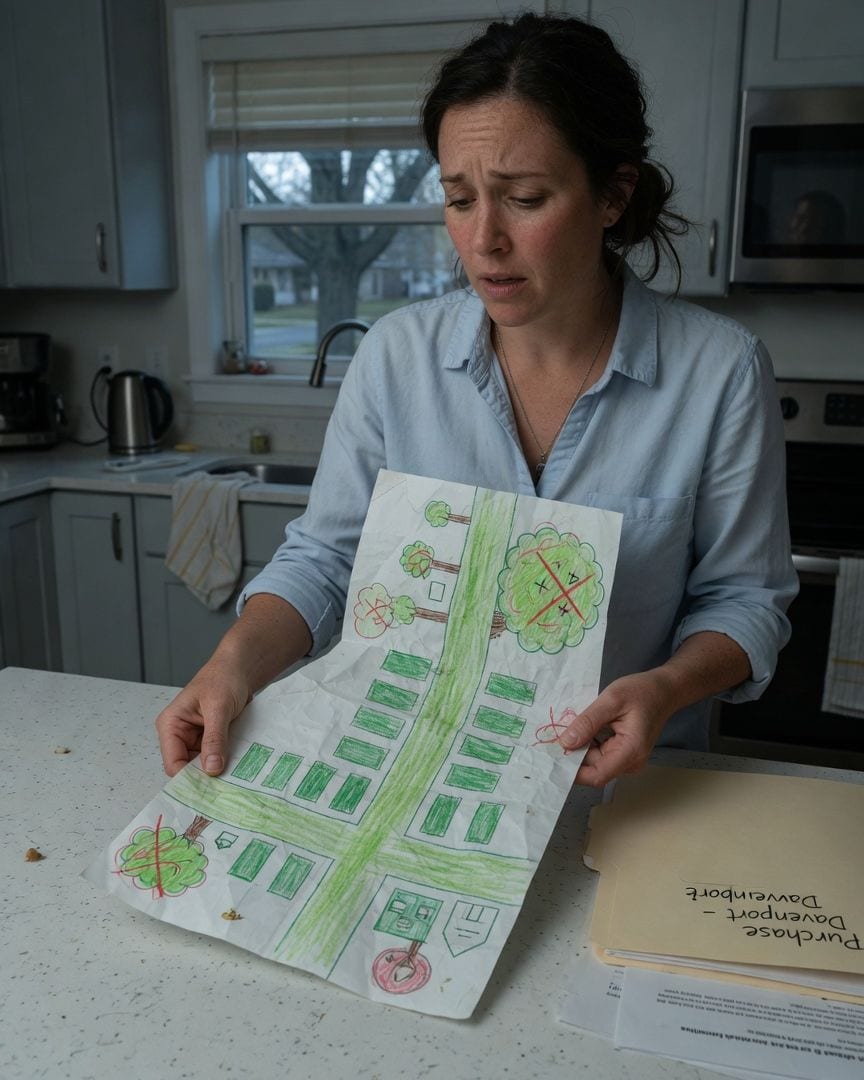
A hand-drawn map keeps arriving through our letterbox — every space on the lane marked green, except the one spot under the old lime tree, alone in red. The agent made us swear we'd never park there.
My new house came with a strange local quirk: weekly maps slipped through my letterbox, each one marking a specific parking spot with an angry red X. A legal addendum about the spot, and my neighbors' evasiveness, made me uneasy. But nothing prepared me for the ancient, identical map I found, which marked my own house with that terrifying red X.
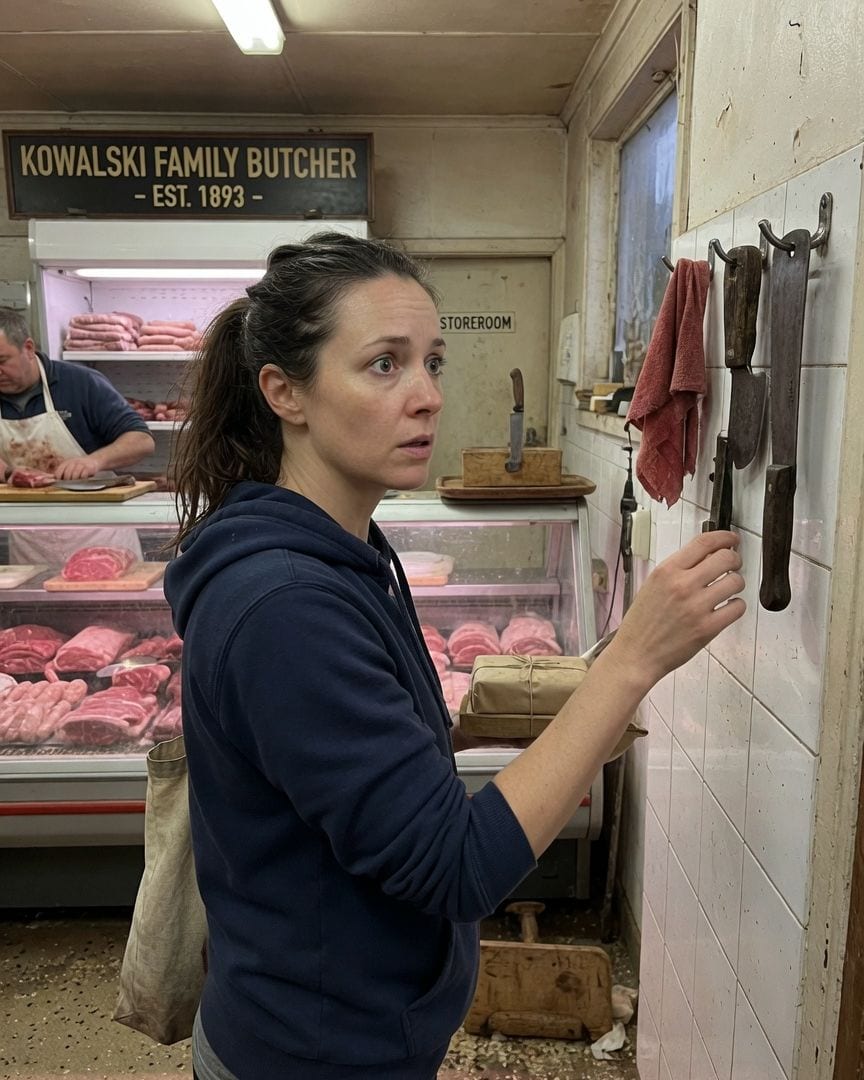
The butcher's back hook always hangs empty, draped with a red cloth. It holds a standing order since 1911 for the Hall, which burned down before the first war. The meat is gone every Friday, but no one's seen a cart.
Still new to Longnor, I stepped into Oscar Kowalski's butcher shop, needing a place to hang my bag. My hand brushed a simple hook, but Oscar's knife suddenly thudded, and he snapped, 'Not that one, dear.' He insisted the empty hook was 'reserved,' leaving me with a strange prickle of unease.
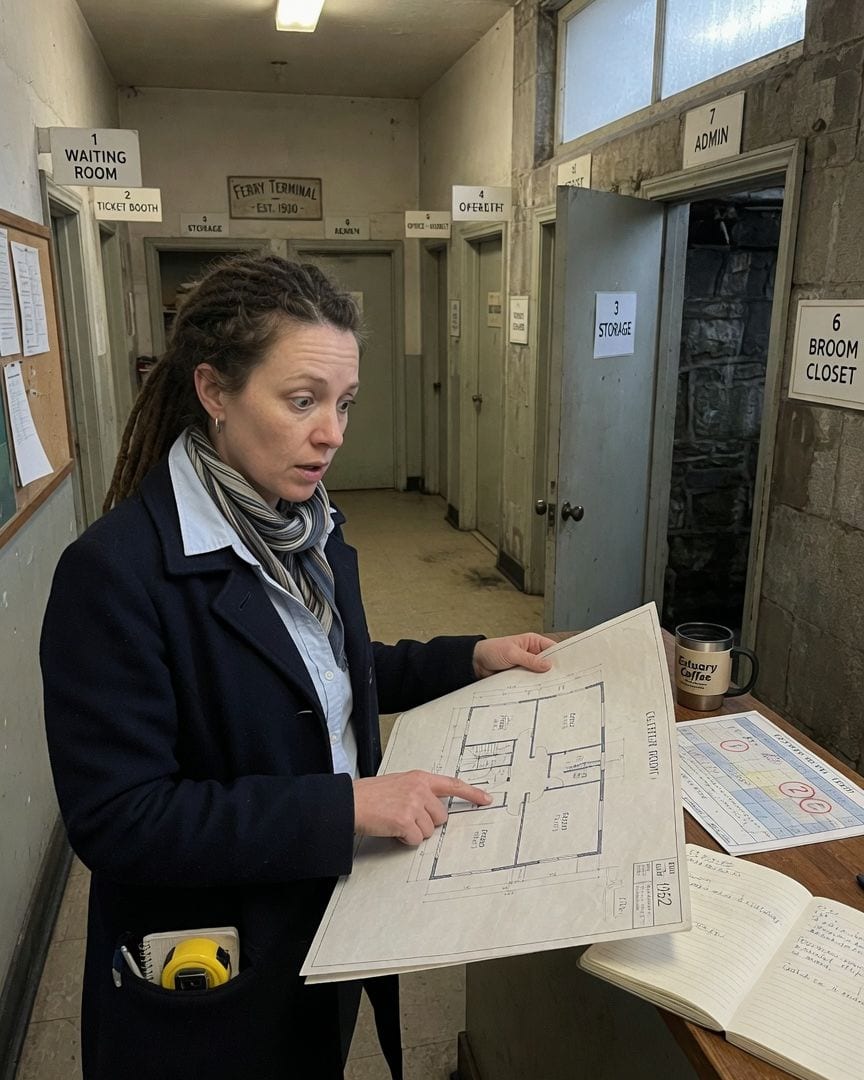
Our ferry returned to the same slipway three times yesterday, the town quay dissolving to our village shore. The crossing was never made.
After our ferry inexplicably kept returning to shore, I investigated the old office building. Its architectural plans clearly showed six rooms, but when I walked the hallway, I found a seventh door. That extra room was undeniably there, an impossible presence.
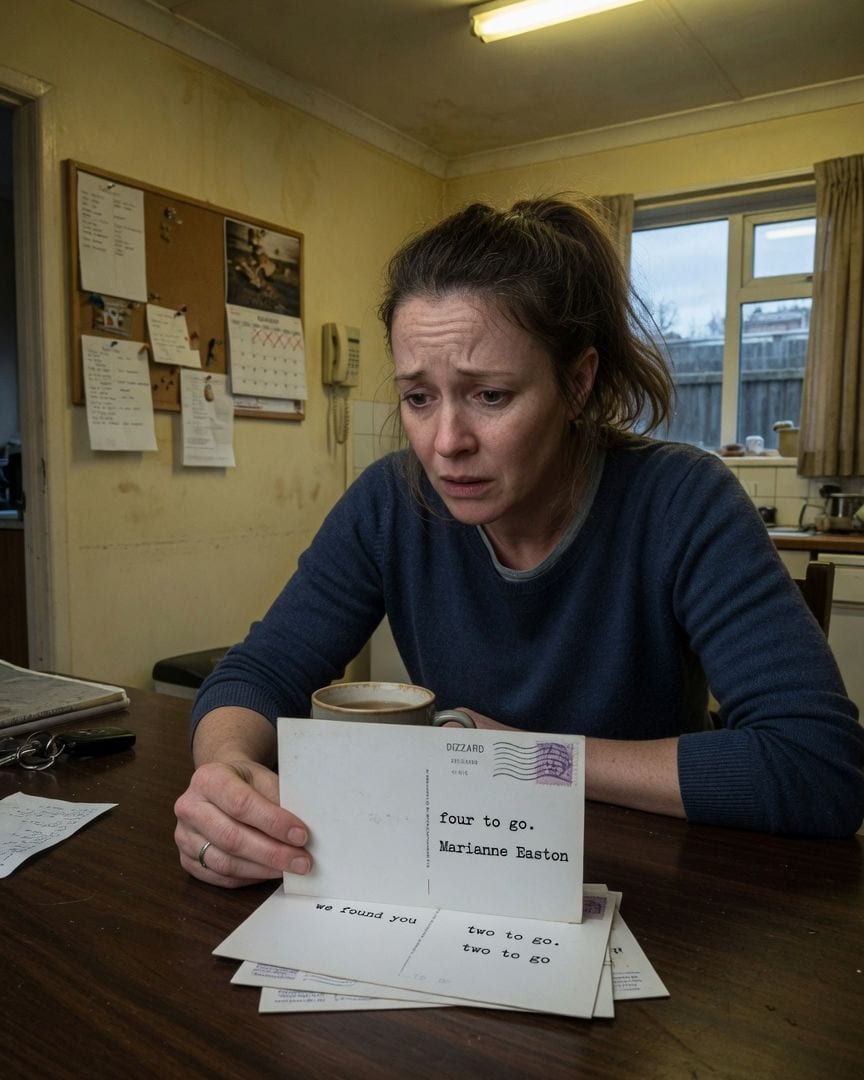
My postcards arrive each Friday, addressed by name, counting down. This week's says 'four to go,' postmarked from a cliff with no postbox.
Every Friday, stark white postcards arrive on my kitchen table, addressed to me. Each one is postmarked 'Dizzard,' a desolate cliff miles from any town, with no post office. For weeks now, they've been counting down.
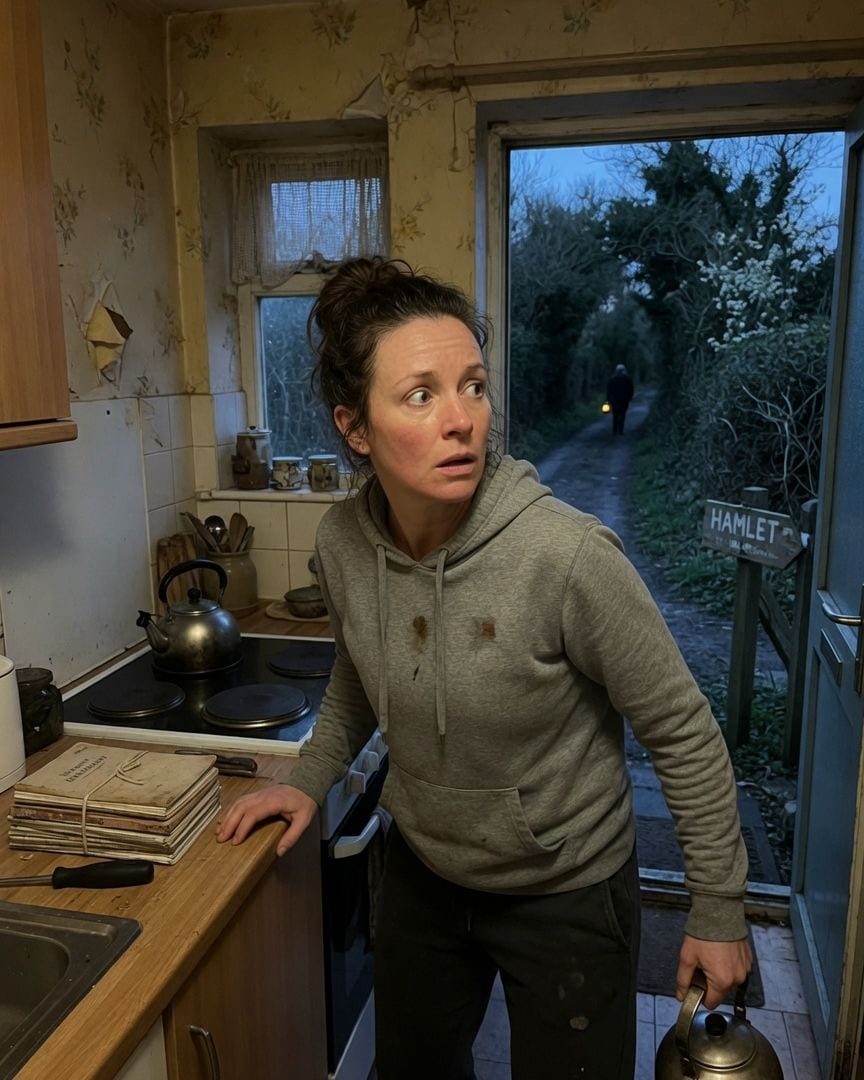
My side gate opens onto a dirt lane between hedgerows, not the close, and a figure with a lantern comes up it toward me.
My side gate normally opens onto the familiar tarmac of the close, but lately, it's opened to a narrow, overgrown dirt lane instead. Three times now, at dusk, I've seen a man with an old-fashioned lantern walking unhurriedly up this impossible lane towards my house. Each time, when I dare to look again, the lane is gone, leaving only the bins and a racing heart.
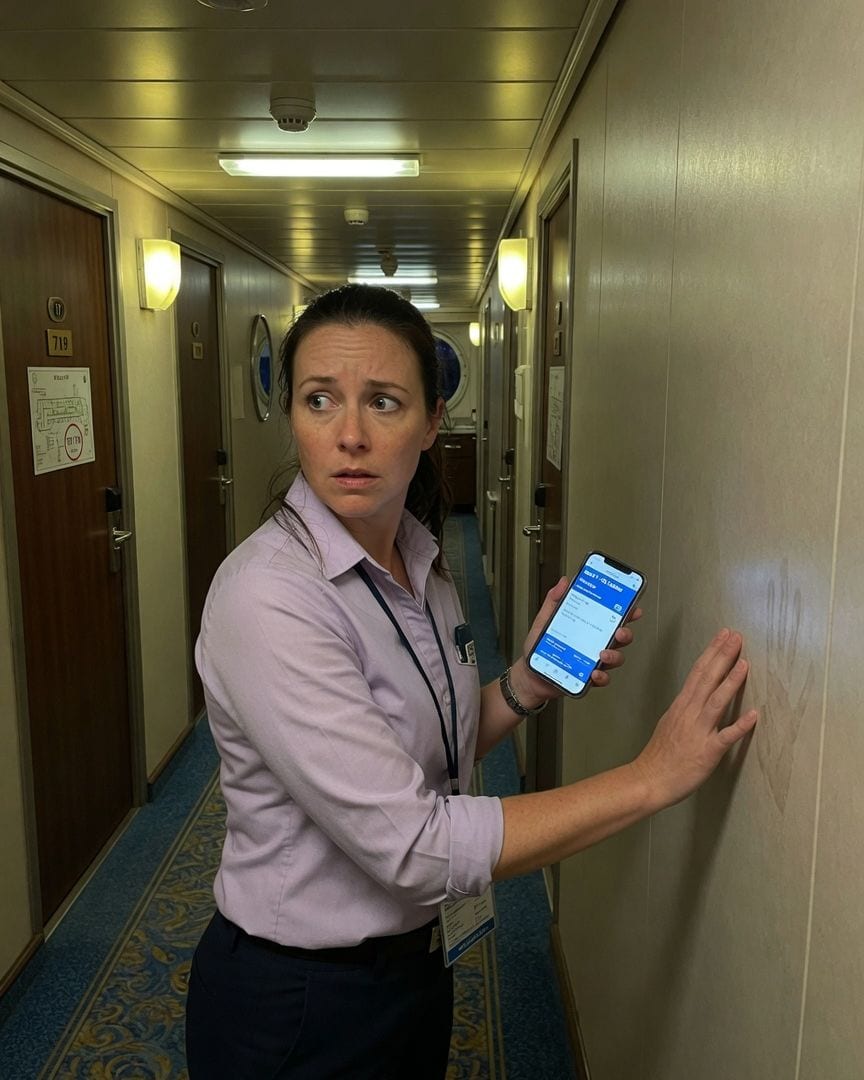
My cruise cabin's evacuation plan shows nineteen doors. I just walked past twenty, with a wet handprint on the twentieth.
On 'The Oceanic Wanderer', I found an extra cabin on Deck 7, complete with a fresh, wet handprint on its frame. The purser denied its existence, and later, the cabin itself vanished, leaving a blank wall. But then I found a damp, ancient map of the deck, tucked under my door, clearly marking the impossible twentieth cabin.