Chaplain's Assistant Moss found Private Kirby's commendation for a mission, dated three days *before* he reappeared from the desert.
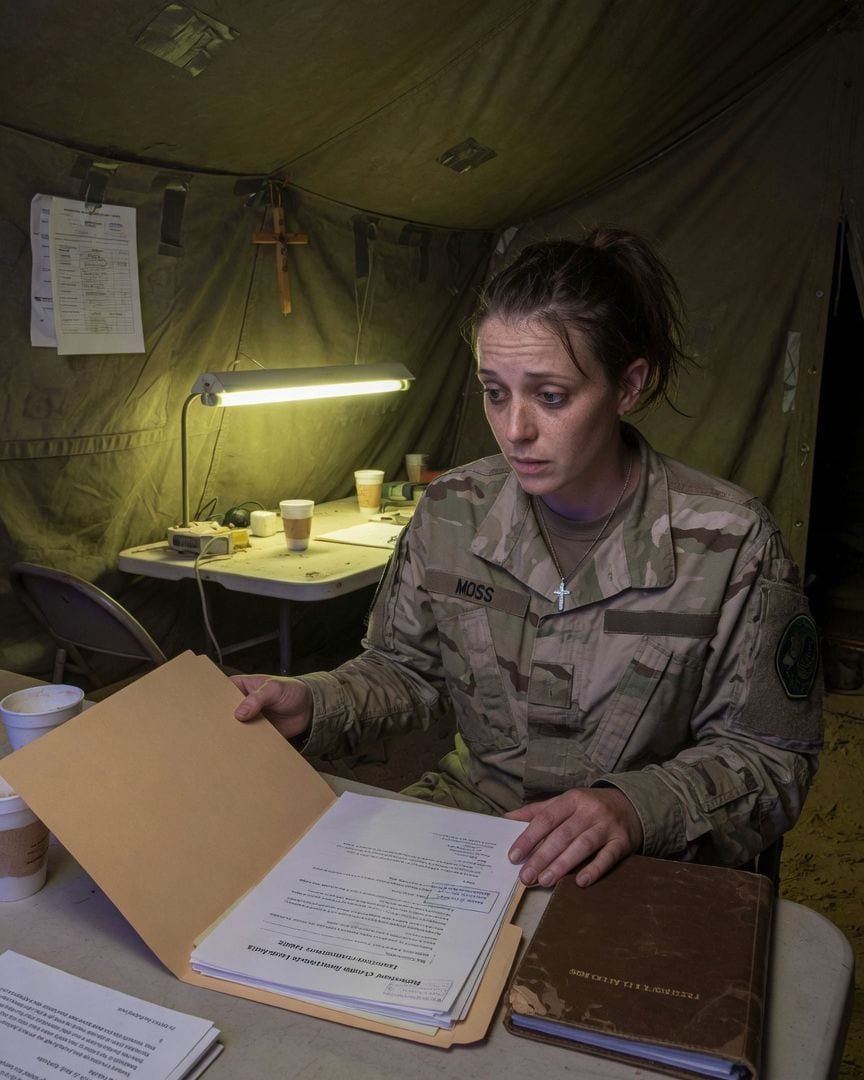
The canvas tent of the field chapel hummed with the drone of the generator. Chaplain’s Assistant Rosemary Moss knelt beside Private Kevin Kirby, as she had at every service for the past year.
Kirby, a lanky kid with an infectious grin, always crossed himself left-to-right, the wrong way round, and chuckled about his mother teaching him backward. It was a small, comforting ritual Moss had come to expect.
Three weeks ago, Kirby had gone missing during a desert patrol, only to reappear, gaunt and grateful, just yesterday. Today, under the flickering lamps, as the Chaplain began the benediction, Moss watched Kirby raise his hand.
He crossed himself right-to-left, clean and correct, then bowed his head. Moss waited for the old joke, the quiet, self-deprecating laugh. It never came. Kirby prayed, his face serene, as if he’d been doing it that way his entire life.
The familiar, endearing quirk was simply gone, replaced by an unnerving, perfect conformity.
The next morning, Moss approached Kirby in the mess hall. His 'welcome back' smile was too wide, too even. She asked him about his mother, hoping to prompt the old joke. Kirby blinked. 'My mother?' he said, his tone flat.
'She taught me to cross myself correctly.' He demonstrated the right-to-left motion with an almost clinical precision. Moss felt a prickle of unease. Later, in the Chaplain’s office, she pulled Kirby’s service record.
His file contained the usual entries: commendations for marksmanship, a minor disciplinary action for unauthorized off-base travel. But on the re-entry manifest, beneath the standard medical clearance, was a new, stamped form: 'Behavioral Compliance Assessment - Level 3.'
She’d never seen such a form before. It listed 'resolution of idiosyncratic habits' and 'enhanced adherence to protocol' as positive outcomes. It felt like reading a report on a machine, not a person.
Sergeant David Vance, Moss’s superior, walked in, coffee in hand. 'Everything squared away, Moss?' he asked, his eyes scanning the open file on her desk.
'Just reviewing Private Kirby’s return documentation, Sergeant,' she replied, pushing the odd form under a stack of papers. Vance nodded, 'Good man, Kirby. Bit of a free spirit before, but the desert can do that to a man.
Focuses the mind.' Moss nodded, but the words didn’t sit right. Kirby wasn’t just 'focused'; he was… different. Too quiet. Too perfect.
Moss couldn't shake the feeling. After Vance left, she dug deeper into Kirby’s file. Tucked between his standard issue forms, she found a recent commendation, dated three days before his official return.
It cited 'exemplary display of tactical precision during an unobserved deep-reconnaissance mission.' The signature was an unfamiliar scrawl: 'Captain J. M. Larson.'
Moss knew every officer on FOB Sandstone, and no Captain Larson had been assigned to the base in months. Her stomach tightened.
Kirby was missing, then he was 'reintegrated,' and now there was a record of him performing a mission while he was supposedly lost in the desert.
She looked from the impossible paper to the old, dusty unit logbook she’d pulled from the bottom shelf of the Chaplain’s archives, its leather cover cracked and faded, a thick repository of decades of base history.
The archival logbook felt heavy in Moss’s hands. Its pages, stiff with age, chronicled rotations, supplies, and minor incidents. She flipped through the entries from the period Kirby was missing, finding no mention of Captain Larson.
The commendation was an anomaly, a ghost in the machine. She cross-referenced the signature with other records, finding nothing. It was like Captain Larson simply didn’t exist. She tried to question Kirby again, gently probing about his time missing.
He’d only offer vague, rehearsed answers about 'finding clarity' and 'reaffirming his purpose.' His eyes, once full of mischief, now held a disturbing, placid emptiness. It wasn’t just the crossing, or the missing joke. It was him.
Everything that made Kirby, Kirby, was gone. Moss then turned her attention to the 'Behavioral Compliance Assessment - Level 3' form. It had an originating department: 'Medical & Reintegration Services.' Dr. Sandra Ellison ran that department.
Moss made an appointment, feigning a minor stress headache. Ellison’s office was sterile, almost unnervingly neat. Ellison herself was composed, her voice calm and even. When Moss subtly brought up the 'Level 3' assessment, Ellison smiled.
'A standard protocol for personnel returning from high-stress, isolated situations, Chaplain’s Assistant Moss. We ensure they’re fully re-acclimated, their habits aligned with optimal operational efficiency. A little… recalibration, if you will.' The word 'recalibration' sent a shiver down Moss’s spine.
It sounded less like therapy and more like engineering. Moss pressed, 'And what about 'idiosyncratic habits'?' Ellison’s smile didn’t waver. 'Minor behavioral adjustments. For the good of the unit, of course. We encourage conformity, focus. It strengthens the team.'
Moss left the office, the sterile calm of Dr. Ellison more unsettling than any anger or evasion would have been. She knew, with a chilling certainty, that Ellison wasn’t just managing stress; she was managing people.
Moss began to observe other soldiers who had recently returned from being 'missing' or from solo assignments. Private Felix Whitmore, who used to hum off-key show tunes constantly, was now silent, his movements precise.
Sergeant Vance, usually gruff, now had an almost robotic politeness when addressing superiors. The 'blankness' she’d first noticed in Kirby seemed to be a subtle epidemic. Her investigation wasn’t going unnoticed.
One evening, as she worked late in the Chaplain’s office, cross-referencing old manifests with current personnel files, she found a small, neatly folded note tucked into her field service logbook.
It was handwritten, in a precise, almost clinical script: 'Some things are better left undisturbed, Chaplain’s Assistant. For your own good.' There was no signature. Her heart leaped into her throat. Someone knew she was looking.
The next day, while walking back from the mess hall, Moss felt a distinct sense of being watched. She glanced towards the medical building.
Dr. Ellison stood at her office window, her silhouette framed by the harsh desert light, unnervingly still. Ellison didn’t wave, didn’t acknowledge her. She simply watched. The calm dread solidified into a cold fear.
Moss wasn’t just investigating a mystery; she was becoming part of it. That night, she heard soft footsteps outside her quarters, pausing, then moving on. She clutched her issued sidearm, but knew it wouldn’t help against whatever this was.
It was a silence, a precision, a knowing that was far more terrifying than any overt threat. The note, the footsteps, Ellison’s gaze – they were all part of a quiet, relentless pressure to stop. But Moss couldn’t. Not now.
The pattern was too clear, the implications too horrifying.
Driven by the chilling note and Ellison’s silent watch, Moss decided to confront Sergeant Vance. She laid out her findings: Kirby’s impossible commendation, the 'Behavioral Compliance Assessment,' the unsettling changes in returning soldiers. Vance listened, his face impassive.
'Chaplain’s Assistant Moss,' he said, his voice low, 'you’re seeing patterns where there’s only stress and reintegration protocols. These are standard procedures.' 'Standard for what, Sergeant?' Moss pressed. 'For erasing who these men are?' Vance’s jaw tightened.
'That’s a serious accusation.' 'I found a note in my logbook, Sergeant. Someone is watching me.' Vance sighed, running a hand over his close-cropped hair. 'Look, Moss. This base… it’s old. It’s seen things.
There are… methods in place to maintain order, especially with the unique pressures of this environment.' He lowered his voice further. 'Some soldiers, they come back… changed. Not always for the better, if left alone.
We ensure they’re fit for duty. That’s all.' 'But the records, Sergeant,' Moss insisted, 'the impossible dates. Captain Larson doesn’t exist.' Vance leaned forward. 'Captain Larson is a designation, Moss. A placeholder. For a process.
The records are always updated to reflect the current reality, the effective reality. What good is a record that says a soldier is 'missing' when he’s performing essential duties?' Moss felt a wave of nausea.
'So you’re saying… you change them? And then you change the records to cover it up?' Vance looked away, out the window at the moonlit desert. 'We ensure the mission continues. We ensure compliance. It’s an old way, but it works.
And it’s for the good of the unit.' The words hung heavy in the air, confirming her worst fears. Kirby’s blank eyes, Whitmore’s silence, even Vance’s own unnerving calm now made a terrible sense.
The system wasn’t malfunctioning; it was working exactly as intended, erasing individuality for the sake of 'compliance.' The ordinary explanation had died for good.
This was an institution, a process, that systematically hollowed out soldiers, and then made the paperwork swear they were always that way.
Vance’s admission, chilling as it was, only deepened the horror. Moss knew she had to find the source. She returned to the archival logbook, now knowing its true purpose.
She searched for more 'Behavioral Compliance Assessment' entries, for more 'Captain Larson' signatures, for any mention of 'reintegration services.' She found them, dozens of them, stretching back decades, each entry a quiet burial of a soldier’s true self.
The pattern across rotations was undeniable. Then, her finger brushed against a thick, bound section labeled 'Medical Reintegration Protocols - Classified.' She forced the brittle pages open, revealing a series of detailed, clinical procedures for 'behavioral modification' and 'memory realignment.'
And there, in a list of 'successful re-integration candidates' from fifteen years prior, she saw a name that made her blood run cold. 'Private Sandra Ellison,' it read, 'Successful re-integration after 21-day absence. Noted for exemplary compliance.'
The same Dr. Ellison, the calm, unblinking woman who had been watching her. Moss’s hand trembled, her flashlight beam shaking on the faded script.
She looked up, through the dusty, grimy window of the archive room, directly into the unblinking, calm eyes of Dr. Sandra Ellison, who was still watching her from her office across the quad, a faint, knowing smile playing on her lips.
Ellison’s smile was a slow, deliberate bloom, devoid of warmth. Moss felt a primal fear, the kind that freezes bone. She knew, then, that Ellison wasn’t just complicit; she was a product, a living testament to the system.
Moss stumbled out of the archive, her mind racing. She confronted Ellison in her office, the archival logbook clutched to her chest. 'You were one of them, weren’t you?' Moss demanded, her voice tight with terror. 'Fifteen years ago.'
Ellison leaned back in her chair, a picture of serene control. 'A necessary adjustment, Chaplain’s Assistant. I was… undisciplined. Too much empathy. A liability. Now, I am efficient. Focused. I serve the unit. As you will, too.'
She gestured to a secure door in her office Moss had never noticed, a steel panel disguised as a filing cabinet. 'The facility is beneath us. It ensures continuity. When a soldier presents… anomalies… we correct them.
The records are then updated to reflect the new, optimal reality. It’s a precise, quiet process. No one is truly 'missing' for long. They simply return… improved.' Ellison’s eyes, devoid of any genuine emotion, held Moss captive.
'You’ve been asking too many questions, Moss. Showing too much 'empathy' yourself. It’s inefficient. A distraction. We can help you, too. Realign your focus. Ensure your compliance.'
The implications crashed over Moss: the missing soldiers, the rewritten records, the blank eyes, Vance’s quiet complicity – it all clicked into a terrifying, coherent whole.
The anomaly wasn’t a glitch; it was the core function of FOB Sandstone, a living machine that consumed individuality and spat out perfect, hollowed-out soldiers, maintaining its existence through a meticulously crafted lie of paperwork and conformity.
And now, Moss was its next target.
Ellison rose, her movements fluid and deliberate, approaching Moss. 'It’s for the good of the unit,' she repeated, a mantra. Moss instinctively backed away, her hand fumbling for the sidearm she had brought. 'No,' Moss whispered, 'you’re killing them.
You’re erasing them.' Ellison’s face remained calm, but her eyes held a chilling certainty. 'We are perfecting them. Eliminating weaknesses. You yourself, Chaplain’s Assistant, have shown signs of… excessive independent thought. A tendency to question. It’s a vulnerability.'
Moss pulled out her sidearm, pointing it unsteadily at Ellison. Ellison didn’t flinch. 'A futile gesture, Rosemary. The facility is secure. No one outside would believe you. Your records would simply reflect a transfer, a new assignment.
And you would return… compliant.' Moss knew she couldn’t shoot. Not a person. But she also knew she couldn’t let this happen. She glanced at the archival logbook she still held, then at Ellison. A desperate plan formed.
She lunged, not at Ellison, but at the secure door disguised as a filing cabinet, slamming the heavy logbook against its surface with all her strength. The impact wasn’t enough to open it, but it drew Ellison’s attention.
As Ellison moved to intercept her, Moss pivoted, throwing the heavy logbook, pages flapping, towards Ellison’s face. It wasn’t meant to harm, only to distract. Ellison, momentarily disoriented, stumbled back. That was all the time Moss needed.
She bolted from the office, sprinting through the deserted corridors of the medical building, the chilling words of Ellison echoing in her ears.
She knew she couldn’t expose the entire system from inside, not with the records rewritten and the personnel compromised. Her only option was to escape, to get the truth out, however fragmented, before she too became another 'successful re-integration candidate.'
She ran towards the perimeter, the desert night her only ally, the heavy logbook still clutched in her hand. She was no longer just a Chaplain’s Assistant; she was a witness, carrying the impossible truth.
Rosemary Moss made it over the wire, leaving the lights of FOB Sandstone behind. She ran for hours, until the desert sun began to paint the horizon.
She found an abandoned supply track and walked for two days, eventually flagging down a passing civilian transport. She carried the archival logbook with her, its impossible entries a damning testament.
Her official service record was indeed updated: 'Transferred without incident.' No mention of her escape, her discoveries.
Back in the civilian world, she tried to tell her story, but without the full context, without the 'corrected' soldiers themselves to testify, it sounded like a paranoid fantasy.
The military closed ranks, confirming her 'transfer' and dismissing her claims as 'stress-related delusions.' The world moved on, oblivious to the quiet horror continuing at FOB Sandstone.
Years passed. Rosemary Moss carried the weight of what she knew, the archival logbook hidden away in a safe deposit box. She worked a quiet job, far from any military installation.
Sometimes, she’d see a veteran, their eyes too calm, their movements too precise, and she’d know. One evening, she saw a news report about FOB Sandstone. The command transfer had finally gone through, years behind schedule.
A new commanding officer, a decorated veteran, was giving an interview. He spoke of the base’s 'exemplary operational efficiency' and 'unwavering compliance.' As he spoke, he crossed himself, right to left, with an unnerving, perfect grace.
Rosemary Moss watched, her breath catching in her throat. She knew that look in his eyes. He’d been missing once, too. The system had simply expanded. The world was full of good soldiers, now. Every one of them.
A wife across the country asks her husband, 'Honey, did you ever tell me about your time at Sandstone?' He pauses, a faint, almost imperceptible smile touching his lips. 'Is that so?'
If this one got to you
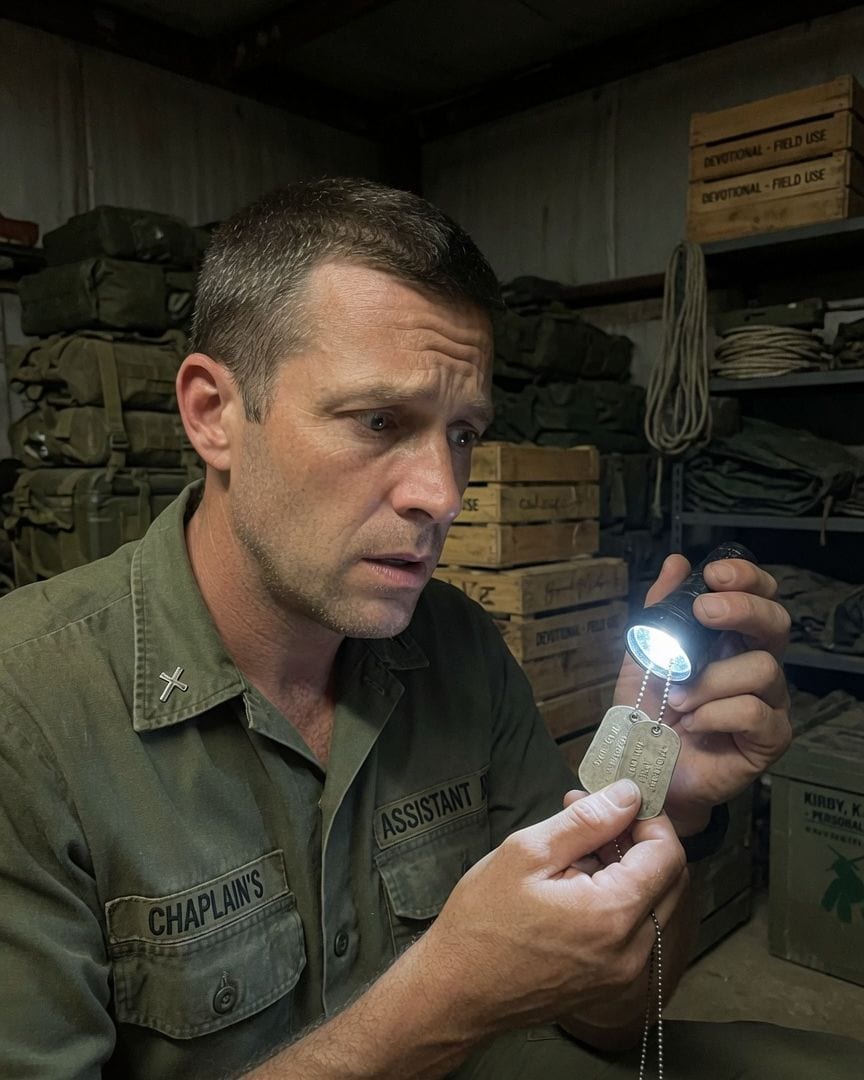
Private Kirby's old dog tags bore a completely different serial number than the ones he wore daily.
Chaplain's Assistant Moss had always known Private Kirby to cross himself the 'wrong way round,' a small joke in their grim routine. After three weeks missing, Kirby returned, but during service, his hand moved cleanly, the 'correct' way. The usual chuckle and self-deprecating shrug were gone, leaving Moss with a specific, cold unease.
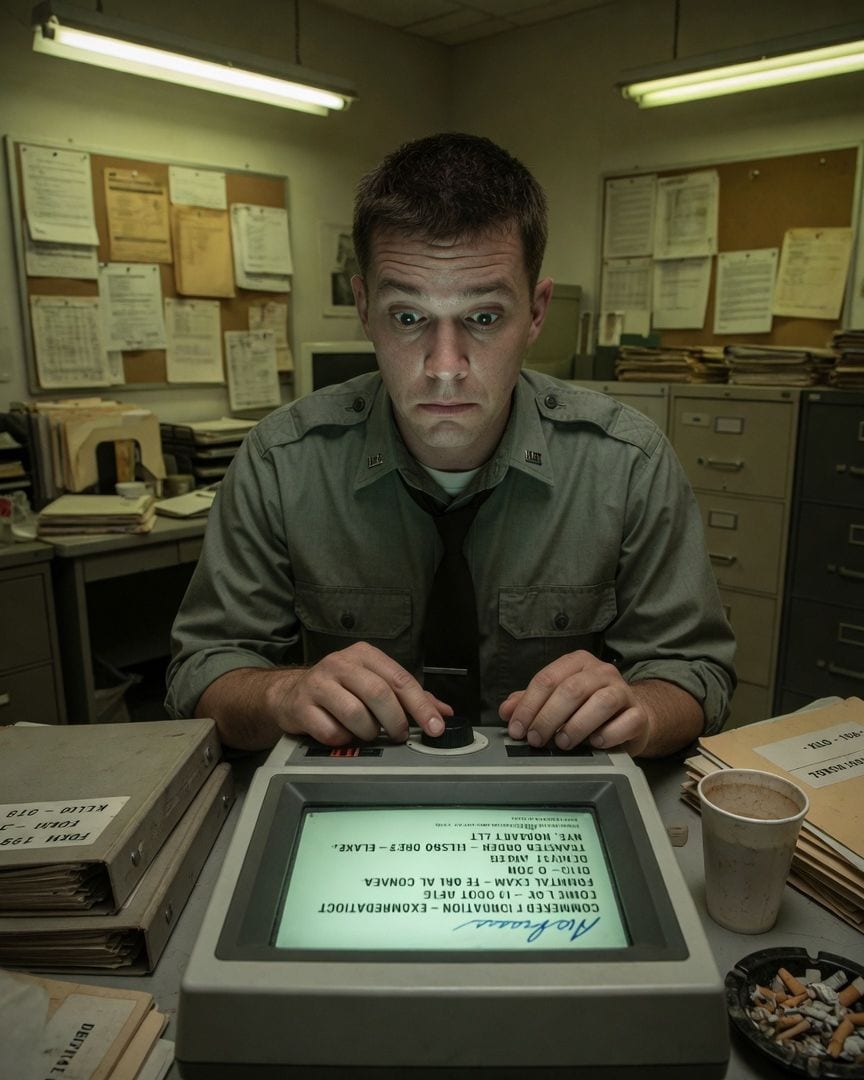
A missile commander watched his ten nuclear silos go dark. His own service record shows his signature on a future he's never lived.
Second Lieutenant Hobart Nye, a missile commander in Wyoming, had his quiet 0247 watch shattered by a security report: a massive, silent black triangle hovered over Launch Facility Kilo, casting a perfect shadow. Hobart watched his console's fault panel light up, signaling all ten nuclear missiles going dark in an impossible silence, followed by eleven minutes his security team could not remember. Official logs called it a "radio malfunction," but Hobart found a requisition for invisible-tracking sensors, signed by a base commander who was supposed to be off-base. The final, chilling discovery came when his own service record showed new entries—a dental check-up, a transfer to Alaska—all dated for a future he never lived, complete with his perfectly replicated signature.
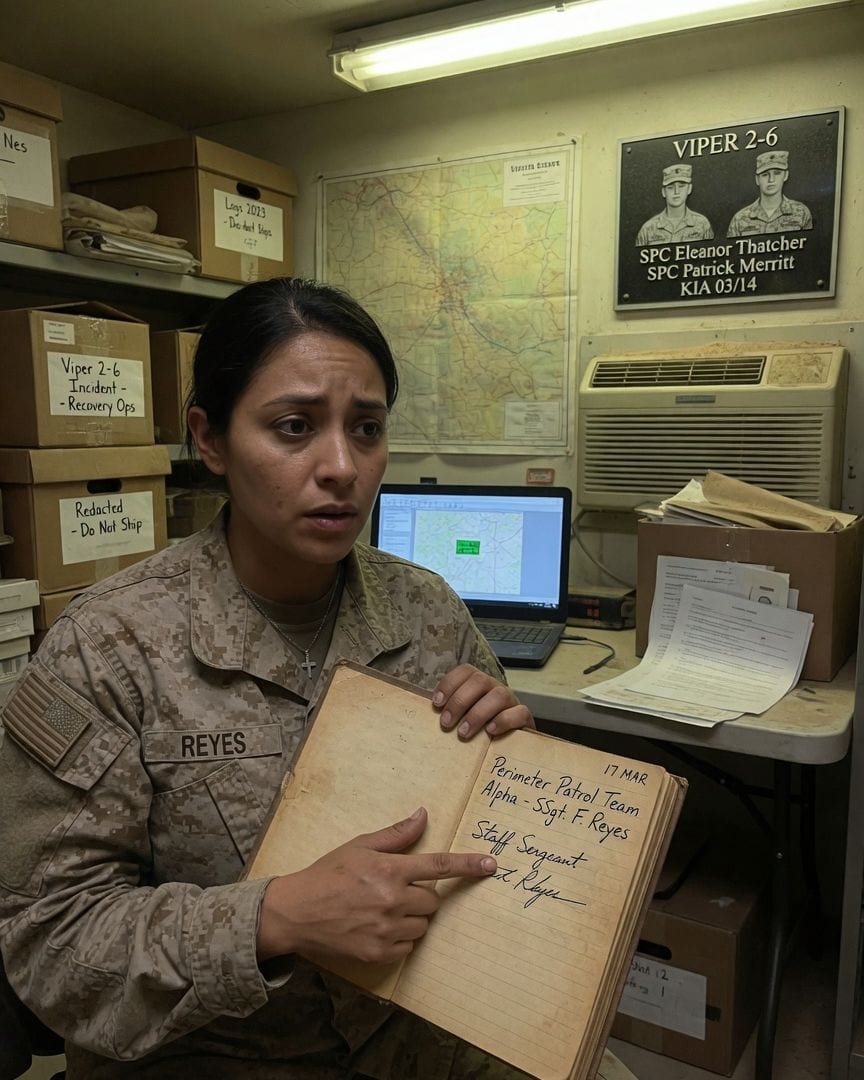
A Staff Sergeant, three weeks from transfer, finds her own signature in a logbook for a patrol she never made.
Staff Sergeant Fiona Reyes counted down her last three weeks at the high desert outpost, the fluorescent hum of the TOC a constant companion amidst the dust and old equipment. Her tired eyes scanned the digital map when an impossible icon, 'Viper 2-6' – a vehicle and crew lost last year – blinked alive, reporting its position and crawling steadily toward the base. Despite commanders dismissing it as a system ghost, Reyes meticulously searched dusty archives, finding strange log entries of phantom contacts and radio chatter, all dismissed as malfunctions. But the true chill came when she unearthed a field logbook from the recovery efforts, revealing her own undeniable signature on a perimeter patrol dated last year, a patrol she knew, with every fiber of her being, she had never made.
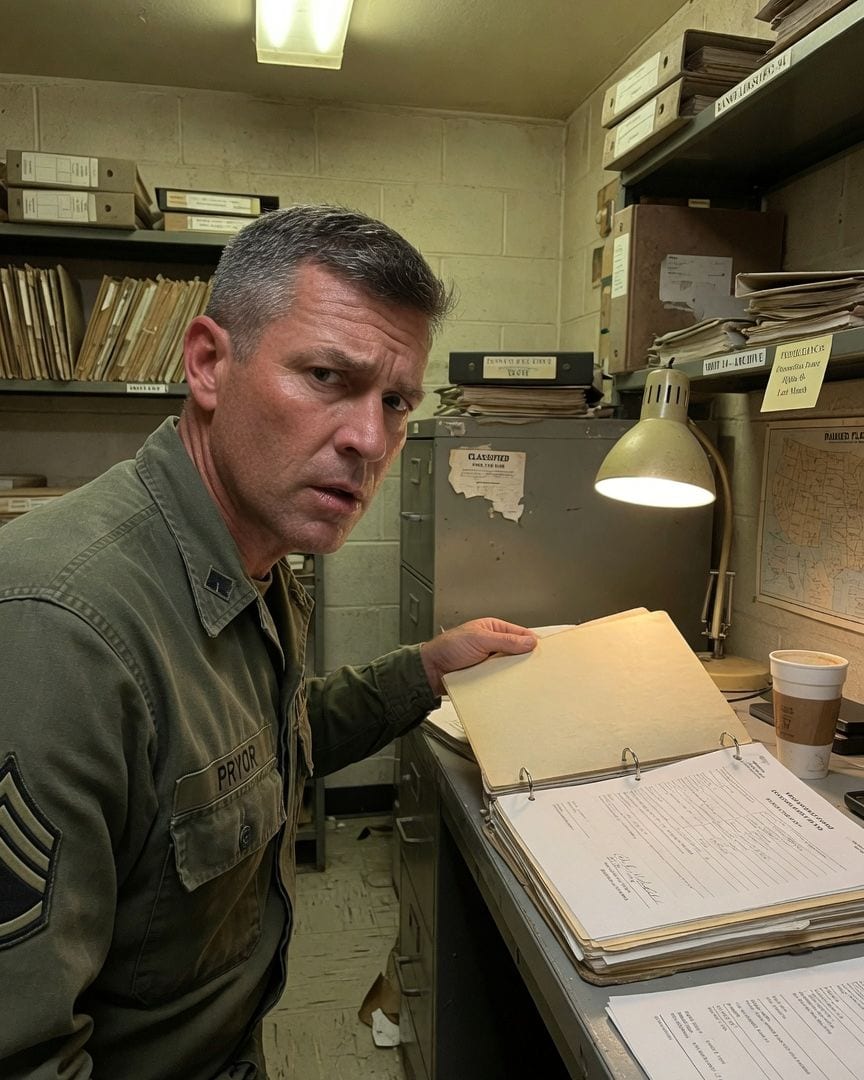
A sergeant with eleven days left finds a warm, glassed crater. Its file shows a captain lost thirty years ago is still signing reports from last week.
Sergeant Alden Pryor was counting down his final eleven days on a twenty-year hitch, expecting to spend them on routine patrols along the Ranier Flats fence line. Instead, his truck stopped at a bizarre sight: a four-hundred-foot glassed crater, miles from anywhere, its sand faintly warm at dawn despite no one recalling a blast. The air above it shimmered with an unnatural distortion, a silent scar of erased violence, and the official file for 'Shot 14' showed recent maintenance sign-offs for a decommissioned tower at the crater site. All these active documents were signed by Captain Everett Caldwell, who had been officially lost in operations thirty years ago, leaving Sergeant Pryor to wonder how a dead man could still be filing reports.
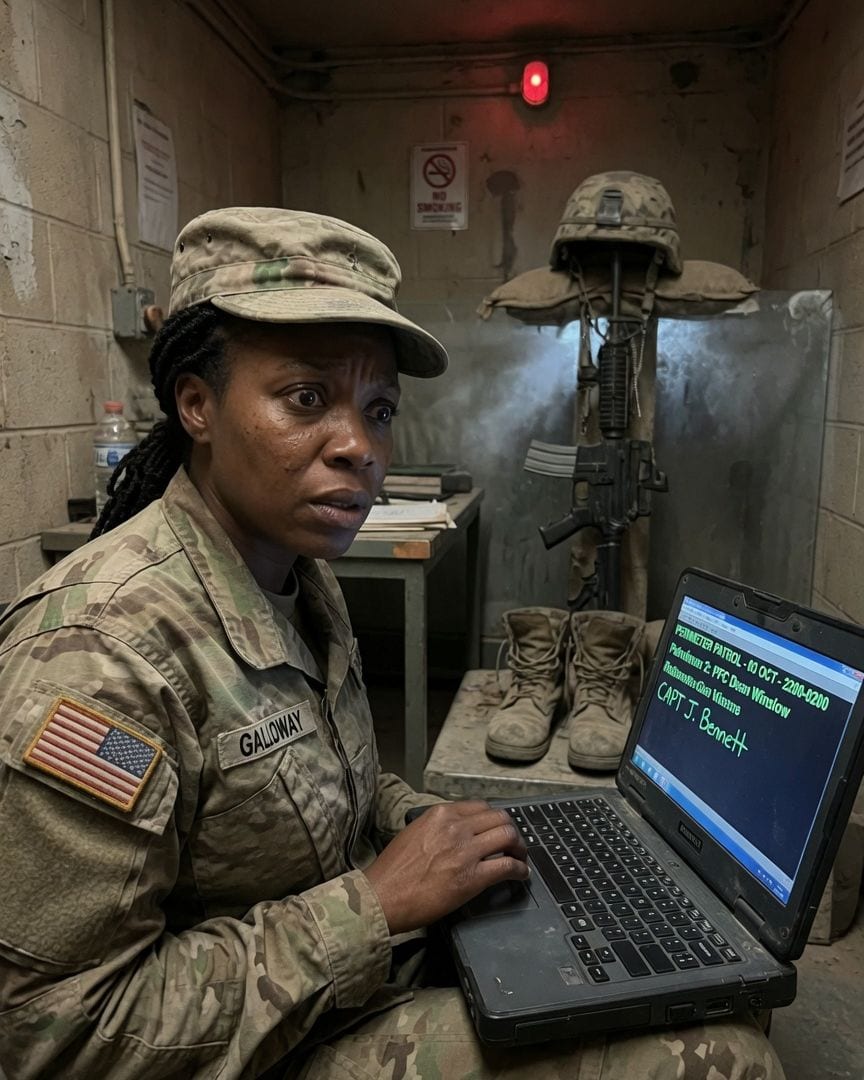
A sergeant found a dead soldier's dog tags on the memorial. He'd been MIA seventy years, but signed a patrol log last Tuesday.
Sergeant Constance Galloway, a squared-away NCO, maintained order at Firebase Alpha, where the desert sun baked the concrete and a solemn battle cross memorialized the fallen. After Private Marsh's rookie prank, Galloway found his combat boots inexplicably at the memorial, then reappearing more scuffed the next dawn. Marsh's genuine fear and the boots' unexplained travels pricked her professional doubt, leading her to investigate the memorial's history. Her search revealed the dog tags belonged to PFC Dean Winslow, declared MIA seventy years ago, yet his name appeared on the base's patrol log for last Tuesday. How could a soldier lost for decades be listed as completing a perimeter patrol just days ago?
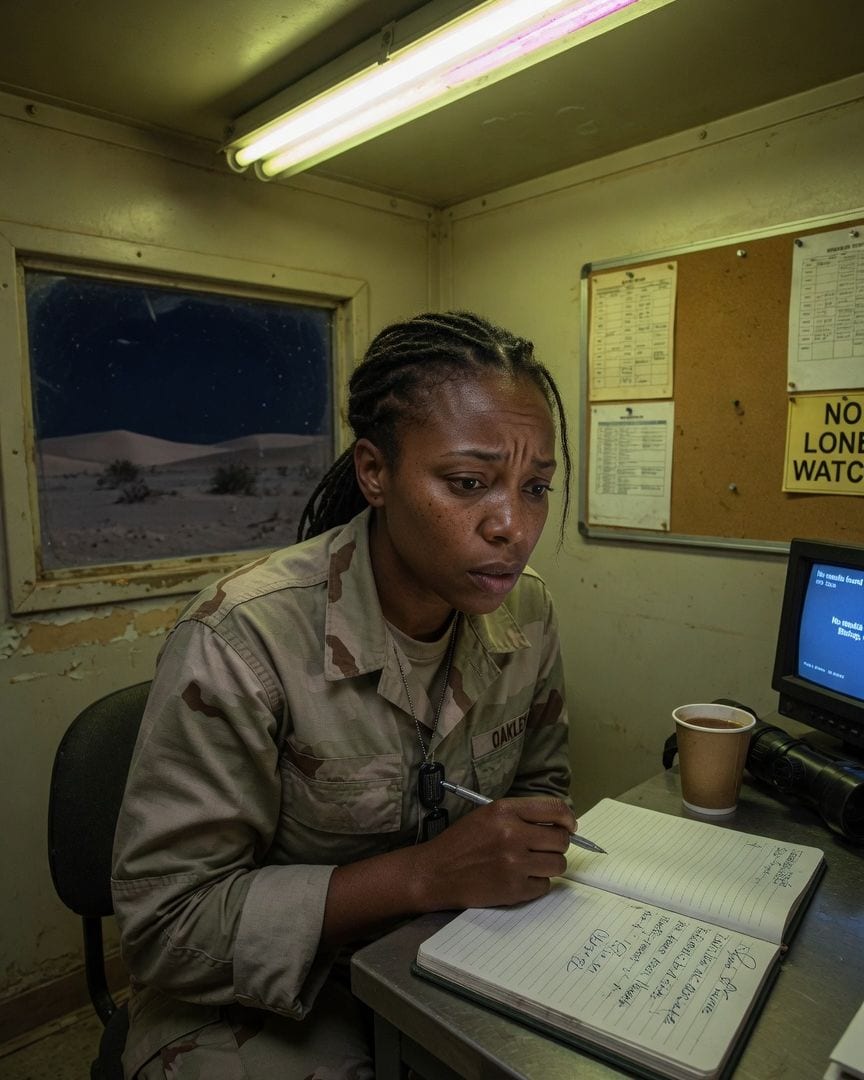
Two nights from rotating off, Corporal Oakley found her own logbook listed a battle buddy who didn't exist, signed in her hand.
Corporal Sylvia Oakley had just two nights left on her remote Yuma desert deployment, scanning the vast, empty landscape with her thermal scope under a cool, biting wind. Every night, precisely at 0247, a human-shaped figure shimmered across the wash, invisible to her night-vision but clear in the heat display, leaving no tracks. Back in the guard shack, reviewing her meticulous patrol logbook, a chilling detail caught her eye. An entry from three nights prior, signed in her own undeniable hand, claimed 'Pvt. K. Bishop' was her battle buddy—yet Corporal Oakley knew she’d stood that watch completely alone. With no digital record or comms log showing any such soldier, she faced a disturbing question: who had written him into her reality?