A sergeant with eleven days left finds a warm, glassed crater. Its file shows a captain lost thirty years ago is still signing reports from last week.
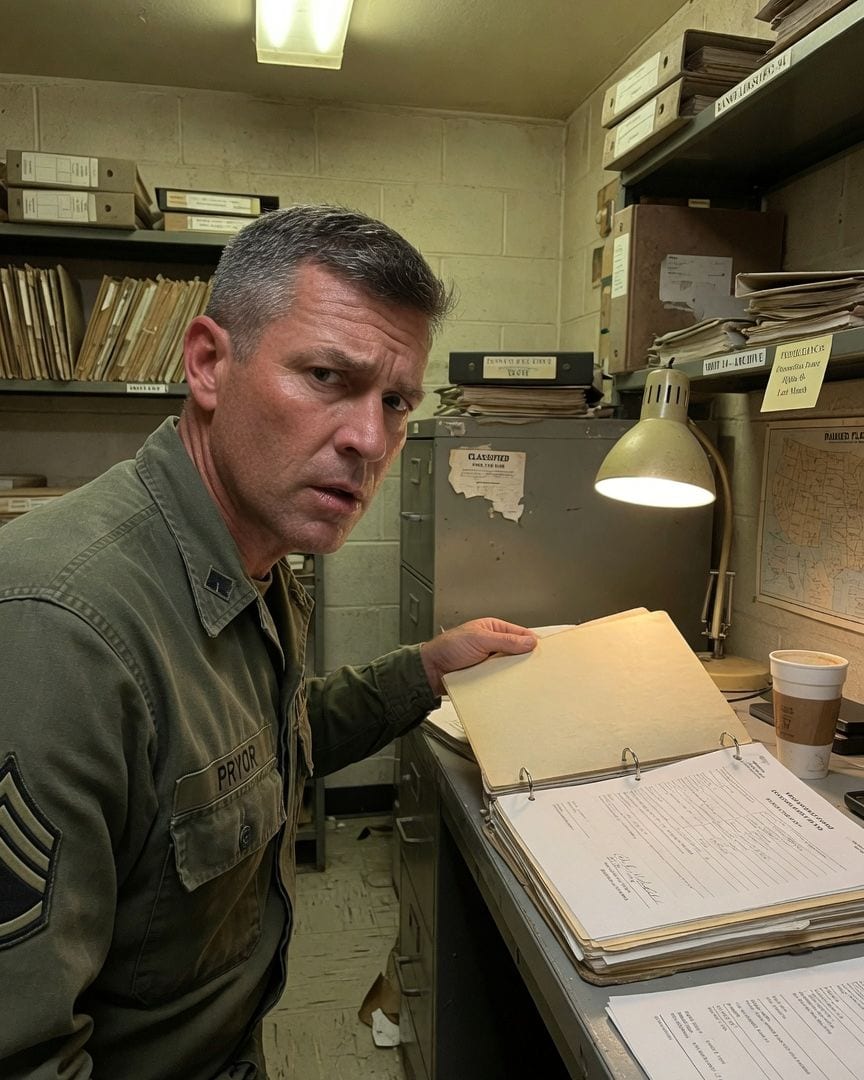
Sergeant Alden Pryor had eleven days left on a twenty-year hitch, and he meant to spend them driving the fence line of the Ranier Flats range, nothing more.
The shot list for the season showed fourteen entries; he had personally hauled the cable for thirteen. On a routine survey run, his truck tires crunched to a halt.
There, nine miles from any tower the Corps of Engineers had ever raised out there, was the fourteenth entry: a glassed crater four hundred feet across, the sand fused smooth and still faintly warm at dawn.
The air above it shimmered, not with heat haze, but with something else, a subtle distortion that warped the distant scrub brush. Every log in the vault agreed it had been fired. Every sensor had registered the blast.
Yet nobody in three states remembered a flash, no local had reported a tremor, and no news archive held a single mention.
Pryor stepped out, the desert wind whipping at his uniform, and felt the unnatural warmth radiating from the ground.
It was an impossible silence, a violent act erased from memory, leaving only a physical scar that pulsed with a faint, unsettling heat against the soles of his boots.
He walked the perimeter, his eyes scanning the impossibly smooth, glassy surface. Not a single stone had been displaced beyond the fused edge.
It was as if the ground itself had absorbed the impact and then smoothed itself over, holding a quiet secret in its molten heart.
The desert, usually a place of dry, endless expanse, felt suddenly small, contained by this impossible circle.
Back at the Ranier Flats records vault, Pryor pulled the official file for 'Shot 14'. He expected a thin folder, perhaps marked 'classified' or 'unexplained', quickly forgotten. Instead, he found a thick, heavy binder, dense with paperwork.
Most of it was yellowed, brittle 1990s-era forms, detailing ordnance deployment protocols and range safety checks for the precise date 'Shot 14' was fired. But nestled among them were documents that made no sense.
A maintenance sign-off for an 'Observation Tower Alpha-9' at the crater's exact coordinates, dated last month.
Tower Alpha-9 had been officially decommissioned decades ago, and its concrete pad was half-buried under sand fifteen miles west, long before Pryor had even joined the Corps.
The signature was crisp, black ink, for a 'Captain Everett Caldwell'. Pryor knew the name; Captain Caldwell was listed as 'lost in field operations' from Ranier Flats in 1993, the same year as 'Shot 14'.
He pulled up Caldwell’s personnel file. It was equally thick, detailing a full career, complete with performance reviews, dental records, and even a requisition for new boots, all dated after his official disappearance. Pryor double-checked the dates, his brow furrowed.
The requisition for boots was from 2012. Caldwell had been gone for nearly twenty years by then.
The ordinary explanation — a misfile, a clerical error, a simple administrative oversight — felt hollow, dissolving in the face of such impossible detail.
The paper in his hand was warm, like the sand at the crater, and the dread that settled in his gut was cold, sharp. The fluorescent lights of the vault seemed to hum a different, more insistent note.
Pryor, unnerved, continued to leaf through the 'Shot 14' file. He found a series of detailed, daily position reports for a ground sensor array supposedly deployed at the crater site. The latest report was from yesterday.
As he read the grid coordinates, a small, official-looking form slipped from between two older, faded pages and fluttered to the worn linoleum. It was a requisition for specialized telemetry cable, dated three days ago, for 'Observation Tower Alpha-9'.
The signature was undeniably Captain Everett Caldwell’s. Pryor’s breath hitched. He stared at the fresh ink, then at the date. Caldwell had been officially lost for thirty years.
He felt a sudden, profound chill, as if someone had just walked across his grave and the air around him had thinned. The file was not just old, it was active.
Pryor showed the recent requisition and Captain Caldwell’s fresh signature to his supervisor, Frank Coleman, a grizzled master sergeant whose desk was perpetually buried under stacks of outdated field manuals. Coleman scoffed, waving a dismissive hand. “Paper shufflers.
Damn ghosts in the machine, Alden. Probably some old administrative loop nobody ever closed. Or a prank. Some new boot, bored.” He suggested Pryor throw it in the 'unsolvable' pile and get back to real work.
But Pryor, methodical and rational to a fault, couldn't shake the feeling. The fresh ink, the specific coordinates, the impossible name – it didn't feel like a prank. It felt deliberate.
He took the file to the base's main archives, a cavernous, climate-controlled space smelling of old paper, dust, and ozone.
There, he found Constance Caldwell, a meticulous archivist with spectacles perched on her nose, her gray hair pulled back in a severe bun.
She listened patiently, her expression shifting from professional skepticism to quiet concern as Pryor laid out the impossible documents on a polished oak table.
The room itself seemed to hold its breath around them, the gentle whir of the cooling system suddenly louder.
Constance cross-referenced the Captain Caldwell entries with other 'lost in action' files from the same period. To their growing unease, they found similar anomalies.
Files for other personnel, officially declared missing decades ago, continued to accrue new entries: payroll runs, supply requisitions for specialized equipment, medical check-up forms, even leave requests.
Each entry was dated years, sometimes decades, after the individual's disappearance, and signed in what appeared to be their authentic hand. The pattern was undeniable. These 'lost' individuals were, on paper, still active, still drawing pay, still requiring supplies.
It wasn't just one misfile; it was an entire administrative ghost army, moving through the system, leaving a trail of impossible paperwork that stretched for decades.
The deeper they dug, the more coherent the dread became: the 'lost' were never lost, they were merely… elsewhere, and still accounted for.
As Pryor and Constance delved deeper, the archives seemed to subtly resist them.
Requested files would vanish from the cart, only to reappear on a different shelf a day later, sometimes in the wrong section, sometimes already open to the page they were looking for.
Their access credentials, usually robust, would inexplicably fail for specific, crucial documents, then suddenly grant them higher clearance than they’d ever had, only to revoke it again without warning.
The overhead lights in their section flickered, casting long, dancing shadows that seemed to watch their every move.
One morning, Pryor found a sealed, official-looking envelope tucked under his windshield wiper, the paper crisp against the desert grit coating his truck. Inside was a single sheet: an 'Observation Report, Ranier Flats Sector 7, 0400-1600 hrs, Subject: Sgt.
Alden Pryor'. It meticulously detailed his movements around the crater the previous day, his stops, even the precise time he’d spent examining the sand. The report was signed, again, by Captain Everett Caldwell, the ink still smelling faintly of chemicals.
Pryor’s blood ran cold. This wasn't a clerical error; this was a live, personal threat. He wasn't just investigating the lost; he was being watched, and the 'lost' were doing the watching, or at least, their administrative proxies were.
He showed it to Constance, her face paling in the harsh archive light. "Someone knows," she whispered, her voice tight, a thin thread of fear. "Someone or something is tracking us. And it's using the system to tell us."
The file wasn't just writing itself; it was writing about them.
Driven by the chilling observation report, Pryor and Constance bypassed standard protocol, ignoring the increasingly erratic behavior of the archive's systems.
Using Constance’s deep knowledge of the archive’s hidden pathways – a series of maintenance tunnels and forgotten service conduits known only to a few long-serving archivists – and Pryor’s old-school security clearances, they discovered a sealed annex.
It was unmarked on any recent blueprint, tucked away behind a false wall in a sub-basement. The heavy steel door was secured with an archaic combination lock, rusted solid.
Pryor used a pry bar from his truck, working silently in the oppressive heat of the hidden space.
Inside, the air was still and cool, smelling faintly of ozone, dust, and old electronics, a contrast to the stifling tunnel they had just navigated.
The room was dominated by a colossal, humming machine: an analog computer system, a relic from the early Cold War, its reels slowly spinning with a hypnotic rhythm, its vacuum tubes glowing with a faint, internal orange light.
It was connected by thick, bundled cables to a bank of old teletype machines and dot-matrix printers, all silently whirring, their paper feeds untouched, yet ready. This wasn't a record vault; it was a generating station.
This was the 'secrecy machine,' Constance breathed, the name echoing eerily in the confined space.
Constance, her voice a hushed whisper, pointed to a console, its screen displaying a continuous stream of green data: personnel identifiers, location pings, requisition codes, all scrolling endlessly. It was the raw data feeding the impossible paperwork they had found.
The 'lost' weren't just names in a file; they were active entries in this system. The machine wasn't recording their continued existence; it was generating it, maintaining their administrative lives.
The crater, the fresh signatures, the ongoing payroll — it all clicked into place with a sickening thud. The 'lost' were not dead, but processed, their physical reality subsumed by this administrative one.
The dread was no longer abstract; it was concrete, mechanical, and horrifyingly efficient, a cold, metallic truth humming in the room around them. The floor vibrated beneath Pryor’s feet, a steady, ancient pulse.
Pryor and Constance watched the data scroll. The machine hummed, an ancient, patient pulse that resonated in their chests. They saw Captain Caldwell’s identifier, followed by a new requisition for specialized long-range sensors.
Constance traced the code to a specific Ranier Flats sector. It was Pryor’s sector, the very fence line he was meant to patrol.
As they watched, a dot-matrix printer, separate from the main bank, nestled in a dusty corner, suddenly whirred to life. Its rhythmic clatter cut through the machine’s low hum. It spat out a single sheet.
Pryor picked it up, his fingers numb. It was a maintenance requisition, dated today, for his own fence line truck, specifically for its comms array. The details were precise, down to the serial number.
And then, a new line of data scrolled onto the main screen, under the 'Shot 14' project: 'Operator Assigned: Sergeant Alden Pryor. Event Type: Calibration. Status: Pending.' Pryor’s hand trembled, the paper rustling softly.
He looked from the screen to the requisition for his truck, and back again. His eleven days to retirement, his carefully planned escape, evaporated. He was no longer an investigator; he was an entry.
The machine wasn't just processing the past; it was processing him.
The realization detonated in Pryor’s mind: his 'retirement' wasn't an exit; it was a transfer, an integration into the system.
The 'Shot 14' event, the crater, was not a test gone wrong but an induction point, a way to physically 'file' an entity, leaving behind a trace for the administrative machine to pick up.
Every impossible log entry, every continuing requisition, every ghost signature was a function of this system maintaining its 'filed' entities. The machine was the institution, quietly consuming.
The 'lost' weren't dead in the traditional sense; they were absorbed, their identities reduced to data points, their existence sustained by the endless hum of the analog computer.
The pattern clicked into place with horrifying clarity: the constant observation, the precise tracking of his movements, the specific requisition for his truck—all precursors to his own administrative absorption.
The machine wasn't just a record keeper; it was a reality generator, transforming physical beings into perpetual bureaucratic entities, forever 'on duty,' forever 'accounted for.' Pryor felt a profound, cold dread settle over him.
He was already inside the machine, his fate already written on its scrolling screens, a future that hummed with the same ancient, patient pulse as the colossal machine.
A cold, desperate resolve settled over Pryor. "We have to shut it down," he said, his voice flat, barely a whisper in the resonating room. Constance, pale but determined, nodded.
She looked at the towering machine, then back at Pryor, her eyes wide with a shared terror. They scoured the machine's archaic controls, a dizzying array of switches, dials, and flashing lights, all labelled with faded, decades-old stencils.
Pryor, with his years of experience with old military tech and his methodical mind, identified the main power conduit, a thick bundle of cables leading to a heavy, rusted lever embedded in the wall.
He wrestled with it, straining against decades of inertia, his muscles screaming. The metal groaned, protesting loudly.
Constance worked furiously on a nearby console, her fingers flying across worn buttons, trying to override a system lock she believed might be preventing a full shutdown.
The machine’s hum intensified, rising in pitch, a low thrum that vibrated through the floor and up through Pryor’s bones, as if resisting their efforts, a mechanical groan of pure defiance.
As Pryor finally yanked the master lever with a final, desperate heave, a shower of sparks erupted from the junction box, filling the air with the smell of ozone and burning dust.
The tubes dimmed, the reels ground to a halt with a shudder, and the screen flickered once before going dark. The sudden silence in the annex was absolute, heavy, almost painful, broken only by the fading crackle of the sparks.
Pryor and Constance stood panting, bathed in the faint, residual glow of the dying tubes, the air thick with tension. For a moment, there was only the sound of their ragged breathing.
Then, from a far corner of the room, a small, independent dot-matrix printer, previously unnoticed beneath a layer of dust, whirred to life. It had no visible power cord, no connection to the now-silent main system.
It slowly, methodically, printed a single document, one line at a time, its clatter unnaturally loud in the silence. Pryor walked over, his legs heavy, his mind reeling. He tore the sheet free, the rough paper crackling.
It read: 'Sergeant Alden Pryor - Status: FILED. Transfer Complete.' He stared at the words, the ink still wet, the dread a physical weight in his chest.
The machine was silent, its cold metal casing a tomb. Constance Caldwell, shaken but resolute, reported the discovery of the annex and the defunct system. The official response was a mixture of confusion and bureaucratic obfuscation.
A team arrived, sealed the annex, citing 'hazardous materials' and a 'classified historical facility', and launched an 'internal review,' which quickly went nowhere. No explanation for the impossible files was offered, nor was any investigation into the 'lost' personnel reopened.
The impossible paperwork for Captain Caldwell and the others ceased, the flow of ghost bureaucracy finally cut off. Sergeant Alden Pryor was officially listed as 'transferred to an undisclosed specialized unit' just days before his scheduled retirement.
His truck was found abandoned at the edge of the Ranier Flats range, its comms array inexplicably dismantled, its logbook missing.
Constance was quietly transferred to a remote, obscure records facility in a different state, far from Ranier Flats, her warnings dismissed as stress-induced delusions.
Months later, in her new, quiet office filled with the endless rustle of paper, Constance Caldwell found a sealed package on her desk one morning, its brown paper plain, its origins unknown. Inside was a single, crisp, official-looking form.
It was a new personnel transfer order, for a Sergeant Alden Pryor, reporting for duty at her facility, effective immediately. The signature was in fresh ink, identical to the one on the old requisition forms and the observation reports.
The world moved on, oblivious, the everyday sounds of the office — the shuffling of papers, the low hum of distant air conditioning — a bland counterpoint to the chilling reality.
The file was still being signed.
If this one got to you
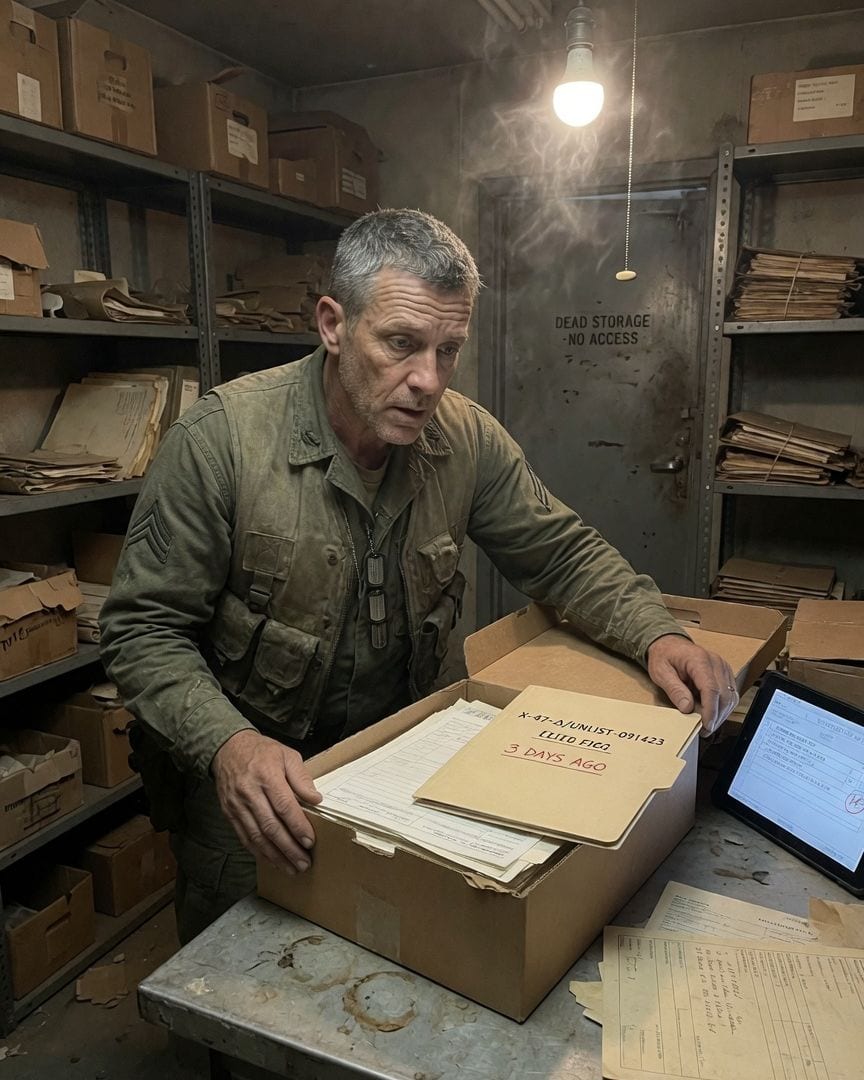
Sergeant Pryor, days from retirement, finds a four-hundred-foot crater. The desert floor is still warm, but no one remembers the blast.
Sergeant Alden Pryor, forty years old and just eleven days from retirement, drove the familiar Ranier Flats fence line for one of his final patrols. The desert stretched out, silent and vast, until he discovered a four-hundred-foot crater, dark and impossibly vast, where the sand had fused into slick glass. The ground within the crater was still faintly warm, a subtle heat defying the cool desert air. Yet, every official log confirmed the blast, while no one recalled a tremor or flash across three states.
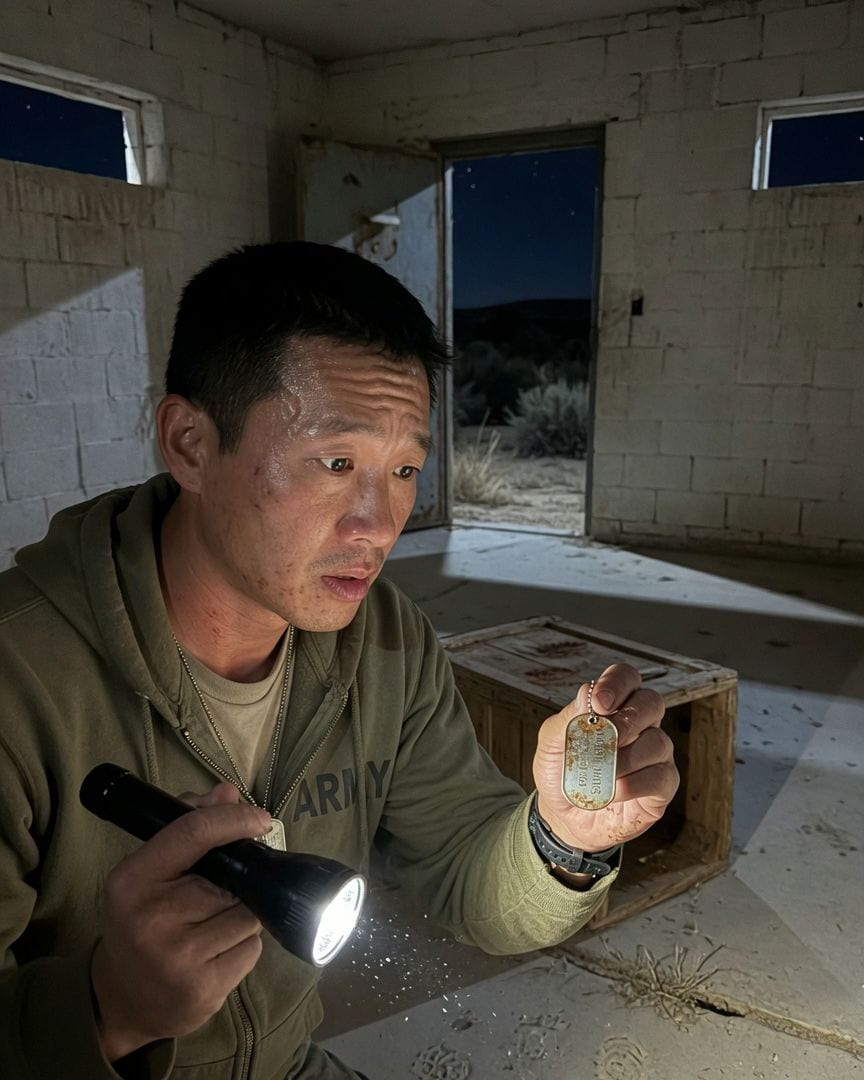
Staff Sergeant Rhee’s squad found a Cold War building not on their map. Range Control confirmed no structure. Minutes later, it vanished, leaving a foundation decades old.
Staff Sergeant Adam Rhee halted his squad at the Yakima Training Center, staring at a cinderblock building that simply wasn't on his map. Range Control confirmed there was no structure at his coordinates, leaving him to wonder what impossible thing stood before them. Moments later, after the range-safety truck arrived, the building vanished, leaving only a rectangular patch of earth with a foundation of decades-old weeds. That night, driven by an unsettling certainty, Rhee returned to find the building reappeared, its door ajar, holding a single, rusted dog tag from 1983. How could a place appear and disappear, leaving behind evidence from forty years ago?
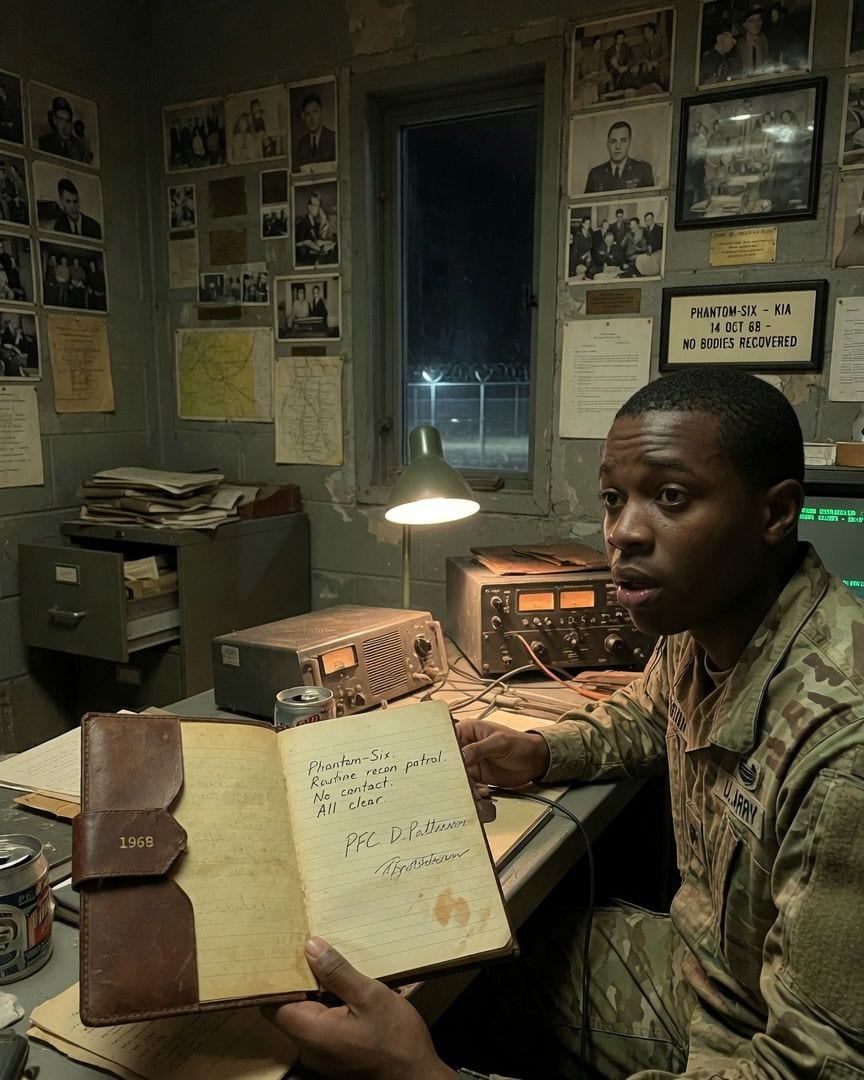
A DMZ specialist finds a 1968 Cold War logbook entry, signed by a lost soldier, its ink shimmering faintly.
Specialist James Farr, on a long night shift at a desolate Korean DMZ outpost, meticulously monitored his console, a squared-away soldier accustomed to the quiet hum of equipment. His focus shattered when a faint, static-laced whisper ghosted from a dead channel, calling out 'Phantom-Six' — a unit lost near this wire in 1968. The urgent voice then specifically mentioned his tower window light, asking him to turn it off before it drew fire. Later, an old logbook from 1968 revealed an entry dated three days *after* Phantom-Six was officially lost, signed by one of the vanished soldiers, its ink subtly shimmering with an unnatural gleam.
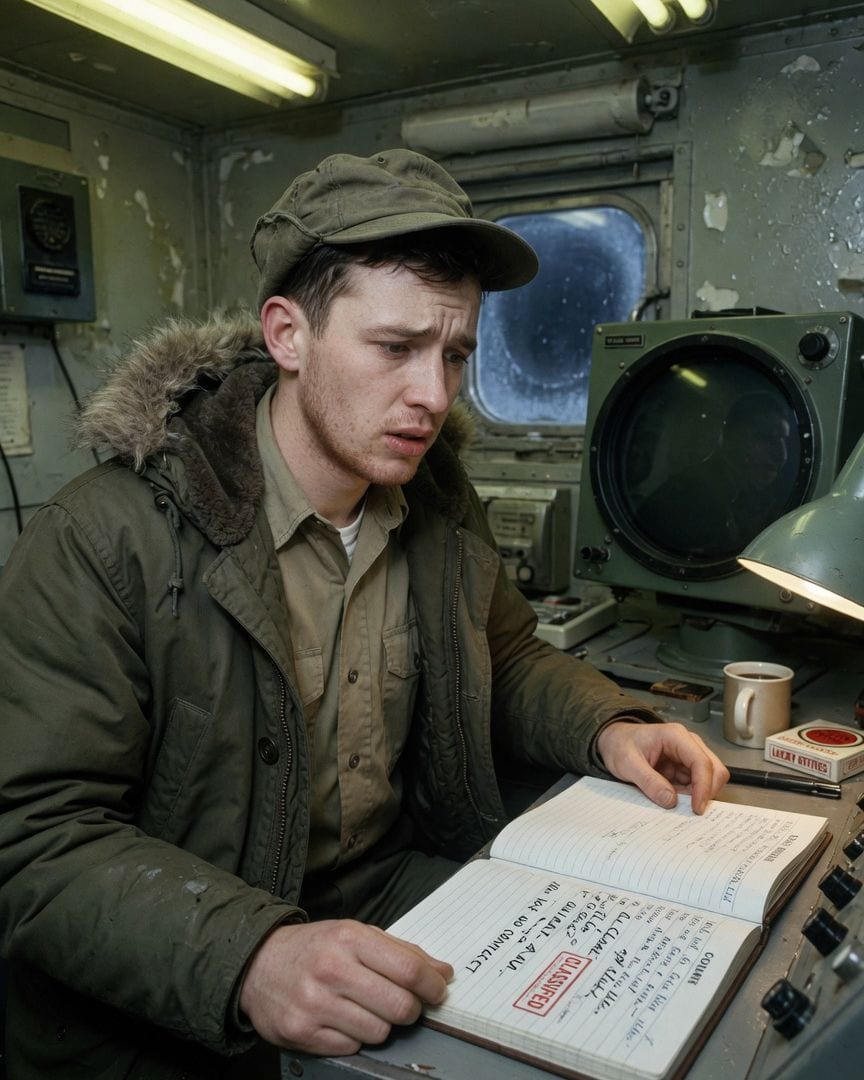
A Cold War airman logs an impossible radar contact on his last sweep. But his official logbook entry is stamped 'CLASSIFIED' and then contradicted by a hastily scrawled 'ALL CLEAR' dated moments before it.
Airman Ordway Vance, 22, manned the radar dome at Site Pellin in the biting North Atlantic dark of January 1962, running the last calibration sweep before its decommissioning. His scope picked up a faint, impossible return, growing closer with each pass, though the ocean remained empty to the eye. When Vance detailed the contact in his official logbook, a 'CLASSIFIED' stamp appeared, followed by a hastily scrawled 'ALL CLEAR' dated moments before his own entry, contradicting his every word. Commander Hartley dismissed it as equipment malfunction, but Vance sensed a chilling, official erasure behind the lie. He soon found a locked cabinet marked 'SITE PELLIN ANOMALIES,' hinting at a deeper truth buried within the base's final days.
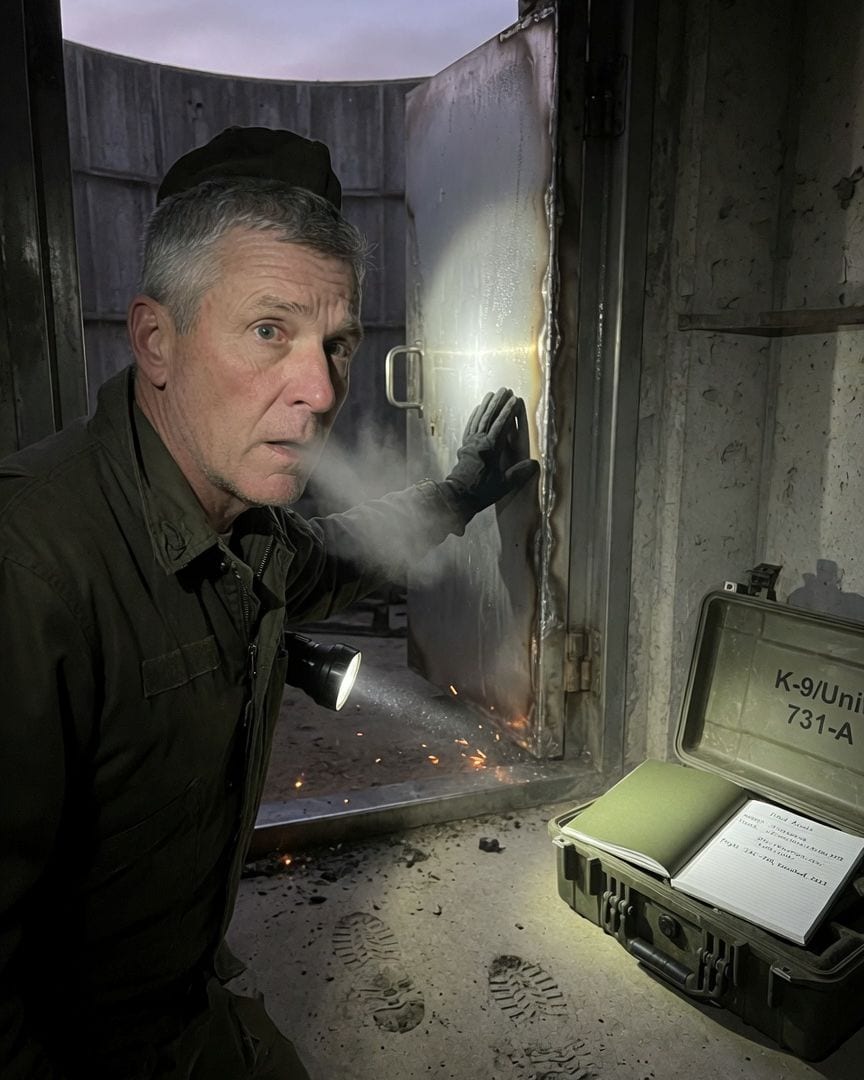
The Cold War silo was welded shut in 1968. A Captain found lights burning, fresh prints leading inside, and a logbook with a vanishing from last week.
Captain Merrit Sable faced a deadline at Silo K-9: one cold morning to retrieve classified hardware before its scheduled demolition at noon. The silo, officially welded shut by the Air Force in 1968 and long off-grid, should have been a tomb of forgotten machinery. Yet, through a cracked port, he saw nine work lights burning steadily forty feet down, and felt the faint suction of an active ventilation system. After breaching the decades-old weld, Merrit found more than just lights; fresh boot prints led deeper into the meticulously clean shaft, but none returned. A hidden compartment in an empty, warm hardcase revealed a logbook, its crisp pages detailing notorious military disappearances, with the latest entry dated just last week.
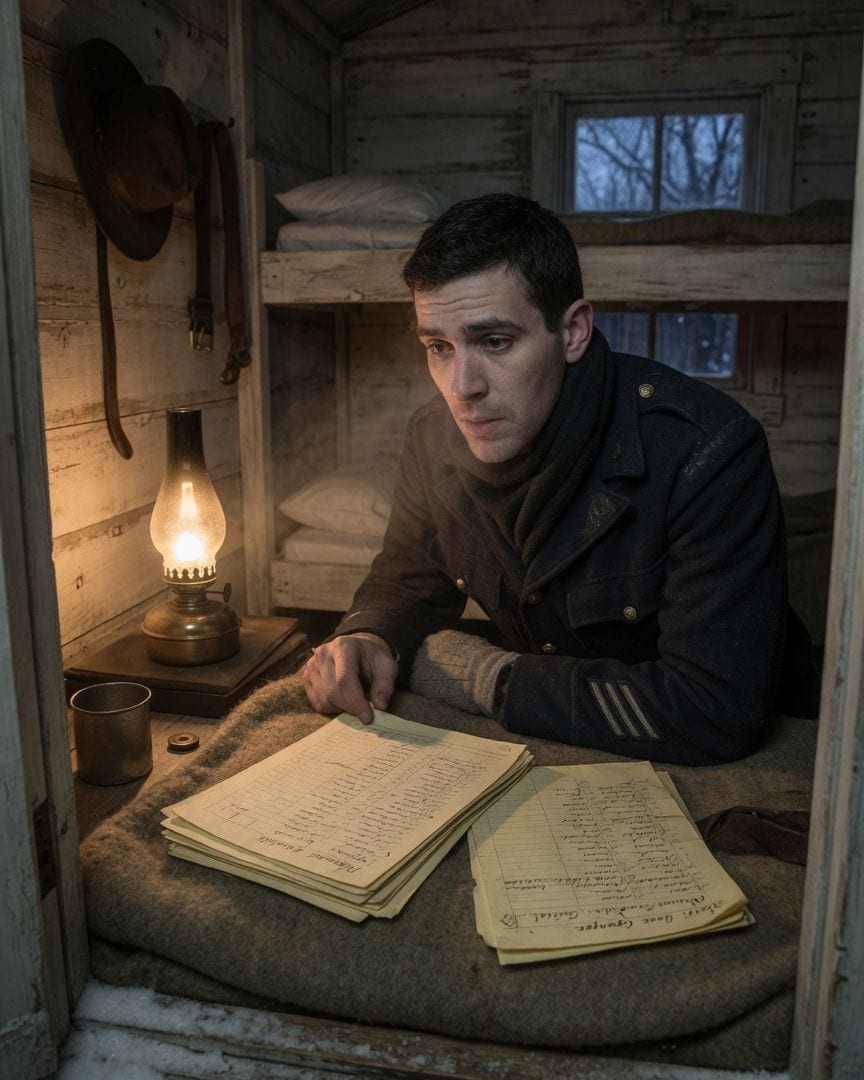
On his last watch, Corporal Carter found boot prints ending inside a sealed magazine, and a blood-red handprint from a soldier decades out of time.
Corporal Franklin Carter shivered, not from the biting November wind, but from the chill of his last pay muster at Fort Taggart before its winter abandonment. His final duty was to count every man, tallying thirty-seven, precisely the company strength. But his breath hitched when he saw the completed roll: it ran thirty-eight names long. An impossible extra slot, filled by a voice that answered 'Here, Corporal,' for a soldier whose name, Pvt. Isaac Granger, vanished from all official records, only to reappear in a forgotten supply log from 1863. Was Fort Taggart abandoning its dead, or something far older?