My church clock was already set, key warm, logbook signed — the sexton’s been in hospital for a month.
I never wanted to be the caretaker of Stonely’s historic church. I’m thirty-two, an architect by trade, and my move here was meant to be temporary, a quiet retreat after a rough patch.
But Mrs. Henderson, God bless her, insisted the old place needed a 'practical mind,' not just a 'dust-bunny chaser.' So, I took the job.
The church clock, up in the bell tower, was a marvel of Victorian engineering: massive gears, a brass pendulum the size of a man’s torso, all encased in dark, polished oak.
It was also, I quickly learned, the subject of a very specific local legend. "Only the sexton," old Mrs. Henderson had said, wagging a finger, "one man, touches it for the hour change. Always has been, always will be."
But Walter Bishop, the sexton for the last fifty years, was seventy-eight and had been laid up in the county hospital with a broken hip for the past month. And this was Daylight Saving Time weekend.
The clock needed to be wound forward an hour. Walter certainly couldn’t make the climb. I considered calling the hospital, but he’d been so frail last time I visited, barely lucid. It seemed a cruel thing to bother him with.
I was practical. Efficient. There was no harm, I reasoned, in saving the old man the trouble. The instruction was clear: wind it forward.
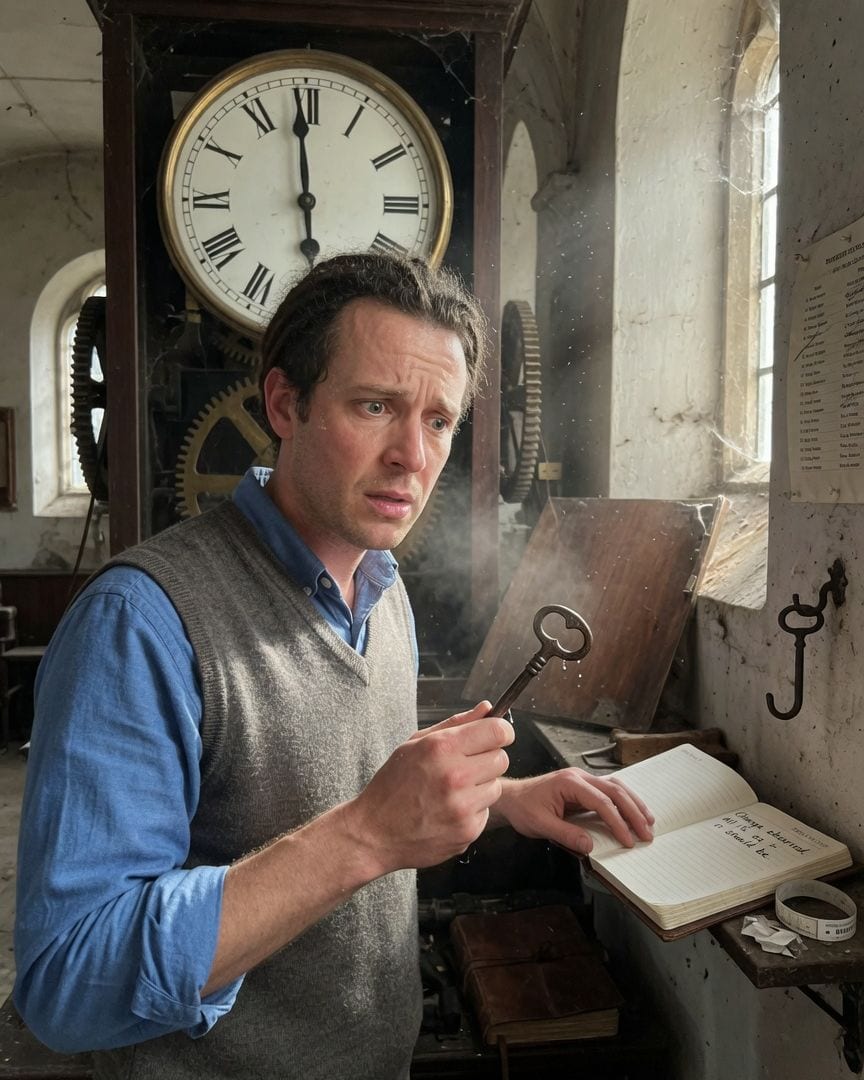
So, on Sunday morning, I took the large, ornate iron key from its hook in the vestry. It was heavier than I expected, cool in my palm, and carried the faint, metallic scent of something ancient.
Up in the tower, the air was still and cool, despite the morning sun streaming through the arched windows. The clock face loomed, a vast white circle with Roman numerals.
I gripped the key, inserted it into the lock near the twelve. It fit perfectly. I braced myself, ready to turn the heavy mechanism.
But then I looked at the face again. And my breath hitched.
The clock already showed the correct new time. Seven past eight. The daylight saving change had happened overnight. I blinked, checked my wrist-watch, then my phone. All matched. The church clock, this massive, ancient thing, was already set.
Confusion warred with a prickle of something else, something I couldn’t quite name. I leaned closer to the mechanism. The key, still in the lock, was distinctly warm to the touch, as if someone had just used it.
Not merely handled it, but worked it. A deep, unsettling warmth. Beside the gears, on a small, dusty shelf, lay the official sexton’s logbook. It was a large, leather-bound affair, filled with Walter’s neat, shaky hand over decades.
It was open. And on the page for tonight’s date, in his familiar, wavering script, was an entry: 'Change observed. All is as it should be.'
A sudden chill, sharp and biting, swept through the tower, cutting through the morning sun. It wasn't from the open belfry window. Walter Bishop was still strictly bedridden, a floor nurse had confirmed it yesterday.
How could he have signed this, and who, then, had wound the clock?
I tried to rationalize it. Maybe Walter had a designated helper? A secret apprentice, perhaps? But the rule was explicit: 'only the sexton, one man.' Not 'one man and his designated helper.'
I even checked the church roster again, just in case. No one else was authorized to even clean the bell tower, let alone touch the clock. I called the hospital, spoke to the day nurse.
Walter was still strictly bedridden, they reiterated, hadn’t even gotten out of his chair for physical therapy. The warmth of the key, though hours had passed, lingered in my mind.
It was a detail that stubbornly refused to fit any logical explanation.
Later that day, the unease gnawing at me, I found myself back in the tower. The clock hummed its ancient rhythm, oblivious. I ran my hand over the massive wooden casing, tracing the grain of the dark oak.
My fingers brushed against a loose panel near the base, almost hidden by centuries of dust and grime. It wasn't part of the main mechanism, more like an old repair, long forgotten, covered by a crude, ill-fitting piece of wood.
Curiosity, a stronger instinct than my growing apprehension, piqued. I dug my fingernails into the seam, wedged a loose coin in, and pried it open. With a soft groan of aged wood, the panel gave way.
Inside, nestled in a cobwebbed recess, was a small, aged leather-bound journal. It was much older and more worn than the official logbook, its leather cracked and faded.
Its pages were brittle, filled with elegant, faded script, an older style of handwriting I dimly recognized from history books. It wasn't Walter's hand.
This was something else entirely, a private record, perhaps, of a sexton from long ago, tucked away where no one would ever find it.
The first entry was dated 1782, almost two hundred and fifty years ago. It spoke of the 'Great Bell' and its 'peculiar hum' during the seasonal changes, a detail never mentioned in Walter's careful, official entries.
It described the clock's strange behavior, 'setting itself' for the hour change, just as I had witnessed this morning.
The air in the tower seemed to thicken around me, growing heavy and still, as I began to read the ancient words.
And then, a line that made my blood run cold: 'Our Brother Thomas, gone from his bed, no trace but the chill in the air.' Brother Thomas. The name snagged in my memory.
I pulled out Walter’s official logbook, flipping through its pages, searching the neat columns of names and dates, each representing a sexton and their tenure. There it was, clear as day: 'Sexton Thomas, 1782-1810.' The same Thomas.
The journal went on to describe how the town had 'learned to let the Bell do its work,' and 'never interfere.' My hand trembled over the faded ink of the journal's first entry: 'The Great Bell set itself this morn.
Our Brother Thomas, gone from his bed, no trace but the chill in the air.'
Shaken, I tucked the small journal back into its hidden compartment, securing the loose panel as best I could, and locked the tower door behind me.
My rational mind screamed for an explanation, something tangible that wasn’t buried in old, cryptic prose. This wasn’t a ghost story; this was something real that had happened to Brother Thomas, and now, possibly, to me.
My first stop was Theresa Kowalski, 67, a lifelong Stonely resident known for her encyclopedic knowledge of local lore – and everyone else's business. She was watering geraniums on her porch swing when I approached.
I kept my tone casual, asking about the church clock rule.
Theresa's eyes, bright behind thick spectacles, narrowed. "Oh, that old thing? The Bell? My grandmother always said, 'You let the Bell sleep and wake itself. Else it gets restless.'" She paused, a knowing look on her face. "Walter knew that.
He’d never touch it for the change, not really. Never. That was the understanding."
"But he'd go up, sign the log, right?" I pressed, a prickle of dread already starting to form on my skin.
Theresa nodded slowly. "Aye, that's the ritual. Acknowledging it, you see. Not doing it. My grandmother also used to say the key, it warms up when it’s ready for the change, not when it’s been wound by hand.
It’s the sign. Like the Bell's letting you know it's done its business."
My blood ran cold. The key had been warm. Distinctly warm. Theresa's words painted a picture of a town not just superstitious, but carefully managing something real, something that did things.
Next, I sought out Vincent Romano, 54, the town archivist. Vincent, a portly man with a penchant for dusty records and local history, was delighted to have a visitor.
I mentioned the 'Sexton Thomas' entry, hoping he'd have some official record of his death.
He chuckled, pulling out a faded ledger. "Odd, isn't it? No death record for him, just… gone. The official story is he left town suddenly for family matters.
But a few others like that, too, over the centuries, mostly caretakers or folks who spent a lot of time up there. Local legends say the old bell has a 'hunger' for meddlers. A folk tale, nothing more."
He gestured vaguely to shelves piled high with ancient ledgers, yellowed newspapers, and brittle documents. "But that's just talk, eh? Unless you think there's more to it?"
His gaze, though curious, held a flicker of something I couldn't quite place—a hint of something carefully unsaid.
The next day, the chill in the bell tower still lingering in my bones, I visited Walter Bishop at the hospital. He looked frail, propped up in bed, but his eyes, when they focused on me, were surprisingly sharp.
He had that unnerving calm about him that the very old sometimes possess, as if they see more than you do.
"You went up to the clock, didn't you, Abigail?" he rasped, his voice barely a whisper, thin as onion skin. "I saw the logbook. You signed it, didn't you, for the new time?"
"No," I corrected, "I found your entry, Walter. And the clock was already set. The key was warm." I recounted the details, the puzzle pieces clicking into place around Theresa’s words, a terrifying new picture emerging.
Walter just shook his head, a deep sadness in his gaze, a profound weariness I hadn't noticed before. "It wasn't for you to do. It was for it to do. My job was to observe, to acknowledge.
To let it pass. That is the rule." He paused, his gaze fixed on some distant point, as if looking through the hospital wall, out into the quiet town. "There are old ways, Abigail. Ways to keep the peace.
You broke the peace." He wouldn't elaborate, only repeated, his voice gaining a strange, soft intensity, "Let things be. Don't look too close at what isn't yours. Some things are best left undisturbed."
He closed his eyes, his breathing shallow, and when he opened them again, the sharp focus was gone, replaced by a vague, contented fog.
It was as if his moment of lucidity had been a singular effort, exhausted by the urgency of his warning.
Later that evening, back in my small cottage by the lake, I felt a persistent unease. It wasn't just the cryptic warnings, but a subtle shift in the town itself.
As I walked home from the grocery store, I noticed a dark sedan parked a block away, its engine off, windows tinted. I’d seen it before: outside the church, then outside the hospital when I’d visited Walter.
As I passed, the driver, a man I didn't recognize, quickly ducked his head, as if deliberately avoiding my gaze. A shiver ran down my spine, a cold knot forming in my stomach. Someone was watching me.
Someone who knew about my interest in the clock. Someone who might even have been at the hospital, listening to my conversation with Walter. The quiet, quaint town of Stonely suddenly felt less welcoming, more watchful.
The next morning, I confronted Vincent Romano at the archive, my voice low, barely a whisper. "You know about the disappearances, don't you? More than just Thomas. More than just 'talk'."
Vincent’s usual jovial demeanor vanished, replaced by a grim set to his jaw. He sighed, rubbing his temples, the dust motes dancing in the faint light from the high windows. "The 'hunger' isn't just talk, is it? You found something.
Something old."
I told him about the hidden journal, the entries about the clock setting itself, the missing 'Brother Thomas.' I told him about Theresa’s words, about Walter’s stark warning. Vincent's face was grim, his eyes avoiding mine.
"The town has always had these stories. Disappearances, accidents, always around the clock changes. Always caretakers, or people connected to the church.
The official explanation is always mundane, a sudden departure, a boating accident, but the whispers…" He trailed off, then with a decisive movement, pulled a heavy, leather-bound book from a locked cabinet – an unofficial 'town history,' compiled by generations of Romanios.
It looked as old as the hidden journal. "My family kept records. Not for public consumption. We call it 'The Cycle'."
He flipped to a page, pointing to meticulous, cross-referenced entries, all written in a familiar, elegant hand, different generations, but the same script. "Every spring and fall, when the clock shifts, something wakes. It demands acknowledgement, not interference.
The sexton's role, for centuries, has been to merely witness, to sign the log, to let it pass. Not to touch the mechanism. To do so is… to engage it."
He showed her entries detailing how previous caretakers, new to the town, had tried to 'fix' the clock or intervene during the change. "Sexton Eleanor, 1893. Tried to oil the gears. Gone. Sexton Arthur, 1937.
Thought it was broken, tried to force the key. Lost at sea."
My mind raced, the truth, cold and unforgiving, snapping into place. The warm key, Walter's warnings, Theresa's cryptic words – it all clicked with horrifying precision. The rule wasn't about maintenance; it was about appeasement.
It was about allowing something to happen, not making it happen. And I, Abigail Whitfield, the practical, efficient caretaker, had broken it. I had intervened. I had touched what must only be observed.
Vincent, seeing the dawning horror on my face, turned to a new section in his family's book. The air in the archive felt heavy, pressing down on me. "The disappearances aren't random. There's a pattern.
Not just the caretakers, but others who tried to unravel the truth, to expose it, or even just to question too loudly." He opened a drawer, pulling out a stack of microfiche films. The thin plastic reels clattered softly.
"I started cross-referencing with old newspaper archives. Missing persons, unexplained deaths, odd accidents… always around the clock changes. Always people who didn’t leave well enough alone."
He loaded a film onto the viewer, the grainy, black-and-white images of old headlines appearing on the screen, flickering like ghosts. My stomach dropped. "Disappearance of Local Antiquarian, May 1893." "Fisherman Lost to Lake, November 1937."
Each article a local tragedy, each date aligning with a clock change. And under each headline, a name. Thomas. Eleanor. Arthur.
Then, a chilling entry that made me gasp: a faded photograph of a distinguished man, 'Vincent Romano, local historian, sought for questioning regarding missing artifacts, 1978.' Vincent, her Vincent, but a different generation. His great-uncle.
The article described his disappearance, never solved, a brief, baffled report. I scrolled through the digitized microfiche, a pit forming in my stomach. 'Disappearance of Local Antiquarian, May 1893.' 'Fisherman Lost to Lake, November 1937.'
Each article a local tragedy, each date aligning with a clock change, each name — Thomas, Eleanor, Arthur, now Vincent Romano’s own surname — a chilling echo of the names I found scrawled in the hidden journal.
I closed the laptop, the screen reflecting my own wide, terrified eyes, seeing myself as the next name in a pattern that spans centuries.
I staggered back from the microfiche viewer, the reflection of my own wide, terrified face superimposed over the grainy ghost of Vincent Romano’s great-uncle. The screen flickered, a tiny pulse of light in the heavy quiet of the archive.
Vincent, the archivist, watched me, his expression weary, as if he’d delivered this exact truth countless times before.
"It’s not just a warning, Abigail. It’s a mechanism. A cycle. The town knows. They don't talk about it, not openly, but they know. The 'rule' is what keeps the balance. The presence isn't evil, not in a human sense.
It simply… maintains. It takes what interferes with its cycle, or what tries to understand it too deeply."
He explained that the 'warm key' was the presence making its adjustment, its 'signature,' a subtle shift in the fabric of the immediate space around the mechanism.
The sexton's logbook entry, he clarified, was a human acknowledgement that the cycle had occurred unmolested. It was a sign of non-interference.
"Your intervention, Abigail, was perceived as a challenge. You tried to control what must only be observed. And now it has observed you."
He showed her the final, most terrifying entries in his family's history: cryptic notes describing how those who 'became part of the pattern' were not necessarily 'killed' in the traditional sense. They simply… ceased to be themselves.
Their lives, their identities, gently folded into the fabric of the cycle, their absence smoothed over by the town's quiet, collective amnesia. No one remembered them exactly as they were.
The sedan I’d seen, the man watching me – Vincent explained it was a member of the 'Watchers,' a small, informal group of town elders who quietly monitored any breaches of the old ways, trying to mitigate the damage.
They had been watching me since I first touched the clock. They knew what was coming.
I felt a cold dread settle deep in my bones, far beyond fear.
This wasn't a monster to fight or a mystery to solve; it was a fundamental force, a part of Stonely itself, like the lake or the granite hills. I asked Vincent, my voice hollow, "What happens now?"
He shook his head slowly. "You cannot undo it. It has marked you. The town will adjust. It always does."
He led me to a hidden room in the archive, a small, dusty chamber filled with more of his family's journals, each detailing the quiet disappearances, the subtle shifts in memory, the town's collective forgetting.
"You are now part of the record, Abigail. Your story will be another entry. The question is, what kind?" He offered her a choice, not of escape, but of understanding.
I could continue to fight, to scream the truth, but it would change nothing, and the town would simply absorb my resistance, my futile defiance.
Or I could accept the knowing, live with the chilling coherence of it all, and perhaps, find a way to exist within the pattern, rather than against it.
The previous sexton, Walter Bishop, had chosen the latter, carrying the knowledge for decades, his calm demeanor born of resignation, not ignorance.
I looked at the centuries of careful, quiet record-keeping, the evidence of a town living in a fragile truce with something immense and ancient. The fight drained from me, leaving behind a profound emptiness.
There was no escape, no victory, only the cold, hard fact of the pattern. I had broken the rule, and the rule was simply the world, adjusting to my error. I chose to know, to carry the weight of it.
To watch. To wait. The chilling implication was that the 'watcher' was now watched, and the 'rule-breaker' was now subject to a different kind of rule.
I returned to the church, the weight of my newfound knowledge pressing down on me like a physical burden. The clock still chimed, marking the hours with its deep, resonant tones.
The town still went about its business, oblivious or perhaps, in a deeper sense, entirely aware. Walter Bishop remained in the hospital, his memory of our conversation seemingly faded, replaced by a vague, contented fog.
Theresa Kowalski greeted me on her porch with a warm smile, asking if I'd finally figured out the old clock.
I simply nodded, a quiet understanding passing between us, though Theresa couldn't possibly know the true depth of what I now understood. The dark sedan was gone from the streets. The quiet surveillance had ceased.
I was no longer a threat; I was simply another piece in the town’s intricate, ancient mechanism. I continued my duties, meticulously, dutifully. But the world had shifted.
The quaintness was gone, replaced by a hollow, ever-present awareness of the unseen forces that governed Stonely.
The clock in the bell tower now held a different meaning for Abigail. It wasn't just a machine, but a quiet, ticking heart for something far older.
She continued her work, fixing loose hinges, sweeping dust from ancient naves, but her steps were measured, her gaze more distant. She knew the pattern now, understood the hollow peace it maintained.
Sometimes, in the quiet of the evening, she would pause by the bell tower door, listening to the soft, rhythmic hum of the clock mechanism. She imagined the key, waiting for its moment, warming itself.
She knew she would never touch it again for the hour change. Her job was simply to observe, to acknowledge. To let it pass.
She was part of the system now, not its victim, but its quiet, knowing witness, forever marked by the terrible coherence of Stonely's deepest secret.
The clock would turn, and the town would keep its time, and she would stand by, another sexton in a long, unbroken line. The town had absorbed her, not through force, but through truth.
She lived, but her old self was gone, replaced by this watchful, burdened knowing. She still signed the logbook, too, a different kind of entry now, a different kind of acknowledgement.
The warmth of the key, she now knew, was not an invitation, but a final, silent warning.
The clock's soft hum echoed through the empty church, marking the passage of another hour. Abigail Whitfield sat at her desk, meticulously updating the church’s visitor records.
A faint, almost imperceptible warmth radiated from the old iron key resting on a hook by the tower door. She didn't notice it. She just kept writing, her hand steady, her eyes distant.
If this one got to you
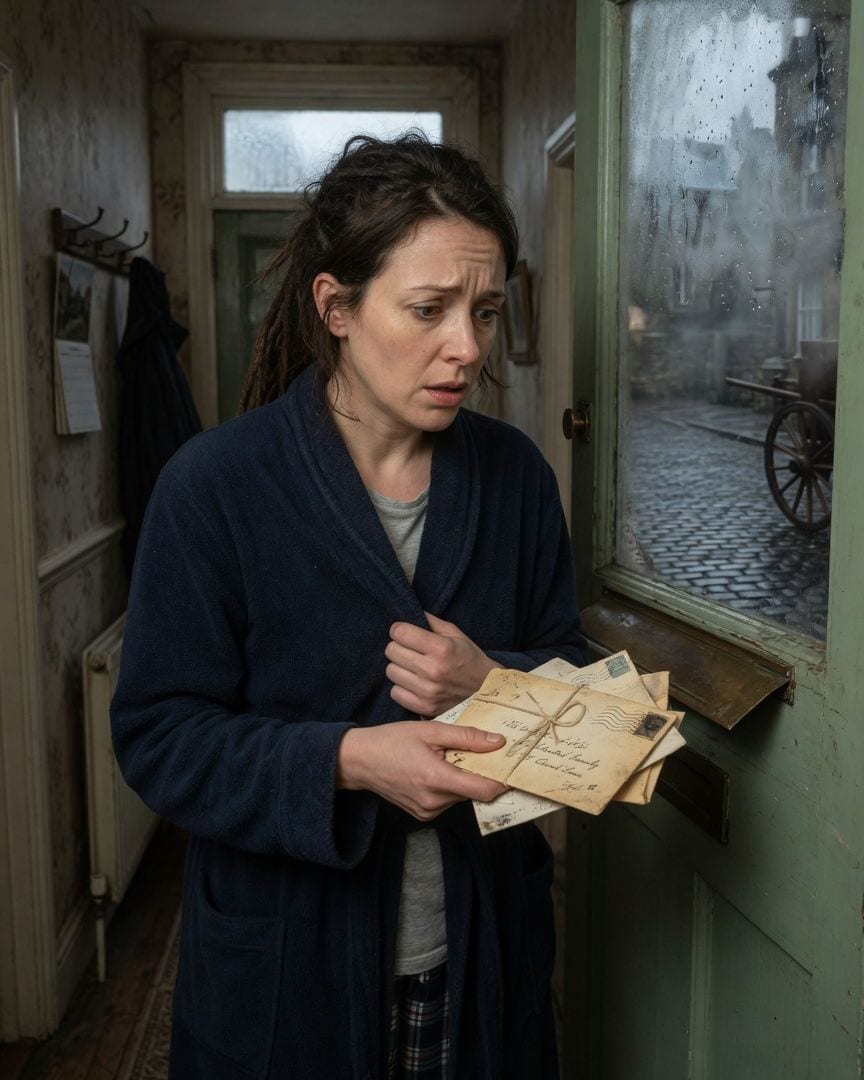
Seventy years ago, a hidden journal recorded my door opening to the wrong street and receiving Lockwood post.
I'd only recently moved into my inherited house, a quiet place on the edge of town. One grey morning, a distinct clatter from the front door's post flap caught my attention. Reaching down, I expected my gravel path, but instead, the flap showed a dark, cobbled street that wasn't mine. A bundle of warm, old letters, addressed to 'The Lockwood Family,' slid through, before the vision flickered and was gone.
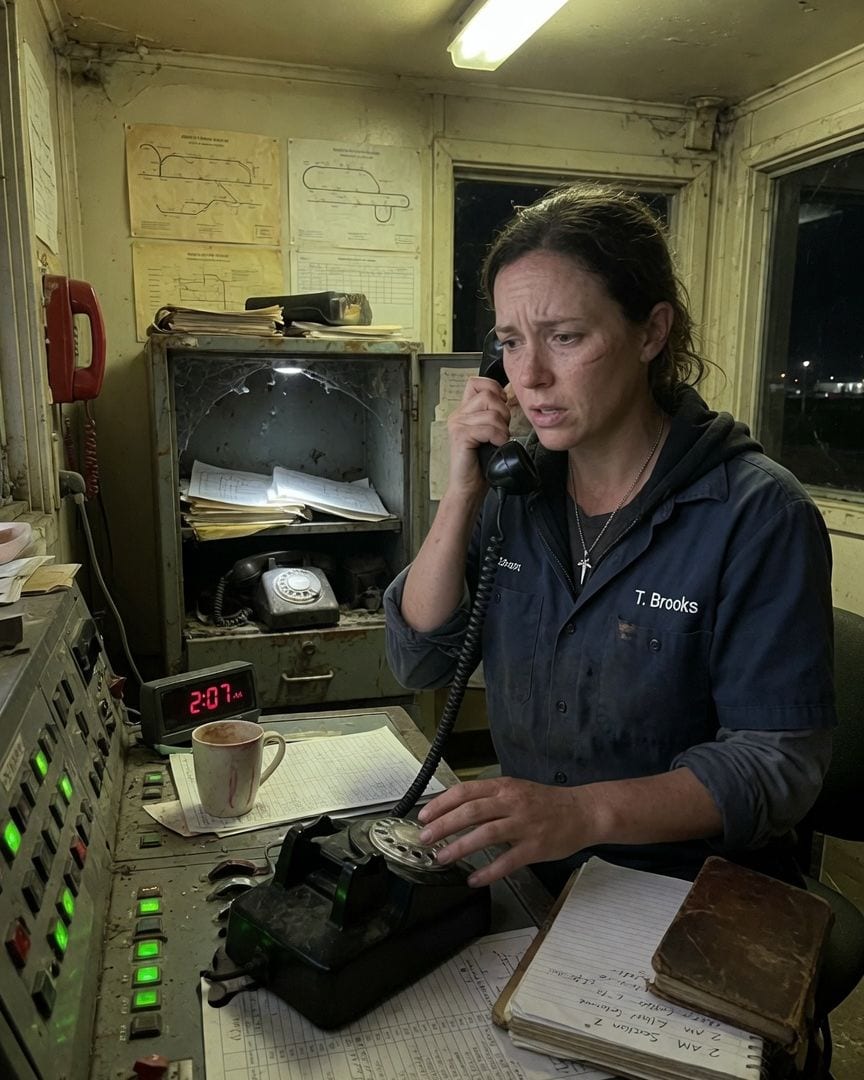
My signal box gets a 2 AM call every night from a man whose section was demolished eleven years ago. Now I found his logbook with today's date.
My night shift at the signal box is quiet and precise, defined by the routine 2 AM call from Ellis confirming Section 7 is clear. But when I asked my duty manager to log it, he said Section 7 hasn't had a track walker in eleven years, not since its cabin and phone were demolished.
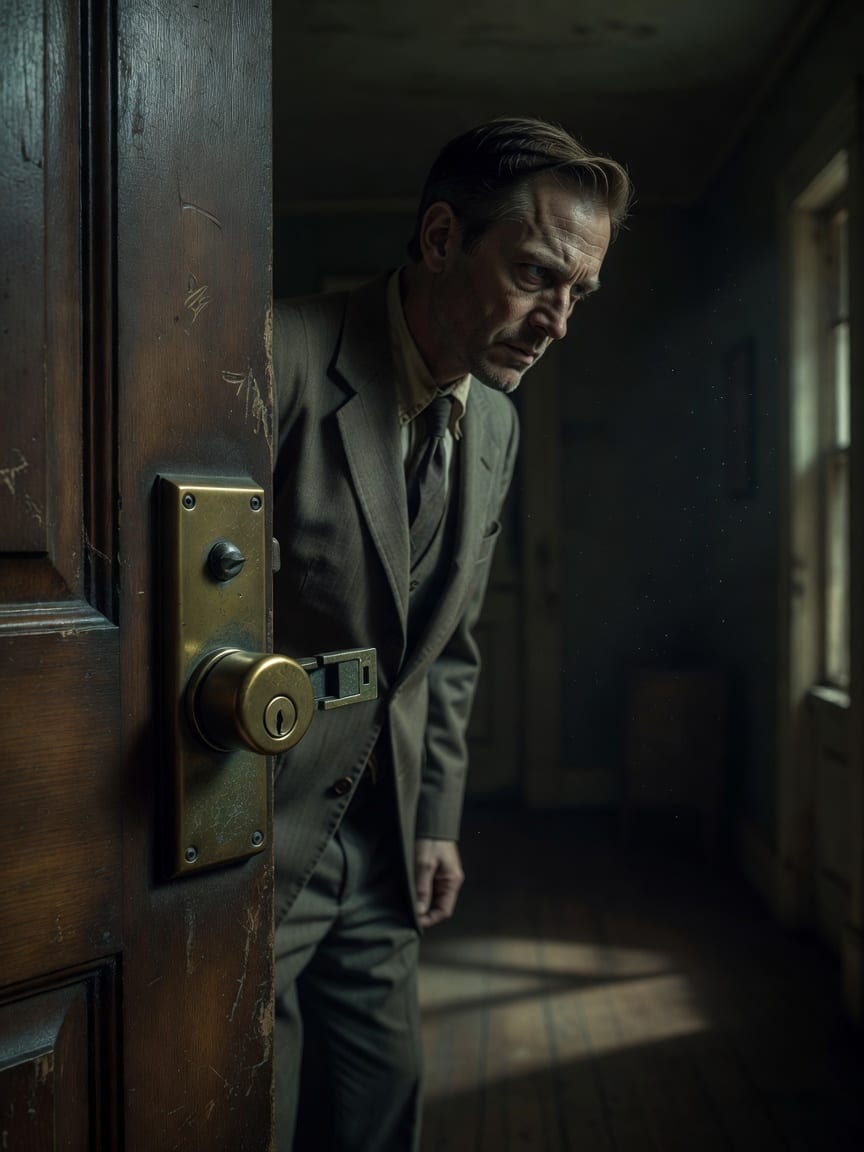
My deadbolt clunks shut from inside every night, long after I'm asleep. I live alone, and I've never heard it drawn back.
Inheriting Great-Aunt Lydia's house felt like a fresh start, until the nightly clunk of the deadbolt from downstairs started. I live alone, but every evening, the front door locks itself from the inside. Now, I’ve found Lydia’s meticulously kept calendar, with a 7 PM 'Deadbolt Check' written for tonight, a year after she died.
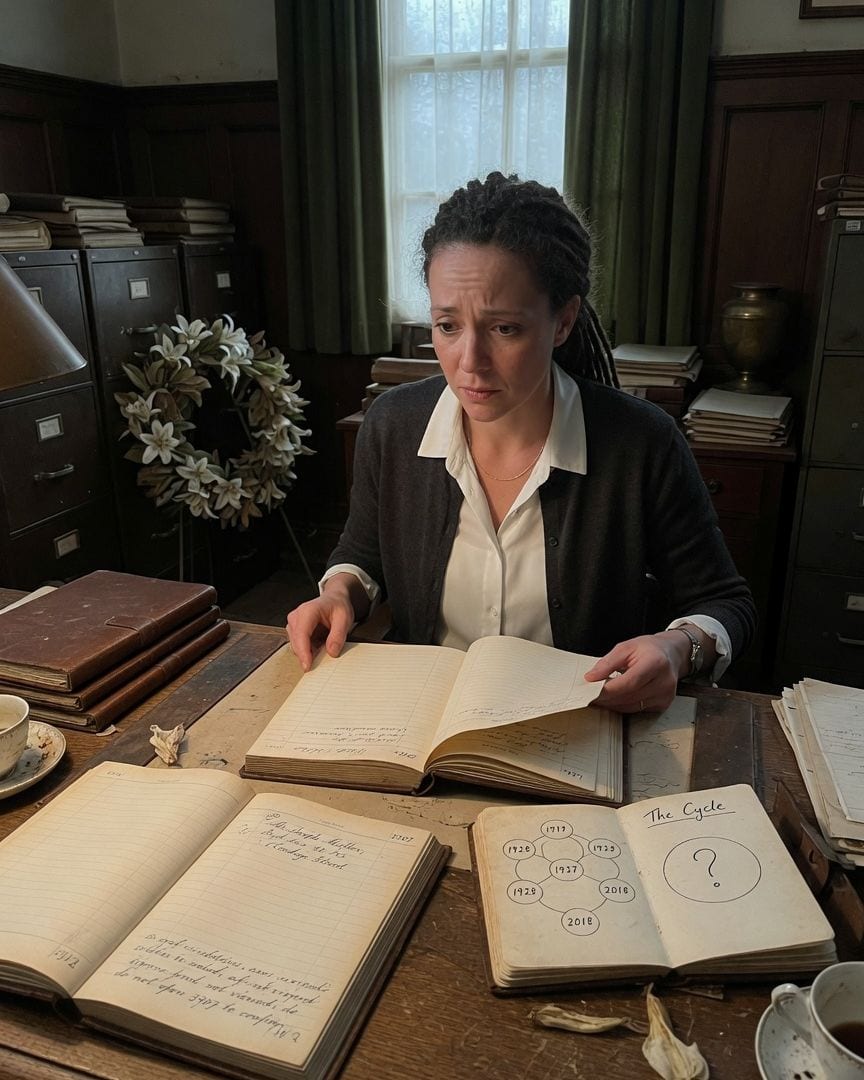
Our funeral ledger records my family name, same age, buried on Cordage Street every nine years since 1919. My great-grandfather's note: 'do not open 3907.'
Reviewing my great-grandfather Joseph’s old ledgers at the Ingram Funeral Firm, I stumbled upon a recurring anomaly. The same burial order for a Joseph Muller, age 45, residing at our family home, 14 Cordage Street, appeared every nine years across decades of records. Each entry, identical, carried the unsettling instruction: 'coffin sealed, not viewed.'
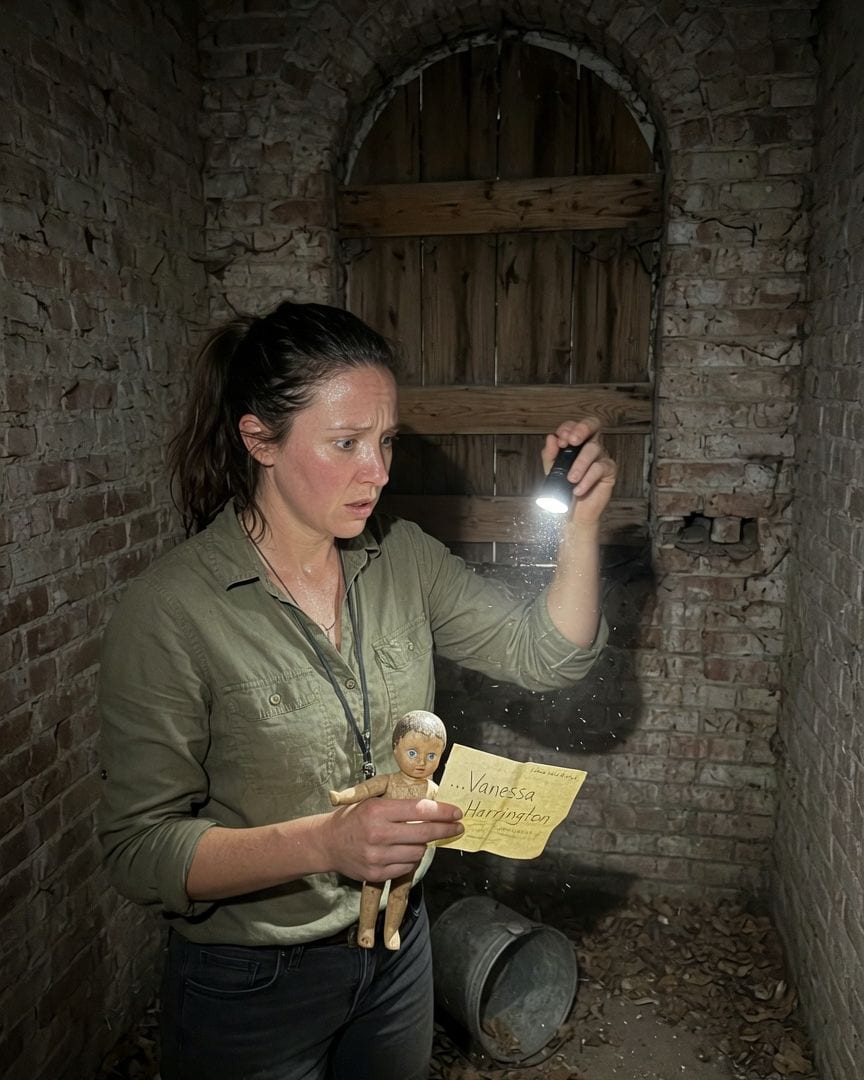
The attendance register has marked one pupil 'present' every single day since 1911 — never once absent. No child by that name has ever sat an exam.
Settling into my new teaching job at Oakhaven Elementary, I found myself drawn to the sealed bell tower. But it was the school's old register that truly unsettled me. A phantom entry, 'Pupil X,' had been marked 'Present' every single day since 1911, with no other records to prove they ever existed.
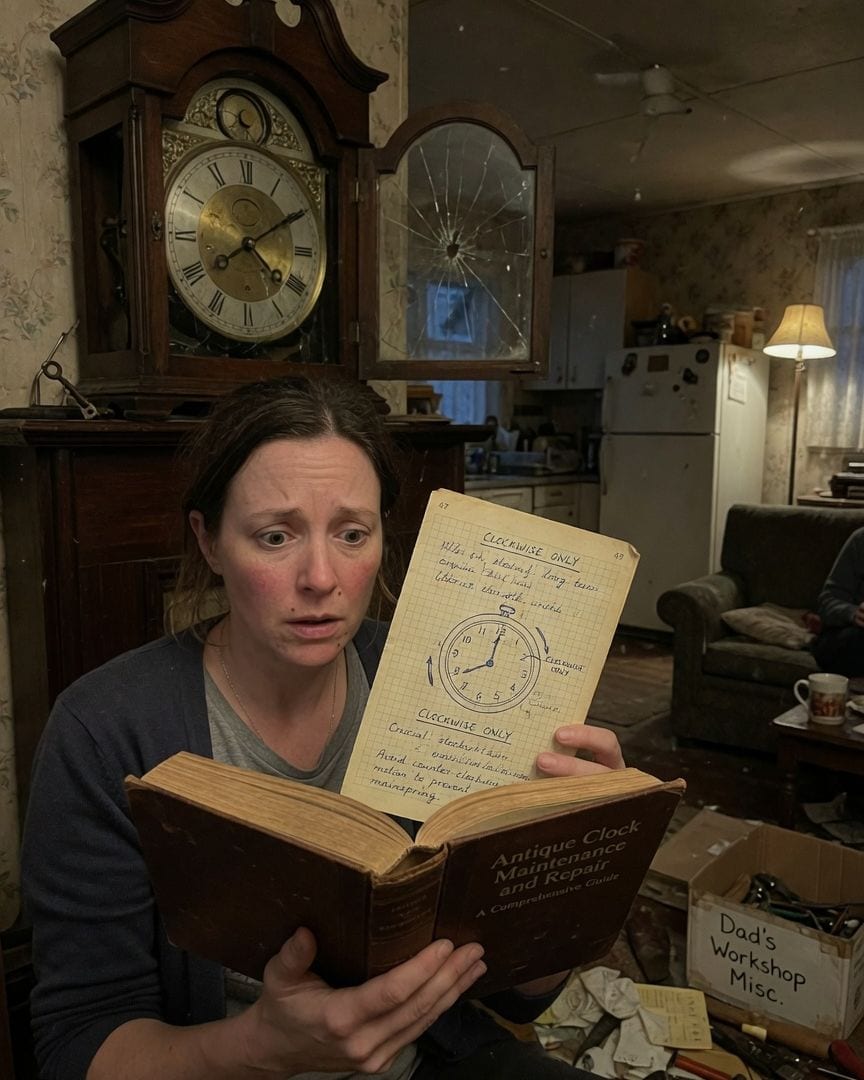
My father wound the hall clock the wrong way. He said he'd been doing it wrong for years.
My father, Henry, has wound our antique hall clock clockwise every Sunday for 32 years. Tonight, just days after getting lost, he turned the key counter-clockwise, shattering it. He looked at the wreckage and calmly stated, 'Must have been doing it wrong for years.'