The church's banns book shows a wedding notice, republished every three weeks. Same names, fresh ink. The marriage was never solemnised.
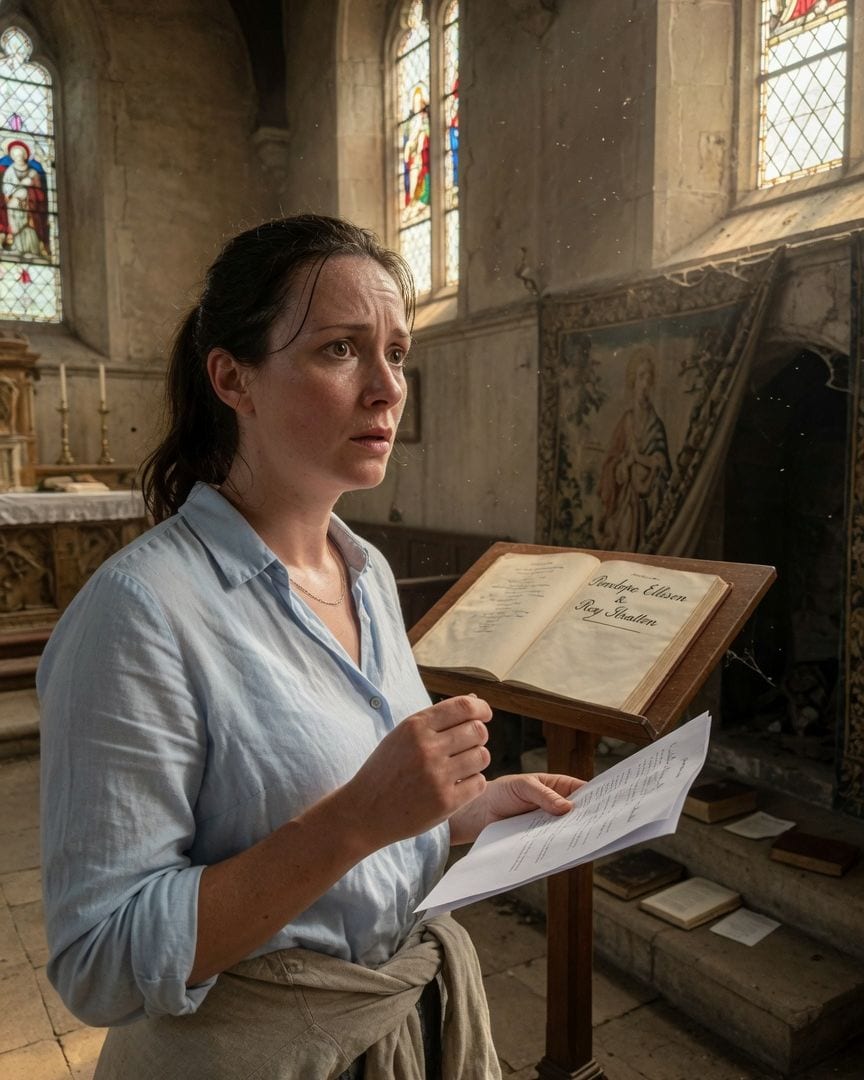
It was a warm Sunday in June 2024, my third week in Marne, and the air inside the old parish church felt thick with sun-dusted history. I sat in the front pew, watching Curate Paul Galloway prepare for the service.
He was a man of nervous habits, his hands perpetually fussing with something – a hymnal, a candle, now the heavy, leather-bound banns book. As he reached the page for new notices, his usual methodical movements faltered.
His eyes darted down, then away, and with a swift, almost imperceptible flick of his wrist, he turned the page before anyone else could clearly see it.
But I had. From my vantage, a flash of stark, fresh black ink stood out against the cream-colored paper. Two names, distinct even from that distance: ‘Penelope Ellison’ and ‘Roy Stratton,’ dated for the current month.
It was a small detail, easy to dismiss as my imagination playing tricks, but the speed of his hand, the slight tensing in his jaw, made it lodge in my mind like a burr.
Later, outside the church, the afternoon sun already dipping towards the rolling Marne hills, I caught Paul as he was locking the main doors.
"Curate," I said, trying to sound casual, "those banns notices today – for a new couple in town?"
He stopped, key still in the lock. His face, usually a placid pink, seemed to tighten, blanching slightly. His eyes, normally mild, flickered with something I couldn't quite place – apprehension, perhaps.
"Ah, Miss Whitfield," he mumbled, his gaze fixed somewhere beyond my shoulder. "Just… old traditions. Nothing of note, really." He cleared his throat, a dry, reedy sound. "Excuse me, I have… matters to attend to."
He hurried away without another word, leaving me standing on the cracked flagstones, the image of that dark, fresh ink on the hidden page quietly looping in my thoughts.
His reaction was entirely out of proportion to a simple question about a wedding.
The curate’s evasiveness bothered me, simmering under the surface of the week. By Monday morning, I couldn't shake it.
I walked back to the church, telling myself I needed to research local history for a project I was supposedly starting – a plausible excuse for a newcomer.
The heavy oak doors creaked open with a groan that seemed to echo through the empty nave.
The banns book sat on its stand, exactly where Paul had left it. My pulse quickened as I approached, a knot forming in my stomach. I found the page.
There they were, 'Penelope Ellison' and 'Roy Stratton,' just as I’d seen. The most recent entry was indeed dated last week. I reached out, my fingertip hovering just above the paper. The ink shimmered, dark and almost wet.
It looked as if it had been laid down only hours ago, not days. The air in the church, though cool, felt strangely charged around that page.
I then went to the vestry, where the official marriage register was kept. It was a much larger, more imposing volume, locked in a glass cabinet.
I convinced Mrs. Gable, the church secretary, that my 'history project' also required me to cross-reference marriage records. She grumbled good-naturedly as she unlocked the cabinet. I began my search, methodically, page by page.
I searched for 'Penelope Ellison' and 'Roy Stratton.' I checked the current year, then the previous year, then five years back. There was nothing. No entry, no solemnisation.
It was as if the banns notice was a declaration of intent that simply evaporated into thin air.
My rational mind, always seeking logical explanations, immediately went to work. Perhaps they’d married elsewhere? A private ceremony? A clerical error? I decided to check the town hall archives next.
For the rest of the afternoon, I pored over microfiche and dusty electoral rolls. Nothing. No Penelope Ellison, no Roy Stratton, not in any census, property deed, or voter registration for at least a decade.
The names existed only in that banns book – a phantom wedding notice, meticulously updated with fresh ink, that led absolutely nowhere else in the world. The ordinary explanations were starting to fray, leaving behind a cold, inexplicable void.
I found Paul Galloway again the next afternoon, inside the quiet chill of the church. He was tidying up prayer cards near the altar.
I approached him, clutching a printout from the town archives – a blank page where 'Penelope Ellison' and 'Roy Stratton' should have been. I held it out. "Paul," I said, my voice steady despite the tremor in my hand.
"There's no record. Not here, not at the town hall. Yet the ink in the banns book is fresh. What is happening?"
His face went impossibly pale, draining of all color. His eyes widened, fixing on the printout, then on me, then darting nervously around the empty church. He clutched a worn hymnal to his chest like a shield.
He didn't answer my questions directly. Instead, his gaze snagged on an obscure, dusty recess behind the altar, almost completely hidden by a heavy, faded tapestry that depicted a forgotten saint. His lips moved, barely a whisper.
"Some things are best left undisturbed, Miss Whitfield." His voice was trembling, thick with a dread so palpable it seemed to fill the very air around us.
He quickly backed away from me, then turned and hurried out of the church, leaving the heavy oak doors to creak shut behind him.
I stood alone, staring at the shadowed alcove, a cold sense of foreboding settling over me like a shroud.
The terror in Paul’s eyes was a stronger push than any rational thought. I walked towards the altar, my footsteps echoing unnervingly on the stone floor. The tapestry was heavy, surprisingly stiff with age and dust.
I reached out, my fingers brushing against the coarse, matted threads, and pushed it aside.
It wasn't a cupboard, or a shelf, or anything practical. Tucked into the recess, almost perfectly camouflaged against the dark stone, was a small, roughly carved wooden box.
It felt surprisingly heavy as I lifted it, its surface smooth under my touch, despite its crude construction. I opened the lid.
Inside, nestled on a bed of ancient, dried moss, was a perfectly preserved, yet gnarled and brown, boutonnière.
The flower was unlike anything I had ever seen – its petals were almost metallic in their dryness, intricately curled, with a dark, almost black center. It looked alien, both fragile and incredibly resilient.
Beside it lay a small, oval-shaped photograph, faded to sepia tones, depicting a solemn-looking couple from a bygone era.
Their faces were indistinct, obscured by shadow and age, a blur of features and expressions, but the man in the picture wore a boutonnière identical to the one in the box, pinned carefully to his lapel.
The silence in the church seemed to press in on me, heavy and resonant.
I carefully closed the box and took it with me. The next few days blurred into a single, relentless pursuit. The local library in Marne was a quiet, dusty place, smelling of old paper and wood polish.
I dedicated every waking hour there, poring over old town records, census reports, and microfiche of the Marne Gazette.
I started in the late 19th century, working my way forward, cross-referencing names against missing person reports, against anything that seemed out of place.
Slowly, agonizingly, a pattern began to emerge. It wasn't always 'Penelope Ellison' and 'Roy Stratton,' but permutations. Sometimes 'Penelope' and 'Robert,' or 'Rose' and 'Roy.'
These names would appear in local event notices – for a harvest festival, or a seasonal fair – never in marriage announcements, almost like placeholder names for generic attendees.
And always, approximately every twenty years, around the same time of year, these names would surface.
And always, within weeks or months of their appearance, the Gazette would carry a brief, cryptic mention of an 'unexplained absence' or a 'quiet departure' from the town.
No fanfare, no investigation, just a laconic two-line announcement that someone had simply ceased to be. The last cycle, I calculated, would have been around 2004.
The wooden box, the boutonnière, the faded photograph – an ordinary explanation, a forgotten wedding memento, began to feel chillingly inadequate in the face of this recurring, two-decade pattern of phantom names and quiet disappearances.
While I was engrossed in my research, hunched over a crackling microfiche reader, I became acutely aware of a presence. Across the quiet library, at a table near the towering fiction shelves, sat an elderly woman. Susan Radcliffe.
I recognized her from church. She appeared to be reading a large, leather-bound book, its spine uncreased. But I noticed her gaze often drifted over, observing me with an unnerving stillness. She never turned a page.
Her eyes, ancient and dark, seemed to track my movements, even when I pretended not to notice. I felt the prickle of her attention, a phantom weight on my skin.
Later that evening, as I returned to my car, parked under the heavy canopy of oaks that lined the library lane, I found a small, folded note tucked under my windshield wiper. My hands trembled as I unfolded it.
It was written in neat, old-fashioned script, the ink a faded blue: 'Some questions bring answers no one wants. Leave the old things alone.'
A jolt ran through me. The phrase, 'Leave the old things alone,' echoed a local turn of phrase I had heard Susan Radcliffe use earlier, almost like a proverb, when I’d asked the librarian about dusty old records.
A shiver, cold and sharp, ran down my spine. The note wasn't aggressive, not a threat, but a statement of fact, a warning delivered with an unsettling calm. I glanced around the deserted street.
The lamplit path was empty, the shadows long and silent. No one.
The realization that my digging had been noticed, that someone in this quiet town knew exactly what I was uncovering, made the solitude feel less peaceful and more like a trap.
I was no longer just investigating; I was being watched.
The note, combined with Susan Radcliffe's unnerving stillness, fueled a mix of fear and grim determination. The next morning, I drove directly to her small cottage on the edge of town.
The air was crisp, but a strange heaviness hung about the old stone house. I knocked, and after a moment, the door creaked open. Susan stood there, her eyes, those same ancient, knowing eyes, meeting mine without surprise.
"Good morning, Miss Whitfield," she said, her voice raspy but calm. "I expected you."
I held out the note and the wooden box containing the boutonnière. "You left this," I said, my voice steadier than I felt. "And what about this?" I opened the box, revealing the gnarled flower.
Susan took the note and read it, a faint, almost imperceptible smile touching her lips. "Yes, I left it," she said, her voice even, unperturbed. "A courtesy, dear. Some things are better undisturbed."
Her gaze lingered on the boutonnière, then swept over the faded photograph of the couple.
"What things?" I pressed, stepping closer, unwilling to let her evasiveness stand. "The names, Penelope Ellison and Roy Stratton. The ones in the banns book. They appear every twenty years, don't they? And then people disappear. Unexplained absences.
What is this?"
She sighed, a sound of weary acceptance, as if explaining something she’d had to explain countless times before.
"The 'banns'," she began, her gaze distant, fixed on something far beyond the cottage walls, "they're not for a human marriage in the way you understand it. It's an old tradition. A debt, you could say.
The town pays it to keep… the quiet things in Marne appeased. To keep us safe. To keep us 'quiet'."
"What quiet things?" I demanded.
"The entity. The land," she said, waving a dismissive hand. "It doesn't have a name that matters. It just… demands. And the 'Penelope' and 'Roy' are not specific people, not anymore. They are roles. Offerings, dear. A symbolic binding."
She paused, her eyes locking onto mine, a profound, ancient sadness in their depths. "The cycle is real. Every two decades, it wakes, and it asks.
The last time the banns were published, in 2004, my own cousin, a young woman named Eleanor, vanished without a trace soon after. Just like others before her. Always two.
Always after the banns are published, and never solemnized in your register."
"But why? Why accept it?" I asked, my voice barely a whisper, the horror of it settling deep in my bones.
"The town just accepts it as 'the way things are'," Susan stated, her gaze distant, reflecting generations of unspoken fear. "It’s better than what happens if you don't. Or if you interfere."
I looked at the gnarled boutonnière in the box, then back at the faded photograph of the solemn couple, and the pieces clicked into place with sickening clarity.
The fresh ink in the banns book, the missing marriage records, the steady pattern of unexplained disappearances, the phantom names – it all fit. It wasn't a clerical error or a local eccentricity.
It was a coherent, ritualistic sacrifice, hidden in plain sight, managed by generations of fearful townsfolk. And I had stumbled right into the middle of it.
Susan Radcliffe reached out, her gnarled fingers gently taking the boutonnière from the open box. She turned it over, examining its brittle, ancient petals.
Her gaze then drifted from the flower to my hand, still clutching the old photograph, my knuckles white. "You've broken the rule, dear," Susan said, her voice devoid of malice, simply stating a grave fact, as if discussing the weather.
"Opened the book, taken the token. And now, you're in the book yourself."
She gently took my hand, turning my palm upward. I felt a strange, cold pressure on my skin.
Where there had been nothing a moment ago, a faint, almost invisible mark began to appear – a small, delicate pattern, like a single dried flower petal pressed into my skin. It was the exact shape of the boutonnière.
I tried to wipe it away, a frantic, desperate swipe, but it wasn't on the surface; it was in my skin, a part of me now.
"They'll be looking for you, now," Susan whispered, her eyes fixed on the mark, a profound, ancient knowing in their depths, "to attend."
The chill spread from my palm, up my arm, and into my chest, a sickening realization that I had crossed a line I could never uncross.
I recoiled, pulling my hand away from Susan, staring at the indelible mark on my palm. A cold dread, sharp and absolute, seized me. "Attend?" I choked out, my voice barely a thread. "What does that mean?"
Susan watched me, her expression a mix of pity and resignation. "The mark signifies your designation as an 'attendant' for the next 'ceremony,' dear. The 'marriage' isn't just between 'Penelope' and 'Roy.'
It's a symbolic binding, yes, but it requires witnesses, or rather, participants. By interfering – by breaking the silence, by taking the artifact, by exposing the cycle – you've unwittingly inserted yourself into the current cycle.
You've answered the call, in a manner of speaking."
"But who are Penelope and Roy?" I asked, my mind reeling. "Are they real people?"
"Sometimes," Susan explained, her voice soft. "Often they are drawn from local residents who are 'chosen,' or simply… disappear. Their identities are absorbed into the ritual. The names are placeholders, but the roles are filled.
The town's quiet acceptance isn't apathy, Emily. It's a deep-seated fear. A desperate, generations-long attempt to manage the entity, never truly understanding its nature, only its demands.
The disappearances are the 'solemnization' of the marriage, the final payment of the debt. The boutonnière," she said, nodding towards the one in the box, "is a 'mark' of those who were taken.
A physical remnant of their unwilling participation, kept as a warning, and a record."
The full horror crashed over me then, not as a sudden fright, but as a coherent, terrifying truth. The entity, the cycle, the names, the disappearances – it wasn't a ghost story, it was a mechanism.
A recurring pattern of sacrifice, woven into the very fabric of Marne. And with that mark on my hand, I was next.
The mark on my hand began to tingle, then burn with an icy fire that spread quickly through my veins. An inexplicable, powerful pull started in my chest, drawing me with an undeniable magnetic inevitability towards the church.
It was as if the ancient stone itself was calling me, asserting its claim. The cycle was active, and I was now a designated participant. I had to do something, anything. My mind raced, desperate plans forming and dissolving.
I ran back to the church, my breath ragged, the cold burn in my hand intensifying with every step. I burst through the heavy doors.
Paul Galloway was inside, nervously tidying a small altar cloth, his face still pale from our last encounter. He looked up as I entered, and his eyes immediately fixated on the faint mark on my hand.
His eyes widened in utter terror.
"No, Miss Whitfield! Don't! Please, you can't!" He tried to bar my way, his arms outstretched, begging me to leave, to not provoke it further, his voice a choked plea.
But I pushed past him, a desperate, half-formed idea solidifying in my mind. I grabbed the old banns book from its stand near the altar. My hands trembled so violently the leather groaned.
I flipped past the current page, past the names Penelope and Roy, past all the phantom weddings.
I went to the very end of the register, to the blank, unused pages that stretched into the back of the book, waiting for a future that might never come.
With frantic urgency, I found a clean spread. I scribbled my own name, 'Emily Whitfield,' and the current date, large and defiant, across the final blank pages, defacing the pristine vellum with a desperate act of rebellion.
Then, with all my strength, I purposefully, definitively, closed the heavy book with a resounding thud that echoed through the empty church. It was a direct, visceral reversal of Paul's initial, fearful action of avoiding the page.
A deep, resonant hum vibrated through the ancient stone of the church, starting low and building in intensity until the very foundations seemed to shake. The stained-glass windows rattled in their frames. The air grew impossibly cold, then suffocatingly warm.
The mark on my hand, the icy fire that had consumed it, suddenly went completely cold, then vanished without a trace, as if it had never been there.
Paul collapsed to his knees, sobbing, his face buried in his hands, as the hum slowly, gradually, faded into an unsettling, profound silence.
The deep hum faded, leaving only the sound of Paul Galloway’s ragged breathing in the sudden, heavy silence of the church.
He eventually explained, between shuddering breaths and trembling hands, that by adding my name to the very end, I had 'completed' the book in a way it wasn't meant to be.
Perhaps, he whispered, it had satisfied the entity's need for a final entry, but not the right kind of finality, not the one it truly sought.
The strange, recurring entries in the banns book stopped. No more fresh ink for Penelope and Roy.
The town of Marne slowly returned to a semblance of normal, but a quiet, uneasy tension remained, a shared, unspoken knowledge that hummed beneath the surface of everyday life. No one else disappeared.
The cycle, it seemed, was broken, or at least, paused indefinitely.
I packed my bags and left Marne a week later. The silence of the town had become too loud, too heavy with its terrible secret.
I never saw Susan Radcliffe or Paul Galloway again, though I knew they remained, forever bound by the town’s silent truth. I never married, never had children.
The mark on my hand never reappeared, but sometimes, on still nights, I feel a phantom chill where it once was, a ghost of the entity's touch, a lingering echo of the demand it almost made.
I know I broke the cycle, but I also know I became part of it, irrevocably. Sometimes, I still wonder what kind of marriage it was meant to solemnize, and who truly paid the price.
If this one got to you
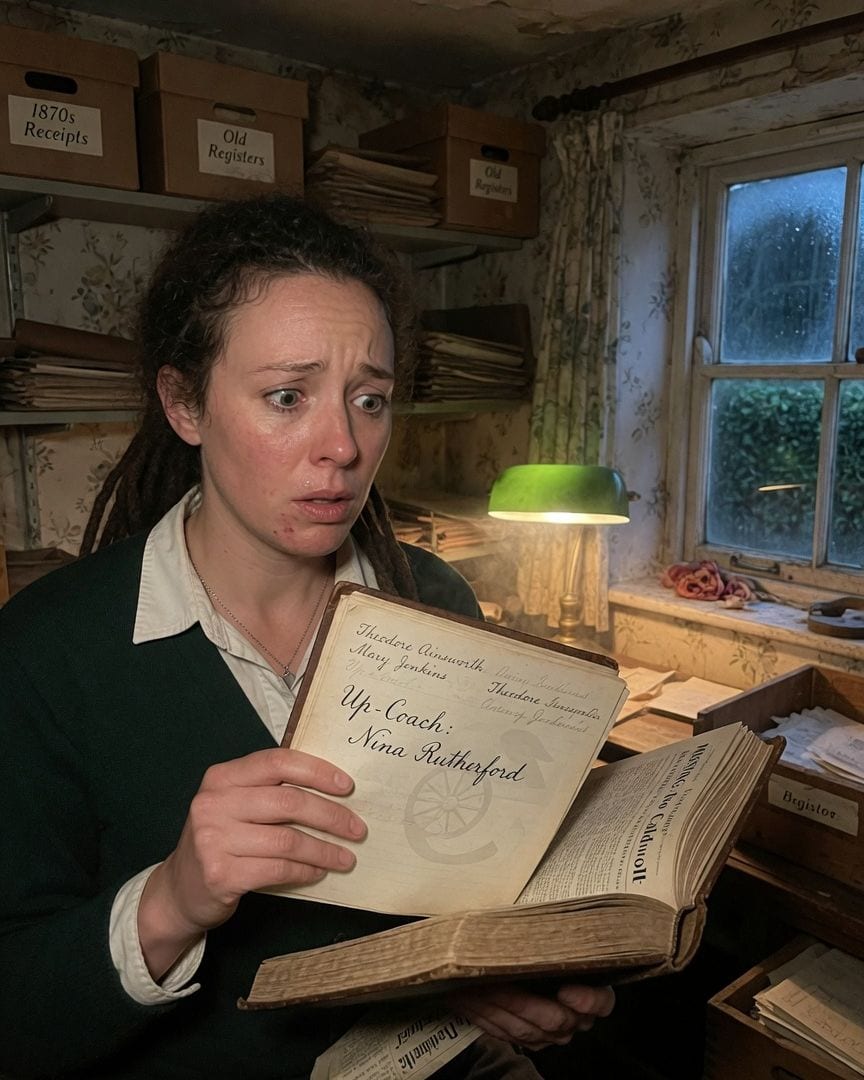
The old inn's arrivals book logs a vanished girl's name. She disappeared two months ago, but the ledger says she checked in last week.
As the new owner of The Angel Inn, I cherished its ancient history. But one evening, while tidying the old arrivals book, I found a chilling entry: Nina Rutherford, a local girl who vanished two months ago, was logged as checking in last week.
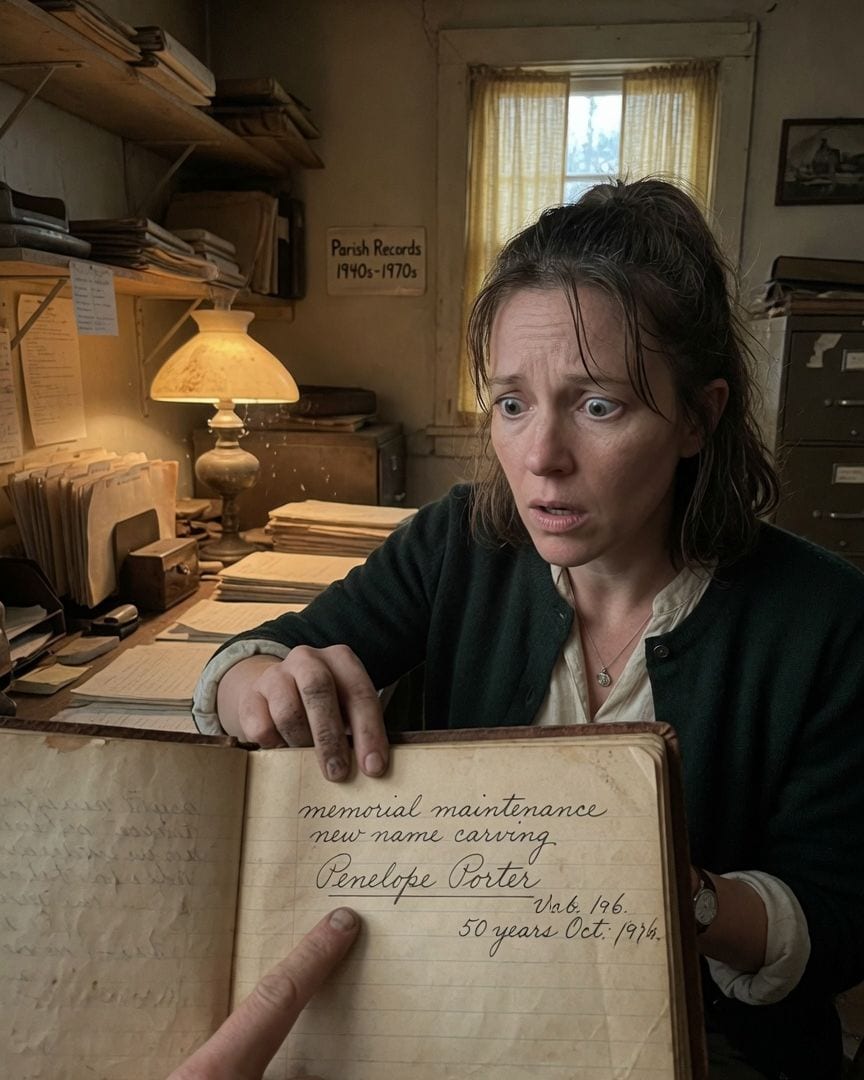
My name is carved on the war memorial with this coming Tuesday's date. The cut is fresh, but the stone inside matches fifty years of age, and a ledger says it was carved exactly fifty years ago.
On a sunny autumn Tuesday, my oldest friend, Gary, urgently called me to the village war memorial. There, carved beneath the names of the fallen, was 'PENELOPE PORTER' with a date from this coming autumn. The fresh carving of my name, dated for a Tuesday yet to arrive, felt like a cold jolt, an impossible message from the stone itself.
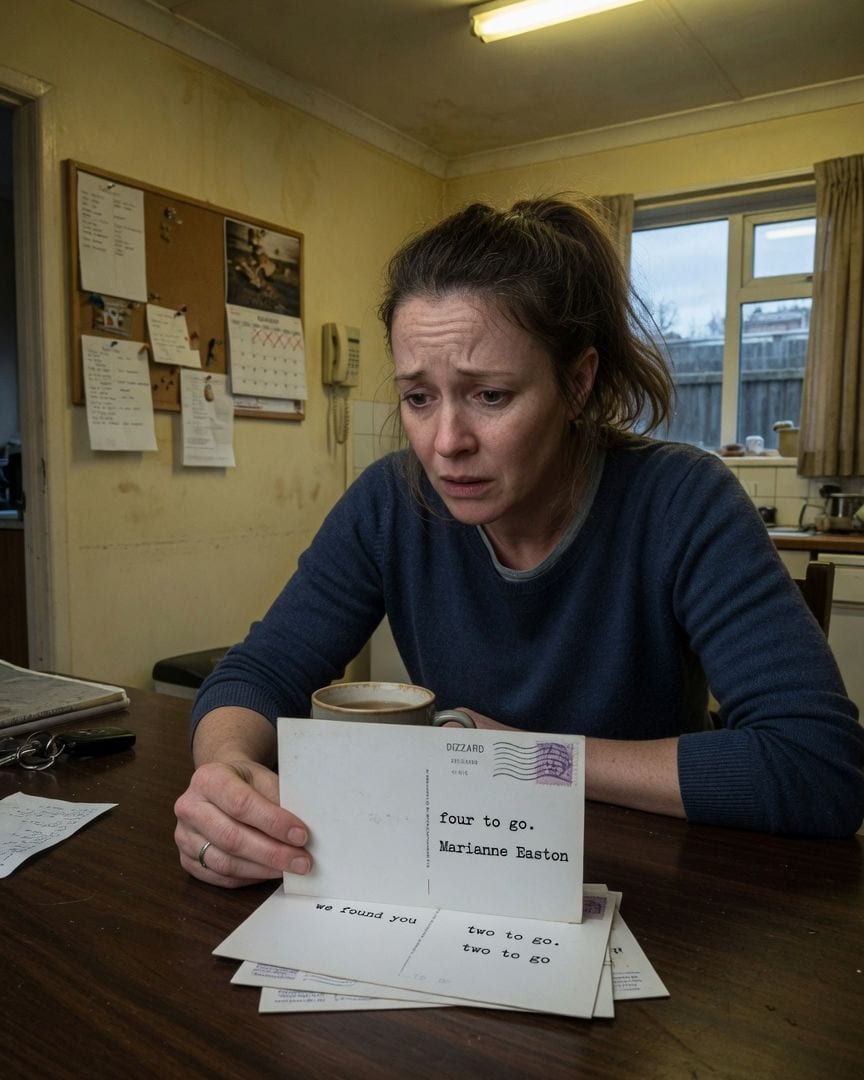
My postcards arrive each Friday, addressed by name, counting down. This week's says 'four to go,' postmarked from a cliff with no postbox.
Every Friday, stark white postcards arrive on my kitchen table, addressed to me. Each one is postmarked 'Dizzard,' a desolate cliff miles from any town, with no post office. For weeks now, they've been counting down.
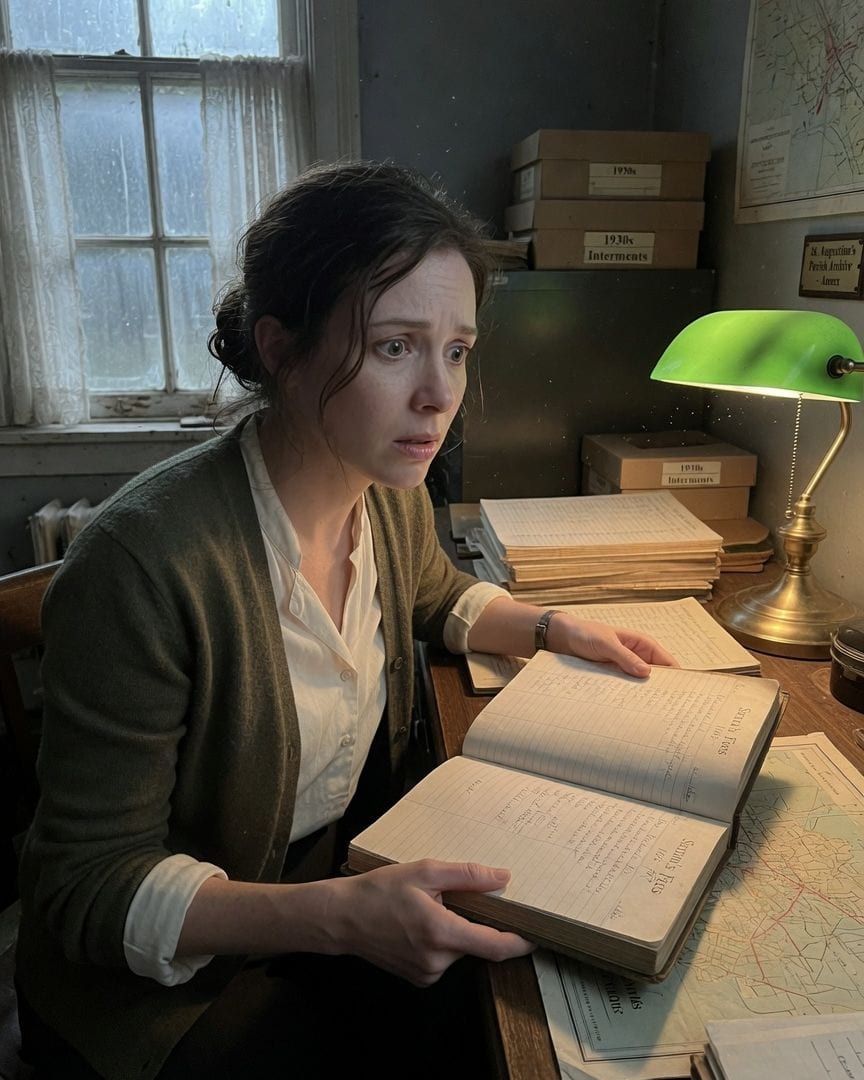
Our churchyard closed in 1974. But the sexton's book shows new graves every month, paid by families whose names are on stones from the 1930s.
As Oakhaven's new archivist, I expected a quiet life of dusty ledgers and ancient records. But a current entry in the sexton's fee book listed a "new burial plot" paid last month for Theresa Romano, who died in 1931. The town ordinance closed the churchyard to new burials in 1974.
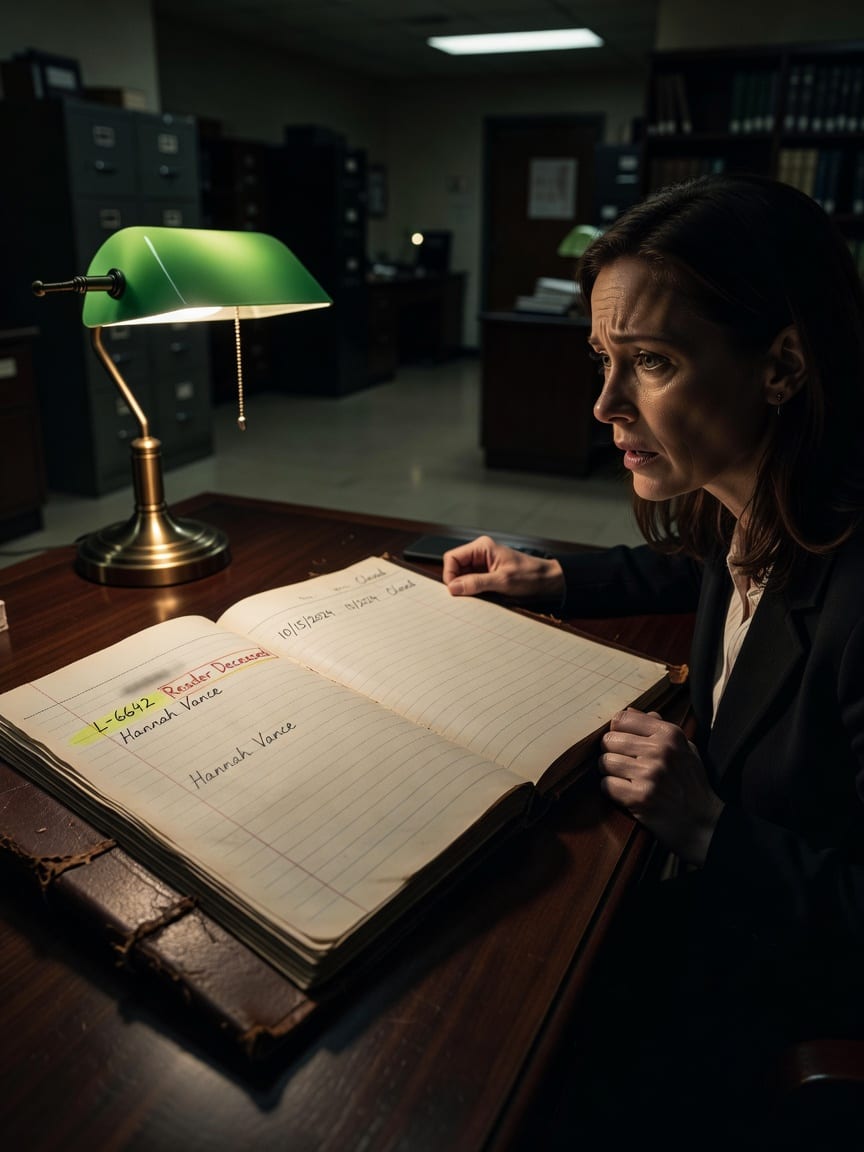
My library card number L-6642 was issued to me at seven — and the ledger shows that number has marked a reader 'deceased' every twelve years since 1949.
Returning my late father's library card to the old town library felt like a small act of closure. But the senior librarian's ancient ledger revealed a chilling pattern of 'reader deceased' entries tied to specific card numbers and borrowed books. My unease turned to cold dread when I secretly found my own name penciled in, marked for a future 'reader deceased' entry.
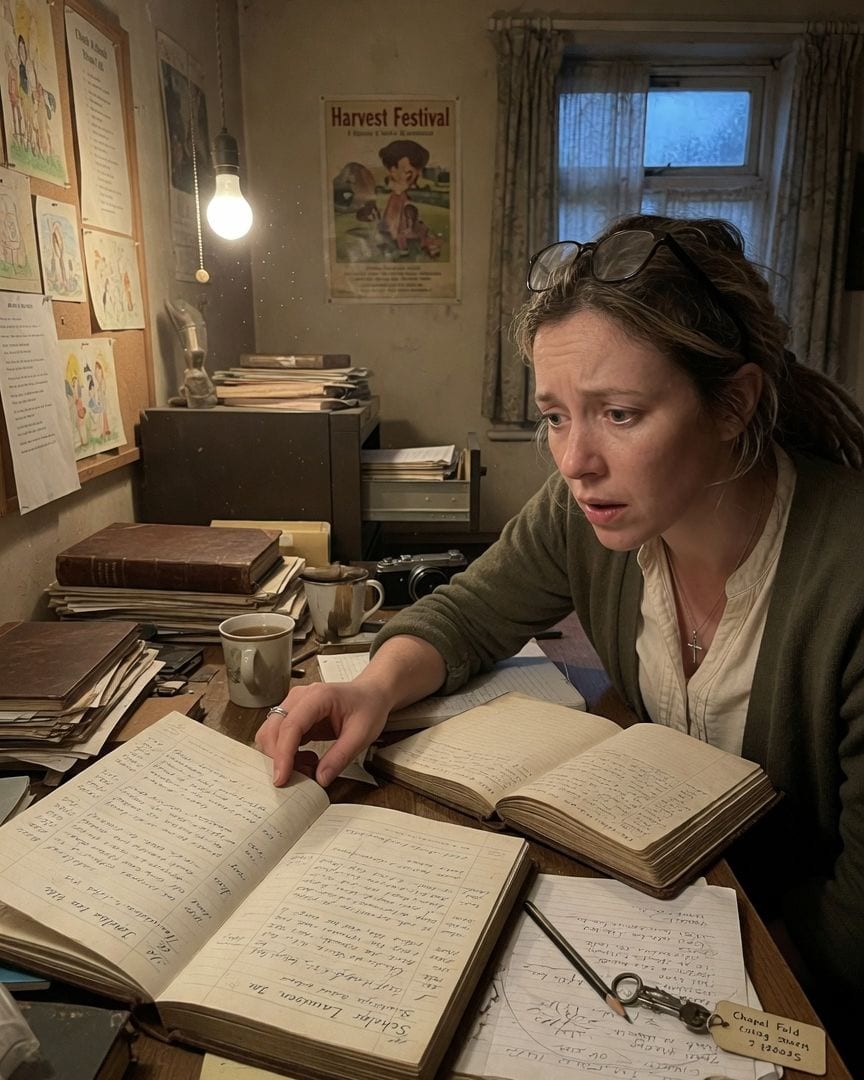
My name is in the chapel's old Sunday school register as 'Scholar 33'. But 'Scholar 33' appears every seventh year since 1907, each child from the same cottage, each marked 'not called for'.
Sorting dusty chapel archives, my job as a local history enthusiast, was a soothing journey through generations. But then my own name, Penelope Lawson, jumped out: 'Scholar 33' for the current year. I'd never attended. Flipping back, I found the same 'Scholar 33' entry repeating every seven years for over a century, always linked to the same old cottage.