A Coast Guard officer found a missing transport's life raft. Inside, a hidden document was dated a full week into the future.
The Aleutian sundown bled purple into the gray, but Dell Krznaric felt no peace. He’d been about to call off the search for USCG Transport 117 when the fishing trawler reported a find.
An empty life raft, its bright orange canopy zipped tight, bobbing alone in the vast, indifferent expanse of the Bering Sea. The crew recovered it, bringing it back to Dutch Harbor, a small, cold port where Dell now stood.
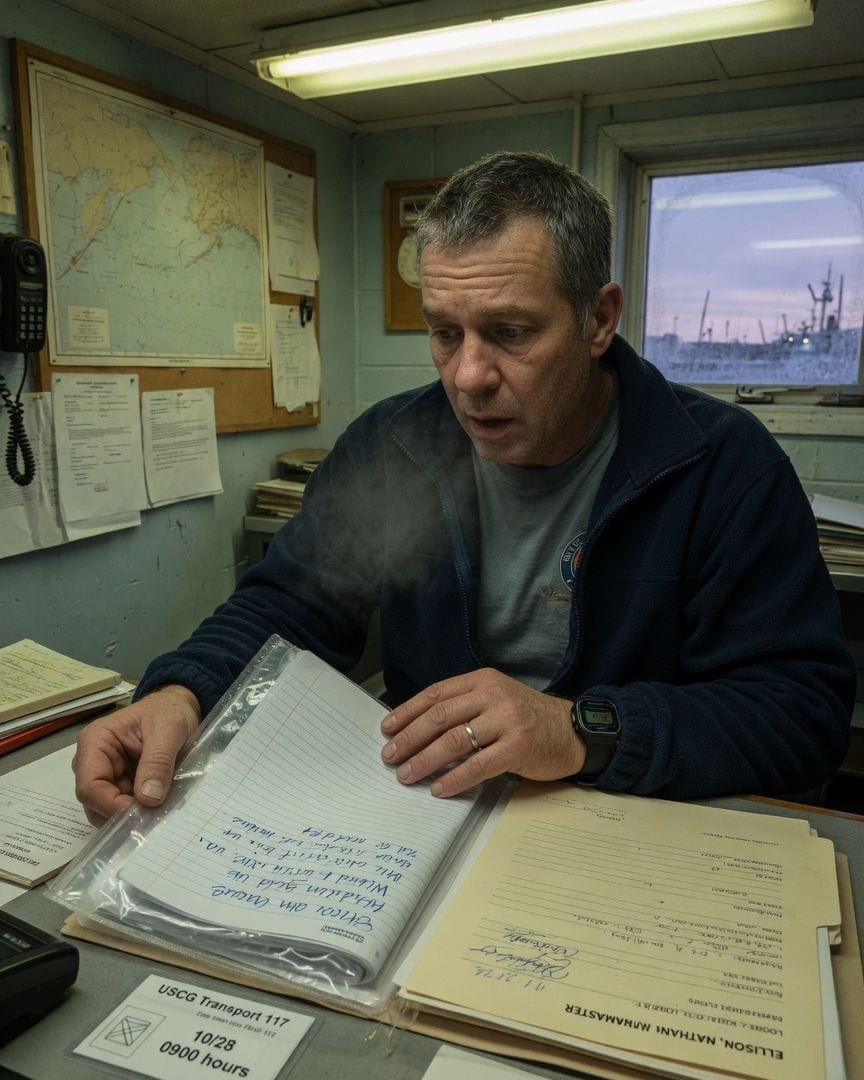
He watched them cut the ties, unzipping the heavy-duty canvas. Inside, a survival log lay secured in a waterproof pouch, in the meticulous hand of Loadmaster Nathaniel Ellison.
Dell’s fingers, stiff from the cold, traced the precise, neat entries: hourly positions, weather, crew conditions. He recognized Ellison’s careful script from countless flight manifests and supply requisitions. The log was a testament to Ellison’s diligence, even in dire circumstances.
Dell felt a surge of grim admiration for the lost loadmaster, mixed with the ever-present ache of responsibility for the missing crew. He scanned the last few entries. “2300. Visibility zero. Heavy chop. Holding.” “0100. Still adrift. Beacon deployed.
Morale low.” Dell looked at the current time on his watch: 2000 hours. Then his eyes flickered to the final entry in Ellison’s log: '0400. Still adrift. Wind picking up. Heard an engine.'
That was eight hours after the raft had been found, eight hours into the future from his perspective. Dell’s breath hitched in the freezing air, a thin cloud against the dying light.
Dell took the log back to his office, the sterile fluorescent light a poor substitute for the open sea. He laid it flat on his desk, its plastic cover still slick with saltwater.
He pulled out Ellison’s personnel file, comparing the handwritten entries to other official forms Ellison had signed. Identical. Meticulous, almost obsessive in its neatness.
Dell ran the reported coordinates through his systems, cross-referencing them with the prevailing currents and the 117’s last known position. The drift prediction aligned perfectly, right up to the 2000-hour entry.
After that, the log stretched into an impossible future, detailing weather patterns that hadn’t yet occurred. Dell tried to rationalize it. A transcription error? A faulty watch on Ellison’s part, making him log future events?
He checked the log’s internal timestamp, but it was a simple, manual record. No internal clock to malfunction.
He pulled the manifest for Transport 117, checking every serial number, every piece of equipment, every emergency kit on board. He found a detail: a specific, limited-issue emergency beacon, serial number 800-457-CG, logged as deployed at 2100 hours by protocol.
Yet, in Ellison’s careful hand, the log stated 'Beacon deployed' at 2030 hours. A thirty-minute discrepancy. Dell leaned back, the old office chair groaning beneath him. He pulled up the distress signal records.
No beacon signal from 800-457-CG had ever been received. The log wasn’t just wrong; it was wrong in a way that had been meticulously recorded, a perfect, precise error that mirrored the impossible future entries. The implications settled on him like a shroud of ice.
As Dell carefully closed the log, he felt a slight stiffness at the bottom of the waterproof pouch. He reached in, his fingers brushing against something small, flat, and hard.
He pulled it out: a second document, no larger than a credit card, sealed in a thin, clear plastic. It wasn’t a personal item.
It looked official, generic, with a small, unidentifiable stamp in the corner – a simple, geometric design with no letters or numbers he recognized. His thumb traced the embossed pattern, smooth and cool beneath his skin.
And then he saw the date, stark against the thick paper: 10/28, 0900 hours. Today was October 21st. Nearly a week from now. A date no one on that raft could have possibly recorded.
Dell brought the small, sealed card to Maureen Sullivan, a records clerk known for her near-photographic memory for obscure government forms.
She sat in her cubicle, framed by stacks of beige files, the drone of the fluorescent lights a constant companion. Maureen took the card, turning it over in her gloved hands. “Never seen this stamp before, Commander.
No agency code, no department identifier. Looks... generic. Mass-produced, almost, but the paper quality is high.” She ran the embossed pattern through a database of official seals. The system whirred, then returned a 'No Match' error. Nothing.
Then she tried the date. “This is the weirdest part,” she said, her brow furrowed, her finger tapping at her keyboard.
“I found three other incidents, all Coast Guard, all unexplained disappearances: a survey vessel in '68, a C-130 in '83, and a small cutter in '97. Each file contained a similar card, same untraceable stamp, same impossible future date.”
She pulled up scanned images of the old documents. Dell leaned over her shoulder, his gaze tracing the identical stamp. “The dates on these cards,” Maureen continued, her voice growing tense, “correspond to the exact moment their last known transmission ceased.
Not when they were declared lost. When they went silent.” The pattern was forming, chillingly precise, across decades and classifications. It wasn’t an isolated anomaly; it was a consistent, terrifying signature.
Dell and Maureen's inquiries into the ghost documents didn't go unnoticed. A few days later, a call came through Dell's direct line, the caller ID simply showing 'Internal Affairs.'
The voice on the other end was flat, devoid of inflection, asking about his 'unorthodox interest in historical records.' Dell brushed it off, citing the open case of Transport 117 and due diligence, but a seed of unease was planted.
The monitor on his desk flickered, then stabilized, as if watching him.
The next afternoon, a man introduced himself as Everett Carter, retired Coast Guard Intelligence, and appeared in Dell's office without an appointment. Carter was lean, silver-haired, with eyes that seemed to have seen too much.
He didn't accuse; he simply observed Dell with a disquieting calm. “Some things are filed for a reason, Commander,” Carter said, his voice a low rumble that seemed to vibrate through the floorboards.
“Better to let the years close over them. You dig too deep, you might find yourself part of the archive.”
His words weren't a threat, but a warning born of weary knowledge, a statement of fact from someone who had witnessed the inevitable. He paused, then added, almost as an afterthought, “Your loadmaster, Ellison. Good man. Meticulous.
The best ones always are.” The air in the room seemed to grow heavier, as if pressed down by an unseen weight.
Dell refused to back down. He cornered Carter in the quiet of the empty mess hall, the clatter of dinner trays long past, only the hum of the refrigerators breaking the silence. “What exactly do you mean, 'filed,' Mr. Carter?
Ellison wasn't filed, he was lost.” Dell’s voice was tight, the polite deference gone. Carter sighed, running a hand over his face, the lines around his eyes deepening. “Lost is a word for what we tell the families.
Filed is what it is. A transfer.”
He pulled a worn leather folder from beneath his coat. Inside, a single sheet of paper, heavily redacted. Black bars covered most of the text, an ink so absolute it seemed to absorb the light around it.
But a few words remained visible: 'Operation… Sub-Designation: Archive… Transfer Protocol…' Dell’s eyes fixed on a section where the redactions were particularly dense, forming an almost recognizable shape. It wasn’t just random blacking-out.
There was a deliberate, consistent form to it. Carter pointed a gnarled finger, his nail yellowed with age. “Ellison. Nathaniel. Service number. Date of transfer.” Dell felt a sickening lurch, a cold grip on his gut.
The redacted shape was clearly a name, and beneath it, a date that precisely matched the impossible 0400-hour entry in Ellison’s survival log. It was the same date that was a week in Dell's future, but Ellison’s past.
“It’s not a clerical error, Commander,” Carter said, his voice barely a whisper. “It’s a process. And the records… the records are how it’s done. They don’t just document it. They are it.”
The full weight of the log’s impossible entries, the thirty-minute beacon discrepancy, the ghost documents with their future dates, crashed down on Dell.
It wasn’t a mistake; it was an active record, a set of instructions for a precise, pre-scheduled event.
Maureen, unnerved by Carter’s visit and his cryptic warnings, had redoubled her efforts. She’d found more 'ghost' documents, all with the same untraceable stamp, their impossible future dates aligning with other cold Coast Guard cases.
She called Dell late that night, her voice tight with suppressed fear, the background noise of her office alarmingly silent. “Commander, I found something. A new file. Not declassified, not even old.
It’s in a secure, internal database, marked 'DECLASSIFY NEVER.'” Her words came out in a rush, desperate, as if she was running out of time. “It’s mostly blank, but it has that control number you asked about: KRZ-770.”
Dell’s mind raced. He remembered seeing that string of letters and numbers on the cover sheets of some of the older redacted files they had reviewed, a code he’d dismissed as an internal administrative tag.
“And there’s a redacted section, Dell,” Maureen continued, her voice dropping to a whisper, barely audible over the phone’s static. “The black bars… they form a shape. It’s your service number.
And beneath it, your current assignment: Aleutian Search and Rescue Coordinator.” Dell gripped the phone, his knuckles white. The chill of the Aleutian night seemed to seep into the room.
Maureen’s finger hovered over a blank space in the digital file, a redaction so absolute it seemed to consume light.
But the shape of the blacked-out text was unmistakable: a series of digits that, when she squinted, mirrored Dell’s own Coast Guard service number, followed by the specific code for the Aleutian search sector he currently commanded.
The file was not just about past disappearances; it was actively being written, and Dell's name was already on a future page.
Maureen projected the digital file onto Dell’s office screen. The harsh light illuminated the blank sections and the stark, blacked-out text.
The redactions, the control number KRZ-770, the impossible future dates on the 'ghost' documents—it all clicked into a horrifying, coherent pattern. The 'engine' Ellison heard wasn't a rescue; it was the precise, internal hum of the mechanism of his 'filing.'
The meticulous logs, Dell now understood, were not just records of disappearances, but active components in them, an accounting that precipitated the very event it described.
The institution, vast and unseen, didn't just document the lost; it facilitated their transfer, sealing them into an inaccessible dimension or state of being from which there was no return, leaving only these 'records' behind.
The 'Redaction That Has a Shape' across the old files, they now realized, was a specific, recurring glyph, a symbol of the 'destination' or the 'type of transfer,' an entry point into something unknowable.
Dell’s own service number, now redacted in the new file, meant he was next.
The Coast Guard wasn't just a search and rescue operation; it was, in part, the keeper of the files, the front line of an archive that consumed people.
Dell sought Carter out one last time, not for answers, but for confirmation of his grim understanding. The Aleutian wind bit at him as he found the retired officer sitting by the docks, watching the waves crash against the pylons.
Carter’s silhouette was etched against the gray sky, still and unmoving. “It’s not just paperwork, is it?” Dell asked, his voice hollow, barely audible over the wind. “It’s how it happens. The files are… the doorway.” Carter didn’t turn.
He simply nodded, a slow, deliberate movement that spoke volumes. “Some doors, Commander, once opened, cannot be closed.”
Dell stood there, the cold wind whipping his coat, the truth settling over him like a shroud of deep-sea ice. There was no escape, no fight to be won against an entity that used bureaucracy as its instrument.
He returned to his office, the Aleutian search now officially closed, the files sealed and forgotten by all but him and those like Carter. On his desk, amidst the usual stack of reports, lay a single, pristine document.
It was blank, unmarked, but Dell recognized the high-quality paper, the subtle texture, and the faint, almost invisible watermark that had been on the original 'ghost' document.
He knew, with a certainty that froze his blood, that it was stamped with the control number KRZ-770. It was the file that was still being written.
Dell continued his duties as search coordinator, his face impassive. He reviewed new reports of missing vessels, signed off on search patterns, and closed cases. Outwardly, he was the same methodical, rational officer.
But inwardly, he was a different man, carrying the weight of what he now knew.
He began to notice subtle shifts in his office: a pen moved an inch to the left on his desk, a file re-ordered itself in his inbox, the faint scent of ozone clinging to the air after hours, a strange cold spot that lingered near his chair.
Small, impossible anomalies that whispered of a presence, of a file being meticulously prepared, of a process steadily moving forward.
Late one evening, Dell sat at his desk, the only light the green glow of his monitor. The building was silent, a tomb of forgotten cases and redacted truths.
He picked up a fresh report, an overdue fishing trawler, and reached for his pen to sign off on the initial search. He paused, his hand hovering over the blank signature line.
From somewhere deep within the building’s old pipes, he heard it: a faint, low hum, like an engine, distant but distinct. A sound no one else would ever notice, a sound he knew was not of this world. He knew.
He lowered the pen, his signature steady, precise, and utterly devoid of hesitation.
The file was still being signed.
If this one got to you
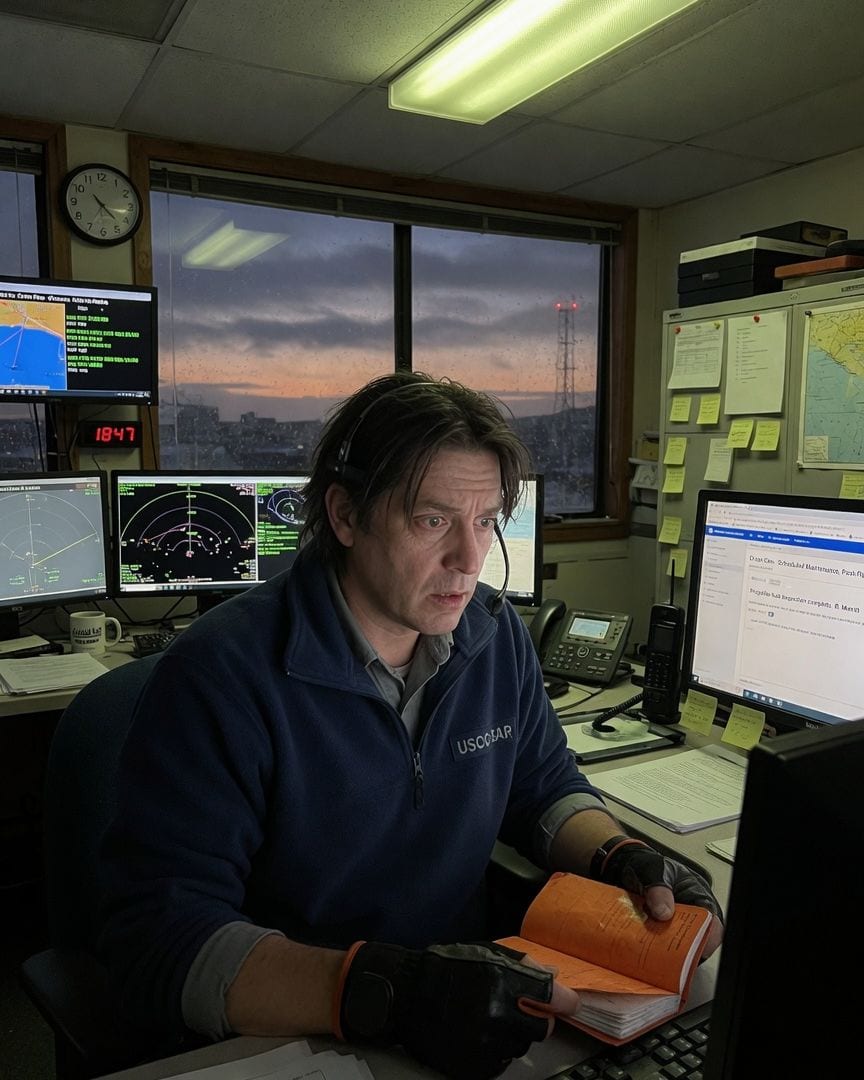
A Coast Guard coordinator found a lost plane's maintenance report, digitally signed two days after it vanished.
Dell Krznaric, a US Coast Guard Search and Rescue Coordinator, faced the grim task of standing down the search for 'Orion One,' a transport missing nine souls for eleven hours as sundown approached over the frigid Aleutian waters. His critical rescue window was closing fast. When a fishing trawler found an empty life raft, Dell discovered a survival log inside—its last entry dated eight hours into the future, reporting an engine sound yet to be heard. Later, he found a maintenance report for the lost aircraft, digitally signed by Loadmaster R. Merritt, dated two days after its presumed loss. The system accepted the impossible signature, leaving Dell to wonder how a lost plane's records could still be writing from a future that hadn't arrived.
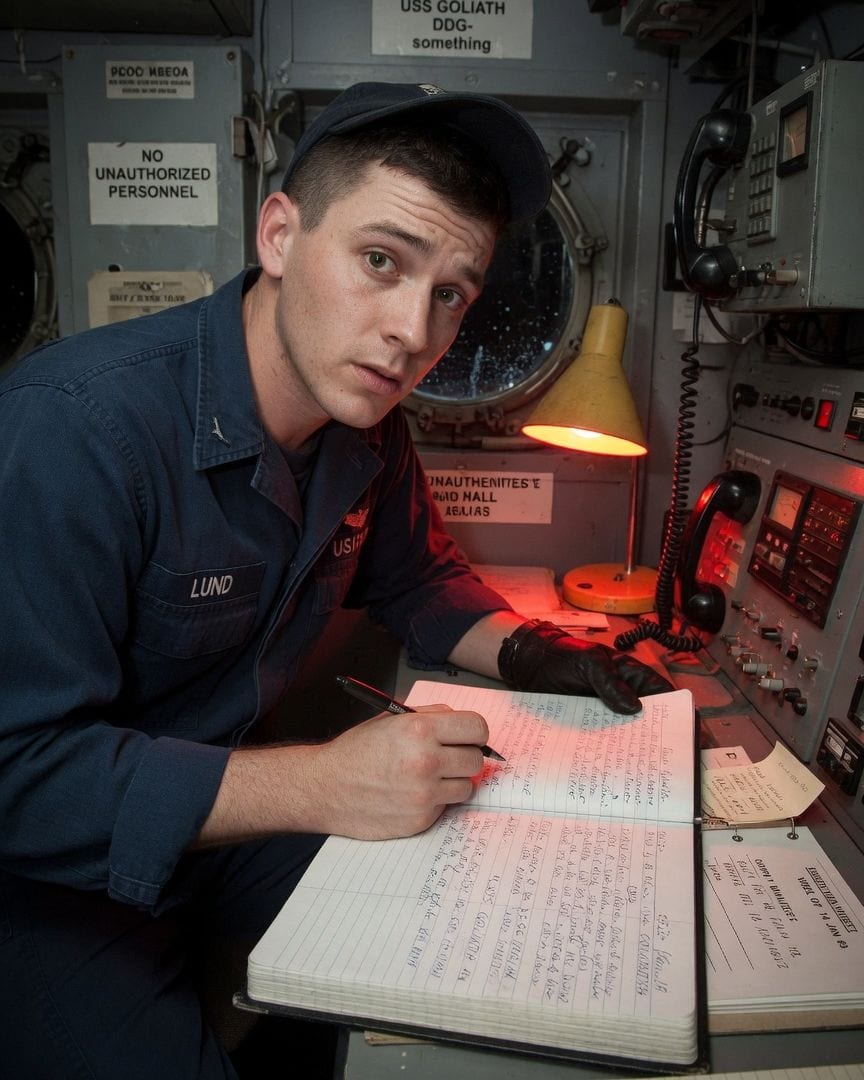
Petty Officer Lund heard his own captain's mayday: the Cold War USS Goliath was sinking, two hundred miles astern.
Petty Officer Marco Lund kept a lonely vigil in the USS Goliath's radio room, the destroyer battling the North Atlantic in deep winter 1983. Suddenly, a garbled mayday broke through: his own ship, his own captain, reporting they were going down two hundred miles astern. Though the bridge confirmed the Goliath was fine, the same chilling call came again an hour later, stronger and from the exact waters they had just crossed. Deeply unsettled, Marco began searching ship logs, eventually discovering a phantom entry: an identical mayday, logged a week prior, pressed into the very paper beneath his own.
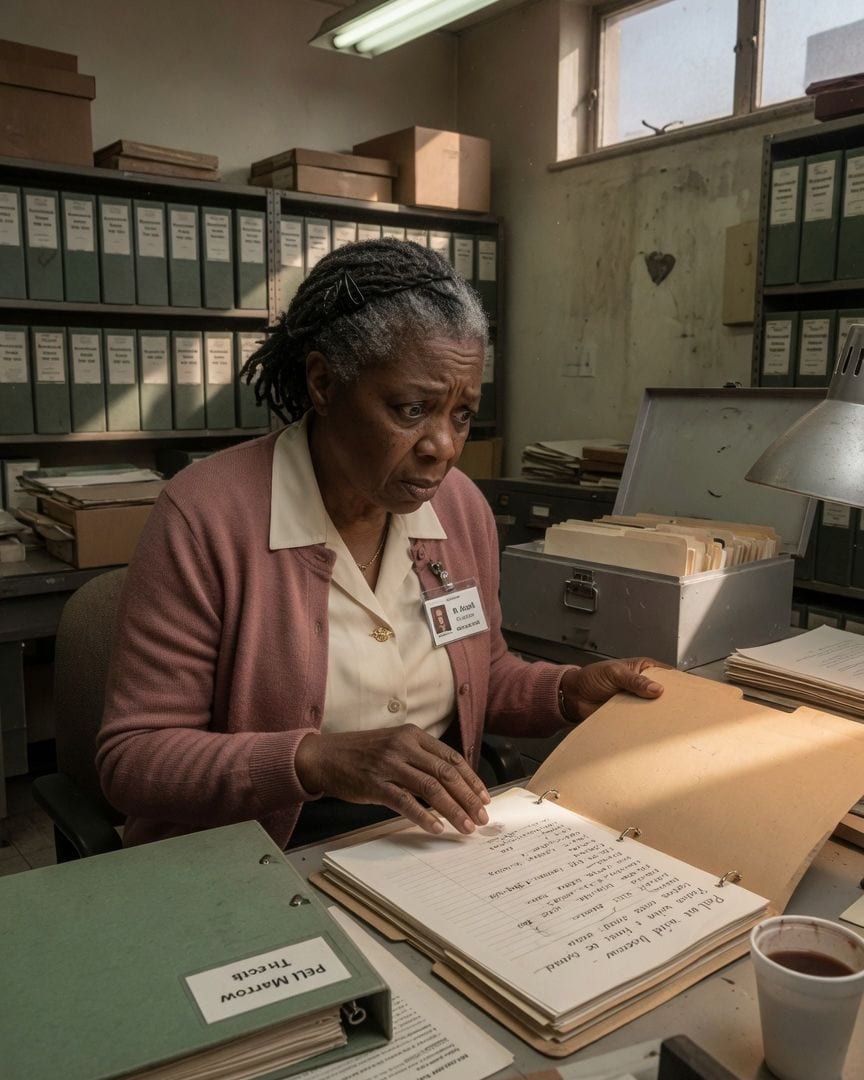
A records clerk's archive file for a Cold War reconnaissance plane lost in 1968 showed it flew yesterday to her own building.
Marguerite Ansell, a records clerk nearing her final week before retirement, meticulously audited Cold War-era files. In the cool, dusty archive, she pulled a file for an oiler declared missing in 1951. Inside, she found a fueling schedule with entries stretching into the present, the last dated just eleven days ago. Then, a second lost ship revealed a similar impossible log, and a cold certainty began to bloom in her chest. Deep in the shadows, Marguerite found an unmarked steel box containing a file for a reconnaissance plane lost in 1968. Its flight log showed a final flight yesterday, to the precise coordinates of her own archive building.
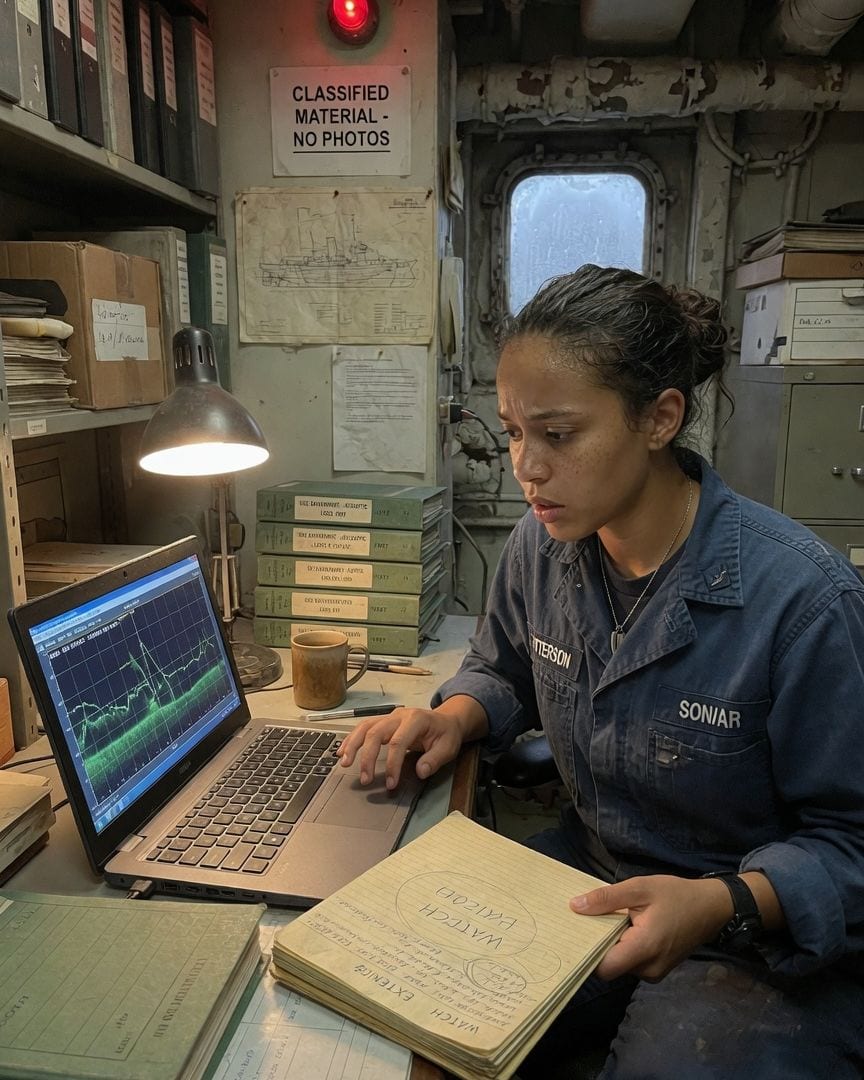
On the USS Calloway's final patrol, a sonar technician found an old log with two chilling words: 'WATCH EXTENDED.'
Sonar Technician Brooke Patterson had only two days left on the USS Calloway's last patrol, a finality that hung heavy in the humid sonar room. Through the impenetrable fog, her radar showed only empty water, but then an impossible biologic contact pinged, mimicking a vessel with eerie precision for three silent hours. It vanished at 0400, just as an identical trace had done weeks before. Searching old archives, Brooke found the precise pattern in a decades-old log from a scrapped destroyer. Scrawled next to it, in faded ink, were two words: "WATCH EXTENDED." What did those words truly mean?
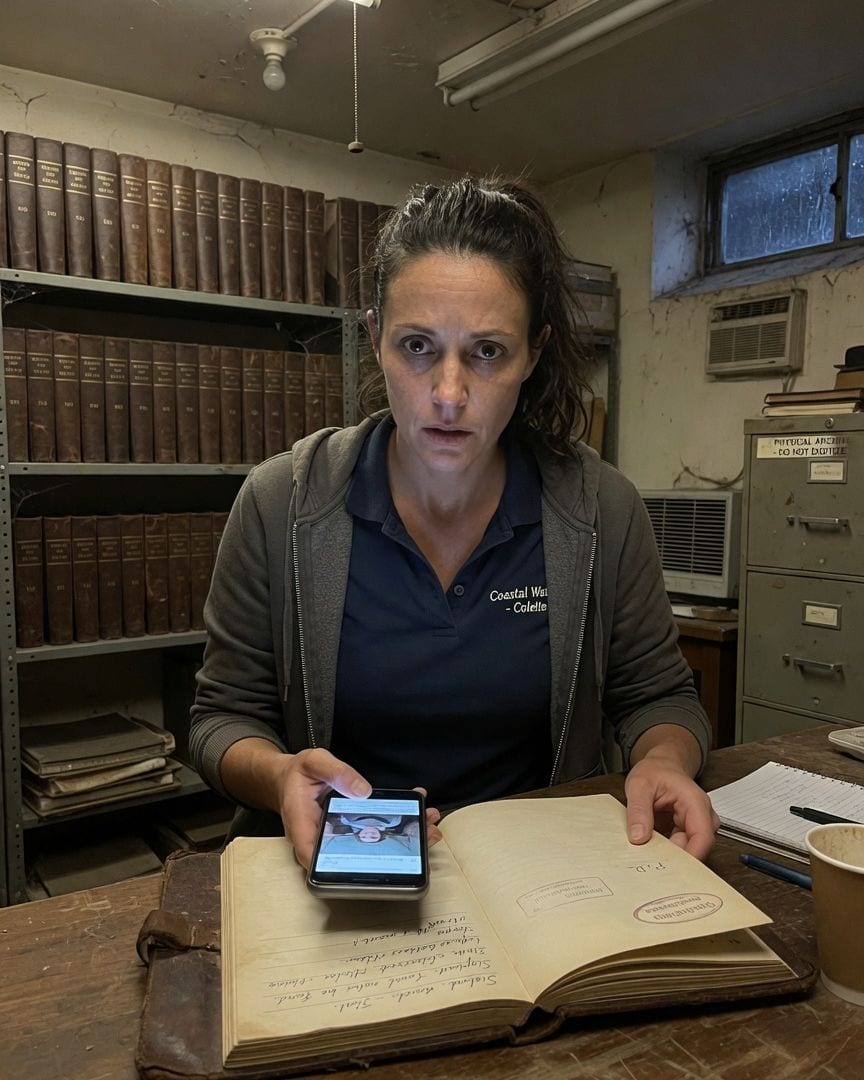
My coastguard log noted Sighting 9 again tonight, a light where no vessel showed. The old logs carry Sighting 9 off Skerry Point at 3:14am every tenth year since 1954, always 'nothing found,' always 'send no boat.'
On my watchtower night shift, the radar screen glowed green and the ocean was quiet. Then, a familiar light appeared off Skerry Point, exactly on cue, just as it had every tenth year for decades. But digging deeper, I found a hidden stamp in an old logbook: 'Operation Skerry. Status: Complete.' It left me with a chilling sense of finality.
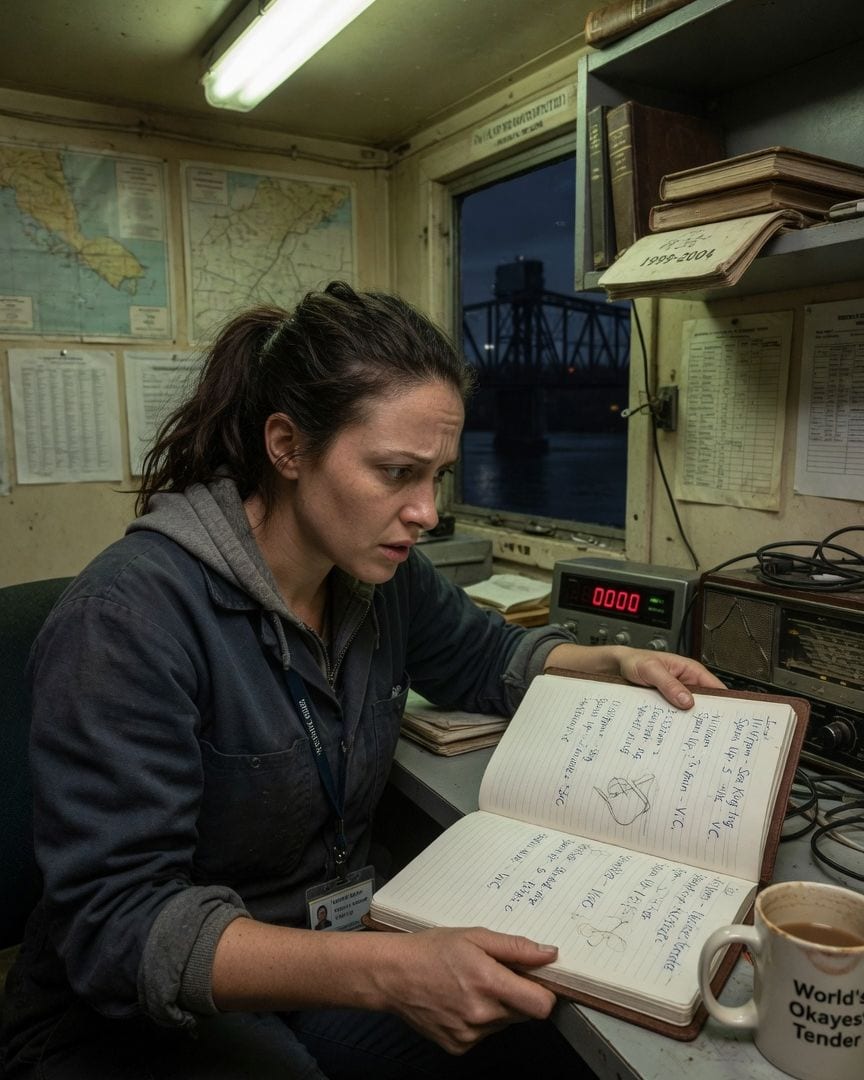
My drawbridge log shows a 2:33am lift I didn't make. The span counter never moved.
As a drawbridge tender, my midnight to dawn shift is usually quiet, a routine of monitoring traffic and logging lifts. But tonight, my own logbook shows an impossible entry for a bridge lift I have no memory of making. My initials and handwriting are there, yet the span counter above my panel reads a steady zero. No boat called, no span ever went up.