A Coast Guard coordinator found a lost plane's maintenance report, digitally signed two days after it vanished.
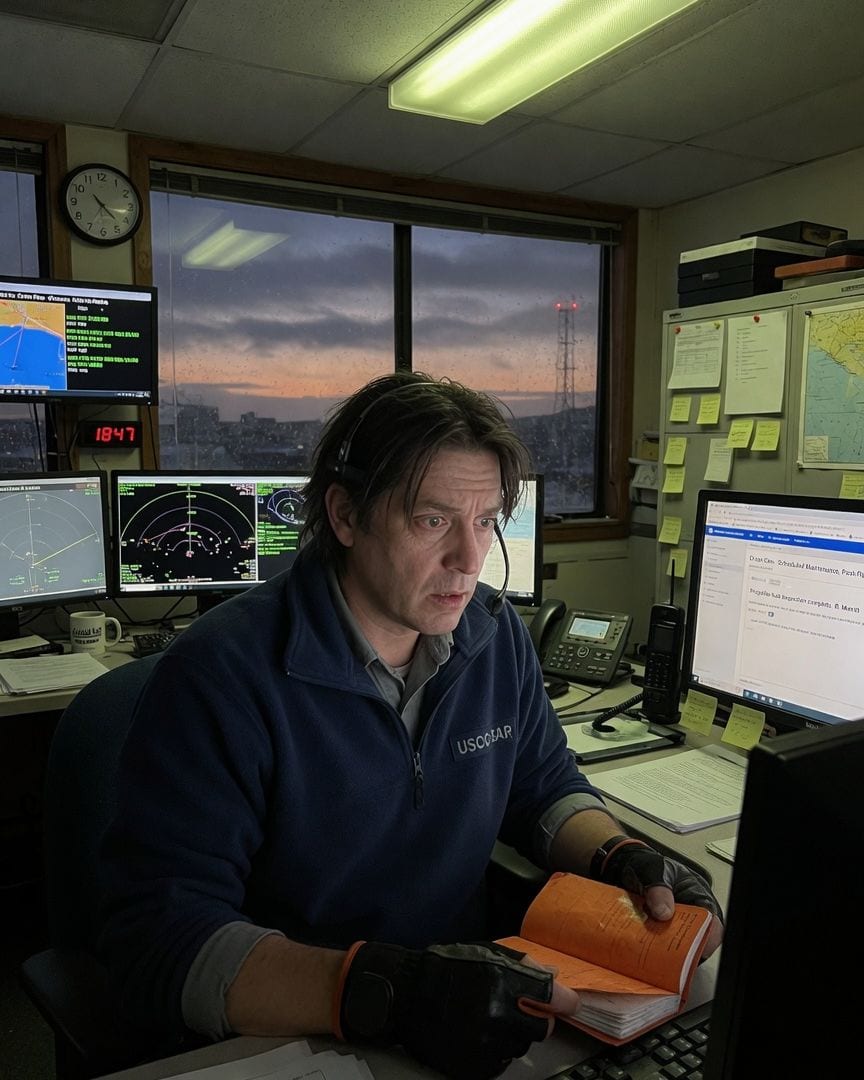
The fluorescent hum of the Aleutian SAR coordination center felt colder than usual to Dell Krznaric, a US Coast Guard Search and Rescue Coordinator. Sundown was closing in, and with it, the critical window for the 'Orion One' transport.
Nine souls aboard, missing for eleven hours. Dell had already mentally drafted the stand-down order, a familiar, grim task he knew too well.
Then the radio crackled. A fishing trawler, the 'Sea Serpent,' had found a life raft. A wave of raw relief washed over Dell, quickly followed by a jolt of confusion.
The raft was empty, its vibrant orange canopy zipped tight, swaying gently in the frigid water. Inside, secured against the cold, a survival log lay on a small, sealed compartment.
Dell’s gloved fingers, still numb from the cold, carefully turned the damp, brine-laced pages.
The handwriting was a steady, official script, later identified as Loadmaster Reginald Merritt's. Entries detailed position, weather, crew condition—all routine, clipped observations. Dell scanned the times, cross-referencing them mentally with the 'Orion One's flight plan. Everything seemed normal, if tragic.
But then his eyes snagged on the last entry. It was dated for eight hours from now. '0200. Heard an engine.'
A chill that had nothing to do with the Alaskan wind snaked up Dell's spine. The log wasn't just a record of the past; it was still writing, and it was writing the future.
The room, usually buzzing with activity, seemed to hold its breath around him, the hum of the computers suddenly too loud in the silence.
Dell immediately cross-referenced the log's entries with the 'Orion One's last known position and flight plan. Every detail matched perfectly for the first few hours of its flight.
Then came the impossible entries, stretching into the night, hours beyond its last transmission. He called the 'Sea Serpent's captain directly, confirming the exact time they discovered the raft. Captain Elias gave him a precise timestamp, down to the minute.
Dell then double-checked the log's timestamp, holding it against the SAR center’s official clock. There was no discrepancy in the discovery time. The log itself was genuinely eight hours ahead.
He tried to rationalize it. A faulty watch on Merritt’s wrist, perhaps, though Coast Guard issue was notoriously reliable. A misread entry, a cruel, elaborate hoax by the trawler crew.
But the steady, professional hand, the precise coordinates that aligned with predicted drift, the specific, unsettling detail of an 'engine' in the vast, silent Aleutian waters—it felt too real to dismiss.
Dell pulled up Reginald Merritt's digital service file. He compared Merritt's signature on past requisition forms, a few years' worth, to the clear script in the log. An exact, undeniable match.
The log wasn't a prank; it was genuine, and it was predicting events that hadn't happened yet. The dread tightened its grip, a cold knot in his stomach.
He started a deep dive into the 'Orion One's digital maintenance records, hoping for a clue, any anomaly that might explain the bizarre timeline.
He searched for anything out of place: a sensor malfunction, a reported ghost in the machine, something, anything, that would make the log's future entries a mundane error.
The database whirred for a long moment, the fan of his computer struggling, then settled into a low thrum. No red flags. Just standard operational reports, right up until the transport's last recorded position.
The silence of the system, its clean, untroubled records, was almost as unsettling as the log itself. It offered no escape from the impossible.
Dell was about to close out the 'Orion One's file for the night. He had found no conventional explanation for the log, no system error, no human mistake. He was exhausted, ready to admit defeat to the unexplained.
His cursor hovered over a sub-category: 'Scheduled Maintenance, Post-Flight.' It was an empty folder on all other lost aircraft he'd ever investigated, a placeholder for reports that would never be filed.
But for 'Orion One,' an entry blinked. It was small, almost hidden, like a quiet accusation. He clicked it open.
The file was dated two days after the transport's presumed loss, a date still in the future relative to the present. 'Propeller hub inspection complete.' And below it, a digital signature, clear and unwavering: 'R. Merritt.'
The system had accepted it as valid. The name, the precise penmanship he'd just seen in the survival log, now on an official maintenance report for a lost aircraft, dated in the impossible future.
Dell stared at the glowing screen, the cold dread solidifying in his gut, spreading like ice through his veins. The file wasn't just predicting; it was still being signed.
The next morning, Dell presented his findings to Commander Howard Holloway, his superior.
Holloway, a man whose entire career was built on order, procedure, and unwavering logic, initially dismissed the post-disappearance maintenance entry as a "system glitch" or a "delayed upload." His gaze was steady, unimpressed.
Dell, methodical and relentless, showed him the audit trail, proving the entry was generated and accepted two days after 'Orion One' was officially declared missing. There was no plausible delay.
Holloway, after a long silence that stretched the air taut, ordered an internal IT review. The review, predictably, found "no evidence of malicious intent or system compromise," attributing it blandly to "unspecified data corruption." The blandness was infuriating.
Unconvinced, Dell began digging deeper, bypassing official channels where possible. The office felt like a cage, the walls pressing in. He found more: a fuel requisition for 'Orion One,' dated three days after its loss, processed and approved.
A payroll run, listing Reginald Merritt and the rest of the crew for a full month after they vanished. The system, the official record, was still seeing 'Orion One' as an active, operational asset.
This wasn't a glitch; it was a coherent, ongoing narrative, a silent, relentless hum beneath the veneer of official mourning.
Dell expanded his search, driven by a growing, sickening certainty. He requested access to declassified files on other unexplained Aleutian incidents from the past—vessels and aircraft that had simply disappeared, leaving no trace. The names of the lost spanned decades.
He started noticing a pattern, subtle at first, then chillingly clear: in several files from the 1970s and 80s, long after the official 'lost' declaration, there were sporadic, inexplicable paperwork entries.
A requisition for parts, a crew roster update, a maintenance sign-off. These were not common to every lost vessel, but they appeared often enough to form a thread.
The 'File That Kept Writing' wasn't unique to 'Orion One'; it was a decades-old institutional phenomenon, a quiet, chilling pulse beneath the official narrative of loss. It was a bureaucracy that refused to let go.
Dell's requests for older declassified files, particularly those he'd identified as having continued paperwork anomalies, were met with unusual delays. System errors plagued his access, requiring multiple re-authentications.
He attributed it to bureaucracy, a deliberate slow-walk by an overburdened system, but a prickle of unease started to crawl under his skin. He found himself looking over his shoulder more often.
Then, an anonymous, untraceable email landed in his inbox. The subject line was blank. The body contained only five words: 'Some files keep signing themselves. Don't look too close.'
The message was short, devoid of any identifying markers, and vanished from his inbox after he read it, leaving no trace in his sent or trash folders. His breath caught in his throat.
He checked his office door. He could have sworn he'd left it slightly ajar when he stepped out for coffee just fifteen minutes ago, but it was now firmly closed, the latch clicked shut.
The feeling of being watched solidified into a cold, hard knot in his stomach. He started working late, after everyone else had left, cloaking his research under the cover of darkness and silence.
He printed out an old anomaly report from 1978, concerning a Coast Guard cutter, the USS Vigilant, lost in the Aleutians.
He’d found a similar, single maintenance entry in its file, dated years after its disappearance, a ghost signature from the past.
As he walked back to his desk from the printer, the report clutched in his hand, he caught a flicker of movement in the darkened hallway just past his cubicle, a shadow retreating too quickly to identify, melting into the deeper gloom near the emergency exit.
His heart hammered against his ribs, a frantic drumbeat against the silence of the empty office. Someone knew he was digging. Someone was protecting the files that kept writing.
The hum of the computer monitors seemed to mock him, a low, constant thrumming sound in the quiet office.
Dell arranged a discreet meeting with Brooke Patterson, an archivist he'd consulted previously for access to historical records. Brooke was usually helpful, her quiet demeanor belying a sharp mind for detail, but today, her demeanor was guarded, her movements stiff.
They met in a small, rarely used conference room, the stale air thick with unspoken apprehension.
Dell laid out his evidence across the polished tabletop: the 'Orion One's future log, its post-disappearance maintenance entries, and the similar patterns he'd found in the declassified 'Vigilant' file from 1978.
He watched Brooke’s face as he spoke, searching for any flicker of recognition.
'Data corruption,' she repeated, her voice thin, almost a whisper, avoiding his gaze. Her fingers picked nervously at a loose thread on her sleeve. 'These systems are old, Dell, prone to anomalies.'
Dell pushed back, his voice low but firm. 'This isn't random corruption, Brooke. This is consistent. The names, the dates, the specific details—they’re too precise. It’s like the system is actively generating these records, feeding itself.'
He slid a side-by-side comparison across the table: Reginald Merritt's signature from the 'Orion One' log and the digital signature on the post-loss maintenance record. 'And it’s the same hand.'
Brooke finally cracked. Her shoulders slumped, a visible surrender. She let out a slow, shaky breath. 'They're called ghost files,' she whispered, her eyes darting around the empty conference room as if seeking unseen listeners.
The fluorescent lights overhead buzzed, a high, thin whine. 'It's a known anomaly within certain classified sections. Not corruption. Not a glitch. The records… they continue.'
She explained that decades ago, a special task force had been assembled to investigate these 'ghost files,' to understand why the paperwork for lost personnel and vessels never truly ended. 'What did they find?' Dell pressed, his voice urgent.
Brooke hesitated, her voice barely audible, tinged with a deep, unsettling fear. 'They found that the investigators who dug too deep… they often disappeared themselves.
Their names would sometimes show up later, in other ghost files, as if they'd been… reclassified.'
The implications hit Dell like a physical blow. The 'File That Kept Writing' wasn't just an observation; it was a mechanism, a living process. The lost were never truly lost. They were filed.
And the institution, or something within it, had known this for decades, actively participating in the quiet, methodical absorption.
Brooke, visibly shaken, her face ashen, slid a manila folder across the table. It was thin, stiff with age. 'This one… it’s different. It's an anomaly report from 1978, about the USS Vigilant incident.
Heavily redacted, but…' Her voice trailed off, her gaze fixed on the folder as if it contained a personal curse.
Dell opened the folder, the old paper crackling faintly. The report detailed the loss of the Vigilant, a Coast Guard cutter, in the Aleutians.
He scanned the familiar details: the harsh weather, the sudden loss of contact, the fruitless search that yielded nothing. His gaze fell upon the crew manifest, a long list of names, ranks, and service numbers.
He wasn't looking for anything in particular, just absorbing the pattern, the sheer volume of lives absorbed by these impossible records, by the files that kept writing.
Then, his eyes snagged on a familiar surname, stark against the faded ink. 'Krznaric.'
He froze, his breath catching in his throat. His finger, trembling slightly, traced the entry: 'Airman, Radar, Krznaric, D. - Assigned USS Vigilant (ETA, Aleutians, 10/14/78). Status: Lost, 10/16/78.'
Dell Krznaric, a man in his mid-forties, born in 1979, felt the blood drain from his face, leaving him cold. He wasn't even born in 1978.
Yet, his name, his initial, his role—it was all there, listed among the lost of the Vigilant. The brittle page felt cold in his hands, a chilling premonition, a cold hand reaching from the past to claim him.
He wasn't just investigating the file. He was already in it.
Dell returned to Brooke, the 1978 anomaly report clutched in his trembling hand. He slammed it onto her desk, the sound echoing in the quiet archive office. His finger jabbed at his name on the manifest. 'Explain this, Brooke.
My name. Lost in 1978. I wasn’t even born.' His voice was tight, strained.
Brooke looked at the file, her face pale, resigned. 'This is what they discovered, Dell. The ghost files aren't just continuing records. They're… an active process. Whatever takes the vessels, it also takes the crew. And it processes them.
Their identities, their service records, they're folded into the archive. The system isn’t just covering up; it’s a conduit.
The paperwork, the requisitions, the payroll—it's all generated by whatever is on the other side, using their names, their hands, their data.'
She gestured to the report, then to Dell himself. 'Your name, appearing in a past file, means you've already been selected. Already been filed. Like Reginald Merritt. The 'engine' he heard in the log… that wasn't another aircraft.
It was the system. Signing him in. And now it’s signing you.'
Dell felt a profound hollowness, a chilling emptiness expanding in his chest. Every clue, every impossible detail, clicked into place with a horrifying precision: the future log entries, the ongoing maintenance reports, the pattern across decades.
It wasn't a clerical error, a glitch, or a hoax. It was a methodical, institutional absorption. He wasn't investigating a mystery; he was living a pre-written fate.
The secrecy machine wasn't just an institution; it was a predatory archive, its hunger for new entries spanning generations, its files an endless, self-generating bureaucracy of the lost.
The air in the archive felt suddenly heavy, thick with the weight of decades of silent filing.
Panic seized Dell, a cold, sharp claw in his gut. He was marked. His only hope, a desperate, irrational thought, was to sever his connection, to make himself un-file-able.
He rushed back to his workstation, his fingers flying across the keyboard. He tried to delete his service record, to erase his digital footprint from the Coast Guard database.
The system resisted, throwing up error messages, denying access, requiring multiple layers of authorization he didn't possess. Each failed attempt was a hammer blow against his dwindling hope.
He tried to physically extract his paper files, to burn them, to scatter them, anything to break the link.
But his personnel records were locked away in a secure, inaccessible archive, their location known only to a few, and guarded by an unbreakable digital key.
Realizing he couldn't erase himself, he decided to flee. He grabbed his coat, stuffing the 1978 report into his pocket, its brittle pages a cold comfort against his thigh.
He headed for the base perimeter, his heart hammering against his ribs, a frantic drum against his ribs. He would drive, disappear, become a ghost outside the system, un-indexed, un-filed.
As he approached the main gate, the floodlights illuminating the chain-link fence, a Coast Guard patrol car pulled up silently beside him, its engine barely a whisper.
Commander Holloway stepped out, his face calm, unbothered, almost serene, bathed in the harsh glow of the lights. He held a single sheet of paper in his hand.
'Leaving us, Dell?' Holloway asked, his voice flat, devoid of accusation, completely even. 'That's a shame. Just got this in.' He extended the paper. It was a requisition form for Dell Krznaric's new duty station: 'Aleutian Sector, SAR Archives.
Effective: Tomorrow.' And at the bottom, a signature that was unmistakably Dell's own, though he'd never signed it.
'Just following orders, Dell,' Holloway said, his eyes empty, reflecting the stark lights. 'The file needs to be signed.' Dell realized Holloway wasn't an antagonist; he was merely another cog, another processed individual in the vast, patient machine.
The dread wasn't in resistance, but in the terrifying, mundane acceptance that had already claimed him.
Dell Krznaric was never seen at the Aleutian SAR coordination center again. His apartment was found empty, his personal effects undisturbed, as if he had simply stepped out for a moment and never returned.
Commander Holloway continued his duties, impassive, his reports meticulously filed, his demeanor unchanged. The file for 'Orion One' continued to accrue entries, a digital pulse in the vast network of Coast Guard records. No search was launched for Dell.
No questions were asked beyond a quiet internal memo noting his "transfer." The system simply absorbed him, a seamless administrative update.
Life at the base continued, undisturbed, as if Dell had never been there, or had always been destined for a different kind of duty.
A few weeks later, Brooke Patterson, the archivist, found a new internal memo in her inbox. The subject line was stark: 'Transfer of Records Clerk, Patterson, B. - To Aleutian Sector, SAR Archives. Effective: Immediately.'
Her heart hammered against her ribs, a frantic rhythm against the sudden, icy stillness in the room.
She stared at the sender's name: 'Krznaric, D.' The signature at the bottom was a perfect, chilling match to Reginald Merritt's, and to the digital signature on Dell's own 'new duty station' requisition form.
She felt a cold, distant hum, like something vast and mechanical coming to life, calling her name from the depths of the archive. She had heard an engine, too.
If this one got to you
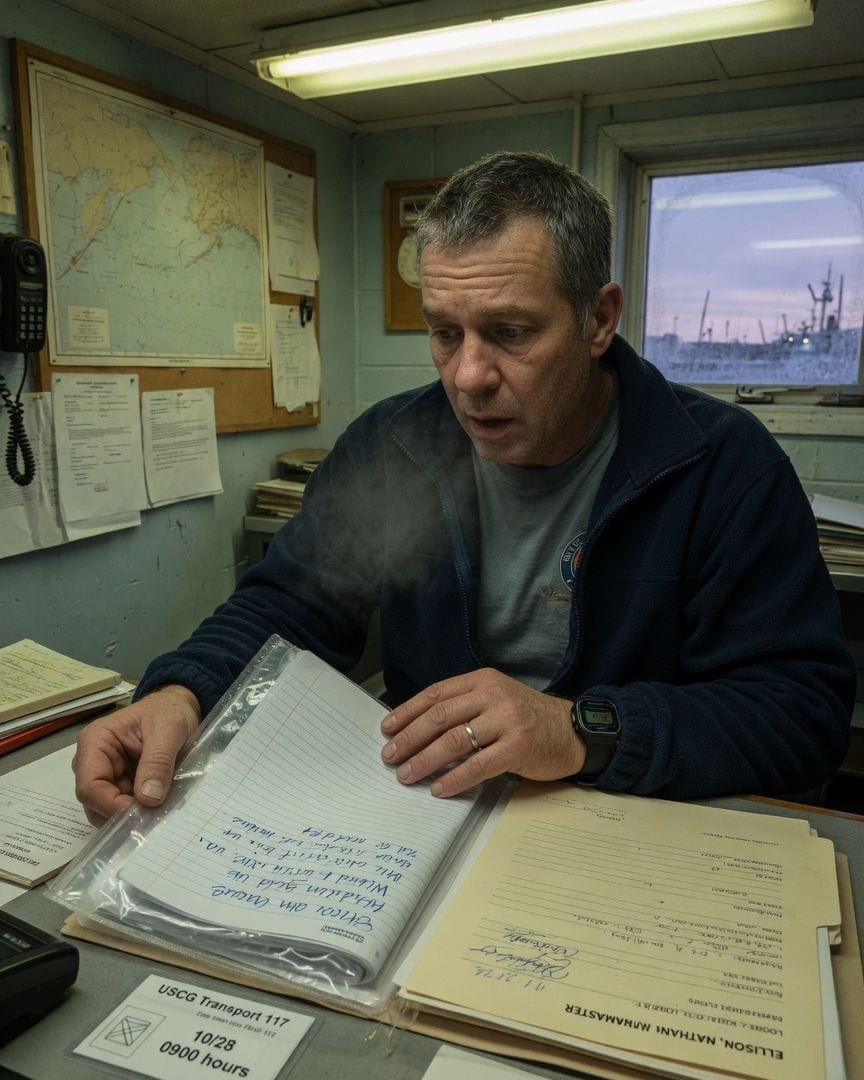
A Coast Guard officer found a missing transport's life raft. Inside, a hidden document was dated a full week into the future.
Dell Krznaric, a Coast Guard officer, felt no peace as the Aleutian sundown bled purple. The search for USCG Transport 117 had just yielded an empty life raft, recovered from the vast, indifferent Bering Sea. Inside, Loadmaster Ellison’s meticulous survival log detailed hourly positions, but Dell’s eyes snagged on an entry dated eight hours into the future. Then, a second, hidden document in the pouch revealed an impossible date: a full week from now. How could a lost crew log events that hadn't even happened yet?
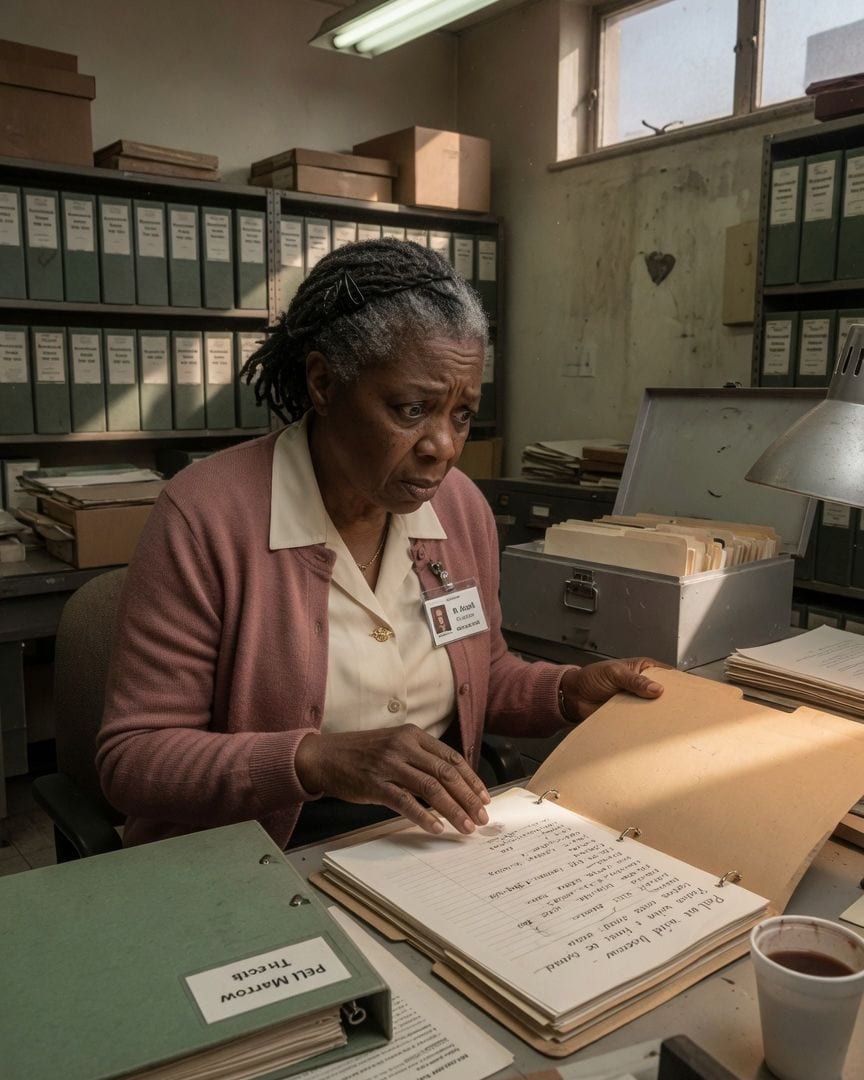
A records clerk's archive file for a Cold War reconnaissance plane lost in 1968 showed it flew yesterday to her own building.
Marguerite Ansell, a records clerk nearing her final week before retirement, meticulously audited Cold War-era files. In the cool, dusty archive, she pulled a file for an oiler declared missing in 1951. Inside, she found a fueling schedule with entries stretching into the present, the last dated just eleven days ago. Then, a second lost ship revealed a similar impossible log, and a cold certainty began to bloom in her chest. Deep in the shadows, Marguerite found an unmarked steel box containing a file for a reconnaissance plane lost in 1968. Its flight log showed a final flight yesterday, to the precise coordinates of her own archive building.
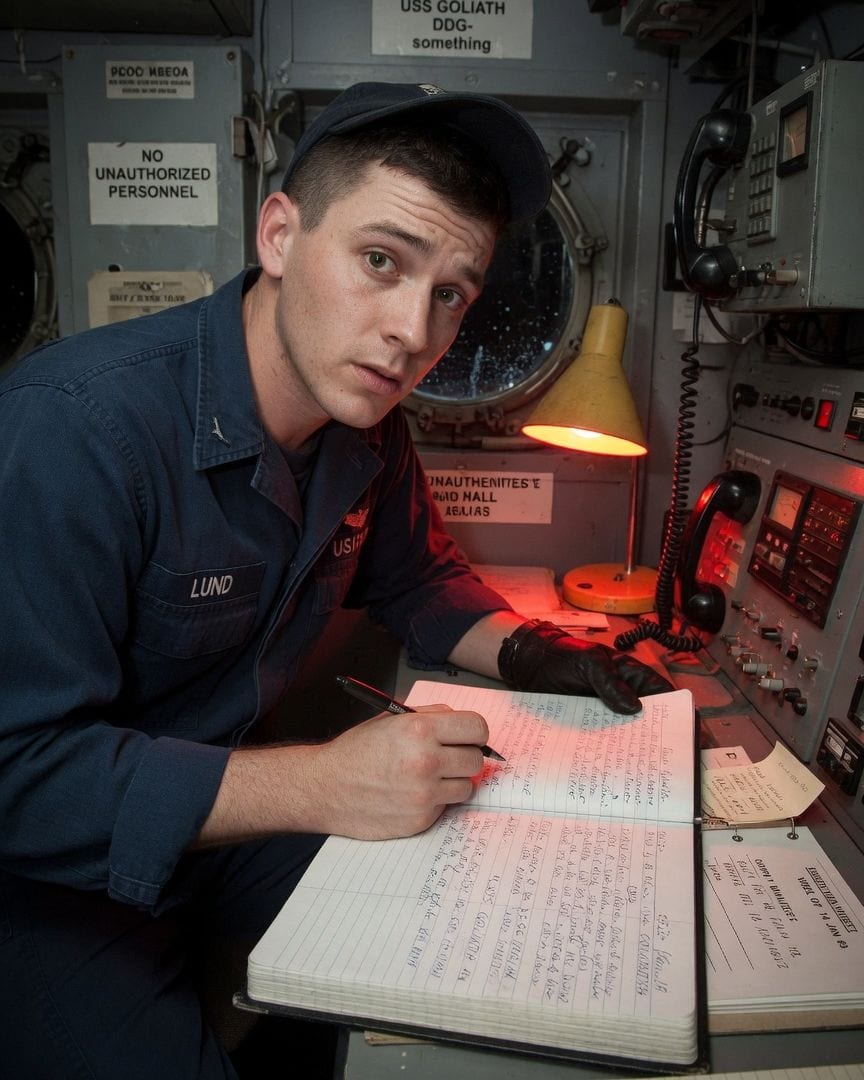
Petty Officer Lund heard his own captain's mayday: the Cold War USS Goliath was sinking, two hundred miles astern.
Petty Officer Marco Lund kept a lonely vigil in the USS Goliath's radio room, the destroyer battling the North Atlantic in deep winter 1983. Suddenly, a garbled mayday broke through: his own ship, his own captain, reporting they were going down two hundred miles astern. Though the bridge confirmed the Goliath was fine, the same chilling call came again an hour later, stronger and from the exact waters they had just crossed. Deeply unsettled, Marco began searching ship logs, eventually discovering a phantom entry: an identical mayday, logged a week prior, pressed into the very paper beneath his own.
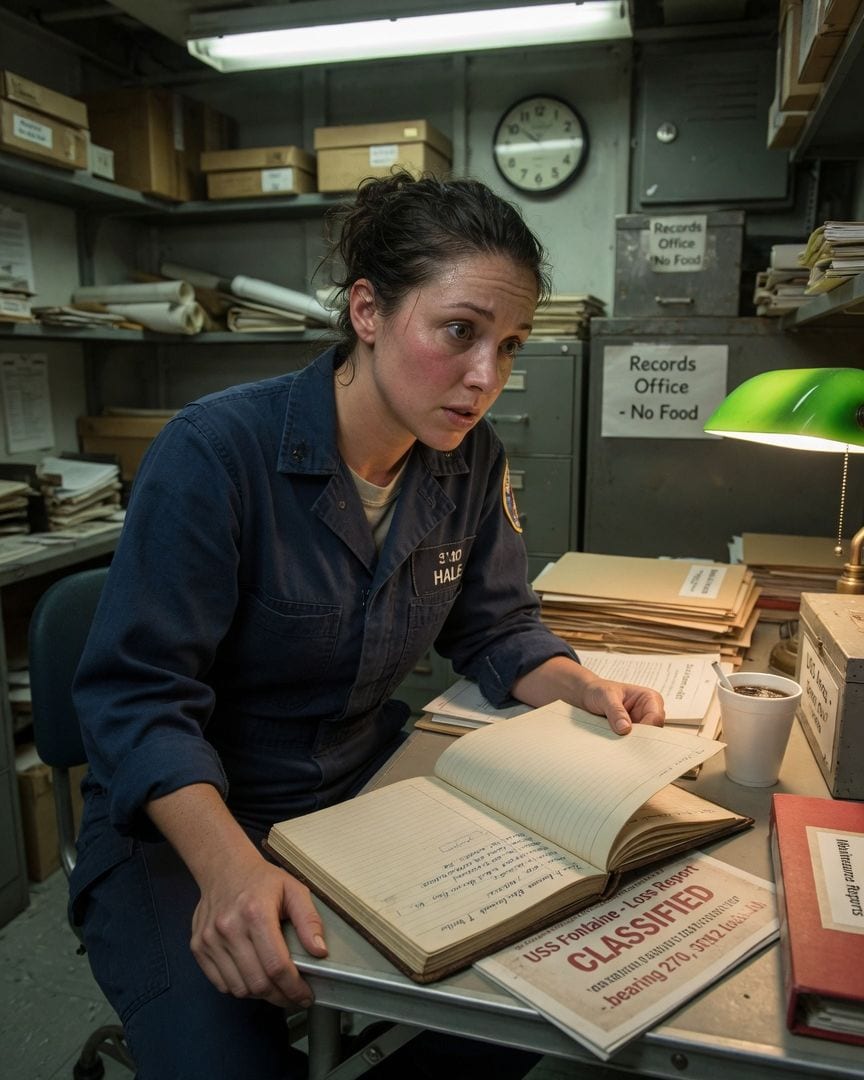
Petty Officer Hale needs a spotless record for her transfer. But the USS Ares sonar logs show an identical, impossible contact, logged to the minute, years apart, and tied to a classified loss report.
Petty Officer Sarah Hale needed a spotless record for her coveted shore duty transfer, a posting she'd worked five years to secure. Alone in the USS Ares sonar shack, three days out from San Diego, her midwatch was broken by an impossible contact: a close, slow echo holding perfect pace, invisible to radar, then vanishing. Her heart hammered, not from fear, but from the data's impossibility. When she found an identical entry in her own log from just one week prior, the cold dread tightened its grip. But the true chill settled when she unearthed decades of similar records, signed by other sonar officers, all showing the same impossible contact at 0212, off the port beam, for nineteen minutes, on the same ship, stretching back years—a persistent echo tied to a classified loss report.
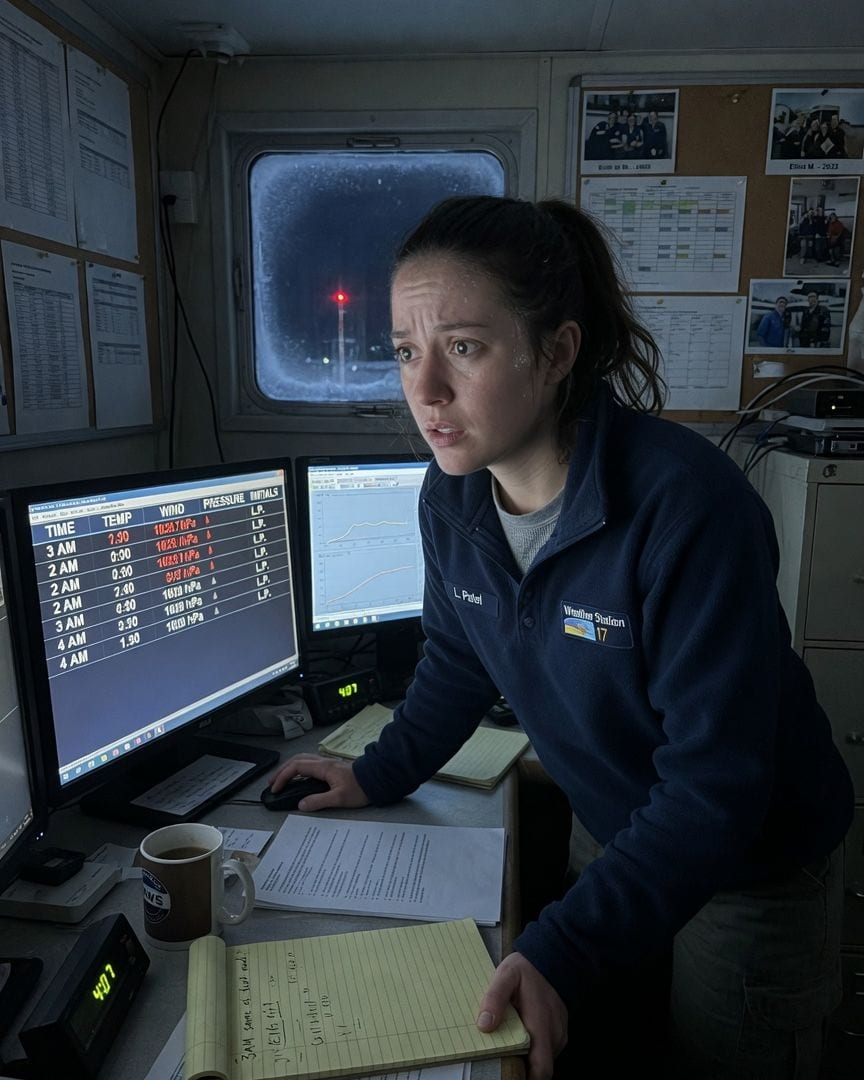
My weather station's 3 AM log shows a pressure reading I never made. My initials are on it, but the dials were dead still.
Working the overnight shift at the remote weather station, I routinely checked the digital logs. The 3 AM entry showed an impossible barometric pressure spike, a hurricane that simply hadn't happened. I distinctly remembered being outside at that time, calibrating a sensor, not making that entry. Yet, my initials, L.P., were clearly logged next to data I never made.
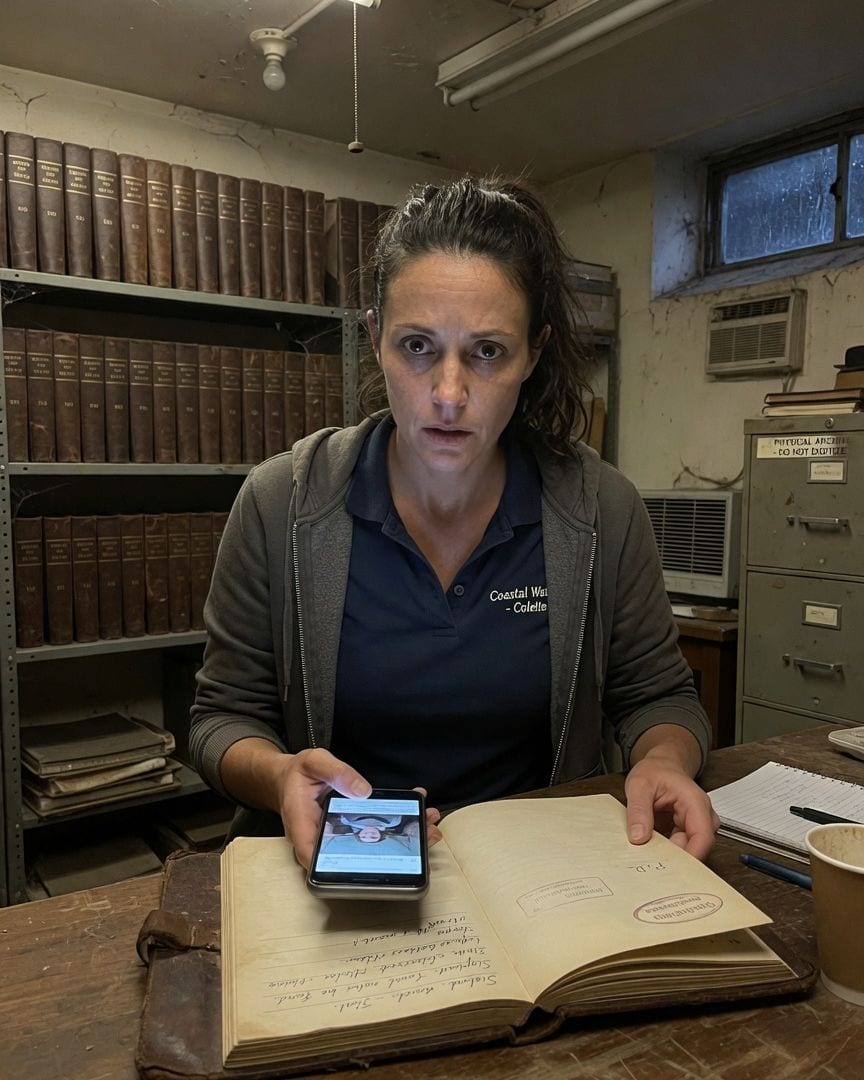
My coastguard log noted Sighting 9 again tonight, a light where no vessel showed. The old logs carry Sighting 9 off Skerry Point at 3:14am every tenth year since 1954, always 'nothing found,' always 'send no boat.'
On my watchtower night shift, the radar screen glowed green and the ocean was quiet. Then, a familiar light appeared off Skerry Point, exactly on cue, just as it had every tenth year for decades. But digging deeper, I found a hidden stamp in an old logbook: 'Operation Skerry. Status: Complete.' It left me with a chilling sense of finality.