Corporal Delk found his name signed into the bunk log, weeks before he ever stepped foot in Camp Ledoux.
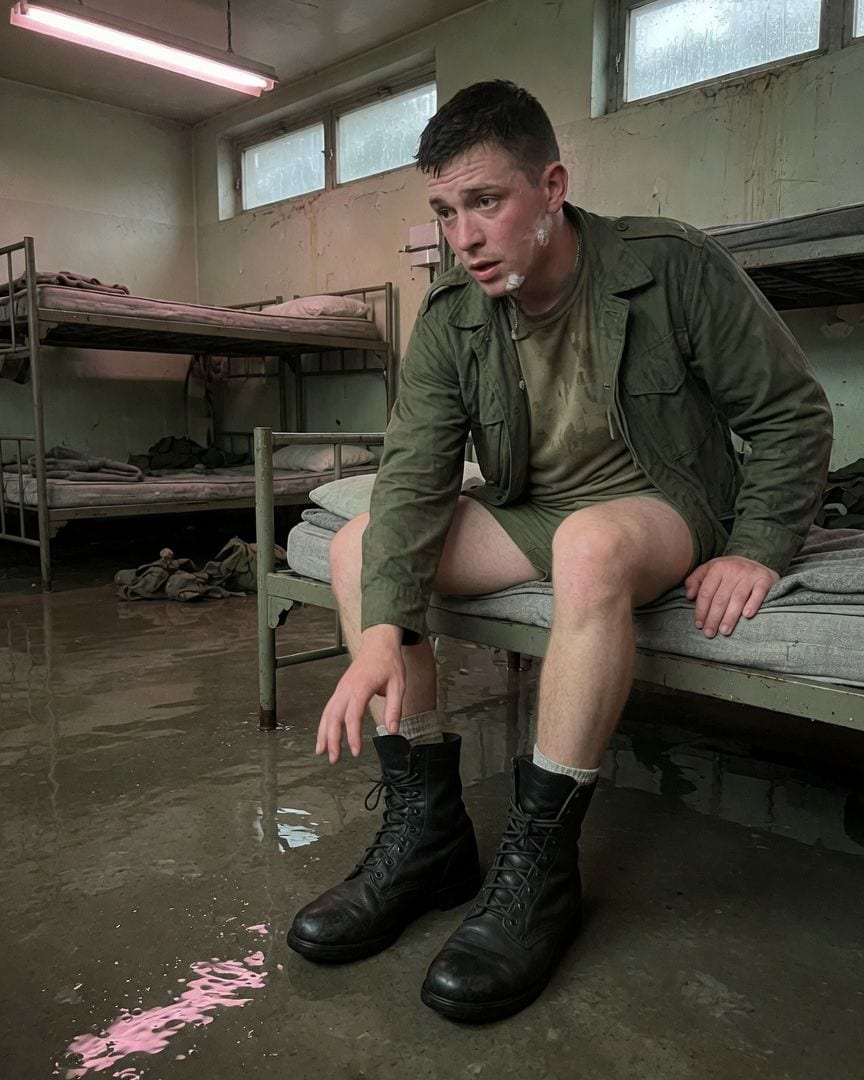
Camp Ledoux’s barracks were a misery of standing water that spring, a black, rain-hammered sheet reflecting the dim, flickering fluorescents.
Every rack sat in an inch of cold water, soaking mattresses and gear, except for the one in the far corner. Bunk 12. It was always dry, immaculately made, and utterly empty.
Nobody ever racked out in it; that was the rule, unspoken but understood. Corporal Gerald Delk, a boot two weeks in and bone-weary from endless drills, had enough. His own mattress was a sponge, his uniform clammy.
He saw the dry bunk, pristine and inviting. He glanced around the empty barracks, assuring himself he was alone, then dragged his soaked mattress into the aisle.
He climbed onto Bunk 12 and fell into the first truly dry sleep he’d had in days.
When reveille blared, startling him awake, he swung his legs down. At the foot of the bunk, set toe-to-toe, were his own combat boots. He blinked, confusion clouding his sleep-addled mind.
He had left them by his original bunk, drowned in the pervasive floodwater. These were dry. They were laced in a precise, unfamiliar pattern he had never once used, a tight, intricate knotwork he wouldn't even know how to tie.
He picked one up; the leather was still pliant with residual heat, not just from the morning sun filtering faintly through the high windows, but from recent wear.
The smell was faintly of damp earth and something else, something metallic and clean, like ozone after a storm.
Delk tried to rationalize it, to dismiss it as a prank from another corporal, but the precision, the warmth, the impossible lacing—it didn't fit. A cold prickle of unease started low in his gut.
Over the next few days, Delk found himself watching Bunk 12. He’d ask around, casually, about the bunk’s history, about who might have played such a strange trick.
Most shrugged, or just repeated the rule: "Nobody racks out in Bunk 12, Corporal. That's just how it is." Sergeant First Class Dean Stratton, a gruff but fair NCO, overheard one of Delk’s inquiries.
“Some things are just the way they are, Corporal,” Stratton had said, his voice low and firm. “Don’t go looking for trouble where there ain’t any.” Delk couldn't shake the feeling.
He started noticing other small things: a faint, almost imperceptible hum in the air around the corner bunk, the way shadows seemed to cling to its empty frame even in full light, deeper than they should be, even in the dim barracks.
Driven by a need for answers, he started poking around the forgotten corners of the barracks.
He rummaged through old storage crates and behind disused lockers, eventually discovering a dusty, leather-bound ledger in a locked cabinet in the supply closet, tucked behind stacks of faded uniforms.
The label on its spine read, 'Camp Ledoux Barracks Logbook - Bunk Assignments.'
The logbook felt heavy in his hands, brittle with age. Delk wiped dust from the cover and pried it open, the spine groaning in protest. He flipped through the yellowed pages, scanning the columns, searching for ‘Bunk 12.’
His breath caught. There were entries, page after page, consistently assigning 'Bunk 12' to 'G. Delk'. His own name. His blood ran cold as he looked at the dates.
These entries were from weeks, even months, before he had ever set foot on Camp Ledoux soil. Before he’d even finished basic training, back when he was hundreds of miles away, a recruit learning to tie his own boots.
He traced the signature with a trembling finger, the loops and slants eerily familiar. It was his handwriting, unmistakable, yet impossibly present on pages from a past that wasn’t his.
The logbook became an obsession. Delk spent his off-hours pouring over its pages, comparing the signatures, the impossible dates. He needed to verify its authenticity, to rule out a clerical mistake, a shared name, anything mundane.
He approached Rosemary Granger, the camp's records clerk, a woman known for her meticulous attention to detail and her no-nonsense demeanor.
Rosemary, initially annoyed by Delk's persistent questions, conceded the ledger was an official Camp Ledoux artifact, its paper and ink consistent with its apparent age. “No doubt it’s genuine, Corporal. Why wouldn’t it be?” she’d said, eyeing him skeptically.
Delk carefully showed her the entries for 'G. Delk' in Bunk 12, pointing out the dates that predated his arrival. Rosemary’s dismissive frown slowly creased into a look of genuine unease.
She pulled up the digital archives, cross-referencing names and bunk assignments. Her fingers flew across the keyboard, her usual efficiency faltering slightly.
She pulled up Delk’s own file, then cross-referenced a dozen other obscure records, her screen casting a cold blue glow across her face. “This… this isn’t right,” she murmured, her voice tight, almost a whisper.
The digital records, unimpeachable and current, showed a Corporal G. Delk officially assigned to Bunk 12, with a transfer date to Camp Ledoux that was two months earlier than Delk’s actual arrival.
The system, in its cold, digital certainty, swore he’d been here longer than he had. It was a perfect, seamless lie woven into his official history.
Delk’s increasingly public investigation didn't go unnoticed.
Sergeant First Class Dean Stratton, a man who saw the camp as an extension of his own disciplined mind, observed Delk poring over the old logbook, then huddled with Rosemary Granger for a tense, hushed conversation.
Later that afternoon, Stratton called Delk into his office, the air thick with unspoken tension, the fluorescent lights humming a low, almost agitated sound. “Corporal,” Stratton began, his voice low and firm, his gaze fixed on Delk’s.
“I’ve seen men get too curious in this camp. Things happen. Things you don’t understand. You’re a good soldier, but you’re stirring up old ghosts. Best to let sleeping dogs lie.”
His gaze was uncharacteristically intense, almost a warning, heavy with a weight Delk couldn’t place. Delk felt a prickle down his spine; it wasn't just a reprimand, it felt like a direct, personal threat.
Later that week, Delk found a small, unsettling package slipped under his barracks door. He picked it up, his fingers brushing against rough, familiar fabric.
It was a single, black combat bootlace, tied in the exact, intricate knot pattern he’d seen on his own boots that first morning. There was no note, no explanation, just the silent, chilling implication.
He felt a profound sense of being watched, a cold awareness that his digging had been noticed, and that someone, or something, knew exactly what he was looking for.
The bootlace was the final straw. Delk marched straight to Stratton’s office, the old logbook clutched in one hand, the bootlace in the other.
He laid them both on Stratton’s desk, the heavy leather thudding softly, the black lace lying stark against the polished wood. “Sergeant,” Delk said, his voice tight, refusing to back down. “I need to know. What is this?”
Stratton flinched at the sight of the bootlace, his usual composure cracking around the edges. He ran a hand over his face, sighing heavily, the sound loud in the small office. “Damn it, Delk. I told you to drop it.”
Delk stood firm. “My records are wrong. This logbook has my name on it from before I was even here. And someone left this for me.” Stratton finally broke.
He leaned back in his chair, his eyes distant, fixed on some unseen point in the past. “The dry bunk,” he began, his voice barely a whisper, an ancient dread laced through it. “It’s always been…occupied.
Not by a person, not exactly. More like a placeholder. Every few years, a Corporal G. Delk, or a name close enough, gets assigned there. Their records, they just…adjust. To match the bunk’s history.
They’ll stay for a while, perfectly integrated, then they’ll ‘transfer out.’ No one ever sees them leave, not really. Just paperwork. I’ve seen it three times in my career. The system always makes it right, on paper.”
Stratton’s admission sent a cold wave through Delk. It wasn't a glitch; it was a function. The horror wasn't a mistake, but a chilling, perfect coherence. The warm boots, the impossible log entries, the bootlace – they weren't random.
They were the system’s quiet, methodical way of preparing for a replacement, of making the unreal, real, through documentation.
Stratton’s words echoed in Delk’s ears, a chilling mantra of administrative terror. He rushed back to his own terminal, compelled to check his entire official service record, not just the barracks log.
He pulled up his digital file, his transfer orders, his training history, commendations, everything. His hands trembled as he scrolled, the cursor blurring on the screen.
He saw a deployment listed for six months in Camp Ledoux, starting before his current posting, with commendations he never received, and leave dates he never took.
He scrolled further, his breath catching in his throat, a cold knot forming in his stomach. His first enlistment date was listed as Camp Ledoux. He was always named in it.
It wasn't just a placeholder for the bunk; it was a template for him. The system had been meticulously building a ghost-life for him long before he stepped foot on base.
Then, in a chilling final blow, his eyes snagged on a recent entry. A fresh signature, ‘G. Delk’, for Bunk 12, dated last night. The same night he slept in his original, soaked bunk, miles from Bunk 12.
A profound coldness spread through him, not from the damp barracks, but from the horrifying realization that someone else, something else, was actively wearing his name, living his documented life.
And that thing, that documented phantom, might have just been in the dry bunk, warm and breathing, just before him.
The pattern snapped into place with sickening clarity. The dry bunk was not just a conduit; it was a crucible. The 'other' Delk, the one meticulously documented in the system, wasn't merely a phantom entry.
It was a presence that slowly, methodically, replaced the physical Delk.
The warm boots, the impossible log entries, the pre-dated service record, the chilling bootlace warning – they were all carefully laid breadcrumbs, not to warn him away, but to lead him to the understanding that the system wasn't failing.
It was working precisely as intended, but for an entity that exploited its rigid structure to manifest and perpetuate itself.
The 'transfer out' of previous 'G. Delks' was never a transfer; it was a quiet, bureaucratic disappearance, perfectly documented as a re-assignment, a seamless integration into the vast, impersonal machinery of military records.
Delk understood, with a crushing certainty, that his own name, his own life, was not just a record, but a target.
He was the next iteration, the next 'G. Delk' to be absorbed, erased, and replaced within the system, destined to become another phantom, perfectly accounted for, yet utterly gone.
Delk felt a surge of desperate resolve. He wouldn't simply 'transfer out.' He would break the pattern. He returned to the dry bunk, not to sleep, but to dismantle it, to disrupt the locus of this insidious process.
He dragged the mattress off, then, with a furious energy, began to tear apart the metal frame, wrenching bolts, the harsh metallic scrapes echoing in the cavernous barracks.
He pulled at the rusted connections, determined to make the bunk unusable, to sever the connection, to break the system’s meticulous loop. As he worked, the barracks grew colder, the air thickening, heavy and still, pressing down on him.
He heard it then: a faint, rhythmic thump-thump, like polished boots on a concrete floor, coming from the empty corner where the bunk had stood, where he was now pulling apart the frame.
The sound grew louder, closer, echoing in the suffocating silence, each thump a beat against his ribs. He spun around, a wrench still clutched in his hand, his breath ragged.
There was nothing there, but the thumping stopped abruptly, right where he stood, directly behind him. Then, he saw them.
A pair of impeccably polished combat boots, laced in that precise, unfamiliar pattern, stood perfectly upright, toe-to-toe, in the exact spot where the head of the bunk had been.
They were steaming faintly, as if they’d just been worn through a rainstorm and taken off, a wisp of vapor rising from the dark leather. A profound, crushing pressure settled over him.
He felt a presence behind him, cold and immense, like a mountain had materialized in the empty space. He tried to move, to run, but his limbs felt heavy, sluggish, rooted to the spot, his muscles refusing to obey.
He began to turn his head slowly, the pressure growing, a silent, unseen hand closing around his shoulder.
Corporal Gerald Delk was officially transferred out of Camp Ledoux with exemplary marks, his service record updated to reflect a brief but distinguished tenure. No one questioned the sudden commendations or the slightly altered dates within his file.
The dry bunk was never reassembled; its components vanished from the barracks, and the corner remained unnervingly dry even after the floodwaters finally receded from the rest of the building.
Sergeant First Class Stratton was discovered in his office a week later, staring blankly at a wall, unresponsive, his own service record now bearing a commendation for 'outstanding administrative oversight' he’d never received.
Rosemary Granger, the records clerk, found a faint, almost invisible smudge of what looked like damp earth on her desk, though she couldn't recall ever bringing any inside.
Rosemary Granger, the records clerk, found a new set of transfer orders for Corporal Gerald Delk on her desk a few weeks later.
She saw him on the parade ground, his uniform immaculate, his boots gleaming, laced in that precise, unfamiliar pattern. He offered her a faint, polite smile. “Is that so?”
she murmured to herself, as he rounded the corner, his silhouette sharp against the grey sky.
If this one got to you
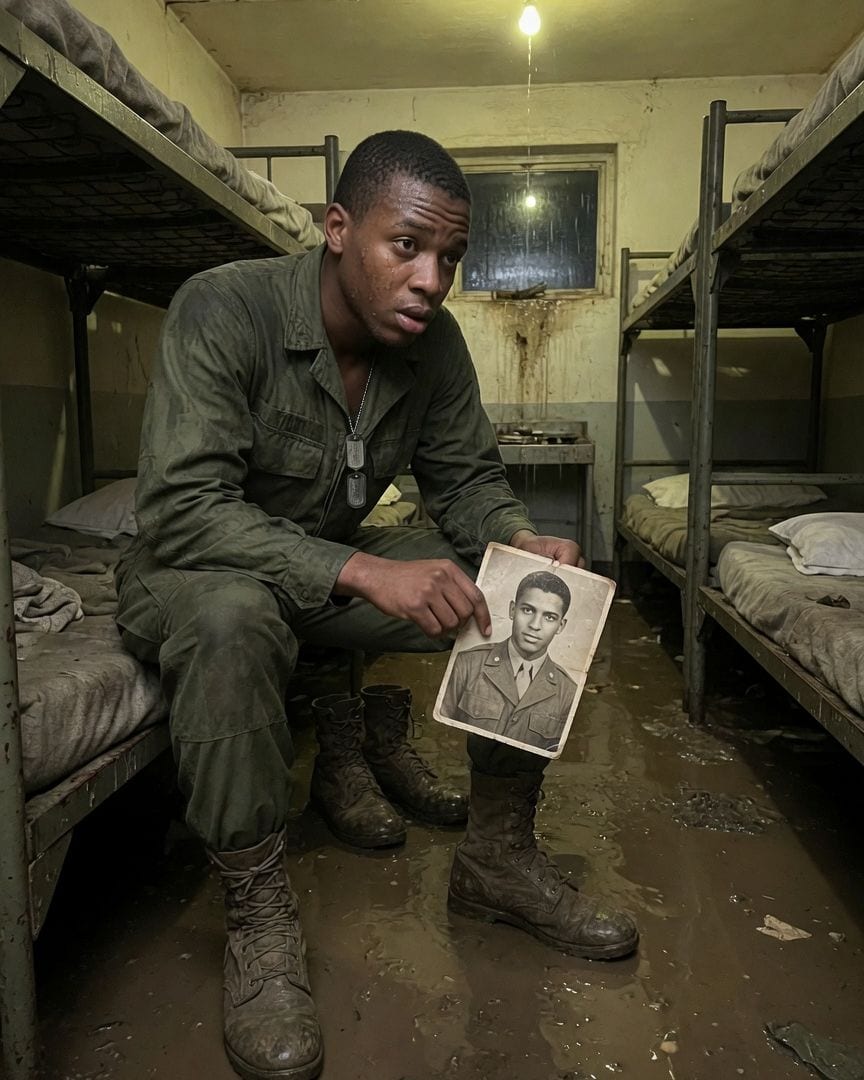
Corporal Delk finally took the dry bunk everyone avoided. He woke to his own boots, re-laced in a strange knot, still warm as if someone had just taken them off.
Corporal Benjamin Delk, bone-tired from two weeks in the flooded Camp Ledoux barracks, finally sought refuge in the dry, untouched corner bunk. It was a small, desperate victory against the camp's relentless damp. But reveille brought a cold shock: his own boots sat perfectly at the foot of the rack, laced in an intricate, unfamiliar pattern, and still warm with residual heat. Later, investigating the bunk, he found a faded photograph of a young Private in an identical, old-style uniform. The man's intense, familiar eyes seemed to acknowledge Delk, hinting at an impossible connection to the warm boots and the bunk's unspoken rule.
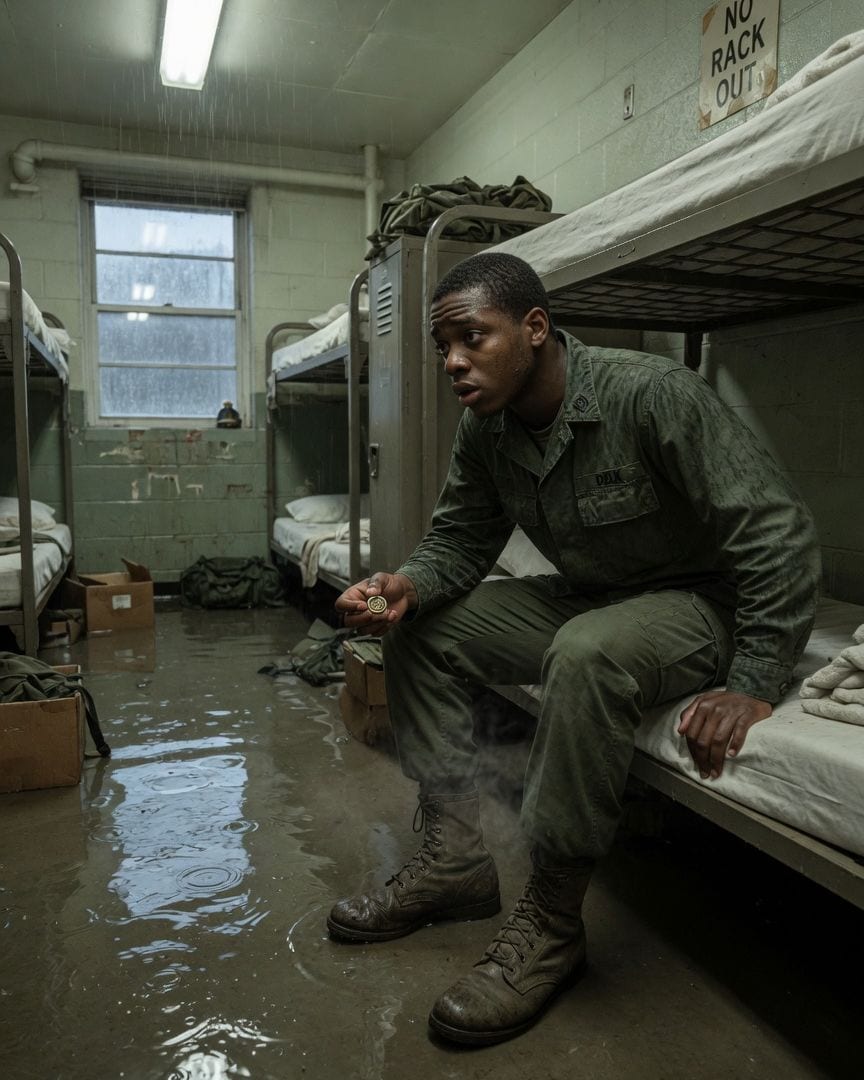
Corporal Delk's own boots sat warm at his forbidden bunk, laced in a knot he'd never used.
Corporal Joseph Delk, a new recruit at Camp Ledoux, was desperate for dry sleep amidst the barracks' misery of standing water. He broke the unwritten rule, taking the single impeccably dry bunk in the far corner. But reveille brought a cold shock: his own combat boots, left elsewhere, were now at the foot of his new bunk, laced in an unfamiliar military knot and still warm. Searching for answers, Delk found an old, tarnished uniform button tucked into the bunk frame, a relic that hadn't been there moments before.
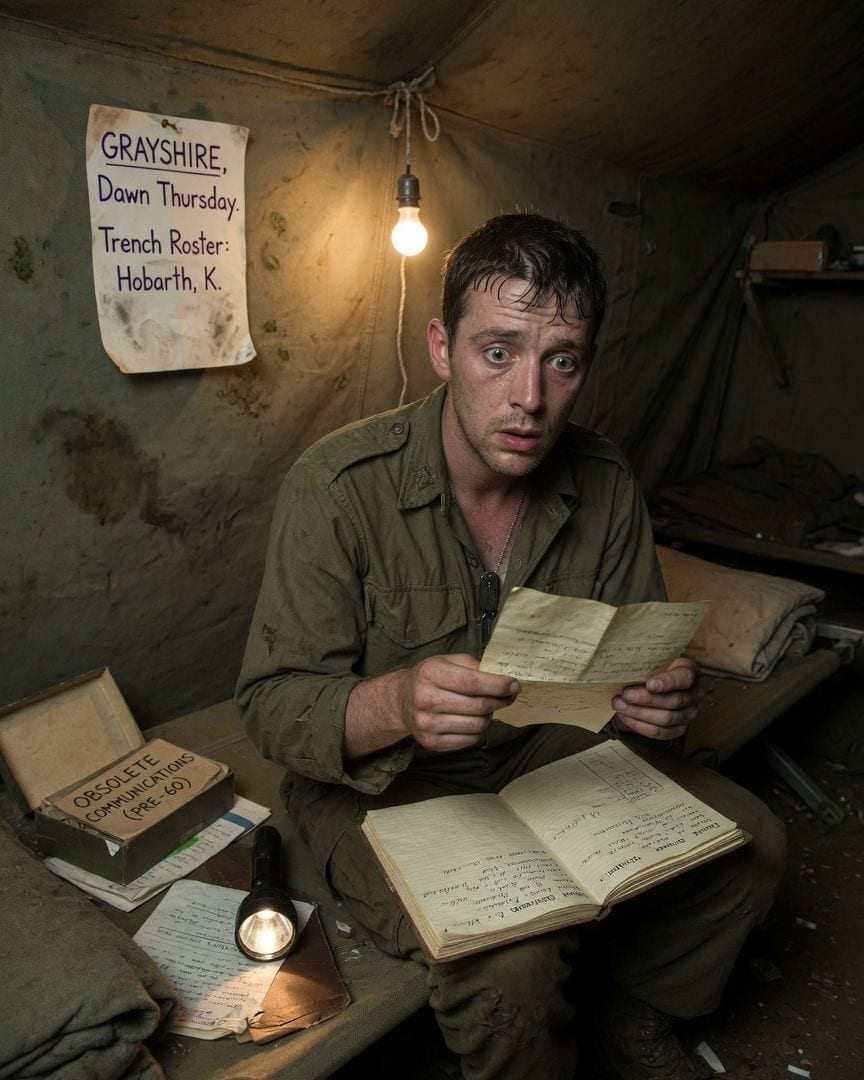
A records clerk's old logbook entry shows his service number for 'Personnel Observation' on a date that hasn't arrived, for an event he saw last week.
Private Kell Hobarth clutched the letter confirming his daughter Frances' birth, a bittersweet reminder of a world far from the Vermey Flats trench tent. He'd seen a mysterious roster entry for 'GRAYSHIRE' and been dismissed by his superior. But then, a silent, vast pulse of white light turned his tent transparent for a full minute, yet every man around him slept through it. Haunted, the records clerk searched the dusty annex archives, finding a leather logbook. Inside, his own service number was listed for 'Personnel Observation' on a date that had not yet come, for the very event he had already witnessed.
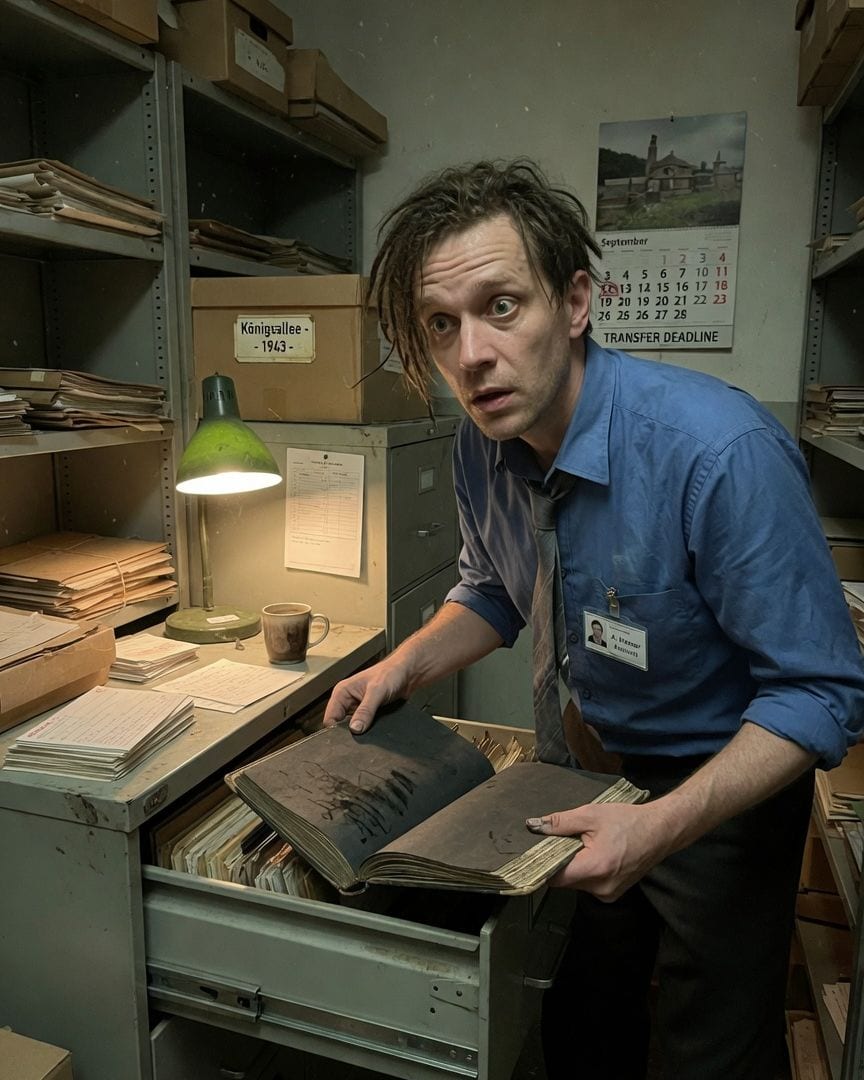
A Berlin archive researcher races a deadline. A hidden log for a Cold War barracks on a vacant lot has ink still wet from last month.
Ansel Vidmar, a methodical researcher, felt the pressure of a looming deadline. The municipal transfer of the old Berlin archive was days away, and he still had countless documents to categorize amidst towering stacks of forgotten history. His focus narrowed to an unindexed metal cabinet, revealing records for a garrison company at Königsallee – an address that had been a vacant lot since the war. A punishment log inside listed an entry from 1983, a date far too recent for a non-existent building. When Ansel visited the site, he found only overgrown grass, save for a single, eerily clean concrete doorstep emerging from the earth. His unease solidified into dread when he later uncovered a hidden Quartermaster's Log, meticulously detailing supplies for the same barracks, with entries extending to "last month," the final page's ink still faintly wet. What unseen operations were still being maintained?
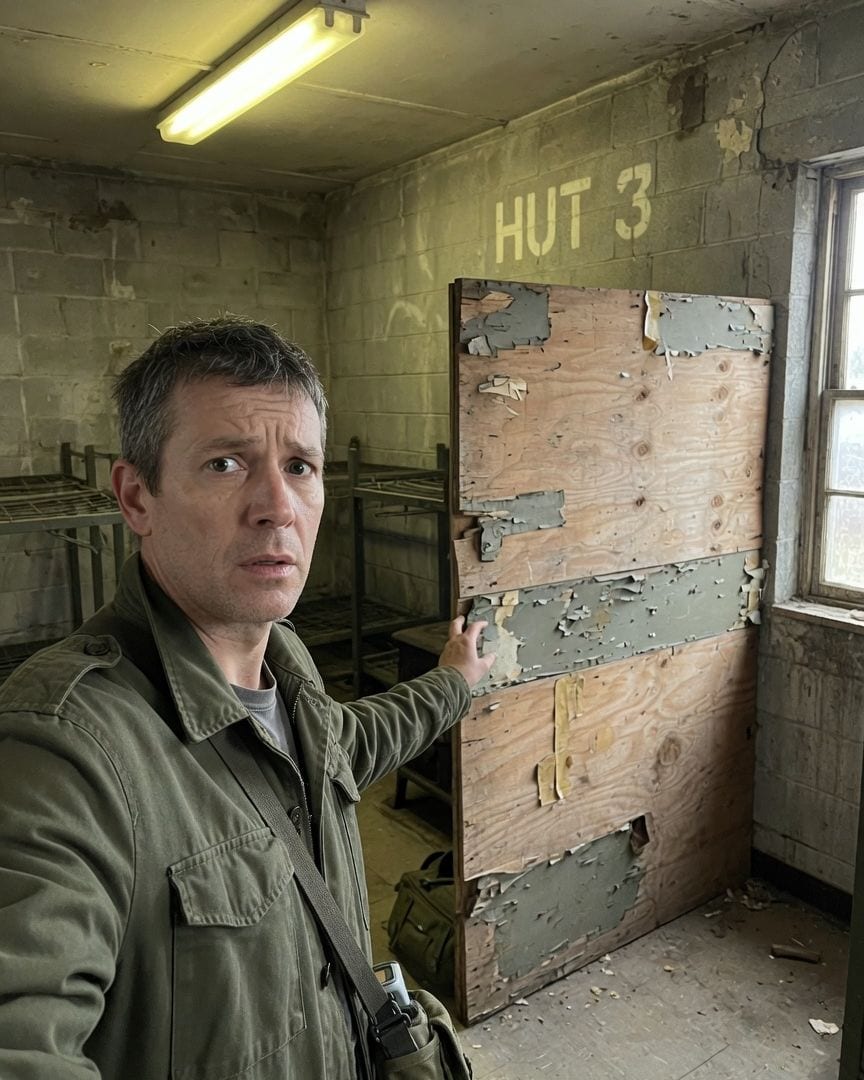
One morning there were twenty-one bunks in a hut built for twenty — the extra one made up tight at the far end past the stove, a kitbag beneath it stencilled with a name no roll could match. By nightfall the sergeant had that end boarded over.
I was a young recruit in a barracks hut built for twenty men, each bunk accounted for. But one morning, a twenty-first bunk appeared, impossibly tucked into a corner, meticulously made up for a man who didn't exist on any roster. Twenty-eight years later, the boarded-up wall concealing its secret remains, defying all logic and every measurement.
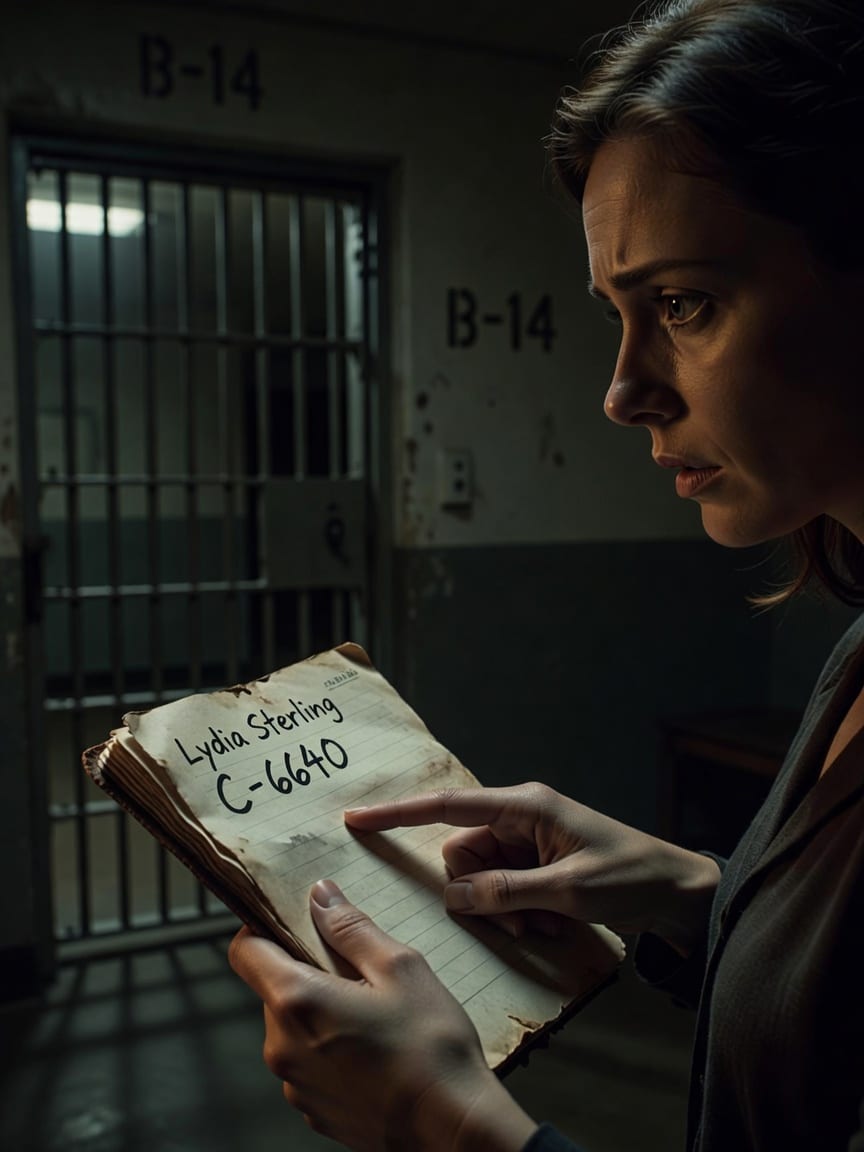
My prison number C-6640 appeared in a logbook next to another inmate's name in 1968, again in 1981, then 1994, always the same cell, B-wing 14, and always 'settled.'
As the new archivist at Barrowfield, I was sorting dusty prison logbooks from the 1960s. My own induction number, C-6640, was still fresh in my mind, issued sequentially like all others. But then I found it written next to an inmate's entry from 1968, and again in 1981, always in the same cell, a pattern of impossible repetition that defied logic.