A cutter's watchman whistled a tune into the Aleutian fog, and a reply came back, pitch perfect, from the black water. Then his recorder whispered a name.
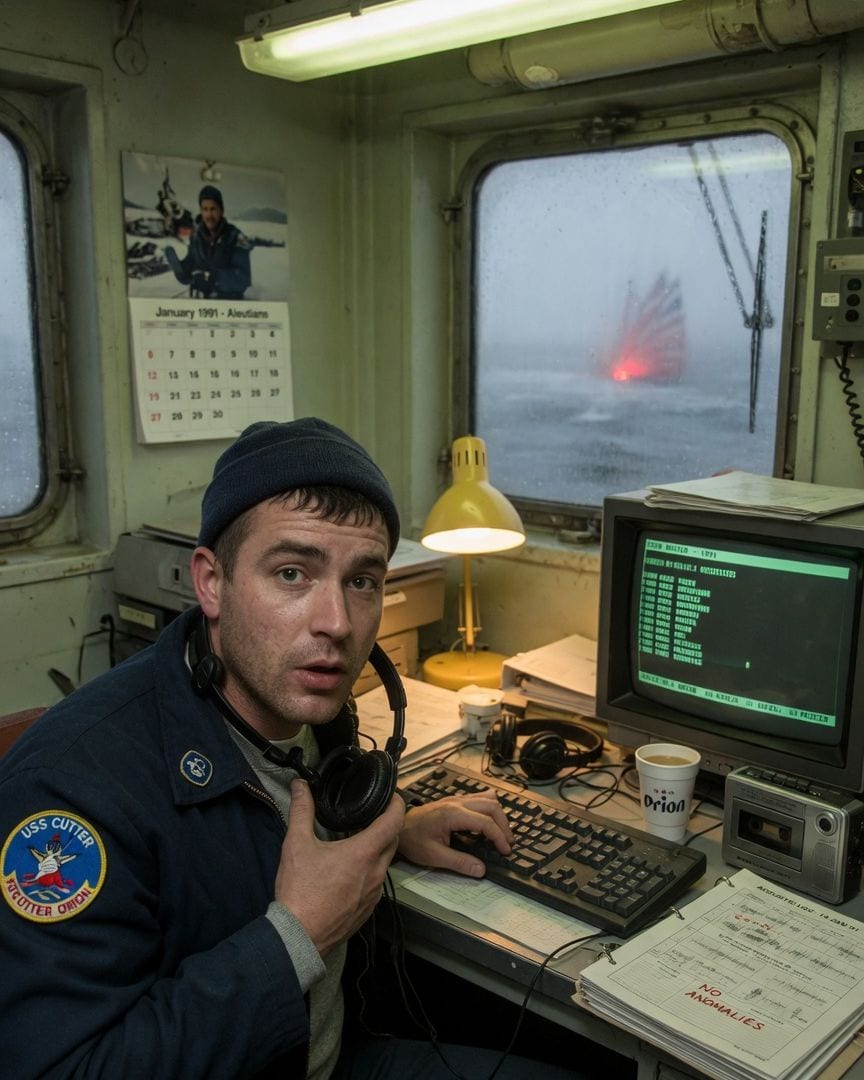
Oscar Petro stood alone on midwatch on the fantail of the USS Cutter Orion, somewhere off the Aleutian Islands in the winter of '91. The fog pressed down to the rail, thick and cold, swallowing the ship whole.
Hours had passed since the last human contact, the endless black water a patient, silent presence beneath the hull.
Boredom, the biting cold, and the vast, unseeing expanse combined to make the old superstition — never whistle on watch, especially over open water — feel less like a warning and more like a challenge.
He thought of his bunk, then a hot cup of coffee. To keep himself awake, to break the monotony, he brought his lips together and whistled eight bars of a jaunty tune his father used to sing.
From somewhere out in the impenetrable blackness, closer than the rail, a reply whistled back. It was the next eight bars of the exact same tune, pitch perfect, in a tone no gull ever made.
Too precise to be an echo, too near to be a trick of the wind.
Petro snapped his head up, scanning the swirling gray beyond the ship's stern light, but there was nothing but the fog, pressing in, and the endless, black swell.
The impossible tune hung in the air for another beat, a silent question waiting for an answer, before it dissipated into the vast quiet.
Petro tried to rationalize the impossible whistle. He told himself it was the wind, a particularly resonant gust that had perfectly mimicked his melody, or perhaps fatigue playing on his ears. He shook his head, pushing the oddity away.
The cold could make you hear things. Later, during shift change, he mentioned it casually to Seaman Chloe Porter, a wry smile on his face, trying to gauge her reaction.
She just scoffed, dismissing it as another "spooky Aleutian tale," a legend for new recruits.
But the precise, impossible reply gnawed at him. Later that day, off duty, he sought out the ship's acoustic sensors log in the sound room, convinced he would find a logical explanation.
He scrolled through the data, looking for anything unusual – a rogue buoy, a unique bird call, maybe a distant fishing vessel.
The logs showed nothing: only the rhythmic thrum of the cutter’s engines, the distant slap of waves against the hull, and the occasional creak of metal. No other vessels, no anomalous sounds.
Then he remembered his personal audio recorder. He carried it in his pocket during his watches, a small, permitted device for dictating observations or notes. He retrieved it from his locker, hoping to prove his mind had been playing tricks.
He connected his headphones, the plastic cold against his ears, and pressed play. First, his own whistle, clear and distinct. Then, after a beat of static-filled silence, the impossible reply.
He leaned closer, adjusting the volume, trying to filter out the hiss. Amidst the faint, impossible tune, he heard it: a barely audible, chilling whisper. A single word that made the hairs on his neck stand on end.
Petro played the recording again, isolating the whispered word, using his headphones to cut out the ambient noise of the ship. The whisper was clearer now, faint but undeniably present: "Mercer."
He ripped the headphones off, the name echoing in his ears, an impossible presence in the silent room. He quickly moved to a nearby terminal, his fingers flying across the keyboard.
He scrolled through the ship's digital manifest, then checked recent transfer rosters he could access, his breath catching in his throat. The name 'Mercer' was not on the current crew list.
It wasn't on any transfer in or out for the past six months.
The ship's intercom crackled, a routine weather report from the bridge, a flat, calm voice detailing wind speeds and sea state. Petro hardly heard it.
He stared out the bridge window at the dark water, the fog pressing close against the glass, and a cold dread settled deep in his gut.
Who was Philip Mercer, and how could his name be whispered from the black water?
Petro approached Chloe Porter again, this time with a more urgent demeanor, the pretense of "local legend research" barely concealing his growing unease. He didn’t bother with pleasantries. He just handed her the headphones.
Porter, initially skeptical, took them, a raised eyebrow his only greeting. She listened, her expression slowly changing from detached curiosity to genuine alarm.
The impossible reply to his whistle, then the faint, undeniably clear whisper of “Mercer,” seemed to lodge itself in her mind.
“Okay,” she said, pulling the headphones off. “That’s… not a gull.” She agreed to help, intrigued and unnerved in equal measure.
They discreetly used the cutter’s limited library resources and secure digital archives – officially, for ‘research into regional maritime folklore,’ a cover Petro had quickly invented.
They searched for ‘Philip Mercer’ in naval and Coast Guard records, hoping to find a common name, an easy explanation.
Their search yielded a chilling result. A Seaman Philip Mercer, listed as lost in 1948 aboard the USS Aleutian Shadow, a destroyer escort that vanished without a trace in these very waters, not far from their current patrol route.
The official reports were sparse, detailing a presumed sinking with no survivors and no recovered wreckage. The dread deepened, morphing from a strange, personal anomaly into a specific, historical horror.
They found a grainy, black-and-white photo of the Aleutian Shadow’s crew, taken on deck just before its final voyage. A young, earnest face among them, dark hair slicked back, was identified in the caption as Philip Mercer.
His eyes, even in the faded image, held a flicker of something unreadable.
As Petro and Porter delved deeper into the Aleutian Shadow’s forgotten story, Chief Petty Officer Lars Forsythe, a quiet, grizzled veteran with decades on these patrols, began to notice their unusual activities.
Forsythe was a man built of old salt and silence, his movements precise, his gaze knowing.
He caught Petro poring over old maritime charts of the Aleutian region in the navigation room, specifically marking the presumed last known position of the USS Aleutian Shadow with a red pen.
Forsythe approached him then, his voice low and calm, startling Petro, who hadn’t heard him approach.
“Some things are best left to the deep, Seaman,” he said, his eyes, dark and distant, holding a look that suggested he’d seen more than just rough seas. “No good comes from stirring old ghosts, especially not in these waters.”
His warning wasn’t hostile, but it carried an unspoken weight, a quiet authority that chilled Petro more than any direct threat. The air in the navigation room seemed to thicken, pressing in on Petro like the fog outside.
Later, Petro was alone in the cutter’s small, rarely-used archives, a cramped space filled with dusty binders and forgotten manuals. He was cross-referencing old weather patterns from 1948 with the Aleutian Shadow’s last recorded coordinates.
He heard a faint, familiar whistle – the same eight bars, then the same impossible reply – emanating from the ventilation system directly above him. He froze, looking up at the grate, but saw nothing.
He checked the ship’s internal comms, but they were silent, only the low hum of the ship’s systems filling the space. A profound, unnatural cold settled around him, despite the cutter’s heating.
He realized they weren't just investigating; they were being watched. And whoever was watching knew what they were doing.
Petro, now convinced that something far beyond coincidence was at play, confronted Forsythe directly. He found the Chief Petty Officer in the mess hall, nursing a mug of coffee.
Without preamble, Petro sat opposite him and played the recording of the whistle and the name from his personal device. Then he slid over the aged printouts of the Aleutian Shadow’s records and pointed to Philip Mercer’s grainy photo.
Forsythe listened, his face unreadable, his gaze fixed on the photograph. He let out a long, slow breath, a sound like air escaping a tired old bellows.
“The Aleutian Shadow,” Forsythe murmured, his voice softer now. He admitted that the local Aleut communities, and some old-timers in the Coast Guard, had a legend about that ship.
He described how the official story was always vague, the search called off too soon, one body never recovered.
He said the incident was quickly overshadowed by a larger, more public naval disaster that same year, absorbing all attention and resources.
Then Forsythe leaned forward, lowering his voice. “There was a hushed-up detail, Seaman. The initial manifest for the Aleutian Shadow listed one more crewman than the final casualty report. A quiet bureaucratic erasure, decades ago.
They couldn’t account for him, so they just… stopped trying. Made the numbers fit the other story.”
The dread that had been building since Petro’s midwatch whistling finally clicked into place. The impossible reply, the whispered name, the impossible sonar contact now made chilling sense. Philip Mercer wasn’t just lost; he was erased, an inconvenient anomaly.
His ghost was now calling for the accountability he was denied, his presence manifesting through the very systems designed to record and account for every man at sea.
The coldness in the archive, the whistle in the vents – it was all him.
Petro and Porter, now with Forsythe’s chilling insights, returned to the Aleutian Shadow’s records, their search driven by a new, horrifying clarity. They focused on the discrepancy in the casualty reports.
With Forsythe's guidance, they located two distinct versions: an initial, internal document, tucked away in an obscure microfiche archive, and the final, publicly released one that had been accessible for decades.
The internal report, dated shortly after the Aleutian Shadow's disappearance, clearly listed Seaman Philip Mercer among the lost, with his service number and next-of-kin details. The public one, compiled later, did not.
His name was conspicuously absent, reducing the total casualty count by one.
They cross-referenced this with other naval losses from 1948 and confirmed Forsythe's claim: a larger, more politically sensitive naval incident involving multiple vessels had indeed occurred in the same timeframe, diverting all resources and attention.
Philip Mercer's disappearance was not just a clerical error; his record was systematically purged to simplify the larger, more complex loss, to make the numbers 'fit' a narrative of full recovery for the other incident, effectively erasing him from official existence.
As they stared at the two conflicting manifests, the quiet hum of the ship around them, the ship's sonar suddenly pinged.
A deep, impossible contact registered directly beneath the cutter, in the exact spot where the Aleutian Shadow was believed to have gone down decades ago.
The sonar screen flashed, an urgent, red alert, and a single, impossible word pulsed next to the contact: 'MERCER.'
Lt. Commander Richard Holloway dismissed the sonar contact with a dismissive wave of his hand. He stood on the bridge, his posture rigid, glaring at the sonar technician. “It’s a geological anomaly,” he declared, his voice tight.
“A fault line, or a deep-sea current playing tricks. Re-calibrate the equipment, Chief. Immediately.” But Petro, Porter, and Forsythe knew better. They had seen the screen, the impossible, pulsating word.
Later, under the cover of a simulated equipment check, they secretly accessed the raw sonar data and analyzed it themselves.
The contact was too precise, too regular, moving with an impossible, slow, rhythmic pulse that was undeniably biological, yet not of any known marine life. It was not geological.
The ship’s systems seemed to be screaming a truth the captain refused to hear.
Forsythe, his voice somber, explained that the Aleutian Shadow was rumored to have carried a classified cargo, something sensitive enough that its loss, and the full extent of its crew, had to be hushed up.
He recounted from the old legends that Philip Mercer was the last man on watch when the ship went down, his ghost now forever bound to the wreck, calling for the accountability he was denied.
The whistling, the whispered name, the erased record, the impossible sonar contact – it all fit into a horrifying, coherent pattern of a man erased by the system, now demanding to be seen and heard.
The cabin lights seemed to flicker for a moment, as if agreeing.
Lt. Commander Holloway, increasingly frustrated by the crew’s unease and their persistent interest in old records, called Petro into his office. He stood behind his desk, his face stern.
“Seaman Petro,” he began, his voice barely controlled, “what exactly are you and Seaman Porter doing? I’ve received reports of ‘unsanctioned research.’ Explain yourself.”
Petro, disciplined but resolute, stood at attention. He presented the recording of the whistle and the name, the conflicting manifests laid out on Holloway’s desk, and the raw, analyzed sonar data, quietly explaining each piece of evidence.
Holloway, a man of rigid order and military logic, was visibly shaken. He tried to find a rational explanation for each piece of evidence, his voice growing strained – “wind noise,” “a hoax,” “a clerical error,” “equipment malfunction.”
But Petro, calm and precise, systematically dismantled his composure. Each rationalization died under the weight of coherent, irrefutable detail.
Just as Holloway was about to dismiss it all as fatigue and superstition, the ship’s lookout shouted from the bridge, his voice strained with disbelief: “Debris! Off the starboard bow! Large contact!” The cutter slowed.
Petro and Holloway both looked through the office’s porthole, towards the churning water. A small, barnacle-encrusted object bobbed in the waves, caught in a fishing net deployed earlier by the Orion’s science team.
It was a waterproof, brass-cased logbook, miraculously preserved, dated to 1948. Holloway, his face ashen, ordered it brought aboard. Petro watched from the bridge as the first page was carefully opened in the cold light of the deck.
The faded, defiant script of Philip Mercer filled the page.
The entries detailed the final, frantic moments of the Aleutian Shadow, culminating in a last, desperate plea for his name to be remembered, scrawled almost illegibly against the terror of the sinking. The ordinary explanation died for good.
The USS Cutter Orion’s patrol was cut short, orders changed under ‘unforeseen circumstances.’ No official report mentioned the sonar contact, the comms breach, or the recovered logbook. Lt.
Commander Holloway’s log entries from that period became unusually terse, omitting details of the final days of the patrol. Seaman Chloe Porter requested and received a transfer to a shore station soon after, her face pale, her usual spark dimmed.
Chief Petty Officer Lars Forsythe continued his patrols in the Aleutians, but now with a knowing, weary look in his eyes, as if carrying a heavier burden than before.
The vast, cold expanse of the ocean seemed to settle deeper into his bones.
Oscar Petro finished his deployment and received an honorable discharge a few months later, never speaking of the incident to anyone outside of the small crew who had witnessed it.
He tried to build a normal life, far from the sea, far from the cold, and the deep.
But sometimes, late at night, when the wind howled just right, he swore he could hear a faint, insistent whistle, always eight bars, carrying over the distant sounds of the city, waiting for a reply that would never come.
Years later, a new Coast Guard cutter, the USS Vance, on patrol in the same Aleutian waters, logged an impossible acoustic signature on its deep-sea sonar. The report noted a rhythmic, low-frequency pulse, accompanied by a faint, almost melodic, whistling.
The sonar technician flagged it, but the Lieutenant Commander dismissed it as a sensor malfunction, a ghost in the machine. The log entry for the anomaly, however, was quietly filed under 'MERCER, PHILIP.'
If this one got to you
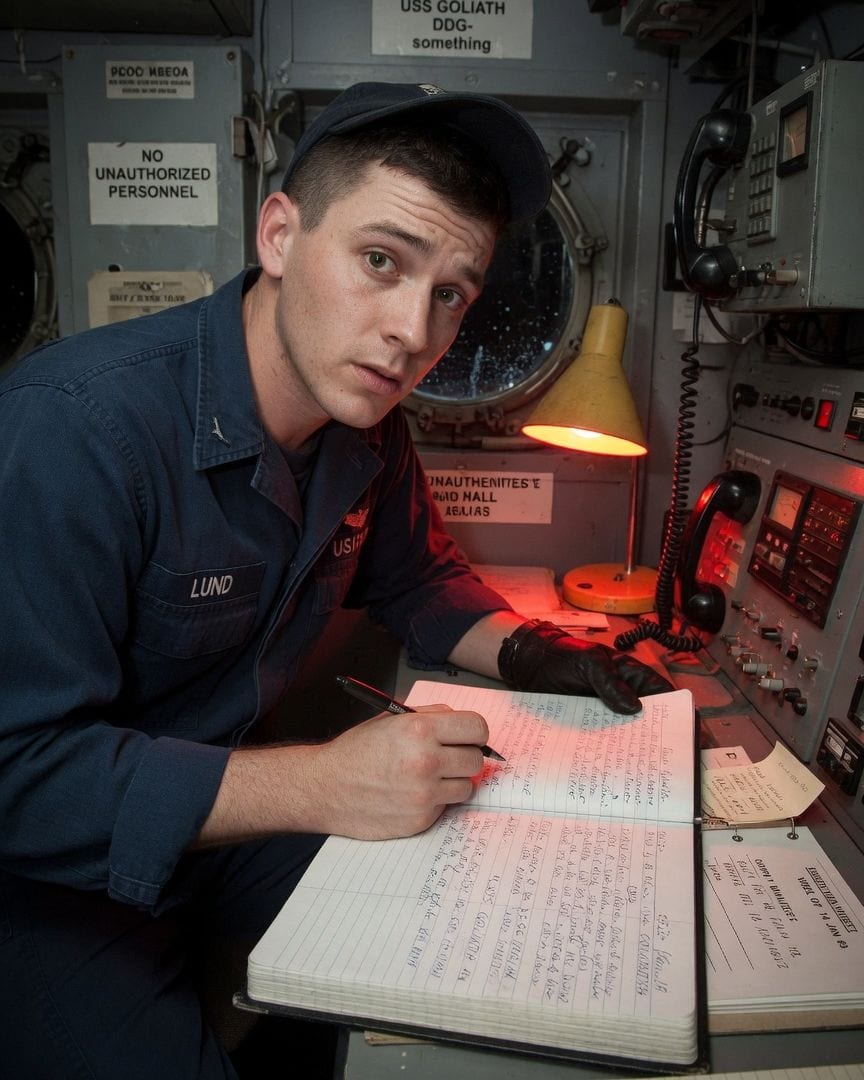
Petty Officer Lund heard his own captain's mayday: the Cold War USS Goliath was sinking, two hundred miles astern.
Petty Officer Marco Lund kept a lonely vigil in the USS Goliath's radio room, the destroyer battling the North Atlantic in deep winter 1983. Suddenly, a garbled mayday broke through: his own ship, his own captain, reporting they were going down two hundred miles astern. Though the bridge confirmed the Goliath was fine, the same chilling call came again an hour later, stronger and from the exact waters they had just crossed. Deeply unsettled, Marco began searching ship logs, eventually discovering a phantom entry: an identical mayday, logged a week prior, pressed into the very paper beneath his own.
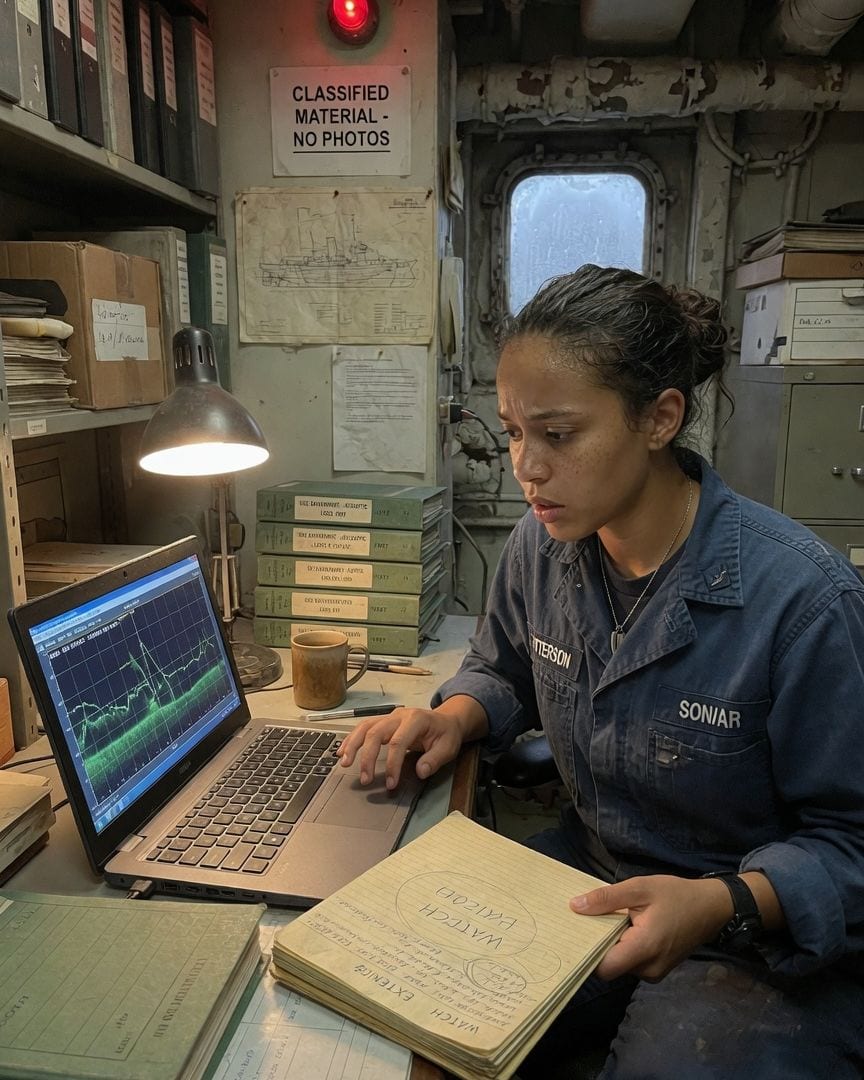
On the USS Calloway's final patrol, a sonar technician found an old log with two chilling words: 'WATCH EXTENDED.'
Sonar Technician Brooke Patterson had only two days left on the USS Calloway's last patrol, a finality that hung heavy in the humid sonar room. Through the impenetrable fog, her radar showed only empty water, but then an impossible biologic contact pinged, mimicking a vessel with eerie precision for three silent hours. It vanished at 0400, just as an identical trace had done weeks before. Searching old archives, Brooke found the precise pattern in a decades-old log from a scrapped destroyer. Scrawled next to it, in faded ink, were two words: "WATCH EXTENDED." What did those words truly mean?
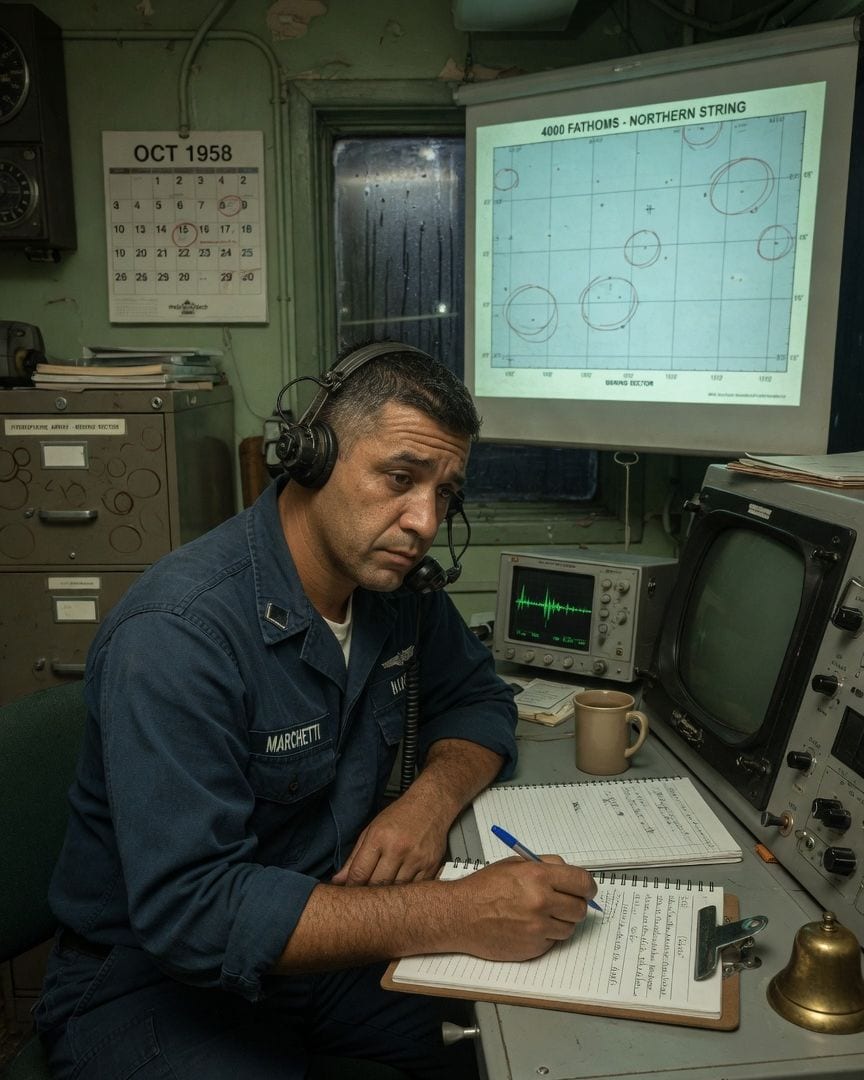
A Cold War Petty Officer, 31 days from retirement, heard a ship's bell answer his own, from 4000 fathoms of empty Bering Sea.
Petty Officer Ruel Marchetti had just thirty-one days left on his career, monitoring the frigid Bering Sea from the lonely Adak surveillance station in October 1958. His headphones, usually filled with the hum of equipment, picked up an impossible sound: a ship’s bell chiming from 4000 fathoms of empty ocean. For six nights, the bell rang precisely on the half-hour, dismissing all his rationalizations and his Chief's easy explanations. On the seventh night, Marchetti rang the station’s fire bell into the churning black sea, and moments later, the deep-sea bell answered his exact count, chime for chime. What was speaking back from the silent depths, and what did its rhythmic chimes truly say?
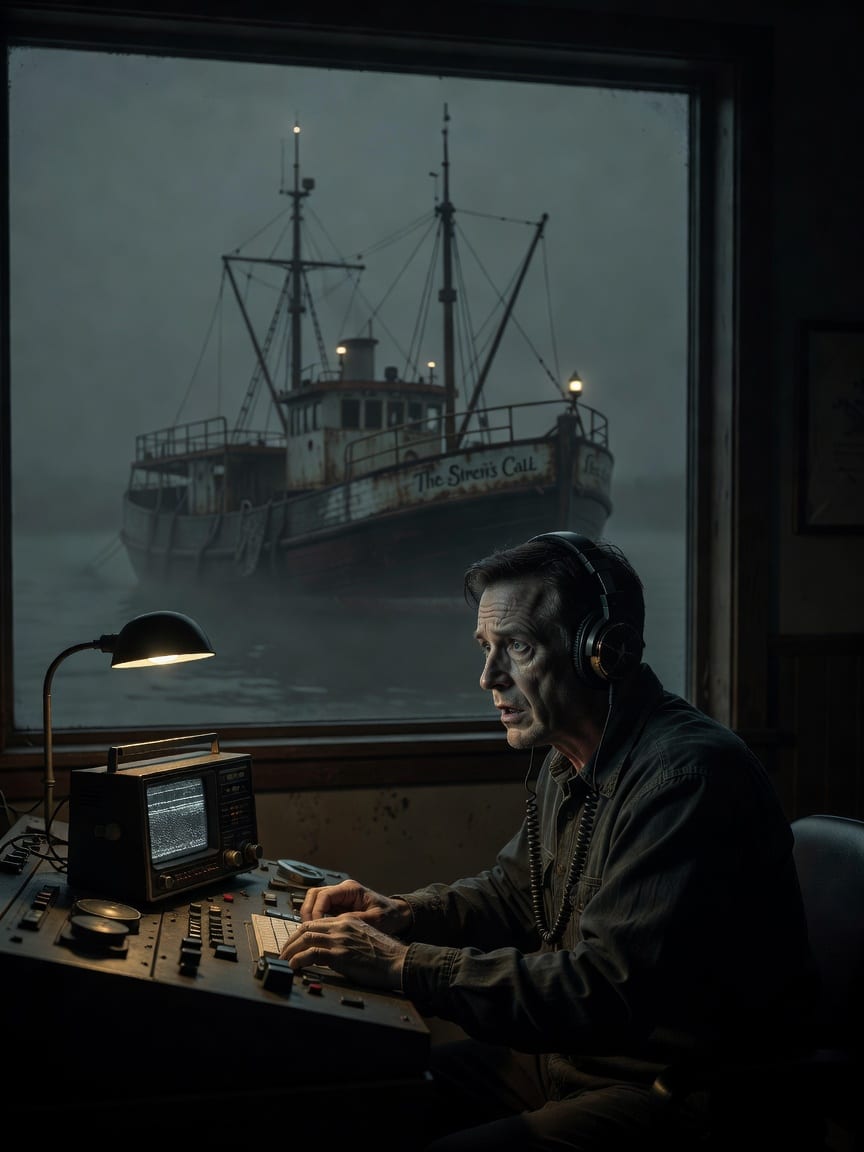
My radio picked up a skipper at 3 AM every night, asking about the bar. The harbourmaster's tapes show no calls, and that boat sank ten years ago.
Every night, as the harbour night watchman, I have a comforting ritual: guiding Tom of 'The Siren's Call' through the channel. But the harbourmaster just reviewed the tapes, and my voice is there, clear as day, while Tom's response is utter silence. And official records show his vessel, 'The Siren's Call,' sank a decade ago with all hands.
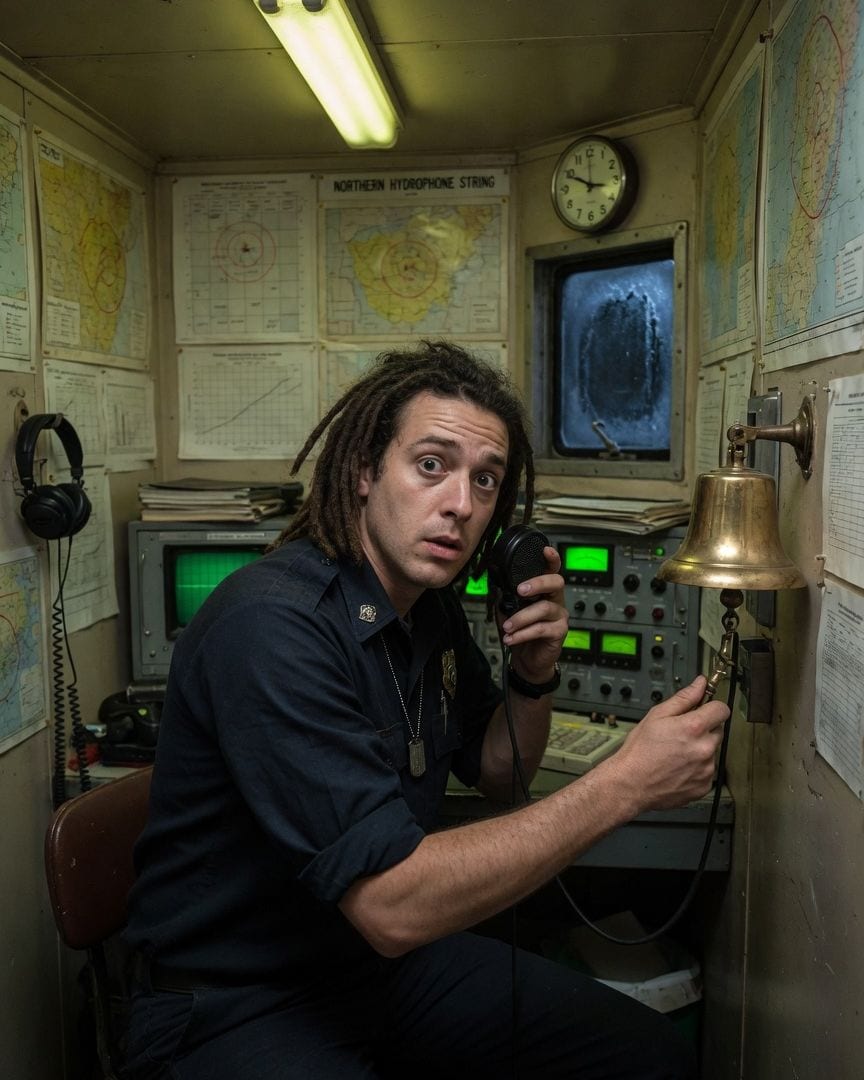
A Cold War petty officer, deep into his last hitch on Adak, heard a ship's bell ringing from four thousand fathoms of empty Bering Sea.
Petty Officer Ruel Marchetti was deep into his final career hitch at the isolated ocean-surveillance station on Adak in October 1958. Under the dim console lights, surrounded by the Bering Sea's droning solitude, he knew every sound the hydrophone arrays picked up. But then, from the Aleutian dark, a clear, resonant ship's bell began to chime on the northern string, from four thousand fathoms of empty Bering silt. He checked and recalibrated, but the signal remained clean, distinct, and utterly impossible, tolling back precisely every half-hour for six nights from a featureless void. What could be ringing a bell in the crushing silence of the abyss?
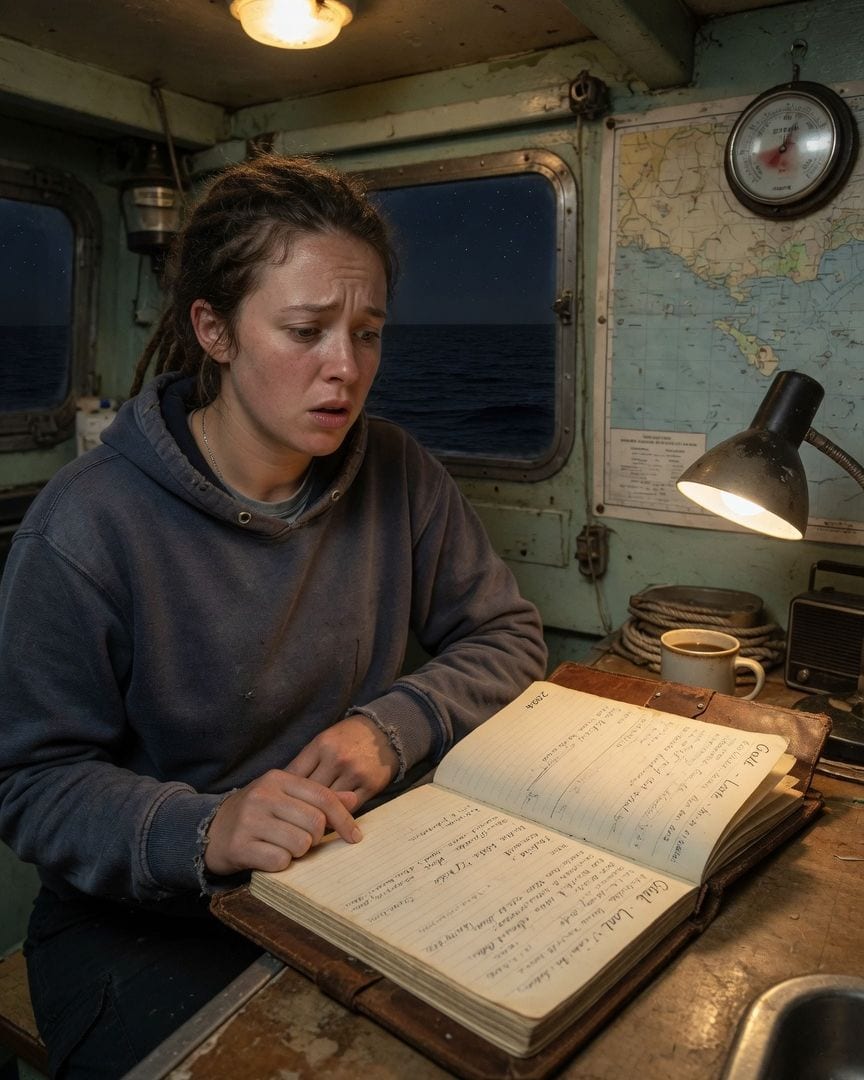
My skipper's logbook showed tomorrow's gale already written, in his dead father's hand, from 1969. I whistled on deck.
Working as a deckhand on the Skerry, I accidentally whistled, breaking a quiet rule Benjamin the skipper had given me. Later, I found the ship's logbook open to today's date, with an entry reading 'Gale - Loss' and the year '1969,' written in Benjamin's long-dead father's hand. He drowned off this very boat in 1969.