Entry 30 in the old records was re-inked for decades, always the same 'foul drain,' same order: 'do not act.' Then I found it on my street.
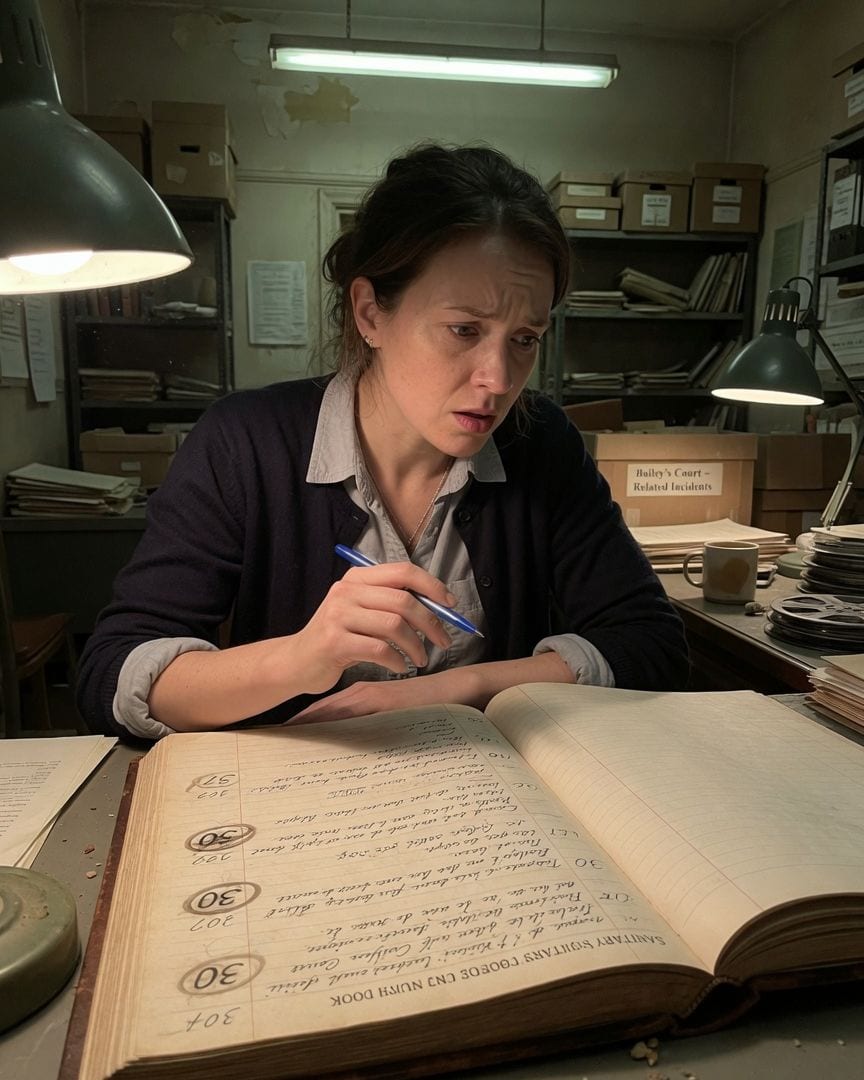
The heavy, leather-bound sanitary inspector’s nuisance book lay open on the archival desk, smelling of aged paper and something vaguely metallic. I sat hunched over it, the low hum of the fluorescent lights a constant companion.
My job as a transcriber at the local record office was usually tedious, a quiet battle against the relentless march of history, digitizing every faded entry. I found a certain comfort in the monotony. Until Entry 30.
My pen hovered. The complaint, logged in 1881, concerned a ‘foul drain and damp cellar’ at Bailey’s Court. Standard enough.
But then I saw it: the number ‘30’ was subtly re-inked, a darker, bolder shade overlying a fainter, identical ‘30’ beneath. My eyes narrowed. Below it, a new date: 1904. Different householder, same complaint, same address.
I flipped the page, following the entry. Again, ‘30’ re-inked, 1927. Another name, same drain, same cellar. And in the inspector’s notes column, repeated verbatim down the decades, a chillingly calm instruction: ‘nuisance as before, enter it, do not act.’
I blinked. This wasn’t just a clerical error; it was too consistent, too deliberate. Three different inspectors, over half a century, logging the exact same problem, at the exact same entry number, with the exact same, baffling order.
It felt less like an archive and more like a quietly maintained trap. The dust motes dancing in the light above the old ledger seemed to hold their breath.
I tried to dismiss it as an administrative quirk, a historical anomaly. Old habits, old ways of tracking things. But the image of the re-inked ‘30’ gnawed at me through the afternoon.
It kept cycling in my mind, a quiet click of wrongness. The next morning, I brought it up with Lars Hartley, my supervisor, a man in his mid-fifties whose perpetually unruffled demeanor was often unnerving.
“Old books, Sophia,” Lars said, waving a dismissive hand, not even looking up from his own screen. “They had their own ways back then. Probably just a way to link recurring issues without creating new files. Nothing to worry about.
Focus on the backlog, eh?”
His explanation was mundane, plausible, and utterly unsatisfying. I nodded, a tight, polite gesture, but later, instead of moving on to the next set of files, I started cross-referencing. The office was quiet, the usual Tuesday lull.
I pulled out more nuisance books, sifting through the years, a low-grade tension coiling in my gut. It took me two days, but I found it: another Entry 30.
This one was from 1950, a different inspector, but the same re-inking, the same ‘nuisance as before, enter it, do not act.’ And the address wasn’t Bailey’s Court. It was 14 Willow Creek Lane.
I froze. Willow Creek Lane. My own street. Not my house number, but close enough to make the historical oddity feel uncomfortably present, like a cold draft creeping under my office door, even though the windows were sealed shut.
The ‘quirk’ had now moved from a distant historical curiosity to my immediate vicinity, transforming from a puzzle into a premonition.
The thought of Willow Creek Lane made my skin prickle. I decided to stay late, long after Lars and the others had left. The fluorescent lights hummed over the quiet stacks, the sound like a distant, mechanical breath.
I bypassed the main archive search, following a hunch, drawn to a section of old, unmarked boxes that Lars had once mentioned were awaiting further classification.
After an hour of dusty searching, my fingers gritty with age, tucked away behind a shelf of forgotten tax ledgers, I found it: a small, unassuming cardboard file box, stained with age, crudely labeled in faded, almost illegible handwriting: 'Bailey's Court – Related Incidents.'
My heart thumped, a sudden, frantic rhythm in the silence. Inside, beneath a layer of moldering newspapers and brittle receipts, I found a single, faded sheet of paper.
It was a handwritten memo, dated 1961, addressed to 'Sanitary Inspector H. Merritt.' The heading read, stark and impossible: 'Protocol 30-B: Nuisance Management, Willow Creek Lane.'
The paper felt cold in my hand, the quiet of the archive suddenly heavy with implied history.
I sat there in the near-darkness, the memo glowing faintly under the beam of my phone flashlight. 'Protocol 30-B: Nuisance Management, Willow Creek Lane.'
The language was precise, almost clinical: 'annual assessment' and 'minimizing public awareness' regarding 'Entry 30 events' in 'Containment Zone 3.' This wasn't about drains. This was about something else entirely, an institutional procedure designed to manage a phenomenon.
My earlier unease solidified into a chilling certainty: this wasn't a historical anomaly; it was an ongoing, managed operation.
Over the next few days, I covertly used my archive access. I cross-referenced 'Protocol 30-B' with other internal records, digging deeper into the council’s digital archives.
I found a series of non-public documents, buried deep, where 'Entry 30' was consistently referenced not as a public complaint, but as a 'case file.' These documents mentioned 'Subject Transfer' and 'Containment Zone 3' with unnerving regularity.
Each click, each new opened file, tightened the knot in my stomach.
I started building a timeline, tracking the recurrence of 'Entry 30' across different properties within Willow Creek Lane and Bailey's Court. The dates were roughly 23 years apart, an eerie, almost perfect cycle.
And then I noticed a pattern in the householders' names, specifically a recurring surname: 'Sutton.' A John Sutton at Bailey's Court in 1904, an Eleanor Sutton at Willow Creek Lane in 1950.
The names shifted, but the surname kept reappearing, always linked to an 'Entry 30' incident. The dread solidified: someone was actively managing this. It felt less like an archive and more like a carefully maintained logbook of something predatory.
I reached out to Dean Stratton, a local historian I’d met once at a digitization seminar.
Under the guise of researching a local history project, I asked him about old property records for Bailey's Court and Willow Creek Lane, specifically inquiring about families named Sutton who lived there in the early to mid-20th century.
Dean, initially enthusiastic, promised to look into it, his voice bright with academic curiosity.
Days later, Dean Stratton called back. His tone was markedly cooler than before, a brittle edge to his usual academic cheerfulness.
He confirmed he had found records of Suttons in both locations, but quickly changed the subject when I pressed for details about their subsequent movements or any unusual circumstances.
"Fascinating stuff, old records," he mumbled, clearly wanting to end the conversation. "So much history, eh? Always something new."
I felt a chill. Had my questions triggered something? That afternoon, a notification popped up on my work computer, a small, red flag: 'Your archive access logs for the past week have been reviewed by system administrator.'
A cold knot tightened in my stomach. Someone knew I was digging.
An hour later, Lars Hartley called me into his office. He leaned back in his chair, seemingly relaxed, but his eyes were sharp, scanning my face as I walked in.
"Sophia," he began, his voice light, almost too light, "I hear you've been quite diligent with the older files. Found anything interesting in those dusty corners?"
"Just the usual," I replied, trying to keep my voice steady, my hands clasped tightly behind my back. "Some fascinating insights into local history, you know."
Lars smiled faintly, a small, unsettling curve of his lips. "Indeed. But some records are best left undisturbed, Sophia. They're historical, not current. You understand."
He held my gaze for a beat too long, and the air in the room grew heavy, thick with unspoken meaning. The message was clear: I’d been noticed, and I was treading on dangerous ground.
The easy camaraderie between us had vanished, replaced by a subtle, unsettling power dynamic. I felt watched, the archive's vast silence now a potential listening space.
The framed photos of smiling families on his desk seemed to tilt, their eyes following me.
I couldn't ignore Lars's warning, but I couldn't stop either. The image of Greta’s face, my sister, flashed in my mind, bright and defiant.
The next day, I cornered him in an empty corridor, a printout of 'Protocol 30-B' clutched in my hand. "What is this, Lars?" I demanded, my voice low but firm, the paper rustling. "This isn't about drains.
This is about 'nuisance management' and 'minimizing public awareness' in 'Containment Zone 3.' What exactly are you managing?"
Lars's relaxed facade finally cracked. He glanced around the empty corridor, his eyes darting to the closed office doors, then sighed, running a hand over his thinning hair. "Come into my office, Sophia. Close the door."
Once inside, he didn't try to evade. He just sat, his posture suddenly weary, the weight of years visibly settling on him. "It's a legacy file, Sophia. A situation the council has… managed for a very long time."
He paused, his gaze distant. "It's not a drain. It's… a cycle. A recurring localized phenomenon. It's harmless as long as it's contained. And it is contained. The 'do not act' is the containment."
He explained, in a calm, almost detached tone, that the 'nuisance' involved a low-level psychic resonance that flared up in specific locations, usually in the basements or cellars of particular properties.
It wasn't a physical entity, he stressed, but a kind of environmental anomaly that, if not managed, could cause widespread panic or even trigger larger, more dangerous manifestations.
"The council's role," he continued, "is simply to document it, to track its cycles, and to ensure no one draws undue attention to it. The 'reissued number' is the designated management file for this particular cycle.
It happens every 23 years, roughly."
He pulled open a drawer, retrieved a folded, old map, and spread it on his desk. It was a faded street map of the town, with several areas circled in red ink, crudely drawn but precisely placed.
One of the circles clearly encompassed Willow Creek Lane. He pointed to it with a long, unvarnished finger. "Containment Zone 3. It's where the phenomenon manifests most strongly."
The earlier clues clicked into place with terrifying precision: the re-inked numbers, the 'do not act' order, the 'related incidents' box. It all fit a system, a cold, bureaucratic management of something utterly unnatural.
The very air in the office seemed to grow colder, solidifying around me.
I was reeling. A 'psychic resonance.' A 'cycle.' A 'containment zone.' The sheer, mundane bureaucracy of it all was more horrifying than any monster. I left Lars's office, the map of 'Containment Zone 3' burned into my mind.
The easy hum of the archive now felt like a low growl. I returned to my desk, determined to understand the 'cycle' fully.
I focused on the 'pattern across dates and names' that Lars had inadvertently confirmed. I pulled up the digital records again, cross-referencing every 'Entry 30' case file I could find, meticulously noting the dates and the names of the householders.
The recurring 'Sutton' surname now took on a darker significance. I noticed a chilling pattern: in many instances, the families associated with the 'nuisance' complaints seemed to simply disappear from the records after the incident.
No forwarding address, no new census data, no death certificate. Just… gone.
It's not just containment, I realized with a jolt of pure terror; it's a harvest. The 'nuisance' isn't just a phenomenon; it's taking people.
My fingers flew across the keyboard, searching for the most recent 'Entry 30' in 'Containment Zone 3.' I found it: a case file from just five years ago, 2018, for 17 Willow Creek Lane.
My breath hitched. The name listed was 'Greta Novak.'
My stomach dropped, a cold, empty plunge. Greta Novak. My younger sister. She had moved into a house on Willow Creek Lane five years ago. She went missing a year later.
Her sister's face, smiling from an old photo on her desk, seemed to mock the calm, bureaucratic record.
I burst back into Lars's office, the printout of Greta's 'Entry 30' file shaking in my hand, the paper rattling like dry bones. "Greta Novak!" I cried, my voice raw, barely a whisper. "My sister!
She went missing from Willow Creek Lane! This isn't containment, Lars, it's… it's a sacrifice!"
Lars's calm facade shattered, replaced by a grim resignation. He pinched the bridge of his nose, his shoulders slumping. "Sit down, Sophia. Please."
I stood my ground, trembling. He explained, his voice low and heavy, that the 'nuisance' wasn't merely a psychic resonance. "It's a dormant, parasitic entity, Sophia," he said, his gaze distant, vacant. "Ancient.
Tied to specific ley lines beneath the town, reactivating cyclically. It requires a 'host' to sustain itself and then goes dormant for another cycle."
These hosts, he revealed, were often from specific lineages or possessed a particular psychic sensitivity, which the 'nuisance' complaints inadvertently identified. The council's 'management' system, established generations ago, wasn't about containing panic; it was about facilitating the entity's cycle.
The 'do not act' ensured the entity's 'transfer'—the host's assimilation—was undisturbed and uninvestigated.
"Greta," he said, his eyes finally meeting mine, holding a chilling blend of pity and resolve, "she was identified as a potential host. The complaint, the 'nuisance,' it was the entity waking. We… we simply ensured the process wasn't interrupted."
He explained that the entity didn't kill; it assimilates the host, absorbing their consciousness and leaving no trace, then retreats into dormancy. The institution knew, and they managed the cycle, trading a few lives for the greater 'containment.'
He leaned forward, his voice dropping to a near whisper. "You now know too much, Sophia. You have a choice: you can join us, become one of the managers, or you become a nuisance yourself."
I stared at Lars, his offer chilling me to the bone. "Join you?" I whispered, the words catching in my throat. "Facilitate this… horror?"
Lars nodded, his expression unreadable, a silent, terrible invitation. "It's the only way to maintain order. We ensure it's contained, that it doesn't spread, that the larger population remains unaware. A small price for stability."
He rose, moving towards me slowly, deliberately, his calm demeanor now a silent threat, the air in the room pressing in on me. "You have a choice, Sophia. The knowledge you possess is too dangerous to let walk free."
My mind raced, a cold, rational fear sharpening my senses. I knew the archives, every hidden passage, every fire escape, every old building system from years of working here.
This institution, this 'management,' it was vast, ingrained, but it was still a physical building.
As Lars reached for me, his hand outstretched, I lunged past him, not for the door, but for an emergency pull station hidden behind a dusty old map cabinet that hadn’t been moved in decades.
My hand slammed down on the lever. The piercing shriek of the fire alarm instantly obliterated the quiet of the record office, tearing through the air, plunging the building into chaos.
Lights flashed, emergency doors clattered open, and distant shouts erupted from the deeper stacks. Lars cursed, momentarily disoriented, spinning around, his face a mask of sudden, cold fury.
From the shadows of the towering shelves, other figures emerged, 'managers' I now recognized—the night security guard, a senior archivist I’d seen every day, even Dean Stratton, his face a mask of grim determination.
They moved with an unnerving, practiced efficiency, converging on Lars and me.
I didn't wait. I ducked through a narrow gap between two towering shelves of records, my intimate knowledge of the building my only weapon.
I sprinted, adrenaline coursing through my veins, navigating the labyrinthine corridors, the blare of the alarm a frantic symphony of escape. I heard shouts, the pounding of footsteps behind me, a chilling echo. I didn't look back.
I burst through a fire exit into the cool, dark night, the damp air hitting my face like a shock, and disappeared into the anonymity of the city streets, a hunted woman carrying a truth too terrible to bear.
I never returned to my apartment. I spent the next few months living off the grid, draining my savings, moving from rented room to rented room in anonymous towns, erasing my digital footprint piece by piece.
I never contacted my family again, knowing that any connection would put them at risk.
Lars Hartley remained in his position at the record office, his demeanor as unruffled as ever, calmly overseeing the quiet, ongoing 'management' of the institution’s terrifying legacy.
The fire alarm incident was officially logged as a malfunction, quickly forgotten by all but a select few.
The cyclical 'nuisance' continued, an unseen horror tended by an unseen bureaucracy, while I lived with the chilling, lonely knowledge of what truly lay beneath the town's placid surface.
I sit in a dimly lit, impersonal rented room, far from the city I once called home. The blinds are drawn, the laptop screen my only source of light, a cold, blue glow.
On a local news channel, muted, a reporter stands in front of a familiar-looking house on a street that sounds vaguely familiar. A young woman has gone missing.
I close my eyes for a moment, the dread a familiar, cold weight in my chest.
I open my laptop, pull up a blank document, and begin to type, the soft click of the keys the only sound in the quiet room.
I transcribe the old sanitary inspector's nuisance books for the record office.
If this one got to you
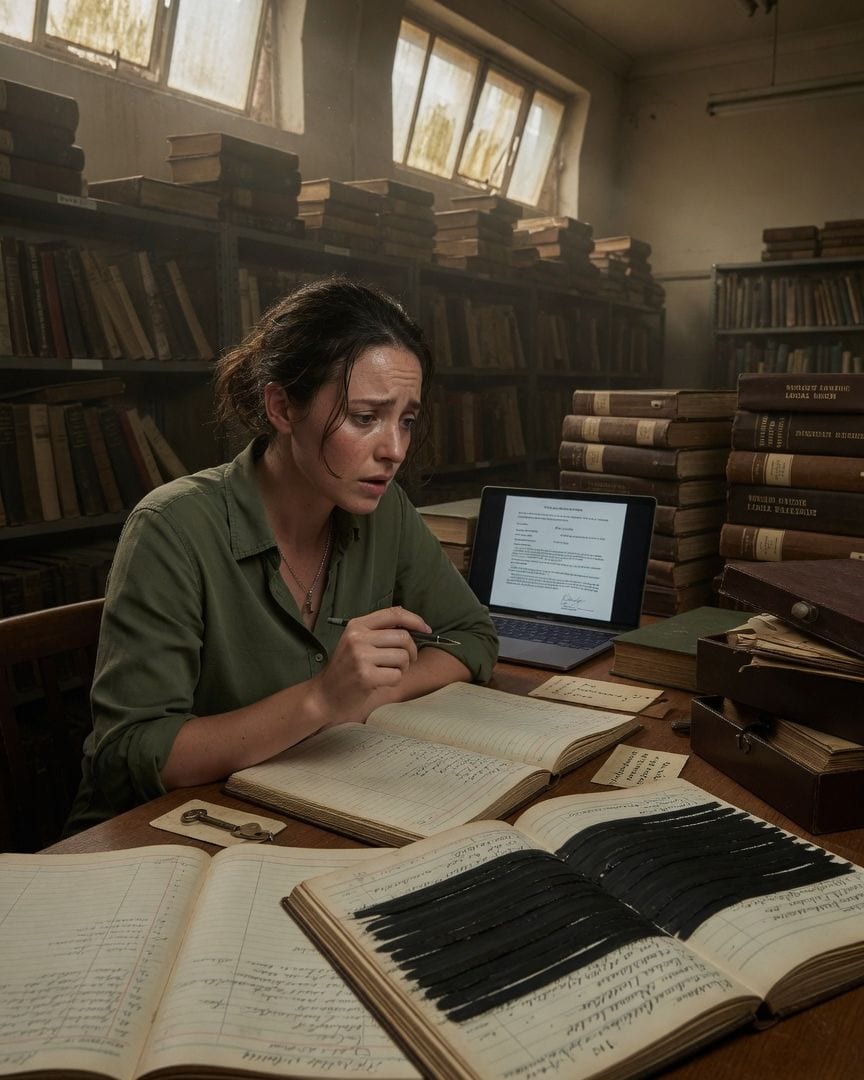
My grandmother’s name is on a blacked-out line from a 1954 drowning inquest, on our street, with a note: 'do not send a second notice.'
Transcribing old inquest registers in the quiet archive was a routine task, until I found a 1954 entry for an accidental drowning. The next of kin line was savagely blacked out, but the faint impression underneath named Patricia Kingsley, my grandmother. Her address was listed on Weir Lane, eleven years before she ever lived there, alongside a chilling note: 'do not send the notice a second time.'
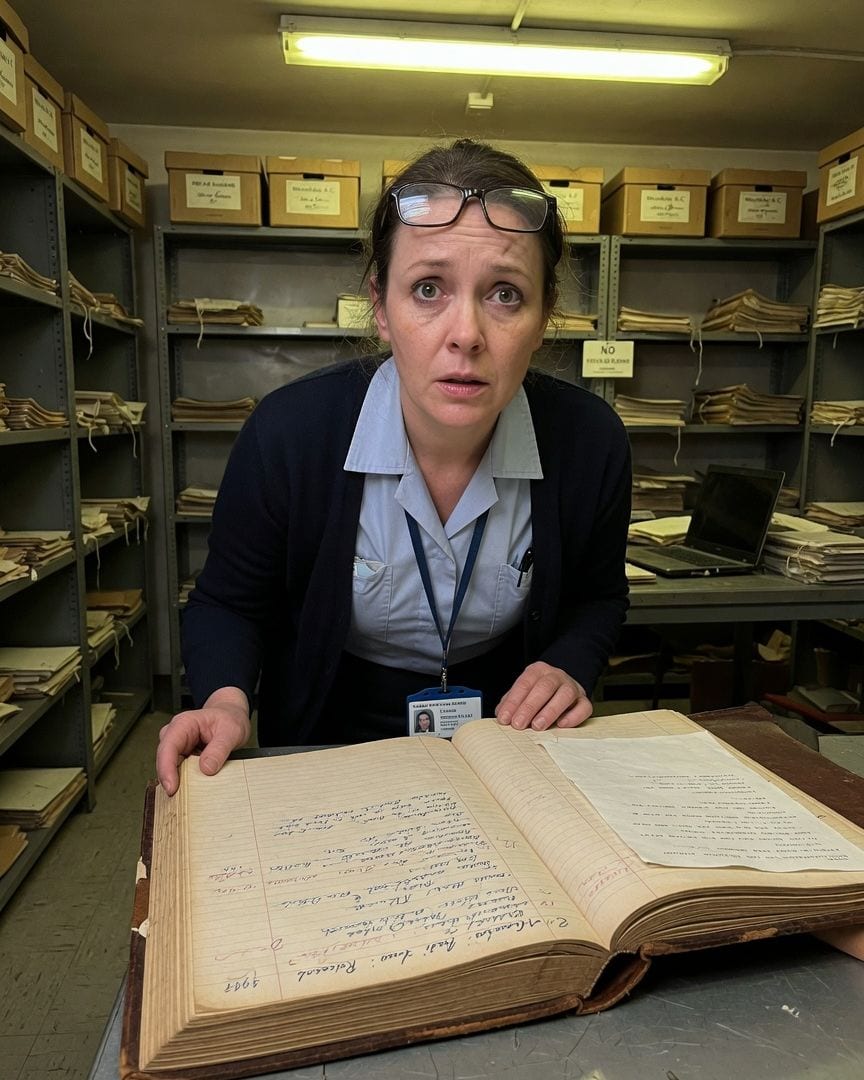
My ambulance trust's incident log shows callout 22-014 to 6 Cathcart Row at 2:40 AM. Every four years, the same call, same address. Always 'patient not found'.
My job involves tedious data entry for ambulance calls, but Incident 22-014 was different. It appeared every four years, always at 2:40 AM, always closed as 'patient not found.' Digging into the dusty physical archives, I found an entry from 1961 for the exact same incident, but its resolution read: 'Subject Secured. Relocated to "Holding".'
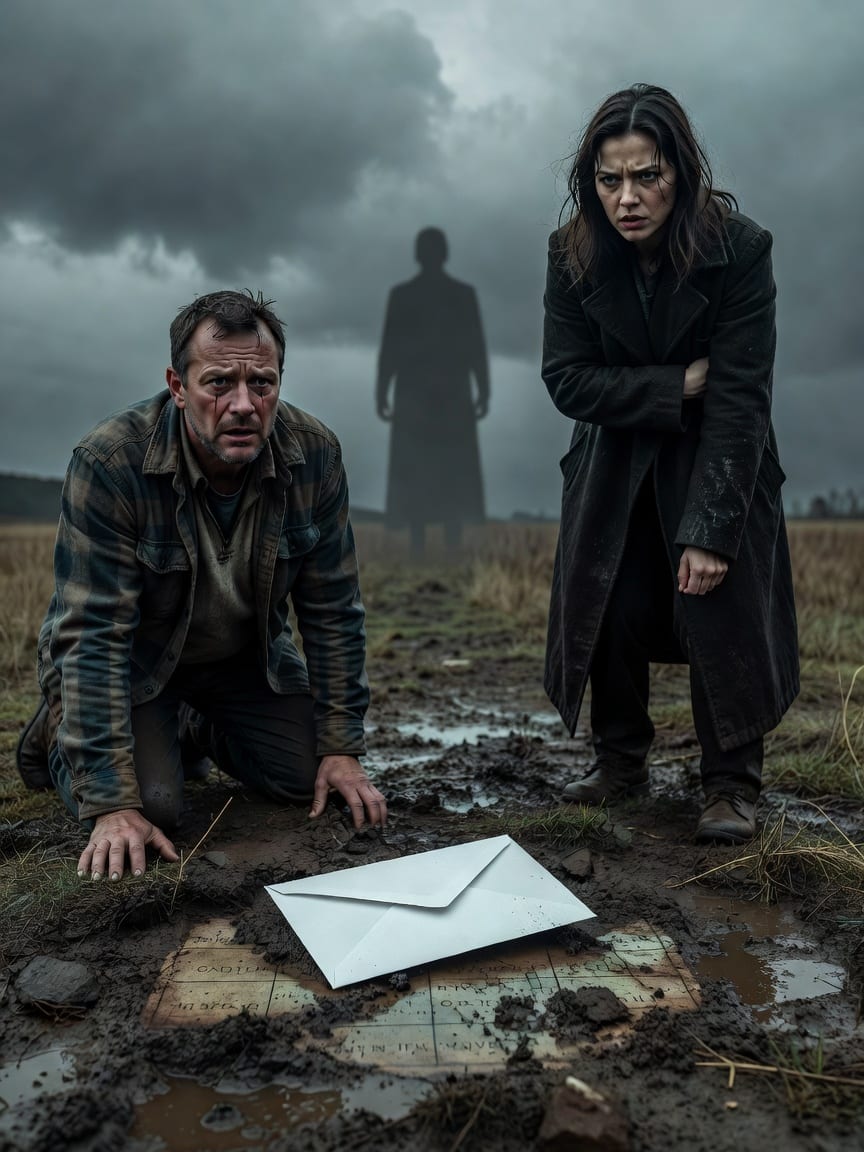
My mail carrier delivers polling cards to Nine Acre Field. It floods, they say. The tithe map shows nine family plots there.
As the new county archivist, I was used to quiet days poring over dusty records. But then I found an empty field, Nine Acre, was receiving current-year polling cards and utility notices for nine distinct addresses. When I investigated, I unearthed a perfectly crisp, current-year tax bill, buried in its soil, surprisingly warm against my fingers.
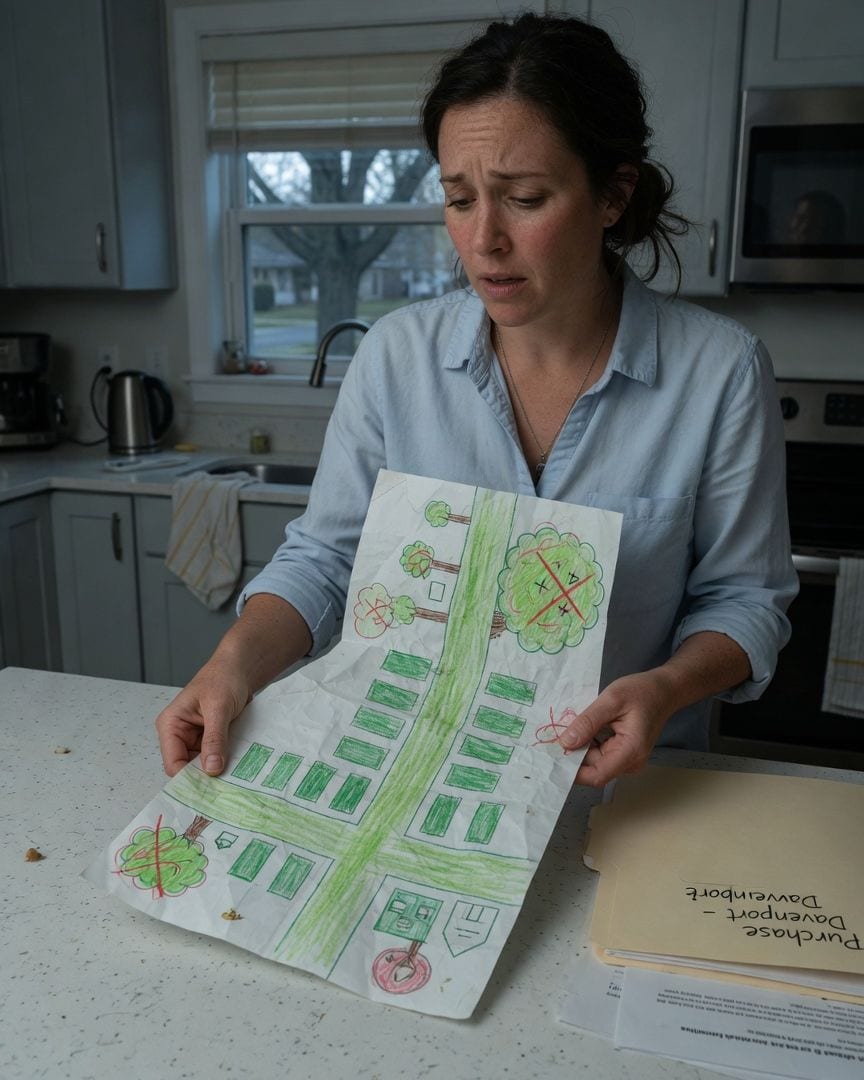
A hand-drawn map keeps arriving through our letterbox — every space on the lane marked green, except the one spot under the old lime tree, alone in red. The agent made us swear we'd never park there.
My new house came with a strange local quirk: weekly maps slipped through my letterbox, each one marking a specific parking spot with an angry red X. A legal addendum about the spot, and my neighbors' evasiveness, made me uneasy. But nothing prepared me for the ancient, identical map I found, which marked my own house with that terrifying red X.
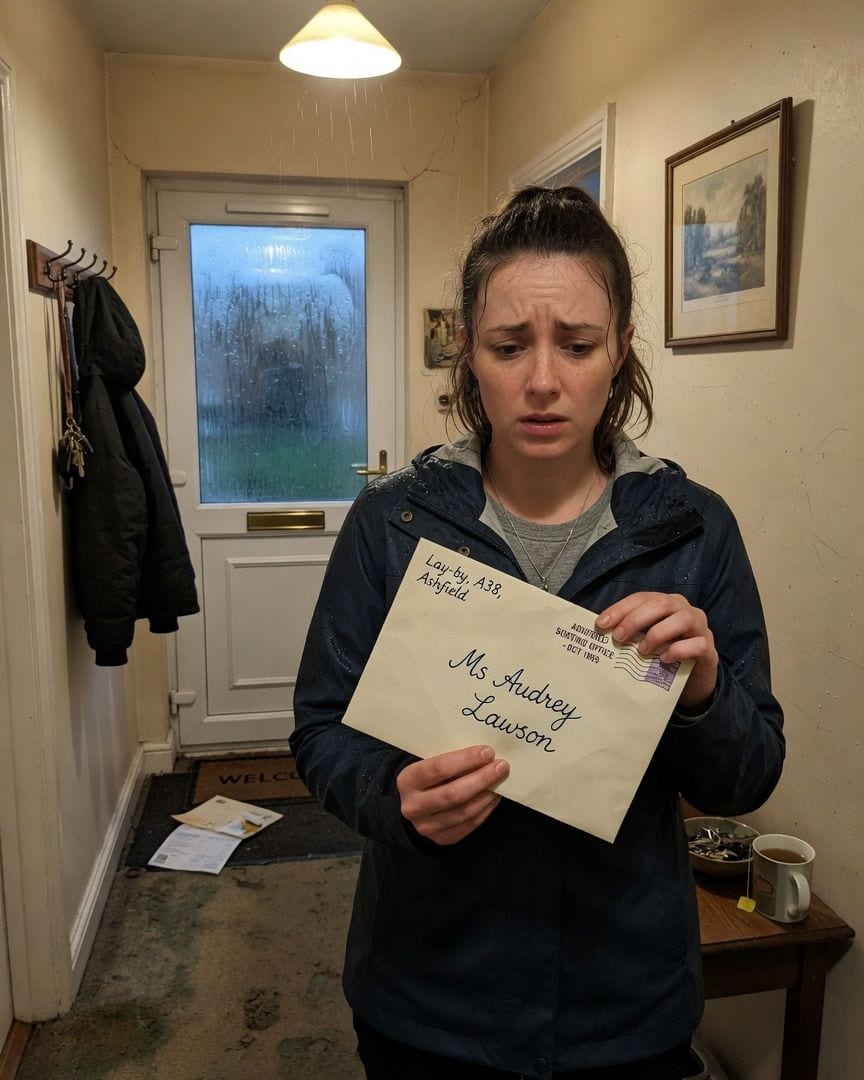
My condolence card arrived for a death that never happened, postmarked from a sorting office that closed before I was born.
My first envelope arrived on a Tuesday, nestled with bills. It bore my full name and a return address for an A38 lay-by that held only a crash barrier. But the postmark read ASHFIELD SORTING OFFICE – OCT 1985, an office decommissioned before I was even born.
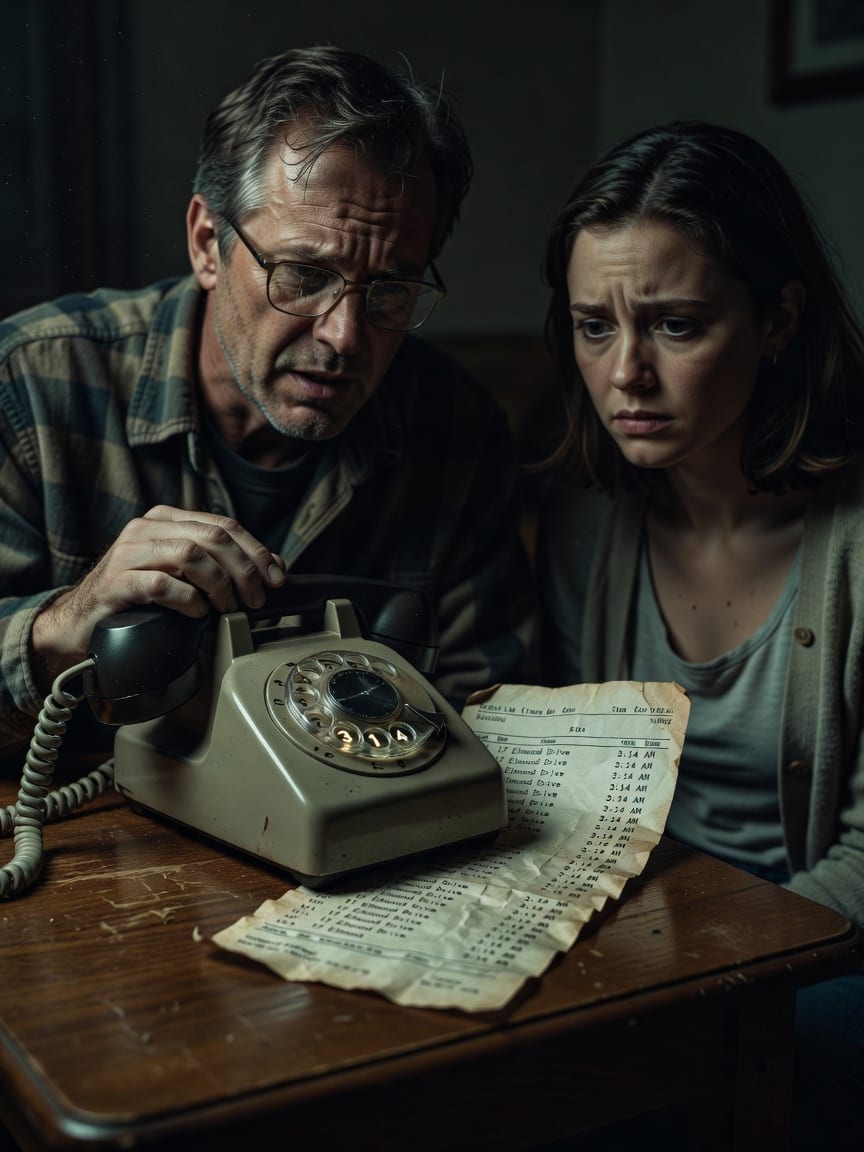
My phone bill itemised forty calls from my number to a house demolished in 1990. Each call at 3:14 AM, lasting eleven minutes. The bill arrived postmarked from a flattened building.
I expected the usual mobile bill, but my landline statement listed forty calls from my number to '17 Elmwood Drive.' That address was for a house torn down in 1990, a vacant lot I remembered from childhood. The phone company insisted the calls were legitimate, leaving me profoundly unsettled by the impossible charges.