My eye bank said my corneas were already donated. In 1989. The donor died that year, but his tissue is mine.
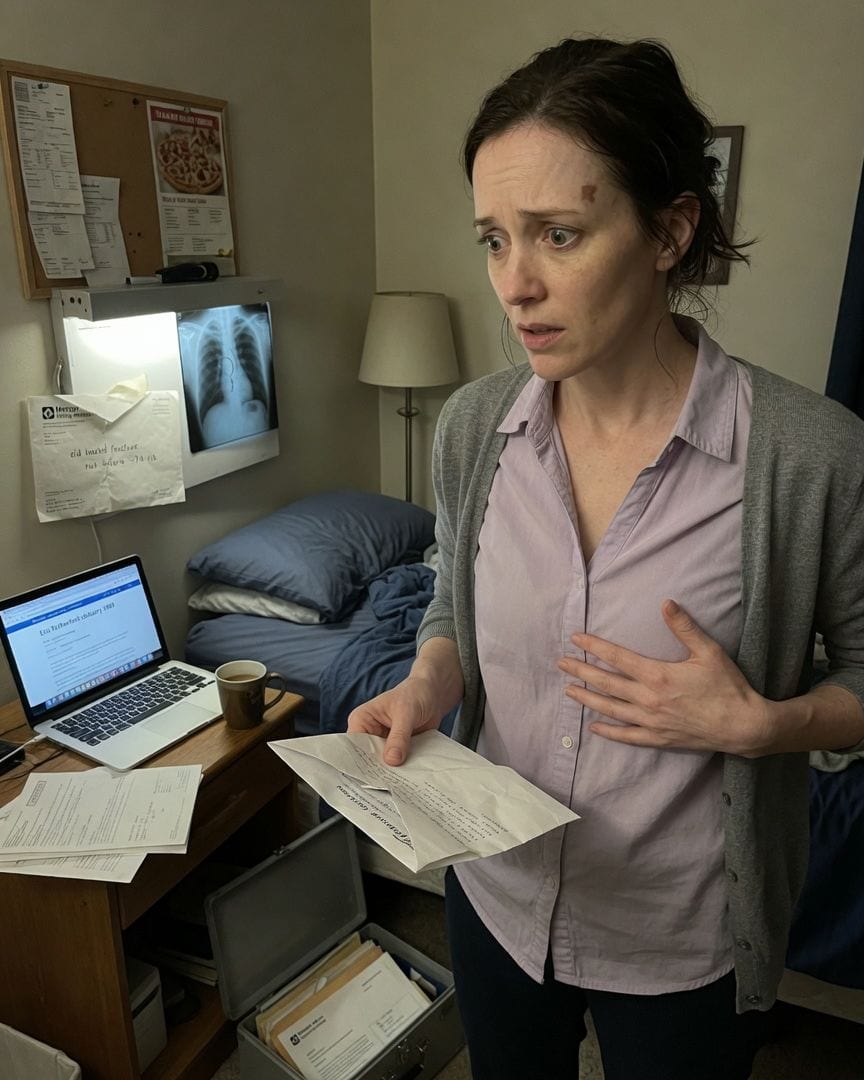
The letter arrived on a Tuesday, tucked between a utility bill and a flyer for discount pizza. I remember the exact weight of the envelope, the sterile off-white of the paper. Rachel Granger, data analyst, thirty-four years old, meticulous.
I’d signed up for future organ donation years ago, a quiet gesture of civic duty. This was a polite, but firm, decline for my cornea donation.
The reason, stated in dry clinical language, made me pause, then frown. My tissue sample was flagged as already in their system. Matched. To a pair of corneas recovered and transplanted in 1989.
I reread the date. 1989.
Then I walked into the bedroom, pulled my birth certificate from the fireproof box in the closet. Rachel Granger, born 1990. A simple, undeniable fact: I didn't exist in 1989. Not yet.
My first thought was a clerical error, a database glitch. I picked up the phone, dialed the eye bank’s number. Cynthia Ellison, the director, answered after a brief transfer. Her voice was calm, professionally empathetic.
"Ms. Granger, yes, I have your file open. I understand your confusion. It's rare, but sometimes... an administrative mix-up. We checked, thoroughly. The donor's tissue markers from 1989 are, according to our records, indistinguishable from yours.
The donor passed that year, and the tissue was immediately utilized."
She said "indistinguishable." Like a perfect fingerprint match. My world, usually so orderly, felt suddenly off-kilter. A wrong note struck in the quiet hum of my carefully constructed life.
The eye bank’s insistence gnawed at me. I tried to rationalize it on the drive to work, then over my lukewarm coffee. A common name. A lab mix-up with the slides.
But the phrase “indistinguishable tissue markers” kept echoing, a cold little bell ringing in the back of my mind. It was too precise for a simple error.
Determined to find a mundane explanation, something concrete and physical, I scheduled a full physical with Dr. Gerald Mercer, my physician for the last decade. I requested comprehensive scans – full body X-rays, an MRI, bloodwork.
I didn't mention the eye bank letter. I wanted an unbiased assessment, a clean bill of health that would prove everything was normal, that I was normal.
Days later, Dr. Mercer’s office called. He wanted to see me.
The fluorescent lights in his examination room always made the air feel thin. He gestured to a large monitor displaying an X-ray. My X-ray. “Rachel, this is curious.” He tapped a spot on my rib cage with his pen.
“You have a perfectly healed fracture on your seventh rib. It’s old, completely calcified. Textbook integration. No external scarring, no memory of a significant injury? A bad fall, maybe, as a child?”
I shook my head, bewildered. “No. I’ve never broken a bone in my life, Dr. Mercer. Not even a finger.” I ran my hand over the spot on my chest, a phantom ache blooming where there should be none.
He peered at the screen again, then at me. “Well, it’s definitively yours. Fully integrated. From the look of it, it happened when you were very young. Or perhaps even in utero, though that’s far less common without other complications.”
The dread deepened, a cold, spreading stain. First the impossible corneas from a man who died before I was born.
Now an impossible injury, a scar of bone, within my own body, something I had no memory of, no explanation for.
The rib fracture, coupled with the eye bank’s impossible records, spurred me to dig deeper into the 1989 donor. Eric Rutherford.
The eye bank, citing privacy laws, could only provide his name and the general date of his death, but that was enough.
A quick online search. Rutherford. 1989. Up popped a faded digital scan of an obituary from a small-town newspaper. It mentioned a promising young man, a car accident.
I scrolled, my heart a dull thump against my ribs, looking for any clue, any connection.
Then I saw it. A brief mention, almost a throwaway line, about a “childhood mishap leading to a distinctive rib injury.”
My breath hitched. The seventh rib. Just like Dr. Mercer had shown me.
I scrolled further, past the eulogy, to the grainy photograph accompanying the obituary. Eric Rutherford, smiling, his face frozen in time.
My gaze locked on the distinct, star-shaped birthmark just visible on his left temple, a mirror image of the one I’d traced on my own skin a thousand times.
The identical birthmark, the matching rib injury, the shared tissue markers – the coincidences were stacking up into something monstrous. I felt a cold certainty blooming in my gut: this was no coincidence at all.
This was something far more deliberate, far more unsettling.
I spent the next weeks glued to my laptop, researching Eric Rutherford’s life, tracing his education and affiliations. He had been a brilliant, if somewhat eccentric, graduate student at a small, specialized bio-engineering institute in the late 1980s.
The institute, nestled on the outskirts of a university campus, was known for its cutting-edge, often controversial, genetics research. It had a murky history, I soon discovered, eventually closing down amidst rumors of ethical controversies and financial irregularities.
The articles I found were sparse, hushed, almost deliberately vague.
I tried to access archived research papers or public records from the institute, but every avenue led to dead ends or heavily redacted documents.
The university library had an incomplete collection, former faculty members were either deceased, notoriously reclusive, or completely unreachable.
It was as if the program, and indeed the entire institute, had been deliberately erased, its existence a ghost in the academic record.
The deeper I dug, the less I found, and the lack of information felt like a suffocating wall, confirming my growing unease. The silence in those digital archives was loud, a warning in itself.
My persistent inquiries, though yielding little in the way of concrete answers, were not unnoticed.
After a particularly frustrating week of stonewalling from university archivists – polite, firm voices telling me records were classified, destroyed, or simply didn't exist – I found an anonymous email in my inbox.
The subject line simply read: 'Rutherford.'
My hand hovered over the trackpad, a sudden chill prickling the back of my neck. I clicked it open. The body contained a single, chilling sentence: 'Some cells are best left undisturbed.'
There was no sender, no traceable IP address. I checked the headers, ran a quick trace, but it vanished into the ether, a phantom message.
I sat there, staring at the screen, the fluorescent hum of my office suddenly sounding like a low, warning growl.
A few days later, the sensation of being watched intensified. I found a small, unmarked envelope tucked under my windshield wiper after leaving my yoga class.
Inside was a faded, photocopied page from an old science journal, its edges brittle with age. A paragraph was highlighted in yellow, barely legible.
It spoke of 'cellular mosaicism' and its potential for 'therapeutic applications,' hinting at genetic manipulation and inter-species tissue integration. No note, no explanation, just the unsettling implication that someone knew exactly what I was researching, what I was looking for.
And they wanted me to stop. The world outside my car felt thin, watchful.
I drove straight to my mother, Laura Granger’s, house. The anonymous email and the journal page were clutched in my hand, damp with sweat. Her small suburban home, usually a haven of quiet domesticity, felt suddenly suffocating.
I laid out all the evidence on her polished dining table: the eye bank letter, a printout of the X-ray of my rib, Eric Rutherford’s obituary, the circled birthmark, the mysterious institute, the anonymous warning.
Laura’s face, usually so composed, crumpled as she looked from the papers to me.
“Rachel, what is this?” she whispered, her voice trembling, an unfamiliar fragility in her tone.
I pressed her, calmly but relentlessly. “Mom, I need to know. What was this institute? What did you know about Eric Rutherford? About any of this?”
Laura initially tried to dismiss it, to wave it away as a strange coincidence, a misunderstanding. She talked about the internet exaggerating things, about how easy it was to draw wrong conclusions.
But my gaze, steady and insistent, broke through her defenses. I could see the wall she’d built, years ago, slowly fracturing.
Tears welled in her eyes, carving clean paths down her cheeks. “After your father and I… after so many years trying to conceive,” she began, her voice barely audible, thick with unshed emotion. “We were desperate.
We heard about a ‘special program,’ very cutting-edge. Advanced tissue therapy, they called it. They promised it would help me carry a child. A donor… anonymous, they said. His contribution was purely cellular, nothing more.
A way to help me, to help us, finally have you.”
I stared at her, the pieces clicking into a horrifying, incomplete picture. The hum beneath my skin turned into a low thrumming. “They lied, didn’t they?” I said, my voice flat, devoid of emotion. “It wasn’t just ‘cellular contribution.’
It was him. It was Eric Rutherford. And I’m not just your daughter, am I?” The air in the room felt heavy, charged with unspoken, impossible truths.
Laura’s partial confession, though incomplete, confirmed my deepest fears. My mother had unknowingly participated in something far more sinister than fertility treatment.
I spent weeks tracking down any remaining leads to the defunct institute, chasing shadows through archives and obscure online forums.
An old, cached message board dedicated to forgotten scientific scandals mentioned a former janitor who had salvaged some ‘junk’ from the institute’s closure years ago, before the demolition crews came in.
After a series of desperate calls, I found him. An elderly man named Arthur, living in a cluttered bungalow filled with forgotten treasures.
He’d kept a dusty box of old lab equipment and papers, “just in case anyone ever needed ’em.”
Among the discarded items – rusty clamps, cracked beakers, desiccated specimens – Rachel found it. A brittle, leather-bound logbook, its pages yellowed with age, its spine cracked.
The institute’s emblem was barely visible on the cover, a faded, stylized double helix.
My fingers trembled as I opened the book, the dry paper rustling like ancient leaves. I flipped through pages filled with dense, arcane handwriting, scientific jargon I barely understood, until I reached a specific entry, dated clearly at the top.
A faded polaroid of Eric Rutherford was taped to the page. He looked younger, unsmiling, a faint, star-shaped birthmark visible on his temple. Below it, a handwritten entry, precise and terrifying: 'Subject R-1, Genetic Profile Match, 1989.'
My own birth year was 1990.
I returned to my mother’s house, the logbook open to the incriminating page. Laura saw the faded photograph, saw the date, and the last of her defenses crumbled.
The house felt cold, even though the sun was streaming through the window. The silence in the room was absolute, but I could hear the echo of a forgotten scream.
She recounted the full, horrifying truth, her voice a thin, reedy whisper. The “special program” had been a radical, ethically dubious experiment, funded by private investors eager for breakthroughs regardless of the cost.
Eric Rutherford, a brilliant but troubled geneticist, had died unexpectedly in a car accident. His family, honoring his wishes for scientific donation, had agreed to donate his body to research.
The institute, facing closure and desperate for one last, groundbreaking discovery, saw an opportunity.
They hadn't just 'harvested' his corneas; they had extracted viable genetic material from his entire body.
Their audacious, monstrous goal: to create a 'cellular mosaic,' a new human life that would integrate his unique genetic markers, effectively making him a co-creator of the new organism.
Laura, desperate for a child after years of heartbreak, had been one of the first successful subjects.
The 'death' was a convenient cover, allowing them to claim his tissue was merely 'donated' for standard purposes, concealing the true scope of the experiment.
I wasn't just related to Eric Rutherford; I was, in a profound and terrifying sense, a living continuation of him, his cellular blueprint woven into my very being.
Every clue, every impossible coincidence – the corneas, the rib fracture, the birthmark, the whispered warnings – now clicked into place, forming a coherent, monstrous pattern. It wasn't random, it wasn't a mistake. It was design.
The full truth detonated within me, a silent, internal explosion that shattered everything I thought I knew about myself. I tried to find any other 'Subjects,' any surviving scientists from the program, but the trail was cold, completely.
The institute had been thoroughly erased, its records scattered or destroyed, its personnel vanished into the academic ether.
There was no one to hold accountable, no legal recourse for a crime that felt too abstract, too profound to fit any existing definition. How do you sue for your own existence?
The truth wasn't external; it was inside me, a constant, silent hum beneath my skin. I underwent extensive genetic testing, the cold sterile slides under the microscope confirming the mosaicism, the impossible blend of my mother's DNA and Eric's.
My body was a testament to a scientific hubris I could not comprehend, a living legacy I had never asked for.
I couldn't escape it; it was me. There was no fight to win, no monster to defeat, only the dawning, crushing realization that the answer was the problem, and it was insoluble.
I was a walking paradox, a body that contained a ghost, and there was nothing I could do to change it.
I moved away, seeking anonymity in a new city. I chose a place where no one knew my past, a quiet, unremarkable apartment building where I could blend in.
I tried to build a new life, to forge a new identity, but the knowledge was a constant, quiet hum beneath my skin, a secret melody only I could hear.
I found myself scrutinizing my own reflection, searching for Eric's features, his echoes in my own face. My jawline, my nose, the way my eyes creased at the corners when I smiled.
For a time, I avoided mirrors altogether, unable to reconcile the self I knew with the impossible history my cells carried. My mother, Laura, remained devastated, a shadow of her former self, burdened by the unwitting betrayal.
Our phone calls grew shorter, less frequent, until they faded into silence.
Years passed. I sat alone in my quiet apartment, a cup of cooling tea on the table beside me. The evening light filtered through the blinds, painting stripes across the wooden floor.
I traced the small, star-shaped birthmark on my left temple with a slow finger. It was a physical testament, a map to a life she hadn't lived, but also, impossibly, had.
The silence in the room was absolute, but she knew it carried the weight of a truth that could never be undone.
If this one got to you
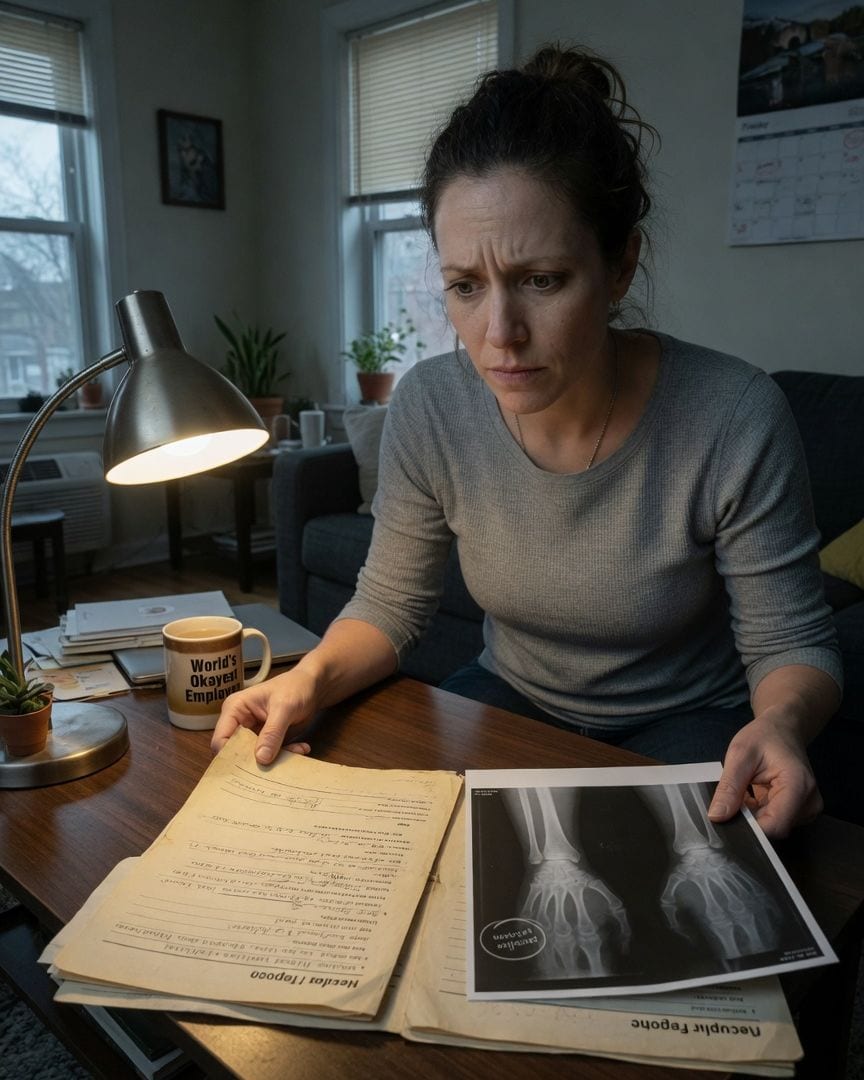
My own X-ray shows a rare wrist bone fusion. It's identical to one in a dead man's 1972 autopsy.
My ordinary work-from-home routine was shattered by a call from a pathology department. They were auditing old tissue samples and found my exact DNA profile matched a man's autopsy from 1972. The chief pathologist calmly stated the impossible: both samples, mine and his, came from one body.
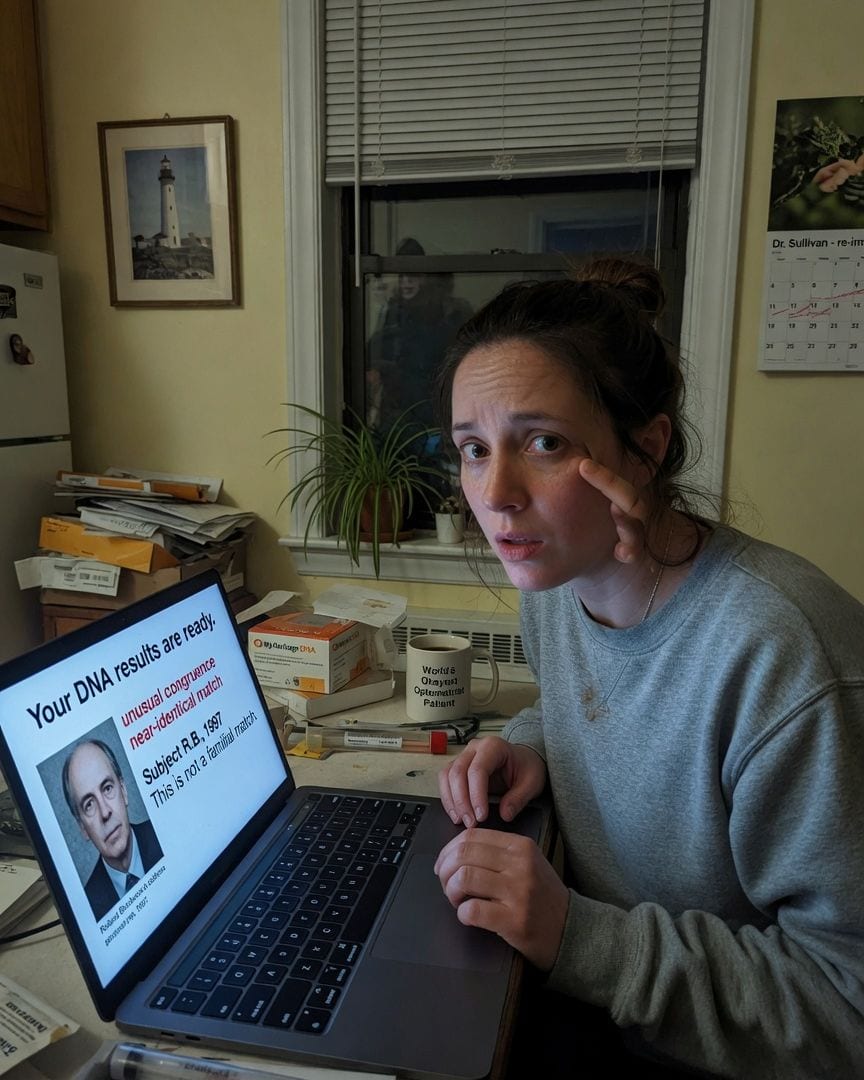
My retinal scan matched a dead man's eyes. His chart said 'deceased' from 1997. The pattern in my eye is his.
An ordinary eye exam turned unsettling when my optometrist paused, staring at the screen. He whispered that the machine flagged me as a returning patient, matching my unique eye pattern to a man deceased in 1997.
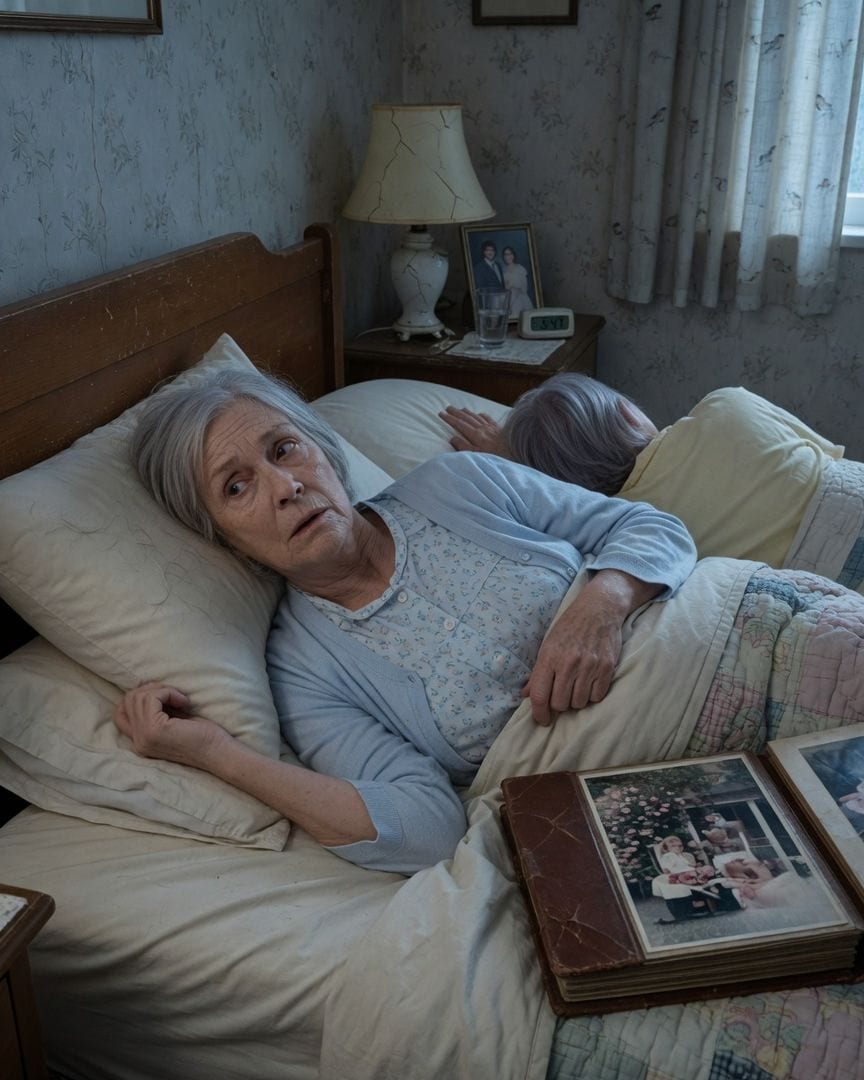
My twin sister Ruth sleeps on the right now, facing the wall. For forty-one years, she always took the left side. She insists I'm misremembering.
After three days missing, my partner Ruth finally came home. But the morning after, I woke to find her sleeping on the wrong side of our bed. She claimed she'd always slept there, and my memory was wrong, despite forty-one years together.
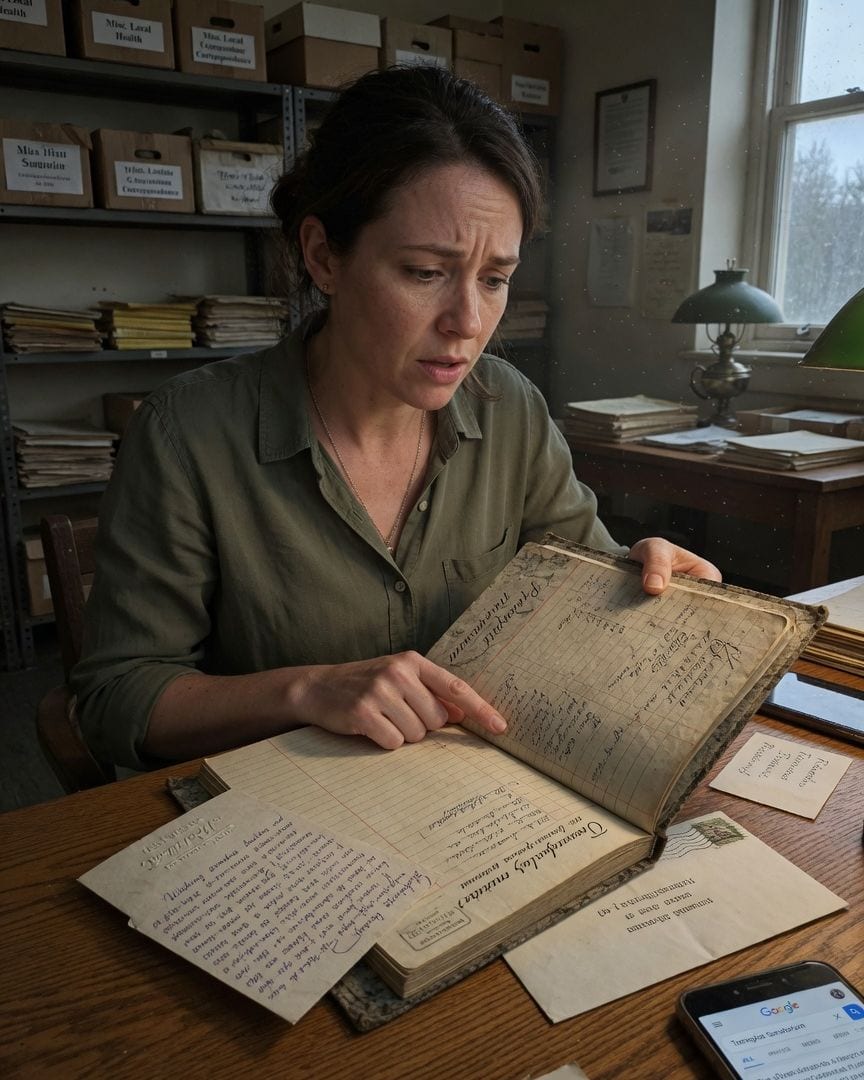
My get-well card wished me recovery from an operation I never had, postmarked from a hospital that burned down in 1963.
I received a get-well card wishing me recovery from an operation I never had. The envelope bore a fresh postmark from Treneglos Sanatorium, a TB hospital that burned down and ceased to exist in 1963. Now, a patient register from that long-gone sanatorium lists my name, dated 1959.
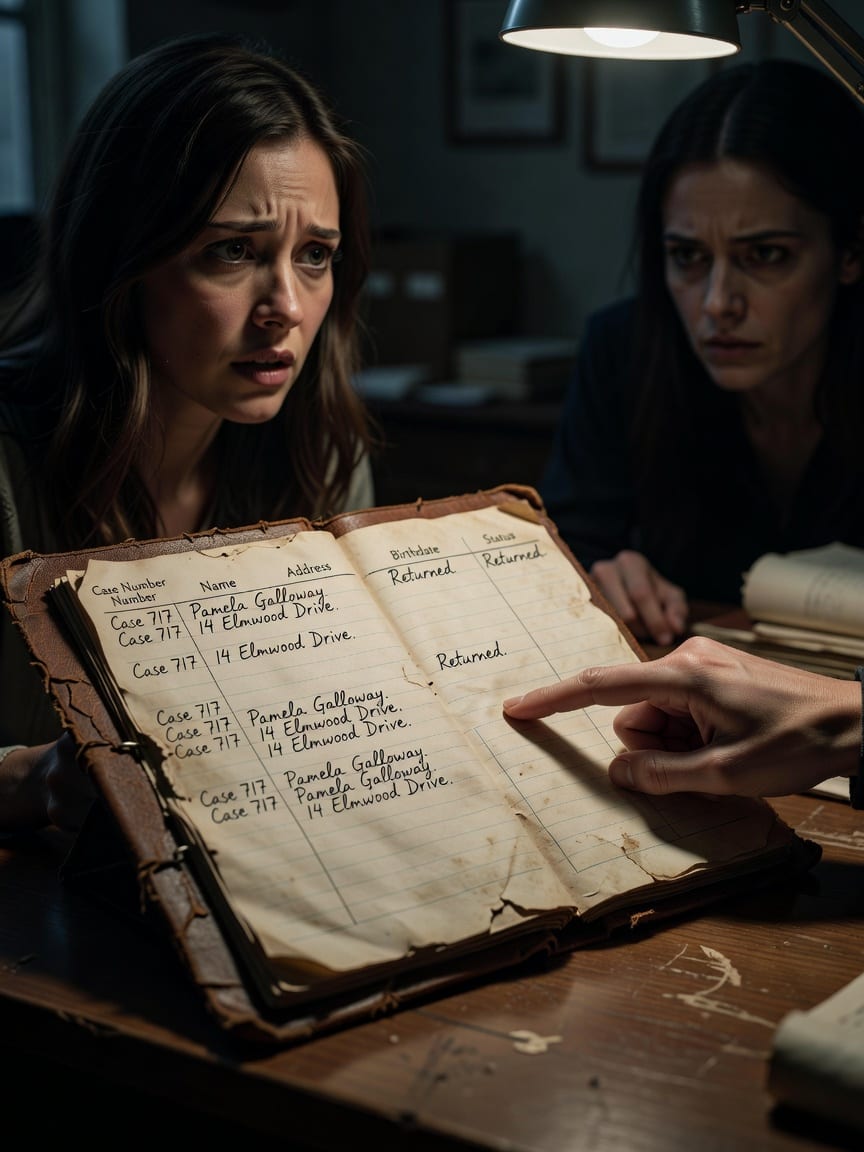
My hospital file has a blacked-out line from 1988. It names my street address, decades before I lived here. Then: 'returned'.
I finally got my medical file, hoping to clear up a ridiculous bill. Inside, I found an entry from 1988: my current home address, scrawled on a partial intake form and marked 'returned.' I was six then, living fifty miles away.
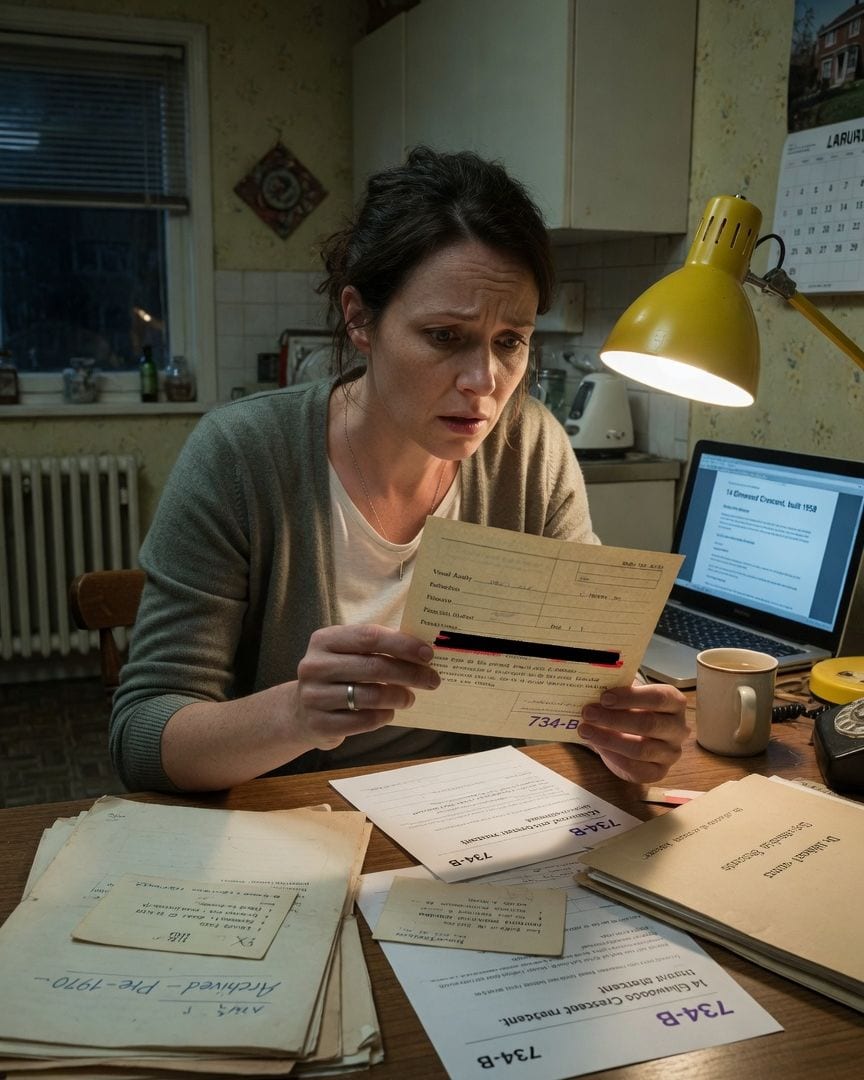
An old eye test card had my patient ID, 734-B, dated 1966. I found another, from 1948, for my house.
Transferring my old eye records should have been routine, but a strange, redacted card from 1966 raised a cold knot of dread. It mentioned my surname and street, along with a chilling instruction: 'tell the patient nothing.' Then I found my unique patient ID, assigned to me, on records dated 1948.