A federal clerk found his dead mother’s photo in a 1983 Cold War file, listed as a witness.
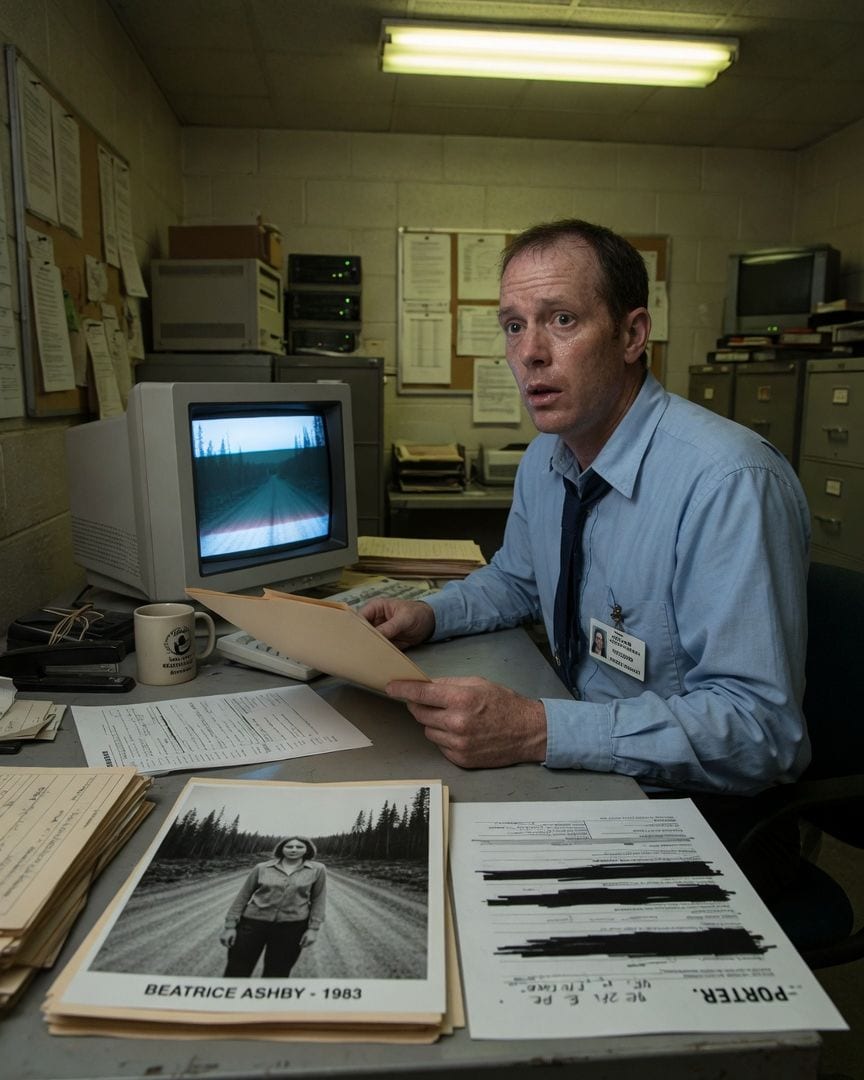
Devon Ashby sat at his desk in the federal records office in Missoula, Montana, the quiet hum of servers and fluorescent lights a constant companion.
For years, he’d dismissed the repeated requests for the 1983 file, assuming it was a clerical anomaly, a ghost in the system. Marcus Porter, the requester, had sent in the same form 32 times.
Today, Devon had decided to just let it go, to pull the file and send it.
The file itself was thin, nondescript. Inside, nestled among a few boilerplate pages, was a single, stark black-and-white photograph. It showed a woman, standing on a desolate logging road, looking directly into the lens.
Her face was calm, her gaze direct, familiar. Unremarkable, until Devon read the caption stamped beneath: "BEATRICE ASHBY - 1983."
A cold, sickening lurch twisted in Devon’s gut. Beatrice Ashby was his mother. She had died in 1981. He remembered the funeral, the biting wind on the hill, the quiet scrape of earth against her coffin in the Montana soil.
He remembered standing beside his father, a small hand in a large one, the smell of damp pine needles and grief. No one in the world had ever connected his mother’s name to his in any official capacity.
Yet, here she was, in an official government file, two years after her burial, her eyes wide and unmistakably hers.
Devon tried to rationalize it. A misfile, perhaps. A common name, though "Beatrice Ashby" wasn’t exactly ubiquitous in rural Montana. Or a photograph taken before her death, misdated by some sloppy clerk.
But the face, even in grainy black-and-white, was undeniable. He knew his mother’s smile, the subtle curve of her lips. This was her.
He pulled up the file’s control number on his console, tracing it through the labyrinthine federal database. The system whirred, indicators blinking, but the number didn’t fully resolve.
Instead, it led to a defunct regional office that had been officially decommissioned in 1980—a year before his mother’s death, and three years before the photograph’s impossible date. The contradiction gnawed at him, a splinter under the skin.
He stared at the screen, then back at the photo.
He accessed the digital archive, locating a microfiche scan of the same file, cross-referenced by the control number. The digital cover sheet listed fewer pages than the physical copy he held in his hand.
As he scrolled through the microfiche, zooming in on each page, he noticed something else. The redactions, thick black bars meant to obscure sensitive information, fell in entirely different places.
On one scanned page, a block of text previously blacked out in the paper file was now clearly visible. It was a brief, official report about "unusual geological activity" near a logging camp, dated late 1983.
And within that report, Beatrice Ashby’s name was listed, not as a casualty, but as a "witness." The date was confirmed. The wrongness solidified, hardening into something far beyond a clerical error. Someone, somewhere, had deliberately created conflicting records.
Devon printed the microfiche version, the laser printer spitting out crisp copies, and laid them out side-by-side with the worn paper file.
His breath hitched when he realized the microfiche contained an additional page, a handwritten addendum tucked into the very end, not machine-stamped like the others.
It listed a series of geographic coordinates, a string of numbers that pinpointed a specific, remote location deep within the Montana logging territory, eerily close to where his mother’s photograph had been taken.
Below the coordinates, a single, thick black line of redaction covered a name. The black ink, though, wasn't fully opaque.
Light seemed to pass through it at an odd angle, revealing the faint, ghosted letters of a surname just visible beneath: 'PORTER.' The name of the relentless requester.
The sight of Porter's name, subtly etched beneath the redaction, connecting the impossible coordinates to his mother's impossible photograph, sent a chill straight down Devon's spine. This was no longer just a bureaucratic mystery. He couldn't let it go.
Using his federal access, he cross-referenced Marcus Porter, not merely as a persistent FOIA requester, but across every declassified file he could reach. He uncovered a disturbing pattern.
Porter had submitted similar requests for other obscure files, all related to unexplained disappearances or anomalous incidents in rural Montana, each clustered around the early 1980s. Every single file, like his mother's, contained subtle inconsistencies, conflicting redactions, or impossible timelines.
Devon also found a brief, heavily redacted service record for a "Marcus Porter" from a defunct government agency, one he’d never heard of, mentioning "field operations" in the Missoula area around 1983.
The pieces began to form a terrifying picture, like fragments of a broken mirror reflecting a distorted, but consistent, image.
Driven by a desperate, growing need for answers, Devon decided to confront Porter directly.
He logged out of the federal system, locked his office, and drove his beat-up sedan out of Missoula, heading deep into the logging territory, towards the remote address listed on Porter’s FOIA request form.
The road narrowed, asphalt giving way to gravel, then just packed earth, winding through towering pines that seemed to press in on either side.
He arrived at Marcus Porter's cabin, a weathered, isolated structure nestled among the trees. Smoke curled lazily from its stone chimney, the only sign of life for miles.
Porter, a gaunt man with eyes that seemed to hold decades of quiet observation, answered the door. He didn't appear surprised to see Devon, his expression unreadable, almost resigned.
"Mr. Ashby," Porter said, his voice calm, gravelly, "I thought you might come." He gestured Devon inside. The air was thick with the scent of woodsmoke and old paper.
Porter sat across from him at a rough-hewn table, a cup of lukewarm coffee clutched in his hands. "The files," Porter began, "they are not about what was lost, but what was kept."
He spoke of "the system" as if it were a living entity, an unseen current shaping the landscape. Devon's mother, he implied, wasn't an anomaly, but one of many "filed" individuals.
As Porter spoke, Devon noticed a small, faded tattoo on the man's wrist. It was an unfamiliar, intricate symbol, subtly drawn, almost absorbed into the weathered skin.
The design seemed to match a faint, almost invisible watermark he’d glimpsed on one of the redacted pages in his mother’s file, a detail he hadn't fully registered until now.
Porter’s gaze, unsettlingly knowing, met Devon's, holding it for a beat too long. "You're asking the right questions, Mr. Ashby," he said, a subtle warning in his tone, "but they don't like questions."
As Devon left, the sun dipping below the mountains, painting the sky in violent streaks of orange and purple, he spotted a dark, unmarked sedan parked a few hundred yards down the winding logging road, its engine off, facing his direction.
He felt a prickle of cold dread, the sensation of being observed.
Unnerved, Devon returned to his office, the dark sedan lingering in his mind. He contacted Rachel Hayes, a retired archivist he trusted, known for her sharp memory and discretion.
He laid out the contradictory files, the differing redactions, Porter’s cryptic warning, and the matching symbol he’d seen on Porter's wrist and in the file.
Rachel, a woman who had seen countless government secrets cross her desk, initially tried to dismiss it as elaborate clerical errors, perhaps a system glitch from a bygone era.
But as Devon meticulously presented the impossible dates, the defunct office connections, and the consistent pattern across multiple 'disappearance' files, Rachel’s calm demeanor slowly cracked.
Her eyes, usually so steady behind her glasses, widened when he described the symbol, tracing it in the air. "I remember whispers," she said, her voice dropping to a near whisper itself.
"From my early career, back in the late seventies, early eighties." She spoke of a highly classified program, 'Project Chronos.' Officially, it was tasked with 'temporal anomaly tracking.'
Unofficially, rumors claimed it managed 'classification incidents' where entire files were duplicated, then selectively redacted to create conflicting narratives for different levels of access.
She confirmed the symbol Devon had seen was the unofficial emblem of Chronos. "They weren't just tracking anomalies, Devon," she said, her voice hushed, the words heavy with forgotten weight. "They were creating them. Or at least... managing them.
And people didn't just disappear. They were... filed." The full weight of it landed on Devon, a cold, hard truth settling in his chest. His mother wasn't a random tragedy, a victim of circumstance.
She was an active subject of this terrifying system, a living part of its unseen machinations. The photograph, the impossible date, the redacted reports, the coordinates—they all clicked into place, forming a coherent, horrifying truth.
Devon, his mind reeling, frantically searched the digital archives again, this time for 'Project Chronos' using Rachel’s fragmented information.
The main directory was scrubbed clean, but tucked away, buried deep within a forgotten corner of the federal server, he found a single, heavily encrypted sub-directory.
It was simply marked 'ASHBY, B.' His heart hammered against his ribs, a frantic drumbeat against the silence of the office. He managed to bypass the encryption, his fingers flying across the keyboard, bypassing the firewalls and lock-outs.
The sub-directory opened to reveal a series of internal memos detailing 'Beatrice Ashby’s anomalous status' and 'ongoing observation.' He scrolled faster, his eyes scanning for any explanation, any reprieve. Then, he saw it: a final, sealed addendum.
He clicked it open, a sense of profound dread tightening his stomach. The title read 'Designation of Next of Kin - Prospective Contact.' It listed his mother, Beatrice Ashby, as the primary subject.
And beneath it, a secondary entry, stark and undeniable: 'ASHBY, DEVON. Born 1985.' His own name. His own birthdate. Listed in a file about his mother, who died in 1981, four years before he was born.
He stared at the computer screen, the words 'ASHBY, DEVON. Born 1985.' starkly visible. The hum of the server room suddenly seemed louder, colder, as the full, horrifying implication of his own predetermined place in the 'filing' system sank in.
The realization detonated in Devon's mind, shattering his understanding of his own life.
He wasn't just a son who had lost his mother; he was an entry, a contingency plan, a 'prospective contact' in a system that transcended life and death.
His mother's public death in 1981, the funeral, the headstone—all of it a carefully constructed narrative, a stage play for the uninitiated. The files, with their impossible dates and ongoing 'observation' entries, revealed her true 'status' within Project Chronos.
And then he, Devon, appeared in 1985, an 'Ashby' born into the wake of an 'anomaly.'
He flashed back to Marcus Porter's resigned demeanor, his knowing gaze.
Porter wasn't just a persistent requester; he was a 'survivor,' or perhaps a 'caretaker,' monitoring the system, perhaps even trying to guide Devon, who was unknowingly walking into his own pre-ordained role.
The pattern across decades and classifications became horrifyingly clear: certain individuals were 'filed' out of public life, their conventional existence ending, but their 'presence' or 'status' was continued or repurposed within the system.
New 'contacts' or 'descendants' were brought into the fold, ensuring the continuity of the 'filing' process. His own birth, his very existence, was a consequence of this system, a mechanism for its perpetuation.
He was a son not just of his mother, but of the file.
Devon knew he could not stay, could not become another marked entry.
He worked with frantic urgency, his hands moving almost independently of his conscious thought, printing every page of the 'ASHBY, B.' sub-directory, including the chilling 'Prospective Contact' addendum, making multiple copies.
As the printer whirred, the fluorescent lights in the office flickered erratically, casting long, dancing shadows. A low, resonant hum emanated from the server room, growing steadily louder, a guttural purr from deep within the building.
He heard faint, deliberate footsteps in the hall outside his locked office door. They were slow, measured, approaching.
He stuffed the printouts into a messenger bag, his hands shaking but his resolve hardened. He grabbed a USB drive, copied everything from the 'ASHBY, B.' folder onto it, then wiped his computer’s local cache, severing his digital ties.
The footsteps paused just outside his door. He froze, listening. A faint metallic click. He knew they were coming in. He moved silently towards the back exit, a rarely used fire escape, pushing the panic down, down.
As he reached it, he heard the main office door creak open, the sound unnaturally loud in the sudden silence. He slipped out into the cold Montana night, the files heavy in his bag, a tangible burden of impossible truth.
He saw the dark, unmarked sedan from Porter's house parked down the street, its headlights off, a patient, predatory silhouette against the distant city glow. He didn't look back.
He ran, melting into the shadows of the alleyways, his old life, his identity, his peace, all irrevocably lost. He was now a fugitive, carrying proof no one would ever believe, forever marked by the file he had opened.
Devon drove aimlessly for days, heading east, eventually abandoning his car in a crowded bus station parking lot in North Dakota and taking a bus across state lines, shedding his old identity like a skin.
He sent encrypted copies of the files to Rachel Hayes, but received no reply.
He tried to contact Marcus Porter, but the phone number was disconnected; a quick online search showed the cabin on the logging road was now abandoned, listed for sale.
Devon knew he could never return to his old life, his old job.
He lived off the grid, taking odd jobs, always paying in cash, constantly looking over his shoulder, the weight of the impossible truth a permanent fixture in his mind.
He kept the files hidden, tucked away in a waterproof container, never showing them to anyone, understanding that such proof would only brand him insane.
Devon settled into a new, anonymous existence under a new name, working temporary labor, moving from town to town. He slept lightly, every rustle of leaves, every distant siren, a potential harbinger.
He occasionally checked the public FOIA database, noting that the 1983 file for Beatrice Ashby had been officially 'reclassified and withdrawn.'
He saw news reports of unexplained disappearances in remote areas, always accompanied by a cold, familiar dread that gripped his chest. He knew the machine was still signing files, still folding people into its silent, enduring logic.
He was free, but the cost was everything. He carried the proof, a truth too terrifying to share, too real to forget.
Weeks later, a new tenant arrived at the small, weathered cabin on the logging road. He found a meticulously carved wooden bird on the mantelpiece, a local Montana species, its details exquisite. He picked it up, admiring the craftsmanship.
On its base, barely visible, was a faint, familiar symbol. He smiled, a small, knowing smile. He knew Devon had gotten the message. The file was still open.
If this one got to you
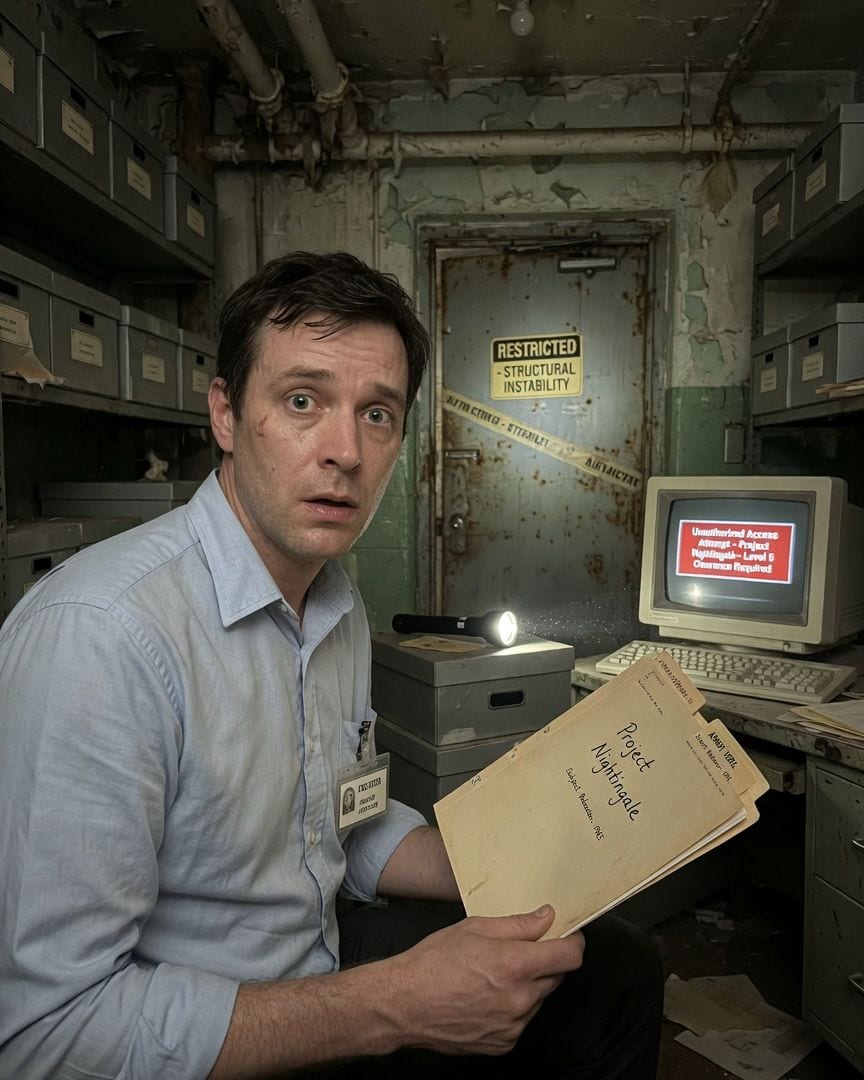
A FOIA officer found his dead mother's photo in a government Cold War file, dated 1983 — two years after her burial. Then he found her new file: 'Relocation - 1985.'
Devon Ashby, a routine FOIA officer, clicked 'release' on a 1983 file he'd seen dozens of times. Inside was a grainy photo of a woman, calmly staring from a logging road. His breath caught: it was his mother, Vera Ashby, dated two years after her 1981 burial. The file jacket, marked "Project Nightingale," led him to a forgotten, sealed sub-basement filled with unmarked metal boxes. There, he found a file for "ASHBY, VERA. Subject: Relocation - 1985," four years after her death. What hidden mechanism was meant to provoke him?
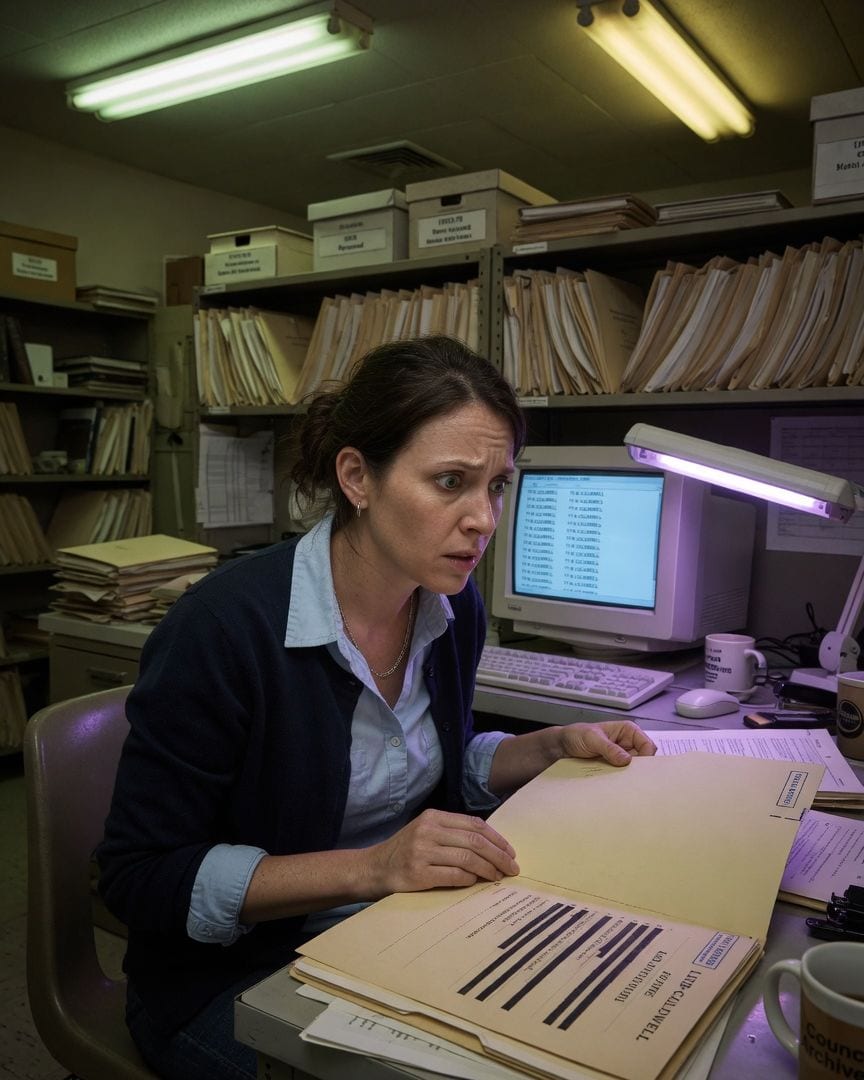
My employer's security file holds a vetting report on me dated nine years before I ever applied. It has my full name and my parents' address — with only one line, the source who referred me, blacked out.
Working a routine data audit, I pull my own security file. The issue date is nine years before I even applied for the job. Then, hidden within an old archive file, I find my current address etched under a blacked-out line.
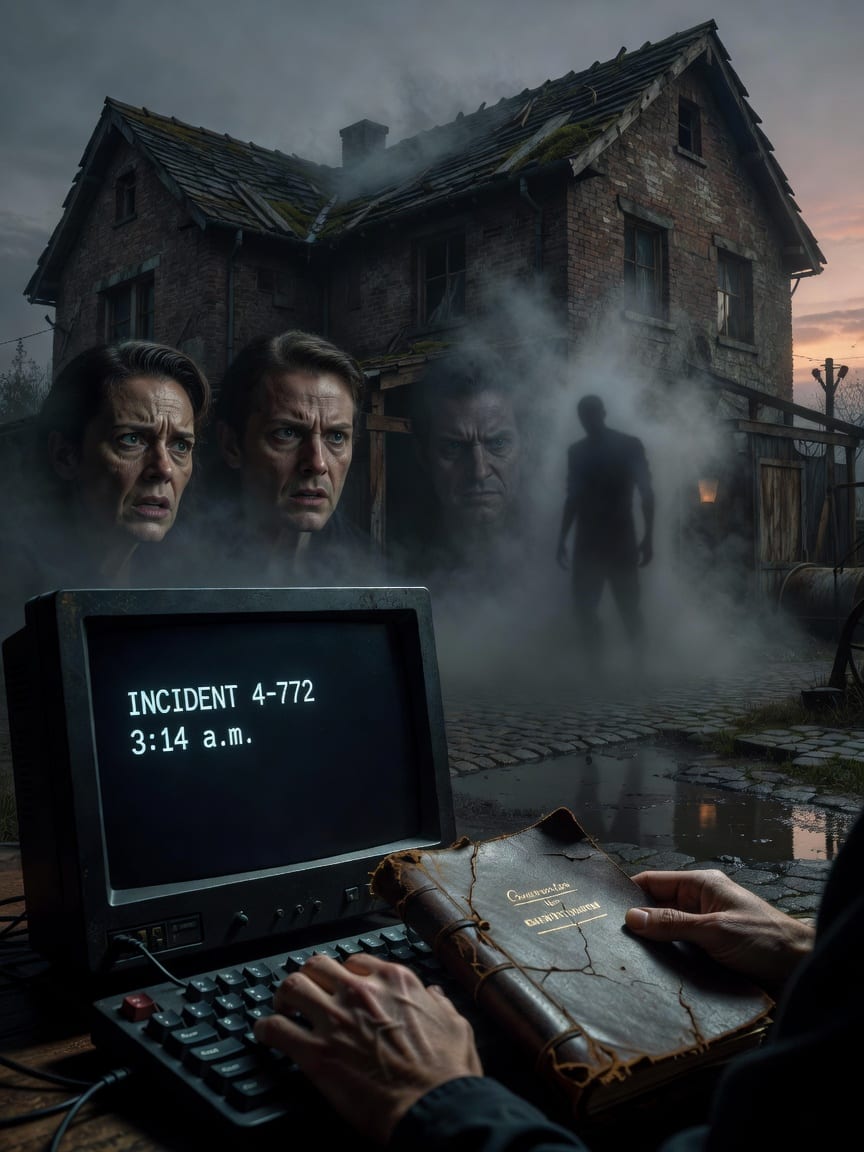
My screen showed Incident 4-772: a fire at the old rope works, 3:14 a.m. It was logged again for 1980. Then 1967. And 1993. Same incident, same time, same building. Each report ended with the same three words: 'expect recurrence.'
As a new archivist, I usually found my work digitizing old fire service records monotonous, until I found a heavily redacted line in a 1961 site assessment. Faint letters beneath the black bar slowly revealed my own family name, DRUMMOND, dated years before I was even born.
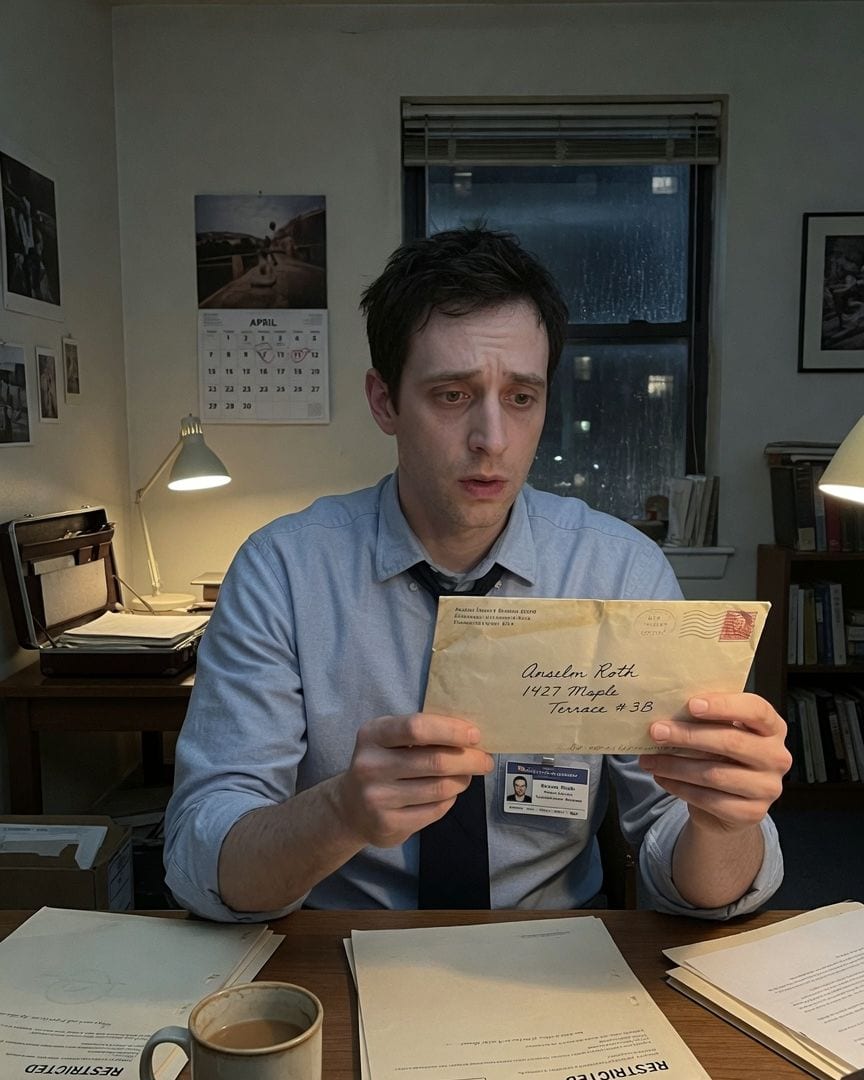
A Cold War declassification reviewer finds his dead grandmother's letter, postmarked 1974, addressed to him years before he was born, and radiating heat.
Declassification reviewer Anselm Roth meticulously sorted through a Cold War-era file on impossible disappearances at the National Archives, a routine 'thirty-year clock' review in 2014. Among the countless records of vanished ships and military units, he found an unscheduled addendum: a thick, sealed envelope addressed to him in his dead grandmother Eleanor Vance’s unmistakable hand. The postmark read 1974, years before he was born, and the paper itself was faintly, inexplicably warm against his fingers, defying every archival principle. Later, a photograph inside revealed his grandmother in an unknown uniform with a stark warning: 'They file us, Anselm. Don't let them finish.' This wasn't just a record of the lost; it was still active.
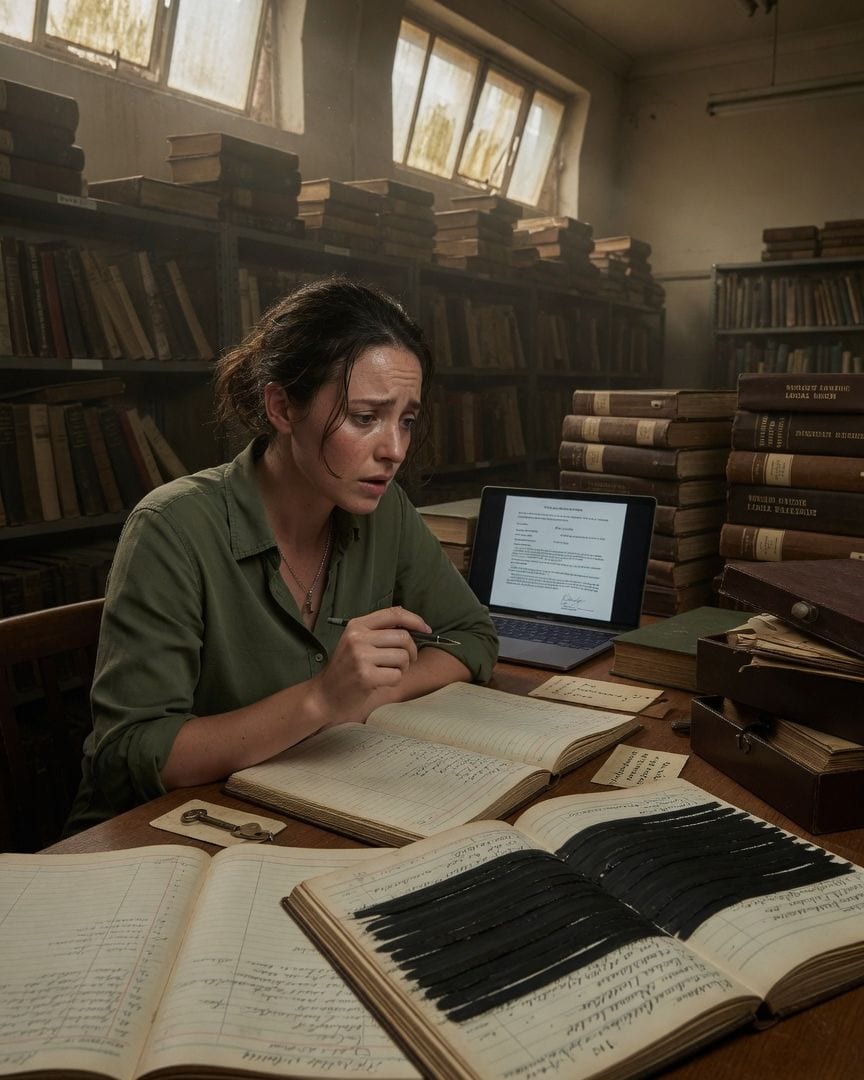
My grandmother’s name is on a blacked-out line from a 1954 drowning inquest, on our street, with a note: 'do not send a second notice.'
Transcribing old inquest registers in the quiet archive was a routine task, until I found a 1954 entry for an accidental drowning. The next of kin line was savagely blacked out, but the faint impression underneath named Patricia Kingsley, my grandmother. Her address was listed on Weir Lane, eleven years before she ever lived there, alongside a chilling note: 'do not send the notice a second time.'
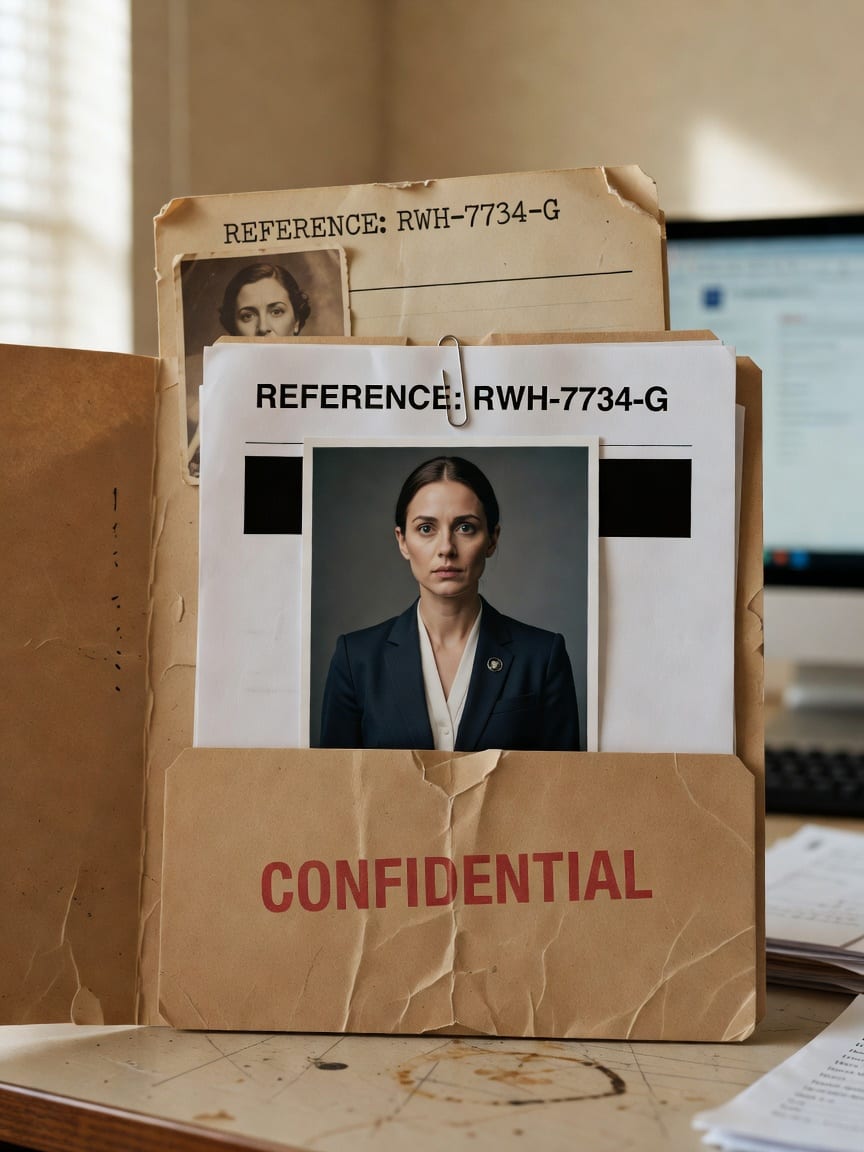
My security file was opened nine years before I was born. Its note said: 'subject not to be briefed'.
Auditing company digital records was routine until I pulled up my own personnel file. It clearly showed a 'Date Opened' nine years before I was born, yet bore my exact name and reference number. Below, an assessor's note from that impossible year mentioned a 'previous holder' and ordered the 'subject not to be briefed,' sparking a cold thrum in my chest.