My security file was opened nine years before I was born. Its note said: 'subject not to be briefed'.
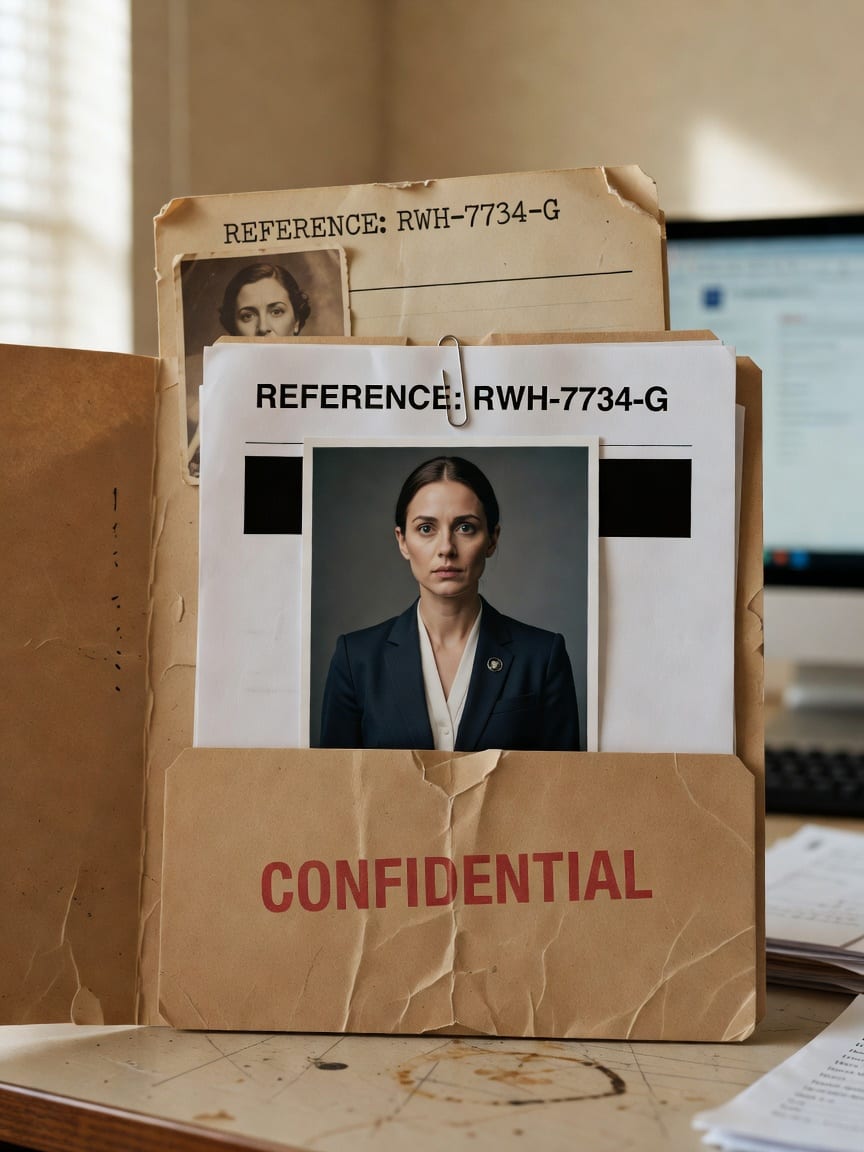
The screen glowed, a sterile blue. My own personnel vetting file, staring back at me. Genevieve Sullivan, Senior Analyst, Radcliffe & Whitmore Holdings.
All the familiar details were there: my full name, current address, a recent ID photo where I looked tired but competent. This was part of the company-wide digital records audit, a tedious but necessary task.
My file was one of thousands.
Then I saw it. The 'Date Opened' field. It read: '1983-05-12'. My breath caught. I was born in 1992. Nine years after this file, bearing my name, my reference number 'RWH-7734-G', had been created. My fingers hovered over the keyboard.
A typo? A system error? I zoomed in, then out. The date was crisp, unambiguous.
Below my name, a specific line, 'Source of Referral', was a stark black rectangle, a digital void where information should have been.
And beneath that, an assessor’s note, dated from that impossibly early year: 'as with the previous holder of this reference, clear and place, subject not to be briefed.'
A cold thrum started in my chest. Not fear, not yet. More like a deep, unsettling vibration, like a distant, heavy engine had just kicked on. I tried to rationalize it. Legacy data. A ghost file. Some bizarre administrative placeholder.
But the precision of the dates, the specific, almost clinical wording of the note, refused to fit any mundane explanation. 'Previous holder'? 'Subject not to be briefed'? It felt too deliberate, too specific, for a mere glitch.
I rubbed my temples, trying to shake off the creeping unease. Marcus Underwood, Head of Corporate Archives, was usually unflappable. He’d know. He’d laugh, explain some technical absurdity, and the cold knot in my stomach would unwind.
I stood, the office lights buzzing, the low hum of the servers a constant, almost imperceptible tremor through the floor. The monitor, with my impossible file glowing on it, seemed to watch me leave.
Marcus was in his office, sorting through a stack of physical files. He looked up, his expression calm, then offered his usual dismissive smile when I explained the anomaly.
“Ah, the old system glitches, Genevieve,” he said, waving a hand dismissively. “Legacy data migration can throw up all sorts of phantom dates. We’ve been digitizing for decades. Nothing to worry about. Focus on your current audit.”
He didn’t even check. Didn't ask for the file reference. Just waved it away like a persistent fly. His casual dismissal didn't reassure me; it deepened the unease, transforming it into a quiet, simmering suspicion.
He looked too calm, too unbothered. It was almost... a practiced response.
Back at my terminal, the reference number RWH-7734-G burned in my mind. His words, 'legacy data migration', echoed, but now they sounded less like an explanation and more like a convenient shield.
I ignored my audit queue and, using my higher-level access, opened the company’s internal archive search—a more granular system than the one Marcus usually supervised.
I entered the precise string: RWH-7734-G. Then, a filter: 'personnel files', 'pre-2000' dates. I expected a 'no results' or, at best, a single, equally erroneous entry that Marcus could shrug off.
The search whirred, the little blue circle spinning on the screen. It felt like an eternity.
Then it resolved. One result.
A file, dated 1961. For a 'Cynthia Radcliffe'. My heart stopped, then hammered against my ribs. I pulled it up. The layout was archaic, a scanned paper document, watermarked and faded, but the details were chillingly familiar.
Full name: Cynthia Radcliffe. Address from a bygone era, a phone number with far fewer digits than mine.
And beneath a heavily blacked-out line, identical in its digital void to the one in my own file, the exact phrase: 'as with the previous holder of this reference, clear and place, subject not to be briefed.'
It wasn't a glitch. It was a pattern. A cold, impossible echo from sixty-three years ago.
The next few days were a blur of clandestine searches. My audit work became a cover, a convenient excuse to delve deeper into the oldest, dustiest corners of the Radcliffe & Whitmore archives.
That first discovery had ripped a hole in my understanding of reality, and I was desperate to see how deep it went.
I began cross-referencing RWH-7734-G with other historical records, using every obscure search parameter my access allowed. Cynthia Radcliffe wasn’t alone. I found a 'Julian Holloway,' whose personnel file from 1978 bore the same reference number and the chillingly familiar note.
Then a 'Beatrice Forsythe' from 1996, the same again: the blacked-out line, the 'subject not to be briefed' instruction.
The names, faces, and personal details were always different—different families, different towns, different eras—but the reference number, the redacted line, and that damn note were unnervingly consistent.
Each individual had been placed in a similar, mid-level administrative role within the company’s records or data management departments. Just like me. Just like Cynthia. It wasn't just a number; it was a job description, a destiny.
I started noticing a subtle but undeniable rhythm in the dates: roughly every fifteen to twenty years, a new file appeared with the RWH-7734-G reference. It wasn't random; it was cyclical. Someone was replacing someone. Or something.
The mundane explanation of 'reused file numbers' now felt like a cruel joke.
No company, not even one as old as Radcliffe & Whitmore, would haphazardly reuse such a critical identifier for different employees, spanning decades, with such specific, cryptic notes attached.
The coherence of it, the systematic nature, was far more terrifying than any random error. This wasn't a mistake. This was design.
I printed out a timeline, a stark line stretching across the decades on my desk, each instance of RWH-7734-G a chilling marker. Cynthia Radcliffe, Julian Holloway, Beatrice Forsythe.
And my own name, Genevieve Sullivan, sat at the very end, the most recent 'placement'. The room grew cold around me, a sudden draft that seemed to originate not from the vents, but from the realization itself.
My late-night searches did not go unnoticed. A week after my conversation with Marcus Underwood, my internal messaging system pinged. It was him. 'Genevieve, a quick chat about your audit progress? My office, five minutes.'
My stomach tightened. I knew. I felt it in my bones. He wasn't just checking in.
In his office, Marcus sat behind his polished mahogany desk, calm as ever, almost serene. The usual scent of old paper and leather clung to the air, but now it felt stale, like something preserved.
"Just checking in," he began, his voice smooth, devoid of any obvious accusation. But his eyes, sharp and intelligent, bored into mine. "You’ve been... quite thorough with the older sections of the archive.
Any particular insights into, say, the 1960s personnel records?"
He leaned back in his chair, a faint, almost imperceptible smile playing on his lips. It wasn't a friendly smile. It was the smile of a predator. I felt a prickle of cold sweat on my neck.
"Just ensuring compliance," I replied, keeping my voice steady, my hands clasped tightly under the desk. "Some fascinating legacy systems, though. So much history."
Marcus’s smile widened, just a fraction. "Indeed. Very complex. Some things, Genevieve, are best left undisturbed in their original context." The subtle menace was unmistakable. His words hung in the air, heavy and solid, like stones.
He wasn't warning me; he was telling me. The air in his office felt suddenly thin, hard to breathe.
Back at my desk, my heart hammering, I checked my access logs. A series of timestamps, precisely mirroring my own deep dives into the 'pre-2000' files, showed 'Marcus Underwood' accessing the same records. Often, just minutes after I had.
It wasn't a coincidence. It wasn't a system glitch. He was watching me. He knew what I was looking for. The hunter had become the hunted, and the institution itself, vast and silent, felt like a single, calm, predatory eye.
The walls around me seemed to close in, the quiet hum of the building now a low, menacing growl.
The next morning, a terrible certainty settled in my gut. I couldn't go to HR. I couldn't go to legal. Marcus was too high up, too connected. This wasn't a rogue employee; this was the institution itself.
There was only one other person who might know, who might remember the things Marcus wanted 'left undisturbed'.
I sought out Eileen Doyle, the retired Chief Archivist who still consulted part-time. She was a legend, a woman whose tenure at Radcliffe & Whitmore spanned over fifty years, more than half the company's existence.
I found her in a quiet corner of the main library, hunched over a microfilm reader, her white hair a halo around her frail frame. Her eyes, though, missed nothing. They were ancient, but incredibly sharp.
I laid out my printouts on the table beside her: my file, Cynthia Radcliffe’s, Julian Holloway’s, Beatrice Forsythe’s. All bearing the impossible RWH-7734-G. Eileen looked at them, a faint, knowing flicker in her eyes, but no surprise. No shock.
Just a weary understanding.
“What does it mean, Eileen?” I asked, my voice barely a whisper, ragged with the effort of holding myself together. “The recurring number, the note, the blacked-out line... for decades?”
Eileen sighed, a sound like rustling paper, old and dry. “Some roles, dear,” she said, her voice soft but clear, “are… legacy placements.” She pushed herself up slowly, her joints creaking, and led me to a forgotten, oak-paneled alcove.
The wood felt cold and smooth under my fingertips. From a hidden compartment, behind a sliding panel that barely registered as a door, she produced a heavy, leather-bound register, its pages yellowed and brittle with age.
It wasn't part of the digital system. It predated it by a century.
Eileen opened it. It was a ledger, hand-written in neat, flowing script. Names, dates, departments, and a column labeled 'Reference Number.' My breath hitched. There, in that meticulous copperplate, were the RWH-7734-G entries, stretching back to the company's earliest days.
Hundreds of them.
“These individuals,” Eileen explained, her voice flat, devoid of judgment or emotion, “they fulfill a specific… function. A pattern maintained for the stability of the institution.” She pointed to a column marked 'Placement Cycle.'
The dates aligned perfectly with my own frantic timeline. The 'previous holder of this reference' wasn't a mistake; it was a lineage, a chain.
Eileen's finger, thin and unhurried, slid down the page, past Cynthia Radcliffe's entry, past several others, until it rested on Genevieve's own name. Beneath it, in a different, elegant hand, was the small, terrifying annotation: 'Subject: Genevieve Sullivan. Status: Activated.'
And then, a date, crisp and clear: '1983-05-12' — nine years before Genevieve Sullivan had ever drawn breath. The same note, 'Status: Activated,' appeared under Cynthia Radcliffe's name, dated 1941, before her birth.
The institution wasn't just reusing numbers, or even just 'placing' people. It was identifying them, marking them, activating them, before they even existed. I felt the floor drop out beneath me.
This wasn't a mistake in a file; it was a blueprint, a living record of a system that had quietly, calmly, been managing lives for generations. My own life.
My voice was a ragged whisper. “Activated? Before I was born? What does that mean, Eileen?”
Eileen Doyle closed the heavy register with a soft thud. The sound resonated in the quiet alcove, thick and final. “It means, Genevieve, that you were identified very early.
Your familial markers, your aptitudes, they matched the profile for this particular legacy role.” She gestured vaguely towards the shelves of ancient documents around us, as if the entire archive was part of the pattern.
“The blacked-out line in your file, and in all the others with that reference number, is the source. The family line. We simply ensure the path is clear.”
My mind reeled, a kaleidoscope of shattered certainties. My parents, their careful encouragement. My academic choices, always gravitating towards data and systems. My 'independent' decision to apply to Radcliffe & Whitmore, the place that felt so right, so natural.
It all snapped into a horrifying coherence. It wasn't coincidence; it was cultivation. My entire life had been a path, not a journey.
“'Subject not to be briefed',” Eileen continued, her voice devoid of malice, as if discussing the weather. “Because knowledge complicates the process. The system is seamless when the subjects are… unaware.”
The pattern was complete. I wasn't an employee who happened to find a strange file; I was a meticulously managed component, chosen from birth, guided into her predetermined place.
The institution hadn't just filed the wrongness; it had engineered me into it. I was the latest iteration of RWH-7734-G, just as Cynthia Radcliffe had been before me, and Julian Holloway, and Beatrice Forsythe.
The dread wasn't a future threat; it was a past reality, a suffocating blanket wrapping around my entire existence. The very air I breathed felt poisoned by this knowledge.
I felt a primal urge to run, to scream, to shatter the calm, impenetrable facade of Radcliffe & Whitmore. But where would I go?
Every decision, every opportunity, every path I’d taken had been a brick in the road laid by this silent, omnipresent institution. My entire life was the pattern. There was no outside, no escape from what had already been done.
I found Marcus Underwood in the main archive hall, overseeing a team of junior analysts, his usual picture of calm efficiency. He looked up as I approached, his expression unreadable, yet knowing. He wasn’t surprised to see me.
He’d been waiting. I approached him, not with rage, but with a terrifying, quiet clarity, a coldness that had settled deep in my core.
“You knew,” I stated, my voice flat, hollow. “All of it. Cynthia, Julian, Beatrice… me.”
Marcus set down a file, his movements deliberate, unhurried. He didn't deny it. He simply met my gaze, a faint, almost imperceptible smile playing on his lips, a mirror of Eileen’s detached calm.
The smile was not cruel, but infinitely, chillingly indifferent. “Some things,” he said, his voice soft, almost a murmur, “are simply how the world works. How our world works.”
He picked up another file, his attention already elsewhere, dismissing my 'discovery' as an expected, managed event, a minor tremor in a perfectly orchestrated system.
There was no escape. Not in the physical sense, not in the emotional. I wasn't just trapped in the building; I was trapped in the system, in the lineage, in the very fabric of my own identity.
The dread wasn't in what they would do to me, but in what they already had done. I was already inside it. I was it.
The archive, with its rows of silent files and its calm, watchful keepers, felt like a tomb.
I continued my work at Radcliffe & Whitmore. My colleagues, oblivious, chatted about weekend plans and project deadlines. The audit continued, the files flowed in and out, pristine and orderly.
Marcus Underwood moved through the corporate halls, a picture of calm efficiency, his faint smile a permanent fixture. Eileen Doyle returned to her quiet corner in the library, a guardian of ancient secrets, her eyes holding the weight of centuries.
Nothing changed on the surface. The institution hummed along, a well-oiled machine, utterly undisturbed.
I performed my duties, filed my reports, but the knowledge was a cold, permanent weight in my chest. I saw the new hires, fresh-faced and eager, and wondered which of them carried a blacked-out line, a pre-birth activation date.
The system was seamless, endlessly self-perpetuating.
I sat at my desk, the digital file open before me. My own file. My own reference number: RWH-7734-G. I looked at my hands, then at the screen, a quiet, chilling understanding settling over me.
The file remained open on the screen, a static record of a life meticulously planned. Genevieve Sullivan continued her work, her movements precise, her eyes holding a knowledge that no one else shared.
The hum of the servers, the soft click of keyboards, the low murmur of conversations—all continued. Everything was as it should be. The number, I knew, was simply waiting for the next one.
If this one got to you
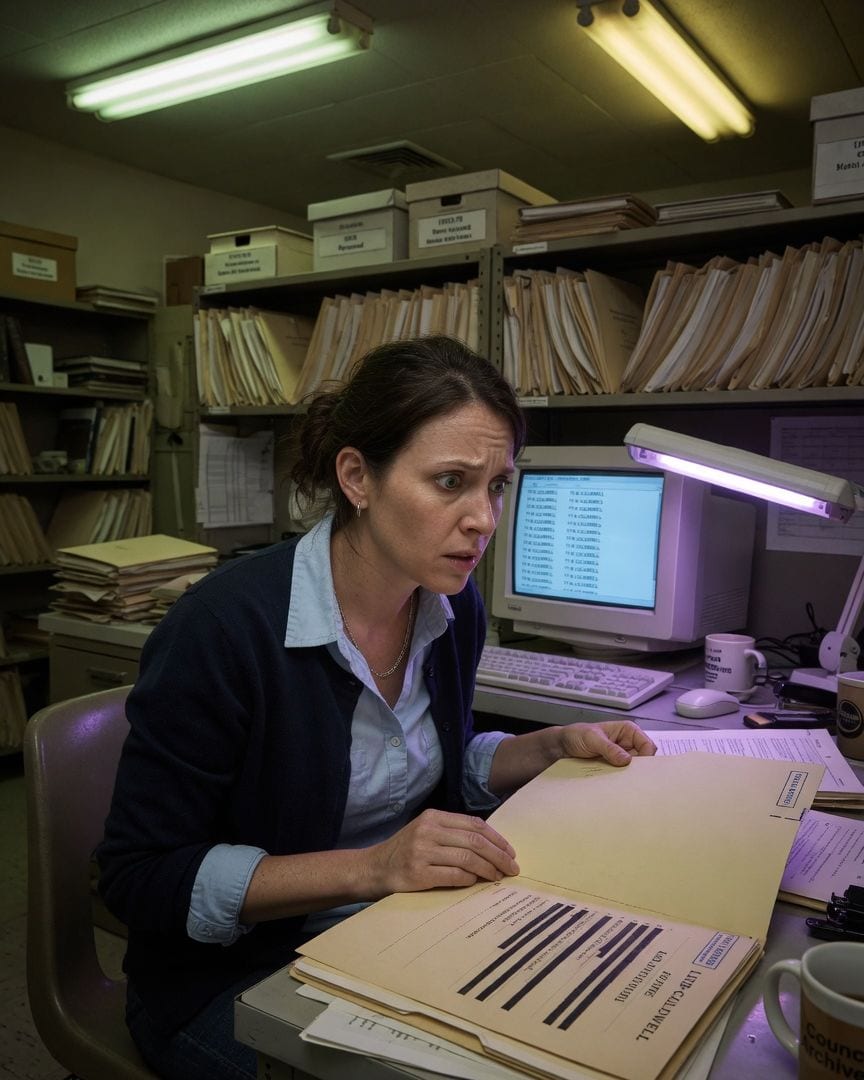
My employer's security file holds a vetting report on me dated nine years before I ever applied. It has my full name and my parents' address — with only one line, the source who referred me, blacked out.
Working a routine data audit, I pull my own security file. The issue date is nine years before I even applied for the job. Then, hidden within an old archive file, I find my current address etched under a blacked-out line.
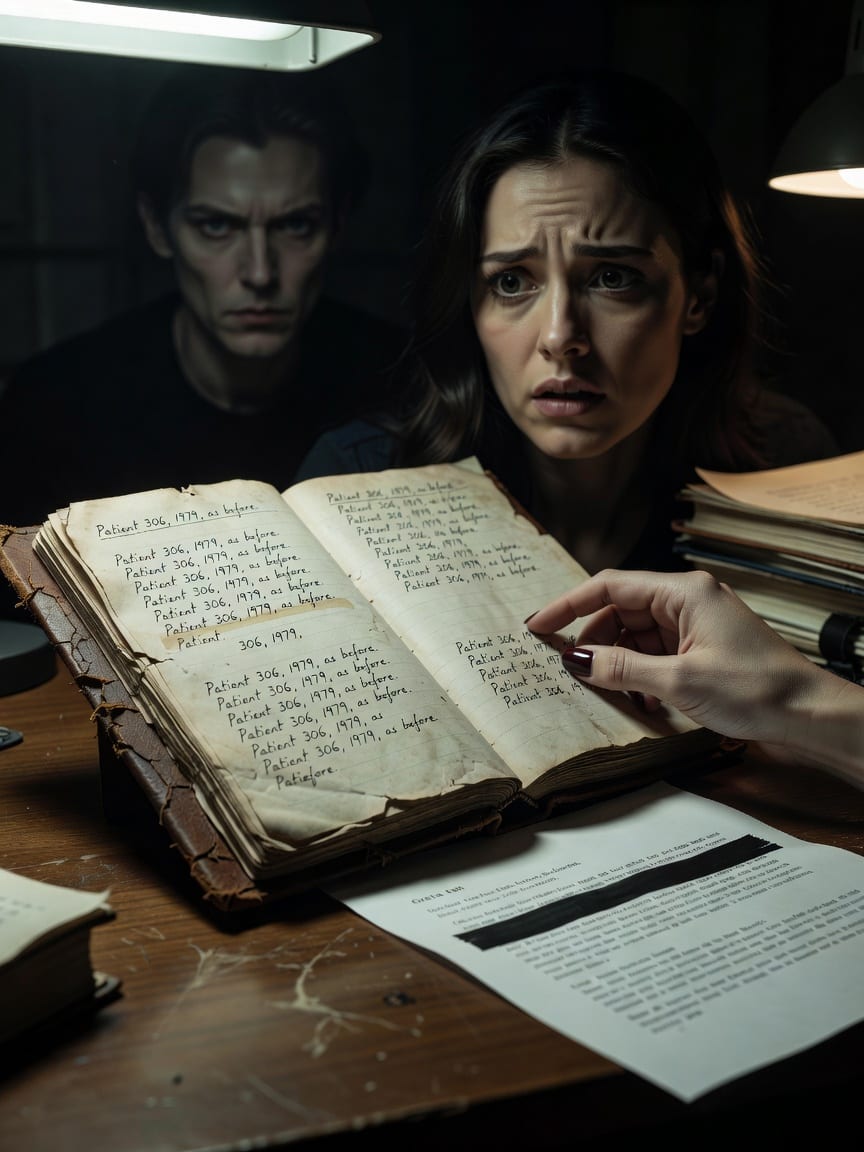
My archive ledger shows Patient 306 admitted in 1889, 1911, 1934, 1957, 1979 — same diagnosis, different names, and always, 'as before.'
My job as an archive transcriber is usually soothing, digitizing ancient admissions ledgers. But a recurring entry for 'Patient 306' caught my eye, noted 'as before' in the same hand for nearly a century. Digging deeper, I found a council file, dated 1998, outlining 'containment procedures' – and it named my own street and surname.
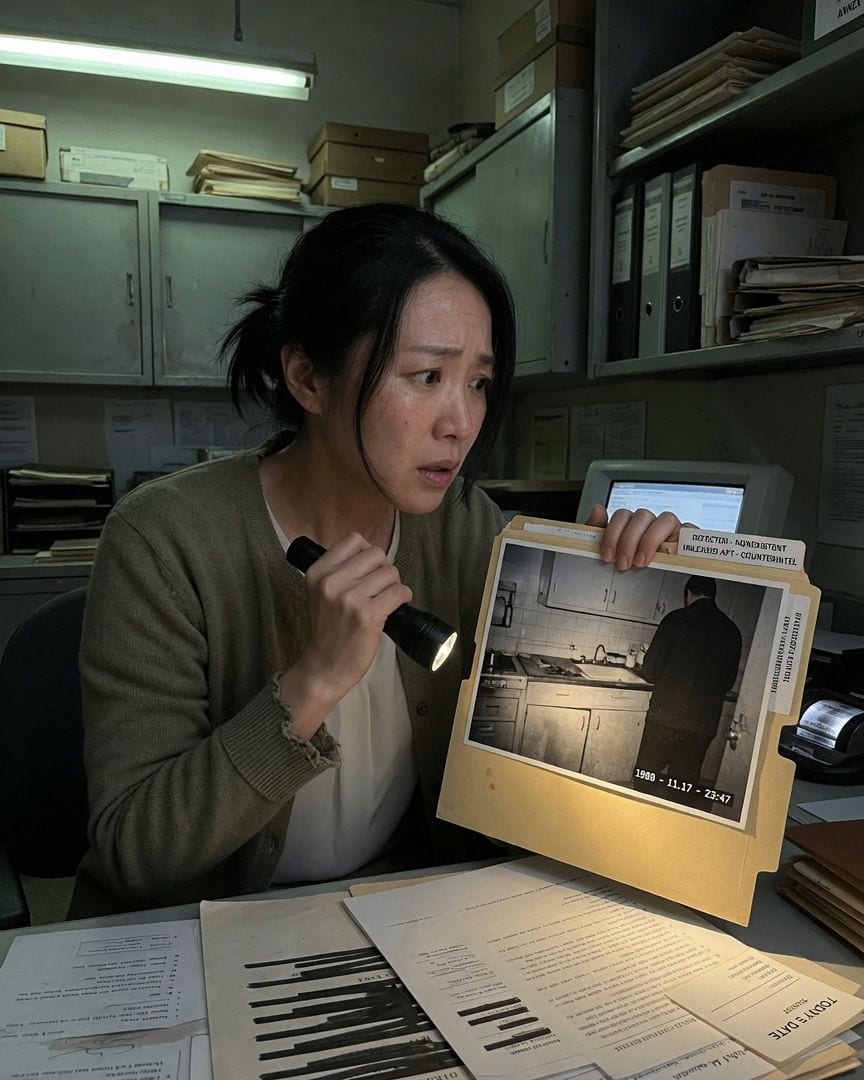
Against a midnight deadline, archivist Junie Kwan finds a Cold War dossier with a photo of her grandmother's kitchen, empty the night of the funeral, with an unknown figure standing inside.
Archivist Junie Kwan huddled in the hushed, cool Alexandria archives, working against a midnight court order to reseal a strange counterintelligence dossier. The file, dense with blanked sections, concerned a 'defector who never existed' and an 'unleased apartment.' As she scanned a grainy surveillance photo, a prickle of unease turned to dread: it was her grandmother's kitchen, dated 1988, the night of the funeral. A tall, rigid figure stood at the sink, yet Junie knew with certainty the apartment had been empty and locked that night. How could an impossible presence appear in a locked, empty room, tied to a phantom Cold War case?
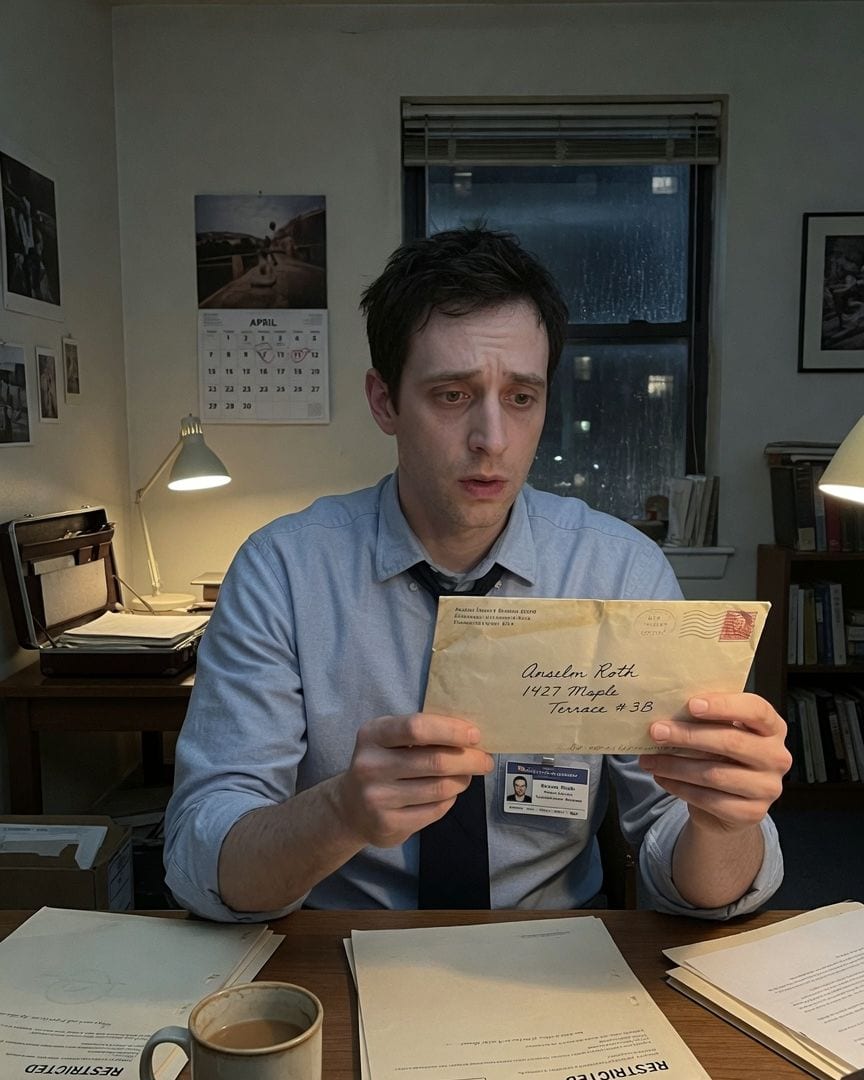
A Cold War declassification reviewer finds his dead grandmother's letter, postmarked 1974, addressed to him years before he was born, and radiating heat.
Declassification reviewer Anselm Roth meticulously sorted through a Cold War-era file on impossible disappearances at the National Archives, a routine 'thirty-year clock' review in 2014. Among the countless records of vanished ships and military units, he found an unscheduled addendum: a thick, sealed envelope addressed to him in his dead grandmother Eleanor Vance’s unmistakable hand. The postmark read 1974, years before he was born, and the paper itself was faintly, inexplicably warm against his fingers, defying every archival principle. Later, a photograph inside revealed his grandmother in an unknown uniform with a stark warning: 'They file us, Anselm. Don't let them finish.' This wasn't just a record of the lost; it was still active.
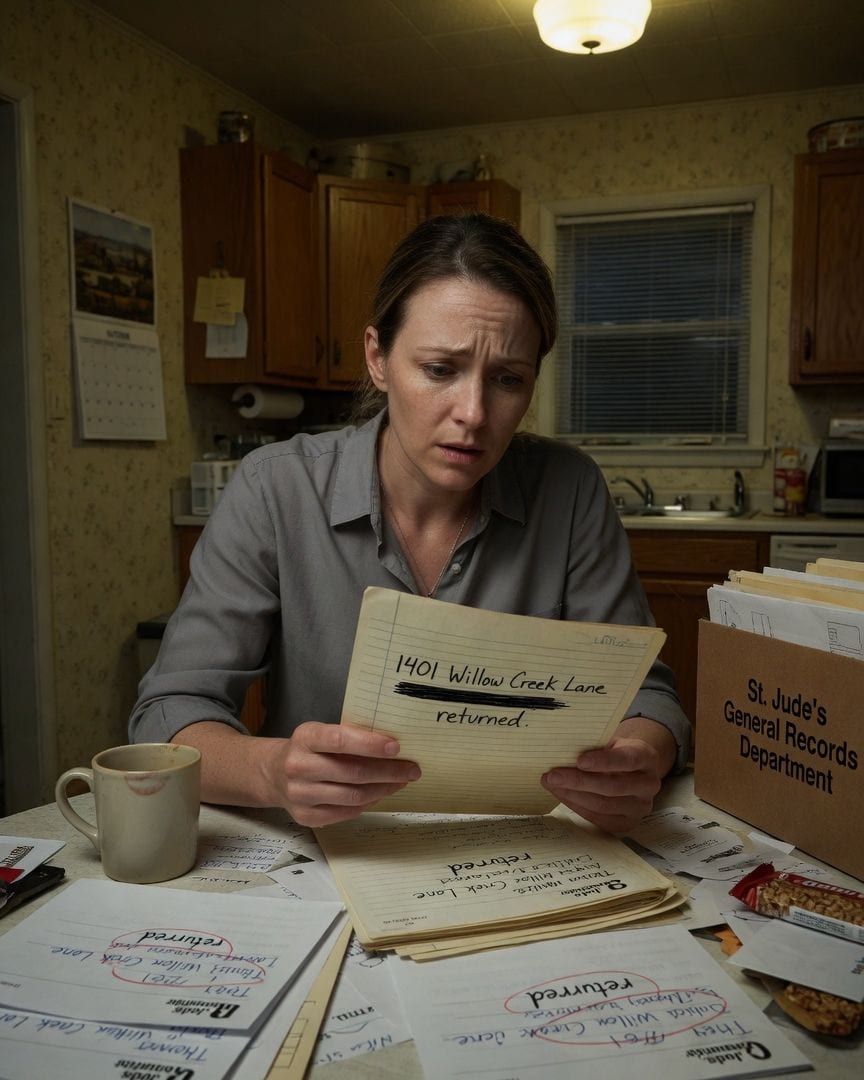
My medical file shows my street address on a struck-through line from 1988, a year I lived two counties away. It just says 'returned'.
A routine insurance audit led me to my childhood medical file from 1988. But among the expected notes, a deliberately struck-through line listed my current house address, followed by the stark word 'returned.' In 1988, I lived two counties away, making this entry an impossible and unsettling mystery.
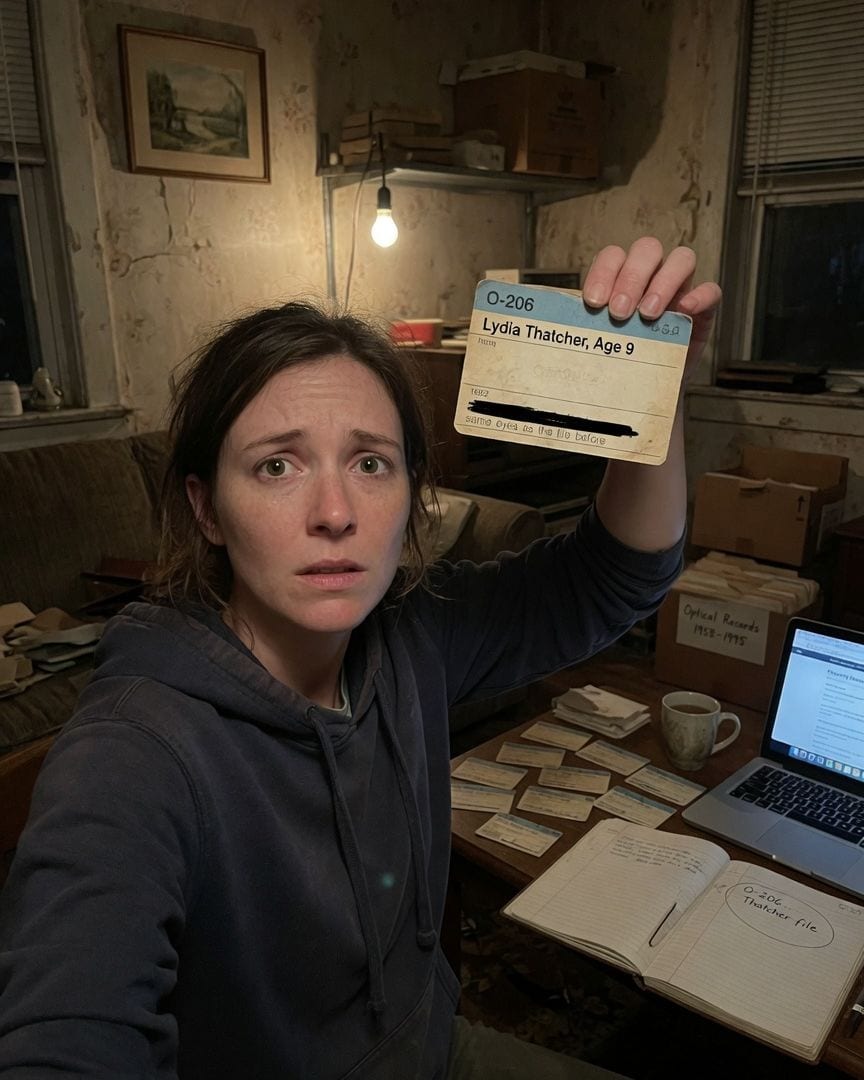
My own optical card is dated 1962, with my name on it. I wasn't born until 1993.
Sifting through old patient files from my former optical practice, I found my own O-206 card. It had my name, Lydia Thatcher, and my current home address printed on it. But the card was dated 1962, decades before I was even born, and a redacted note mentioned 'same eyes.'