Against a midnight deadline, archivist Junie Kwan finds a Cold War dossier with a photo of her grandmother's kitchen, empty the night of the funeral, with an unknown figure standing inside.
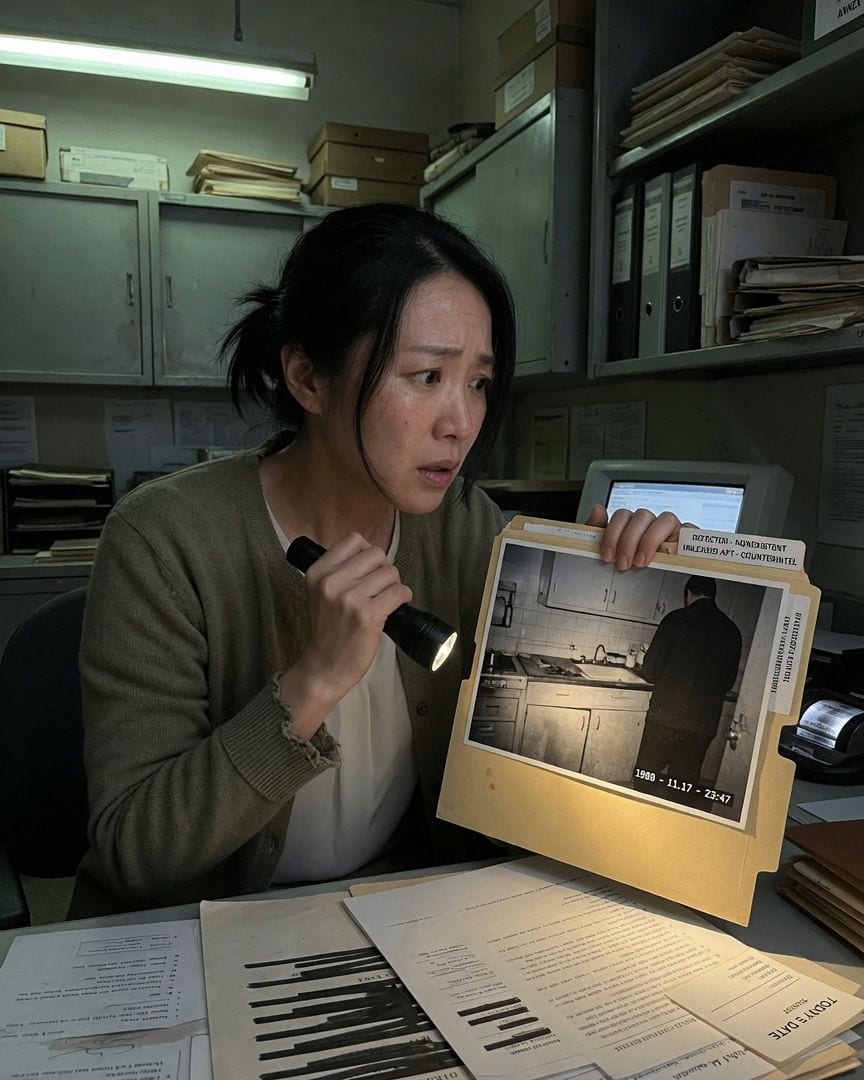
Junie Kwan huddled deeper into her worn cardigan, the Alexandria archives a cavern of hushed whispers and cool, stale air. Outside, the city was long asleep.
Inside, only the hum of the fluorescent lights and the soft whir of the microfiche reader broke the silence. She worked against the clock, a court order demanding the resealing of this particular counterintelligence dossier by midnight.
It was a strange file, officially concerning a "defector who never existed" and an "unleased apartment"—a phantom case, dense with blanked-out sections and contradictory reports.
Junie felt the file itself seemed to argue with itself, a paper labyrinth of omissions and half-truths.
Her flashlight beam, a focused spear in the gloom, drifted over a surveillance photograph clipped to a loose page. It was a grainy, black-and-white image, taken through a window, showing a kitchen sink and a small section of countertop.
A prickle of unease started low in her stomach, then climbed. She knew that kitchen. Every chipped tile, every scuff on the linoleum, was burned into her memory. It was her grandmother's apartment.
And the date stamp in the corner, small but stark, read: 1988, the night of the funeral.
Her breath hitched. In the frame, behind the glass, a tall, indistinct figure stood at the sink, perfectly still, facing away from the camera. Its posture was unnaturally rigid.
Junie knew, with absolute certainty, that no one had been in that flat that night. She had been there herself, with her parents, locking the door for the last time.
The apartment had been empty, quiet, smelling faintly of lilies and disinfectant. The presence in the photo was an impossible intrusion.
She pulled the photo closer, the paper cool and slightly textured against her fingers, and a shiver, cold and sharp, traced its way up her spine. The silence of the archive seemed to press in, heavier than before.
Junie tried to rationalize it, her mind scrambling for an ordinary explanation. A misfiled photo, perhaps? A squatter, somehow gaining access despite the apartment being locked and sealed? A trick of light, an optical illusion in the low-quality print?
She checked the photo's metadata, then cross-referenced it against the dossier's internal logs. All lines pointed back to it being integral to this file, dated and logged correctly.
The apartment number, the specific block, the precise timestamp—they all matched the night her grandmother’s body had been taken, the night the apartment was supposed to be completely vacant.
The file itself was a maddening maze of inconsistencies. Official reports stated the apartment was "unoccupied," "unleased," and "under observation for a non-existent entity."
The figure in the photo had no file ID, no description, just a blank space where a subject name should be. It was as if the system acknowledged its presence while simultaneously denying its existence.
The more she dug into the file’s internal documents, the more the mundane explanations crumbled, replaced by a growing, formless unease. A draft, cold and subtle, stirred the pages on her desk, though no windows were open.
Then she found it: a handwritten annotation in the margin of a particularly dense technical report, scrawled in an archaic, almost calligraphic script. It read: "Site Alpha-7: Local resonance confirmed. Legacy access protocol pending."
The words felt like a physical weight, settling cold and hard in her chest.
Panic began to prickle, a cold burn behind her eyes. "Legacy access?" What could that possibly mean?
She flipped through the dossier again, her fingers fumbling with the thick pages, frantically searching for any mention of "Site Alpha-7" or a "legacy protocol." The quiet of the archives seemed to hold its breath.
Tucked deep within a sealed annex, marked boldly with "FOR EYES ONLY - MERRITT," she found a single, thin memo, separated from the main dossier's index. Its date stamped across the top was undeniably today's.
The memo detailed an "activation event" at Site Alpha-7. Her eyes raced down the page to the "Subject" field. Her heart slammed against her ribs, a frantic drumbeat in the sudden, overwhelming silence of the archive.
The memo read: 'Subject: Kwan, J. Designation: Observer.' The initial was hers, the surname was hers, and the date was today's date. Her flashlight beam froze on the line, the words impossibly clear and precise in the gloom.
Junie’s mind raced, trying to process the impossible memo. Her own name. Today’s date. Observer. She checked her own service ID, her employee records—nothing about any 'observer' designation, no mention of 'Site Alpha-7.'
She tried to find 'Merritt' in the archive directory. No active personnel with that name. The system pinged back "no results." She tried inactive personnel, narrowing the search.
Eventually, she found a retired archivist, Evelyn Merritt, listed in an old personnel file, address in a quiet suburban neighborhood several towns away. The clock on the wall above the archive entrance ticked relentlessly towards midnight.
Bypassing protocol, her hands shaking slightly, Junie made a precise digital copy of the memo and the surveillance photo.
She called Quentin Sinclair, her senior archivist, trying to sound calm as she mentioned the strange discrepancies in the Kwan dossier and the odd memo.
He dismissed it quickly as a "misfile" or "clerical error," reminding her of the midnight deadline. But his tone was too quick, too firm, almost as if he were trying to convince himself as much as her.
A chill ran through Junie.
The next morning, Junie drove to Evelyn Merritt’s address. It was a small, neat house with an overgrown rose garden, the petals a riot of deep crimson against the pale siding.
Evelyn, frail but with surprisingly sharp, intelligent eyes, answered the door. Her silver hair was pulled back in a neat bun. Junie, bypassing pleasantries, showed her the copied photo and the memo.
Evelyn’s face, etched with a familiar weariness that seemed to settle in the lines around her mouth, drained of color. She didn't deny anything. Instead, her voice soft but firm, she said, "You shouldn't have seen that file, Junie."
The old house seemed to hold its breath around them.
Evelyn, after a long, heavy silence, explained that the 'Merritt' on the memo referred to her. She had retired decades ago, after "seeing too much," as she put it.
She warned Junie that once you were on their radar, you didn't get off.
Evelyn wouldn't tell her everything, not yet, but she hinted at an unofficial network of 'Site Alpha' locations, and a 'filing system' that wasn't just about records, but about containment.
She said the 'defector' dossiers were nothing more than official covers for something far older and more patient, something that operated in the deep background of the world.
She pushed a ceramic teacup towards Junie, but Junie couldn't bring herself to touch it.
As Junie left Evelyn's house, a sense of eyes on her prickled at the back of her neck. She noticed a dark sedan parked down the street, its windows tinted to an opaque black.
It definitely hadn't been there when she arrived. She dismissed it as paranoia, a side effect of Evelyn’s unsettling revelations, but a cold knot formed in her stomach.
Later that day, back at the archive, she found the original Kwan dossier, which she had meticulously left open on her desk, now closed and secured with a fresh, official seal.
The court order for resealing it wasn't until midnight tonight. Someone else had already been here. The air in her office felt suddenly colder, denser.
Junie confronted Quentin Sinclair, demanding to know why the file had been resealed early. He feigned ignorance, his eyes darting away from hers, then tried to brush her off with talk of "security protocols" and "preemptive measures."
Junie pressed him, showing him the memo she had copied, mentioning "Site Alpha-7" and "legacy access." Sinclair’s composure cracked like old plaster. The easy dismissal in his voice vanished.
He admitted, in hushed tones that barely carried over the hum of the servers, that the 'Kwan dossier' was an outlier, a "legacy file" that was supposed to stay buried, its contents meant for only a select few, far above their pay grade.
He revealed that 'Site Alpha-7' was one of several "nodes," locations where "anomalies" tended to manifest. The 'defectors' were just a convenient cover for surveillance, for observing these manifestations without causing panic.
He confessed that the "figure" in the photo was not a person, but an "echo" or "manifestation" of whatever was contained at the site.
His voice dropped to a barely audible whisper, his gaze fixed on a distant point beyond her shoulder. "Your grandmother's apartment was... active. It was always active. The 'legacy access' means it passes on."
Junie felt the blood drain from her face. The apartment wasn't just where her grandmother died; it was why. The blanked-out reports, the 'non-existent' entities – they all re-meant as deliberate obfuscation, a terrifyingly coherent narrative of continuous truth.
The pieces clicked, horribly. A small, cold tremor started in her hands.
Shaken, Junie returned to Evelyn’s house, the dark sedan still parked discreetly down the street. Evelyn, seeing Junie's distress, finally offered to show her something.
She led Junie down a narrow, creaking staircase to a hidden, dusty room in her basement. It was filled with old microfiche readers, yellowed binders, and archaic computer terminals.
This was Evelyn's own unofficial archive, a cross-referenced index of all the 'Site Alpha' files she had ever encountered, painstakingly compiled over decades.
Junie scrolled through hundreds of entries, a sickening sense of recognition washing over her as she saw the same patterns repeated: "non-existent defectors," "unleased apartments," "legacy access" notes, impossible figures.
The pattern stretched across decades, across classifications, and across agencies, a sprawling, terrifying tapestry. Each entry was a tiny, cold mirror reflecting her own experience. The low hum of the old microfiche reader felt like a heartbeat.
Then, Evelyn pointed a trembling finger to a specific entry under 'Site Alpha-7.' The 'Subject' field was blank, as expected for the original entity, but the 'Observer' field had been updated.
Junie leaned in closer, her breath catching in her throat. It showed her own service number, followed by her full name, and today's date. Evelyn’s eyes, wide with a familiar, resigned terror, fixed on Junie.
She pointed to the 'observer' entry, her hand shaking. "They don't observe," Evelyn whispered, her voice barely audible, raw with a lifetime of silent knowledge. "They deploy."
The words hung in the air between them, heavy and absolute. Evelyn explained that the 'filing system' wasn't merely a record of these anomalies; it was a mechanism.
The 'observers' weren't just watching; they were designated points of contact, intended to manage or, in some cases, channel the entities.
Her grandmother wasn't just in an 'active' apartment; she was herself a 'subject' who facilitated a subtle containment or interaction, a human conduit for forces barely understood.
The 'legacy access' meant that the apartment's role, and the family's connection to it, was passed down, from her grandmother to Junie. Junie finally understood.
The figure in the photo wasn't just a random manifestation; it was a previous 'observer' or even the entity itself, interacting with her grandmother in some way she couldn't fathom.
The entire archive, the 'secrecy machine,' was a vast, patient, and terrifyingly active system that used people, sometimes unwitting, to maintain a delicate balance with forces it could not fully understand or control.
Her own 'designation' meant she was now the next link in this chain.
Junie felt a profound, chilling dread settle deep in her bones. She wasn't an archivist; she was a pawn. The file didn't just contain a secret; it contained her.
Evelyn, seeing Junie’s realization, her face etched with a mix of fear and regret, urged her to disappear, to change her identity, to break the chain. "It’s the only way," she pleaded, her voice raspy. "Don't let them file you."
But Junie knew it was too late. The sedan she had seen earlier was parked outside Evelyn’s house again, a dark, silent predator.
As they watched through the basement window, two figures in dark suits emerged from the car, moving with an unsettling, synchronized purpose towards the front door.
Evelyn grabbed Junie’s arm, her grip surprisingly strong. "Go! The back! Break the cycle!" Junie hesitated, looking at the frail old woman who knew too much, who was now sacrificing her own safety.
But Evelyn shoved her, a desperate plea in her eyes. Junie scrambled for the back exit, through a forgotten cellar door and into the overgrown rose garden.
She heard the insistent, heavy knocking at the front door behind her, echoing in the quiet suburban afternoon. She fled into the labyrinth of suburban streets, the knowledge of her 'deployment' a cold, heavy weight in her gut.
She ran, not from the men in dark suits, but from the pattern that had just claimed her, from the unseen forces that had always been there, just out of sight, and now, impossibly, within her.
Junie vanished. Her car was found abandoned at a bus station in a neighboring state, a ticket stub for a Greyhound destination unknown clutched beneath a seat.
Quentin Sinclair filed a missing person report, his voice devoid of its usual bureaucratic precision, but it was quickly closed by "higher authorities." The Kwan dossier, along with Evelyn Merritt’s entire unofficial archive, disappeared without a trace.
The Alexandria archives remained quiet, its rows of files standing in silent judgment, as if nothing had ever disturbed their order. The apartment, Site Alpha-7, was eventually sold, its history meticulously scrubbed from public records, becoming just another anonymous address.
Months later, a new assistant archivist, Benjamin Rutherford, was assigned to the Alexandria branch. One quiet afternoon, he found a loose surveillance photograph tucked into a recently declassified property file.
It showed a familiar kitchen, bright under fluorescent light, and a tall, indistinct figure standing at the sink, perfectly still. The photo was dated last week.
He paused, recognizing the distinctive window and the particular pattern of light from his own new apartment, just a few blocks away.
He picked up the phone to call his landlord, a small frown creasing his brow, but then he paused, his thumb hovering over the dial pad. A faint, wrong smile touched his lips, barely visible. He simply continued filing.
If this one got to you
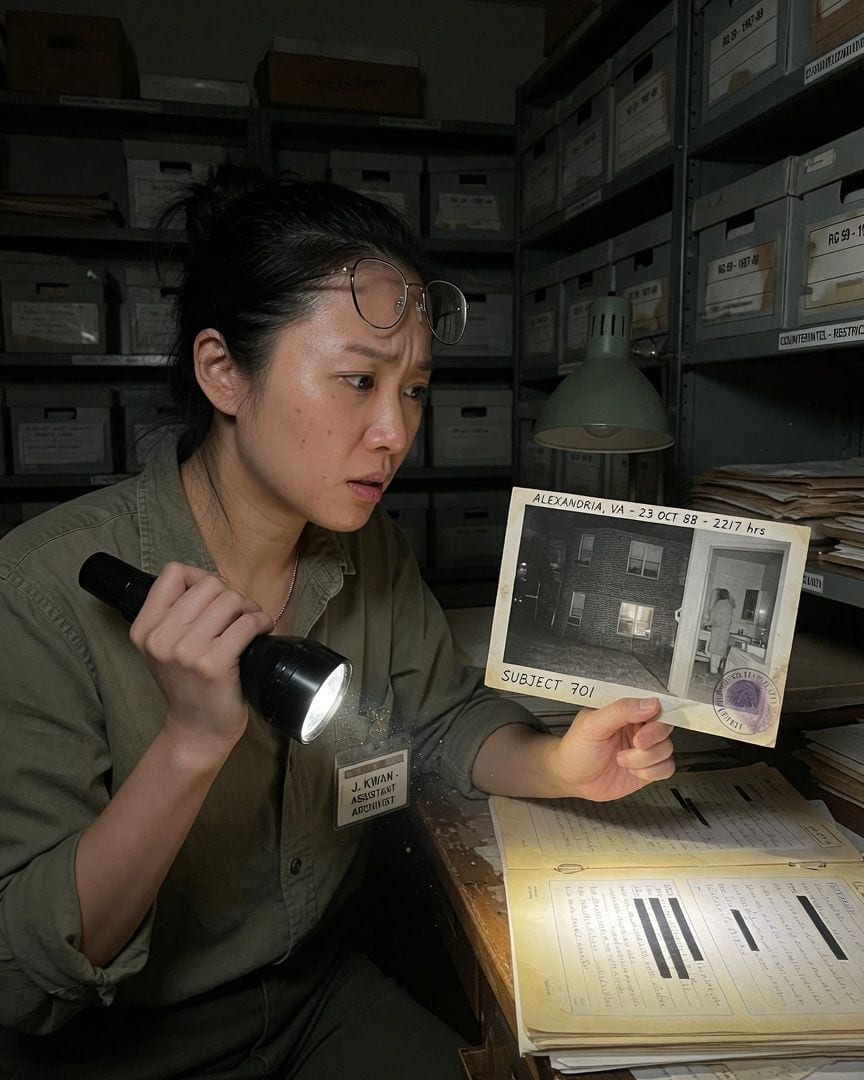
An assistant archivist's Cold War file held a photo of her grandmother's empty 1988 apartment. A figure stood in the window, stamped 'UNIT 701'.
Assistant archivist Junie Kwan hunched over a heavy 1988 counterintelligence dossier in the silent gloom of the National Archives. With only an hour before a court order sealed the file, she faced a personal horror. Tucked inside was a grainy surveillance photograph, dated the night of her grandmother’s 1988 funeral, showing the very apartment where Florence had lived and died. In the frame, behind the grimy kitchen window, a faint figure stood at the sink, despite the apartment being meticulously cleared out, empty, and locked. Junie discovered cryptic marginalia and a mysterious 'UNIT 701' stamp on the photo, hinting at a secret far deeper than a simple clerical error.
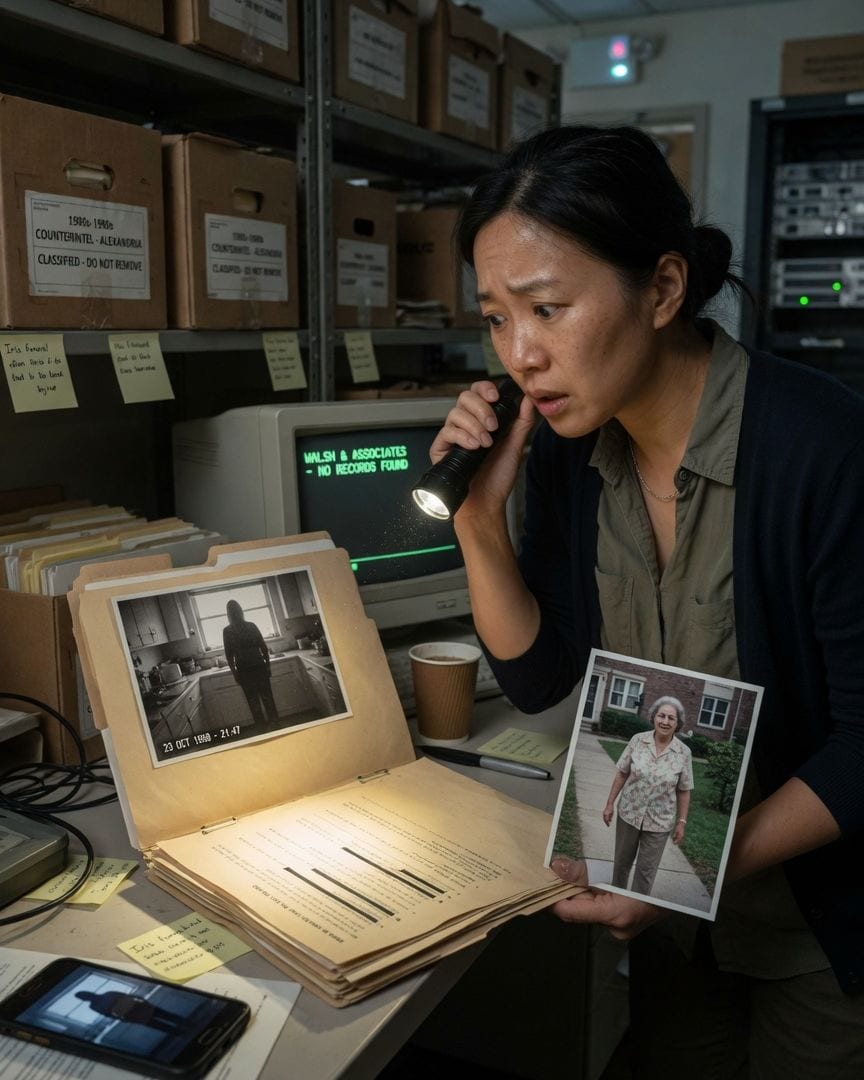
An archivist finds her grandmother's photo in a Cold War dossier. Iris smiles, vacant-eyed, with a face her granddaughter never saw.
At eleven PM, archivist Junie Kwan, 32, had just one hour before a 1988 counterintelligence dossier on a non-existent defector resealed. In the dusty, silent Alexandria archives, the hum of ancient HVAC was the only sound as she adjusted her flashlight beam over the stacks. Her heart seized when she found a grainy surveillance photograph inside: it was taken through a window of her grandmother Iris Sinclair’s flat, dated the night of Iris’s funeral. The photograph showed someone standing at the kitchen sink, even though Junie knew the flat had been empty and locked that night. As her search deepened, a loose photo of Iris herself slipped out, showing her grandmother months before her death with a vacant-eyed, unnatural smile Junie had never seen. Could her own grandmother have been part of this chilling Cold War mystery?
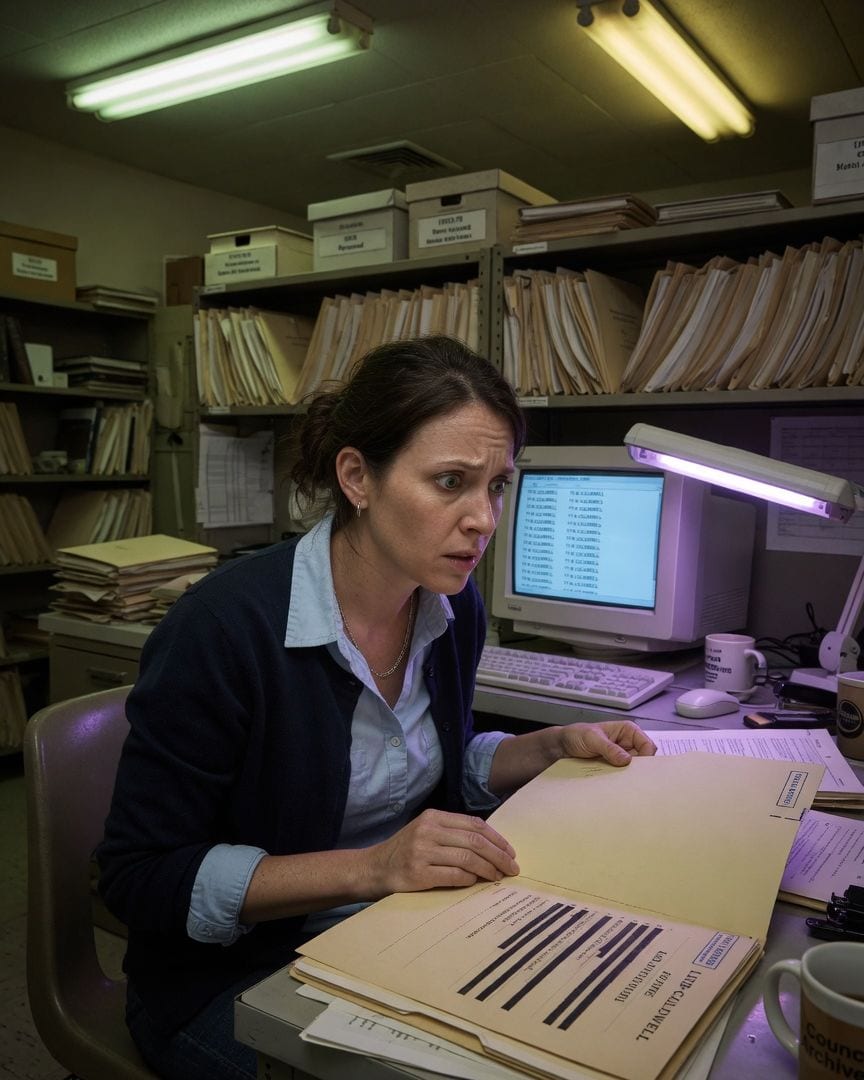
My employer's security file holds a vetting report on me dated nine years before I ever applied. It has my full name and my parents' address — with only one line, the source who referred me, blacked out.
Working a routine data audit, I pull my own security file. The issue date is nine years before I even applied for the job. Then, hidden within an old archive file, I find my current address etched under a blacked-out line.
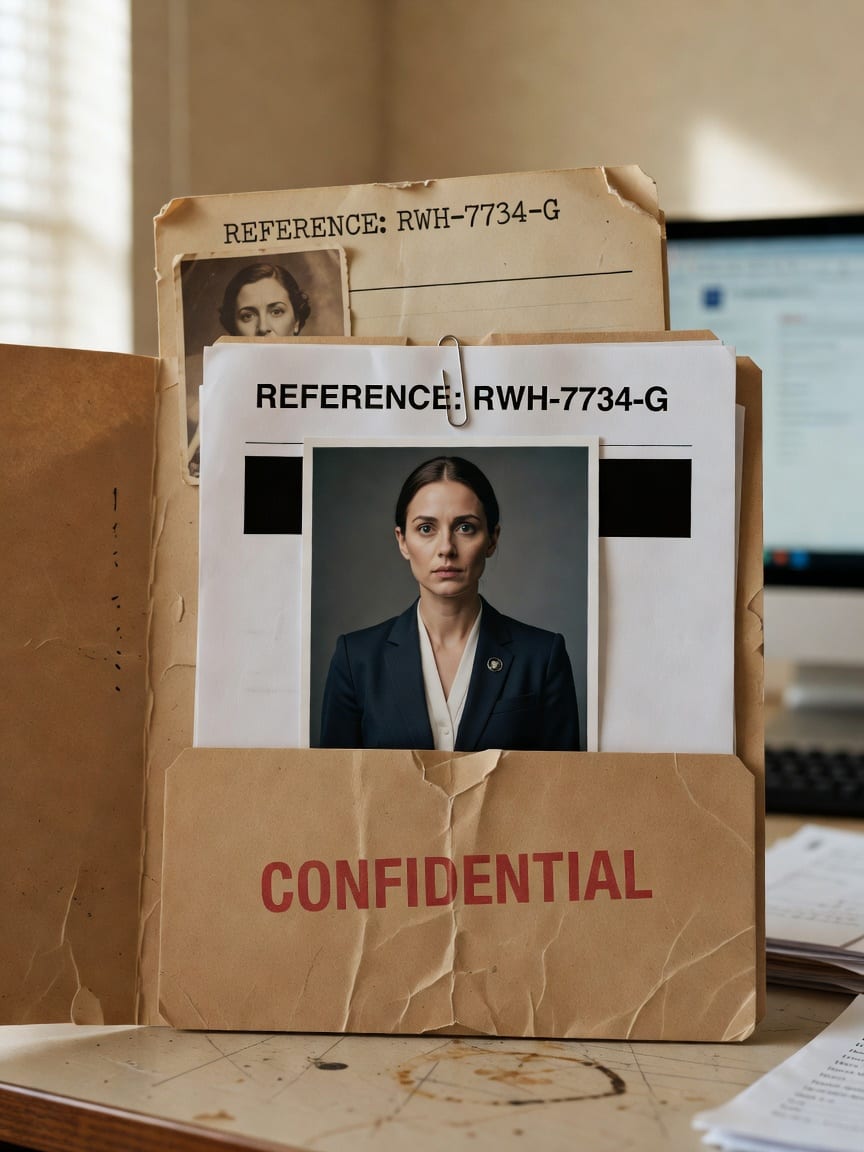
My security file was opened nine years before I was born. Its note said: 'subject not to be briefed'.
Auditing company digital records was routine until I pulled up my own personnel file. It clearly showed a 'Date Opened' nine years before I was born, yet bore my exact name and reference number. Below, an assessor's note from that impossible year mentioned a 'previous holder' and ordered the 'subject not to be briefed,' sparking a cold thrum in my chest.
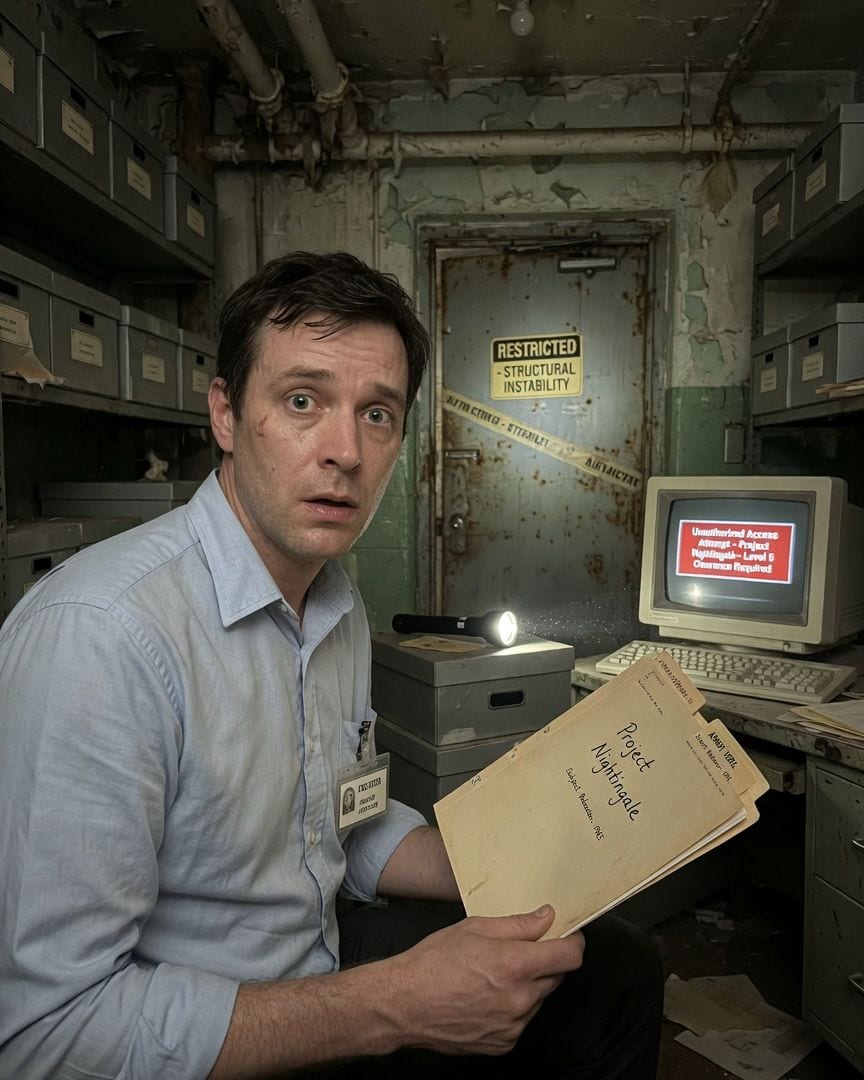
A FOIA officer found his dead mother's photo in a government Cold War file, dated 1983 — two years after her burial. Then he found her new file: 'Relocation - 1985.'
Devon Ashby, a routine FOIA officer, clicked 'release' on a 1983 file he'd seen dozens of times. Inside was a grainy photo of a woman, calmly staring from a logging road. His breath caught: it was his mother, Vera Ashby, dated two years after her 1981 burial. The file jacket, marked "Project Nightingale," led him to a forgotten, sealed sub-basement filled with unmarked metal boxes. There, he found a file for "ASHBY, VERA. Subject: Relocation - 1985," four years after her death. What hidden mechanism was meant to provoke him?
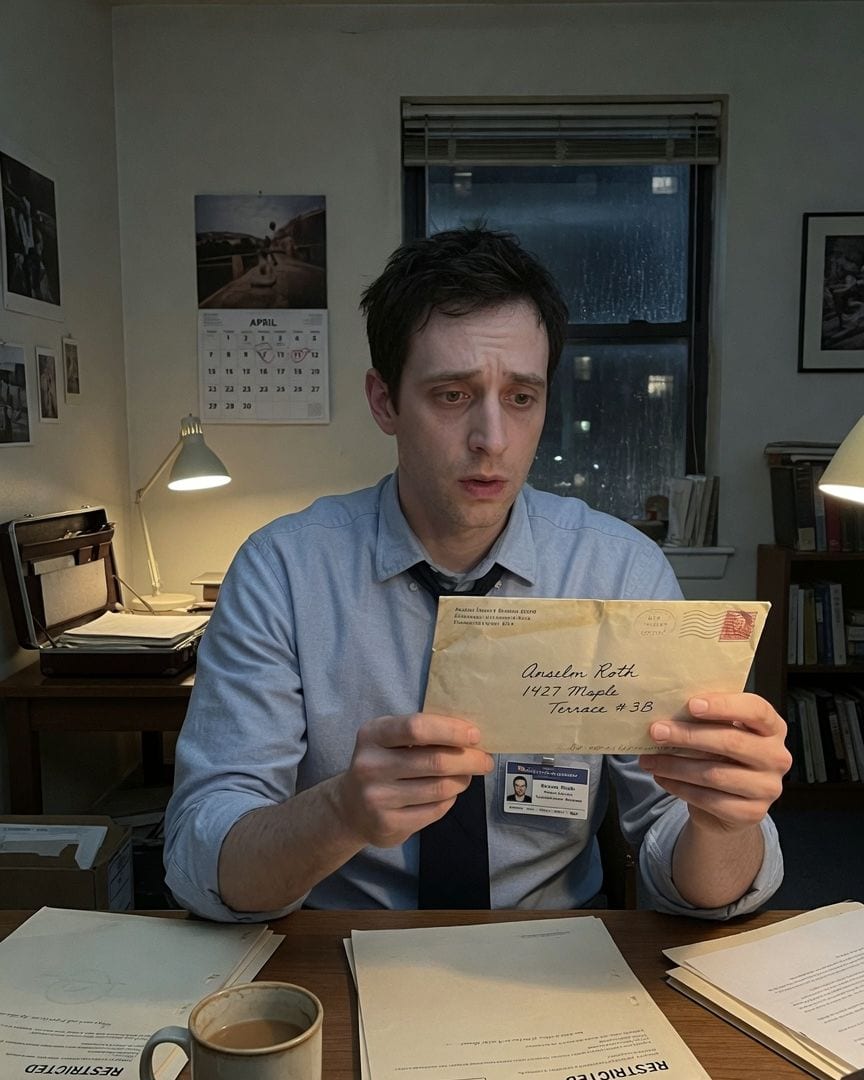
A Cold War declassification reviewer finds his dead grandmother's letter, postmarked 1974, addressed to him years before he was born, and radiating heat.
Declassification reviewer Anselm Roth meticulously sorted through a Cold War-era file on impossible disappearances at the National Archives, a routine 'thirty-year clock' review in 2014. Among the countless records of vanished ships and military units, he found an unscheduled addendum: a thick, sealed envelope addressed to him in his dead grandmother Eleanor Vance’s unmistakable hand. The postmark read 1974, years before he was born, and the paper itself was faintly, inexplicably warm against his fingers, defying every archival principle. Later, a photograph inside revealed his grandmother in an unknown uniform with a stark warning: 'They file us, Anselm. Don't let them finish.' This wasn't just a record of the lost; it was still active.