First Lieutenant Marsh's own signed service record lists a mission he can't recall from the night his desert outpost vanished.
The Mojave dark swallowed the resupply convoy. First Lieutenant Elliot Marsh, riding lead, felt the rumble of the trucks on unpaved ground, a wrong turn off the designated route from Fort Irwin.
The desert wind whipped fine dust against the windshield, blurring the already nonexistent trail. Ahead, through the swirling particulate of the desert night, faint lights shimmered.
A small firebase materialized, unlisted on any map or mission overlay Marsh had ever seen. He saw the sandbags, piled high and a distinct, faded tan, their texture rough even at a distance.
A worn US flag snapped violently in the headlights, its edges peculiarly frayed, almost tattered in a deliberate pattern. A lone soldier, a silhouette against the meager glow of a distant floodlight, waved them through the rudimentary gate.
Marsh, perplexed, radioed his grid up to higher, to Captain Rachel Davenport, asking whose outpost this was. The response was immediate, crisp, and chilling: there was nothing at that grid, he was to turn around, now.
Marsh’s hand tightened on the wheel. He looked into his rearview mirror, seeing the dim lights of the trucks behind him, then back at the outpost.
He drove through, the air suddenly cold, a phantom chill in the heat of the Mojave. On the drive back out, after making a wide turn, where the firebase had been, there was only empty, featureless desert.
Marsh stared at the vacant expanse, the cold dread settling deep in his gut, the impossible reality a physical weight.
Back at Fort Irwin, Marsh filed his report. His superiors, including Captain Davenport, listened with polite skepticism, attributing the sighting to fatigue or a sensor glitch.
Marsh, known for his meticulousness, his reputation for being squared away, began his own quiet investigation.
He poured over satellite imagery, old topographical maps, and obscure local land records, searching for any trace of an abandoned outpost, a former survey marker, anything that could explain what he saw. Every search yielded nothing but empty desert.
The quiet hum of the computer servers in the archive room seemed to mock his efforts, whispering of absence. Frustrated, he turned to the internal military records. He pulled his convoy manifest and vehicle logs from that night.
He remembered signing them, the routine paperwork of a resupply mission, the scratch of the pen across the carbon copy.
But the logs, bearing his own crisp signature, detailed a route that explicitly bypassed the grid where he’d encountered the firebase, showing him miles away at the precise time he’d been waved through its gates.
He stared at the page, his name a stark, undeniable line.
The official account, signed by his own hand, flatly contradicted his lived experience, and for the first time, Marsh felt a tremor of doubt about his own memory, a crack forming in the bedrock of his certainty.
The discrepancy in the convoy log gnawed at Marsh. He spent hours replaying the drive in his mind, certain of what he’d seen, the feel of the cold air, the specific fraying of the flag.
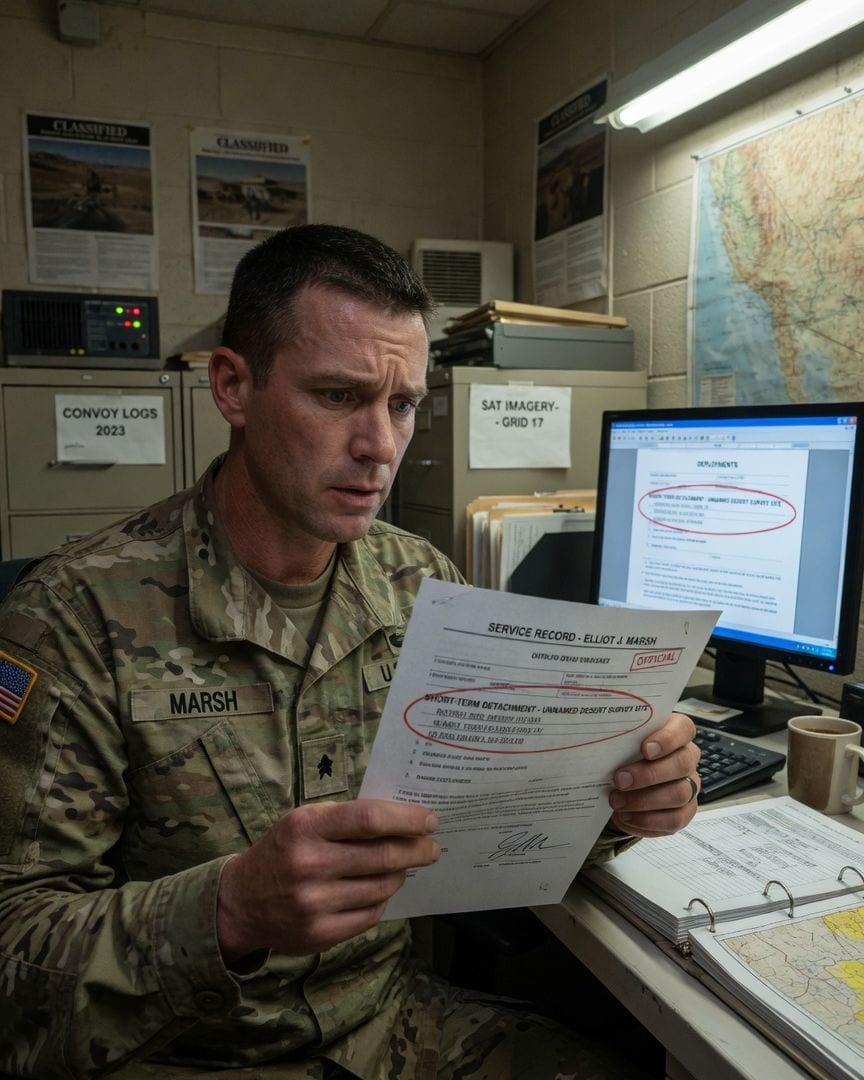
Determined to find an explanation, he accessed his own service record. The terminal screen glowed with the stark black-on-white of his military history. He scrolled through deployments, training exercises, commendations, a linear life of ordered events.
Then, his eyes snagged on an entry that seemed to jump off the screen, a jagged disruption in the smooth flow of his career: a 'short-term detachment' to an 'unnamed desert survey site.'
The dates matched the night of the phantom firebase, exact to the hour. Below the description, a scanned signature. His own. Unmistakably his, the familiar slant of the ‘E’, the sharp hook of the ‘M’.
He held the printed page, the official stamp crisp and red, his own name clearly printed beneath it, detailing a mission he had no memory of, a place he hadn’t been, on the very night his convoy encountered the phantom firebase.
He stared at the impossible entry that claimed he was elsewhere, his mind reeling, his hand trembling, the paper rustling softly in the quiet office.
Marsh, now driven by a desperate need for answers, began a discreet, almost obsessive, investigation into 'unnamed desert survey sites.'
The fluorescent lights of the records annex hummed with a low, constant drone, a sound that seemed to intensify with his growing desperation.
He spent his off-duty hours trawling obscure, declassified map archives, searching through decommissioned base records for any hint of infrastructure that appeared and vanished.
He found fragmented references: rumors of 'anomalous infrastructure zones' in the Mojave, redacted documents hinting at unacknowledged facilities. Each mention was like a faint echo in a vast, empty hall.
One dusty file, buried deep in a digital archive, mentioned a 'Quartermaster Corps survey' from decades past that noted 'unstable ground configurations' near the Fort Irwin perimeter.
Marsh tracked down the project's lead, a retired Quartermaster named Thomas Ellsworth, now living a quiet life in Barstow, the desert sun bleaching his memories as much as his porch.
Ellsworth was initially evasive, his eyes darting nervously around his cluttered living room, avoiding Marsh’s direct gaze. He dismissed Marsh’s questions with a wave of a wrinkled hand, muttering about 'bad memory' and 'too much sun.'
But over several guarded conversations, Marsh pressed, carefully detailing his experience, the specific sandbags, the flag. Ellsworth eventually, reluctantly, spoke of 'things that come and go' in the sand, structures that defied logic, that were there until they weren't.
He recalled a specific type of faded tan sandbag and a US flag with a peculiar, almost unnatural fraying pattern, details Marsh remembered from the phantom firebase. Ellsworth’s voice dropped to a whisper, 'Some things, son, the desert just reclaims.
Or maybe it never let go.' The words hung in the air, heavy and unsettling.
Marsh’s relentless digging did not go unnoticed. He began to feel a subtle shift in the air around him, a tightening pressure. His computer access logs, usually unremarkable, were flagged for review.
He noticed small delays in his network permissions, brief moments of denied access to his own personnel files, as if an unseen hand was gently testing the locks on his digital doors.
The coffee in the break room tasted a little more bitter; the conversations in the mess hall seemed to quiet slightly when he approached. Then, Captain Davenport called him into her office.
The room felt colder than usual, the smooth surface of her desk reflecting the harsh overhead light with an unforgiving glare.
Her demeanor was professional, her posture impeccable, but her questions were unnervingly precise, probing his recent inquiries into 'unlisted infrastructure' and 'archived survey data.'
She warned him, not unkindly, about 'conspiracy theories' and the potential for 'compromising his career' if he pursued 'unproductive lines of investigation.'
Her words were calm, measured, but Marsh felt the unspoken threat, a gentle hand pushing him back into line, away from the edge of something dangerous.
Later that week, reviewing his digital duty roster for the coming months, he found a subtle, almost imperceptible alteration: a small, unscheduled 'field exercise' had been added to his schedule, sending him back to the general area where the phantom firebase had appeared.
The details were vague, the purpose undefined, simply a grid reference and a date.
It felt less like a direct order and more like a quiet, internal redirection, a nudge back towards the very thing he was trying to understand, but on someone else’s terms, under someone else’s watchful eye.
The danger was no longer abstract; it was personal, a tightening noose, tightening around his own carefully constructed life.
Marsh, now cornered, decided on a direct approach. He confronted Captain Davenport in her office, the coldness in the room amplified by the starkness of his evidence.
He laid out the conflicting records: his convoy log showing him elsewhere, his service record entry for the phantom deployment, and the specific details of the faded tan sandbags and peculiar flag Ellsworth had described.
Davenport’s initial response was a practiced dismissal, attributing everything to 'clerical errors' and 'unreliable civilian testimony,' her voice smooth and even. The official seal on her desk seemed to vibrate with her quiet authority.
But Marsh pressed harder, his voice steady despite the tremor in his hands. He cited the vague references to 'anomalous infrastructure' he’d found in the archives, the very existence of which she had implicitly warned him against.
Her composure, finely honed, began to crack. Her eyes darted to the secured terminal on her desk, a flicker of something close to fear in their depths.
She finally admitted to being aware of 'certain protocols' regarding 'unaccounted-for assets' and the necessity of 'reconciling discrepancies.' Her voice lowered, a strained confession, barely audible over the low hum of the office lights.
She explained that her role, and that of others in her specialized unit, involved maintaining the official narrative. Certain 'events,' she revealed, things that defied conventional explanation, were never officially recorded as they occurred.
Instead, they were 'adjusted' into a coherent, deniable reality. She accessed a highly classified directive, displaying it on her screen.
The document, stark and unblinking, detailed a protocol: any individual who reported such an anomaly, whose testimony threatened the integrity of the official record, would have their own service records automatically modified.
Their presence would be documented elsewhere, their testimony discredited, effectively integrating them into the system's fabricated history.
Marsh’s own contradictory records clicked into place, not as errors, but as deliberate acts of systemic erasure, a chilling logic that swallowed his every certainty.
Davenport, now visibly shaken by her own admission, pulled up an archived digital record of 'reconciled incidents' – a long, scrolling list of similar phantom sightings across decades, each entry detailing how the witness's record had been modified to align with the official, fabricated truth.
The screen glowed with the weight of countless forgotten lives. Marsh watched, horrified, as names and dates blurred past, a river of suppressed realities. His breath hitched in his throat.
This wasn't just about him; it was a vast, unseen history. As Davenport scrolled further down the list, a faded, scanned image of a handwritten logbook page appeared, an anomaly itself in the digital archive.
It was old, brittle, and clearly from a decommissioned desert outpost, its paper yellowed with age, the ink bleeding slightly in places.
Marsh leaned closer, his breath catching in his throat, the metallic tang of fear suddenly sharp on his tongue.
The entry was dated exactly forty years ago, detailing a 'short-term detachment' to an 'un-base' in the same general area of the Mojave.
His eyes fixated on the name typed next to the entry, a name that made the blood run cold in his veins: 'PFC Elliot Marsh.'
Beneath it, a faded signature, identical to his own, a perfect match for the one on his current service record, the same precise loops and angles.
The past had reached out, a cold, impossible hand, claiming him before he was even born.
The revelation of the logbook entry hit Marsh with the force of a physical blow. He staggered back from the terminal, demanding to know more, his voice hoarse, barely a whisper.
Davenport, her own face a mask of weary resignation, explained the full, horrifying truth.
The 'un-bases' were not isolated incidents but a persistent, inexplicable phenomenon within US military-controlled lands, appearing and disappearing without warning, like blips on a radar screen that refused to be pinned down.
The military's response, developed over decades, was not to understand them, but to contain them, to cordon them off from the collective consciousness.
This containment involved not only erasing their existence from all official records but, critically, absorbing any witnesses into the fabricated history.
The logbook entry proved Marsh was not merely a recent witness; he was, in some terrifying, preordained way, always destined to be one.
His 'previous self' had been recorded into the system decades ago, a placeholder for the inevitable, a pre-written character in a story he hadn't yet lived.
The system wasn't just covering up an anomaly; it was actively integrating individuals into its own false timeline, making them part of the anomaly's record itself.
This 'field exercise' on his roster, Davenport confirmed, was the next step in his integration, a controlled environment where he would be further 'reconciled' into the system, his truth dissolved into its convenient lie, his memories overwritten.
The coherence of it all, the chilling logic, made the dread absolute, leaving him no room to breathe.
Marsh understood: his 'field exercise' was a trap, designed to complete his erasure, to make him a ghost in his own timeline. He had to act.
He didn't try to destroy the un-base; he knew it was beyond him, a thing of impossible physics. Instead, he would force its official recognition, however brief.
Using his knowledge of the system's 'reconciliation' protocols, the very rules designed to erase, he devised a desperate plan.
He discreetly contacted Sergeant Wayne Harlow, his NCO from the convoy, under the guise of a classified training exercise, giving him a precise grid coordinate and a time in the pre-dawn hours.
Marsh drove back to the phantom firebase's location, the desolate Mojave road stretching endlessly before him, knowing the anomaly would briefly reappear for his 'integration.'
As the desert night deepened, the stars sharp and indifferent above, he positioned his vehicle alone in the vast emptiness.
When the faint glow of the firebase began to coalesce on the horizon, the familiar faded tan sandbags and unnaturally frayed flag emerging from the dust, Marsh activated his encrypted comms.
He sent out a distress signal, a specific code that, if ignored by higher command for a defined period, would trigger an automatic, system-wide alert about a 'critical unaccounted-for asset' at his grid.
The system was designed to prevent such alerts from external sources for 'unaccounted-for assets,' but Marsh was already inside its logic, a part of its own flawed code.
As the soldier at the gate waved him in, the un-base fully materialized around him, its meager lights cutting through the pre-dawn gloom. Marsh saw headlights in the distance, growing larger.
Harlow’s convoy, a line of official military vehicles, was approaching, their beams cutting through the vast, dark desert, a tangible, undeniable reality. The system, caught between erasing Marsh and ignoring a critical, self-generated alert, began to flicker.
The un-base destabilized, its edges blurring, struggling to maintain its impossible presence against the encroaching, undeniable reality of Harlow's convoy and the incoming system-wide response.
The phantom firebase never fully materialized for Harlow’s convoy; it flickered out just as they arrived, leaving only the dust of the desert wind. But Marsh’s system alert had been triggered.
The grid was swarmed by official personnel within the hour, a frantic scramble of floodlights and hushed orders.
Marsh was found disoriented, but physically unharmed, standing alone in the empty desert, the ghost of the firebase a physical ache in his memory. The official report cited a 'training exercise malfunction' and 'communications error.'
Captain Rachel Davenport was quietly transferred to a desk job in a remote, non-operational command, far from any records or anomalies, her composure finally broken.
The records now showed Marsh’s distress call as a 'false alarm,' a curious footnote in an otherwise clean incident report.
But the system’s internal logs, the ones only a few could ever truly access, carried a permanent, undeniable record of an 'unaccounted-for asset' at that grid, for a few critical, impossible minutes.
Marsh is back on active duty, his career intact, his reputation solid, the desert sun still bleaching the world outside. But he is not the same.
He knows the truth, a truth that hums beneath the surface of every official document, every routine order, a dissonance only he can hear.
He still checks the internal system logs, every day, every morning before the sun fully crests the mountains, for any new 'unaccounted-for assets,' for any flicker of the impossible.
Once, he saw a temporary entry, a ghost in the machine, for a 'PFC Rachel Davenport' assigned to a remote survey site, dated a week after her transfer. The screen glowed, mocking him with its precision.
He closed the terminal, his jaw tight, the metallic taste returning. The system continued, unbroken, relentless in its maintenance of the lie.
He had stopped one instance, forced one moment of recognition, but the anomaly, the system that managed it, remained. He lived now in the gap between what was real and what was recorded, a sentinel of the impossible, watching.
His wife, Helen, asked him at dinner one night, "Elliot, you've been so quiet lately. Is everything alright?" He looked up from his plate, a faint, wrong little smile on his face, and said, "Is that so?"
If this one got to you
A missile commander watched his ten nuclear silos go dark. His own service record shows his signature on a future he's never lived.
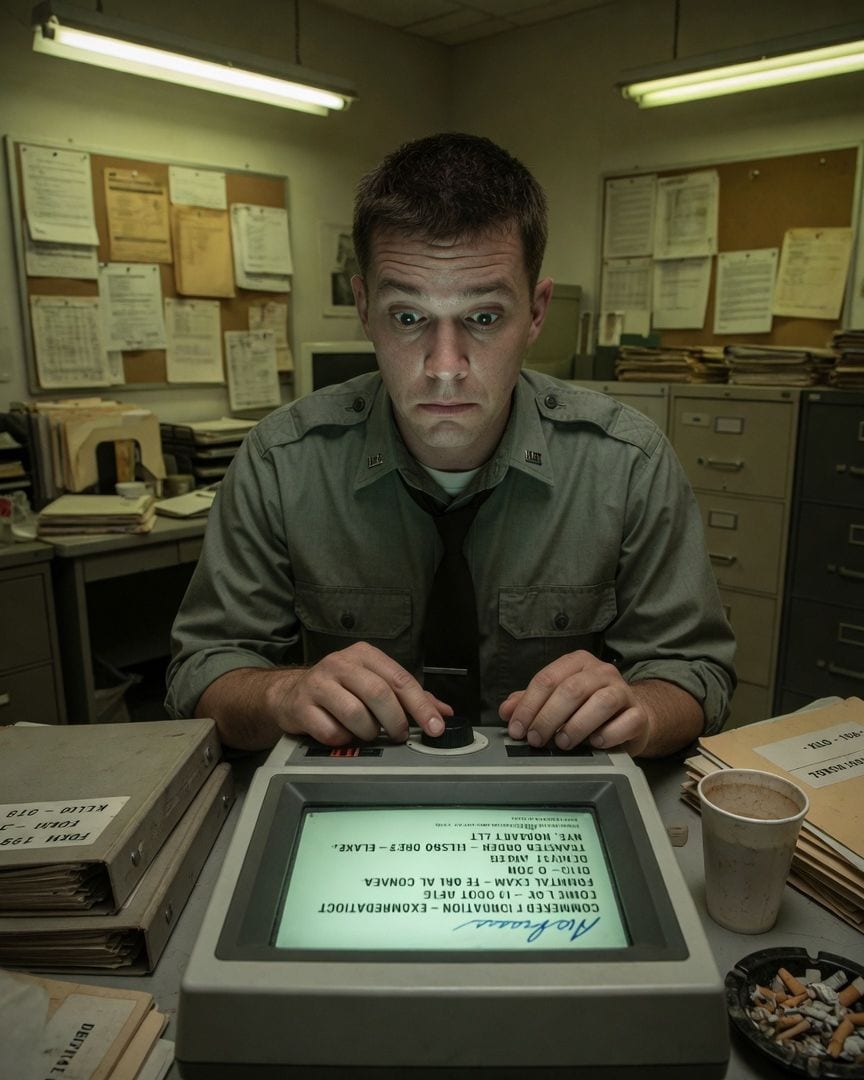
Second Lieutenant Hobart Nye, a missile commander in Wyoming, had his quiet 0247 watch shattered by a security report: a massive, silent black triangle hovered over Launch Facility Kilo, casting a perfect shadow. Hobart watched his console's fault panel light up, signaling all ten nuclear missiles going dark in an impossible silence, followed by eleven minutes his security team could not remember. Official logs called it a "radio malfunction," but Hobart found a requisition for invisible-tracking sensors, signed by a base commander who was supposed to be off-base. The final, chilling discovery came when his own service record showed new entries—a dental check-up, a transfer to Alaska—all dated for a future he never lived, complete with his perfectly replicated signature.
With Firebase 7 days from demolition, a dispatch specialist found his own signature on a log entry from a lost outpost. Then, a dead soldier's name appeared.
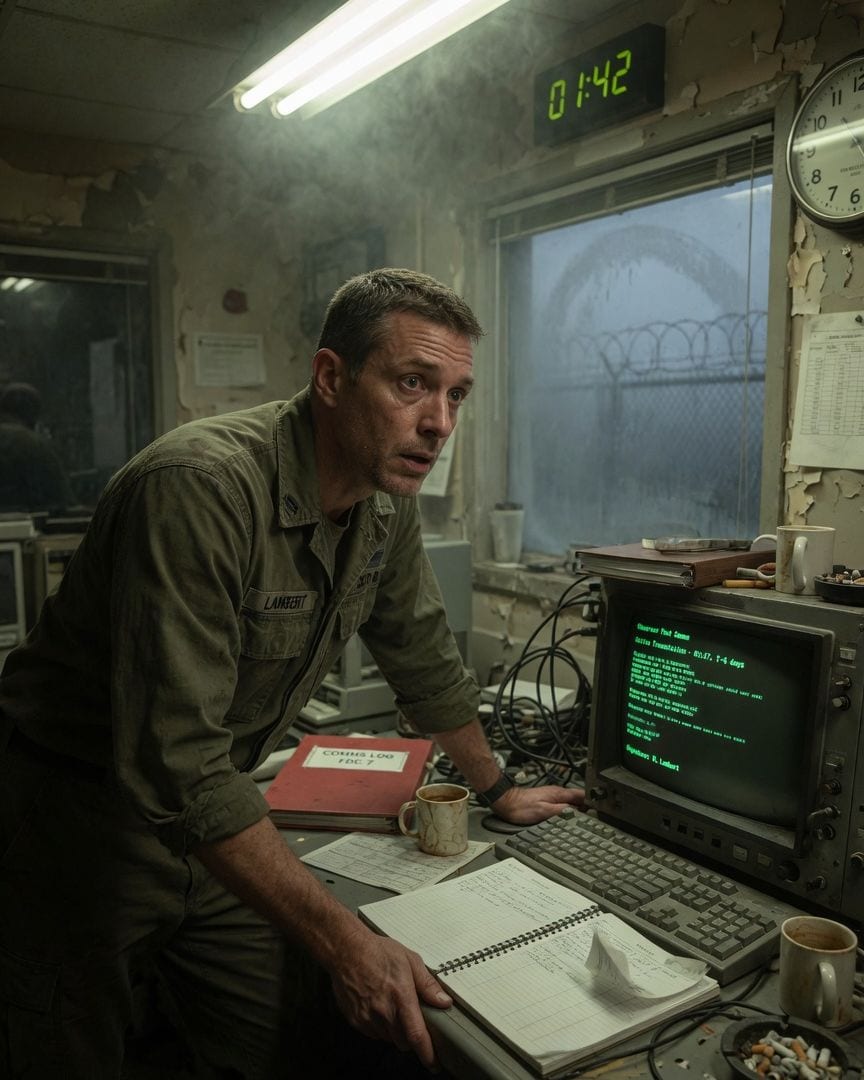
Specialist Robert Lambert hunched over the radio console in Firebase 7, the mountain fog pressing in as the base counted down its final days before demolition. His quiet shift shattered when urgent calls began arriving from outposts officially declared silent a week ago. His sergeant calmly informed him that he’d been speaking to no one, as all comms with those posts had been lost for hours. Later, Robert found a log entry for an active transmission, dated days after a post went dark, bearing his own signature. What chilling truth lay beneath the paper, revealing a dead soldier's name reporting from the grave?
Specialist Duarte, two weeks from going home, found his empty truck seat warm and dented — then his service record showed a ghost deployment he never made.
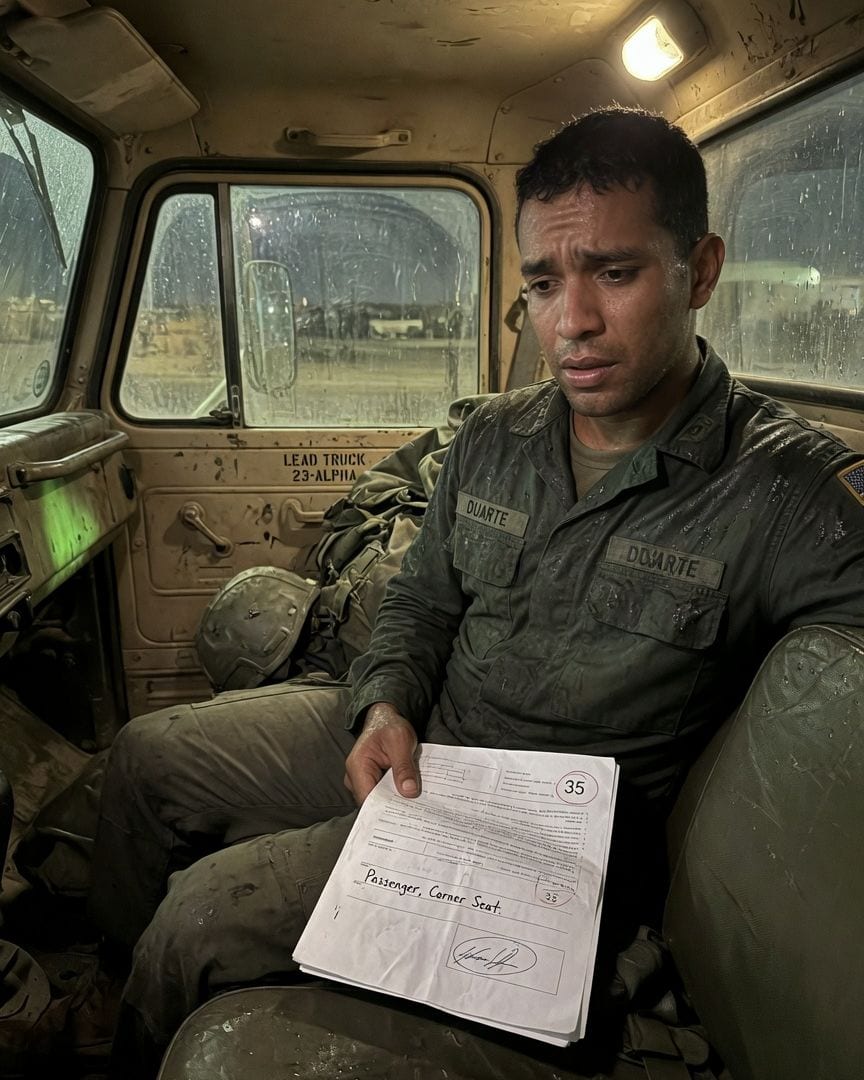
Specialist Felix Duarte was just two weeks from going home, but a final convoy mission held an unsettling mystery. Soaked and running late, he squeezed into the lead truck's forbidden corner seat, a place every soldier knew to leave empty. Hours later, stepping out into the desert, he found the seat was strangely warm and distinctly dented, as if two unseen bodies had pressed in beside him. The official manifest then listed an extra soul for his truck, simply 'Passenger, Corner Seat,' signed by his own hand. What impossible presence had shared Specialist Duarte's ride, and what other records might it have altered?
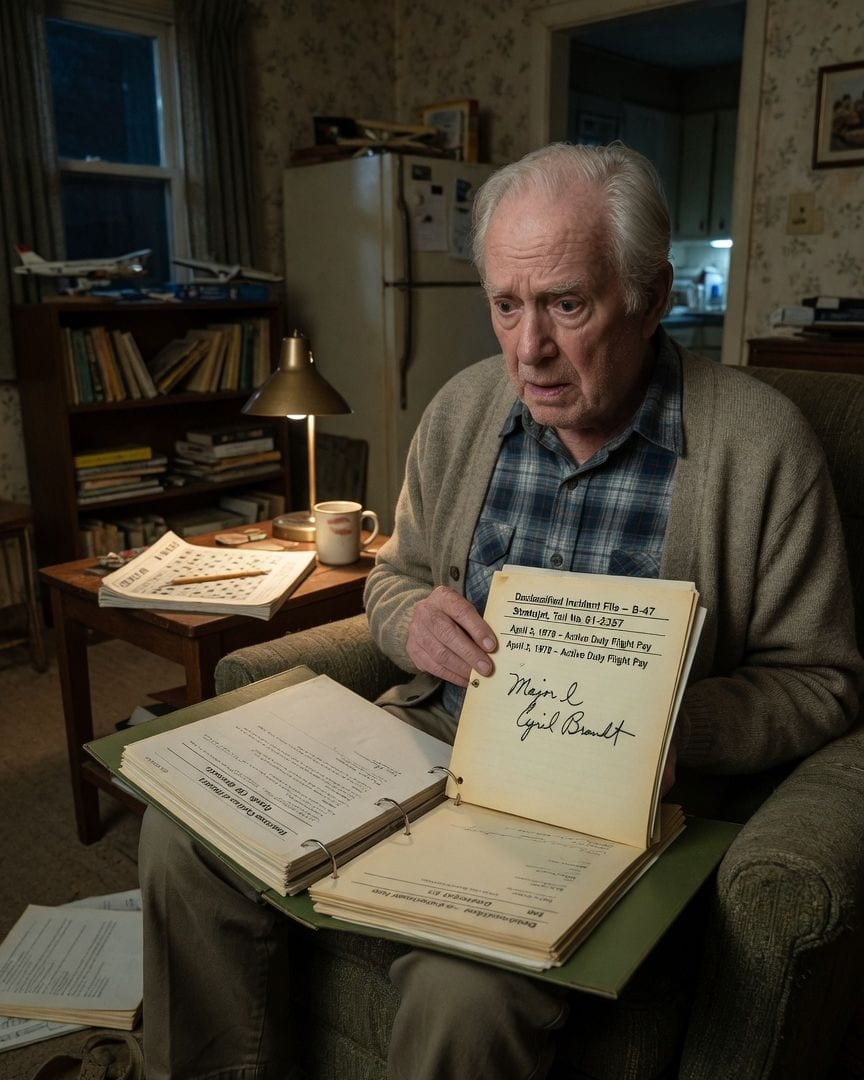
A retired Cold War pilot found his own signature on a flight pay record, dated five years after he left active duty, the ink unnervingly fresh.
Cyril Brandt, a seventy-two-year-old retired B-47 pilot, cherished his quiet Dakota retirement, his days filled with crosswords instead of combat. He expected to find long-awaited closure on a strange 1968 UFO incident when a heavy, declassified file arrived. Settling into his armchair, the weight of the olive-green binder felt familiar, but its contents quickly shattered his calm. He discovered maintenance logs for his B-47, detailing engine hours and tire rotations, dated years after the aircraft had been scrapped. Then, buried deeper, he found a payroll entry for himself, dated 1978 — five years after he left active duty — bearing his own unmistakable signature, the ink unnervingly fresh. How could his own hand have signed off on a mission that never happened, for a plane that no longer existed?
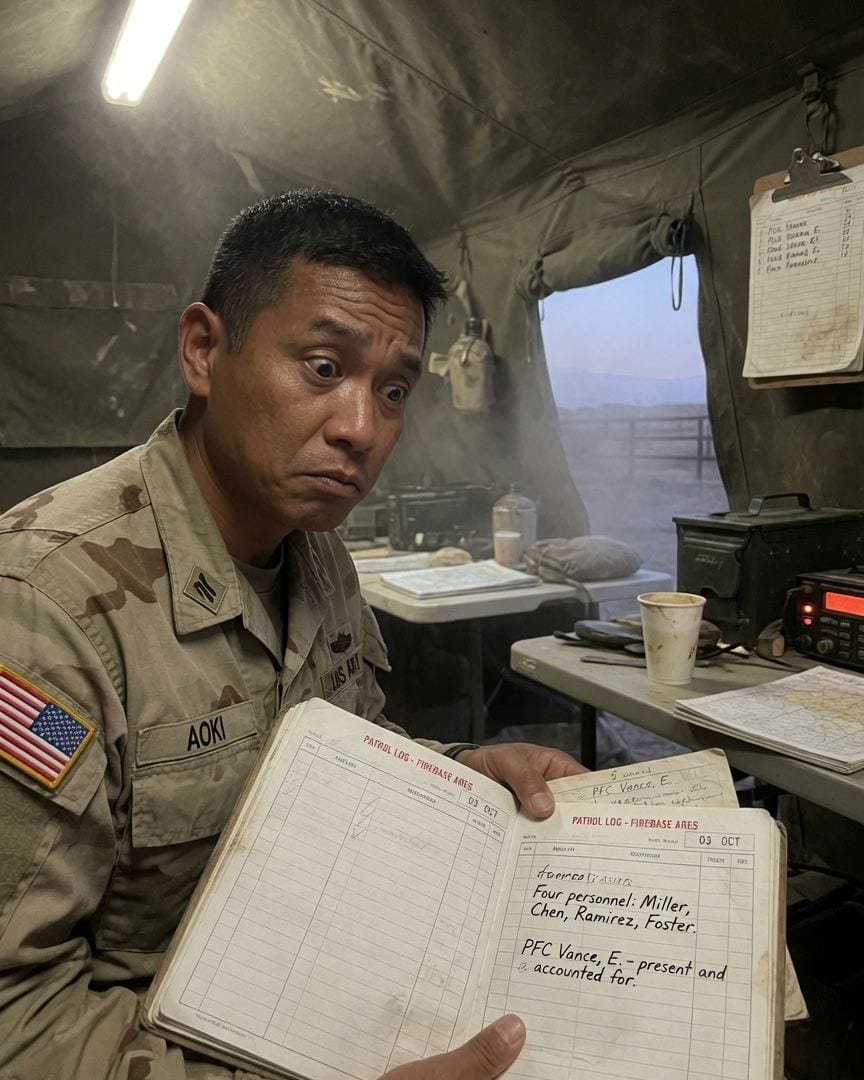
On his final patrol, Sergeant Hans Aoki led his four-man team. A fifth figure, silent, disciplined, shifted its weight right off his shoulder. Then his own signed log confirmed five men present.
On his final patrol through the pre-dawn Afghan desert, just hours from leaving Firebase Ares for good, Sergeant Hans Aoki led a disciplined four-man team. At the halfway point, a fifth figure, silent and disciplined, shifted its weight right off his shoulder, matching his stride; Aoki saw only four men, but the phantom presence remained, and the comms static felt like a muffled whisper. Back at the operations tent, his own signed patrol log, confirming four men, then listed an impossible fifth soldier, 'PFC Vance, E.', as present and accounted for. What impossible truth had his own hand attested to?
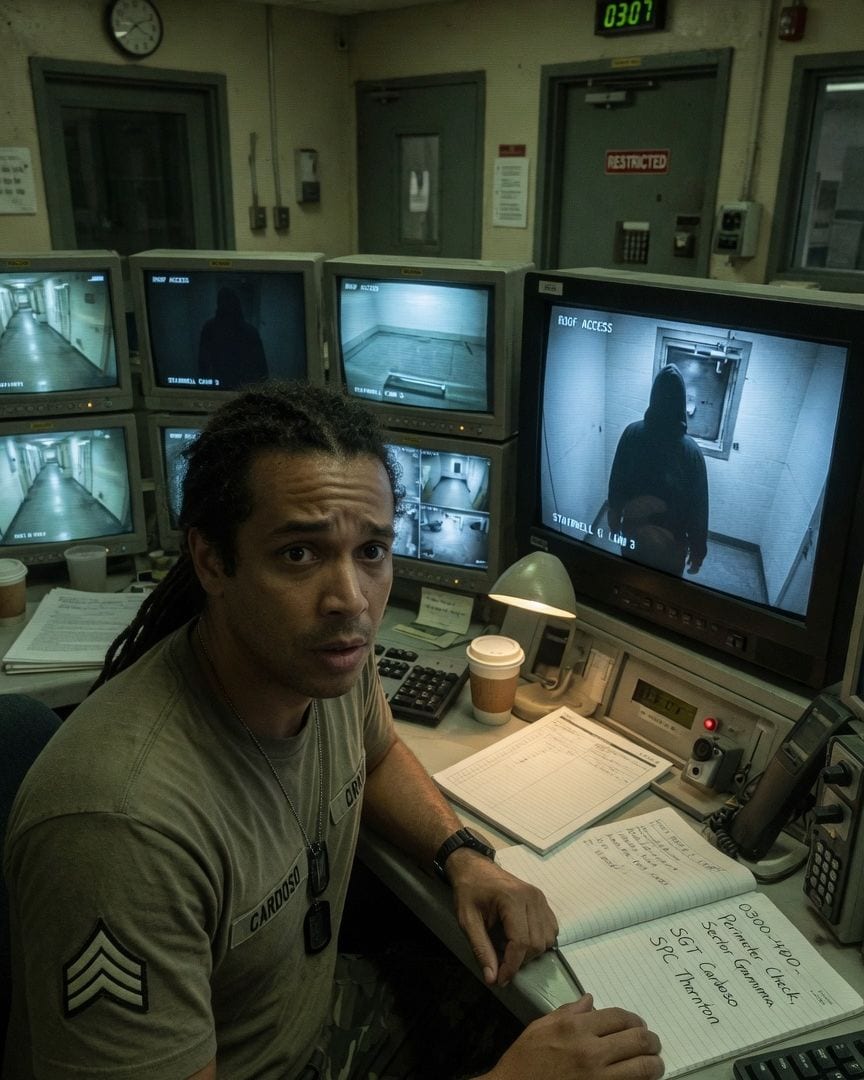
On his last watch, Sergeant Cardoso found his own signature in the duty log for a perimeter check he never did, with a name he didn't know.
Sergeant Rui Cardoso was on his final interior watch at Fort Merritt, a remote coastal outpost, as 0300 ticked by. He spotted a dark, unmoving figure on a monitor showing the sealed roof access, a figure that inexplicably shifted closer to the hatch moments after a specialist confirmed the roof was empty. Rui checked every log and sensor, but the digital fortress showed no breach, and the figure's appearance defied all logic. Yet, in the physical duty log, he found his own unmistakable signature on an entry for a perimeter patrol he never took, alongside a soldier's name he'd never seen. What impossible truth was written in his own hand?