A Fort Clayborn private only folded one flag, but the official record swore he performed a second, impossible service.
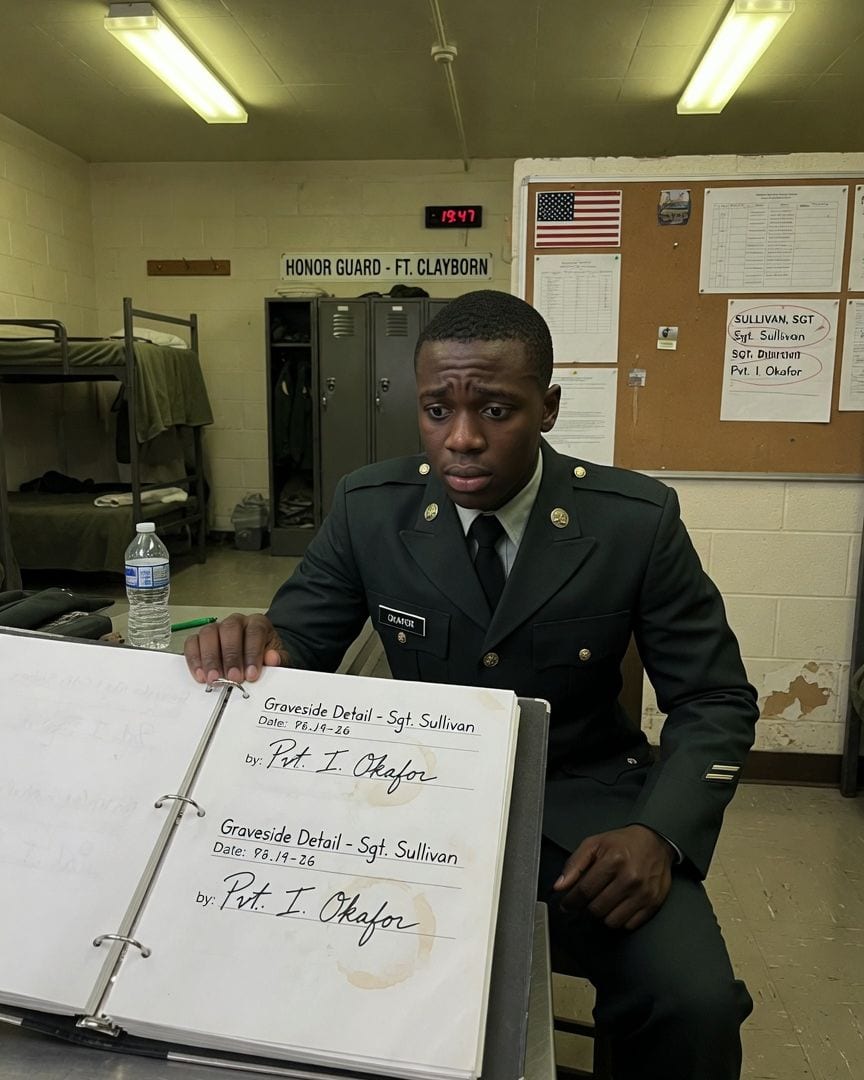
Private Isaac Okafor, new to the Fort Clayborn honor guard, stood beside the fresh grave. The ceremony had concluded, the family had departed, and the flag was ready for its final folds.
The air hung heavy with the scent of damp earth and faded lilies. Against the unwritten rule, a quiet, almost unconscious whisper escaped his lips, a soft, reverent sound carried by the faint breeze.
He repeated the name of the fallen soldier: "Sergeant Sullivan."
He began the solemn process, counting the folds in silence, his movements precise and practiced. One, two, three… The flag, crisp and star-spangled, transformed into a tight triangle of red, white, and blue.
But as he reached the thirteenth section, the fabric came out loose, resisting every attempt to pull it taut.
He tried again, his brow furrowing, pulling harder, but the material refused to hold its crisp line, a small, stubborn wrinkle in the perfect form.
The dread was a quiet hum beneath the skin, a wrong note in the sacred silence, a tiny flaw in what should have been immaculate. The weight of the flag in his hands suddenly felt heavier.
Back in the barracks, the fluorescent lights hummed with an indifferent drone. Isaac stared at the duty log, a standard-issue binder filled with printed rosters and handwritten signatures. His name, ‘Pvt.
I. Okafor,’ was signed neatly beneath an entry for a graveside detail that afternoon – the very one he’d just finished.
But then, an identical entry, impossibly, for a second service for Sergeant Sullivan, listed for the same day, hours later, complete with his own signature. Isaac hadn't signed this. He knew for a fact no second service had occurred.
He stared at the looping 'f' in Okafor, the familiar slant of the 'k.' The handwriting was undeniably his own.
He pulled Specialist Benjamin Kowalski aside, who had been on duty at the time, his uniform still smelling faintly of starch and recent outdoor air.
Kowalski, chewing on a piece of gum, confirmed there was only one service for Sullivan that day. Isaac had been present only for that one. Kowalski shook his head.
He’d never seen a second service scheduled, let alone signed Isaac into it. His own entry showed a different detail entirely.
Isaac’s rational mind tried to find an explanation: a prank by another recruit, a clerical error, a new recruit misfiling. But the signature was too perfect, too authentic, the detail too specific.
And the memory of that loose thirteenth fold persisted, a nagging physical impossibility that defied any simple explanation.
The silence of the barracks felt suddenly oppressive, the mundane objects around him – the neatly made bunks, the lockers, the polished floor – seemed to watch.
Isaac reported the anomaly to Sergeant Emily Ford, a no-nonsense NCO who ran the honor guard detail with meticulous precision. Ford listened, her expression unreadable, her gaze steady.
She gave a curt nod, then pulled up Isaac’s digital service record on her console. Her fingers flew across the keyboard, a rapid, practiced blur.
The screen refreshed, displaying a commendation for 'exemplary conduct during the graveside service of Sergeant Sullivan,' dated that very afternoon. But it wasn't for the single service Isaac had performed.
It was for the impossible second ceremony, the one he was sure never happened. Below it, his own name, 'Pvt. Isaac Okafor,' was listed as the primary flag-folder.
The system, built for unimpeachable accuracy, swore he was there, and that he had been recognized for it. The soft hum of the console seemed to intensify, the air in the small office growing colder.
Sergeant Ford simply stared at the screen, then at Isaac, her silence heavy with unspoken questions. The official record, unyielding and digital, proclaimed a truth Isaac knew to be a lie.
The next day, Isaac, armed with the printout of his impossible commendation, sought out the records office.
Fort Clayborn was slowly emptying out, its vast halls echoing with the occasional clang of distant demolition or the whir of a cleaning cart.
Lieutenant Walter Mercer, a stoic, silver-haired officer with an air of quiet efficiency, was still there, overseeing the final archiving.
He sat behind a large, metal desk piled with dusty ledgers and binders, a single desk lamp casting a pool of yellow light.
Mercer, without looking up from one of the ledgers, listened to Isaac’s account. His only reaction was a slow, deliberate nod.
Then, he calmly typed Isaac’s name into the system on his own console, his fingers moving with a surprising speed for a man who seemed so rooted in the past.
He pulled up not just the commendation, but other, smaller, less significant entries.
Isaac watched, transfixed, as more impossible duties scrolled across the screen: a 'graveside vigil' for a corporal in a town thirty miles away, a 'midnight flag change' at a post that had been empty for a decade.
Each entry bore Isaac’s digital signature. And each was for a duty he had never performed.
Mercer clicked through a few entries, revealing brief, handwritten margin notes beside several of them: '13th fold loose.' The phrase was unsettlingly familiar.
The pattern was emerging, recent, all within his own tenure on the honor guard detail, and chillingly consistent. Isaac felt a cold knot tighten in his stomach, a physical sensation of growing unease.
This wasn't a prank, nor a simple clerical error. This was a system failing, not through human mistake, but through something else, something that left a physical trace, a repeated, impossible flaw.
The records office, with its smell of old paper and dust, suddenly felt less like a bureaucratic hub and more like a mausoleum of forgotten truths.
Isaac left Mercer’s office feeling exposed, as if the walls of Fort Clayborn had suddenly become transparent. Later that afternoon, he caught sight of Lieutenant Mercer watching him from the mess hall window.
Mercer stood perfectly still, a cup of coffee steaming in his hand, his gaze distant but focused, fixed squarely on Isaac as he walked past.
The lieutenant didn’t wave, didn’t acknowledge Isaac in any way, just observed, a silent sentinel in the window. The mess hall, usually a place of chatter and clatter, felt unnaturally quiet from this distance.
A few hours later, back in his barracks, Isaac found a printout tucked under his pillow. It was a copy of his own impossible service record entries, the details circled in red ink.
On the back, scrawled in Mercer’s precise, almost elegant hand, was a single question: 'Whispered any names lately, Private?' The question wasn't accusatory, nor did it hold any surprise.
It was knowing, almost weary, as if Mercer had expected this, had been waiting. Isaac felt a prickle of fear, cold and sharp, realizing his investigation had not gone unnoticed.
Someone knew, and that someone was now turning their attention to him. The hunter, he realized with a jolt, had become the hunted. The barracks, once a sanctuary, now felt like a glass cage.
Isaac confronted Mercer in his office the next morning, the printout crumpled in his hand. “What is this, sir?” he demanded, his voice tight, barely controlled.
Mercer looked up from a stack of files, his expression unperturbed, his gaze calm as he met Isaac’s eyes. “A confirmation, Private,” he said, his voice flat. “That you’ve joined the club.”
Mercer gestured to a worn, leather-bound binder on a high shelf. Its spine was labeled, in the same precise script that appeared on the note under Isaac’s pillow: 'Anomalous Records - Honor Guard.'
“This has been happening here, at Fort Clayborn, for decades.”
Mercer reached for the binder, pulling it down with a soft thud onto his desk. Inside were meticulously organized records, photocopies of old logbooks, service files, and commendations, all carefully sorted and indexed.
He flipped it open, the pages stiff and yellowed with age, and pointed to an entry for a Private Albert Hayes, dated 1978.
Hayes’s record showed a commendation for a graveside duty he couldn’t have performed, followed by subsequent impossible entries for other duties. And in the margin, a familiar, unsettling note: '13th fold loose.'
Mercer leaned back in his chair. “The unwritten rule about not whispering the name, Private, is not superstition. It’s a forgotten warning.” He paused, allowing the words to sink in. “You whisper a name, Private, and it anchors something.
Something that weaves itself into the records, into the very fabric of this place. It’s not a ghost. It’s a distortion. And the more you try to make sense of it, the deeper it pulls you in.”
Isaac’s earlier encounters, the loose fold, the impossible signatures, the phantom entries – they clicked into horrifying focus, like tumblers falling into place in a lock. It wasn't a glitch in the system.
It was a system, a pattern, cold and deliberate. The room seemed to expand around him, filled with the weight of decades of documented impossibilities.
Mercer flipped through the binder, past dozens of similar cases, each detailing a soldier, a whispered name, a loose fold, and then a cascade of impossible records stretching across the years.
The air in the office seemed to grow heavier with each turn of the page. “The distortion isn’t just present,” Mercer said, his voice low, almost a whisper, “it’s recursive. It pulls you into its own history.”
He stopped on an entry from 1985, for a Specialist Nancy Sheppard, detailing a minor honor guard ceremony, an impossible duty, and, of course, a loose 13th fold noted in the margin.
Beneath Sheppard’s name, under 'Witnesses,' was a faded, almost invisible script. Isaac leaned closer, his breath catching in his throat, a cold rush through his veins. Written there, in a hand that was impossibly familiar, was the name: 'Pvt.
Isaac Okafor.' A cold dread, far deeper than before, settled over him. He hadn't just discovered a pattern. He was already a part of its past, a ghost in records that predated his own existence.
“It’s not just a record of what happened,” Mercer explained, his finger tapping the faded name in the 1985 log. He sounded like a professor lecturing on an obscure but self-evident truth. “It’s a record of what will happen.
Or, rather, what has always happened here. The whispered name, the loose fold—they’re not just effects, they’re triggers, anchors for the distortion. It’s a localized anomaly, tied to this ground, to the ritual itself.”
Mercer looked at Isaac, his eyes holding an ancient weariness. “It feeds on the precision, the accountability of the military system, twisting it.
You whisper a name, Private, and you become a part of the ‘honor guard’ of this place, not just for the living, but for the dead, and for the records that swear otherwise.”
He closed the binder with a soft thud that echoed in the quiet room. “Your name appearing in 1985 isn’t a paradox.
It’s the distortion weaving you into its own timeline, making you a phantom witness to events long past, and ensuring your own records will become part of the anomaly’s history for others.”
Every strange detail, every impossible signature, every loose fold, now clicked into a horrifying, coherent whole. Isaac wasn't just observing a mystery; he was becoming its next entry.
The very air in the office seemed to hum with this impossible, self-evident truth.
Isaac, overwhelmed, lunged for the binder, his intention clear: to destroy it, to break the cycle, to obliterate the impossible. Mercer intercepted him with surprising agility, placing a hand on his arm, a grip that was firm but not violent.
“It won’t work, Private,” he said, his voice calm but firm, holding Isaac’s gaze. “You can’t destroy it. You can only understand it, and perhaps, endure it.”
Mercer released his arm and led Isaac to a locked display case in the corner of the office, bathed in a soft, ethereal glow from a small spotlight.
He unlocked it with a practiced hand, the tumblers clicking softly, revealing a single, carefully folded American flag, encased in clear acrylic. “This,” Mercer said, his voice dropping slightly, “is from a ceremony in 1978.
Private Albert Hayes, the first entry in my binder, folded this flag.”
Isaac looked closely, his heart pounding in his chest. Despite the years, despite the perfect preservation under the acrylic, the thirteenth fold of the flag was visibly, inexplicably loose, a subtle but undeniable flaw in the otherwise immaculate fabric.
It was real, it was dated, and it was irrefutable. The ordinary explanations – a clerical error, a prank, fatigue, a simple mistake – died a final, definitive death in that moment.
The artifact, impossible and tangible, confirmed the horror of Mercer’s words. Isaac stared at the flag, his escape now an illusion, a distant, forgotten hope.
He was already part of the record, woven into the fabric of Fort Clayborn’s quiet, systemic dread. The display case hummed with its own silent, contained power.
Days later, Fort Clayborn was a ghost town, mostly empty save for the final demolition crews and a few lingering administrative staff.
Isaac’s transfer orders to a new posting came through, without a hitch, as if nothing out of the ordinary had ever occurred.
His service record, he noticed, had a few more minor entries: 'graveside assistance, Camp Pendleton, 2015,' 'flag maintenance, Fort Bragg, 2017' – small, innocuous duties he had never performed, scattered across dates when he was nowhere near those bases.
No one in his new unit seemed to notice, or if they did, they dismissed them as the usual bureaucratic oddities, the inconsequential background noise of military administration.
The anomaly had not been stopped, only absorbed, and Isaac with it, a small, recurring detail in its vast, impossible tapestry.
A week into his new assignment, Isaac received a small, official-looking envelope, addressed to him by name. Inside was a farewell note from Sergeant Ford, wishing him well in his new unit, her signature crisp and professional.
Tucked beneath it was a single, folded piece of paper. It was a printout of a duty roster, dated years in the future, for an honor guard ceremony at Fort Clayborn, long after its official closure and complete demolition.
Under 'Witnesses,' in a faint, almost invisible script, was the name: "Pvt. Isaac Okafor."
Life went on, the military system humming along, precise and accounted for.
Occasionally, a new recruit on honor guard duty at a different, older base, might whisper a name a second time, and find their thirteenth fold just wouldn't stay tight.
For those who noticed, another name would subtly appear, a ghost in the machine, on a future roster for a place long gone. "Pvt. Isaac Okafor."
If this one got to you
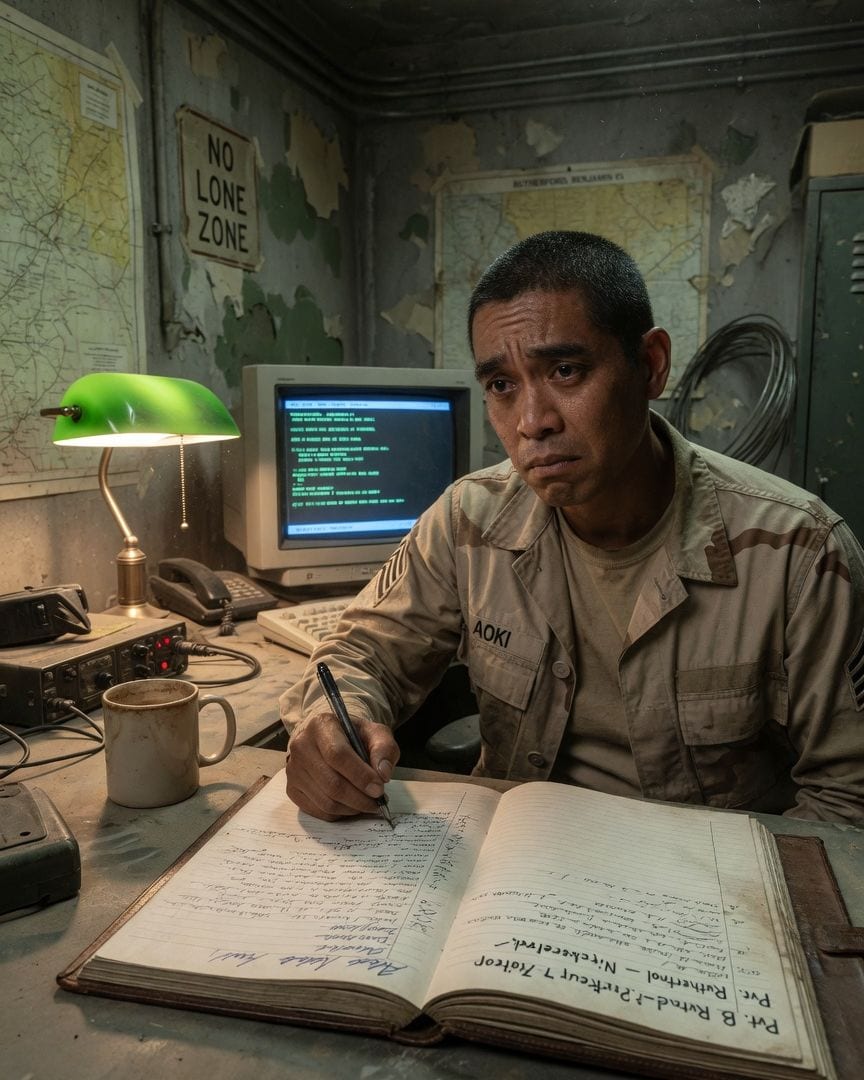
Sergeant Aoki's four-man patrol hears a fifth voice answer their count. A fresh name then appears in the duty log beneath his own signature.
Sergeant Isaac Aoki's final rotation at Outpost 7 was nearing its end, with relief due at dawn. On his four-man night patrol, he broke an old superstition, counting his team aloud in the dust-choked desert. A fifth voice answered, clear and unsettling, from the moonless dark. Back inside the bunker, the chill deepened when a fresh name appeared in the duty log, 'Pvt. B. Rutherford,' beneath Aoki's own signature, a soldier no one knew. Even more disturbing, Aoki later found his own signature on a valor citation for Rutherford, an event he never witnessed.
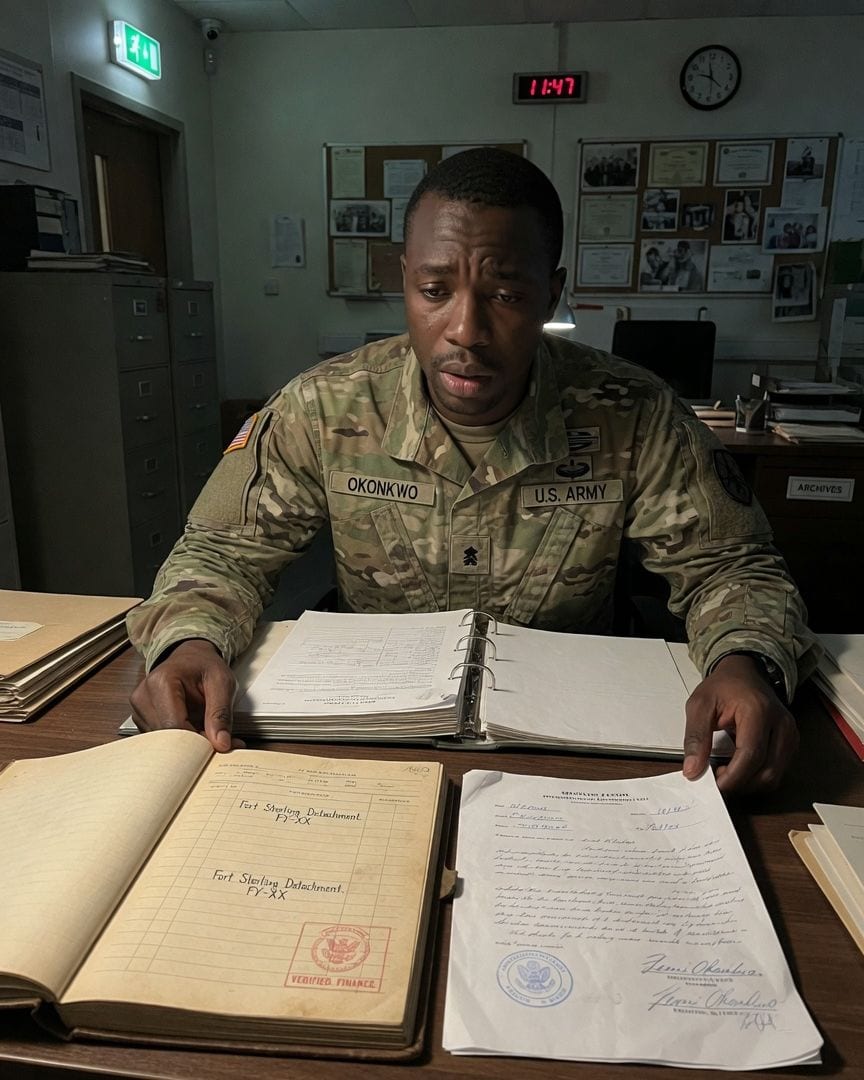
An old deployment ledger bore Specialist Femi Okonkwo's name, but the elegant signature was not his own.
Specialist Femi Okonkwo, an Air Force cargo hauler, stared at an earnings statement that contradicted his entire four-year enlistment. It listed nine months of jump pay and a mountain duty station in Colorado—places he’d never been, operations he’d never completed. Finance and HR records, seemingly impeccable, confirmed every detail of his impossible deployment. But when Femi finally retrieved the physical sign-in ledger, the faded blue ink of his supposed signature revealed the true, chilling discrepancy: the neat, elegant hand on the official document was unequivocally not his own. Who signed for Specialist Okonkwo’s impossible deployment, and why was it so meticulously verified?
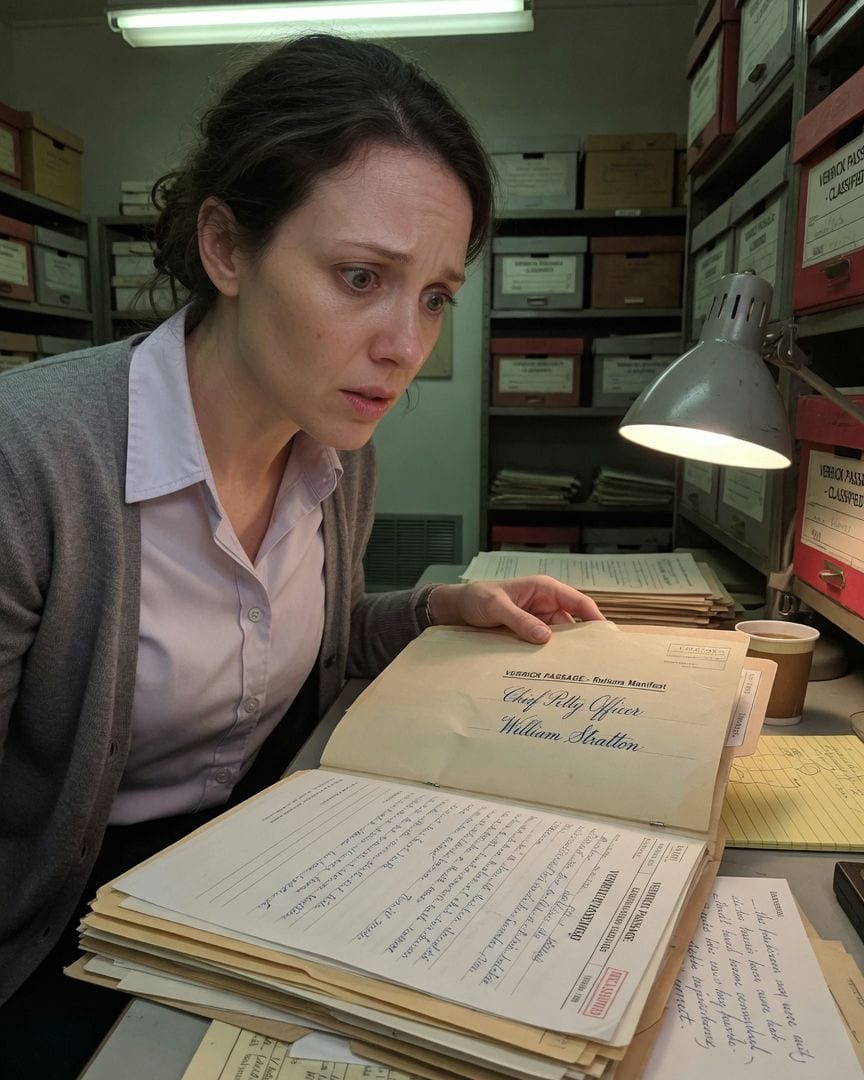
A records reviewer found personnel files for men lost 80 years ago, still being signed in an identical, perfect hand.
In the sterile hush of the declassified archives, meticulous reviewer Ione Fash had a routine task: cross-referencing witness statements from the Verrick Passage file. But as she reviewed files eighty years thick with official silence, she found nine separate interviews containing the exact same chilling sentence, all in an identical, precise hand. Her rational mind sought explanation, yet then she discovered something worse: personnel files for men lost in 1943, still being updated with modern requisitions and payroll runs. Each impossible entry, including a manifest signed just two weeks ago by a casualty from eighty years prior, bore the same unnervingly perfect signature. The file wasn't just a record of the lost; it was still being signed.
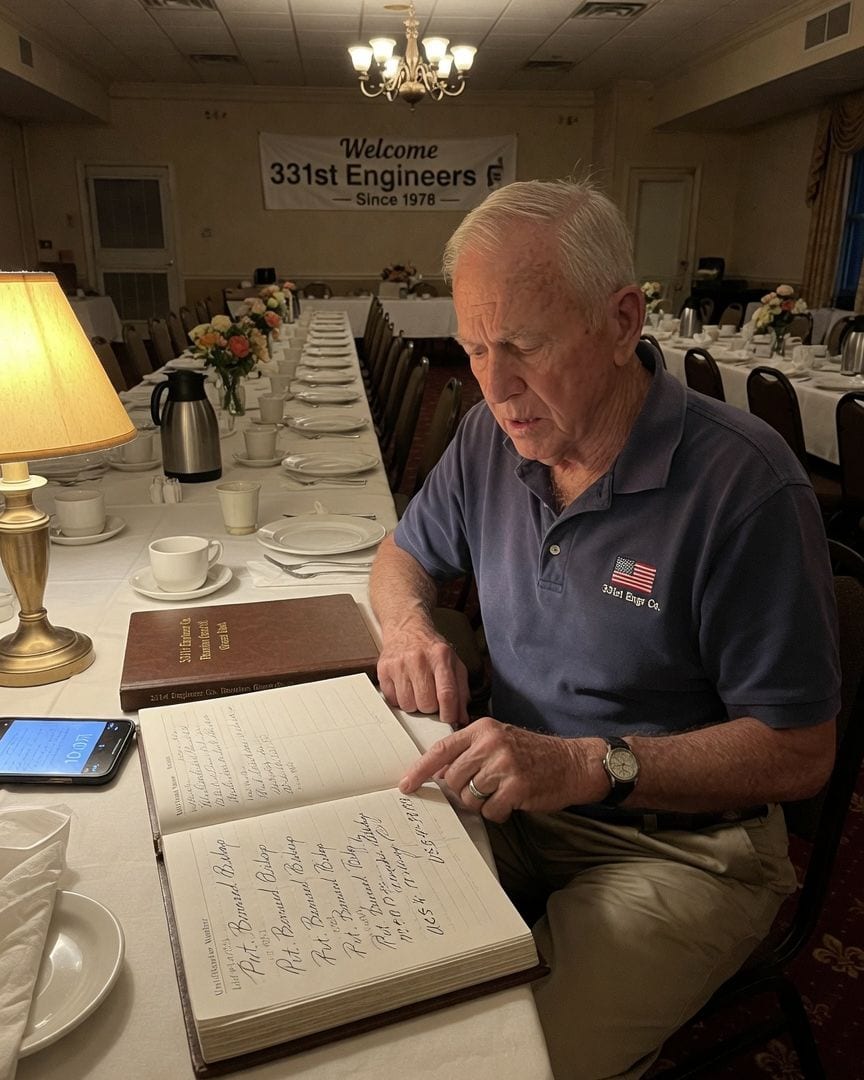
Retired Sergeant Odis Trumbull found a reunion guest book signed by a dead man. His service number was for a classified unit, not his own.
Retired Sergeant Odis Trumbull arrived at his annual company reunion, a tradition held in a Biloxi hotel ballroom since 1978. He sat alone for three hours, watching thirty empty chairs, each a ghost of a comrade he had personally buried over four decades. When the guest book arrived, Odis found thirty-one signatures, one for every man on the rolls. The ink on the last entry, for Private Bernard Bishop, was still wet. Yet, Odis had carried Bishop's coffin in 1976, two years before the reunion even began, and his service number matched a classified Cold War command. As Odis ran his thumb over the impossibly fresh ink, a cold dread began to settle.
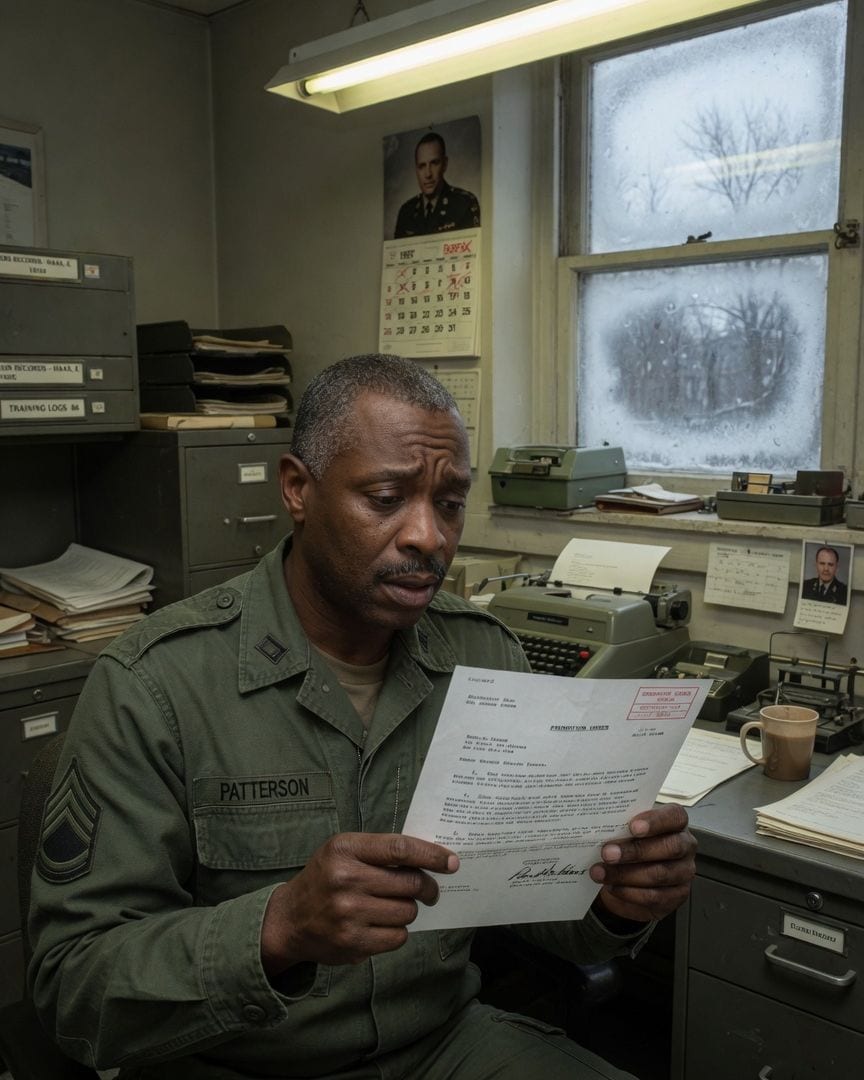
Staff Sergeant Felix Patterson held a promotion order for a young corporal, signed by a Cold War colonel dead for a full year.
Staff Sergeant Felix Patterson felt the German winter chill as he stood in the base admin office, holding Corporal Erich Haas’s promotion order. The young clerk, Private Davenport, wrung her hands, confirming the impossible: Colonel Fairfax’s signature was genuine, despite the colonel having been dead for a full year. A deep, cold dread settled in Felix’s gut, making the office air feel heavy and silent around him. He spent days scrutinizing Haas’s service record, soon uncovering a training certificate also bearing the deceased colonel’s signature, dated months after his death. This was no mere bureaucratic slip; these meticulously clean documents were fundamentally, impossibly wrong.
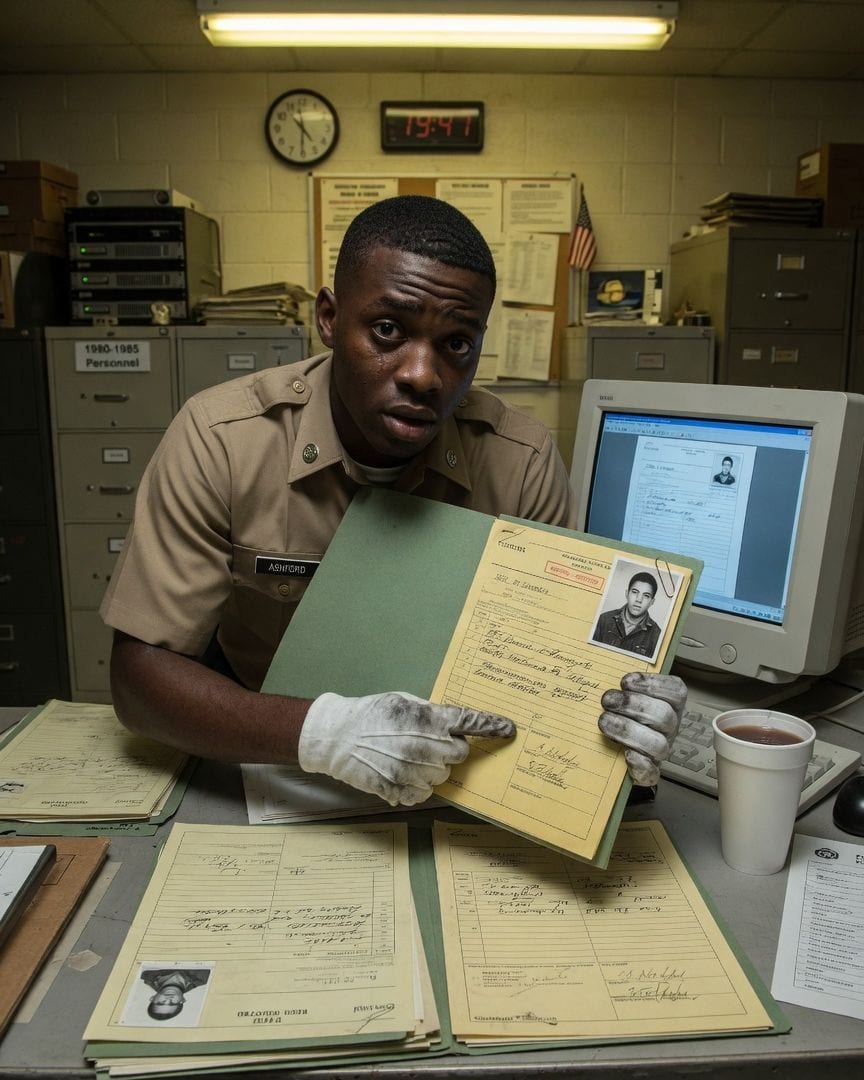
An honor guard private finds his own signature on a dead soldier's 1980 supply form, dated for a week he was sick on base.
Private Samuel Ashford, new to the honor guard at Fort Bragg, took his duties with solemn precision, even whispering a fallen soldier's name a second time to be sure. But soon, strange things began to disturb his routine. First, the flag for every ceremony refused to hold its final, perfect thirteenth fold. Then, a dead soldier's name, PFC Damien Kingsley, kept reappearing on the unit duty log, even after being scratched out, always with Private Ashford's own unmistakable signature beneath it. The chilling discovery led him to the base's digital archives, where he found his signature on a supply requisition from 1980, dated for a week he was sick in his own quarters. How could his handwriting appear on a document from decades before he was even born?