My half-landing window looks down on a cobbled street and a lamplighter. The same panes, the same crack in the corner, but below, only my bins.
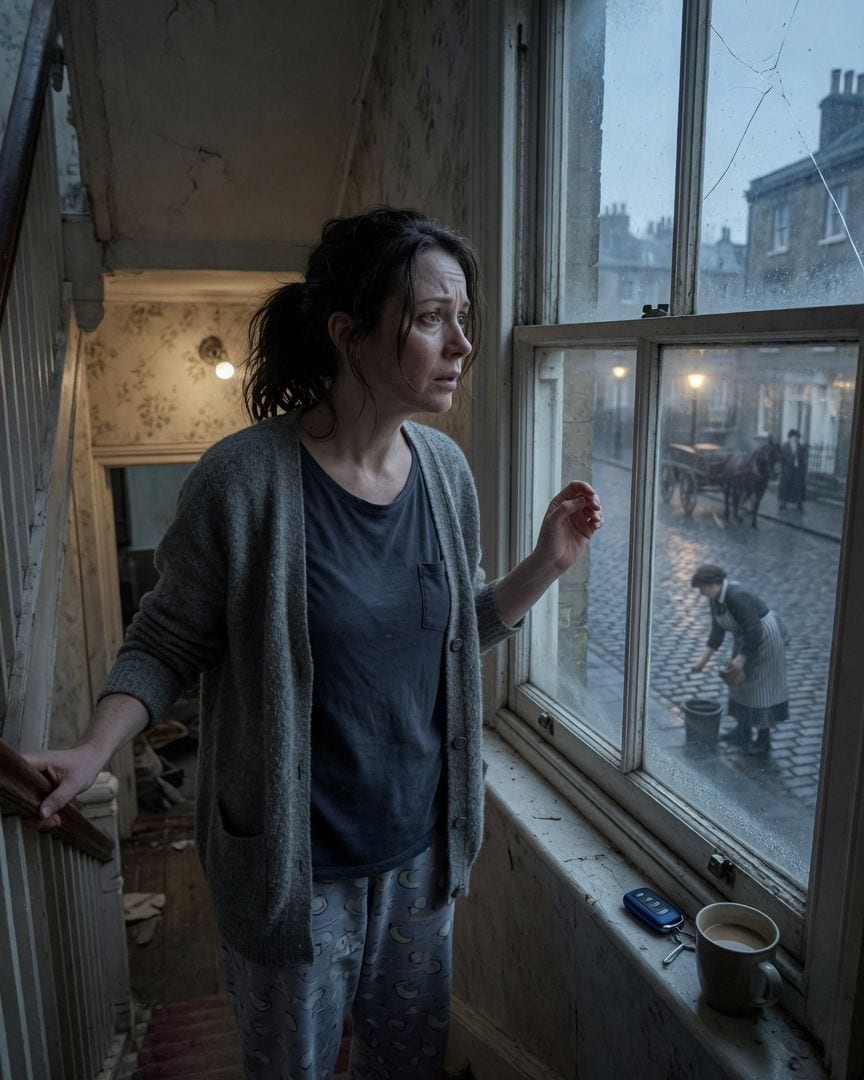
I knew, when I first saw the Victorian terrace, that it was perfect.
The high ceilings, the quiet street (or what I thought was a quiet street), the way the morning light hit the half-landing window, glinting off the familiar crack in the top right pane.
I’d inherited a bit of money and, at 34, was ready for something permanent. Something mine. For the first month, it was everything I’d dreamed of.
Then the mornings started.
The first time, it was a Thursday. A sharp, frosty morning, just after 7 AM. I was heading downstairs, still a bit groggy, when I glanced out the half-landing window. And there it was. Not my parked car.
Not the row of green wheelie bins. Below me, on what should have been the paved street, was a cobbled lane. A horse-drawn cart rumbled by, hooves clattering softly.
I could see the glow of a gas lamp and a lamplighter, a silhouette against the grey dawn, already at work. Further down, three doors along, a woman in an apron was scrubbing her doorstep with a bucket of suds.
It was like looking into an old photograph, only vibrant with movement and sound. I blinked, rubbed my eyes. The crack in the corner of the pane was still there, distinct and familiar, a small spiderweb in the glass.
I raced downstairs, flung open the front door. Nothing. My blue hatchback was exactly where I'd left it, an empty bin standing by the curb. The pavement was cold and damp. The air smelled of exhaust fumes and wet concrete.
I told myself it was tiredness. A trick of the light, perhaps, or a waking dream. But two days later, Friday, it happened again. Exactly 7:20 AM.
The same cobbled street, the same horse, the same lamplighter, the same woman scrubbing the same doorstep. Every detail identical. My stomach knotted, a cold, hard stone. I knew I wasn't imagining it. This wasn't a dream. This was happening.
The window wasn't the only thing. Once I started looking, once I started feeling that knot in my gut, I noticed the house had other habits. Uncanny, scheduled occurrences that made no sense.
At precisely 5 PM, almost every day, a faint but distinct smell of slow-cooked stew would drift through the kitchen. It was meaty, thick with root vegetables, almost savoury enough to make my mouth water.
But I’d only cooked toast that day. Or a ready meal. My kitchen was clean, empty, not a pot on the hob. I checked the drains, the cupboards, even the next-door neighbour's vents. Nothing.
The smell was there, then it wasn't.
Then there was the kettle. Most mornings, around 6 AM, I’d hear a faint click from the kitchen, sometimes followed by the soft hiss of water coming to a boil. I always left it empty.
I made coffee, not tea, and I usually filled it fresh. I’d rush in, half-expecting to see a ghost, but it would just be sitting there, warm to the touch, or even still bubbling gently, steam pluming from its spout.
Once, I actually saw the handle depress, heard the switch engage, and watched the water begin to roil, all on its own. I yanked the plug out of the wall and left it on the counter, unplugged, for a week.
The clicks stopped, but the memory didn't.
The house had other, quieter echoes. There was a particular worn patch on the carpet in the living room, right by an old, dark wooden armchair that came with the house.
It was a perfect semi-circle, as if someone had habitually sat there, turning their feet outwards, for decades. I found myself drawn to that chair, but never sat in it. And the third stair.
On the main staircase, four flights up, the third step from the bottom. I found myself unconsciously avoiding it. Stepping over it, or shifting my weight to the side, a habit I couldn't explain.
I’d catch myself mid-stride, wonder why I’d done it, and then do it again the next time without thinking. It was like an invisible tripwire.
One afternoon, still unsettled by the phantom stew, I was investigating a slight draught in the hallway, pulling up a loose floorboard near the skirting. It creaked, stubbornly, revealing nothing but dust and cobwebs.
But further in, tucked deep into the cavity, my fingers brushed against something solid. I pulled it out. It was a small, leather-bound appointment book.
Its pages were brittle, yellowed with age, and it smelled faintly of damp earth and something else I couldn't quite place. Old paper, perhaps. Or something forgotten.
I carried it to the kitchen table, wiping away the dust. My hands were shaking a little. I opened the book. It was a meticulously kept diary, dated from decades ago.
The script was elegant, looping, but the ink was faded, difficult to read in places. My eyes scanned the brittle pages. January. February. March. Then, I saw it. An entry for '6 AM: Kettle.' And another: '5 PM: Stew.'
My breath hitched. There was even a small, hand-drawn map of the stairs, with an unmistakable 'X' on the third step. And on two specific dates, dates that precisely matched my unsettling window visions, the entry read: '7:20 AM: Window.'
My finger traced the latest of these dates, circled heavily in red. Beneath it, in faded ink, were two words. Just two.
‘Today. Don’t look down.’
The book felt cold beneath my fingers, despite the warmth of the room. ‘Today. Don’t look down.’ It spun me.
I couldn’t reconcile the neat, looping script with the chilling command, or the fact that this private record seemed to mirror my own strange experiences in this house, decades apart.
Shaken, I locked the diary in my bedside cabinet and spent the next few days in a blur of frantic online searches. House history. Past occupants. Anything.
Local records were sparse, but persistent digging eventually confirmed the house's last long-term owner: Rosemary Prescott. She had lived here alone from 1958 until her death in 1985, aged 78.
I found an old utility bill tucked into the back of a drawer in the kitchen, Rosemary's name faded at the top.
In another old book, left behind on a dusty shelf in the study, a faded sepia photograph slipped out. It showed a severe-faced woman, her hair pulled back tightly, sitting in the very armchair with the worn carpet.
The date stamped faintly on the back: '1971'. Rosemary Prescott.
The routines, meanwhile, intensified. The kettle didn't just click; it boiled with an insistence that rattled its lid. At five o'clock, the stew smell was so potent I could almost taste it, clinging to the air like a physical presence.
And the third stair. It wasn’t just a habit anymore. As I approached the staircase, I’d hear a rhythmic, soft tap-tap-tap from that specific step, almost like a cane. It wasn't loud, but it was there.
And I realised I wasn’t just unconsciously avoiding it; I was walking around it, stepping far to the left, as if following an invisible path already laid out, an invisible presence making space.
I pulled out the diary again, comparing Rosemary’s entries to my research. The dates, the times, they were exact. And the street. I cross-referenced it with old town plans. The street outside had been cobbled. Paved over around 1930.
Long before Rosemary moved in, according to records, but not so long before she was born.
One evening, the scent of stew was so strong it made my head spin, almost sickly sweet in its intensity. I’d left Rosemary’s diary on my bedside table, open to the last entry.
Now, tucked carefully between two of its brittle pages, was a small, hand-written note. I hadn’t seen it there before. The paper was identical, the same antique cream, the same faint watermark. And the script.
The elegant, looping hand of Rosemary Prescott. It read:
"You look down too, don't you? Some things are best left undisturbed."
A chill ran down my spine, an icy tendril that seeped into my bones. Not a note from the diary, but a note in the diary, addressed to me.
Later that night, as I sat reading in the living room, trying to make sense of it all, I heard a distinct creak from the floorboards directly above me. It wasn't the usual settling of an old house.
It was heavy, deliberate. Like someone shifting their weight. I froze, my book halfway to my lap. “Hello?” I called out, my voice thin in the sudden silence. No reply. Just the oppressive stillness.
The feeling of being watched, of another presence mirroring my movements, was now constant. I no longer felt alone in the house. I felt company. Unwanted, unseen company.
I needed to talk to someone. Not a friend. Someone who knew.
The next morning, I drove to the address listed for Sharon Sutton, Rosemary Prescott's old neighbour. She was 72 now, her house a mirror image of mine, but meticulously kept, with a riot of flowers in the front garden.
She offered me tea, and after some polite small talk about the weather and my new renovations, I cautiously brought up Rosemary.
Mrs. Sutton stiffened almost imperceptibly, her grip tightening on her teacup. "Oh, Rosemary Prescott," she said, her voice dropping. "A creature of habit, she was. Very particular."
"Yes," I ventured, "I've… heard. I found some old papers of hers." I paused. "She had some routines, I gather."
Mrs. Sutton gave a curt nod. "Set in her ways. Like clockwork. You could set your watch by Rosemary."
I pushed a little further, my heart thumping. "Did she… ever mention a particular window? The half-landing one, maybe? Checking it at, say, 7:20 in the morning?"
Mrs. Sutton sighed, a long, deep exhalation, her gaze distant, fixed on a spot somewhere beyond my shoulder. "That window," she murmured. "Oh, that poor woman. She never got over it." She looked back at me, her eyes surprisingly clear.
"She'd witnessed something terrible from that window, you see. As a child. Before she even lived here, really, but she visited family down the street. A little girl, barely five, fell from an upstairs window, right onto the cobbled street.
Didn't survive it. Happened just opposite, they said. Rosemary saw it all. Haunting, it was. Happened around 1910, I think. She was just a wee thing." Mrs. Sutton shook her head slowly. "She never got over it. Not ever.
She’d check that window every morning, same time. Every single morning. Even after the street was paved over, even after she got frail and barely moved. Her routines... well, they just kept going after she passed, didn't they?
Some said the house remembered her. Remembered her grief."
A cold dread seeped through me, deeper than anything before. The stew, the kettle, the worn carpet—all the tiny, inexplicable details of my life here snapped into sickening focus. Echoes. Echoes of a life lived with unwavering, tragic precision.
The house didn't just remember her grief; it remembered her.
Returning home, the house felt heavier, colder, the air thick with something unspoken. Mrs. Sutton's words had cemented the impossible truth: the house wasn't just old, it was… a record. Or something worse.
The first thing I saw when I walked into the living room, flicking on the light, was the mantelpiece. A small, framed, sepia-toned photograph now stood there, face down, resting against the stone. I didn't remember putting it there.
It definitely hadn't been there when I’d left. My hands trembled as I reached out, picking it up.
I turned it over.
It was a photograph of Rosemary Prescott, clearly older now, her face lined with the years. She was looking out from the half-landing window.
And the street visible behind her, beyond the glass, was unmistakably the cobbled street from my morning visions. The gas lamp. The horse-drawn cart, frozen mid-motion. The woman scrubbing her steps. All of it.
And the date, stamped crisply in the bottom corner of the photo itself, in clear, bold numbers, read:
'1988'.
I stared at the photograph, the weight of it heavy in my hands. Rosemary Prescott died in 1985. The cobbled street vanished in 1930. The date '1988' on the photograph was an impossible, undeniable fact.
My mind, usually so precise, buckled under the contradiction. It wasn't an echo chamber. It was a temporal trap.
The house wasn't merely retaining imprints; it was holding Rosemary, keeping her here, within her own looped routine, replaying the traumatic event that had defined her. Her grief, her habits, her very presence, were anchored here.
The 'Don't look down' in the diary. The note, "You look down too, don't you? Some things are best left undisturbed." It was Rosemary. A desperate, fading consciousness, trying to warn me.
Or perhaps, not just trying to warn me, but trying to reach me. The house, I realised with a sickening lurch, wasn't just absorbing its past. It was absorbing its occupants. Forcing them to relive a perpetual past.
The routines weren't just memories or echoes. They were the threads of Rosemary's continued, trapped existence.
And the house, by making me a witness, by drawing me into those same fixed points in time, was slowly weaving me into the same pattern. Preparing me. Preparing me to replace the fading imprint of Rosemary Prescott.
Panic, cold and sharp, rose in my throat. I couldn't let it happen. I had to break the cycle. I had to sever the threads. I went to the stairs. My heart hammered against my ribs.
Deliberately, I put my foot down on the third stair. A sudden, intense cold spot enveloped my ankle, a distinct pressure against my leg, as if someone was pushing back.
I held my breath, forced myself not to recoil, and marched up the rest of the steps. The house groaned, a deep, resonant sound from its timbers.
That evening, at 5 PM, the scent of stew was overwhelming, like someone was cooking it right there in the living room. It was thick, cloying.
I pressed my hands over my nose and mouth, forcing myself to ignore it, even as my head swam. I went to bed early, clutching the diary beneath my pillow.
At 6 AM, the kettle in the kitchen began to whistle, a thin, rising shriek. I lay in bed, rigid, clenching my jaw. I did not go near it.
The whistling continued, louder and louder, until it was a piercing scream that seemed to vibrate through the floorboards. Then, abruptly, it cut out, leaving a ringing silence that felt heavier than the noise.
At 7:20 AM, the time of the window, I stood defiantly in the middle of my living room. I would not go to the half-landing. I would not look down.
The air around me dropped to an icy temperature, so cold I could see my breath. My teeth began to chatter uncontrollably. A shimmering appeared on the wall opposite me, directly above the armchair.
It started as a ripple, like heat haze, then resolved itself into a perfectly clear, vibrant image. The cobbled street. The horse and cart. The lamplighter. It was all there.
And at the half-landing window, a faint, transparent figure of Rosemary Prescott stood, her face a mask of profound sorrow and desperate warning. Then, slowly, as if she knew I was watching, Rosemary's head turned.
Her eyes, filled with an ancient, weary dread, locked directly onto mine.
Pamela Hale sold the house within the month, accepting a significant loss. She gave no explanation to the estate agent beyond a vague 'personal reasons,' a phrase that felt utterly inadequate for what she'd experienced.
She moved into a modern, newly built apartment on the sixth floor of a glass-and-steel block, deliberately choosing a place with no history, no creaking floorboards, no half-landing windows looking onto anything but new construction and the distant city skyline.
She never spoke of the house or Rosemary Prescott again. The details were too sharp, too terrifying, too unbelievable to share.
Pamela now lives a quiet life. She's learned to ignore the subtle shifts in temperature that sometimes occur in her apartment, a sudden chill in the air when all the windows are closed.
She's learned to ignore the faint, unidentifiable smells that sometimes drift through her pristine, modern kitchen, a fleeting hint of something rich and savoury.
She’s learned to live with the quiet hum of the city and the occasional, unprompted click from her brand-new, unplugged kettle. Sometimes, I still catch myself avoiding the third step, in a flat with no stairs at all.
If this one got to you
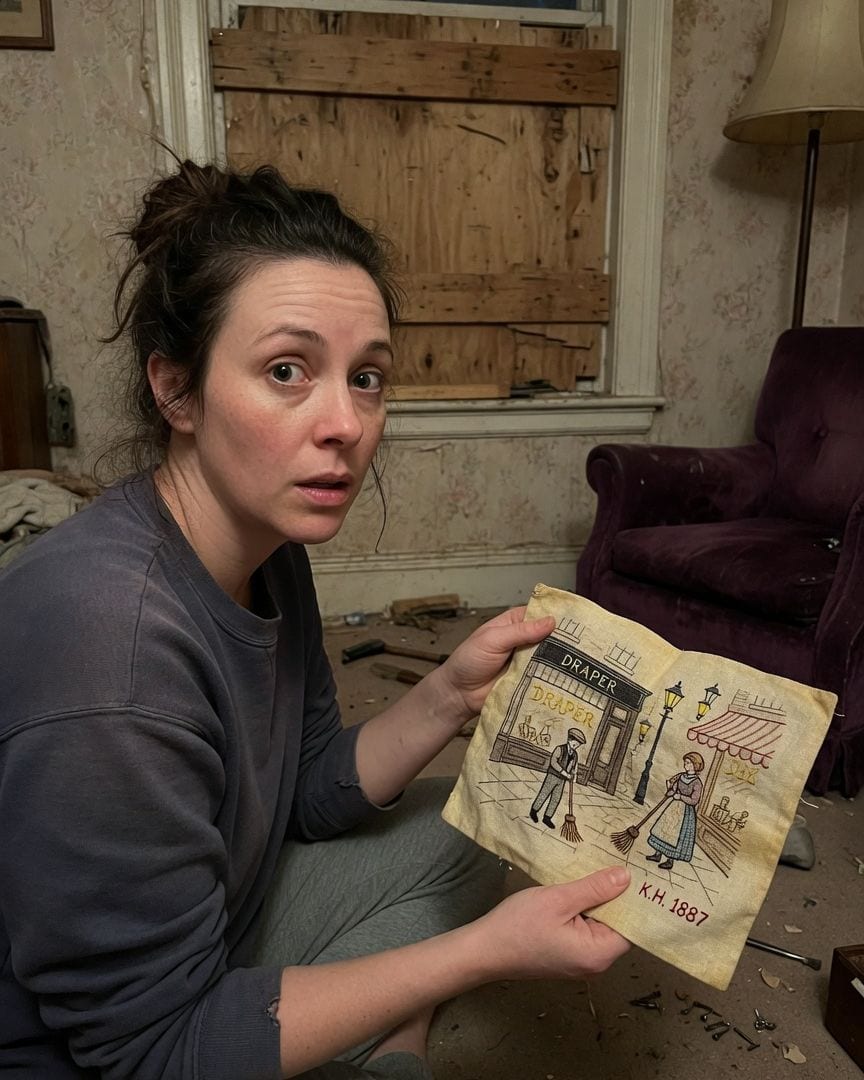
My flat's window shows a gaslit Victorian street across a brick shaft. The nails I hammered back into its frame went into wood soft and new.
My new flat came with a boarded-up window, which the agent dismissed as just an old lightwell. Driven by curiosity, I removed the boards, expecting brick or darkness. Instead, my window opened directly onto a bustling, gaslit street from 1887, a vision that defied all sense.
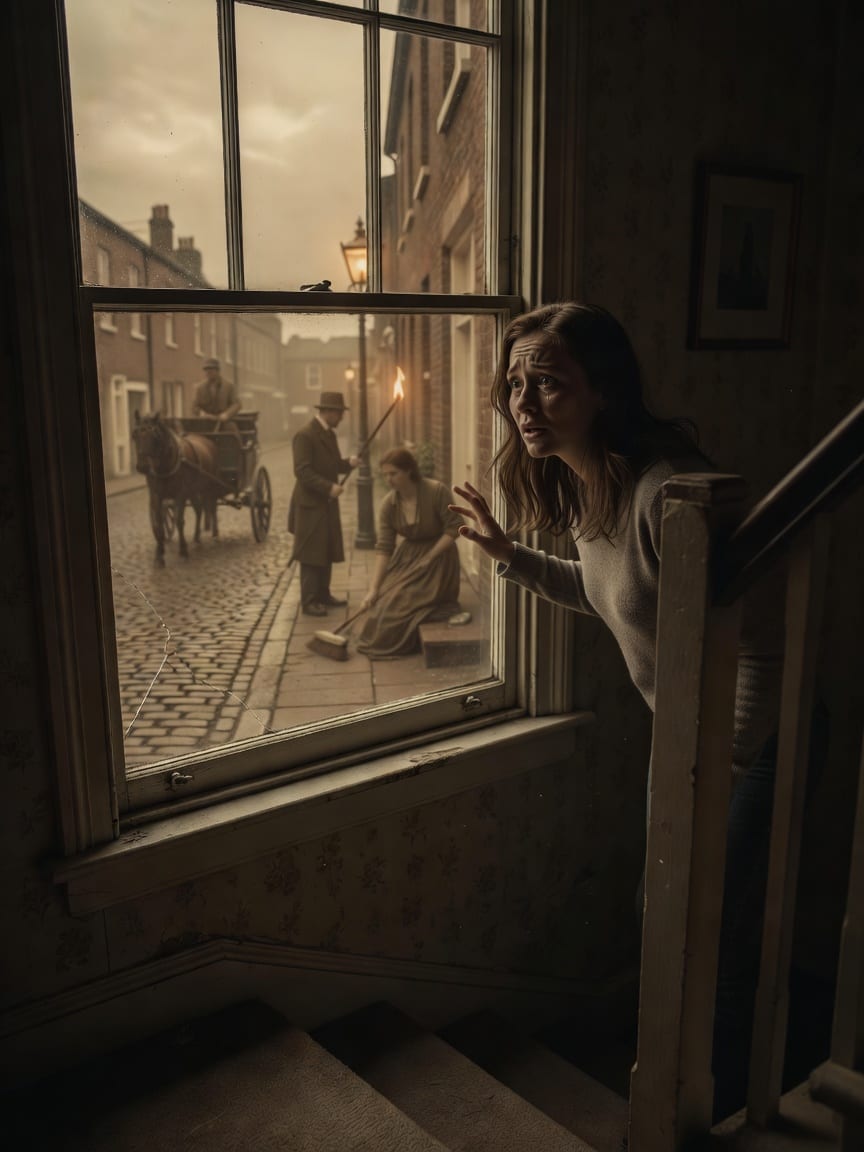
My half-landing window looked down on a cobbled street, a horse and cart. My panes, same crack. Below, only the bins.
I moved into this inherited house for a fresh start, living alone in the quiet. But the third stair on the main flight is deeply worn, a ghostly scoop hinting at decades of unseen footsteps. It feels hollow, and the wall beside it hides a faint, inexplicable seam.
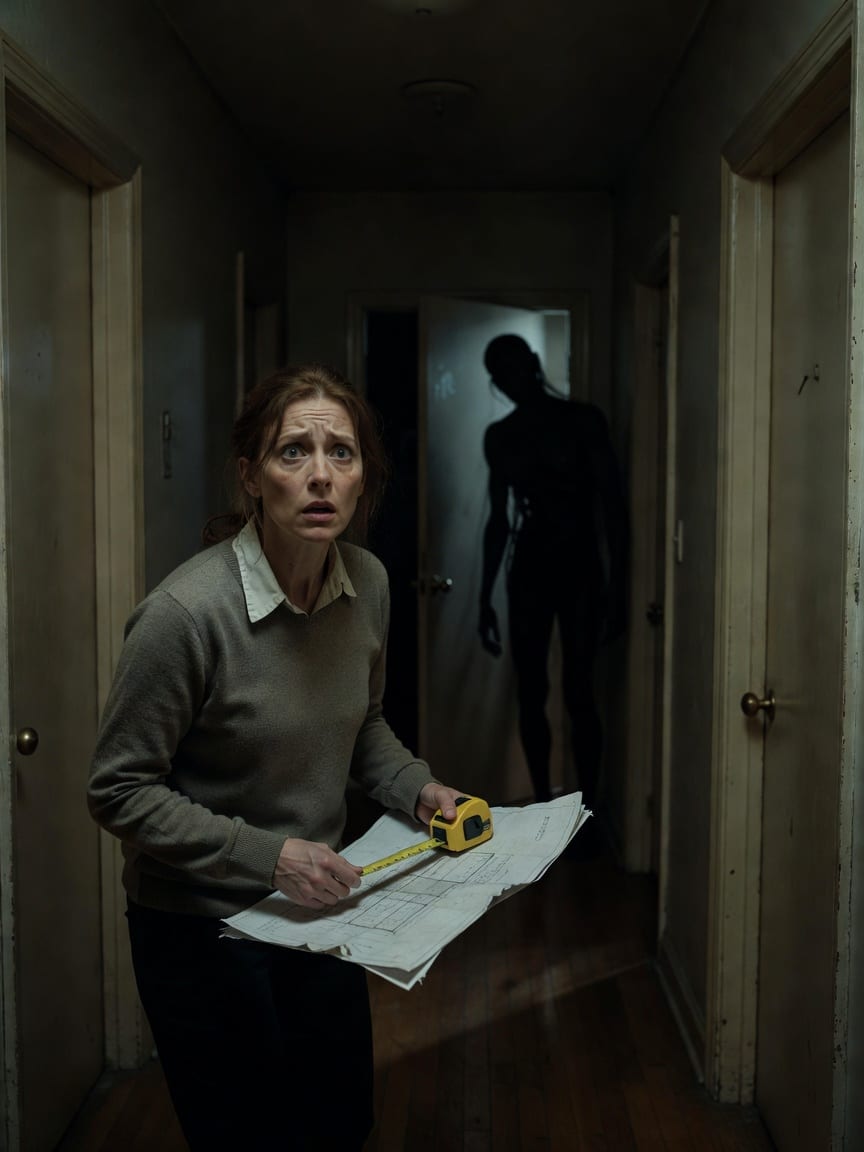
My front door has a dented gate and a dead hydrangea. I walked past it six times, trying to reach the corner shop just a hundred yards away. The pavement kept bringing me back to my own porch, and the shop's light never moved.
My morning started like any other, a quick walk to the corner shop from my home at Number 14, Elm Terrace. But after walking what felt like two minutes, I found myself back at my own front door, the shop no closer. I tried six times, faster and slower, but my street kept compressing, refusing to let me leave.

Our removal van's tracker logged 71 miles, looping back to our old flat. The men swore they unloaded somewhere. The map showed only the same postcode, over and over.
We were moving to our new house on Elm Street when the van's GPS tracker showed our movers circling our old address for 71 miles. I dismissed it as a glitch, until I found an old journal in the attic. Inside was a hand-drawn map of Elm Street, labeling our new road as an impossible loop, dated 1973.
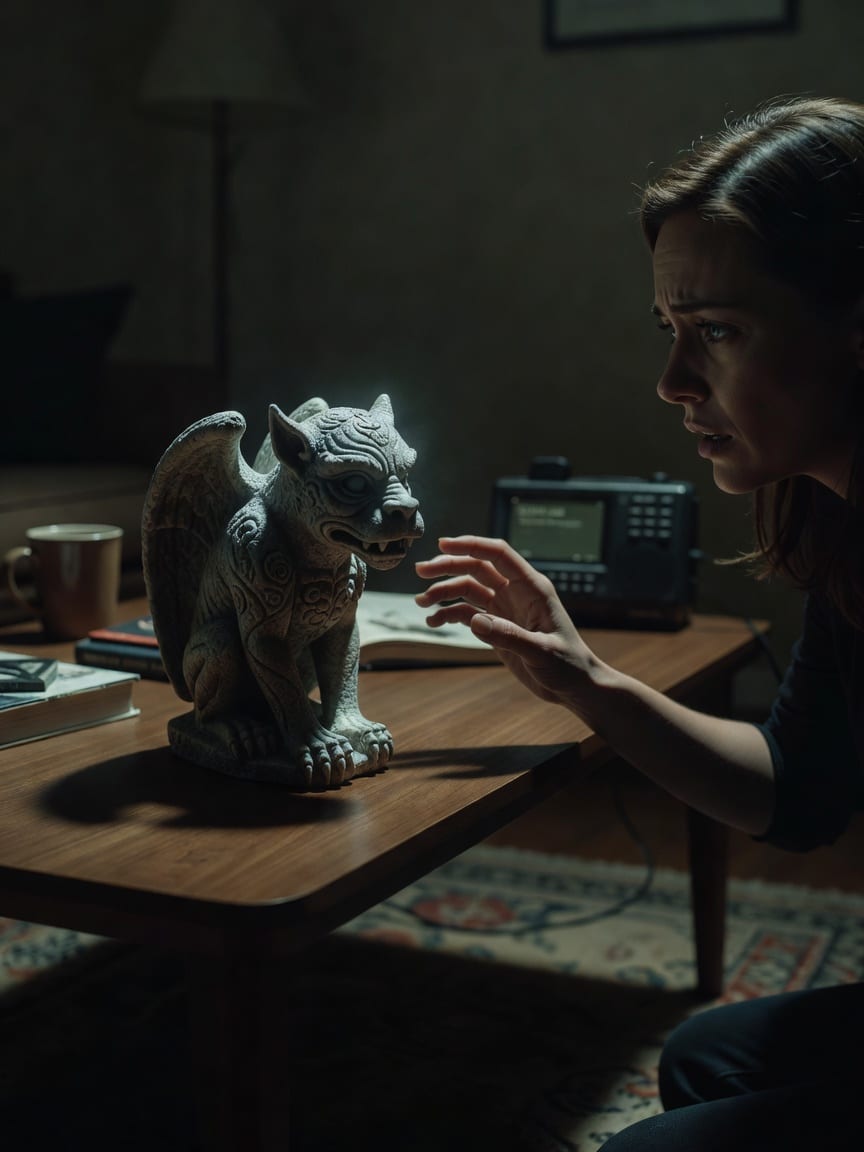
My radio scanner spoke my address at 2 AM. A flat voice read local homes, all with past dates. Mine was the only one in the future.
It was two in the morning, and my quiet house was filled with the usual hum of my weather scanner. But the static broke, replaced by a flat, synthesized voice reading a list of local addresses and dates. My hand froze when it spoke my own address, 181 Foster Drive, followed by a date: October 27th. That date was three weeks from now.
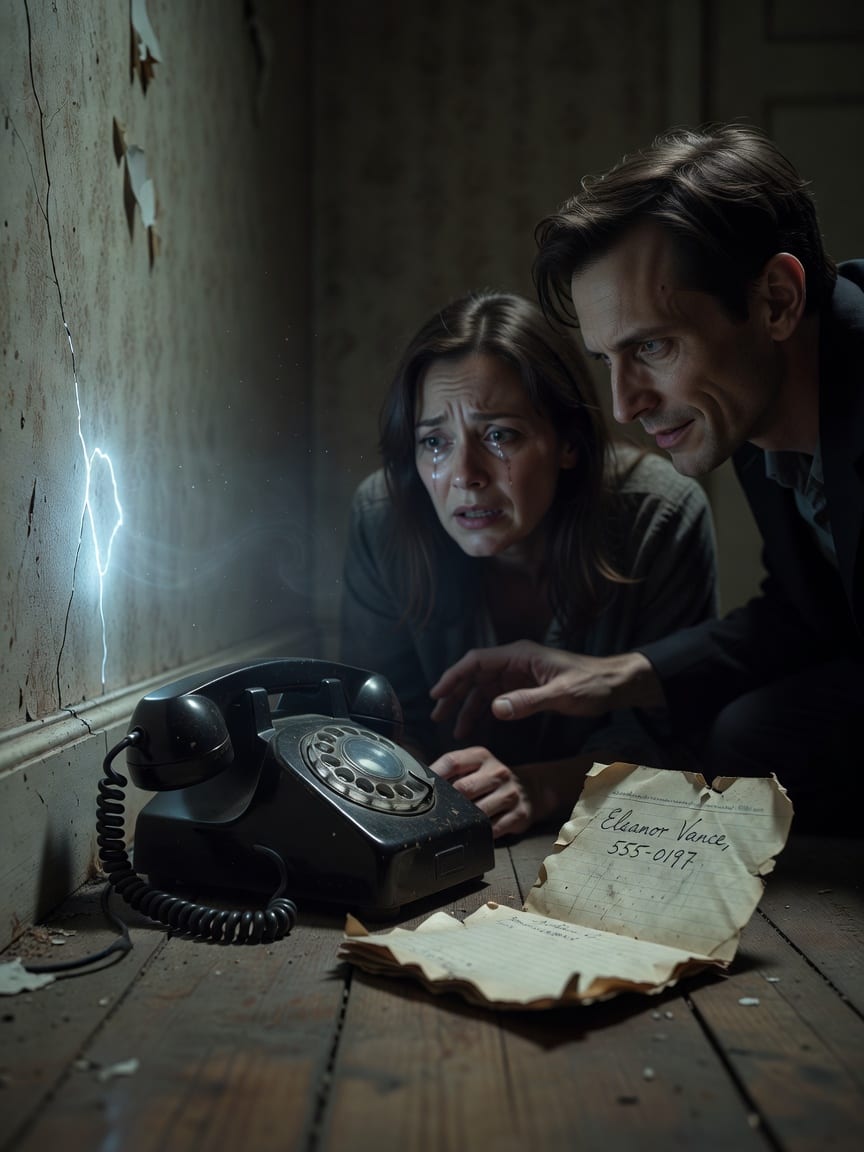
My house's walls ring when I dial a phone number from a 1974 directory. My neighbors said that directory was trash.
I was sifting boxes in my new house when I found an old 1974 telephone directory for my street. It listed my address, 12 Elm Street, under the name "Mr. & Mrs. Sheppard." On a whim, I called the faded seven-digit number. My cell phone rang, but a low, muffled sound also vibrated from the wall beside me.