My inherited family portrait. The child's face in it is slowly, steadily turning to watch me.
The quiet of the New England coast was a balm, almost. I’d moved into the house a few months ago, inheriting it from a distant aunt I barely remembered.
It was an old place, built late in the 1800s, full of the kind of character you only find in homes that have seen generations.
I’d been enjoying the fresh start, the salty air, the feeling of history in the floorboards beneath my feet.
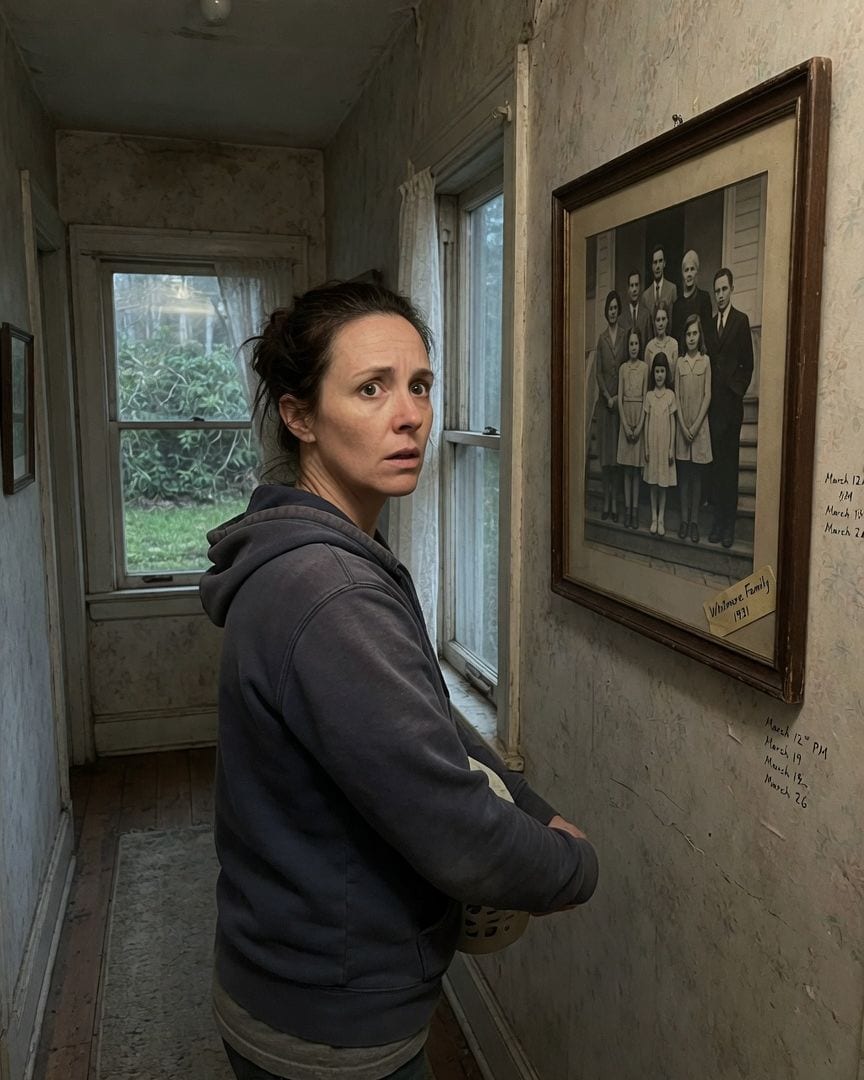
One afternoon, sorting through boxes, I found a framed photograph tucked away in the back of a linen closet. It was a formal family portrait, seven people stiffly posed on what looked like the front steps of this very house.
On the back, in faded ink, someone had written ‘Whitmore Family, 1931.’ A nice touch, I thought, a piece of the house’s past.
I hung it in the hall, just opposite the window, a small nod to the people who’d lived here before me.
A few days later, passing through the hall with a load of laundry, I stopped. The photograph. Specifically, the child in the photograph, a girl of about seven, standing at the front of the group.
Her face, which I distinctly remembered being angled slightly away, almost in profile, was now turned a fraction more towards the camera. It was subtle, barely perceptible, a tilt of maybe an inch. I frowned, dismissing it.
The house was old, it settled. Maybe the frame had shifted on its hook. I reached out, adjusted it, nudging it back to what I imagined was its original position. Just an optical illusion. Or maybe I was just tired.
Over the next week, the photograph continued its unsettling dance. I started taking a digital photo of it every morning with my phone, then another each evening. Comparing them was like watching a slow-motion film.
The child’s face, undeniably, was turning. Steadily. Week by week, she was rotating towards the viewer, towards me. It wasn’t the frame shifting; the edges of the picture stayed perfectly aligned.
It was the image itself, the girl’s painted eyes slowly swiveling into focus.
I tried to rationalize it away: the old photographic paper reacting to humidity, contracting, twisting the image. But the change was too deliberate, too focused solely on that one child, and too consistent.
It wasn't random warping; it was a slow, deliberate pivot.
Then other small things started. A faint, sweet scent, like woodsmoke and fresh-baked bread, would sometimes waft from the empty kitchen. My stove was electric, the fireplace in the living room had been sealed shut decades ago.
There was no source for it. I’d check the windows, open the front door, convinced it was a neighbor, but the scent was strongest right inside my house, right there in the kitchen, then gone as quickly as it came.
Every evening, precisely at 8:05 PM, a specific floorboard on the landing above creaked. It was a heavy, measured sound, like someone stepping down from a bed. I’d be downstairs, reading or watching TV, and it would punctuate the quiet.
I knew I was alone. I tested it, of course. I’d walk the landing at other times, trying to replicate the sound, shifting my weight, but it remained silent, stubbornly mute.
Only at 8:05 PM, when I was elsewhere in the house, did that distinct, heavy sound echo through the old house.
The photograph in the hall was no longer just shifting; the family within it, led by the little girl, was slowly, steadily, coming to face me.
I stood in the hall, staring at the photograph, the quiet drone of the coast outside the only sound. The child’s face was now almost fully angled towards me, her eyes, painted so long ago, seeming to meet my own.
A chill prickled my skin, a feeling not of cold, but of being observed. Not just by the photo, but by something deeper in the house itself.
I tore my gaze from the unnerving image, looking past the child’s face, to the window directly opposite the hall. This window looked out onto my overgrown, slightly neglected backyard, a tangle of rhododendrons and unkempt grass.
But for a split second, it wasn’t my backyard. Instead, I saw a vibrant, meticulously manicured garden, bursting with summer flowers I didn't recognize. A crisp white sheet swayed gently on a clothesline, catching a bright, impossible sun.
The house's exterior, through the glass, appeared freshly painted, gleaming. A woman in a long, pale 1930s dress walked along a stone path, her back to me, moving towards the house.
Then, as quickly as it had appeared, the image snapped back to my familiar, overgrown yard, the summer light fading into the present. The woman, walking towards the house, had looked directly at me.
The impossible vision of the garden left me shaken for days. I tried to dismiss it as a hallucination, a trick of light on the old glass, maybe exhaustion. But the memory was too vivid, too precise.
It had been real. Everything else I could almost explain away, but not that. Not the woman in the period dress, walking on my lawn as it had been ninety years ago, looking right at me.
Determined to find a rational explanation for everything, I dove into the house's history. I needed to understand what was going on, to find a logical thread that would unravel the unsettling knots.
I spent days at the local historical society, a dusty building downtown, filled with old records and the faint scent of aged paper and something else I couldn't quite place.
I met Sean Whitmore, the archivist. He was a kind, deliberate man in his fifties, with a neat gray mustache and soft-spoken manner.
He seemed genuinely pleased to have someone interested in the town’s past and was surprisingly helpful, though he had a quiet, watchful air about him. He pointed me to old deeds, census records, town maps.
The house, built in the late 1800s, had changed hands many times, as old houses do.
I finally found what I was looking for. After hours poring over microfilm and yellowed documents, I identified the family in my photograph: the Whitmores.
They had owned the house in 1931, exactly as the faded script on the back had claimed. Their records, however, abruptly ended after that year. No sale, no death certificates, no forwarding address. Just... nothing.
As if they simply ceased to exist after 1931.
Sean, noticing my intense focus on the Whitmore file, mentioned, almost too casually, that the house had a local "reputation," but quickly waved it off as old wives' tales, the kind of stories spun about any old property in a small town.
He chuckled, but his eyes didn't quite match his smile. He’d excuse himself periodically, stepping out for a smoke. Each time he returned, I noticed a faint but distinct scent of pipe tobacco on him.
A smell I'd recently started to associate with the inexplicable occurrences in my own home, though I couldn't say why.
My research into the Whitmores' sudden disappearance intensified. Sean’s dismissive wave didn't quiet my unease; it amplified it. I felt like I was picking at a scab the town had collectively decided to ignore.
I finally uncovered a microfiche of a small, obscure newspaper article from early 1932, tucked away in a regional bulletin. It reported the Whitmores' "unexpected departure" from the town and their house being left vacant.
Unexpected departure. The vagueness of the language unnerved me. No details, no destination, no reason. Just gone. I dug deeper, searching for any other mention, any official report, anything that would explain it. There was nothing.
It was like the town had scrubbed them from the records.
Late one night, after a particularly frustrating day at the archives where I’d found only dead ends, an email landed in my inbox. The sender was unknown, the address a string of random characters. The subject line was blank.
The message read only: 'Some things are best left undisturbed. The house remembers what it needs.'
The words chilled me to the bone. The house remembers what it needs. I tried to trace the sender, but the email was untraceable, bouncing through proxies, vanishing into the digital ether. It had to be connected. Someone knew. Someone was watching me.
The next morning, as I left the historical society, the cool morning air did nothing to ease the knot tightening in my stomach. I glanced up at Sean Whitmore’s office window on the second floor.
He was standing there, behind the glass, watching me walk down the street. His expression was unreadable, just a flat, neutral gaze. A faint plume of pipe smoke curled from his open window, dissipating into the pale sky.
I walked directly into Sean Whitmore’s office. I didn’t knock. He looked up from a stack of old maps, startled, the pipe in his hand. I didn’t sit.
I walked to his desk and placed the printout of the cryptic email on the polished wood. My voice was steady, despite the tremor in my hands.
"This came after I started asking about the Whitmores," I said.
Sean’s calm demeanor wavered for a moment. He picked up the printout, his brow furrowing, though his eyes seemed to already know what it was. He tried to dismiss it, of course. "A prank, Ms. Drummond.
We have a few local eccentrics here. Small town. Nothing to worry about."
"A prank?" I pressed, stepping closer to his desk. "Or a warning?" I described the photograph, how the child’s face was slowly turning to watch me.
I told him about the faint smell of woodsmoke and baked bread in my kitchen, the specific floorboard creak every evening at 8:05 PM, even when I was alone. Then, I told him about the hall window.
The meticulously manicured garden, the 1930s sunlight, the woman walking towards the house, then the sudden snap back to my overgrown yard. "It’s like the house is replaying something," I insisted, my voice gaining a desperate edge. "Something specific."
I leaned in, lowering my voice. "And the pipe tobacco smell in my house? Sometimes, it’s exactly like the one in your office. The one on your clothes."
Sean finally sighed, a deep, defeated sound. He took a long draw from his pipe, then set it down in an ashtray, the smoke curling up like a surrender flag.
"The email was from me, Ms. Drummond," he admitted, his voice barely a whisper. "I had hoped to... dissuade you."
My breath hitched. "Why?"
He ran a hand over his mustache. "My great-grandfather was the local constable in 1931. He investigated the Whitmore disappearance. The official story was 'departure.' But he always believed they simply vanished from the house, leaving everything behind.
Food on the table, clothes in the drawers. As if they just... stepped out for a moment and never came back." Sean leaned forward, his gaze direct. "My family has lived in this town for generations.
There's a legend, or perhaps a truth, that the house 'keeps' its occupants. Not a haunting, not ghosts in the traditional sense. It's more like... a loop. It replays their lives, their last days, on a cycle.
And it needs a witness for the cycle to complete."
He then pulled out a heavy, leather-bound ledger from a locked drawer in his desk. The leather was worn smooth, the pages thick and yellowed. "This was my great-grandfather’s personal record," he said, pushing it across the desk towards me.
"He documented other disappearances from that house, always around late summer or early fall. He believed the house was a kind of trap. A temporal anchor, fixed in time, absorbing its inhabitants, replaying their final moments again and again."
My hands trembled as I reached for the ledger, its weight a sudden, dense reality in my hands. I opened it, the old pages crackling softly. It was filled with meticulous, looping script, Constable Whitmore’s careful hand.
It detailed not just the Whitmores, but three earlier families, all recorded as having 'vanished without trace' from the house. The dates were roughly thirty years apart: 1901, 1871, 1840. A cycle. Sean’s words echoed in my mind: replaying their lives, their last days, on a cycle.
My eyes scanned the names for the 1871 entry. My vision blurred for a moment, then sharpened. Under the list of family members, beneath a father, a mother, two children, I saw it: the surname 'Drummond.'
A jolt went through me, sharp and cold. Not my direct family, I thought, trying to rationalize. But 'Drummond' was a common regional name in this area, yes. And it was my great-grandmother’s maiden name.
My heart hammered against my ribs, a frantic drum in my chest. It was too close. Too specific.
Then, at the very bottom of the page, in a different, more recent hand – Sean’s hand – was a chilling addition. A scrawled note, hastily written: 'The house needs a witness to complete the cycle.
It always finds its way back to one who remembers.'
The pipe tobacco smell, Sean’s scent, was suddenly thick in the air around me, cloying, suffocating. My head swam. From the stack aisle, behind me, I heard it again. Faint at first, then distinct: the heavy creak of a floorboard.
The exact sound from my own silent house, precisely at 8:05 PM.
I raced home, the old ledger clutched tightly in my numb fingers, its weight a physical manifestation of the dread in my gut.
My own footsteps echoed too loudly on the floorboards, each one a stark reminder of the sound that now haunted me. I paced my hall, the ledger open to the 1871 entry, the name 'Drummond' staring up at me.
My great-grandmother, a Drummond, had grown up in this very region. The connection was undeniable. The house wasn't just replaying; it was searching. It was pulling in those with a connection, a bloodline, to complete its cycles.
Every clue, every unsettling detail, now clicked into place with horrifying precision. The turning photograph wasn't just a random ghost.
It was a slow, agonizing invitation into the tableau of 1931, the family within it, led by the child, slowly turning to welcome me, to draw me in.
The faint smells of woodsmoke and baked bread weren't just phantom scents; they were sensory ghosts, the retained aromas of a family’s last ordinary day, preserved within the house's memory.
The 'Door Onto The Wrong Year,' the glimpses of the vibrant 1931 garden through my hall window, weren't hallucinations.
They were momentary collapses of time, revealing the house in its prime, just before the vanishings, showing me the scene that would repeat.
The house was a kind of temporal predator, a fixed point in time that absorbed and replayed lives, creating an endless, horrifying loop.
The note in the ledger, Sean's desperate, modern-day warning: 'The house needs a witness to complete the cycle. It always finds its way back to one who remembers.' The words resonated with a terrifying personal implication.
The child’s face in the photograph, steadily turning to meet my gaze, wasn't just a random ghost. It was looking for me, Olivia Drummond, the descendant, the 'one who remembers,' to step into the vacant role.
To become the final, missing piece of the 1931 tragedy. To be absorbed into the house's memory forever.
I stood in my hall, facing the photograph, my breath catching in my throat. The child’s face was now almost fully turned, her eyes wide, expectant, meeting Olivia’s.
The other family members were also significantly angled towards the viewer, their stiff, painted poses subtly contorted, their gazes converging on me.
The air itself felt heavy, alive around me, colder in some spots, inexplicably warm in others, as if two seasons, two times, were merging, colliding in this space.
The faint scent of woodsmoke and baked bread was no longer faint; it was overwhelming, thick in the air, almost suffocating, as though a meal had just been taken from an oven that wasn’t there.
From the kitchen, I heard them. Not clearly, but I heard them.
Hushed voices, a faint, distant laugh, the clatter of a plate – the mundane, ordinary sounds of the Whitmore family living their last, ordinary day, about to become part of the house's endless memory.
The window opposite the hall flickered again. The present, overgrown garden blurred, replaced by the vibrant 1931 summer. This time, the woman in the period dress was no longer walking away.
She was standing at the path's edge, framed by meticulously tended hydrangeas, looking directly at the house, directly at me, her hand raised in a slow, deliberate, beckoning gesture.
I understood. To stay was to be absorbed, to become another memory in the house's endless cycle. Another nameless face in a photograph, turning endlessly, waiting. I would not be a witness. I would not complete the cycle.
With a deep breath, clutching the ledger to my chest as if it were a shield, I walked calmly to the front door, my hand steady on the cold brass knob.
I turned it, pulled the door open, and stepped out into the fading light of the present day. I did not run. I did not look back.
I simply walked away from the house, leaving it and its turning memories behind me.
I never returned to the house. I contacted a realtor the next day, selling the property sight unseen to an out-of-state investment company. I signed the papers quickly, never once mentioning its peculiar history.
Sean Whitmore retired from the historical society a few weeks later, citing "burnout" and a desire for quieter days. I saw him once, in the grocery store. He nodded, a sad, knowing look in his eyes, but we didn’t speak.
The town, accustomed to the house's periodic vacancies, quietly accepted its new, anonymous owner. I kept the ledger, a heavy, leather-bound weight in my new life, a constant, tangible reminder of what I had seen and understood.
The house remained, a silent, watchful presence on the edge of town, its secrets undisturbed by its new, distant owners.
I live in a small apartment now, miles inland from the coast. I’ve built a new life, free from the specific creaking floorboards and the phantom scent of baked bread.
But sometimes, on a quiet evening, I catch the faint, sweet smell of pipe tobacco on the wind, or see a particular shade of summer blue in a neighbor's garden that makes me think of a clothesline swaying in 1931.
I know the house is still there, still waiting for its next occupant, still retaining its memories, running its silent loops.
I sometimes wonder if the photograph in the hall has finally completed its turn, if the family now stares directly out, waiting.
She wonders if a new child’s face has begun to slowly swing round to watch whoever now stands in the hall.
If this one got to you
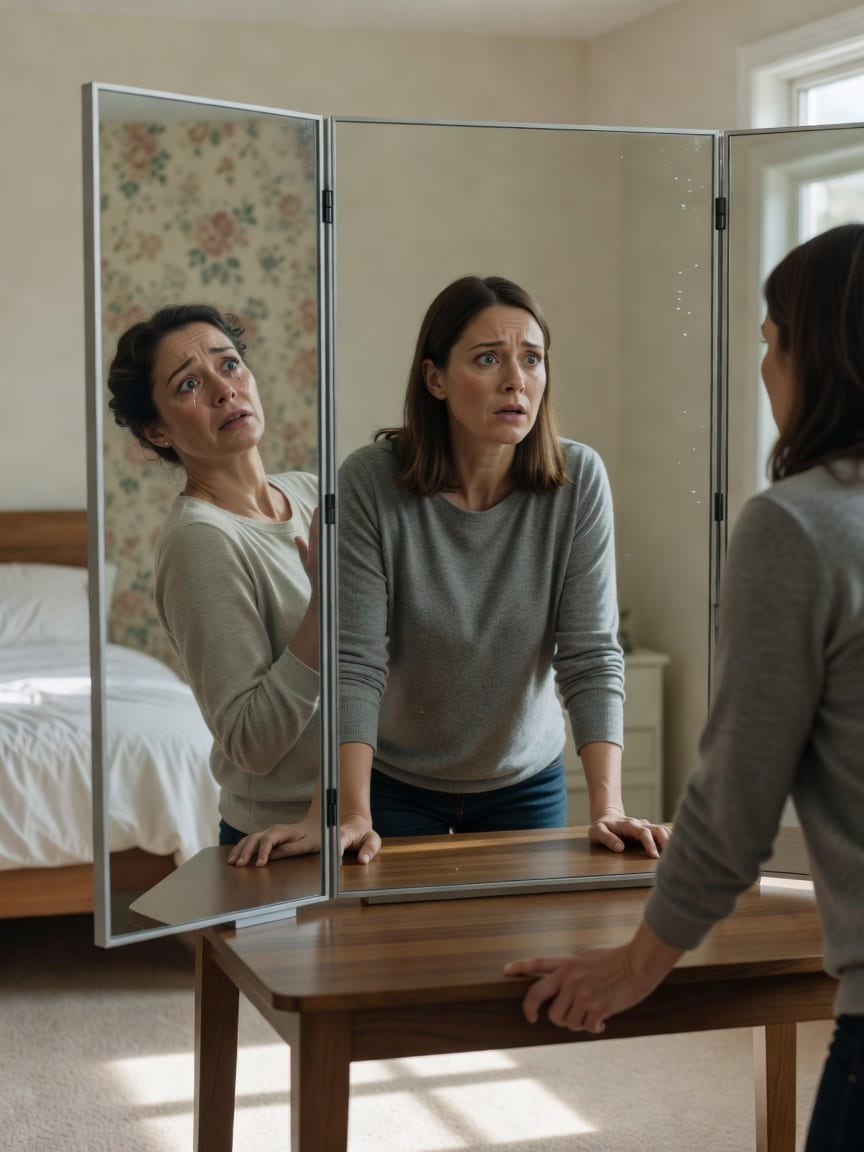
My bedroom mirror shows a woman doing her hair, in a room papered differently than mine. She moves a half-second late.
I moved into my inherited house, with its antique dressing table and mirror. Late at night, the mirror shows a woman doing her hair, but it's not my reflection. Her room has faded floral wallpaper, a stark contrast to my white walls.
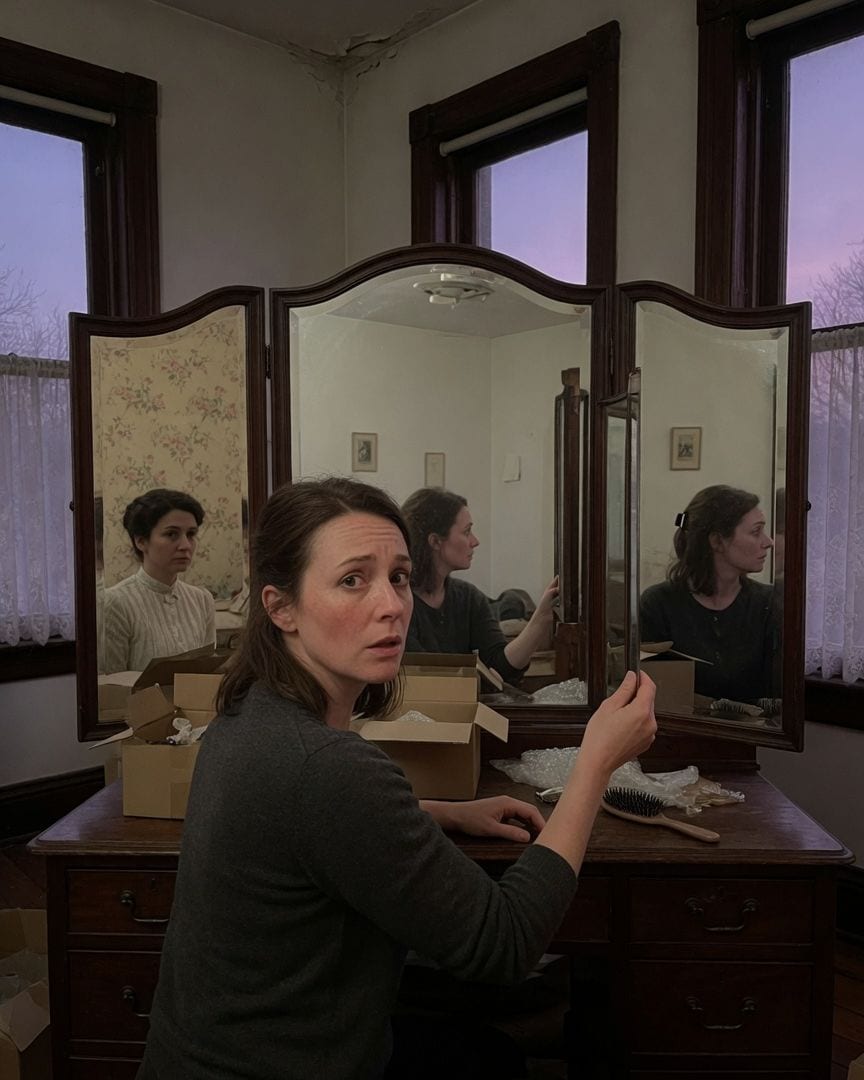
My dressing table mirror shows a woman in a high-necked blouse, doing her hair in a room papered differently from mine. She moves a half-second late, catching up to a memory of the gesture.
Settling into my inherited, old house, I found myself drawn to an antique dressing table with a three-winged mirror. But when I angled the mirror, it showed a woman from another time, brushing her hair in a room unlike my own. Her every movement in the reflection was a half-second too slow, an unsettling temporal stutter across the decades.
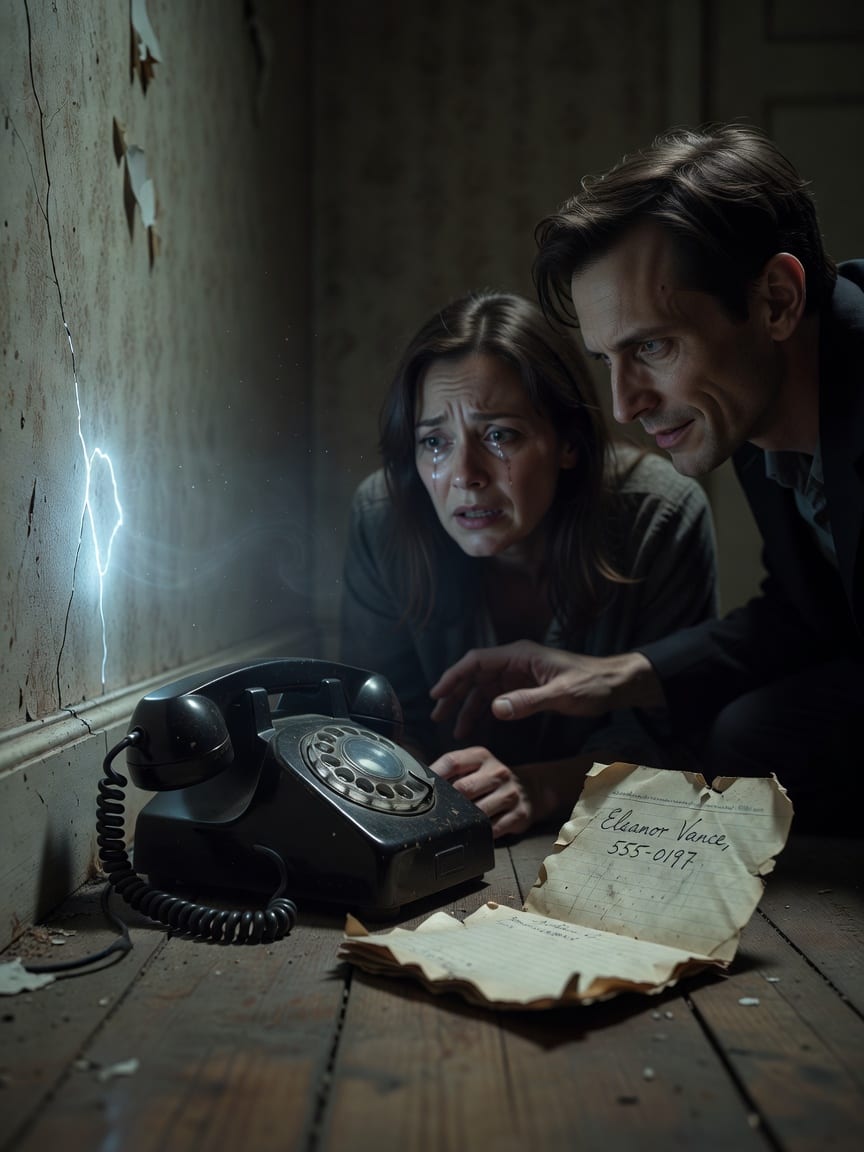
My house's walls ring when I dial a phone number from a 1974 directory. My neighbors said that directory was trash.
I was sifting boxes in my new house when I found an old 1974 telephone directory for my street. It listed my address, 12 Elm Street, under the name "Mr. & Mrs. Sheppard." On a whim, I called the faded seven-digit number. My cell phone rang, but a low, muffled sound also vibrated from the wall beside me.
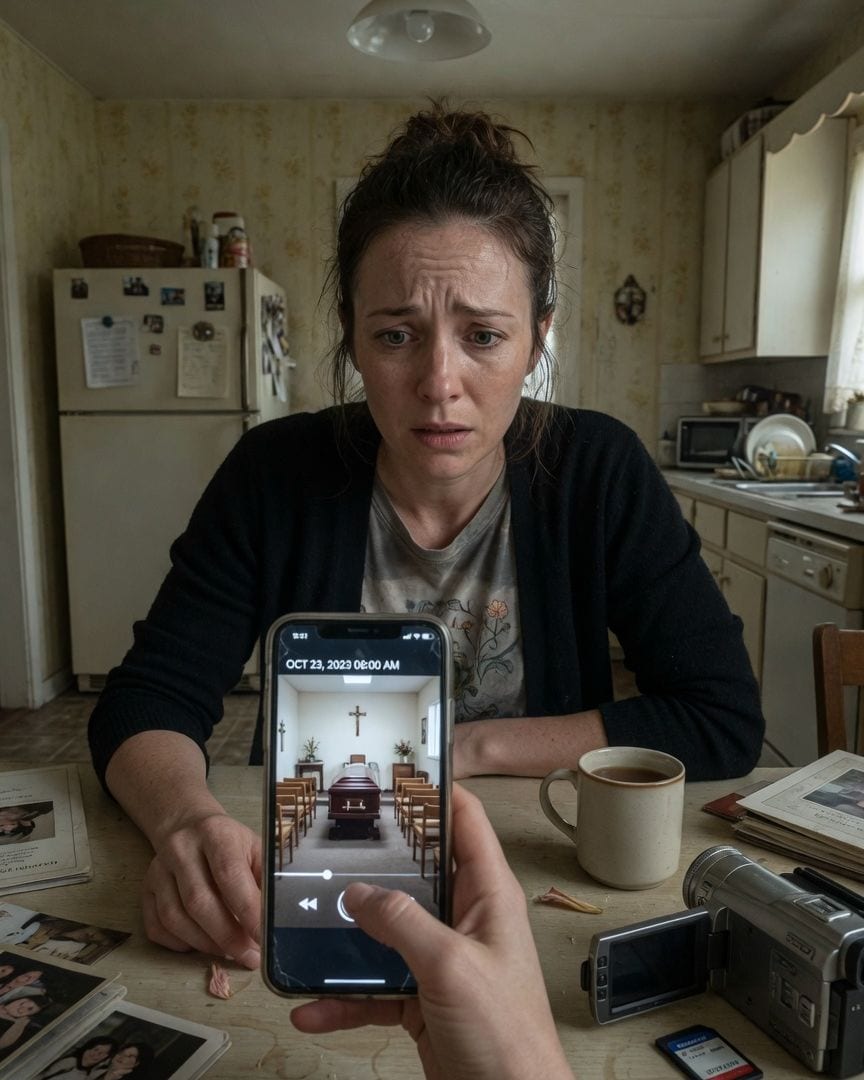
On my dead mother's phone I found a video of her funeral — steady, shot from the back over the mourners' heads, holding on her coffin. The timestamp says it was filmed an hour before any of us had arrived.
Days after my mother's funeral, I sifted through her digital life, hoping for comfort. Instead, her old camcorder revealed a video of my living room, timestamped for tomorrow morning. The abstract landscape I'd just hung was already there, waiting on the wall, a cold dread tightening in my gut.
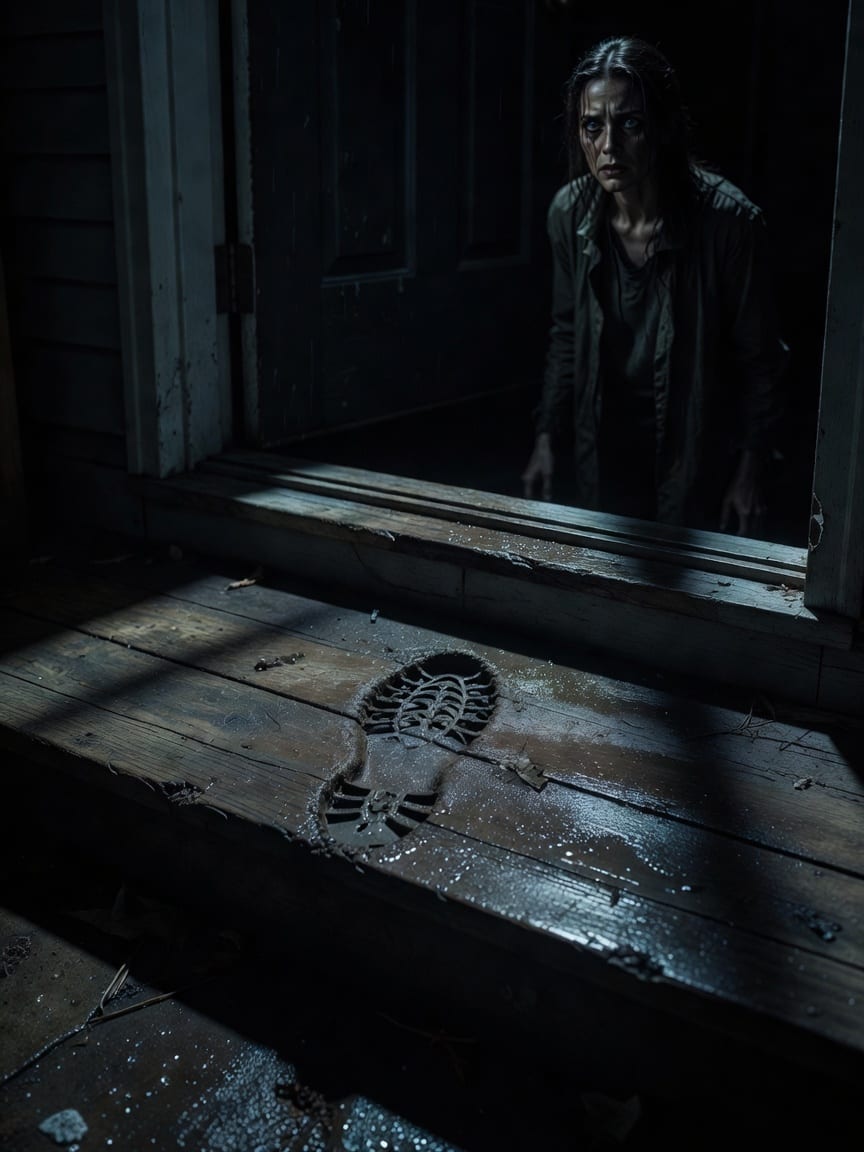
My landlord's only rule: never let the outside tap run after sundown. Last week it dripped. This morning, wet bootprints ringed the back step from the tap to my door, all the same size. The tap was off.
We'd just settled into Waterside House, with its strange landlord rule about the outside tap. After the washer broke, I found perfect, wet bootprints leading from the tap to our back door, but the tap was cranked completely off, tighter than I could manage.
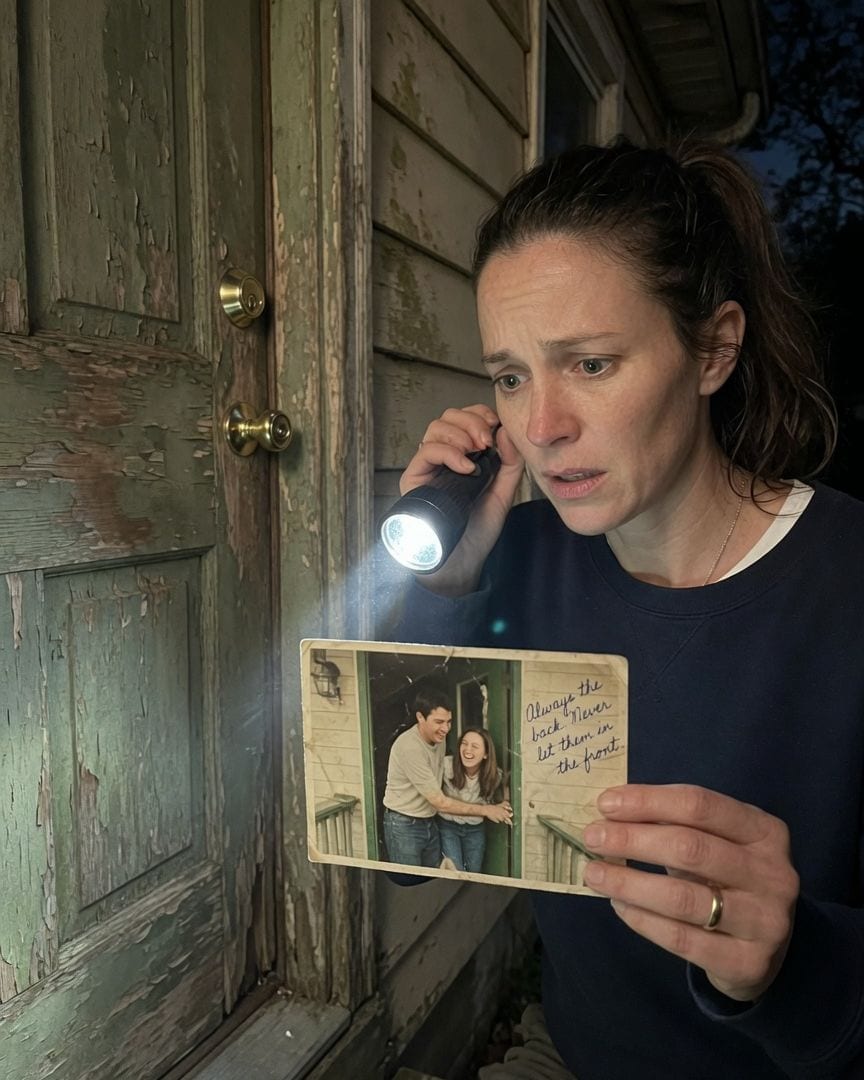
My mother waves us to the front door now. She was missing five days. She says we've always used the front, but the back door, our kitchen door for thirty years, is locked.
My mother, Janet, finally came home after five days, but her overly bright smile and insistence on using the front door felt wrong. For three decades, our family always used the back entrance, which now had a gleaming, new deadbolt. The quiet hum of unease quickly grew into a chilling dread.