On his lonely watch at Site 73, Airman Petrov's logbook is signed by a man declared MIA forty years ago.
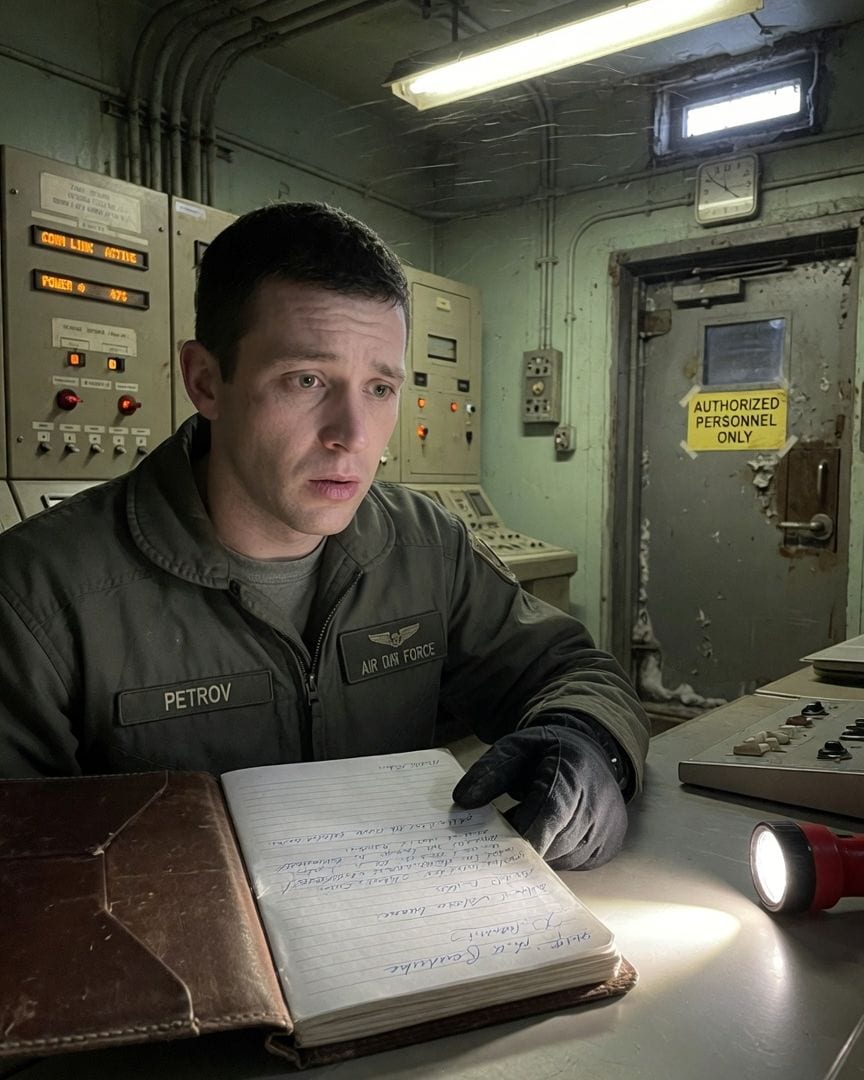
Airman Thomas Petrov squinted against the horizontal sleet, the wind a constant, low howl across the North Dakota flatland. Site 73, a decommissioned missile silo-turned-relay station, was his lonely kingdom for the next two weeks before his transfer.
He just needed to keep the comms humming and the logbook current. Inside the bunker's control room, the stale air hummed with the faint thrum of old machinery.
He pulled on his insulated gloves, scanning the console, then his gaze drifted to the battered, leather-bound logbook on the desk. It was open to today’s date.
A neat, precise hand had filled in the morning checks, the weather, and signed off on the last watch.
Petrov frowned. Every single entry in the book was current, a meticulous record of daily operations, signed through the night, every night. He was the only man assigned to Site 73.
He had never written a single word in that book.
Petrov stared at the signature: ‘A1C R. Fontaine’. He knew his own name wasn’t Fontaine. He flipped back pages. The same signature, consistently neat and firm. Days, weeks, months. Always ‘R. Fontaine’. He tried to rationalize it.
Maybe a previous airman forgot to take his old logbook? A prank by the last guy, knowing Petrov was on his way out? He pulled up the official duty roster on his tablet for Site 73.
His name, Thomas Petrov, stared back at him. No Fontaine. Not on the current roster, not on any previous ones for the last fifteen years, since the site’s decommissioning.
He opened a work order for a faulty comms unit, needing an excuse to contact Staff Sergeant Novak back at base. “Just a quick question about the logbook from the last rotation,” he’d say.
“Looks like someone left their old one here.” Novak, always by the book, would likely tell him to toss it and start a new one. But the entries were current.
He ran a quick check of the site’s personnel history on the secure network, filtering for Site 73. Nothing. No R. Fontaine listed as having been assigned here in the last twenty years.
He spent the rest of his shift, the wind rattling the heavy steel door of the bunker, trying to find a logical explanation. Every search returned only his name, the sole occupant.
As night fell, casting long shadows across the control room, Petrov looked at the logbook again. It had been closed, and a fresh entry for the evening watch was neatly signed off. He hadn’t touched it since that morning.
Driven by a mounting unease, Petrov began searching the forgotten corners of Site 73. The control room had offered no answers, so he descended into the sub-levels, the air growing colder and heavier with each step.
Behind stacks of rusted spare parts and defunct server racks in an old equipment room, he found a small, locked metal locker. To his surprise, the key was hanging on a hook next to it, almost as if waiting.
He twisted the key. The lock groaned open. Inside, among old manuals and a moth-eaten uniform, was a water-stained file. It was a service record. A faded photo, a grim young face staring out. Name: Richard Fontaine. Airman First Class.
Assigned to Site 73. Declared Missing In Action, forty years ago.
Petrov stared at the faded signature in the old service record, then back at the crisp, recent entry in the logbook on the control desk, which he’d brought down with him, a knot tightening in his stomach.
The two signatures, separated by forty years and a declared MIA status, were identical. His flashlight beam trembled slightly as it fell across the name: A1C Richard Fontaine.
The revelation of Richard Fontaine’s service record shattered Petrov’s rational explanations. He couldn't dismiss it as a prank or clerical error anymore.
The tremor in his hand persisted even after he secured the logbook and Fontaine’s record in his personal locker. He needed answers, and he knew he wouldn't find them by himself in this isolated bunker.
He contacted Staff Sergeant Russell Novak, maintaining a controlled tone. He reported a "discrepancy in site historical documentation" and requested access to the base’s archived personnel files for Site 73, citing the upcoming demolition as justification for a thorough inventory.
Novak, a gruff but fair NCO, grumbled about "paperwork ghosts" and the inefficiency of "old systems," but granted the access.
Petrov spent his next off-shift hours at the main base, poring over microfiche and digital scans in the dim, dusty archive room. He found more.
Incident reports detailing Fontaine’s disappearance: a routine comms check failure, followed by an empty site, just the wind for company. No signs of forced entry, no struggle. Just… gone. The reports were chilling in their stark simplicity.
He cross-referenced names mentioned in the older reports, looking for any other anomalies, any other forgotten names.
While digging, he found a contact for Helen Pierce, a retired archivist known for her encyclopedic knowledge of base history.
Her number was scribbled on a sticky note in one of the physical archives, next to a file labeled “Site 73 – Anomalous Operational Logs.” He called her, feigning interest in local history for a personal project.
“Site 73,” she mused, her voice raspy, a smoker’s cough following her words. “Ah, the oddities of Site 73. Always had unreconcilable manifests, that one. Little ghosts in the machine, we called them. Probably just poor record-keeping, old boy.
Or maybe the wind played tricks on the old-timers.” Her words, meant to reassure, only deepened his unease. The casual dismissal of “unreconcilable manifests” suggested a pattern, not an isolated incident.
The file label “Anomalous Operational Logs” now pulsed in his mind.
Back at Site 73, Petrov felt a shift in the isolation. The wind still howled, but now it seemed to carry a low, persistent whisper, just at the edge of hearing, almost like faint radio static.
He found the control room door ajar one morning, even though he distinctly remembered locking it and testing the deadbolt.
Nothing was missing, but the logbook was back on the desk, open to a fresh page, a new entry dated only hours before, signed neatly, ‘R. Fontaine’.
A cold prickle ran down Petrov’s spine. He started setting up motion sensors and a discreet camera feed in the control room, rigging them to his personal laptop.
He told Novak he was “enhancing site security” due to the upcoming demolition, a story Novak bought easily enough.
The feed showed nothing but the empty room, the occasional flicker of old fluorescent lights, and the sway of a loose cable. But the entries kept appearing.
He started leaving the logbook in different places – hidden under the console, locked in his personal locker, even once buried under a pile of old manuals in the sub-level.
Each time, he’d find it back on the desk, open to the current day, signed. The sense of being watched, of being subtly outmaneuvered, grew with each impossible occurrence.
One night, he woke to a metallic clang from the sub-levels, sharp and clear above the wind’s moan. Heart pounding, he grabbed his service pistol from its holster and descended, flashlight beam cutting through the dust-laden air.
He found an old radio antenna component, a piece of equipment long since replaced and stored away, lying squarely in the middle of the floor, as if dropped.
A faint, ozone smell hung in the air, like after a lightning strike. The hair on his arms stood on end. He felt a cold dread settle over him. Someone, or something, knew he was investigating.
It wasn't just making entries; it was responding.
Petrov decided to confront Helen Pierce directly. He drove back to the nearest town, the desolate landscape offering no comfort. He found her small, cluttered house, smelling faintly of old paper and dust.
He laid Fontaine's service record and the current logbook out on her kitchen table. Her eyes, initially dismissive, widened as she saw the matching signatures, the forty-year gap. “Good heavens,” she whispered, her raspy voice barely audible. “It’s true then.”
She admitted that “Fontaine’s Ghost” was a whispered legend among the old records keepers, a story told in hushed tones over lukewarm coffee during late shifts.
“But it wasn’t just him,” she confessed, her voice dropping, laden with the weight of years. “There was another. Before Fontaine. Bernard Harlow. Disappeared from Site 73, too. Fifteen years earlier. Same story. Comms failure, empty site.
We thought it was a coincidence. A tragic pattern, maybe, but not… this.”
She rose, moving stiffly to a locked cabinet in the corner. From it, she pulled out a dusty, leather-bound volume, distinct from the official archives Petrov had been sifting through.
“This was my predecessor’s ‘unofficial’ log,” she explained, holding it out. “She tracked these things. Said the site had a… an appetite for accountability.” Inside, Petrov found entries spanning decades, recording the disappearances and the impossible continuation of log entries.
He recognized Harlow’s signature, too, a distinct, earlier hand, in the initial pages of his own logbook.
The terror wasn’t just a ghost, he realized. It was a system, a duty that never ended. The site didn't just have one phantom airman; it accumulated them, each taking up the watch of the last.
The sheer, chilling coherence of it settled over him like a shroud.
Petrov returned to Site 73 with a grim understanding. The site wasn't just haunted; it was a trap, a mechanism that bound airmen to eternal duty. The low hum of the machinery now sounded like a slow, deliberate breathing.
He started cross-referencing the unofficial log with classified incident reports Helen had hinted at, delving deeper into the digital archives. He found the declassified report on Bernard Harlow's disappearance. The details were almost identical to Fontaine's. Comms failure. Empty site.
No trace. A familiar, sickening rhythm.
He scrolled through the report, the chilling parallels tightening his chest with each line. The scanned images of Harlow's deployment orders, his leave requests, his final, routine duty roster.
He saw the scanned image of Harlow's service record, his signature matching an earlier hand in the logbook he now clutched.
Then his cursor hit a line of text at the bottom, a single, impossible sentence buried in the decades-old report, set apart in a different font, almost an afterthought: "Further analysis of Site 73's systems indicated anomalous, continuous operational logging by an unknown party for 15 years prior to Harlow's disappearance, consistent with the previous occupant's duty cycle."
The sentence in Harlow's report was the final, devastating piece of the puzzle. It wasn't just Fontaine, or Harlow; the pattern extended even further back, a chain of phantom airmen stretching into the site's operational past.
The site, designed for ultimate accountability, for constant readiness, had somehow inverted its purpose.
Any airman who vanished while alone on duty at Site 73, their absence officially unaccounted for, became part of its spectral crew, compelled to continue their duties.
The logbook wasn't merely a record; it was the binding contract, the manifest of the permanently assigned.
Helen Pierce, contacted again, confirmed his terrible hypothesis. She had found similar, suppressed reports on other remote, decommissioned sites, hints of "unreconcilable personnel counts" or "ghost manifests" that were always dismissed as folklore.
"The system demands a tally, Thomas," she'd said, her voice thin with a knowledge that had clearly burdened her for years. "And if a body can't provide it, something else will. The duty must be accounted for."
The upcoming demolition of Site 73, far from ending the cycle, would simply transfer the 'duty' of its current phantom occupant.
The site's destruction would release Fontaine, but the pattern of forced accountability would remain, ready to ensnare another at a different, equally forgotten, post.
Petrov knew he couldn't just leave. If the duty was transferred, another would be bound, another forgotten airman forced into an eternal, impossible watch. He had to break the cycle.
He theorized that if the site's final, official decommissioning was performed by a living, accounted-for airman, actively 'signing off' the site from existence, it might disrupt the phantom accountability.
He requested to be the sole airman present for the final phases of demolition, arguing for consistency and a thorough final report. Novak, surprised but keen to have the site cleared and out of his hair, agreed.
As the demolition crews prepared the charges, setting the timers for the following morning, Petrov entered the control room one last time. The air was thick with the scent of dust and stale metal.
The logbook lay open on the console, signed 'R. Fontaine' for the evening watch, a testament to its relentless, impossible vigilance. He took a deep breath, steeling himself.
His plan: to physically, officially, and undeniably close out the site's function himself, thereby removing the 'duty' that bound Fontaine.
He sat at the console, overriding the automated shutdown sequences that would normally be handled by a contractor. The old screens flickered, displaying lines of code. He typed out a final, official report: "Site 73: All functions terminated.
Personnel accounted for: Airman Thomas Petrov." He hit enter, watching the old screens go dark, one by one, until only the emergency lights glowed. Then he took the logbook, its leather cover smooth and cool beneath his gloved fingers.
He wrote a final entry on the page after Fontaine's: "Site 73 officially decommissioned. All duties concluded. All personnel accounted for and released." He signed his name, Thomas Petrov, in clear, firm script.
As he finished, a faint, almost imperceptible sigh seemed to ripple through the bunker, like a last breath exhaled. The air grew still, the low hum of the remaining power generators fading into silence.
He felt a profound sense of release, mixed with a chilling certainty.
The demolition of Site 73 was swift and total, the concrete superstructure collapsing into a crater of dust and twisted metal with a thunderous roar.
Petrov oversaw the final cleanup, ensuring every piece of equipment, every scrap of paper, was removed or destroyed.
He retrieved the logbook from the control room before the charges were set, wrapping it in a protective bag, making sure it was part of the final, official inventory.
He presented it to Novak as part of the official site closure documentation, along with his final report. Novak, scanning the entries, frowned slightly at Petrov's final, unusual entry, but shrugged it off as "Airman Petrov's personal touch, I guess."
Petrov completed his transfer, his service record clean, his two weeks finishing without incident. He never spoke of Fontaine or Harlow again, or the impossible entries.
He had survived, but he was not saved from the knowledge of what the system had created.
Years later, Thomas Petrov, now a civilian, occasionally found himself scanning news articles about military base closures or decommissioning projects. He'd find himself drawn to stories about remote outposts, abandoned communication relays, or forgotten missile silos.
One afternoon, he read a short article about the final demolition of ‘Site 41’, a similar, long-decommissioned relay station in the Nevada desert.
It mentioned the recovery of an old, leather-bound logbook from the control bunker, "an interesting historical artifact" that would be added to a museum collection. The article included a blurry photograph of the open book.
He zoomed in, his breath catching. The logbook, retrieved from the rubble, lay open to a fresh page, the date neatly entered, the signature a steady hand he didn't recognize.
If this one got to you
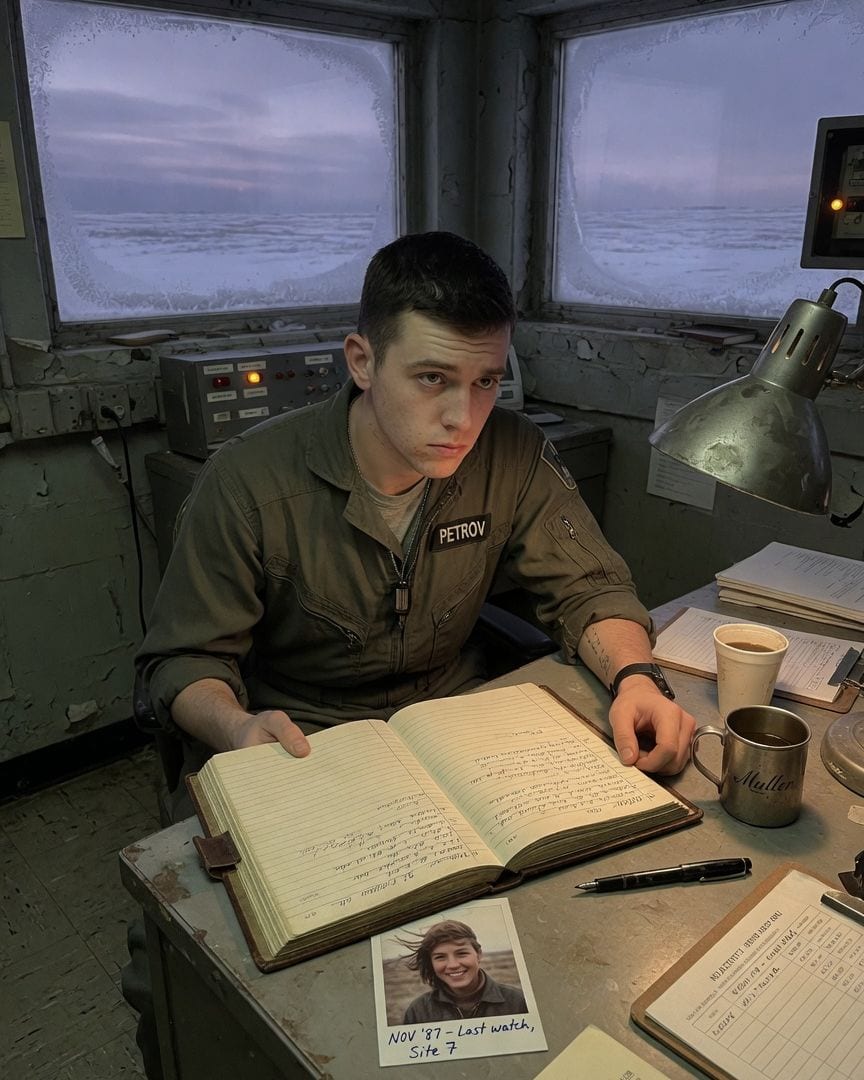
Airman Petrov found a photo dated 1987 in a base logbook, but the Cold War site was officially decommissioned in 1975.
Airman Nathaniel Petrov endured another lonely watch at Site 7, a decommissioned missile silo turned communications relay in desolate North Dakota. His six-week rotation became unsettling when he noticed the logbook on his desk, filled with daily entries detailing his watch, signed by unfamiliar names, though he had never written a word. The latest ink was fresh, and pages revealed years of similar entries from different hands, defying the fact Petrov was the only man assigned. Later, tucked within, he found a faded polaroid photo dated 'NOV '87 - Last watch, Site 7,' a full twelve years after the base was officially decommissioned in 1975.
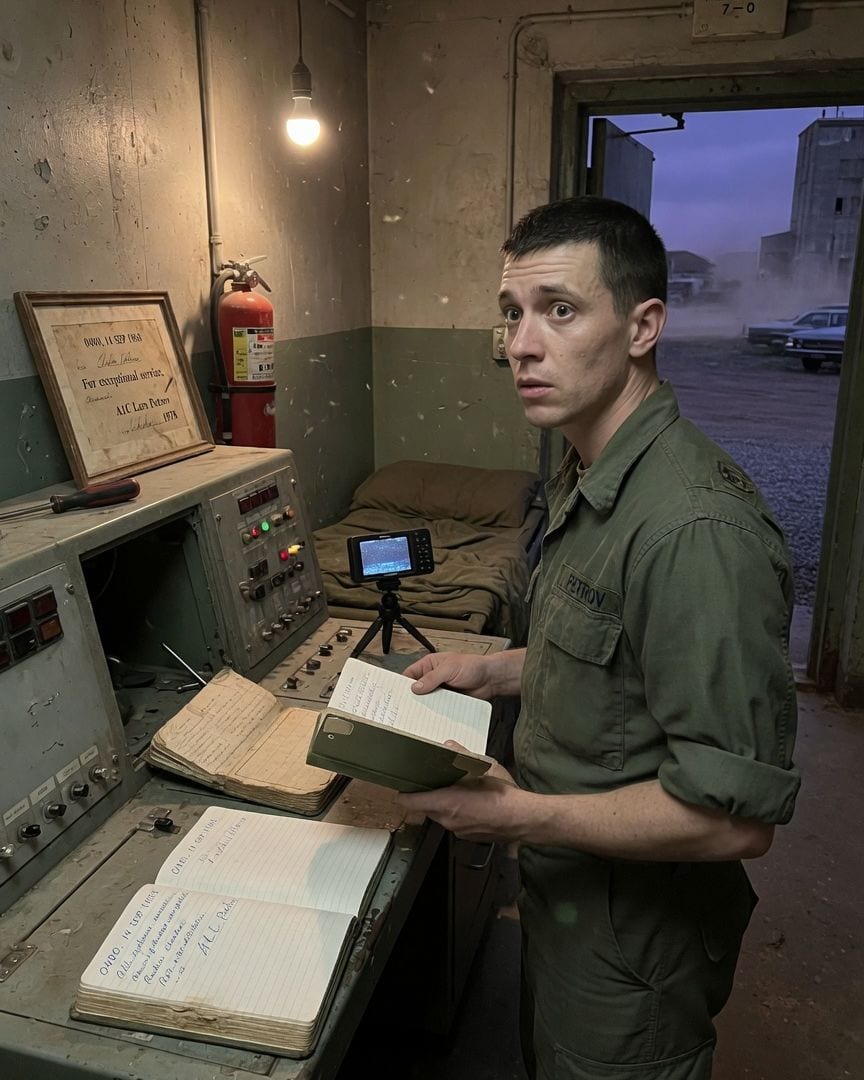
Airman Lars Petrov finds his own name signed in a Cold War logbook from 1968, decades before he was even born.
Airman Lars Petrov was counting down the days at Missile Site 7-0, his final remote posting before discharge, the North Dakota winds his only company. Inside the cold control room, he found a logbook where meticulous entries, including his name, detailed activities he hadn't performed, appearing nightly while he slept. Frustrated, he uncovered a hidden compartment holding an identical logbook, its pages yellowed with age. There, his own signature stared back at him from 1968, decades before he was born. Who was writing his name, and for how long?
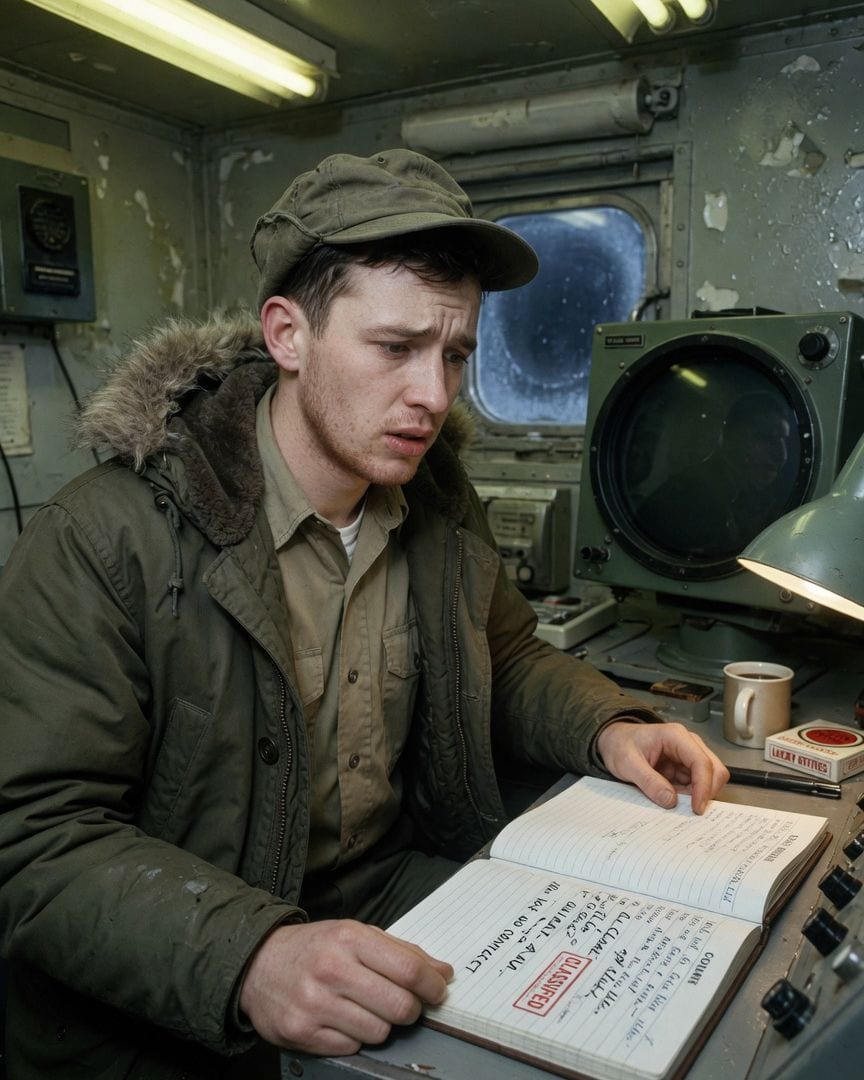
A Cold War airman logs an impossible radar contact on his last sweep. But his official logbook entry is stamped 'CLASSIFIED' and then contradicted by a hastily scrawled 'ALL CLEAR' dated moments before it.
Airman Ordway Vance, 22, manned the radar dome at Site Pellin in the biting North Atlantic dark of January 1962, running the last calibration sweep before its decommissioning. His scope picked up a faint, impossible return, growing closer with each pass, though the ocean remained empty to the eye. When Vance detailed the contact in his official logbook, a 'CLASSIFIED' stamp appeared, followed by a hastily scrawled 'ALL CLEAR' dated moments before his own entry, contradicting his every word. Commander Hartley dismissed it as equipment malfunction, but Vance sensed a chilling, official erasure behind the lie. He soon found a locked cabinet marked 'SITE PELLIN ANOMALIES,' hinting at a deeper truth buried within the base's final days.
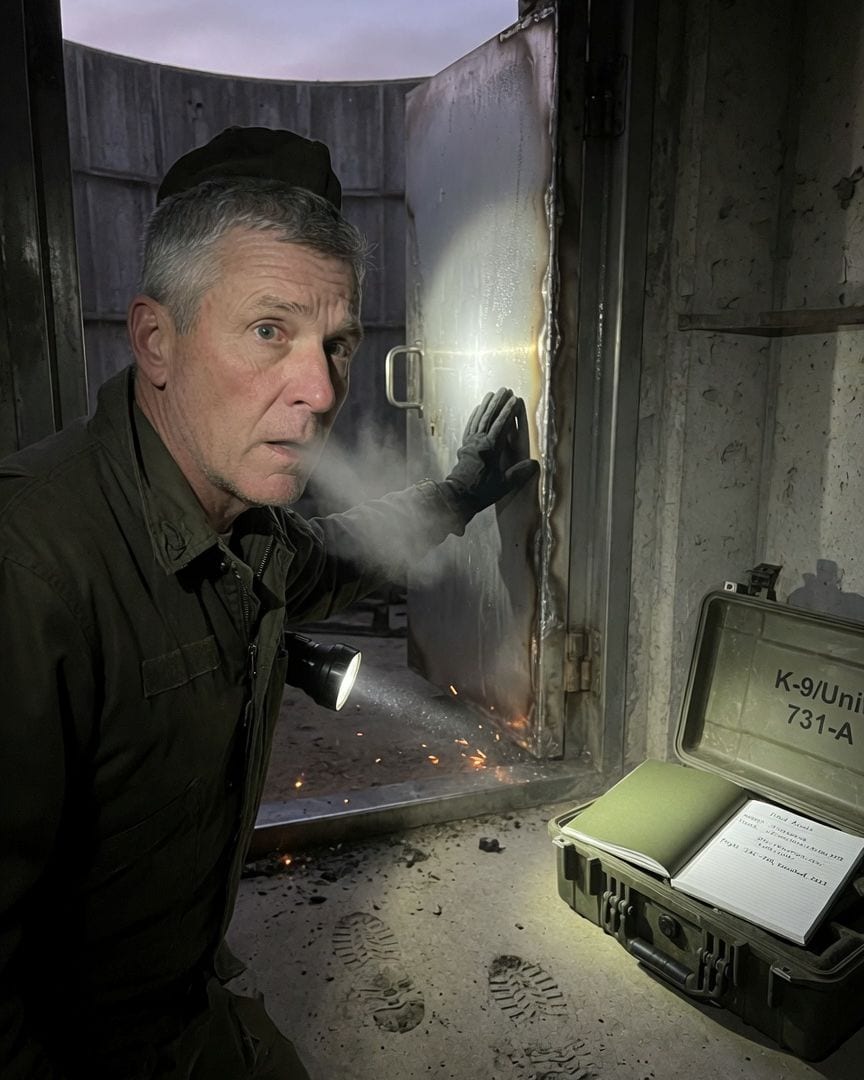
The Cold War silo was welded shut in 1968. A Captain found lights burning, fresh prints leading inside, and a logbook with a vanishing from last week.
Captain Merrit Sable faced a deadline at Silo K-9: one cold morning to retrieve classified hardware before its scheduled demolition at noon. The silo, officially welded shut by the Air Force in 1968 and long off-grid, should have been a tomb of forgotten machinery. Yet, through a cracked port, he saw nine work lights burning steadily forty feet down, and felt the faint suction of an active ventilation system. After breaching the decades-old weld, Merrit found more than just lights; fresh boot prints led deeper into the meticulously clean shaft, but none returned. A hidden compartment in an empty, warm hardcase revealed a logbook, its crisp pages detailing notorious military disappearances, with the latest entry dated just last week.
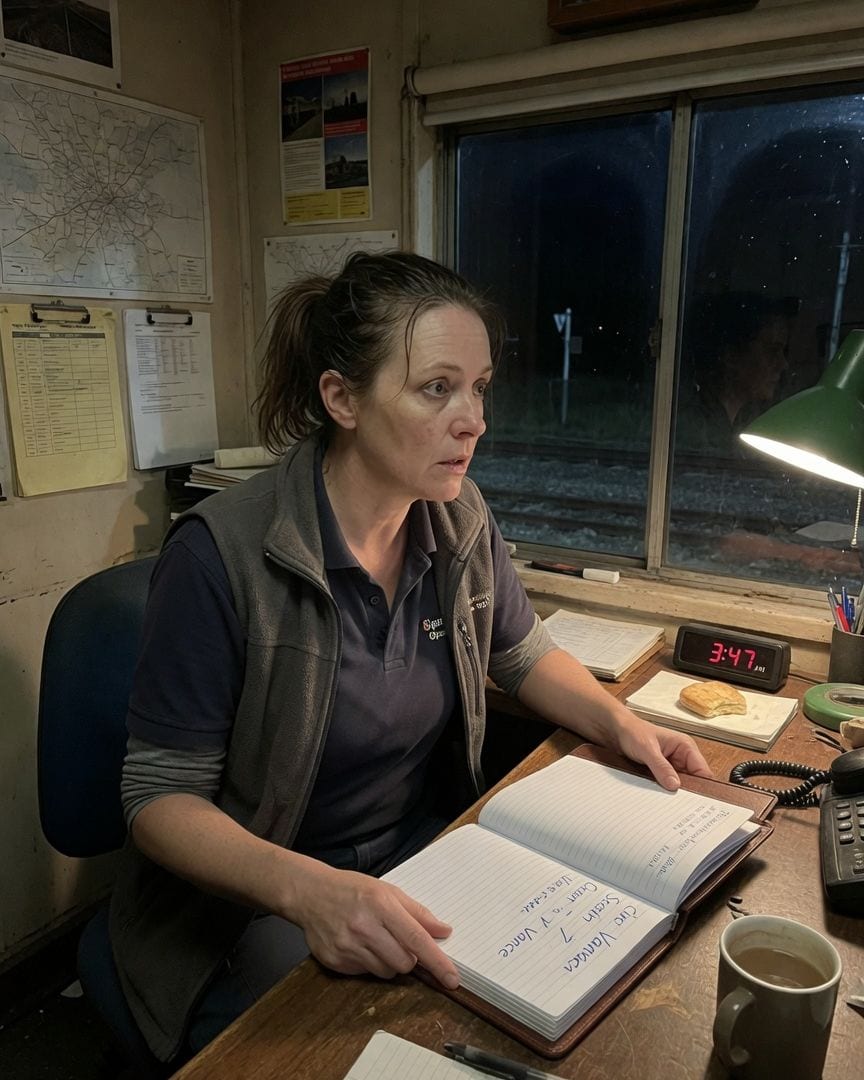
My linesman taps twice on my window at 3 AM. Control says he retired and passed years ago.
My routine at the rural signal cabin was regular: the linesman's double tap on the window at 3 AM. But then my supervisor called, revealing the linesman I knew, Warren Vance, had died five years ago. Now, an impossible entry in my official logbook, with his signature and timestamped from my shift, proves someone else was there.
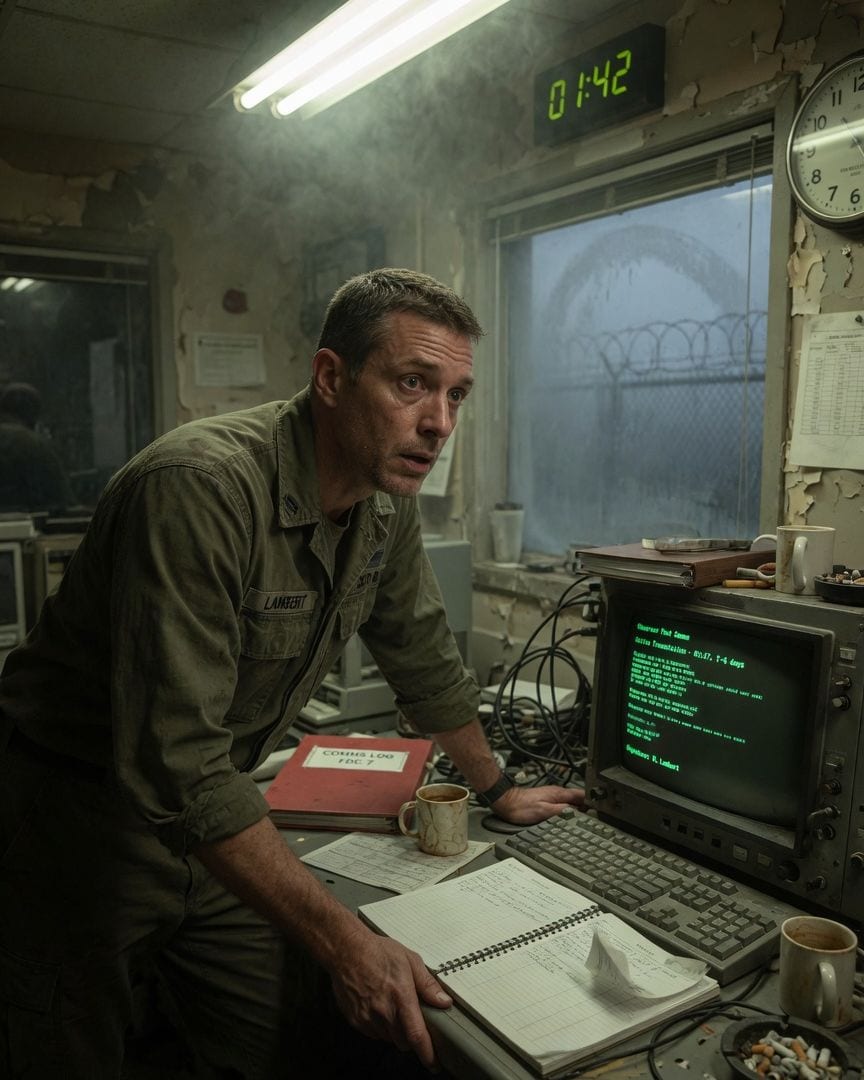
With Firebase 7 days from demolition, a dispatch specialist found his own signature on a log entry from a lost outpost. Then, a dead soldier's name appeared.
Specialist Robert Lambert hunched over the radio console in Firebase 7, the mountain fog pressing in as the base counted down its final days before demolition. His quiet shift shattered when urgent calls began arriving from outposts officially declared silent a week ago. His sergeant calmly informed him that he’d been speaking to no one, as all comms with those posts had been lost for hours. Later, Robert found a log entry for an active transmission, dated days after a post went dark, bearing his own signature. What chilling truth lay beneath the paper, revealing a dead soldier's name reporting from the grave?