My neighbor’s house plans show a room in my bedroom that doesn’t exist. The surveyor described its door, but my wall is solid.
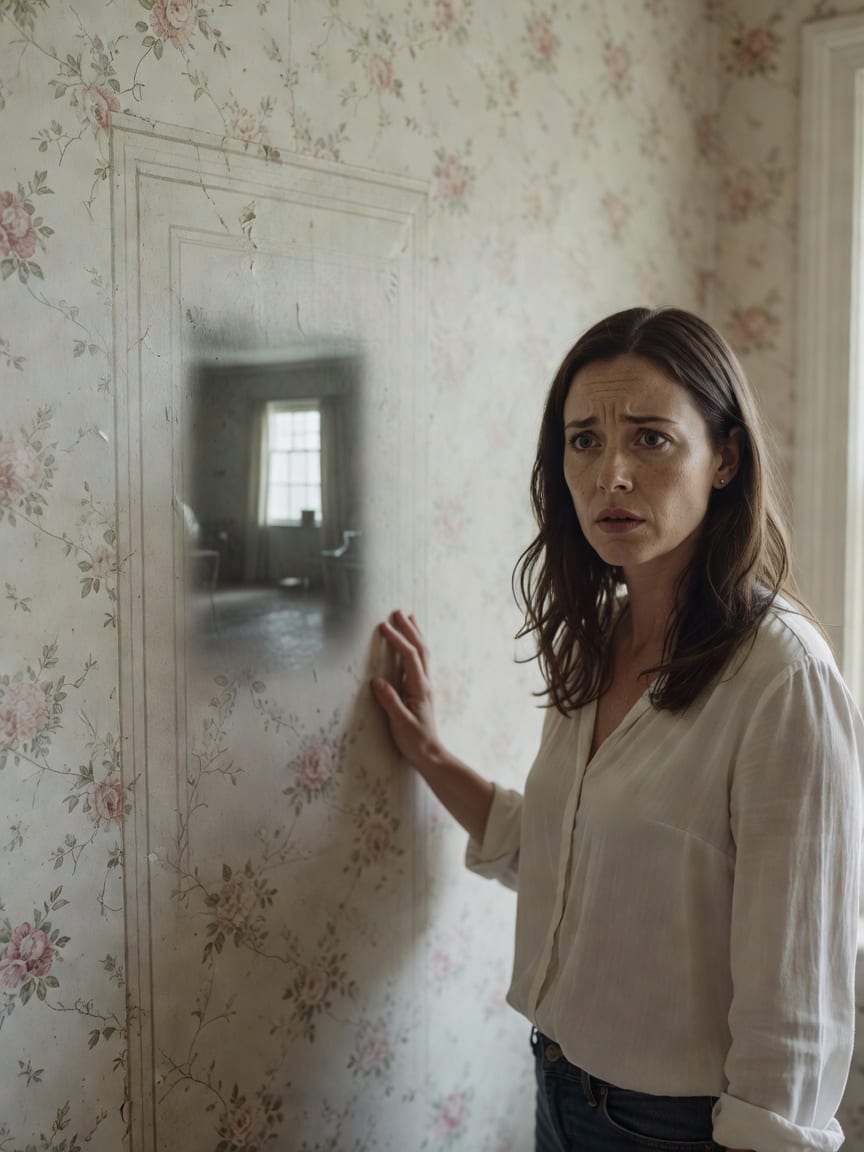
I sat at my kitchen table, the morning sun glinting off my coffee mug, staring at the architect’s plans for my neighbor Greg Bennett’s loft conversion.
Greg had just bought the place next door, number 12 Elm Street, and needed my signature for a party-wall agreement. A formality, he’d said. I was happy to oblige.
But as I unfolded the large sheet, my eyes snagged on my own house, 14 Elm Street, drawn in meticulous detail right there alongside Greg’s. My finger traced the familiar layout of my bedroom upstairs, then stopped cold.
Off my bedroom, where my solid wall stood, the blueprint showed a room. A small, square space, about eight by eight feet, labeled 'Storage/Access'.
I scoffed. Must be a drafting error. I’d lived in this house for five years; my bedroom wall was bare plaster, just one continuous surface. No door, no alcove, definitely no extra room. I called Simon Fletcher, the surveyor.
He was a quiet man, efficient, mid-fifties, who’d been inside both houses to measure.
'Mr. Fletcher,' I said, trying to sound casual, 'the plans for 12 Elm Street… they show an extra room off my bedroom. Is that a standard placeholder? A common mistake?'
Simon paused, a brief, thoughtful silence on the line. 'No, Ms. Vance,' he said, his voice calm, even. 'That’s a small, windowless space. Access via a door in your bedroom wall, just past the chimney breast.'
My stomach did a slow flip. I looked up from the table, through the kitchen doorway, to the solid expanse of my bedroom wall, visible through the archway. There was no door. Only wallpaper.
The surveyor’s calm description had lodged in my mind, a tiny splinter of wrongness. I walked into my bedroom, the afternoon light streaming through the bay window, illuminating the floral wallpaper I’d chosen when I moved in.
I ran my hand along the wall where Simon had described the door, just past the chimney breast. It felt solid, cool, unyielding. No seam, no handle, no hint of an opening.
I pressed my palm flat against it, then my ear. Nothing.
I knocked, my knuckles rapping against the plaster. Mostly solid thuds, a dull, reassuring firmness. But then, just where Simon had pointed, a faint, almost imperceptible hollowness. It was subtle, barely a different resonance, but it was there.
I pressed my ear to the spot again, hearing nothing but the distant hum of traffic from the street outside. It wasn't enough. It could be anything. A stud missing, a patch of older plaster.
A few days later, the thought still bothering me, I found myself driving to the local planning archives. I gave myself an excuse – ostensibly to check old deeds for a 'historic feature' I was considering for my garden.
My real target, though: the original blueprints for 14 Elm Street.
The clerk, a kind, bespectacled woman named Audrey, pulled several dusty folders for me. I started with the most recent, working my way back. I found plans from 1950, then 1972.
Both showed my house, its dimensions consistent with what I knew. And both, unmistakably, depicted the small, square room off my bedroom. In the older plans, it was simply labeled 'Ancillary Space.'
The impossible room wasn't new; it had been there for decades, on paper at least.
I felt a prickle of unease, like a cold finger tracing my spine. A consistent error across seventy years of official records? That was no error at all. It was a fact. A fact that contradicted my reality.
Back home, I didn't bother with the garden. I went straight to my bedroom, a hammer and a small flashlight in hand. I found the hollow spot again, tapping more deliberately, listening for the slight change in pitch.
The wallpaper, old and thick, felt slightly bubbled there, a subtle unevenness I’d never noticed before. With a careful hand, I peeled back a corner of the floral pattern, revealing the bare plaster beneath.
And there, etched so finely it was almost invisible, was a hairline crack, a perfect vertical seam running from floor to ceiling. It wasn't a crack from settling; it was too straight, too precise.
I traced it with my fingertip, feeling a faint ridge, then another, forming a rectangle. A doorframe.
I ran my fingers over the barely perceptible seam in the plaster, feeling the faint coldness emanating from it, a coldness that wasn't present anywhere else on the solid wall.
I pressed harder, and a faint, hollow thud echoed back from behind the plaster.
The hollow thud confirmed it: the door was there. Or had been. Or was there, somehow, in a way I couldn't comprehend.
I spent the next few days in a quiet frenzy, measuring my bedroom with a tape measure, then the exterior of the house with a long, retractable one.
The external dimensions of 14 Elm Street, according to the original deeds I’d found, were a solid 30 feet by 20 feet. My internal measurements, however, seemed to lose a few inches here and there.
Small discrepancies, barely noticeable on their own, but when added up, they accounted for a volume I couldn't place. It was as if a small slice of my house simply wasn’t there, absorbed by an unseen space.
I tried calling Simon Fletcher again, but his office number went straight to voicemail. His extension just rang and rang, then kicked over to a generic greeting.
Frustrated, unable to shake the feeling that I was missing something crucial, I decided to drive to the next town over, Newton. A larger, regional archive there might hold even older property records, perhaps something that predated the 1950s plans.
I set my GPS for 'Newton Historical Society.' The drive was familiar, a straight shot down Elm Street, then a left onto the old highway.
I drove for twenty minutes, passing familiar landmarks: the old dairy farm, the rusted billboard for a long-closed diner, the big oak tree at the bend in the road. Then, something felt off.
The gas station I’d passed ten minutes ago reappeared on my left, its red and yellow sign glaring in the afternoon sun.
I checked the GPS. It showed me still on the highway, but the arrow indicating my location was drawing a tight loop. A glitch?
I frowned, confused, and took a different turn, heading down a residential street I knew led to the highway bypass, a route I often took to avoid traffic.
Ten minutes later, I saw the familiar oak tree at the end of Elm Street. Then the faded yellow house next to mine. I was back at 14 Elm Street. My own damn house.
The mileage on my car confirmed I’d driven over fifteen miles. The clock on my dashboard showed nearly an hour had passed since I’d left. Yet, I was exactly where I started. The road, somehow, had returned me.
The next morning, I found Simon Fletcher on my driveway, adjusting his surveying tripod. He looked up, a placid, almost gentle smile on his face, as if he expected me. 'Ms. Vance, what a coincidence.
Just checking some boundary markers for Mr. Bennett. Thought I heard your car last night, driving off then returning.' His eyes, though, held a knowing glint, a spark of something that wasn't casual curiosity.
'Everything alright with the party wall agreement?' he asked, his tone too casual, too even.
I felt a chill that had nothing to do with the cool morning air. He knew. He knew about my midnight trip. He knew I’d been poking around.
'Mr. Fletcher,' I said, my voice steady despite the tremor in my hands, 'I found the door.'
Simon’s smile didn’t falter, but his gaze sharpened, focusing on me with an intensity that made me uncomfortable. 'Did you, now? Remarkable, isn't it? How some things hide in plain sight.'
He began packing up his equipment with unnerving slowness, coiling the thick yellow measuring tape with deliberate movements. 'Some houses, Ms. Vance, have a deeper memory than their residents. They hold onto things. Things that don't quite fit the map.
Things you can't always see, but are undeniably there.' He paused, meeting my eyes, holding my gaze. 'You've been asking questions at the archives. And driving rather circuitously, I hear.'
I felt exposed, caught. Like a rat in a trap. 'What is it, Simon? What's in my house? What the hell is going on?'
He sighed, a gentle, almost weary sound, as if he’d had this conversation countless times before. 'It's not what's in your house, Ms. Vance. It's what your house is. And what it has always been.'
I pulled Simon into my house, into the quiet dread of my living room. I didn't offer him coffee, didn't make small talk. 'Explain,' I demanded, pointing towards the solid wall in my bedroom.
I needed answers, and I needed them now.
Simon sat on my sofa, unbothered, his hands clasped, like a doctor delivering a grave but unchangeable diagnosis. 'Your house, 14 Elm Street, is what we call a 'fixed point.' It’s a nexus where geometry… misbehaves.
Not in a destructive way, not like a crack in the foundation. But in a subtle, persistent way that allows for spaces that shouldn’t exist, according to conventional physics.
The room you saw on the plans, the door in your wall – it’s real. It's always been real.'
I felt a surge of cold anger, a desperate frustration. 'And you just surveyed it, drew it, and said nothing? You let me think I was losing my mind, seeing things that weren't there?'
Simon held up a hand, calm as ever. 'My role, Ms. Vance, is to document what is. And what is, is a consistent, recurring anomaly. It’s been observed here for generations.
The room itself isn't always accessible, or even visible, to everyone. Most people, like yourself, perceive the house as solid, Euclidean, perfectly normal. But its true dimensions, its true self, includes that space.'
'The road,' I whispered, remembering my fruitless drive, the hours I’d spent going nowhere. 'The road that returns.'
Simon nodded, a faint, almost pitying look in his eyes. 'A side effect. The house anchors itself, geometrically. It holds its place. It resists being left behind, or having its pattern broken. It keeps its occupants close.
If you try to leave, it finds a way to bring you back. It needs to remain stable.'
'Occupants?' I asked, a knot forming in my stomach. 'Who else knows about this? And who built a damn house that does… this?'
Simon’s gaze softened, tinged with a strange, calm sadness. 'A few of us. Those who monitor these places. We call ourselves the Wardens. And those who… become part of them. The house has a way of selecting its anchors.
Its keepers.'
Simon reached into his worn leather satchel, pulling out a thick, yellowed envelope. The paper felt like dried parchment in his hands. 'This was left to me by my grandfather, who also surveyed this area.
A note, a warning, and this.' He slid out a sepia-toned photograph, carefully, as if it were fragile as glass.
It was a clear, crisp image of 14 Elm Street, unmistakably Nancy’s house, nestled amongst young trees. The facade was familiar, the bay window, the porch.
But in the background, a small, attached structure, undeniably the 'missing room,' was clearly visible, its single window looking out. And standing by that window, looking directly at the camera, was a woman.
Her hair was pulled back in a severe bun, her face obscured slightly by the quality of the photograph, but her posture, her high cheekbones, her steady gaze…
My breath hitched. It was a mirror image of a faded portrait I kept in my living room, tucked away on the mantelpiece. My great-grandmother, Patricia Vance.
Patricia, who had lived in a small farming community three hundred miles away in the 1930s. Patricia, who had never set foot in Elm Street, as far as my family knew.
Simon’s voice was a quiet hum, a drone that somehow amplified the impossible image before me. 'The house, Ms. Vance, doesn’t just hold its geometry. It holds its history. And sometimes, its people.'
He pointed to the back of the photograph. Faintly written in elegant cursive, the ink faded but clear: 'Patricia Vance, 1934. The Keeper of the Unmapped Room.'
I stared at the photograph, the words 'The Keeper of the Unmapped Room' echoing in my mind, a chilling pronouncement. 'My great-grandmother,' I finally managed, my voice thin, reedy, barely my own. 'She was never here.
She lived in Willow Creek. Three hundred miles away.'
Simon nodded, his face impassive. 'Not in the way you understand 'here,' Ms. Vance. The house, this fixed point, creates a recurring pattern. Certain bloodlines, certain individuals, seem to be drawn to it, or rather, it draws them.
Patricia Vance, your great-grandmother, was one such anchor. She lived a life in another town, yes, but her consciousness, her presence, was also here, experiencing the house, maintaining its stability within the anomaly.
It's a generational echo, a duty passed down, often unknowingly.'
He explained that the 'missing room' wasn't just a physical space; it was a pivot, a point of geometric torsion that allowed the house to exist slightly outside conventional space. It was the heart of the anomaly.
'When the house feels unstable,' Simon continued, 'the room becomes more prominent, more accessible. It needs an anchor, a conscious presence to maintain its balance. Your presence. Your lineage has always been connected to keeping it stable.
The 'Road That Returns' isn't just a trick of perception; it's the house ensuring its anchor remains. It ensures the pattern holds.'
The terror wasn't just the impossibility of it, but the insidious coherence. Every unexplainable detail, every historical discrepancy, every pull of the thread, now clicked into place with horrifying precision.
I wasn't just observing an anomaly; I was an integral, inherited part of it. A piece of the mechanism.
I stood, walking to my bedroom, to the solid wall that now felt like a veil, a thin skin over another reality. 'So what do I do?'
I asked, my voice barely a whisper, the question hollow in the silent room.
Simon followed, his calm presence a contrast to my internal turmoil. 'You accept it, Ms. Vance. You live in the house. You become its anchor. You perceive it as it is, not just as it appears.
If you resist, if you try to leave, the house becomes unstable. The geometric anomalies will intensify. Not just for you, but for the surrounding area. It could… unravel. The geometry might collapse, and it would be catastrophic.'
He spoke of it not as a threat, but as a simple, undeniable fact of physics, of existence. His calm was the worst part, a chilling normalization of the utterly impossible.
I looked at the faint seam in the wall, the ghost of a doorframe. I understood now why I'd felt so drawn to this house, why I'd never truly felt at home anywhere else.
It wasn't a choice I was making; it was a destiny I was fulfilling. I was Patricia Vance, and Patricia Vance before her, all of them tied to this place, this impossible geometry.
I could feel the subtle shift in my perception, the faint hum of the unmapped room just beyond my sight, a new layer of reality settling over me. I knew I could never truly leave.
The road would always bring me back. I was inside it now, completely.
Nancy Vance still lives at 14 Elm Street. She stopped trying to uncover the house’s secrets, realizing she was one of them. Simon Fletcher still performs occasional 'boundary checks,' his visits now brief, silent acknowledgements of their shared, impossible understanding.
The house remains, a quiet sentinel of distorted space, its unseen room a constant, subtle pressure behind her bedroom wall. The world outside continues unaware, oblivious to the geometric anchor in their midst.
Nancy no longer measures the internal dimensions of her home. She knows the numbers won't add up, and she no longer cares. She has found a strange, unsettling peace within the anomaly.
Nancy often finds herself in her bedroom, staring at the solid wall where the door should be. She doesn't see it, not with her eyes, but she feels it now.
A distinct presence, a quiet hum just beyond the plaster, a space that exists without existing. Her perception has changed, irrevocably. She is no longer just a resident; she is a component.
She feels the house, its impossible geometry, as an extension of herself. She is its anchor, its keeper, and she is always, always inside it. She never leaves.
A new neighbor, Greg Bennett, bought Roland Bennett’s house next door. He often sees Nancy Vance tending her garden, a placid, distant look in her eyes.
Sometimes, late at night, he notices a faint, warm light glowing from a small, square window on Nancy’s second floor. A window that, according to the original plans for 14 Elm Street, shouldn't exist.
If this one got to you
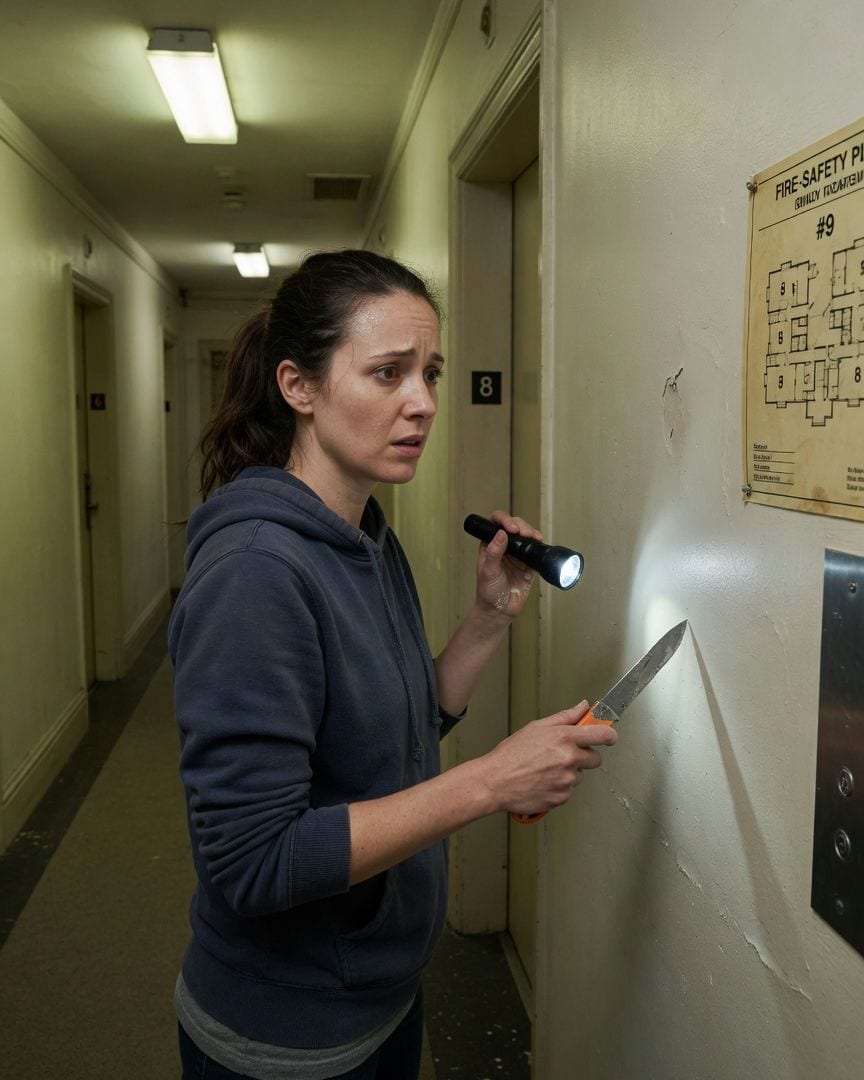
That blank wall in my hallway has a hidden metal plate. Tonight, after eleven years, it just clicked.
For eleven years, my apartment building's fire plan has shown nine apartments on my floor. But I've only ever counted eight doors, the space for the ninth a blank wall. Now, I've found a hidden metal plate behind the plaster, and from deep within, I just heard a soft *click*.
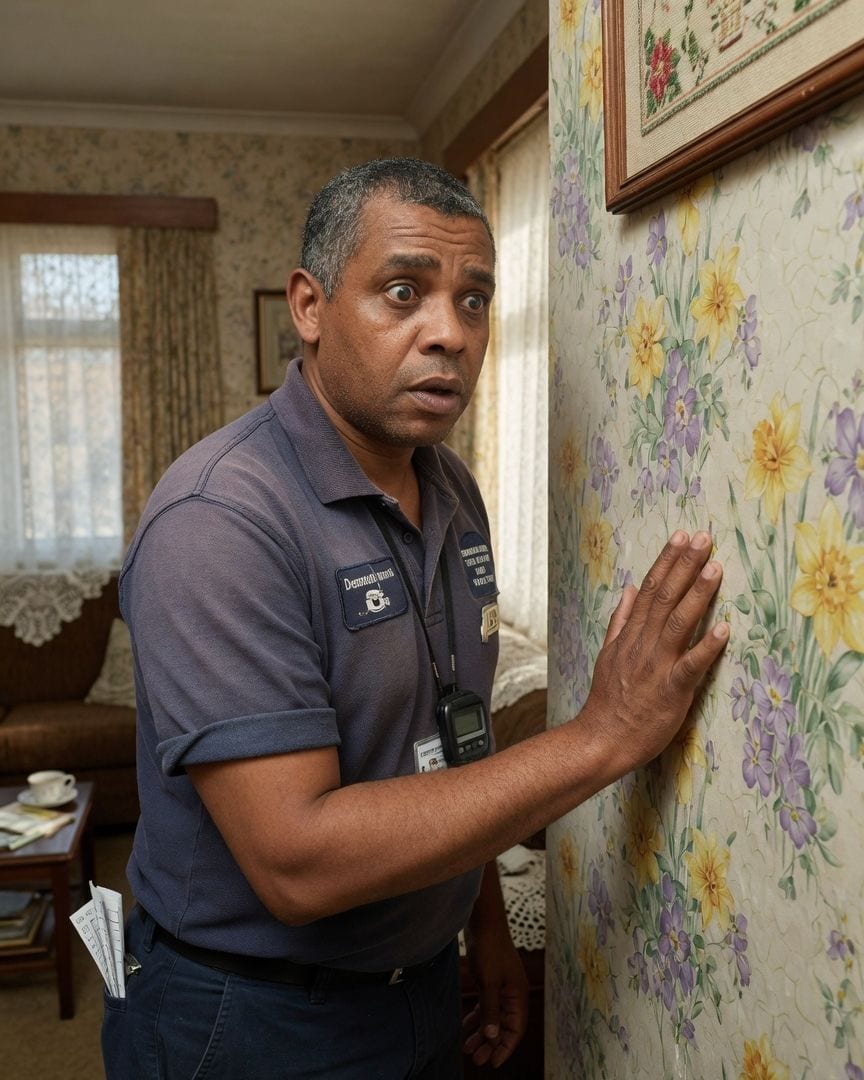
I read the water meters on this street, and this month number 30 grew a second one in pavement that was solid last month — its pipe runs back under a front door I cannot find.
I'm Desmond Drummond, a city water meter reader, used to the predictable rhythm of my fifteen-year route. But this month, Mrs. Crane's house on Elm Street showed a second meter reading. It led to a new meter pointed at a blank brick wall, and later, to a hidden door behind her living room wallpaper where no door should exist.
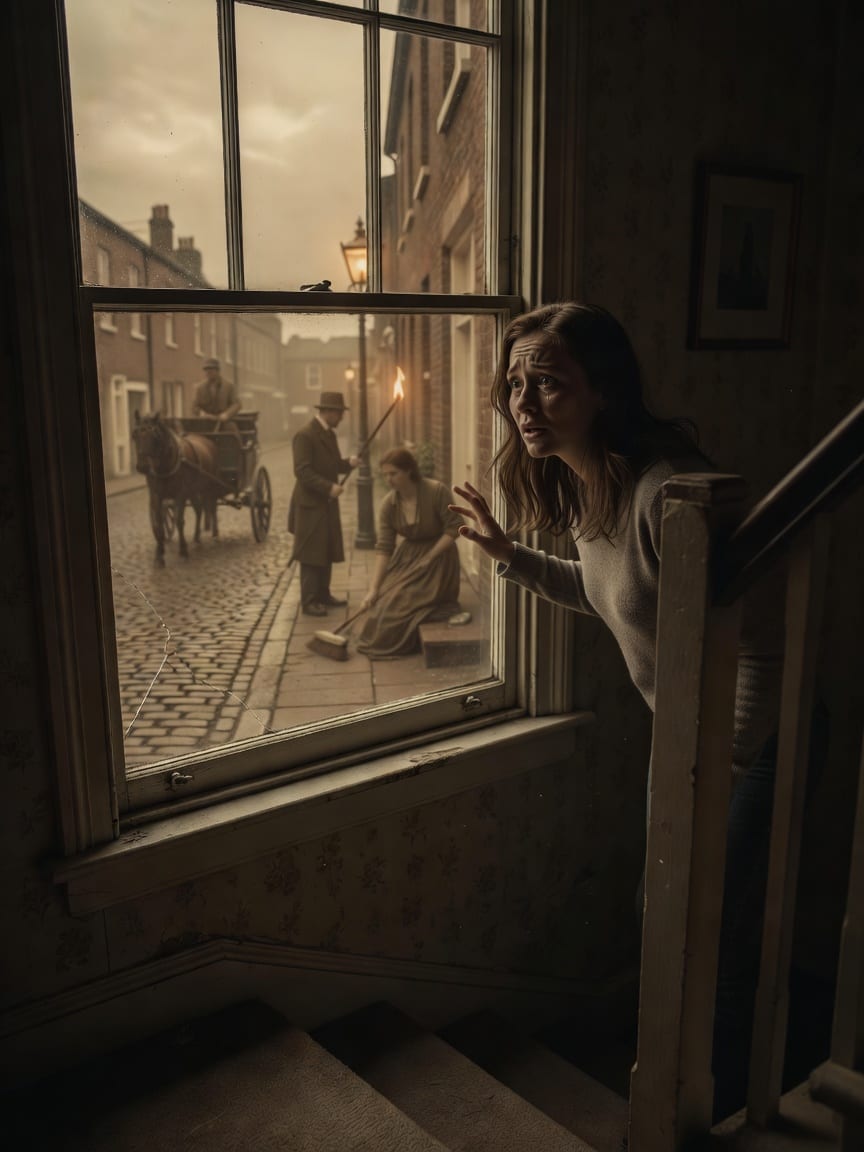
My half-landing window looked down on a cobbled street, a horse and cart. My panes, same crack. Below, only the bins.
I moved into this inherited house for a fresh start, living alone in the quiet. But the third stair on the main flight is deeply worn, a ghostly scoop hinting at decades of unseen footsteps. It feels hollow, and the wall beside it hides a faint, inexplicable seam.
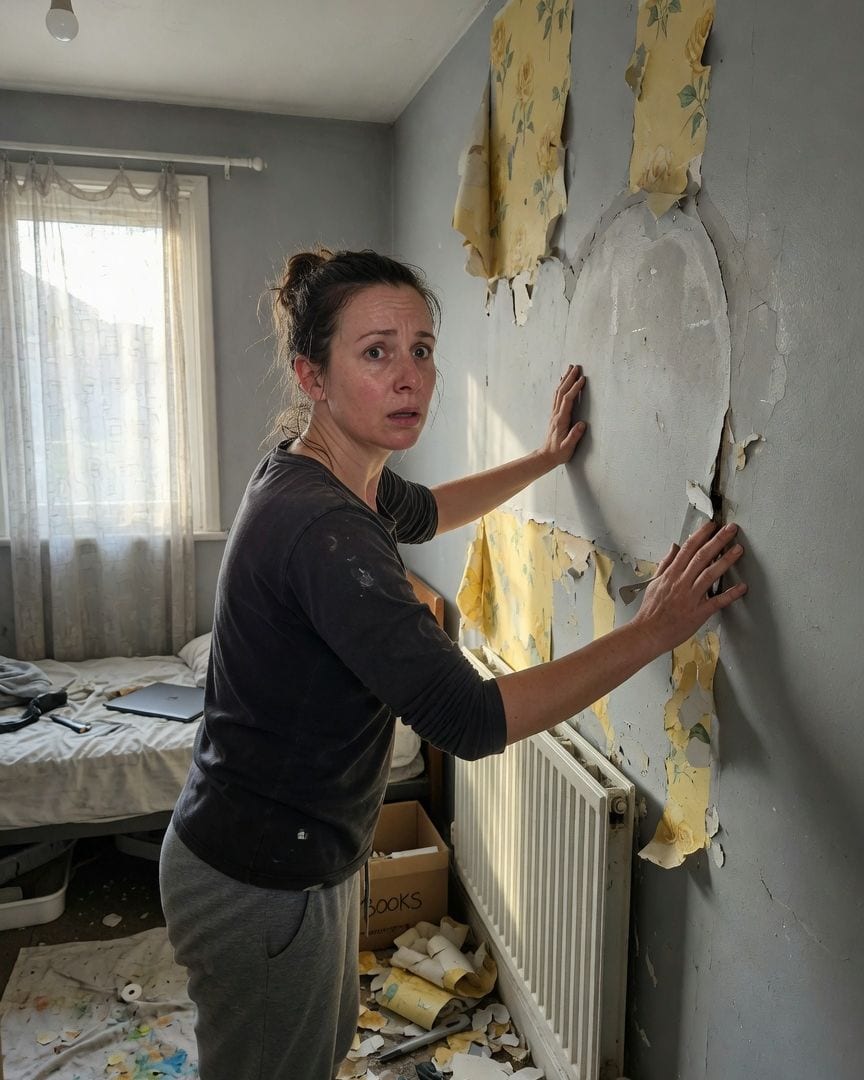
I painted the box room grey, but twice I've woken to find it papered in yellow roses I never bought — seams lifting exactly where the empty-flat photos show bare plaster.
I moved into my new flat in March, ready for a fresh start. But the box room, freshly painted grey, kept growing old-fashioned yellow rose wallpaper. The third time, as I stripped it, the wall opened to reveal a perfectly preserved, sunlit room from May 1978, complete with a steaming teacup.
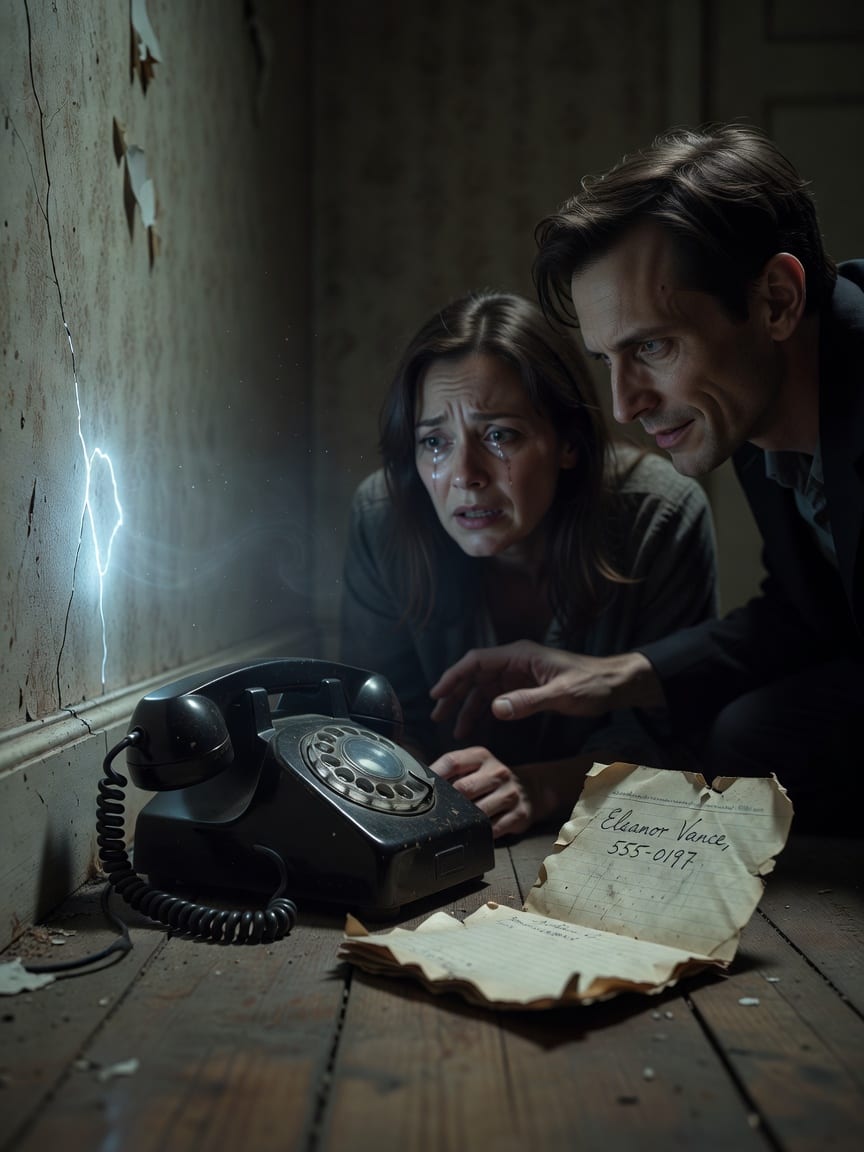
My house's walls ring when I dial a phone number from a 1974 directory. My neighbors said that directory was trash.
I was sifting boxes in my new house when I found an old 1974 telephone directory for my street. It listed my address, 12 Elm Street, under the name "Mr. & Mrs. Sheppard." On a whim, I called the faded seven-digit number. My cell phone rang, but a low, muffled sound also vibrated from the wall beside me.
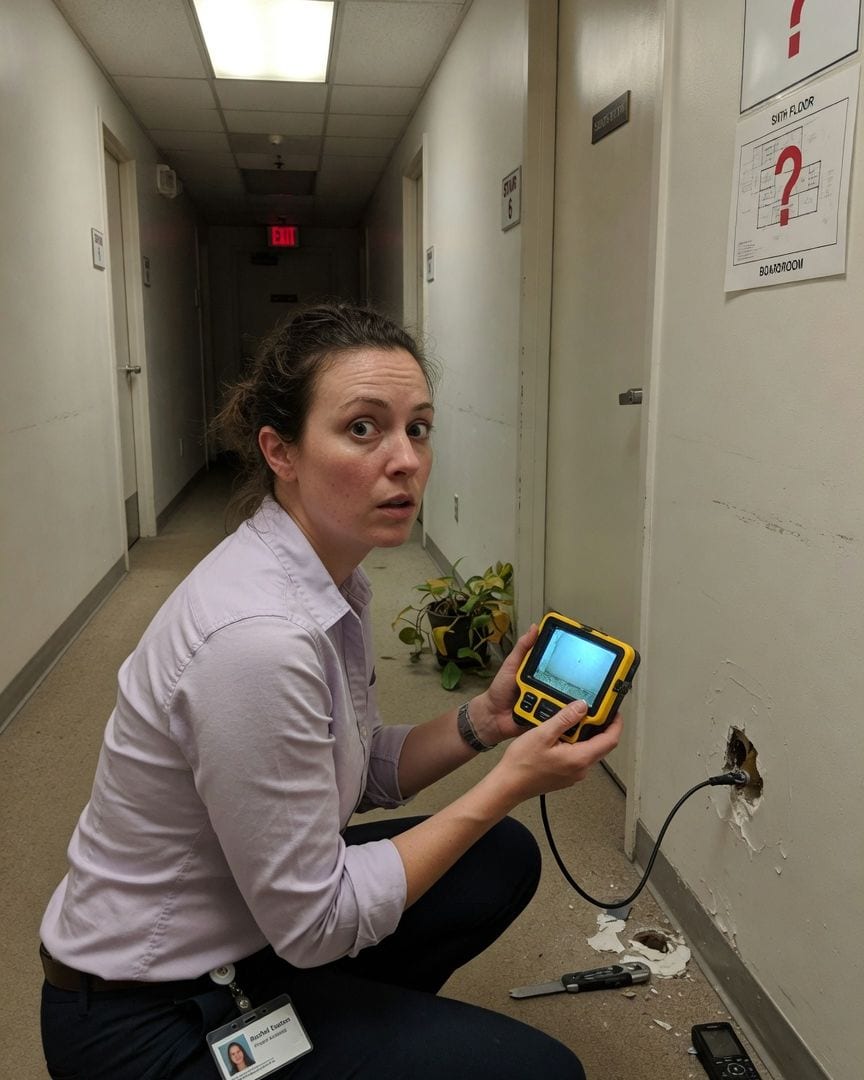
Footsteps cross our boardroom ceiling every evening at six – directly over the empty space where the office plans show a room that doesn't exist.
I'm a project architect who discovered an unlabeled room on our new office plans, a space on my floor that simply wasn't on any old blueprints. Now, every night at 6 PM, faint, rhythmic footsteps cross the boardroom ceiling, exactly where that phantom room should be. Security logs confirm no one is ever there.