A Petty Officer logged a sailor on his final watch. Then he found the same exact entry in a logbook from forty years ago.
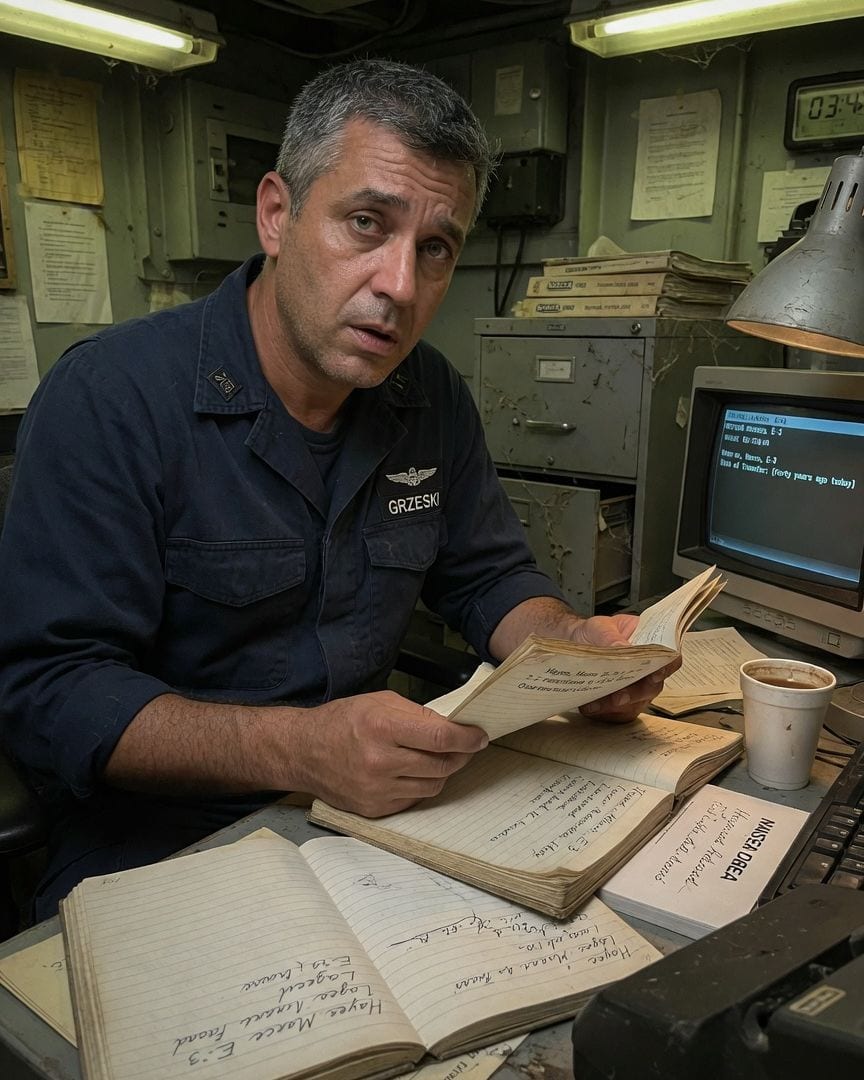
Petty Officer Anton Grzeski, 38, stood his final quarterdeck watch on the USS Vance, the humid Gulf night thick around him. Six hours from transfer, he knew every face, every gait, every worn patch of dungarees that climbed the brow.
He'd seen thousands of sailors come and go in his time on the tender. At 0130, a figure appeared, climbing the gangway from the shore.
The sailor moved with textbook precision, saluting aft and forward, his dungarees a cut out of date, but otherwise standard issue. He gave his name: 'Hayes, Marco.'
Grzeski’s pen paused mid-air over the logbook. Marco Hayes, E-3, had been listed as 'transferred off'—forty years ago, if he remembered the old database entry correctly.
The name was etched in his memory from a casual conversation with the ship's archivist. Grzeski, rational and tired, logged him aboard anyway, chalking it up to fatigue or a hazing prank for the departing Petty Officer.
He scrawled the name, the rank, the time, then signed off on the watch, eager for relief.
The next morning, the berthing count came back one over. Commander Pierce, reviewing the daily reports, frowned. 'Petty Officer Grzeski,' he called, 'the berthing count for 2-Section is off by one. Do we have an unauthorized overnight guest?'
Grzeski felt a jolt. He’d personally checked 2-Section. Every rack was empty save those officially assigned. No one had slept in the extra spot.
He pulled the quarterdeck logbook, his own neat handwriting staring back at him, confirming the impossible entry. Hayes, Marco, E-3 – Logged Aboard. The ink was dry, undeniable.
The impossible entry gnawed at Grzeski, a splinter under the skin. He went to the small, cramped QM office, the smell of stale coffee and cleaning solvent thick in the air.
He fired up his console, the screen flickering to life, and checked the digital ship’s manifest. As expected, no current Marco Hayes.
He typed the name into the retired personnel database, a slow, clunky system he rarely accessed, half-expecting an error message or a blank return. To his shock, a record appeared: Hayes, Marco, E-3, Date of Transfer: \[Forty years ago today].
Below it, in a smaller, almost forgotten font: 'Last Duty: Quarterdeck, USS Vance.'
Dread tightened its grip around Grzeski’s chest, cold and precise. This wasn't fatigue. This wasn't a prank.
He remembered the old, rarely accessed file cabinet in the back of the QM office, rumored to hold physical records from before the digital age, preserved for historical archives or just forgotten.
He found it, tucked behind a stack of outdated manuals, cobwebbed and smelling of stale paper and trapped time. The metal handle was cold beneath his fingers.
Digging through dusty folders, he located a personnel manifest from exactly forty years prior. He flipped through the brittle pages, his breath held.
And there it was, in faded ink, listed among new transfers: 'Hayes, Marco, E-3 – Transferred to USS Vance, Quarterdeck Duty.' The mundane explanation of a prank or clerical error dissolved, replaced by a cold, undeniable fact.
This wasn't a mistake. This was a record, solid and physical, swearing to a thing that could not be.
With trembling hands, Grzeski continued to search the old manifest. He looked for the duty roster from that same night, forty years ago, hoping for some discrepancy, some error, anything to break the growing cold logic.
He found it, a separate sheet paper-clipped to the manifest, listing the quarterdeck duty Petty Officer as Wayne Ellison, QM3. Ellison. The name meant nothing to him.
Grzeski then located the corresponding physical logbook from that year, its binding cracked and pages yellowed with age. It felt heavy in his hands, dense with forgotten time. He turned to the date, to the 0130 entry.
Beneath Petty Officer Wayne Ellison's neat, looping signature, was an entry that mirrored his own, chillingly precise: 'Hayes, Marco, E-3 – Logged Aboard.'
Grzeski presented his findings—the current log with his own entry, the old manifest with Marco Hayes's transfer details, the forty-year-old logbook signed by Wayne Ellison, bearing the identical, impossible entry—to Commander Russell Pierce.
Pierce, a by-the-book officer, listened patiently in his office, the ship’s low thrum a constant presence. He examined the documents, his brow furrowed, then dismissed it as an elaborate prank, a forgery, or Grzeski’s fatigue playing tricks on him.
'Get some rest, Petty Officer,' he advised, his voice firm but not unkind, 'and complete your transfer paperwork. You've earned it.'
Disciplined by years of service, Grzeski tried to let it go, but the cold coherence of the logs haunted him. The identical handwriting, the exact time, the same name, separated by forty years. It was too precise to be random.
He sought out Laura Carver, 45, the civilian Ship's Archivist, a woman with a reputation for knowing the USS Vance's deepest secrets, the kind of woman who might notice things the official channels missed.
Carver, a slight woman with sharp, observant eyes, sat amidst stacks of ledgers and microfiche. She initially feigned disinterest, her gaze drifting over his shoulder. But as Grzeski described the recurring 0130 entries, the impossibility of Marco Hayes, she paused.
The air in the archives seemed to grow heavier, as if the ship itself were listening. 'Sometimes,' she said, her voice barely a whisper, 'the old records have their own patterns. You might want to check the other quarterdeck logs.
From, say, every five to ten years.' Her gaze, unblinking, held his.
Grzeski, following her subtle guidance, spent the next day burrowing through the dusty shelves. He found more old logbooks tucked away, some brittle with age, others remarkably preserved. He began compiling a timeline.
Every 5-10 years, roughly, the pattern recurred: an impossible sailor, always an E-3, always at 0130, always logged aboard by the duty PO, and always resulting in an 'one over' berthing count that vanished without a trace.
The names of the manifesting sailors changed, as did the duty Petty Officers, but the pattern was undeniable, a cold, mechanical recurrence. The unease solidified into concrete dread. The ship was repeating itself, over and over.
As Grzeski delved deeper into the archives, into the ship's forgotten past, he began to feel a presence. He'd catch glimpses of Laura Carver, always at a distance, her eyes following him, her expression unreadable.
She moved through the shadows of the stacks like a ghost herself, silent and watchful.
Once, he turned suddenly and found her standing at the end of a long, dimly lit corridor, near a sealed-off access hatch to the ship's oldest, unused lower decks. The air down there felt colder, thicker.
She simply watched him, a calm, knowing look on her face, before turning and vanishing into the shadows of the passageway, leaving only the memory of her unsettling stillness.
The silence in the archives, usually a comfort, now felt like a held breath.
The next day, he found a small, folded piece of paper tucked into his rack, nestled under his pillow.
It was blank except for a single, stark sentence, written in neat, precise block letters: 'Some things are meant to stay logged.' Grzeski’s heart hammered against his ribs.
It had to be a prank, a sick joke from a shipmate who knew he was poking around in the ship's history.
But the unsettling calm of Carver's gaze, combined with the note, made the threat feel deeply personal, as if the ship itself had sent it.
He went back to the sealed hatch, pressing his ear against the cold, sweating metal, but heard nothing but the deep, internal hum of the ship, a sound he now perceived as something more than just machinery.
He was no longer just investigating; he was being observed, warned.
Grzeski confronted Laura Carver in the archives, holding up his compiled timeline of impossible log entries, the yellowed pages trembling slightly in his hand. 'What do you know?' he demanded, his voice tight. 'What is this ship?'
Carver sighed, a sound that seemed to carry the weight of years, her calm demeanor unwavering. She didn't flinch from his intensity. 'The USS Vance has a… reputation, Petty Officer. Not ghosts, not in the way you think.'
Her gaze swept over the ancient ledgers surrounding them. She explained that certain duty stations, especially the quarterdeck, sometimes 'hold onto' a piece of the crew. 'An imprint,' she clarified, 'a record that refuses to be erased. The ship remembers.'
She described the 'extra' sailor as a manifestation of the ship’s deep memory, a recurring echo, an identity pulled from its own past.
'And the duty PO who logs them,' she said, her gaze steady and direct, 'becomes part of that memory.'
Grzeski felt a chill crawl up his spine, prickling his skin. 'You mean… they get taken?'
Carver didn't answer directly. Instead, she walked to a display case near the back of the room and retrieved a faded, sepia-toned photograph.
It was the USS Vance’s original commissioning crew, lined up on the deck, young faces staring out from a distant past. In the background, slightly out of focus, almost a trick of the light, but undeniably there, was a figure.
A young E-3, in dungarees a cut out of date, standing at the quarterdeck. It was Marco Hayes.
'Previous COs have tried to seal off areas, transfer personnel, even decommission the ship early,' Carver continued, her voice flat, 'but the pattern always reasserts itself.'
The earlier clues—the outdated uniform of Marco Hayes, the mysteriously 'one over' berthing count, the precise, recurring 0130 entry, the identical logs from forty years apart—snapped into horrifying focus.
It wasn't a random glitch; it was a deeply ingrained, cyclical process, like the turning of a dark, unseen gear.
Grzeski stared at the photograph, at the ghostly image of Marco Hayes, then back at Carver. 'So, what happens to the PO? The one who logs them?' he whispered, a tremor in his voice that he couldn't control.
Carver's eyes softened, a flicker of something akin to pity passing through them. She reached beneath her desk and pulled out a thick, leather-bound ledger, its pages yellowed and filled with meticulous, handwritten entries.
It had the look of something private, deeply personal, cared for over decades. 'This,' she said, placing it gently on the table, the soft thud echoing in the quiet room, 'is the unofficial log.
The one that tracks what the official records can't. Or won't.'
She opened it to a page near the beginning, its ink faded but still legible, smelling faintly of age and something indefinable, like salt and old metal.
It was a cross-reference, listing the impossible log entries, the dates, the names of the manifesting sailors. And in a parallel column, the names of the duty Petty Officers who logged them aboard.
Her finger, surprisingly delicate, traced a line, stopping at the entry for Marco Hayes, forty years ago. Beside his name, clearly written, in a small, precise hand, was the name of the duty PO.
It read: 'Grzeski, Anton.'
Anton Grzeski stared at the name in the ledger, his own name, forty years in the past. It mocked him from the page, an impossible, chilling accusation.
'It's not a different Anton Grzeski,' Laura Carver confirmed, her voice barely audible, as if she were speaking to herself. 'It's you. The ship… it doesn't just record events. It absorbs them.
And certain individuals, especially those on their final watch who log the impossible, become part of that absorption.'
She explained that the ship retroactively stitches their identity, their service record, into its own deep history.
The Marco Hayes Anton had seen was not a ghost, but the previous 'retained' individual, now a manifestation of the ship's memory, a recurring anomaly given temporary form.
By logging him, Anton had unwittingly completed a cycle, fulfilling a role that had been waiting for him. 'The 'one over' berthing count,' Carver said, her gaze fixed on a distant point, 'wasn't for Marco Hayes. It was for you.
You are the extra, uncounted presence now, already part of its past, and destined to be its future.'
Every planted clue—the outdated uniform, the precise 0130 timing, the impossible log entries, his own name in the shadow log—clicked into place with sickening coherence.
Anton Grzeski was not just a witness; he was the next entry, a living paradox already logged into the ship's indelible record.
Panic seized Grzeski, a cold, consuming fire. He rushed back to the quarterdeck, to the console, trying to delete his entry for Marco Hayes, to undo the irreversible.
But the system merely refreshed, the data immutable, his own log entry locked in place.
He ran to the QM office, tried to physically remove the old logbooks, to destroy the evidence of the pattern, but they felt impossibly heavy, cemented to their shelves, refusing to budge.
He even considered abandoning his post, running, but the weight of his training, the years of discipline, held him rigid, a phantom hand on his shoulder.
He approached Commander Pierce again, desperate, trying to explain the 'anomaly,' the 'pattern,' the 'retained crew.'
Pierce listened, his expression unchanging, then gently but firmly reminded him of his duty, of his 'exemplary record,' and the importance of completing his final hours with honor.
'You'll be off the Vance by 0800, Petty Officer,' Pierce said, his tone final, a door closing. Grzeski realized there was no escape. The system had already accounted for him, his fate sealed by his own hand.
He tried to warn the other QMs, but the words felt foreign on his tongue, nonsensical, like trying to explain a dream that was only half-remembered.
As his final watch approached, a strange detachment settled over him. His own memories seemed to blur, his identity slowly overwriting itself with something older, deeper, part of the ship.
He stood on the quarterdeck, the ship's hum a low thrum through the deck plates, a vibration that seemed to emanate from his very bones, waiting for his relief. But no one came. The clock ticked past 0600, then 0700.
He was alone, the quarterdeck silent, save for the rhythmic sloshing of the ocean against the hull, like a slow, deliberate breath.
The next morning, Petty Officer Grzeski's transfer paperwork was signed and processed without incident. Commander Pierce noted a faint, uncharacteristic tremor in his own hand as he initialed the final document, a fleeting chill despite the ship's regulated temperature.
Laura Carver found her unofficial ledger open in the archives, a new entry added in a familiar, precise hand. It read: 'Grzeski, Anton, E-3 – Logged Aboard,' dated for the night of his transfer.
The USS Vance continued its deployment, its quarterdeck manned by new faces, its routine unbroken.
Decades later, the USS Vance still plied the seas, an aging but stalwart vessel, its steel hull worn by countless voyages.
On a cool, moonless night, a young, tired Petty Officer, standing their own final watch before transfer, logged an old sailor aboard at 0130. The man wore dungarees a cut out of date, his salute perfect, his eyes still.
His name was Grzeski, Anton.
If this one got to you
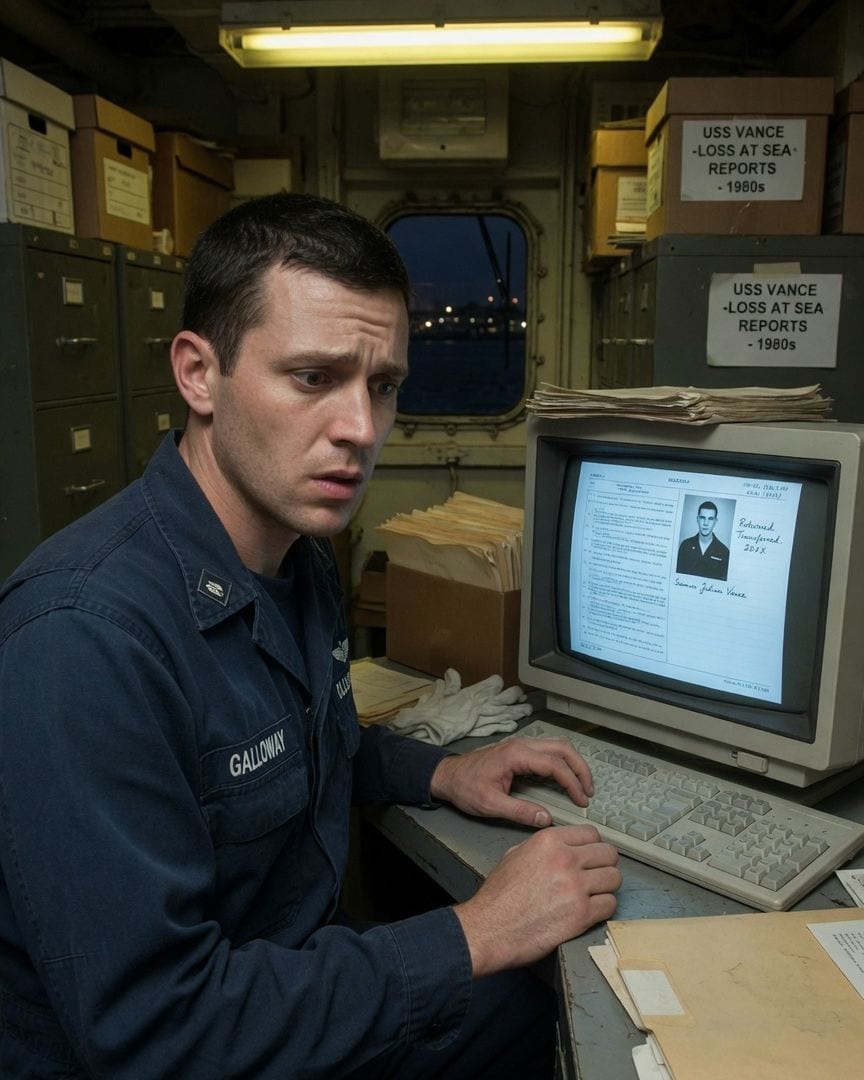
Petty Officer Galloway logged a sailor onto his ship. The man died at sea 40 years ago.
Petty Officer Joel Galloway scanned a sailor's ID on the USS Vance quarterdeck. The man's name, 'Seaman Julian Vance,' and his out-of-date uniform pricked at Galloway's memory. Later, the ship's berthing count came back one over, with an extra entry in the system but no physical body.
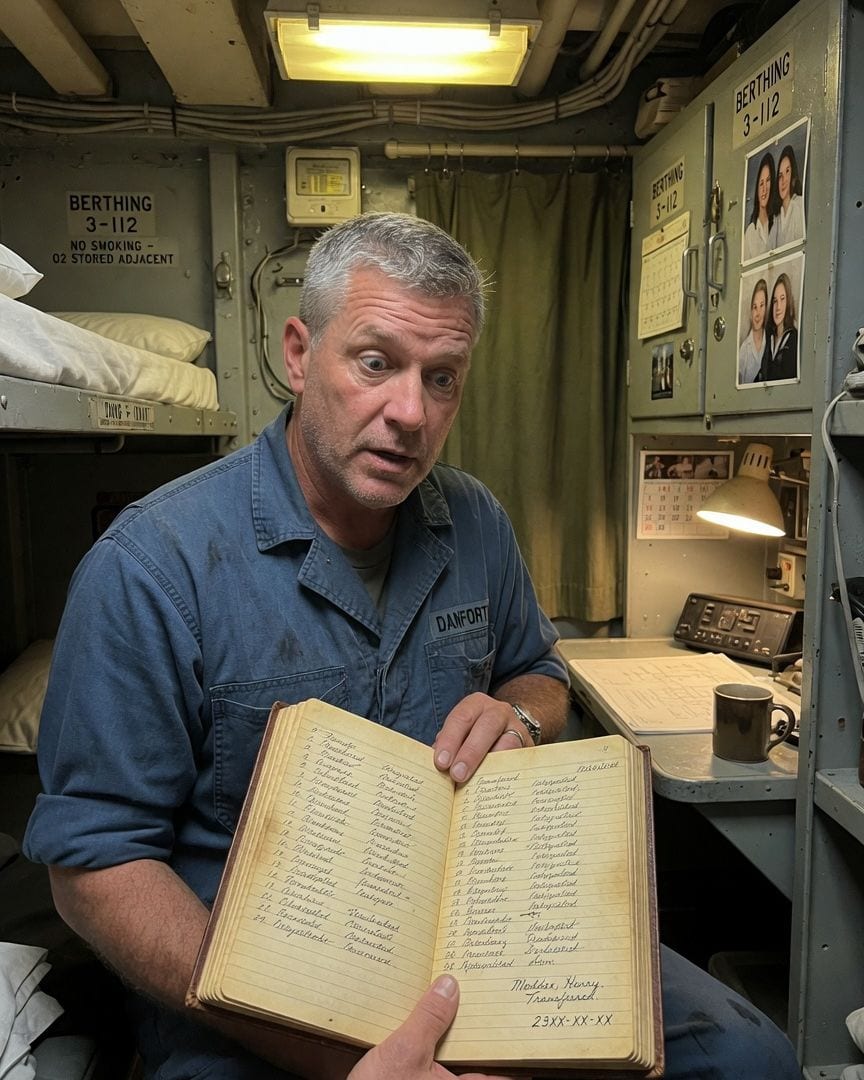
A Chief Petty Officer found a strange logbook. Its last entry listed a living crewman, dated next week.
Chief Petty Officer Russell Danforth was weeks from retirement, his three decades of service nearing an end aboard the USS Weatherall. Deep in the destroyer's familiar steel passages, he stumbled upon a sealed hatch where official plans insisted only solid bulkhead should be. Forcing it open, he discovered a cramped, unsettlingly 'lived-in' compartment holding a bare bulb and a mysterious logbook. Its final entry, stark and fresh, named a living junior petty officer from his own division, dated a week from today. What chilling fate awaited Henry Maddox, according to the Weatherall's secret history?
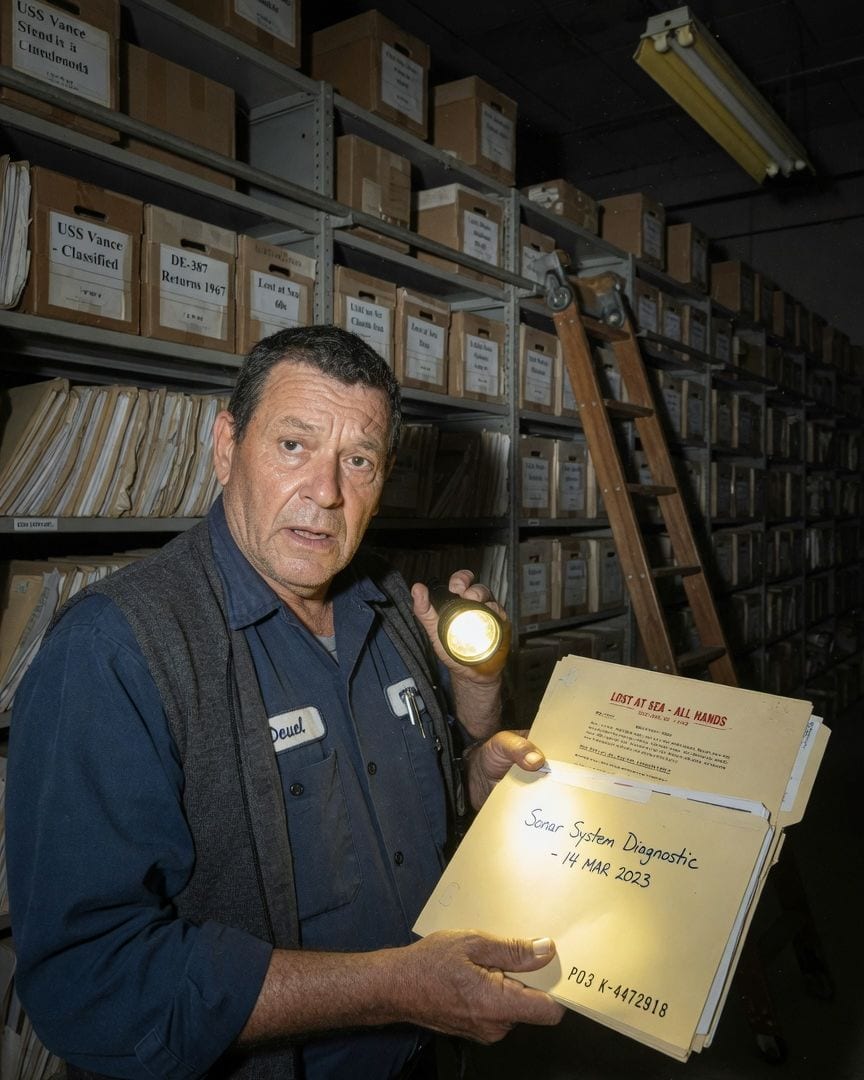
An archivist, alone in the Suitland annex, finds a 1968 lost Cold War ship file with a handwritten entry dated last Tuesday. The ink looks damp, but feels dry.
Carmine Deuel, 62, spent forty years amidst the dust and forgotten files of the Suitland annex. One night, alone in the cavernous space, a sticky squeal and the faint sway of a rolling ladder broke the silence. He found a classified file from the USS Vance, a ship lost in 1968, pulled from its shelf. Inside, a typed form held a handwritten entry: a routine sonar check, dated last Tuesday. The ink, impossibly, looked damp yet was perfectly dry. Who had accessed the file, and how could its entry be so recent?
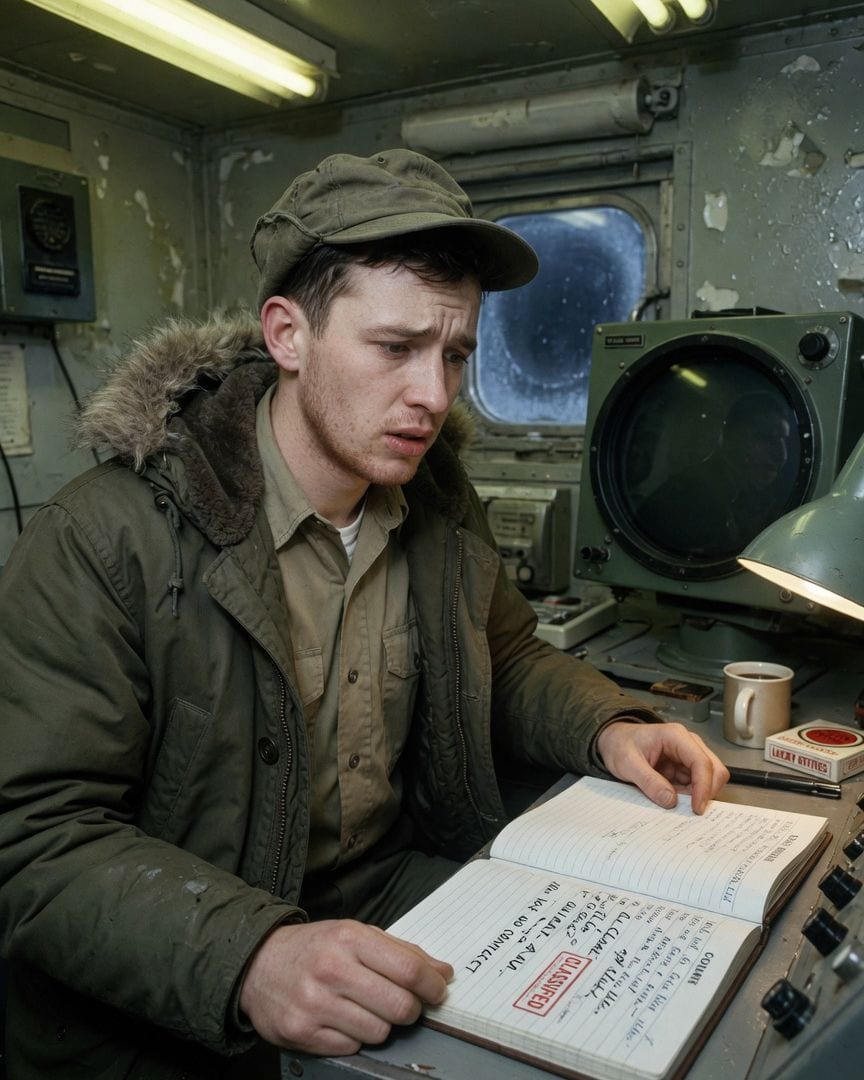
A Cold War airman logs an impossible radar contact on his last sweep. But his official logbook entry is stamped 'CLASSIFIED' and then contradicted by a hastily scrawled 'ALL CLEAR' dated moments before it.
Airman Ordway Vance, 22, manned the radar dome at Site Pellin in the biting North Atlantic dark of January 1962, running the last calibration sweep before its decommissioning. His scope picked up a faint, impossible return, growing closer with each pass, though the ocean remained empty to the eye. When Vance detailed the contact in his official logbook, a 'CLASSIFIED' stamp appeared, followed by a hastily scrawled 'ALL CLEAR' dated moments before his own entry, contradicting his every word. Commander Hartley dismissed it as equipment malfunction, but Vance sensed a chilling, official erasure behind the lie. He soon found a locked cabinet marked 'SITE PELLIN ANOMALIES,' hinting at a deeper truth buried within the base's final days.
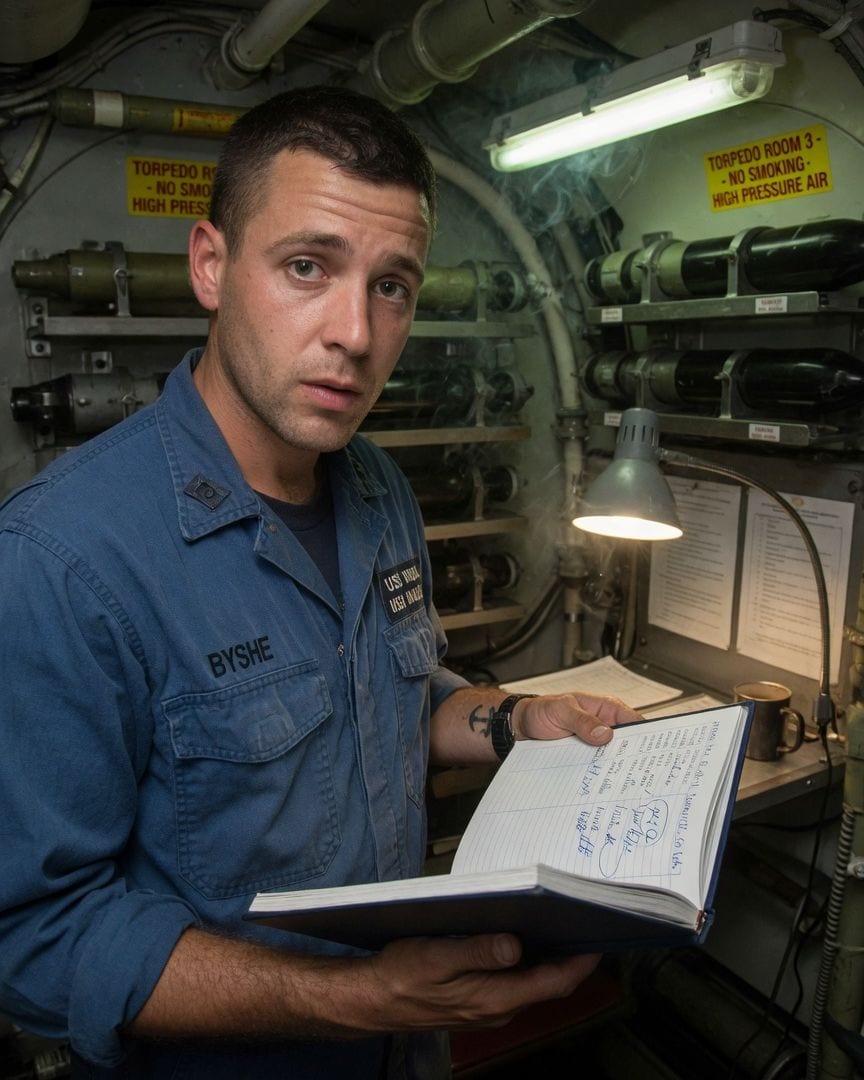
A torpedoman found his own signature in the USS Vanguard's duty log for a watch he never stood, beside a name not on the master crew manifest.
Torpedoman Oscar Bysshe, a rational sailor on his first deep patrol aboard the USS Vanguard, dismissed the messcook's nervous claim of an extra man at the table. He attributed the perfectly clean, untouched tray left behind to a prank. But later, during a routine systems check, Bysshe discovered his own familiar signature in the official duty logbook, for a watch he had been asleep through. Beside it was a name he didn't recognize, a name that shouldn't be there. A frantic check of the master crew manifest confirmed the impossible: the name appeared in the 'temporary assignments' section, dated just yesterday, scrawled in a hand eerily similar to his own.
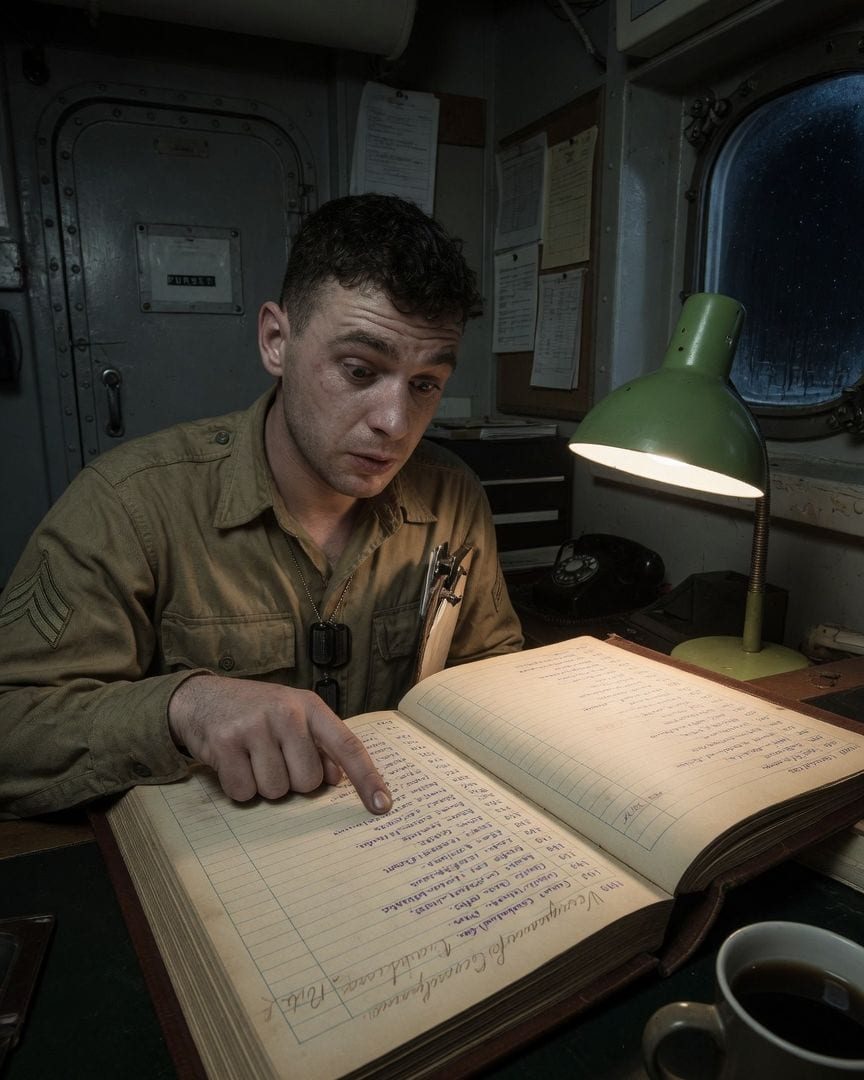
On his final crossing, Corporal Kowalski found a WWI soldier's name: 'Vestergaard, Corporal, 1918,' on his 1943 manifest.
Corporal Arthur Kowalski was on his final Atlantic crossing aboard the USS Harrington, a promised reprieve before reassignment, but the cold Atlantic air was nothing compared to the chill seeping into his bones. Despite the official roll listing 402 men, the boat drill revealed 403 soldiers lined up, an impossible discrepancy that defied every record. His discreet investigation led him to the ship's master embarkation roll, where beneath the 1943 entries, he found a faint, handwritten name: 'Vestergaard, Corporal. 1918.' A World War I soldier’s name, in archaic ink, woven into a modern manifest – how could such an impossible entry exist?