Petty Officer Galloway logged a sailor onto his ship. The man died at sea 40 years ago.
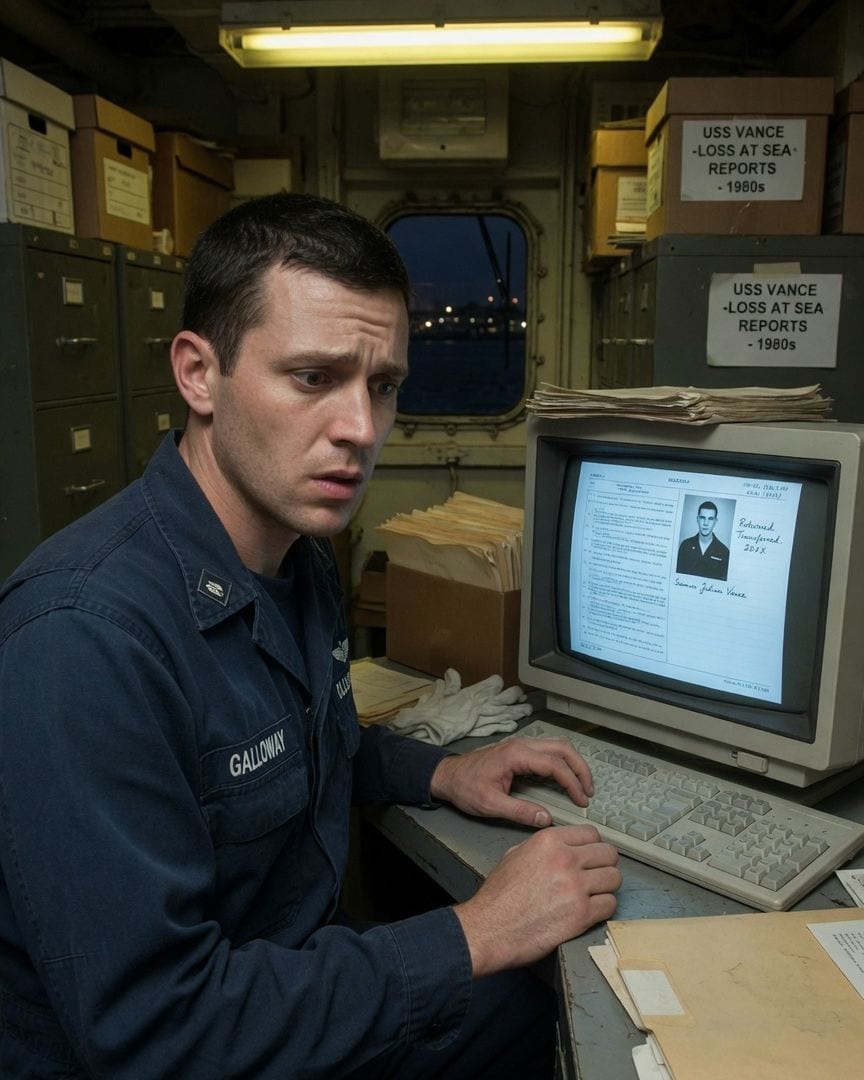
Petty Officer Joel Galloway stood the quarterdeck watch aboard the USS Vance, the rhythmic hum of the tender a familiar companion beneath his feet. The ship felt alive, a leviathan of steel and purpose, yet utterly predictable.
Joel knew every face on the duty section, every ID badge swiped across his scanner as sailors came and went.
The brow, a steel ramp connecting the ship to the pier, was a meticulously controlled threshold, a chokepoint he guarded with practiced efficiency.
At 0130, a sailor ascended the brow. He moved with a practiced confidence, his silhouette sharp against the distant pier lights.
His dungarees were a cut out of date, faded to a near-charcoal gray, yet clean and pressed as if fresh from the laundry. Joel noticed the detail instantly; no one wore those anymore.
The sailor saluted aft and forward with textbook precision, then presented his ID. Joel took the card, the plastic cool against his fingers. The name, 'Seaman Julian Vance,' registered, as did the rate.
He scanned it, the machine beeping its confirmation. A small, anachronistic detail, the faded uniform, pricked at Joel. He knew that name. Not from the current crew.
It felt like a memory just out of reach, a name whispered in a story, not a living person standing before him. He returned the ID. The sailor nodded, then vanished into the ship’s interior.
Joel continued his watch, the encounter settling uncomfortably in his mind. The ship’s hum seemed to deepen, a subtle shift in the vibration that Joel felt in his teeth.
Later that morning, as the duty section reports trickled in, the berthing count came back one over.
Every rack in every compartment was accounted for, every name checked off, but one more body had been logged aboard than could be found. No rack had been slept in. No personal effects.
Just an extra entry in the system, a ghost in the machine. Joel’s unease sharpened into a cold certainty that something was profoundly wrong.
Joel spent the next hour reviewing the digital watch log, trying to pinpoint the error, to find the mundane explanation. The entry for Seaman Julian Vance, 0130, was there, pristine and unassailable. He cross-referenced it with the ship’s current roster.
No Julian Vance. He checked the muster for the entire pier, the lists of contractors and visitors, the transient personnel. Nothing. He tried to rationalize it – a prank, a misread ID, a system glitch.
Perhaps the scanner had malfunctioned, inventing a name from a loose database entry. But the precision of the salutes, the confident, almost archaic bearing of the sailor, stuck with him.
The cut of the dungarees wasn’t just old; it was from a specific, distant era.
He approached Chief Prescott, a woman whose face was perpetually furrowed over a stack of maintenance reports. She was a no-nonsense veteran, solid and practical, not given to flights of fancy.
'Chief,' Joel began, 'I had a strange log-in last night. Name doesn't match the roster, uniform was off. Said his name was Julian Vance.'
Chief Prescott barely looked up, her pen scratching against paper. 'Probably some reservist on a short-term TAD you missed, Galloway. Or a bad sensor read. Log it as an anomaly, close it out. We've got real issues to deal with.'
But Joel couldn't. The feeling in his gut was stronger than her dismissive tone. He knew it wasn't a glitch. He needed more.
During his lunch break, he found himself heading for the ship’s archived paper logs, a dusty, seldom-visited room tucked away near the stern.
The air was thick with the smell of old paper and ozone, the silence broken only by the distant thrum of the ship’s engines.
He pulled on a pair of white gloves and began to search, hoping for a past crew list, a historical note, anything that might explain the name. He searched for 'Julian Vance' in any context he could think of.
Hours blurred. Then, nestled deep in a box labeled 'USS VANCE - LOSS AT SEA REPORTS - 1980s,' he found it. A record from exactly forty years ago, almost to the day.
A Seaman Julian Vance, assigned to a sister ship, the USS Puget Sound, officially listed as 'lost at sea' after a sudden, violent storm.
The faded, water-stained photograph attached to the report showed the same face Joel had seen on the brow. The same strong jaw, the same dark eyes, the same peculiar set to the mouth.
He felt the blood drain from his face.
Joel felt a cold dread spread through him, a sickness that started in his stomach and crawled up his throat. The face was identical.
The name, the rate, the ship of origin in the photograph, even the subtle cut of the uniform. It couldn't be a coincidence. It simply could not be.
He scrolled through the scanned pages of that vintage logbook, his finger tracing the lines on the dusty monitor, past the official report of Seaman Vance's disappearance, past the formal declaration of loss.
The ship’s hum seemed to falter, then surge, as if the very structure of the USS Vance was reacting to his discovery.
Then, on a subsequent page, an almost illegible, hand-written addendum, dated exactly 40 years to the day after the loss, and precisely 0130, the time Seaman Vance had appeared on Joel’s watch. The faint, overwritten line read: 'Returned. Transferred. 20XX.'
The year was the current year. Joel stared at the entry, the digital ghost of a past handwritten note, his mind reeling. The exact time. The exact date. The impossible return.
He felt the hair on his arms stand on end as he reread the words, the silent hum of the archive room suddenly oppressive, pressing in on him from all sides.
Joel couldn’t let it go. The phrase 'Returned. Transferred.' gnawed at him, a splinter of impossible logic buried deep in his mind.
He spent his off-watch hours, his lunch breaks, even stolen moments late at night, deep in the ship’s archives, both physical and digital.
He chased the thread, inputting the cryptic phrase into search functions, cross-referencing dates of naval losses with anniversaries.
He found other similar, faint annotations, always on the anniversaries of officially lost sailors, always associated with tenders, vessels like the Vance, that had operated in specific patrol zones or deployments.
The words were often obscured, buried under layers of official stamps or faded to near invisibility, but they were there.
He cross-referenced these bizarre log entries with contemporary news archives from decades past, searching for any reports of unusual incidents or 'unexplained disappearances' from those same ships, often dismissed as desertion or unfortunate accidents in the official record.
The pattern was diffuse, scattered across decades, but undeniable once Joel knew what to look for. He found a grainy photograph from the 1970s of a crew formation on a dock, men standing at attention, sun glinting off their brass.
In the background, just outside the official ranks, stood a sailor in dungarees, subtly out of place, his face blurred by distance but eerily familiar, a ghost in the periphery.
The caption beneath the photo simply mentioned a 'routine muster, one over.' The same impossible count.
Joel started to notice a recurring, subtle resistance from the digital archive system itself. When he typed in certain keywords or date ranges, the system would lag, its processors grinding as if fighting a command.
Sometimes, it would present corrupted files, always just enough to deter, never enough to break completely.
A particular search for 'unlisted units' resulted in a cascading error that locked him out for an hour, the screen flashing 'ACCESS DENIED: SYSTEM INTEGRITY COMPROMISED' before reverting to normal.
He began to suspect the system wasn't just old and failing, but actively guarding something, a digital sentinel programmed to obscure the truth. The air in the archive room grew colder around him, even as the ship’s engines thrummed.
Joel’s late-night searches didn't go unnoticed. Chief Prescott, initially dismissive, started asking pointed questions about his 'obsession' with old records. Her gaze held a new, unreadable quality, no longer simply annoyed, but watchful.
Commander Vance, a man known for his meticulous attention to detail and sharp, assessing eyes, observed Joel with a strange intensity during daily briefings.
His gaze lingered a moment too long when Joel reported, a silent question that made Joel’s skin prickle.
One evening, as Joel was reviewing a particularly obscure log from the 1950s—an account of a seaman who had reportedly walked overboard in calm seas, only to be briefly sighted again hours later by a passing merchant vessel—the archive room door, which he had locked and double-checked, slowly creaked open.
The sound was drawn out, like old wood groaning under an unseen weight. Joel froze, heart pounding, his flashlight beam cutting a stark path through the dust motes dancing in the stale air. No one was there.
He walked over, peered out into the deserted passageway, then quickly slammed the door shut, twisting the lock again.
He dismissed it as a draft, a trick of the old ship’s ventilation, but a cold sweat trickled down his spine, prickling his skin.
Later that night, back in his berthing, he found a Post-it note stuck to his monitor. It wasn't his handwriting, and he couldn’t place the script. It simply stated: 'Some things are better left accounted for.'
The words resonated with the cryptic 'Returned. Transferred.' entries, with the ‘one over’ musters, with every unsettling anomaly he had uncovered. It was a chilling confirmation that his digging was known, that someone, or something, was watching his every move.
Was it a warning, a threat, or a desperate plea? The danger was no longer just an abstract historical pattern; it was personal, immediate, and inside the very system he trusted.
The bunk above him groaned, an old, familiar sound that now seemed to hold a new, sinister weight.
The next day, Chief Prescott called Joel into her office. Her face, usually a map of various shades of exasperation, was unreadable, flat. The air in the small office felt heavy.
'Galloway,' she said, her voice low, 'Commander Vance has noticed your… extracurricular activities. He wants to know what you’re looking for.'
Joel, emboldened by his discoveries, by the sheer, terrifying weight of the evidence he had accumulated, laid out his findings. He spoke of the impossible log-ins, the 'Returned.
Transferred.' annotations hidden in the archives, the matching photographs of men officially lost decades ago, the 'one over' musters that defied logical explanation. He showed her the faded copies, the grainy photos.
Chief Prescott listened, her expression slowly shifting from skepticism to a grim, chilling understanding. She didn’t interrupt, her gaze fixed on the old records.
The faint clatter of a wrench from the engine room below seemed to echo the racing of Joel’s own pulse. 'I… I’ve seen things like that before,' she admitted, her voice barely a whisper, as if speaking a forbidden truth.
'My first ship, a tender, just like the Vance. A man came back from a shore leave he'd never taken, said he’d been on watch the whole time. Nobody could shake him from it.
Then he was gone, just like that. Vanished one night. Nobody ever spoke of it again. Not officially, anyway.'
She rose, walked to a locked drawer in her desk, the movement deliberate, like someone bracing for a blow. She pulled out a thick, unmarked binder, its cover worn smooth. 'This isn't official. It's… a courtesy.
Passed down through certain Chiefs, certain Commanders.'
Inside were photocopies of more 'Returned. Transferred.' entries, but these were far more detailed, meticulously maintained, written in different hands across different eras, yet all following the same chilling format.
They listed not just names and dates, but also 'Transfer Destination: Unlisted Unit' and 'Accountability Status: Special.' The dates on these unofficial logs spanned back seventy years, forming a chilling, unbroken chain that snaked through the Navy’s history.
The 'one over' count wasn't an error; it was a precursor. The 'no rack slept in' was because they were merely passing through, echoes making a temporary stop.
The whole system, she explained, was a silent, unacknowledged process of accounting for the impossible, of balancing an equation no one dared to acknowledge aloud.
The truth of it settled around Joel, cold and heavy, a vast, complex mechanism hidden in plain sight.
Chief Prescott’s face was pale, drawn, her eyes wide with a profound, weary sadness that sent a fresh wave of dread through Joel. 'It’s not just a pattern of returns, Galloway. It’s a pattern of… transfers.
And sometimes, for every one that comes back, one of ours… goes.' Her voice was flat, devoid of emotion, yet her hand trembled as she slid a final page from the binder across her desk.
It was a digital printout, newer than the others, but clearly part of the same hidden system. It was a current manifest, titled 'Active Special Accountability Roster.'
Joel’s eyes scanned the names, a chilling mix of old, familiar 'lost at sea' personnel he had researched and some names he recognized from current Navy rosters, men he had stood watch with, men whose faces he knew.
Then, his breath hitched, catching in his throat like a shard of ice.
Near the bottom, in stark, undeniable print, was his own name: Petty Officer Joel Galloway, with his rank and service number. Beside it, under 'Transfer Destination,' was the familiar 'Unlisted Unit.'
And under 'Transfer Date,' a precise day and time: '0130, 7 Days Hence.'
The words swam before his eyes, blurring and reforming into an impossible, horrifying prophecy. He wasn't just observing the pattern; he was already inside it. His hands clenched, knuckles white.
He looked up, his gaze meeting Chief Prescott’s, her eyes filled with a profound, helpless sorrow, reflecting his own terror back at him.
The hum of the ship seemed to deepen, a low, resonant thrum that vibrated in his bones, no longer a comfort, but a countdown.
The realization hit Joel with the force of a physical blow, knocking the air from his lungs. The 'one over' wasn't just a count, it was a placeholder, a temporary entry in a ledger that spanned decades.
The 'no rack slept in' meant the returned were not here to stay, but merely to be processed, logged as present before their final, unseen departure.
The 'transfer' wasn't to another ship, to a new duty station, but to a state of being accounted for, yet utterly absent, erased from the world of the living.
Chief Prescott, seeing his terror, his dawning comprehension, explained in a hushed voice, her words like individual drops of ice. 'It’s always been like this. Since the first tenders, since the first losses at sea in these specific waters.
They return, they’re logged, they’re 'accounted for' by this… shadow system. And then, at a specific time, a living crew member is… transferred. Replaced, in a way. The system needs balance.'
She showed him more records, pages detailing sailors who had disappeared without a trace, their official records simply stating 'Transferred to unknown unit' after a brief period marked as an 'anomaly.' The dates always matched a preceding 'return.'
The 'accountability that cannot be' was in fact a complete, self-sustaining system, a hidden bureaucracy of the impossible.
It was maintained by a select few, the knowledge passed down from Chief to Chief, from Commander to Commander, because the alternative was unthinkable: acknowledging a truth that would shatter naval discipline and the very fabric of reality.
Joel now understood the Post-it note, the Commander's intense gaze, Chief Prescott’s knowing silence. They weren't warning him away; they were observing the inevitable, watching the next 'transfer' unfold in a long, unbroken lineage.
The ship’s hum, constant and pervasive, was the sound of the system itself, an ancient, relentless clock ticking.
Joel spent the next seven days in a haze, every passing minute a countdown to 0130. He tried to fight it, to break the pattern.
He attempted to delete his name from the manifest Chief Prescott had shown him, using every trick he knew, but the system, even the hidden one, resisted him with an unseen, immovable force.
His changes would simply revert, his name reappearing in its allotted place. He confronted Commander Vance, showing him the manifest with his own name on it. Vance’s face was etched with a deep, weary resignation, his eyes hollow.
'Galloway,' he said, his voice barely audible, 'some things… are beyond our command. We maintain the logs, we keep the order. It’s all we can do.'
On the eve of his 'transfer date,' Joel stood watch again on the quarterdeck, the salt air chilling him to the bone, a profound silence seeming to fall over the ship, muffling the usual sounds.
He clutched a small, worn photograph of his family, his fingers numb. He knew he couldn't escape it.
The system was too pervasive, too ancient, too deeply ingrained in the very structure of the vessel, in the very fabric of the sea.
As 0129 ticked over on the clock above the log tablet, a figure ascended the brow. It was Seaman Julian Vance again, in his faded dungarees, saluting crisply.
But this time, Vance looked directly at Joel, and in his ancient, vacant eyes, Joel saw not just the lost, not just the returned, but a profound reflection of his own impending vacancy. The clock struck 0130.
Joel felt a profound, chilling emptiness begin to spread from his core, dissolving his fear, his memories, his very self, leaving behind only a faint, echoing awareness.
The next morning, Petty Officer Theresa Abbott, taking over the quarterdeck watch, found the log tablet showing the previous night's entries. The 0130 log-in for Seaman Julian Vance was there, pristine as the first time.
Below it, a new entry read: Petty Officer Joel Galloway, transferred 'Unlisted Unit.' A standard muster that morning showed the berthing count for the USS Vance was now precisely one under. No alarms were raised. No questions were asked.
The system, once again, had accounted for everything. The ship hummed on, its purpose unwavering.
Chief Prescott sat in her office, the unmarked binder closed on her desk. She looked out at the gray ocean, a faint, almost imperceptible tremor in her hand, the movement barely noticeable.
The Navy continued its endless mission, the ships sailed, the logs were kept. Somewhere, a new petty officer would stand watch, and one day, they might notice a discrepancy, a name that shouldn't be.
The pattern would continue, silent and unbroken.
Days later, Commander Robert Vance passed Chief Prescott in the passageway. 'Chief,' he said, his voice flat, 'I need you to prepare a transfer request for Petty Officer Abbott. She's been asking too many questions about the archives.'
Chief Prescott nodded, a faint, wrong little smile touching her lips. 'Is that so?'
If this one got to you
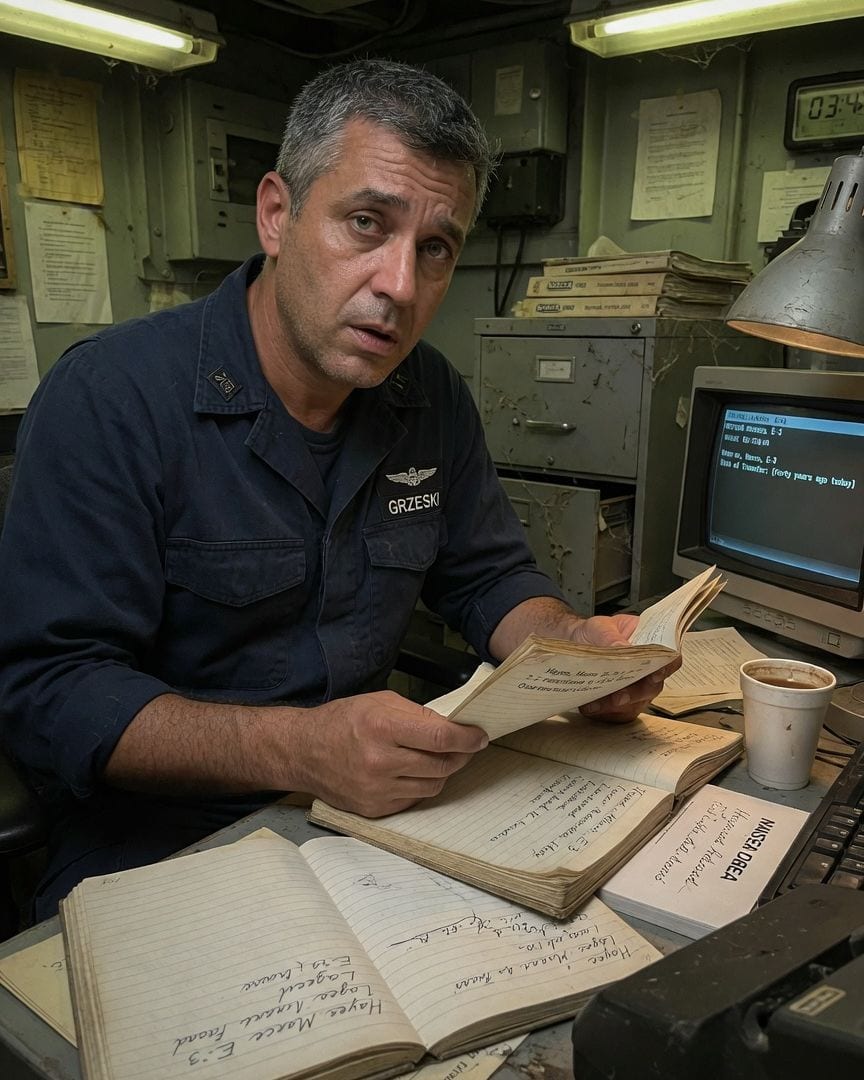
A Petty Officer logged a sailor on his final watch. Then he found the same exact entry in a logbook from forty years ago.
Petty Officer Anton Grzeski stood his final quarterdeck watch on the USS Vance, just six hours from transfer. The humid Gulf night was thick around him as a sailor climbed the gangway at 0130, giving his name as Marco Hayes. Grzeski logged him aboard, but a nagging memory surfaced: Hayes had been listed as transferred off forty years ago. The next morning, a berthing count came back one over, and Grzeski's own logbook entry for Hayes chillingly mirrored one from four decades prior, found in the ship’s dusty archives. What impossible record had he just confirmed?
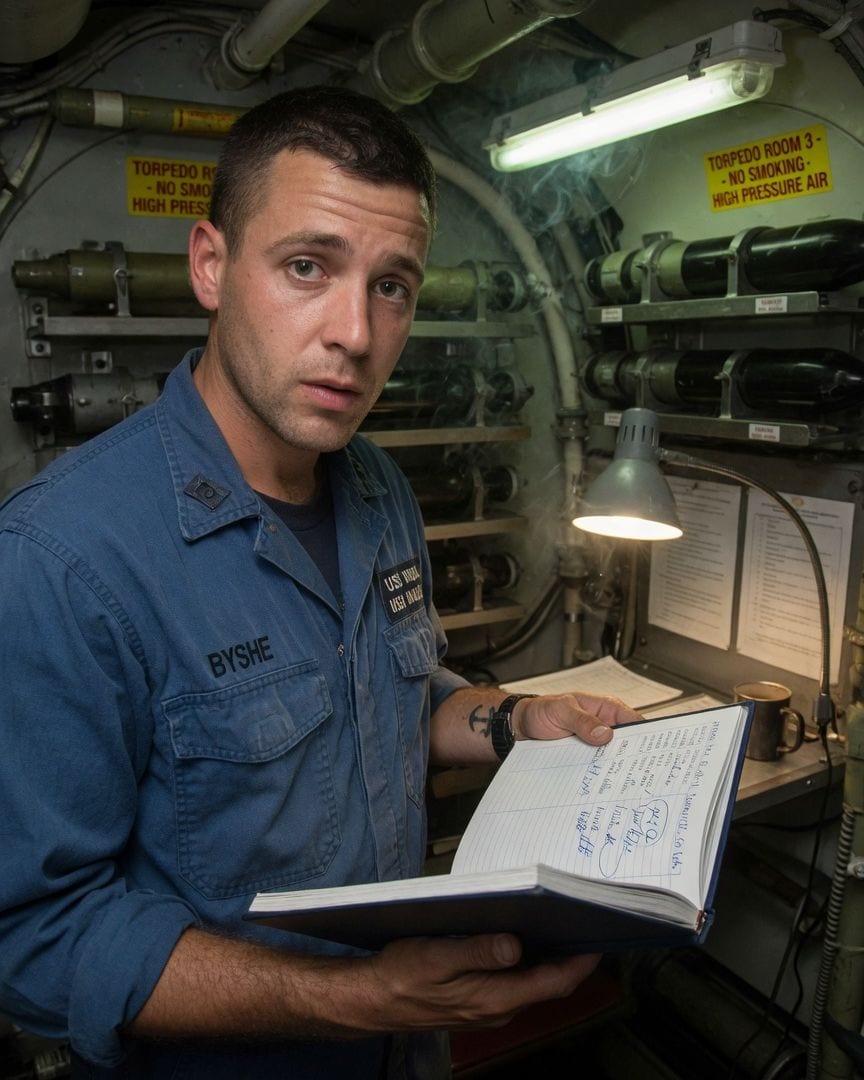
A torpedoman found his own signature in the USS Vanguard's duty log for a watch he never stood, beside a name not on the master crew manifest.
Torpedoman Oscar Bysshe, a rational sailor on his first deep patrol aboard the USS Vanguard, dismissed the messcook's nervous claim of an extra man at the table. He attributed the perfectly clean, untouched tray left behind to a prank. But later, during a routine systems check, Bysshe discovered his own familiar signature in the official duty logbook, for a watch he had been asleep through. Beside it was a name he didn't recognize, a name that shouldn't be there. A frantic check of the master crew manifest confirmed the impossible: the name appeared in the 'temporary assignments' section, dated just yesterday, scrawled in a hand eerily similar to his own.
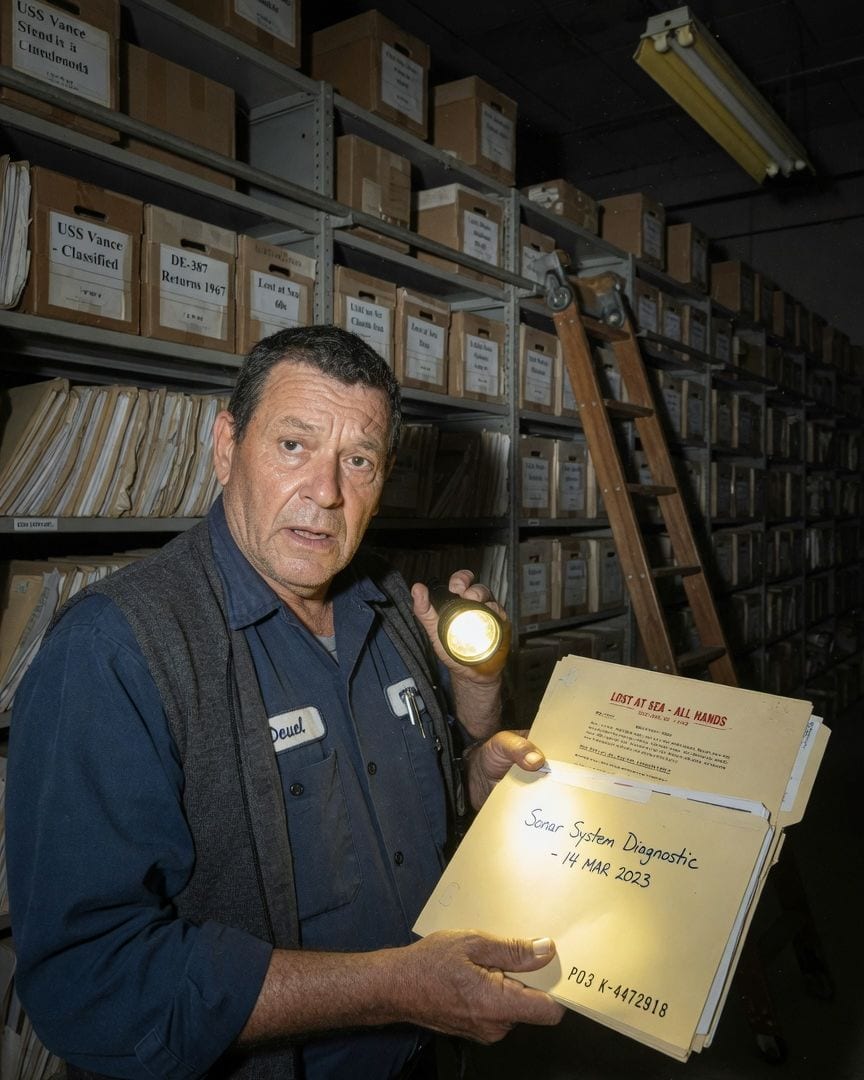
An archivist, alone in the Suitland annex, finds a 1968 lost Cold War ship file with a handwritten entry dated last Tuesday. The ink looks damp, but feels dry.
Carmine Deuel, 62, spent forty years amidst the dust and forgotten files of the Suitland annex. One night, alone in the cavernous space, a sticky squeal and the faint sway of a rolling ladder broke the silence. He found a classified file from the USS Vance, a ship lost in 1968, pulled from its shelf. Inside, a typed form held a handwritten entry: a routine sonar check, dated last Tuesday. The ink, impossibly, looked damp yet was perfectly dry. Who had accessed the file, and how could its entry be so recent?
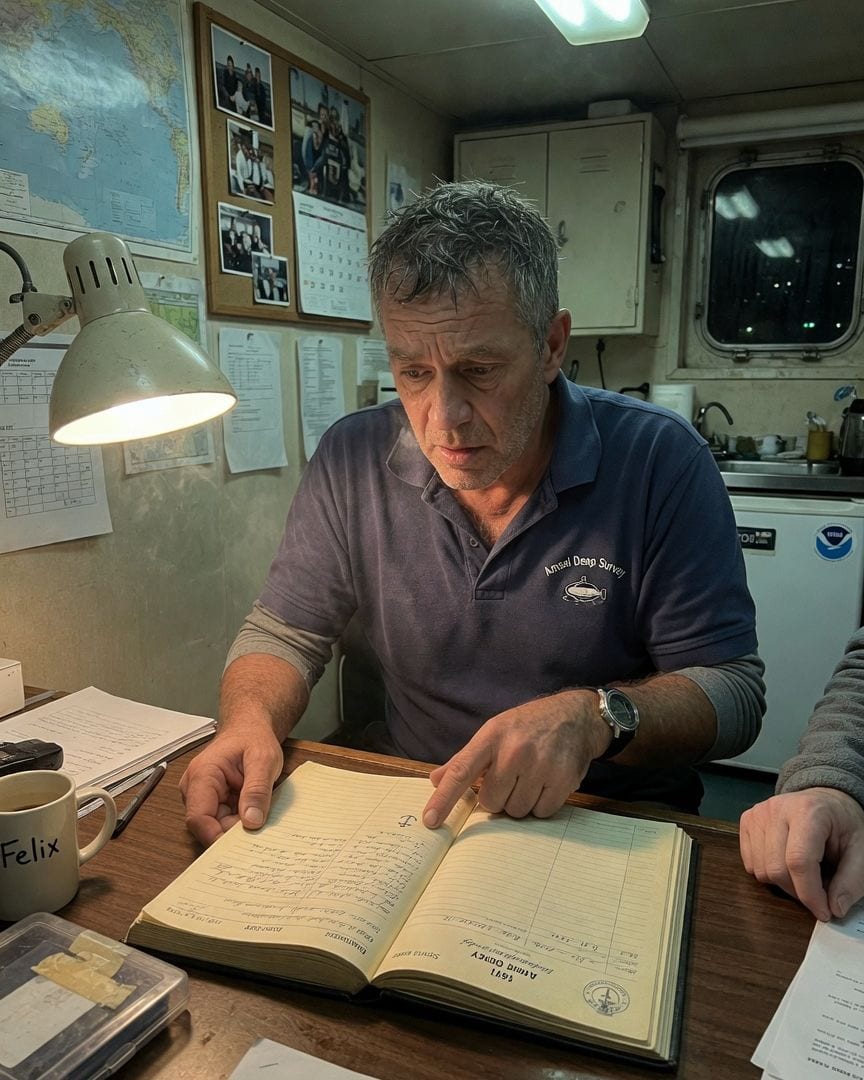
On his final deep-sea survey, a submersible pilot watches a 32-year-old Cold War wreck's rudder shift two degrees.
Deep-sea surveyor Hugo Amsel embarked on his final major dive, anticipating a quiet retirement after decades exploring the crushing pressures of the deep. His submersible's lights cut through the murky green, revealing the *Wynn Portal*, a sealer vanished in 1991, eerily preserved with unnervingly clear windows, free of any marine growth. Then, the inexplicable: the wreck's rudder angle indicator, softly lit, twitched two degrees further to starboard. Later, inside the wheelhouse, Hugo found the ship's official logbook, its final entry dated three days *after* the vessel's recorded disappearance, hundreds of miles north. How could a ship vanish, only to log a journey days later, from a place it never reached?
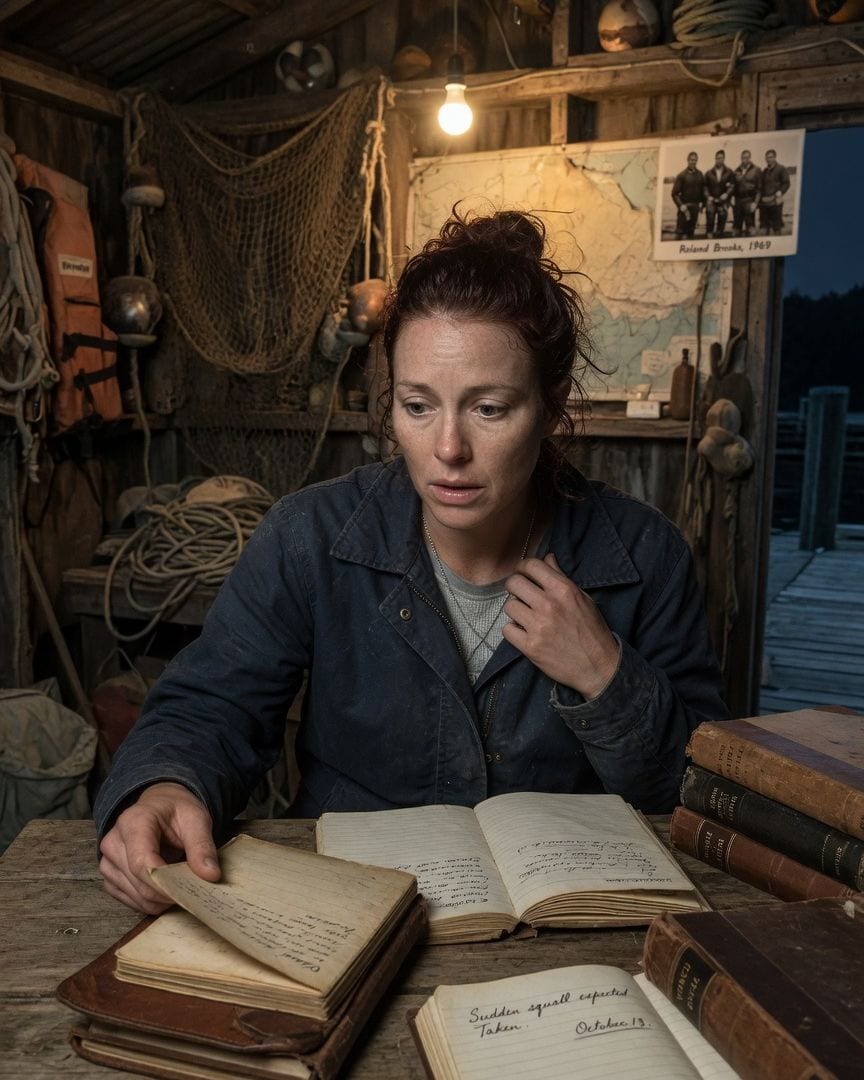
Tomorrow's gale was already written in the skipper's logbook — in his dead father's handwriting. His father drowned off that boat in 1969, and I'd whistled aboard.
My new deckhand job on the fishing boat was simple, until I saw Skipper Henry’s logbook. For *tomorrow’s* date, his dead father’s unmistakable handwriting had already scrawled “Gale Warning. Heavy Seas.” and “Payment Due.” The man drowned decades ago, and the entry leaves me cold.
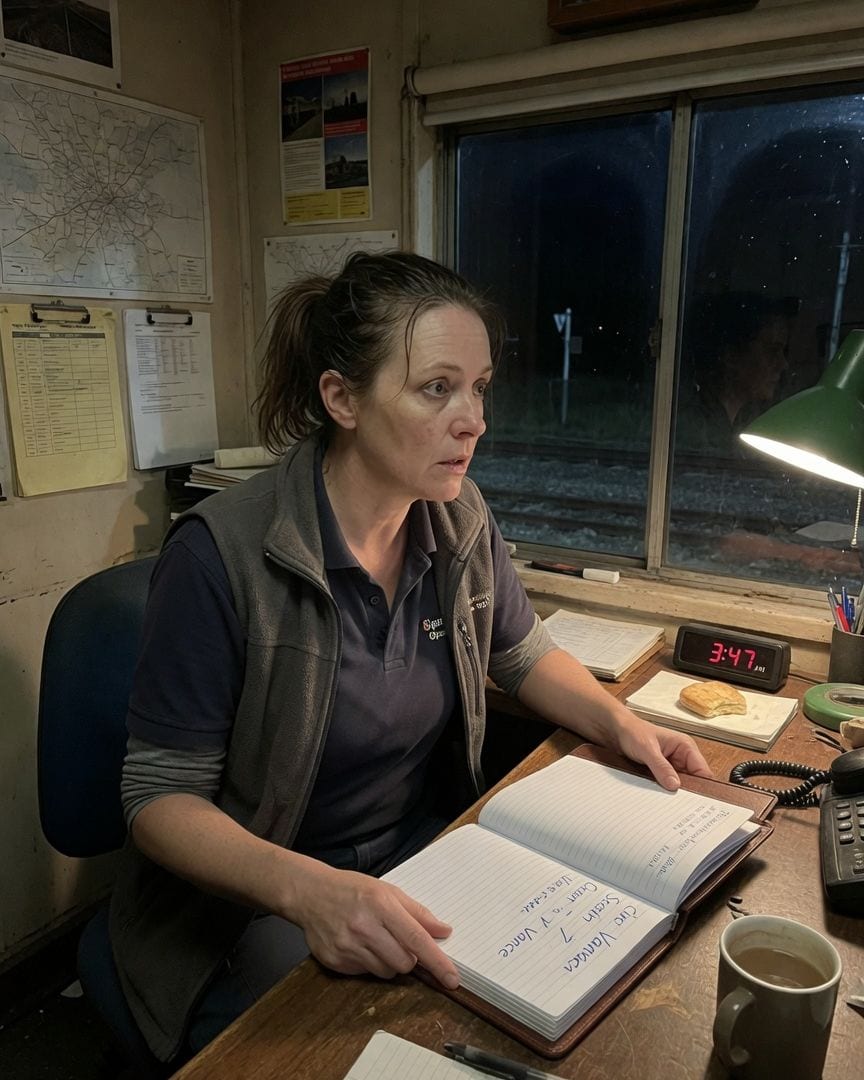
My linesman taps twice on my window at 3 AM. Control says he retired and passed years ago.
My routine at the rural signal cabin was regular: the linesman's double tap on the window at 3 AM. But then my supervisor called, revealing the linesman I knew, Warren Vance, had died five years ago. Now, an impossible entry in my official logbook, with his signature and timestamped from my shift, proves someone else was there.