On his final deep-sea survey, a submersible pilot watches a 32-year-old Cold War wreck's rudder shift two degrees.
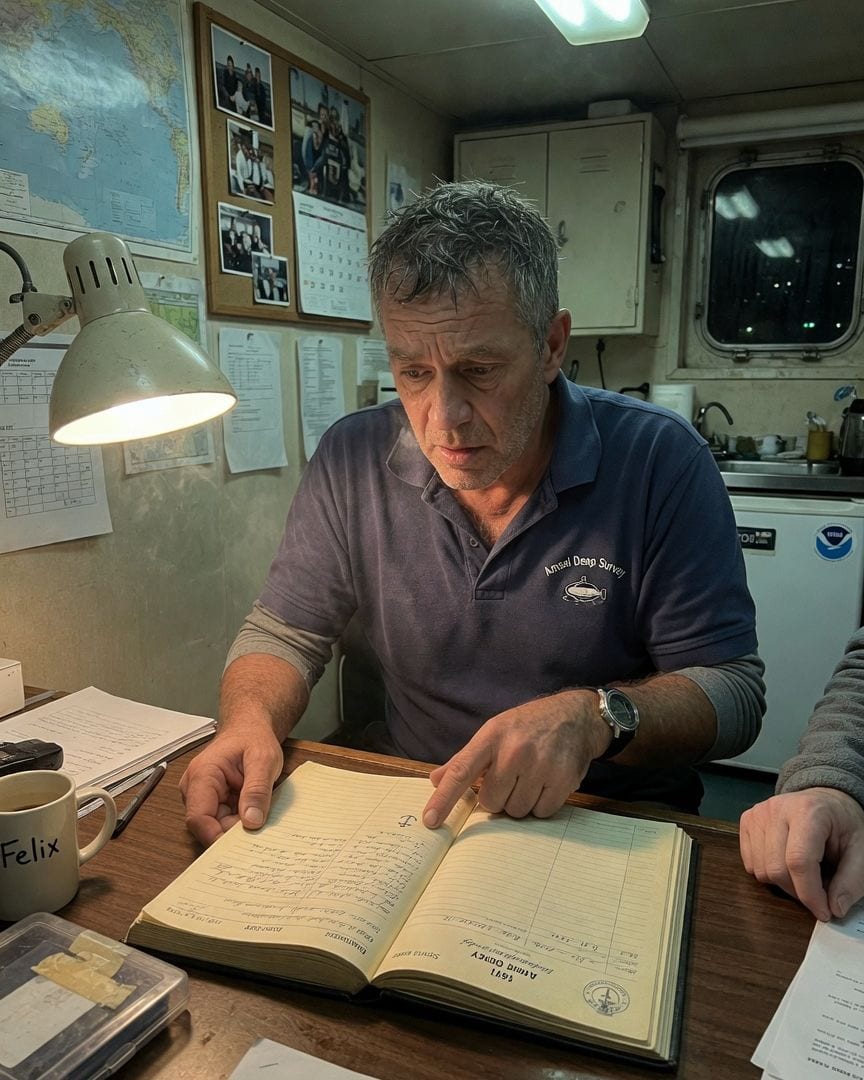
Hugo Amsel gripped the controls of his specialized submersible, the manipulator arm extended, its powerful lights cutting through the murky green depths.
At 52, this was his final major deep-sea survey, a quiet retirement from the crushing pressure of the deep awaiting him on shore.
His target, the Wynn Portal, a sealer vanished in 1991 with fourteen souls, now sat eerily preserved on the seabed. As his lights illuminated the wreck, a chill, unconnected to the abyssal cold, settled in his bones.
The Wynn Portal's wheelhouse windows were not just intact, they were unnervingly clear, completely free of the usual crust of marine growth. It looked like the ship had sunk yesterday, not thirty-two years ago.
Behind the glass, the helm was hard over, ten degrees to starboard, its rudder angle indicator softly lit by some inexplicable internal glow.
Hugo checked his own instruments, looking for a faulty sensor, a trick of the light, anything to rationalize the impossible sight. He held his breath, watching the indicator.
For six minutes, the needle remained static, a silent testament to a static wreck. Then, in the imperceptible shift of deep-sea currents, or perhaps without them, the needle moved. A slow, deliberate twitch, two degrees further to starboard.
Hugo shone his light closer, his breath fogging his mask, searching for any ripple, any external force. There was nothing but the dark, cold water and the ship’s impossible, silent turn.
Unsettled, Hugo broke the silence on the comms, calling his first mate, Felix Winslow, on the survey vessel above. "Felix, secure the site. I need an immediate interior survey of the wheelhouse."
Felix, a pragmatic man, voiced concerns about time, safety protocols, and the unusual nature of the request. "Hugo, we're already behind schedule. And going inside a thirty-year-old wreck is... a risk." But Hugo's voice, usually calm, held an uncharacteristic edge.
He insisted. "Now, Felix. I need to see something in there." Minutes later, Hugo was maneuvering through the wheelhouse's main hatch, his submersible's lights probing the dim interior.
The silence was absolute, broken only by the faint whir of his sub's thrusters. Amidst the ghostly array of controls and gauges, tucked behind a console, Hugo spotted a rectangular shape.
He extended the manipulator arm, his gloved fingers carefully extracting a sealed, waterproof case. Back inside his sub, he carefully opened it. Inside, protected by layers of heavy-duty plastic, lay a ship's log.
It was the official Wynn Portal log, its early entries filled out in a familiar, precise hand belonging to the vessel's last captain, detailing voyages up to the vessel’s last known position on the day it vanished.
Hugo flipped to the back. There, scrawled in the same distinctive hand, was a final entry, a set of precise coordinates—hundreds of miles further north, deeper into the Bering Sea. The date above it read: September 17, 1991.
Three days after the Wynn Portal's official disappearance. The ink, despite being sealed for decades, looked startlingly fresh.
Back on the survey vessel, Felix, poring over the log, tried to dismiss it as a prank or a duplicate log from another ship, a relic from some bizarre maritime incident.
Hugo pointed to the official seal embossed on the cover, then to the consistent handwriting that matched every other entry in the book. "This isn't a duplicate, Felix," he said, his voice flat. "This is the log. And this entry...
it's impossible."
Hugo and Felix hunched over the logbook in the survey vessel's cramped mess hall, the coordinates of the final entry stark against the faded paper.
The position was baffling, placing the Wynn Portal hundreds of miles from its last known location and current wreck site.
Hugo, tracing a finger across the page, noticed a faint, almost erased stamp in the margin near the final entry: a stylized anchor with the sequence '00-14-91.' It didn't match any known maritime agency, any classification Hugo had ever seen.
Felix, who had been trying to find a rational explanation, suddenly froze, his hand hovering over the page. His eyes fixed on the number, a haunted, distant look crossing his face.
His knuckles, white against the dark wood of the table, trembled. "My grandfather," he said, his voice barely a whisper, "He was on a Coast Guard cutter that vanished in '44.
Its last known position was logged with a stamp like that. Different number, same anchor. My family kept the records." Hugo felt a cold dread settle in his gut, a sickening plummet. The impossible had just become terribly, irrefutably real.
Felix’s revelation ignited a new, desperate urgency in Hugo. His transition to a shore-based role was imminent, a fact he now regarded with a strange mix of relief and mounting terror.
He used his remaining time, the last vestiges of his authority, to pursue the elusive stamp.
He made contact with Vivian Hartley, a retired Coast Guard records clerk he’d known from previous assignments, a woman now living a quiet life in a small, coastal town in Oregon.
Hugo, careful not to reveal too much over the crackling phone line, described the '00-14-91' stamp and the anomaly of the Wynn Portal's log entries. Vivian, initially guarded, admitted she remembered "ghost classifications"—a system for records that, officially, "don't exist."
These files, she explained, were meticulously kept in a rarely accessed "cold storage" section of the regional archive in Juneau, Alaska.
She described the section with a nervous catch in her voice, a detail that had always unnerved her: it physically measured longer than the building diagrams indicated, stretching beyond its supposed footprint.
She cryptically referred to "the box that is not on any list," a collection of files that, officially, had no accession numbers but contained information on these phantom classifications.
Her voice was tight with a fear Hugo recognized as genuine, a quiet, settled dread that vibrated through the phone line.
Hugo traveled to Juneau, convincing Vivian to meet him at the regional archive. She was visibly nervous from the moment he met her, constantly glancing over her shoulder as if expecting someone to materialize from the shadows.
She led him down to a rarely used sub-basement, its air thick with the dust of forgotten history and the acrid smell of old paper. The fluorescent lights hummed with a sickly yellow glow.
As she fumbled with a heavy ring of brass keys for a locked, unmarked door, she suddenly stopped, her hand freezing mid-air.
Her eyes, wide and unnaturally bright, fixed on a small, dark dome camera mounted high in the corner of the corridor, barely visible against the peeling paint.
"That wasn't there," she whispered, her voice strained with fear, barely audible above the drone of the distant ventilation. She insisted they leave immediately, pulling Hugo back up the stairs, her grip surprisingly strong.
Later that evening, back in his hotel room, a single, official-looking envelope slid under his door. It contained a printout of the Wynn Portal's original manifest, a stark list of names. Felix Winslow's name was circled in precise, angry red ink.
Scrawled across the bottom of the page, in a precise, almost clinical hand, was a handwritten note: "Some things are better left filed."
The message was clear, a direct warning that his digging had been noticed, and that Felix’s connection was known. The fear Vivian had shown solidified into a terrible, cold certainty.
Shaken by the warning, Hugo called Vivian. Her voice trembled as she admitted she’d been followed since their archive visit, the same black sedan parked down her street, shadows moving too quickly outside her windows.
The personal nature of the note about Felix, however, pushed her past her fear. "There's only one person," she told him, her voice cracking, "who would know about those files, about the 'box that isn't on any list.'
He worked with me, decades ago." She spoke of Benjamin Radcliffe, a former Coast Guard investigator who had become obsessed with these ghost classifications.
Radcliffe had been officially discredited years ago, his theories dismissed as delusion, his career ending in disgrace. Hugo tracked down Radcliffe, now elderly and living reclusively in a cabin deep in the Alaskan interior, miles from any paved road.
The old man, gaunt and with eyes that seemed to hold the weight of distant seas, was initially dismissive and wary, almost chasing Hugo off his porch with a rusty shotgun.
But when Hugo produced the Wynn Portal log and the '00-14-91' stamp, Radcliffe's eyes, though old, sharpened with a terrifying clarity. He took the log with a trembling hand, tracing the stamp with a gnarled finger.
"Not a classification," he rasped, his voice a dry whisper. "A sequence code. The fourteenth vessel 'filed' in 1991." He shuffled through a stack of old, brittle, hand-drawn maps and charts, cross-referencing other 'lost' vessels with similar stamps.
"The Wynn Portal wasn't lost," he concluded, looking up at Hugo, his gaze piercing. "It was processed."
He explained that the 'lost' ships were not destroyed or sunk, but systematically moved to an unknown location, and the log entries, like the one Hugo found, were the meticulous "receipts" of their relocation, disguised as final moments.
The clear windows, the clean helm—they were never truly lost at sea for decades, subject to the forces of the ocean. They were simply elsewhere.
Radcliffe pulled out a dusty, worn ledger, its cover unadorned, clearly not official, but his own meticulous compilation. The binding was loose, the paper inside yellowed and fragile.
He flipped to a page covered in similar sequence codes and dates stretching back to the 1940s, each entry written in a precise, almost calligraphic hand.
He pointed to an entry from 1944, next to a precise, detailed drawing of a Coast Guard cutter, its lines rendered with an almost obsessive accuracy. The sequence code next to it read '00-07-44.'
He tapped a finger on the name of the vessel next to it: the CSS Orion. "Felix's grandfather," Radcliffe said, his voice grim, confirming Hugo's worst fears. The room, already cold, seemed to drop another ten degrees.
"The Orion wasn't lost at sea. It was filed. Just like the Wynn Portal. And look here." He traced a line of faint coordinates beside the Orion's entry, then pointed to the Wynn Portal's final log entry.
The coordinates, though different, were part of a larger, repeating geometric pattern across the ledger's pages, a vast, intricate grid that covered the entire Bering Sea, extending far beyond the conventional shipping lanes.
"They're not just moving them," Radcliffe whispered, his voice barely audible, the words hanging heavy in the dusty air. "They're mapping something. And the map is still being drawn."
Radcliffe, his voice hoarse but resolute, explained that the 'secrecy machine' wasn't a single institution, but a legacy system, a network of individuals ensuring these 'filings' continued across generations.
"They don't want anyone to find them," he stated, "but they need to know where they are."
He believed the ships weren't merely taken to a static location, but were actively used as mobile markers or anchors for something immense and unseen, something that required a precise, constantly updated grid within the Bering Sea.
The Wynn Portal's helm moving was the ship recalibrating itself, adjusting its position within this vast, dynamic pattern. The vessels were not destroyed; they were moved through locations, often resurfacing briefly or in altered states, only to be moved again.
The clear windows and lack of marine growth on the Wynn Portal weren't a miracle of preservation; they indicated it was only recently placed at the 'wreck' site, a temporary filing point, or that its time underwater was not conventional.
The true location of the 'filed' ships was a constantly shifting, unmappable space within the Bering, a space defined by the intricate, geometric pattern of their disappearances.
"The 'file that is still being written'," Radcliffe said, his eyes distant, "refers to the ongoing movement and mapping, a cosmic cartography of the impossible."
The full truth detonated in Hugo's mind: a vast, patient, and terrifying operation that stretched across decades, always just out of sight. As Radcliffe finished speaking, Hugo heard the crunch of tires on gravel.
A black sedan, too sleek and dark for this remote Alaskan landscape, pulled up the long, winding driveway to the cabin. Radcliffe, seeing it, shoved the heavy ledger, its pages fluttering, into Hugo's hands.
"Go," he rasped, his eyes wide with a desperate urgency that cut through years of professional calm. "Tell someone. Anyone. They’ll come for this."
He pushed Hugo toward a hidden exit at the back of the cabin, a low door obscured by thick brush.
As Hugo scrambled into the dense Alaskan wilderness, the sounds of the cabin door bursting open reached him, followed by muffled, terse voices and a heavy, sickening thud.
He didn't look back, pushing through the tangled undergrowth, the weight of the ledger in his hands undeniable, physical proof of an impossible truth. He knew, with chilling certainty, that no one would ever believe him.
He was now a marked man, carrying a burden of knowledge that would isolate him forever, the cost of his escape a permanent severance from the world he once knew.
Hugo eventually made it to a small, remote fishing village on the Alaskan coast, exhausted and haunted. He attempted to contact various authorities—the Coast Guard, federal agencies, even a few investigative journalists.
His calls were met with polite skepticism, then outright dismissal, his claims attributed to stress and isolation after a long career.
His final survey report for the Wynn Portal was quietly filed, its discovery attributed to an anonymous sonar scan, and his new shore-based position was rescinded without explanation, a terse email citing "unforeseen administrative changes."
Felix Winslow was unreachable; his contact numbers disconnected, his last known address now an empty lot. Vivian Hartley's archive section was suddenly declared "under renovation," all "ghost files" reportedly transferred to an undisclosed federal facility.
The world moved on, undisturbed by the patterns Hugo now saw everywhere, the geometric lines of loss etched across the grey-blue of the Bering.
Hugo sat alone in a dusty, rented room overlooking the grey expanse of the Bering Sea, the heavy ledger spread open across a small, scarred table.
He's marked new entries on one of Radcliffe's hand-drawn maps, faint new coordinates appearing in the vast, empty spaces of the Bering, continuing the geometric pattern. The file was still being signed, the unseen machine still working.
He heard a faint, almost imperceptible hum coming from the wall beside him, a low, resonant vibration that seemed to emanate from the very earth, a sound that resonated deep in his bones.
He knew what it was now, the sound of the grid shifting, the machine working, forever just beyond the horizon, calling to its next marker.
No one came looking for the room. The lights inside never seemed to turn off, yet no one ever saw him leave. He gently places his hand on the table, feeling the hum, and for the first time, he understands.
If this one got to you
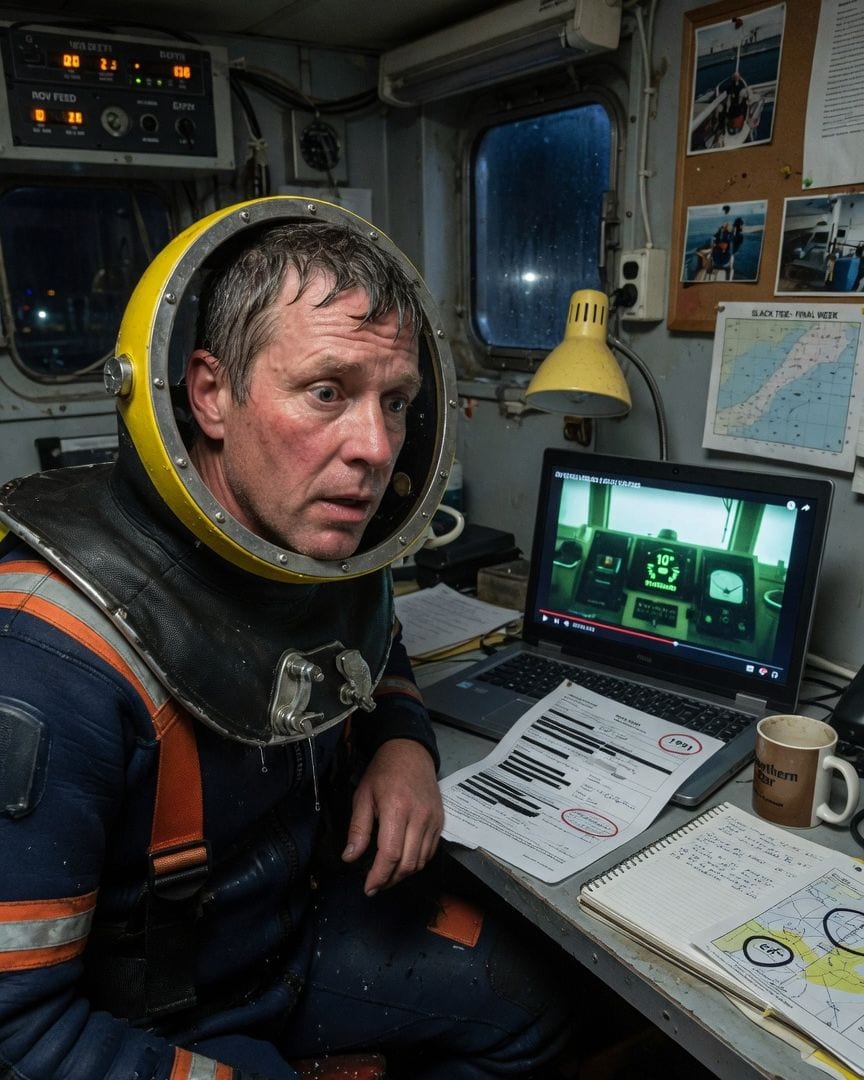
A deep-sea surveyor's final dive into a 1991 wreck found a logbook dated 2023, and a figure watching him.
Deep-sea surveyor Hugo Amsel faced the final week of his Bering Sea survey, under immense pressure to find conclusive evidence before the short season closed. In the abyssal gloom, he located the *Wynn Portal*, a sealer lost with fourteen crew in 1991, surprisingly intact. Through its clear wheelhouse window, he saw a rudder indicator glowing green, an impossible light on a dead ship. Later, on a second dive, he found a leather logbook tucked beneath the helm, open to a page clearly dated 2023. As he stared, a shadow inside the window shifted, coalescing into a figure watching him from the depths.
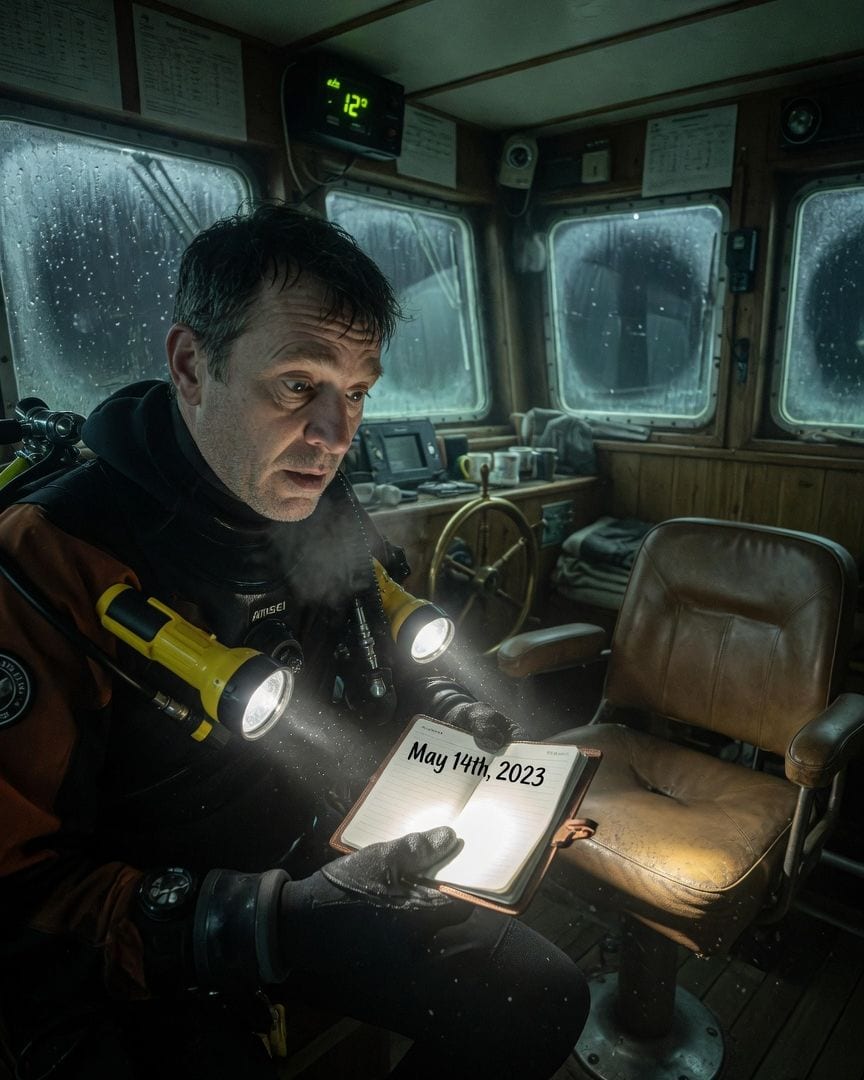
A dive supervisor exploring a Cold War sealer found its logbook on a wheelhouse shelf, with an entry dated this morning.
Dive supervisor Hugo Amsel felt the familiar cold of the Bering Sea as his submersible approached the 'Wynn Portal,' a sealer vanished without a trace in 1991. The wreck sat eerily intact, its wheelhouse windows impossibly clear, and the helm locked hard to starboard. But then the rudder angle indicator twitched, moving two degrees, a ghost still at the wheel. After breaching the sealed hull, Hugo and his lead diver found the ship's interior pristine, frozen in time. In the wheelhouse, on a shelf next to the chart table, lay the logbook. Its final entry, written in Captain Larsen’s hand, was dated 'May 14th, 2023' – today. The ink was still unsettlingly fresh, leaving Hugo to stare at the impossible date and the empty captain's chair.
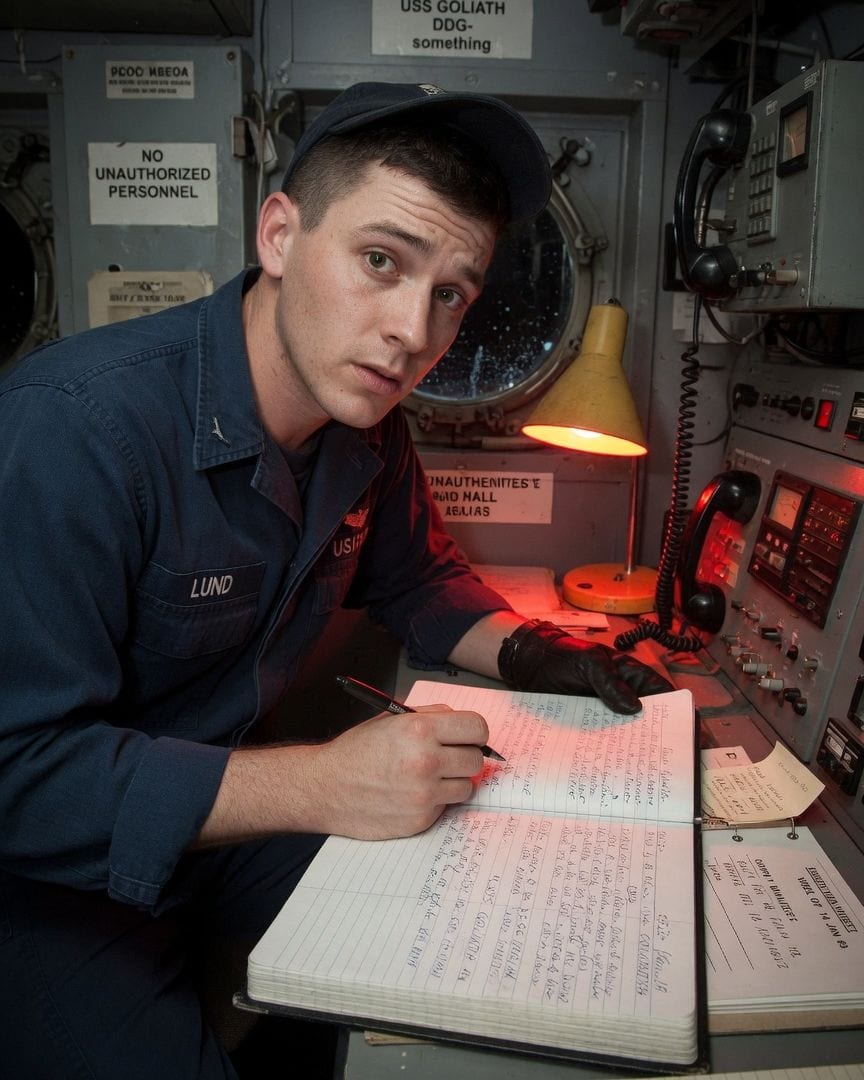
Petty Officer Lund heard his own captain's mayday: the Cold War USS Goliath was sinking, two hundred miles astern.
Petty Officer Marco Lund kept a lonely vigil in the USS Goliath's radio room, the destroyer battling the North Atlantic in deep winter 1983. Suddenly, a garbled mayday broke through: his own ship, his own captain, reporting they were going down two hundred miles astern. Though the bridge confirmed the Goliath was fine, the same chilling call came again an hour later, stronger and from the exact waters they had just crossed. Deeply unsettled, Marco began searching ship logs, eventually discovering a phantom entry: an identical mayday, logged a week prior, pressed into the very paper beneath his own.
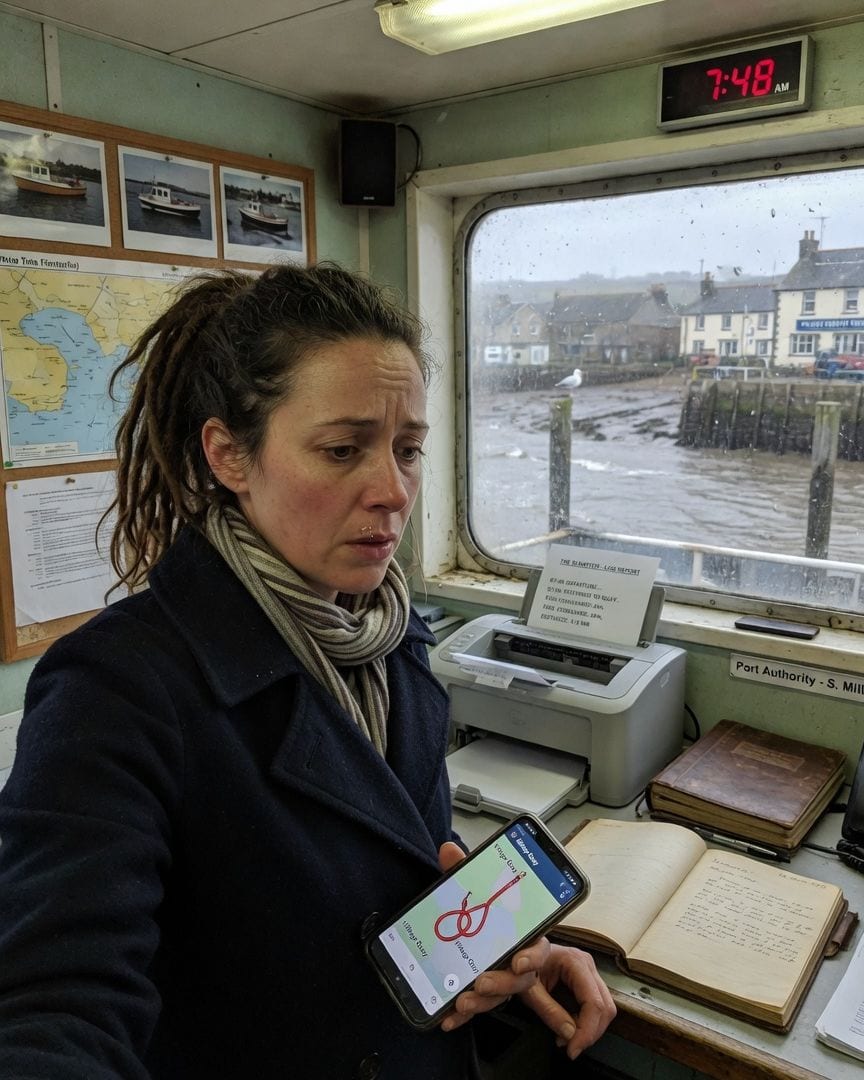
My morning ferry crossed for 40 minutes. The destination town just disappeared.
I board 'The Seawitch' every Tuesday for the familiar eight-minute estuary crossing. But this morning, after making good time, Captain Bernard and I watched the town quay simply fail to appear. Instead, our ferry repeatedly returned to the very same village quay we'd just left, despite burning fuel and advancing the clock.
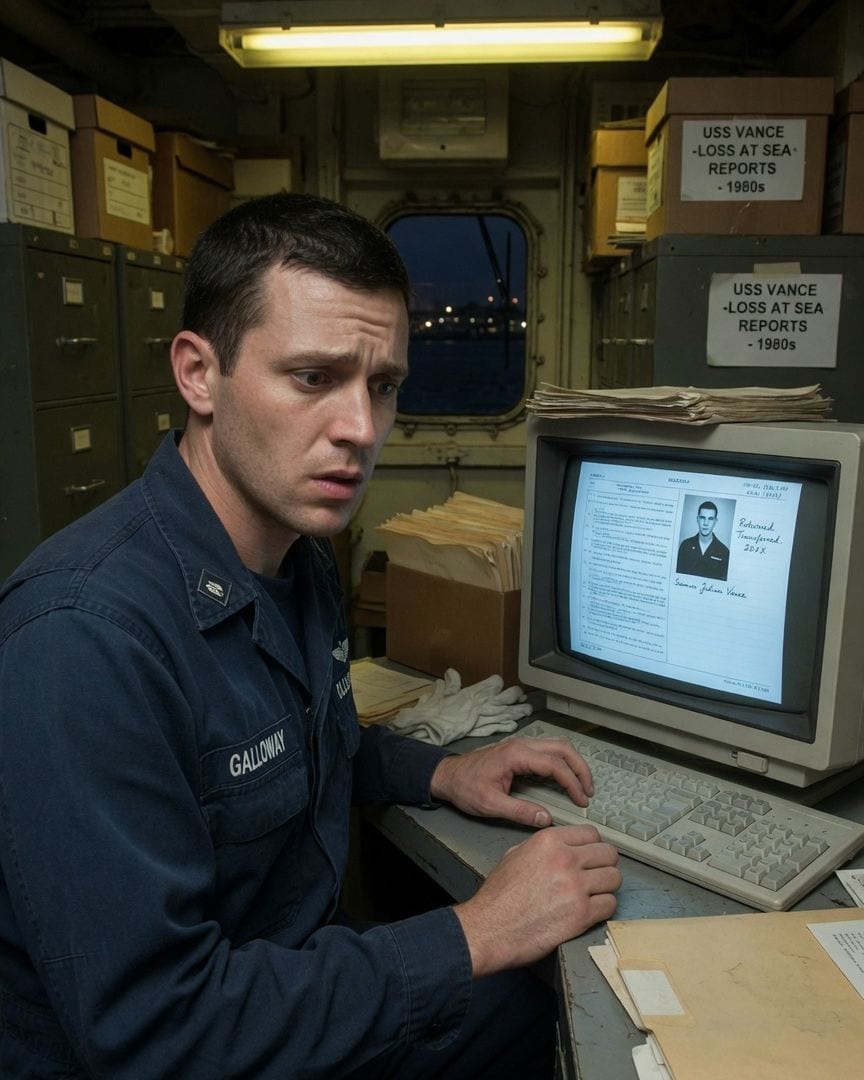
Petty Officer Galloway logged a sailor onto his ship. The man died at sea 40 years ago.
Petty Officer Joel Galloway scanned a sailor's ID on the USS Vance quarterdeck. The man's name, 'Seaman Julian Vance,' and his out-of-date uniform pricked at Galloway's memory. Later, the ship's berthing count came back one over, with an extra entry in the system but no physical body.
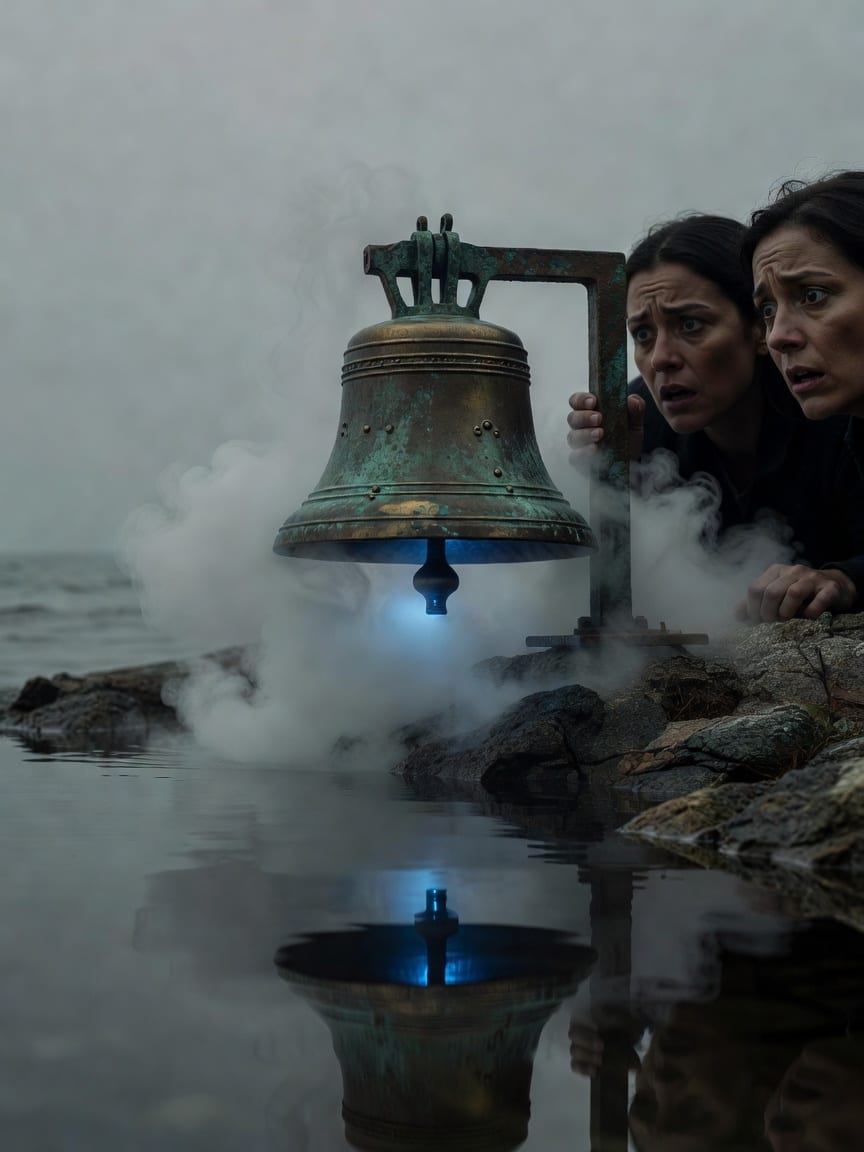
The fog bell on the point rings itself on still nights. The framed log at the yacht club lists eleven calm evenings it rang – each entry beside a boat that never came home.
Moving to a quiet coastal town, I found myself drawn to an old logbook at the yacht club. It recorded the fog bell ringing on flat-calm nights, each instance tied to a boat that simply vanished. Then, I found my own boat's name, 'The Osprey,' penciled at the bottom, marked with an unfinished, cryptic symbol.