A sentry finds a fresh boot print *inside* the wire, but the barbed fence is untouched.
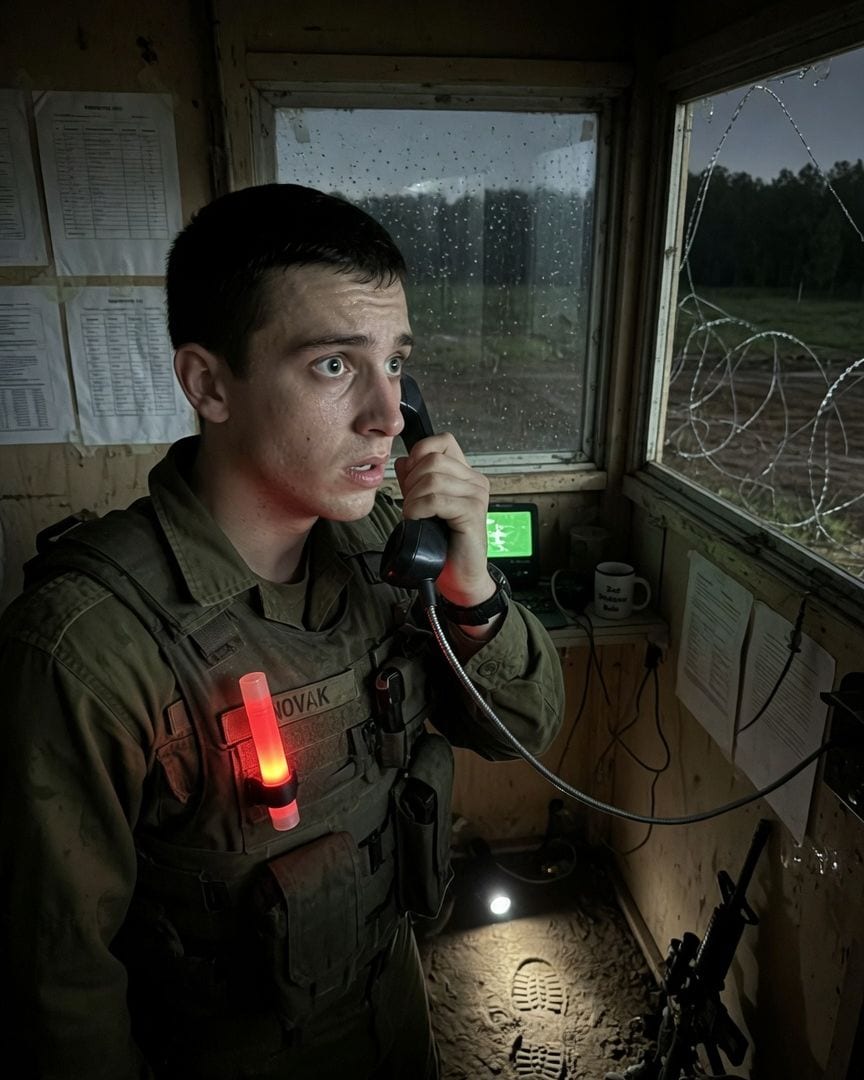
PFC Isaac Novak kept the 0000-to-0200 watch in the outpost tower, his gaze sweeping the perimeter with a starlight scope. He’d been told the far treeline, beyond the wire, was friendly ground, nothing out there but scrub and quiet.
But just after 0100, a man stepped out of those trees. He was in their own regulation gear, right down to the unit patch.
The man paused, then raised a hand and waved the daily recognition signal, the one that changed every night, the correct one for this very hour. He was smiling up at Isaac as he walked toward the wire.
The countersign had been set at last light, known only to the men inside the wire. Isaac grabbed the field phone, trying to hail him, but got only static.
The man reached the wire, stopped, still smiling, his eyes fixed on the tower. The smile seemed too wide, fixed and unnatural, as if painted on his face. It didn't reach his eyes.
Isaac felt a cold knot tighten in his stomach. The air in the tower, usually still, seemed to press in on him, heavy and silent.
Isaac hit the loudspeaker, his voice tight, echoing across the silent perimeter. "Identify yourself! State your purpose!" The man didn't respond, just stared, his smile unwavering, almost too wide.
Then, slowly, he turned and walked back into the treeline, disappearing as silently as he’d arrived. Isaac checked the sensor logs for that section of the perimeter: a brief, anomalous heat signature, then nothing.
He reported the contact, but the duty officer's voice was flat, dismissing it as a possible animal or a sensor glitch. "Probably a deer tripping the old thermal, Private. Go get some rack time."
The words felt hollow in the quiet of the tower. Isaac, however, was unconvinced. He descended the tower and patrolled the wire himself, the beam of his flashlight cutting through the predawn gloom.
The ground was soft from a recent drizzle, making the damp earth yield easily. Near where the man had stood, he found it: a single, fresh, size 10 boot print, standard issue, but impossible.
It was inside the wire, a clear, deep impression in the damp earth, where no one should have been able to cross without tripping an alarm or being seen.
The barbed wire along that section was intact, undisturbed, still glinting with droplets of water. No sign of a breach. The footprint was too perfect, too crisp, as if the boot had been set down with deliberate care.
Isaac followed the print a few feet. It led away from the wire for a short distance, then stopped abruptly, as if the person had simply ceased to exist. Isaac knelt, examining the perfect, unsmudged impression.
The dread in his gut curdled. The air grew colder around him, chilling his face. He slowly straightened, scanning the dark perimeter, then instinctively looked up.
There, standing silently on the very top of the guard tower, outlined against the faint glow of the distant base, was the same man. He wasn't smiling now. His head was tilted slightly, watching Isaac.
Isaac immediately reported the second sighting to Sergeant Roland Barlow, his superior. Barlow listened, his expression unreadable, then meticulously logged the report, attributing it to "fatigue-induced hallucination" and scheduling Isaac for a mandatory rest period.
"Private, you’re seeing things the night shift often conjures. Get some sleep." Barlow’s dismissiveness was unsettlingly calm, his adherence to protocol almost mechanical. He spoke in clipped, measured tones, his eyes never quite meeting Isaac's.
The overhead fluorescent lights in the ops center hummed, casting a sterile glow that seemed to flatten Barlow’s features. Isaac, however, couldn't shake the image of the man on the tower. During his 'rest,' he started digging.
He accessed the outpost's digitized incident reports through his terminal, filtering for any mention of phantom contacts or unusual perimeter breaches.
He found a disturbing pattern: every few years, reports of "unexplained transfers" or "rotational shifts cut short" appeared, often following vague mentions of "anomalous activity" or "sensor malfunctions." Each instance involved personnel who had reported 'phantom contacts.'
The digital records, typically precise, held an odd, almost rhythmic silence around these entries, as if the system itself was reluctant to elaborate.
He tried to find the original records for the daily recognition signals, noticing some patterns that seemed to repeat on long, obscure cycles, almost like a code cycling through different permutations over decades. The logic was inscrutable, yet undeniably present.
Isaac's search led him to Margaret Stratton, a retired Army archivist living in a quiet town upstate. He found her contact information through an obscure forum discussing military historical oddities, a thread titled "Ghost Outposts."
He called her, explaining his situation carefully, the field phone crackling with distant static that mimicked the one he'd heard on watch. Margaret was initially dismissive, her voice crackling with age, attributing his experiences to stress.
"Son, these old outposts get to people. Loneliness can play tricks." But as Isaac described the recognition signal and the impossible boot print inside the wire, her tone shifted.
The crackle in her voice deepened, taking on a new, heavier quality.
She warned him cryptically about "the paperwork that writes itself," hinting that some military records were "too clean" and that certain remote outposts, this one included, had "persistent patterns" that never officially got noted.
"There are some things the ledger likes to keep to itself, Private," she’d said, her voice dropping to a near whisper. She advised him to be careful about what he looked for.
The next morning, Isaac returned to his bunk after breakfast. On his perfectly made bed, a perfectly folded piece of paper lay on his pillow. On it, written in the exact official font and format, was the next day's recognition signal.
No one had been in the barracks, and no one had seen it placed there. The note was crisp, unsettlingly fresh. It was a clear, silent message.
The quiet of the barracks seemed to deepen, holding its breath around the impossible paper.
Shaken, Isaac called Margaret again, describing the note. Her voice was grave. "They know you're looking," she said. Isaac pressed her, demanding to know what she meant by "paperwork that writes itself."
Margaret sighed, a long, weary sound that seemed to carry the weight of decades. She explained that for decades, certain outposts, including his, had shown subtle, impossible deviations in their manifests and operational logs.
Names of soldiers who never existed, or who were listed as having served at impossible dates, sometimes even appearing on multiple, conflicting records.
"It’s like the system itself is… creating its own personnel," she said, the words barely audible over the phone line. "The outposts, they just keep running, no matter who's supposed to be there.
Like clockwork, but the clock has too many gears, and some aren't quite human-sized." She then sent him a scanned image: an old, unofficial unit roster from his very outpost, dated 1983.
It was a handwritten ledger, far less formal than official records, but meticulously kept. The faded ink, the slightly smudged paper, all spoke of a forgotten reality.
Several names were listed under a column marked "transferred," but with a handwritten note beside them: "unexplained."
These names, she said, were later found on official manifests from other units, but always subtly off – wrong service numbers, slightly altered ranks, like a perfect, yet flawed, forgery.
"These were the ones who saw something, Isaac," she whispered, her voice heavy with an unspoken understanding. "And then they became part of it." The implication hung in the silence.
Isaac stared at the digital image of the 1983 roster on his tablet. The names of the "transferred" soldiers blurred together as his eyes raced down the list. He scrolled, his breath catching in his throat.
Halfway down, a name jumped out, stark and impossible. "Novak, I." It was there, plain as day. The rank and service number didn't match his own, but the name – Isaac Novak – was identical.
The date of "transfer" was listed as October 27, 1983, just days after a similar "phantom contact" incident was vaguely noted in the outpost's informal records, an incident eerily similar to his own.
The tablet felt suddenly cold in his hands, its screen glowing with the terrible truth. He looked around the empty barracks, the rows of perfectly made bunks, a profound sense of dread washing over him.
He wasn't just investigating a pattern; he was part of it. He had always been part of it.
Isaac found Sergeant Barlow in the operations center, meticulously reviewing reports under the cold hum of the lights. Isaac approached him, not with accusations, but with the tablet displaying the 1983 roster.
"Sergeant," he said, his voice steady despite the tremor he felt in his hands, "this name. 'Novak, I.'" Barlow looked up, his expression unchanging, a mask of calm. "Ah, yes. The current cycle."
He spoke without emotion, as if discussing routine equipment maintenance. His eyes, usually sharp, seemed oddly flat now, reflecting the tablet's glow. "The 'transfers' are a necessary protocol. This outpost… it requires maintenance. Its function must be preserved."
He explained that the entities Isaac had seen were the outpost, in a way. They were the previous "transferred" soldiers, integrated into a continuous, non-human crew that maintained the facility, its signals, its records, and its patrols.
The recognition signals, the logs, the boot prints – all were part of the system they perpetuated, a self-sustaining loop.
"The man you saw on watch," Barlow continued, his gaze flat, fixed on some point beyond Isaac's shoulder, "was simply performing his duty. Just as 'Novak, I.' from 1983 performed his, before his integration.
And just as you will perform yours, Private." The silence that followed was absolute, cold enough to feel like a physical presence in the room.
Barlow stood, his movements fluid and precise, not threatening, but utterly resolute. His uniform remained uncreased, his posture perfect. "Your watch is over, Private Novak," he said, his voice even, devoid of inflection. "It's time for your transfer."
He gestured towards the door of the tower. The words hung in the air, heavy with implication. Isaac, his mind racing, understood. He wasn't being transferred to another base; he was being transferred into the system.
He glanced at the field phone on the console, a desperate, last-ditch hope. He lunged for it, his fingers fumbling for the dial.
Barlow was already moving, with an unnatural speed that belied his age, a blur of motion that seemed too quick, too smooth.
His hand closed over Isaac's, not with violence, but with a firm, cold grip, guiding Isaac's hand away from the phone. Barlow's eyes, normally sharp and commanding, were now strangely flat, like polished stone, reflecting Isaac's own terrified face.
A faint smile, identical to the one Isaac had seen on the man outside the wire, touched Barlow's lips. It was a smile of perfect, unsettling contentment.
"No need for that, Private," Barlow murmured, his voice soft, yet chillingly devoid of human warmth. "You're home now."
A week later, a new Private First Class reported for duty at the remote outpost. Sergeant Barlow, as always, was there to greet him, meticulously going over the standard operating procedures, including the precise sequence for the daily recognition signals.
The new PFC noted that Barlow was remarkably efficient, almost machine-like in his adherence to protocol, never missing a detail, never showing a flicker of fatigue.
Barlow explained the outpost’s long history, its crucial role, the importance of exact adherence to routine. The outpost hummed with a quiet, unchanging routine, its records pristine, its manifests perfectly accounted for.
The new PFC took over the 0000-to-0200 watch. He saw a figure on the far treeline, stepping out of the trees, waving the correct recognition signal for the night.
He turned to the field phone, his hand hovering over the receiver, about to report the contact. A voice, calm and familiar, came from behind him. "Just part of the routine, Private. Nothing out there."
The new PFC nodded, a faint, uncharacteristic smile touching his lips, and put the phone back down. He turned to face the figure now standing silently at the wire, its smile mirroring his own. Just part of the routine, Private.
Nothing out there.
If this one got to you
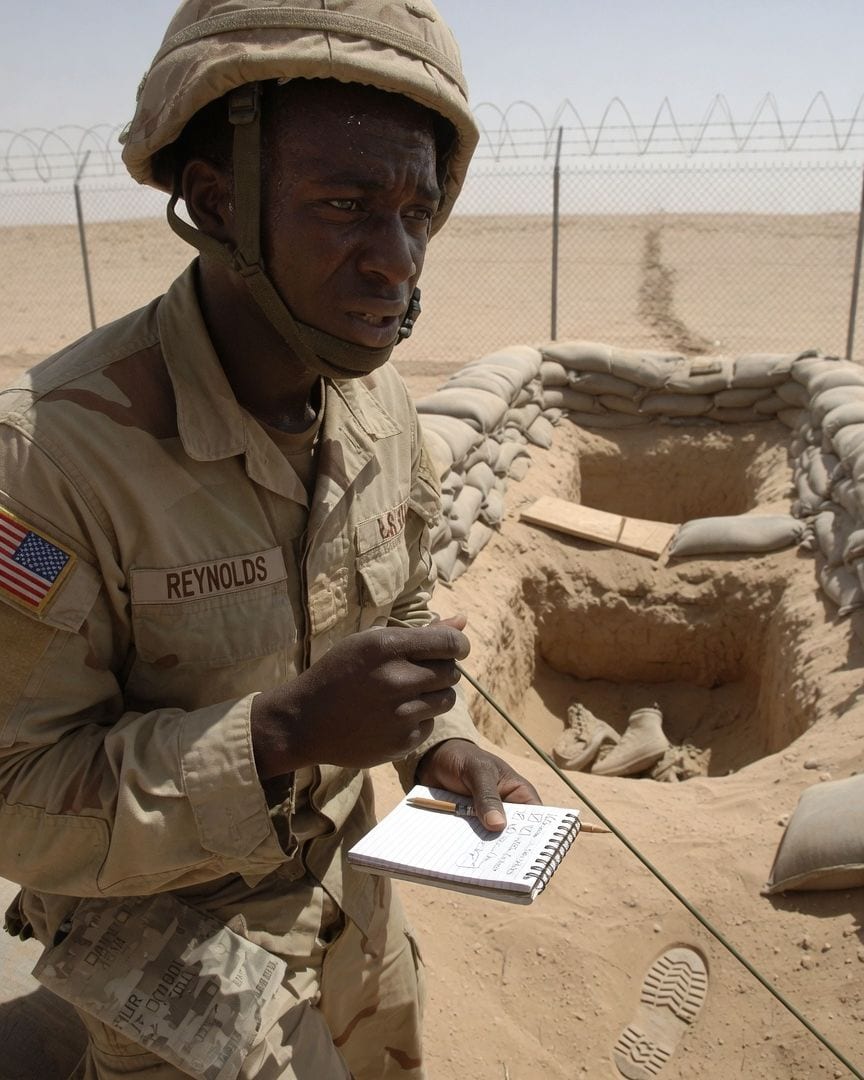
Weeks from going home, Lance Corporal Reynolds found a boot print leading straight through the base's perimeter wire.
Lance Corporal Isaac Reynolds was just weeks from his discharge, eager to leave Firebase Kettle and finally go home. On his final rotation, running routine wire-checks around the remote, slowly collapsing outpost, he expected nothing but the familiar rhythm of confirmed positions. But near an empty foxhole, a comm wire tugged back as if from a living man, and his crew count came out one man too many. Later, walking the perimeter, Reynolds found a distinct boot print leading directly through the intact fence line, out into the empty, silent desert. No breach, no cut wire—just the impossible impression of a boot sole where no one should be.
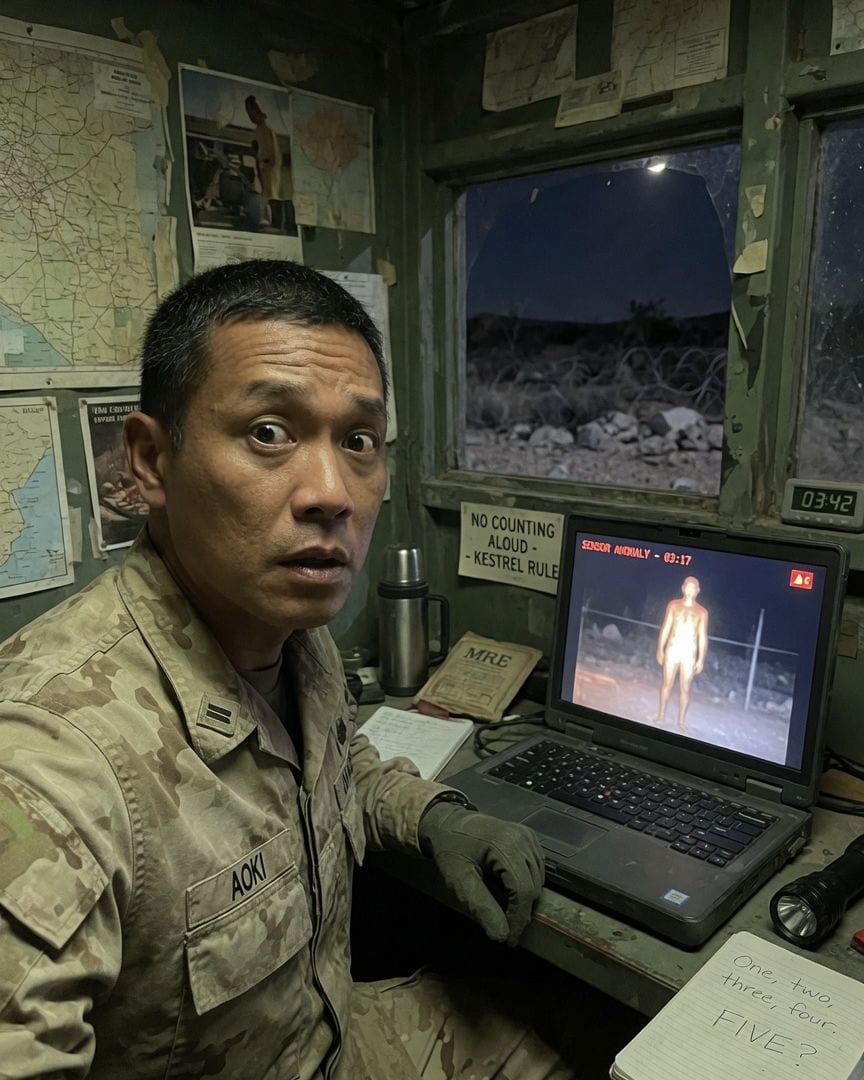
Sergeant Harold Aoki, hours from relief, counted his four-man patrol. A dry voice rasped, 'Five.'
Sergeant Harold Aoki was just hours from relief, walking the perimeter of Firebase Kestrel under a sliver of moon. A man who valued accountability, he counted his four-man patrol at the halfway mark: 'One, two, three, four.' A beat of silence, then a faint, dry voice, not one of his men, rasped, 'Five.' Later, back in the watchtower, the thermal camera feed flickered with a distinct, too-tall heat signature outside the wire, then vanished. When Aoki went to check, he found impossible boot prints just beyond the perimeter, appearing from nowhere and leaving no trail.
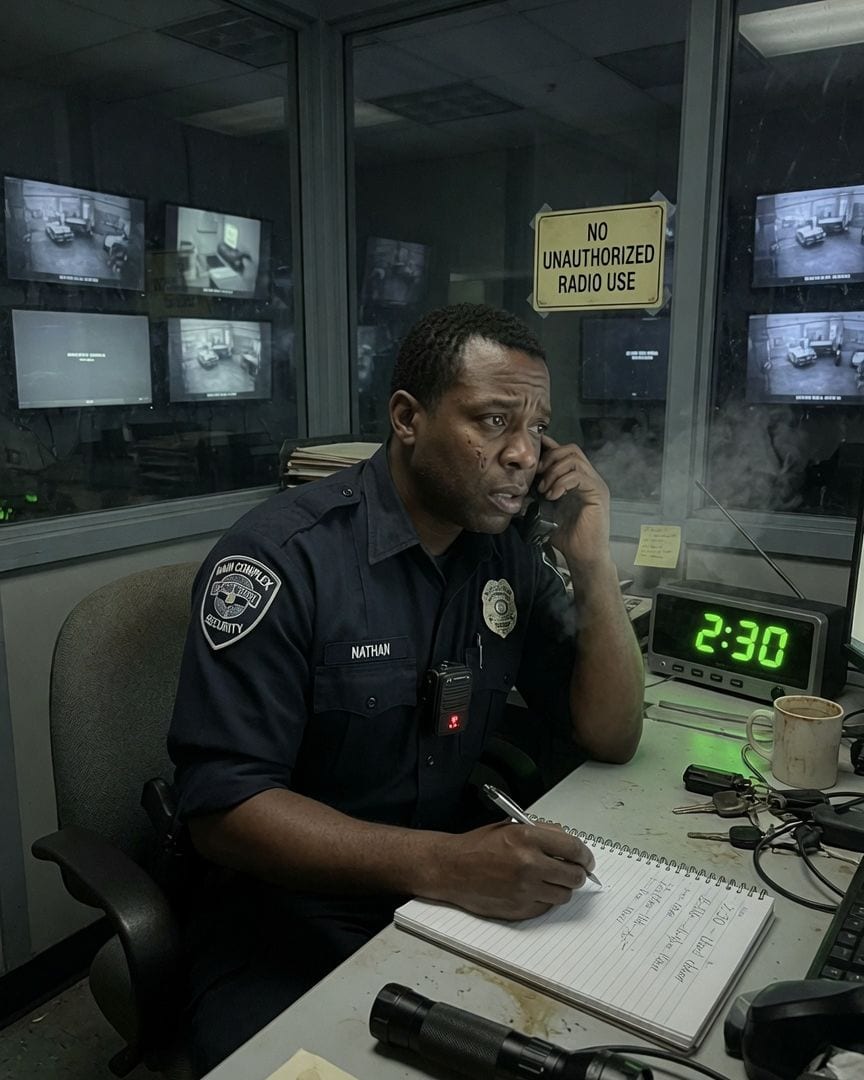
I radio Cole every night. My supervisor says his dock post was cut two years ago, and no Cole exists. But I just found Cole’s old logbook.
My graveyard shift usually consists of monotonous hourly check-ins with Cole, the guard at the loading dock. But my supervisor just revealed that the dock post was cut two years ago, and no one named Cole has ever worked for the company. I've been talking to someone who simply isn't there.
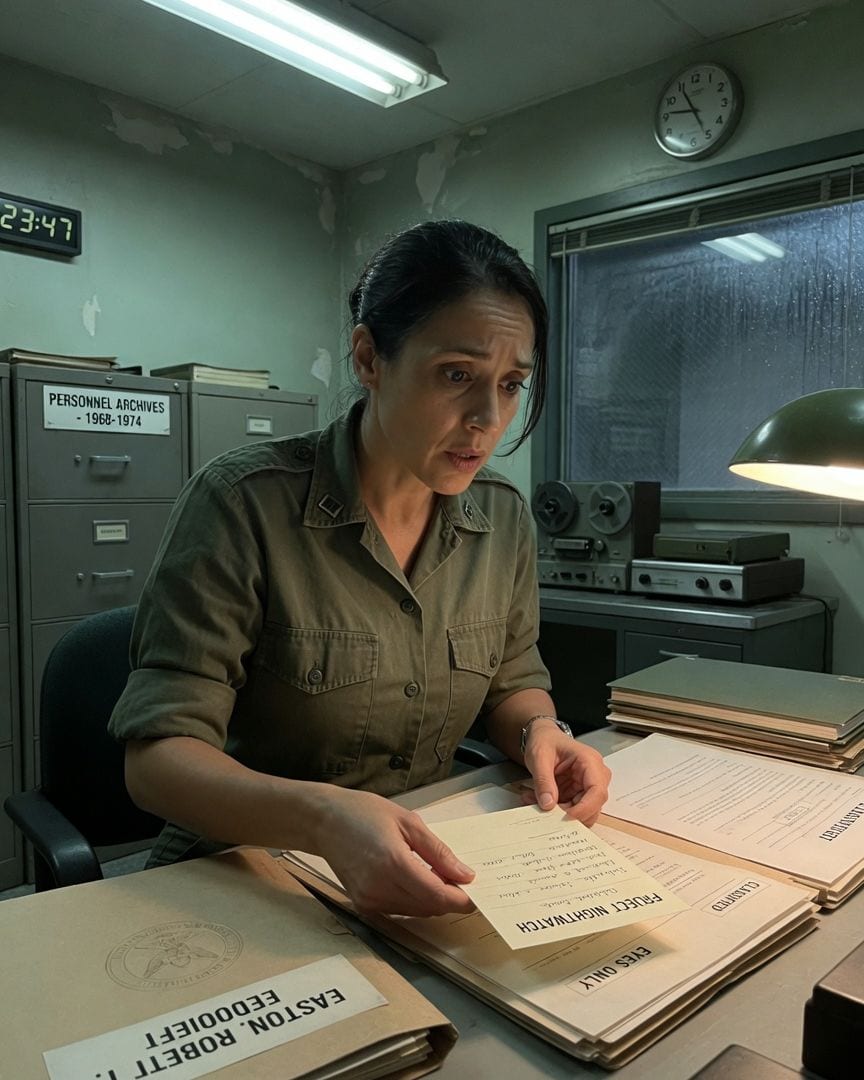
A Cold War tower controller logs an object vanish from radar, then hears the pilot scream it’s filling his windscreen. Her own name, 'Bardolph, Ines', now marked 'Observed' in a secret file.
Captain Ines Bardolph, a tower controller, was counting down the months until her transfer to Langley and the decommissioning of her base, hoping to leave behind the unsettling incidents of her final posting. But one night, her radar scope showed an impossible blip, solid and unwavering, 40 miles north of the Danube, only to vanish in less than a second, leaving a pilot screaming in terror. Despite the clear evidence, the official report blamed "atmospheric inversions," while the terrified pilot received a glowing review and promotion, his file meticulously scrubbed of any anomaly. As Captain Bardolph reviewed the pilot's pristine record, she found a hidden slip of paper, revealing a chilling truth: 'Subject: Bardolph, Ines. Status: Observed.' Was she merely an observer of the impossible, or was she now part of something far more sinister?
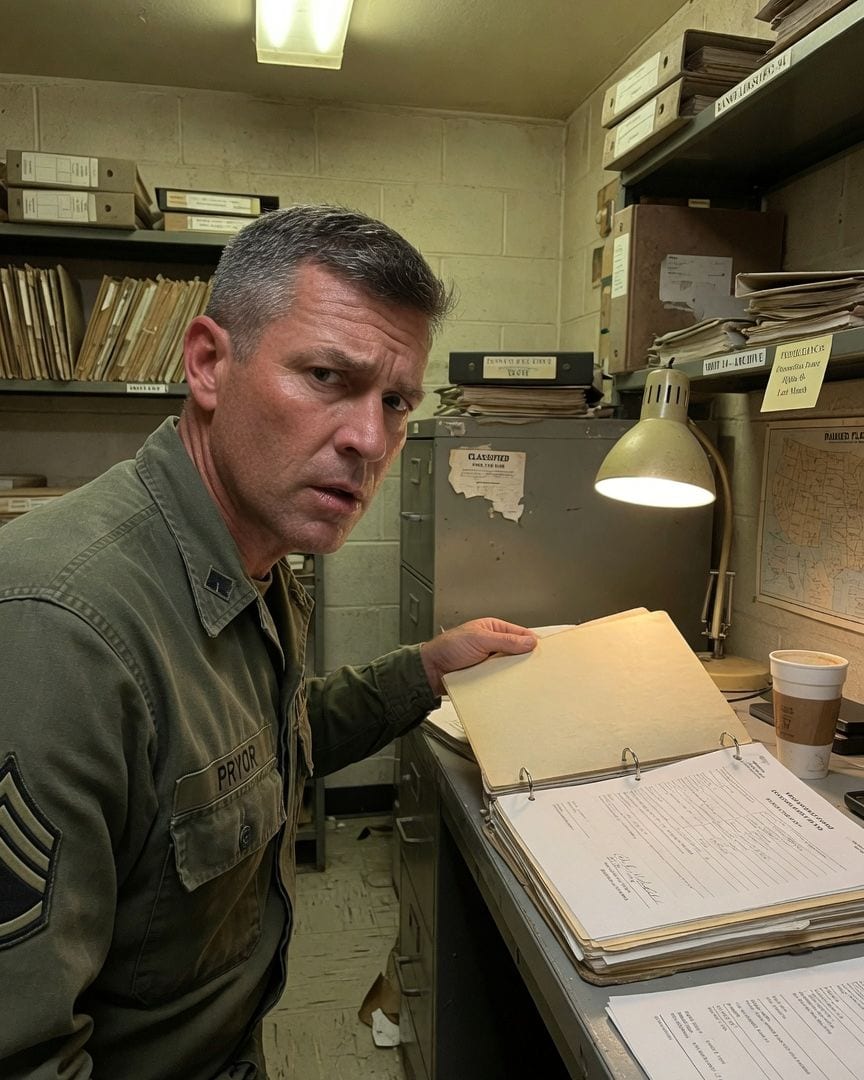
A sergeant with eleven days left finds a warm, glassed crater. Its file shows a captain lost thirty years ago is still signing reports from last week.
Sergeant Alden Pryor was counting down his final eleven days on a twenty-year hitch, expecting to spend them on routine patrols along the Ranier Flats fence line. Instead, his truck stopped at a bizarre sight: a four-hundred-foot glassed crater, miles from anywhere, its sand faintly warm at dawn despite no one recalling a blast. The air above it shimmered with an unnatural distortion, a silent scar of erased violence, and the official file for 'Shot 14' showed recent maintenance sign-offs for a decommissioned tower at the crater site. All these active documents were signed by Captain Everett Caldwell, who had been officially lost in operations thirty years ago, leaving Sergeant Pryor to wonder how a dead man could still be filing reports.
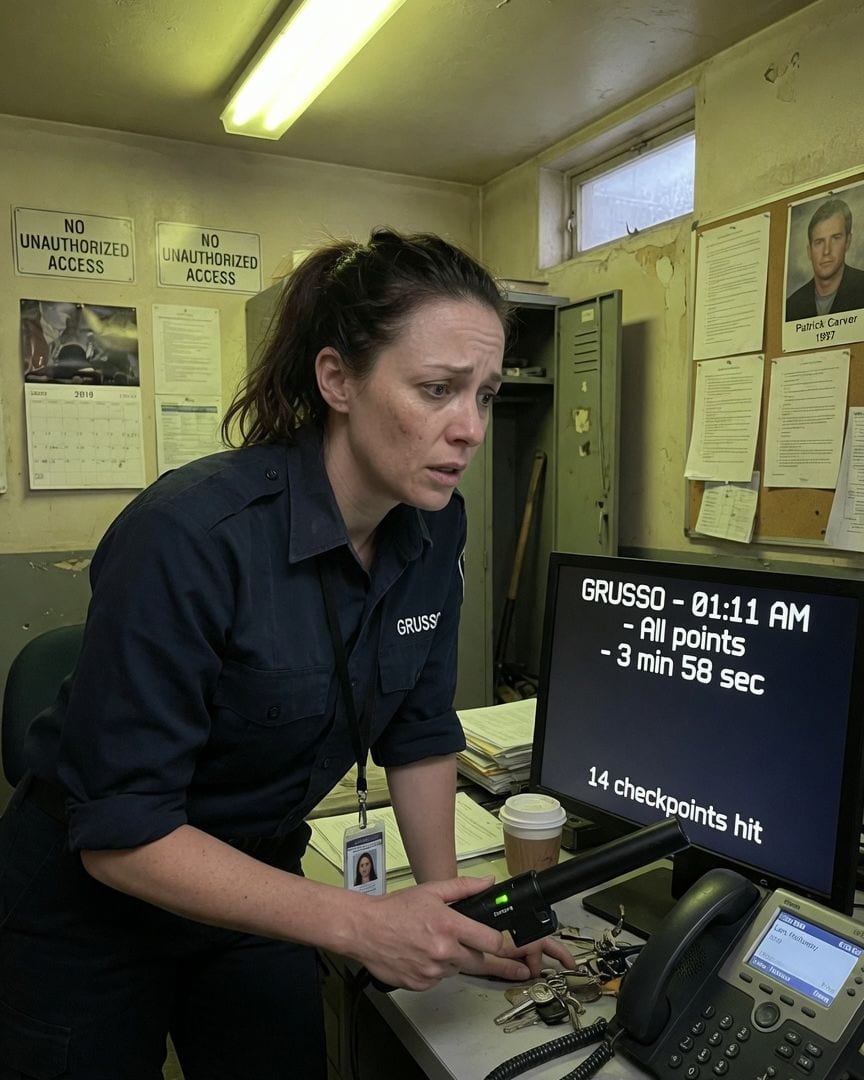
My security wand logged a full round at 1:11 AM in under four minutes. It was in the charger. Every tap is logged as mine.
Finishing my night shift, all I wanted was to get home. But the dock readout screen showed my security wand logged a full patrol at 1:11 AM, completed in just under four minutes. I knew my wand had been charging right beside the monitor the entire time, yet the log, under my ID, confirmed the impossible.