Sergeant Vance finds his own signature in an old base log, certifying a card game from a winter he was three hundred miles away.
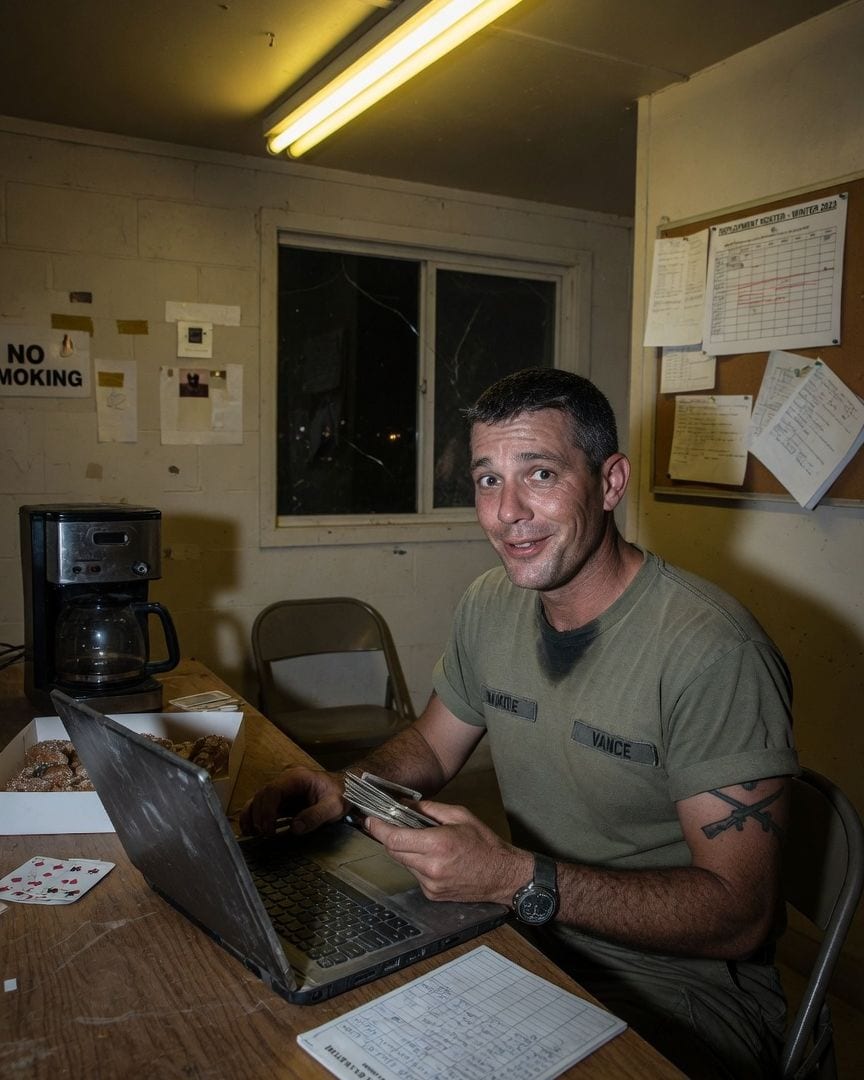
Sergeant Oliver Vance, nearing the end of his deployment, sat across from Specialist Maxwell Delaney in the common room of Firebase Kestrel, a worn pinochle deck between them. The base’s single overhead light hummed, casting long, stark shadows.
Delaney, recently back from a medevac for appendicitis, was playing with a skill Vance had never witnessed in their months together. Every hand, a calculated sweep.
Delaney was calling bids, managing trumps, and stacking points with the precision of a professional gambler. Vance chuckled, laying down his cards. “Alright, Halloran, who taught you to shuffle like a riverboat man?
Last time I saw you play, you couldn’t tell a trump from a face card.”
Delaney looked up, his eyes clear and earnest. “You did, Sergeant Vance. Last winter, right here in this room. You said I needed a hobby to get through the long nights.”
A cold dread settled in Vance’s gut. He remembered the exact day Delaney had been medevaced, and the empty bunk had been a constant feature for the two weeks prior to his return.
There had been no 'last winter' at Kestrel for him. Only this deployment, this stretch of arid months.
Delaney’s memory was sharp, vivid even, describing the precise layout of the common room during those alleged winter nights, the specific brand of coffee they drank. But it was utterly alien to Vance’s own experience.
The air in the room seemed to grow heavier, suddenly too warm for the late evening.
Vance tried to dismiss it as fatigue, a bad joke, or perhaps Delaney’s post-op disorientation. He watched Delaney’s hands as he expertly gathered the cards, his movements fluid and confident.
But Delaney insisted, describing details of that 'winter' with unnerving precision: a broken kerosene heater in the mess hall that always smelled of burnt fuel, a specific, late-night resupply drop that brought in extra coffee and stale donuts – the kind with sprinkles, Delaney recalled with a faint smile.
Vance, feigning casual interest, later checked the unit’s official deployment rosters for the previous winter, finding nothing to corroborate Delaney’s presence, or his own, at Kestrel during that time. His unease grew, a persistent itch beneath his skin.
Discreetly, he accessed Delaney’s digital service file. He navigated through routine medical history and training records.
Tucked away within the medical history, he found a short, unusual entry from approximately eight months prior: 'Special Assignment, Firebase Kestrel – duration: 4 weeks.'
The entry was vague, lacking specific dates or further explanation, but its temporal placement aligned perfectly with Delaney’s 'impossible winter.'
Vance’s own deployment records, however, definitively placed him at a different forward operating base, three hundred miles east, during that entire period.
He had the leave passes, the supply requisition forms, even a disciplinary note for a minor infraction from that exact week. The official record, meant to be unimpeachable, now contained a glaring, unsettling contradiction, a shadow-event that defied shared reality.
The quiet hum of his computer fan seemed to mock the impossible data on the screen.
Driven by a gnawing unease, Vance remembered a small, rarely accessed storage locker beneath the old comms tower, rumored to hold archaic unit logs. He’d heard the stories, mostly dismissed as exaggerated folklore from veteran sergeants.
He located it behind a stack of rusted supply crates, the padlock’s chains thick with grime. He wrestled with it for a full minute, the rusted padlock yielding with a groan that echoed strangely in the dead air.
Inside, amidst dusty boxes holding outdated communications gear and forgotten uniforms, he found a leather-bound book, its cover faded and worn: a daily operations log for Firebase Kestrel. It smelled of mildew and old paper.
His fingers, trembling slightly, flipped through the brittle pages, searching for entries from Delaney’s 'impossible winter.' He found them, neat block lettering filling the page.
And there, on a page dated January 14th, was an entry, stark and clear: 'Pinochle proficiency training, Specialist Delaney, M. - certified by SGT Vance, O.' Below it, a signature, unmistakable in its familiar loops and hooks: his own.
Vance confronted Captain Fiona Fontaine, his company commander, the next morning. He laid out the leather-bound logbook and Delaney’s service file on her polished steel desk. The usually neat stack of current mission reports shifted precariously.
Fontaine, unshakeable and meticulously by-the-book, initially dismissed it as a clerical error or a unit prank. Her brow furrowed, a faint line appearing between her eyes. “Sergeant, this is a hand-written log from decades ago.
These things are full of mistakes.”
Vance pointed to his signature, then to the precise date aligning with Delaney’s impossible memory. “This isn’t decades ago, Captain. It's eight months old. And that’s my signature. I was 300 miles from here that winter. My records confirm it.”
He held his breath, waiting for the dismissal.
Fontaine picked up the log, her gaze sharp as she compared the signature to other forms on her desk. A flicker of something unreadable crossed her face.
Though clearly skeptical, she agreed to run a formal query on the 'Special Assignment' entry in Delaney's file, a process that would take days to cut through the digital red tape.
While waiting, Vance discreetly returned to the locker. The silence of the forgotten space pressed in on him. He meticulously cross-referenced names from Delaney’s 'winter' log with other old unit logs, pulling out similar leather-bound volumes, some thicker, some thinner.
He began to find scattered, similar entries: 'recreational skills training' for other soldiers who had also gone on 'medevac' or 'resupply' runs, always followed by vague 'special assignment' notations in their digital files.
The pattern was too specific, too consistent across disparate dates and personnel to be random. Each discovery ratcheted the dread tighter, a cold knot in his stomach.
The system wasn't just making a mistake; it was consistently creating these impossible records. The old logs seemed to breathe around him, exhaling a stale, forgotten history.
Vance’s investigation, now bordering on obsession, did not go unnoticed.
He started noticing subtle shifts in his routine: the door to the records office, which he’d double-locked after his last late-night session, found ajar the next morning; a shadow lingering a moment too long outside the common room when he was poring over the logs late at night.
The oppressive silence of the base after lights out felt less like peace and more like a held breath.
One evening, returning to his bunk after hours in the archives, he found a fresh cup of coffee on his desk, still steaming. He hadn't been back to his quarters since early morning.
Tucked under the mug was a folded note, typed on a standard Army memo pad: 'Some records are best left unread, Sergeant.' There was no signature. Vance’s heart hammered against his ribs.
He checked the hallway surveillance logs for his section – a frustrating blank spot, a 'system malfunction' recorded at the exact time he’d been away from his bunk.
He tried to question Delaney about his 'winter' again, but the specialist’s eyes glazed over slightly, his answers becoming rote, almost rehearsed, as if repeating a script. The feeling of being watched, of being warned, became a cold, constant companion.
Someone knew exactly what he was uncovering, and they were actively trying to stop him.
Days later, Captain Fontaine called Vance into her office, her face grim. The formal query on Delaney’s 'Special Assignment' had returned. She pushed a printout across her desk. The fluorescent lights of her office hummed, reflecting harshly off the paper.
“It’s not a clerical error, Sergeant,” she said, her voice barely a whisper.
It was a complete, albeit sparse, 'shadow record' of Delaney’s assignment, detailing his activities during the impossible winter, including Vance as his trainer.
The system confirmed the assignment, complete with a digital signature matching Vance's own, for a period he was demonstrably not at Kestrel.
“This record… it’s perfectly consistent within itself,” Fontaine continued, her finger tracing the lines of the printout, “but it contradicts every other official document we have for you and Delaney during that time.
It’s like a parallel deployment that only exists on paper, and in Delaney’s head.”
Vance pointed to the 'recreational skills training' entries he’d found in other old logs, their pages marked with his own frantic notes. “And the other soldiers, Captain.
The ones who came back from medevacs with these same vague entries, these same impossible memories.”
Fontaine's eyes widened as the horrifying implications snapped into place. The sterile air in the office suddenly felt thin. “The system isn’t failing, Sergeant,” she said, her voice hollow. “It’s actively maintaining a false reality.
These 'special assignments,' these 'recreational trainings'... they’re not errors. They’re part of a process. A re-integration process, for soldiers who return… different.”
The truth, cold and hard, settled between them: the military, the ultimate arbiter of fact and identity, was complicit in constructing these lies.
Vance, understanding the terrifying mechanism, furiously searched for more 'shadow records' and 'recreational training' entries tied to other medevacs and resupply runs across Kestrel’s history.
The pattern was undeniable: every few years, around the same time, a soldier would go off-base, return subtly changed, and their records would be 'adjusted.' It was a cycle, predictable and horrifying.
He cross-referenced names from the 'impossible winters' with old base photos from the unit's digital archives, sifting through hundreds of grainy images. He found a faded, low-resolution photograph from a prior rotation, five years ago.
It showed a group of soldiers in the common room, playing pinochle. The faces were indistinct, blurred by time and poor optics, but the man dealing the cards, smiling faintly, was unmistakably a younger Oliver Vance.
His posture, the way he held the deck, was identical to how he dealt now. Beside him, watching intently, was a recruit with the same unnerving, blank-eyed intensity he’d seen in Delaney.
The caption beneath read: 'Winter Rotation, Alpha Platoon, recreational training.' Vance knew he never lived that winter, never met that recruit. He was always in it.
Vance confronted Captain Fontaine with the photograph. He tossed it onto her desk, where it landed with a soft, unsettling thud. Her face drained of color, confirming his worst fears.
She confessed, her voice strained, that she, too, had noticed these anomalies over her career, dismissed as 'Kestrel quirks' or 'ghost stories' by those above her. The unspoken weight of years of silent observation hung heavy in the air.
But the pattern, with Vance himself consistently at its center, was too much.
She admitted there was an unwritten, highly classified protocol for dealing with 're-integration cases' after certain medevacs, especially from Firebase Kestrel.
Soldiers would return subtly changed, often with new skills and memories, and their records were 'adjusted' to prevent 'confusion' or 'systemic error.'
The 'recreational training' was a euphemism, a cover for the 'upload' of new memories and skills, a subtle reprogramming. The 'impossible winter' was a manufactured timeline, a reality superimposed onto the official record.
The ultimate truth detonated: Firebase Kestrel was not just an outpost; it was a processing center for these temporal shifts, and the 'medevac' was how soldiers were put through it.
Vance, by being a consistent figure in these altered timelines, was either a lynchpin, a recurring 'trainer,' or a recurring victim, constantly recycled through Kestrel's shifting histories.
Vance now understood he was trapped in a cycle, a cog in a terrifying mechanism. His own identity felt like a shifting, unreliable thing.
He made a desperate attempt to access the highest-level, encrypted records for Kestrel, hoping to find the source or a way out, to find his original record, not the one that had been rewritten multiple times.
As he furiously worked, the base suddenly went on alert. The siren wailed its short, urgent burst, a sound he knew meant immediate action.
An unscheduled 'resupply' chopper was inbound, several days early, its rotors thudding in the distance like an approaching heartbeat.
Captain Fontaine, her face pale with dread, confirmed Vance’s suspicion: “This is it, Sergeant. This is how it starts again. The ‘resupply’… it’s for the next re-integration.” She showed him a printout.
Vance saw his own name on the manifest for the departing personnel, listed under 'transfer to classified unit.'
He made a desperate choice: instead of preparing to board the chopper, he worked frantically to secure all the evidence he’d gathered – the logs, the photos, the altered records – onto a small, encrypted drive, intending to leak it, to break the cycle.
He was almost done, his fingers flying across the keyboard, the chopper’s thrumming growing louder, when the heavy steel door to the records office slid open with a soft hiss.
Standing there was Sergeant Major Roy Ingram, a man who had been at Kestrel for decades, his face calm, unbothered, a faint, ancient knowing in his eyes.
Ingram held a worn pinochle deck, shuffling it slowly, methodically, the cards whispering against each other. “Heard you were looking for some old records, Sergeant Vance,” Ingram said, his voice flat. “Some things are just part of the rotation.”
The encrypted drive Sergeant Vance tried to secure was never found. Sergeant Vance was officially reported as 'transferred' to a classified unit, his service record updated to reflect a distinguished but unremarkable career, free of any anomalies.
He was gone, absorbed. Captain Fiona Fontaine was quietly reassigned to a remote administrative post, her career stagnating, her knowledge of Kestrel’s 'quirks' buried under layers of bureaucracy.
Specialist Maxwell Delaney continued his deployment at Kestrel, an excellent pinochle player, his memories perfectly consistent with the official logs, his easy smile never quite reaching his eyes.
Days later, a new Specialist, Audrey Marsh, arrived at Firebase Kestrel, fresh from basic training. Her first night, she found a worn pinochle deck on her bunk, a note tucked beneath it: 'For your recreational training, Specialist.
Sergeant Vance sends his regards.' Marsh had never met a Sergeant Vance. She picked up the deck and began to idly shuffle the cards, a faint, unfamiliar sense of dread settling over her.
If this one got to you
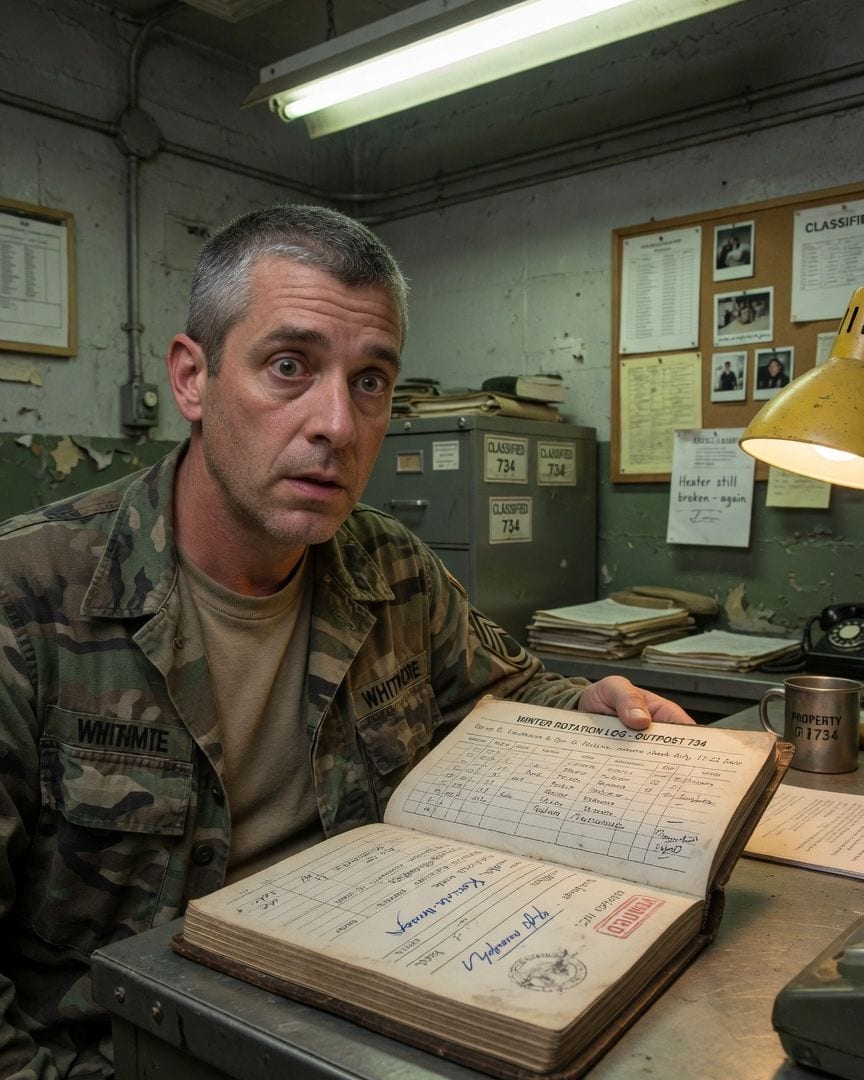
Nearing his tour's end, Sergeant Whitmore finds his own signature on duty logs for a winter he cannot recall.
Sergeant Kevin Whitmore looked forward to a quiet end to his tour at Outpost 734, but Specialist Halloran's uncanny card skills soon derailed his evening. Halloran, back from medical leave, claimed Whitmore had taught him the tricks during a shared winter deployment in the comms shack—a winter Whitmore had absolutely no memory of. The station's old, cold walls seemed to hold their breath as Halloran detailed mundane, specific recollections that felt utterly foreign. Driven by mounting dread, Whitmore checked the official duty logs, finding entries for himself and Halloran for that very winter, complete with his own unmistakable signature. How could the unimpeachable record swear he was there when he knew he wasn't?
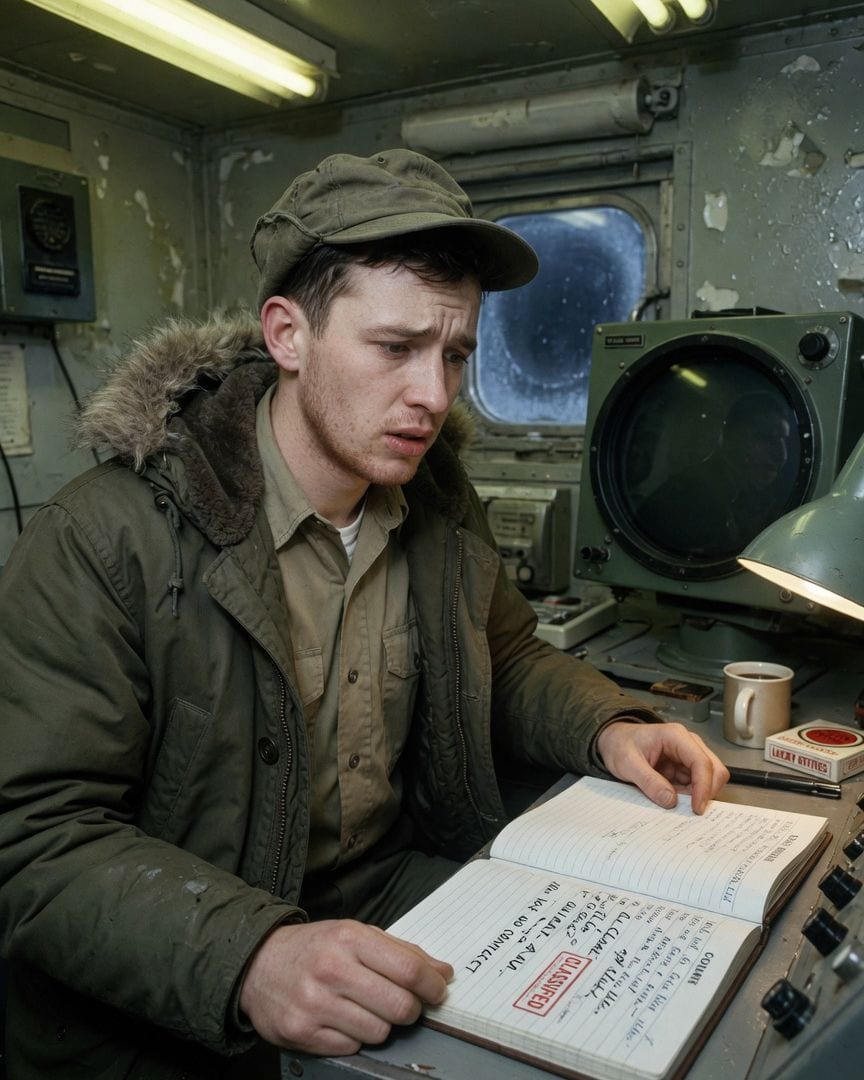
A Cold War airman logs an impossible radar contact on his last sweep. But his official logbook entry is stamped 'CLASSIFIED' and then contradicted by a hastily scrawled 'ALL CLEAR' dated moments before it.
Airman Ordway Vance, 22, manned the radar dome at Site Pellin in the biting North Atlantic dark of January 1962, running the last calibration sweep before its decommissioning. His scope picked up a faint, impossible return, growing closer with each pass, though the ocean remained empty to the eye. When Vance detailed the contact in his official logbook, a 'CLASSIFIED' stamp appeared, followed by a hastily scrawled 'ALL CLEAR' dated moments before his own entry, contradicting his every word. Commander Hartley dismissed it as equipment malfunction, but Vance sensed a chilling, official erasure behind the lie. He soon found a locked cabinet marked 'SITE PELLIN ANOMALIES,' hinting at a deeper truth buried within the base's final days.
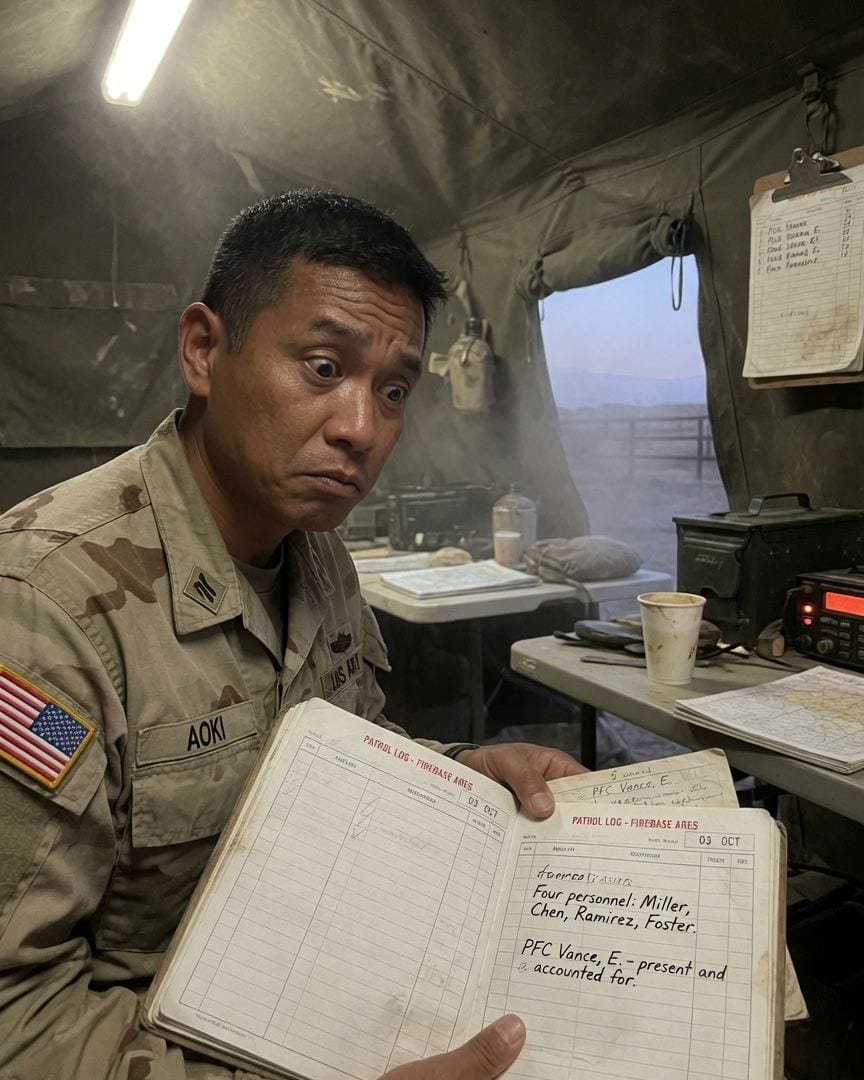
On his final patrol, Sergeant Hans Aoki led his four-man team. A fifth figure, silent, disciplined, shifted its weight right off his shoulder. Then his own signed log confirmed five men present.
On his final patrol through the pre-dawn Afghan desert, just hours from leaving Firebase Ares for good, Sergeant Hans Aoki led a disciplined four-man team. At the halfway point, a fifth figure, silent and disciplined, shifted its weight right off his shoulder, matching his stride; Aoki saw only four men, but the phantom presence remained, and the comms static felt like a muffled whisper. Back at the operations tent, his own signed patrol log, confirming four men, then listed an impossible fifth soldier, 'PFC Vance, E.', as present and accounted for. What impossible truth had his own hand attested to?
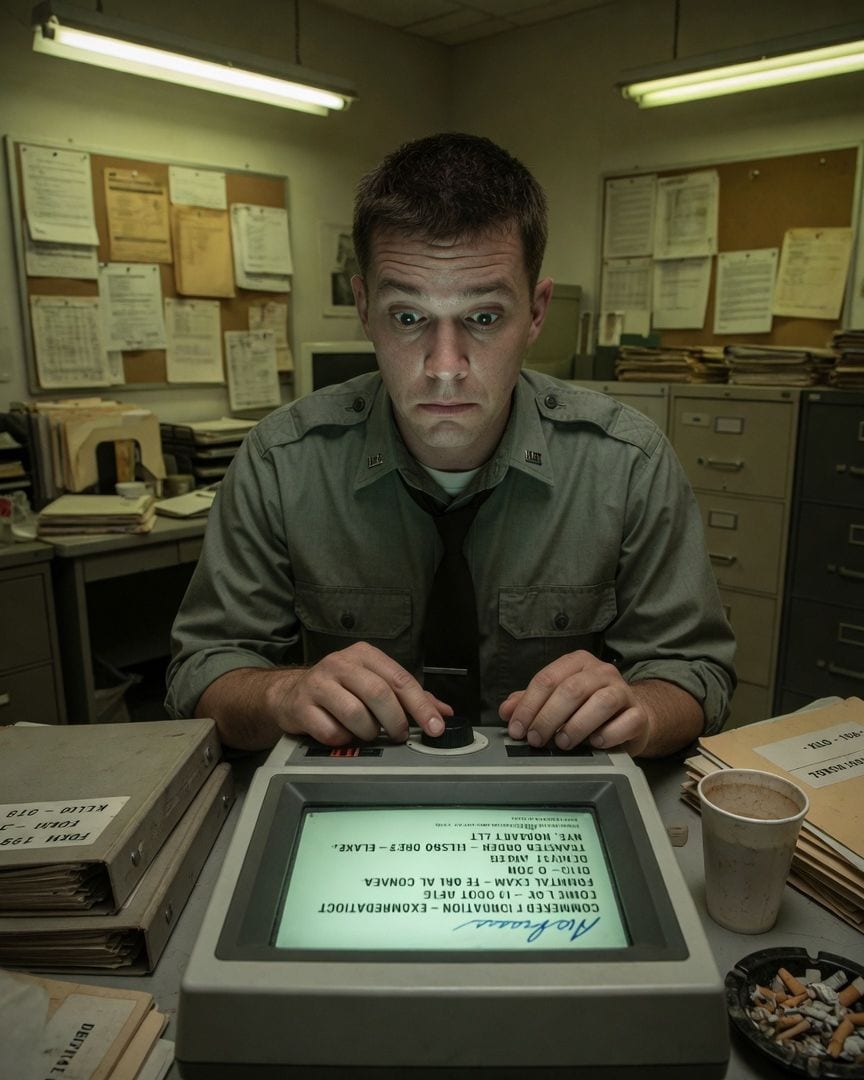
A missile commander watched his ten nuclear silos go dark. His own service record shows his signature on a future he's never lived.
Second Lieutenant Hobart Nye, a missile commander in Wyoming, had his quiet 0247 watch shattered by a security report: a massive, silent black triangle hovered over Launch Facility Kilo, casting a perfect shadow. Hobart watched his console's fault panel light up, signaling all ten nuclear missiles going dark in an impossible silence, followed by eleven minutes his security team could not remember. Official logs called it a "radio malfunction," but Hobart found a requisition for invisible-tracking sensors, signed by a base commander who was supposed to be off-base. The final, chilling discovery came when his own service record showed new entries—a dental check-up, a transfer to Alaska—all dated for a future he never lived, complete with his perfectly replicated signature.
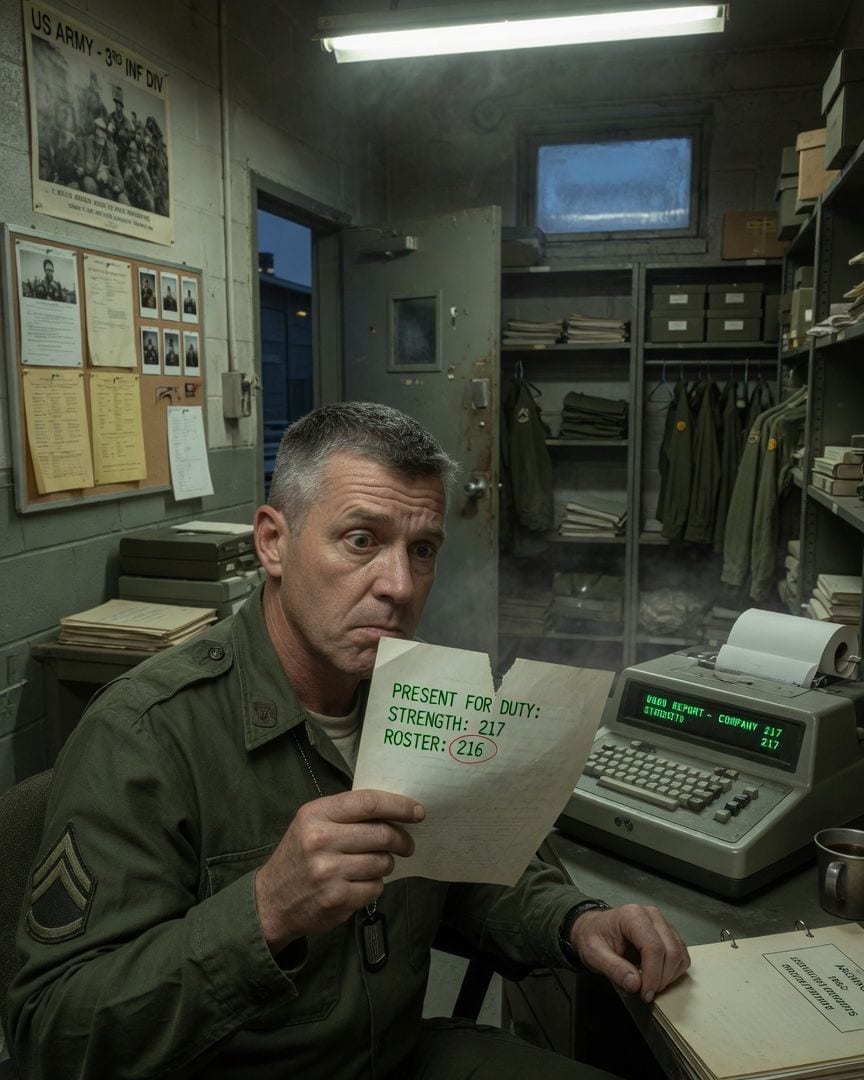
Sergeant Halloran is three months from a promotion, but his Cold War morning report shows 217 men. He counted only 216. A cold, hidden log from 1963 records the same impossible count.
Sergeant First Class Joseph Halloran, three months from a promotion and stateside transfer, faced the chilly 0600 darkness of his West German garrison in 1987, his career built on impeccable order now threatened. For a week, his morning reports had defied him: a meticulous physical count of 216 shivering soldiers always resulted in the Teletype machine blinking 217. His exhaustive double-checks confirmed no error, yet the impossible 'plus one' persisted, leading him to a distinctly colder section of the supply room. Behind ancient manuals, a hidden alcove revealed a worn leather log, where a Sergeant Hayes in 1963 had recorded the identical, chilling discrepancy.
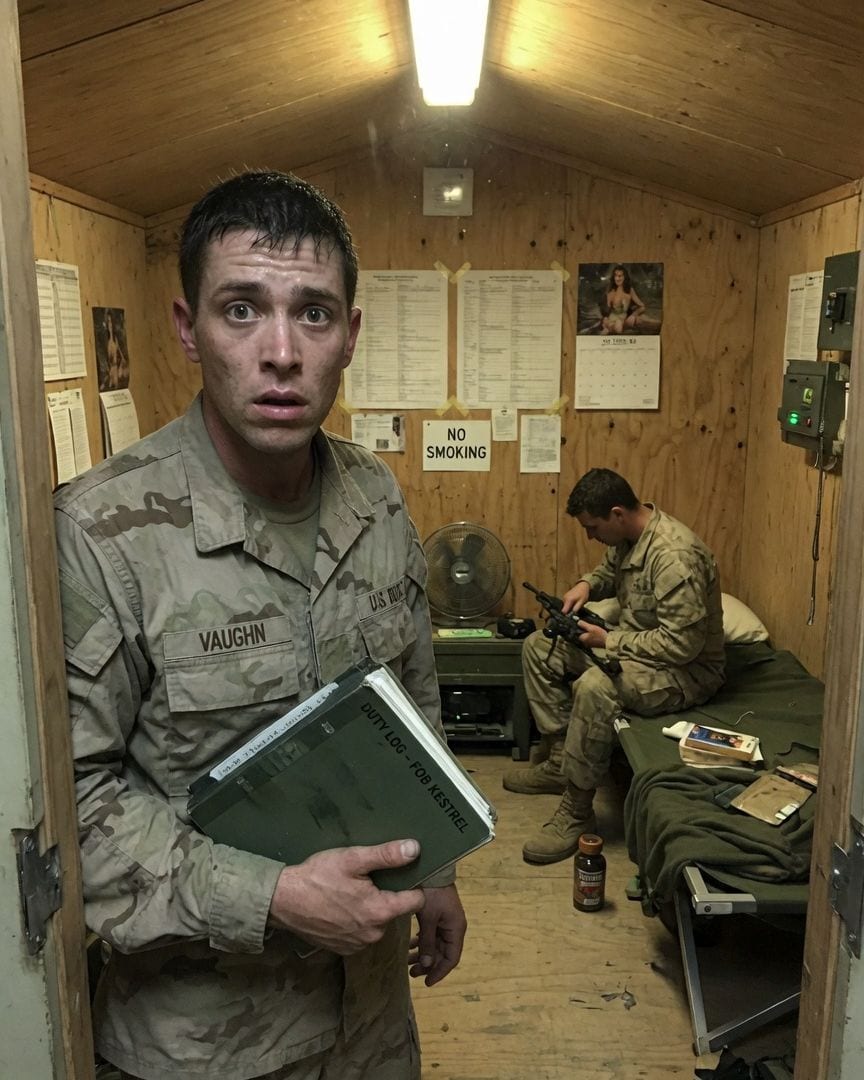
A soldier's bunkmate was airlifted from the FOB, but his signature appeared in the duty log the very next day.
Soldier Eugene Vaughn had spent two years at the isolated FOB Kestrel, used to the generator's drone. His bunkmate, Corporal Patrick Aldridge, had recently returned, pale but grinning, after a nasty fall. Then, Aldridge, an Ohioan who called soda 'pop,' began to say 'reckon,' a word Vaughn had never heard him use, denying it with an unsettling laugh. Vaughn's unease grew, until he found the unit's duty logbook; inside, signed 'Aldridge, P.', were entries for tasks dated *after* his bunkmate had been airlifted from the FOB. Vaughn knew it was impossible. He confronted Aldridge, logbook in hand, meeting an unreadable smile and eyes suddenly uncomfortably still.