My ship's evacuation plan shows nineteen cabins. I just walked past twenty. Cabin 20 had a name-card and a wet handprint, on a deck the purser swears doesn't exist.
The insistent, muffled clang of the muster alarm was already grating, even before we started the walk-through. I’m an accountant, you see, so details matter. Rules, systems, processes – they’re my comfort zone.
That’s why the mandatory safety drill on the Ocean’s Embrace III was, for me, less a chore and more a necessary verification.
My cabin’s evacuation plan, taped to the back of the door, was explicit: Deck 4, port side, cabins numbered 1 through 19. Nineteen cabins. A neat, sensible sequence.
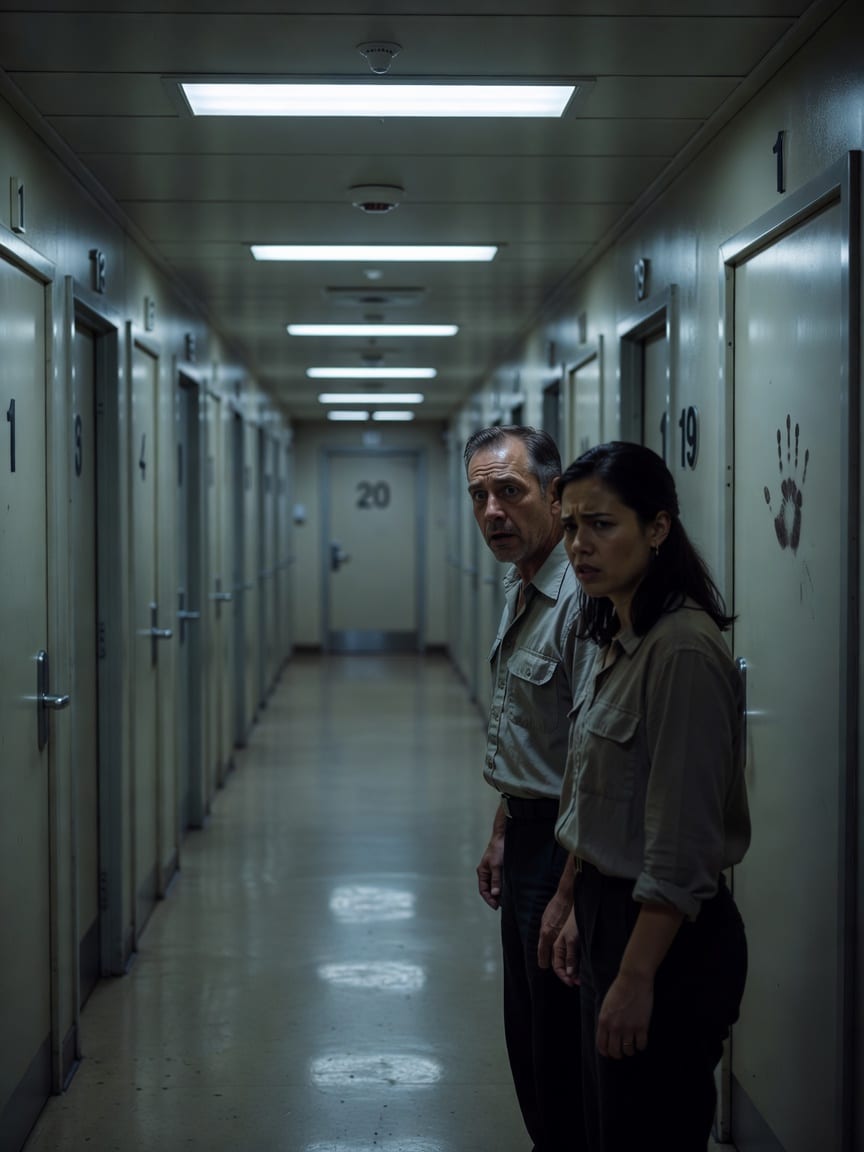
So when Thomas Fletcher, the ship’s purser, began leading our group down the brightly lit corridor of Deck 4, patiently pointing out safety features, I was paying attention. We passed Cabin 17, then 18, then 19.
My internal checklist was complete. But then we kept walking. And there it was. Not a utility closet, not an emergency exit, but another cabin door. Solid, dark wood, with a polished brass number plate. “20.”
My breath hitched. I paused, just for a second, my eyes darting from the number to the familiar life-jacket diagram on its wall, identical to every other cabin door. It was impossible. But undeniably there.
My gaze dropped to the small, empty name-card holder beneath the number. And then, the frame. Just above the handle, a distinct, glistening smear. A handprint. Wet, still.
As if someone had just tried to open the door from the inside, leaving a faint, disturbing smudge on the polished wood. My rational mind, so keen on order, suddenly spun.
I knew, with a certainty that chilled me despite the warm air, that Thomas Fletcher would soon insist this door didn't exist. The handprint seemed to shimmer, refusing to dry.
Later that evening, the image of Cabin 20 gnawed at me. The pristine white of the evacuation plan, the hard, physical reality of the door. I couldn’t let it go. Dinner was a blur.
The ship’s gentle roll usually lulled me, but tonight, I was on edge. I found myself back on Deck 4, the corridor quiet now, most passengers either at dinner or enjoying the evening’s entertainment.
My footsteps echoed softly on the carpet. Cabin 20 was still there. Not a trick of the light, not a momentary hallucination. It was as solid, as real, as the bulkheads themselves.
I approached it cautiously, my heart thumping a little faster than it should. The handprint had dried now, leaving behind a faint, disturbing outline, a ghostly record of something that had been wet moments before. I leaned closer.
The name-card holder, which had been empty during the drill, now held a simple white card. Slightly damp at the edges, as if recently placed, it read: ‘Hazel Whitfield.’
Hazel Whitfield. The name, simple and clear, hit me with a jolt. I pulled out the ship map from my bag, the one from my cabin, and spread it against the wall. I traced my finger along Deck 4.
Cabin 19. Then blank wall. No Cabin 20. I pulled out my phone, logged onto the ship’s Wi-Fi, and navigated to the Ocean’s Embrace III passenger manifest. I typed in 'Hazel Whitfield.' The search returned nothing.
No passenger currently aboard by that name. No record of anyone named Hazel Whitfield having embarked or disembarked this voyage. The card, the cabin, the name – none of it computed. My hands trembled as I reached for the handle.
It was locked. A shiver, colder than the air-conditioning, ran down my spine. A prank? A mistake by the cleaning crew?
My usual, rational explanations felt utterly inadequate against the stark, cold fact of the door and the name on the card.
I clutched the impossible name-card, its damp edge now warm from my palm, my mind racing for a logical explanation. There wasn’t one. This wasn't some minor discrepancy. This was a physical impossibility.
I needed to report this, directly to someone in authority, to someone who couldn't simply dismiss it as a misplaced cabin number. I decided it had to be the purser, Thomas Fletcher, despite my earlier misgivings about his inevitable denial.
I turned to head back towards the main deck, the white card a stark, impossible truth in my hand. Just then, a familiar figure rounded the far corner of the corridor.
It was Thomas Fletcher, striding purposefully, a genial smile already forming on his face, his master key ring jingling softly at his hip. He was heading directly towards me.
He hadn't seen me yet, caught up in the rhythm of his evening rounds. I knew, with sickening certainty, that he was about to tell me, again, that Deck 4 ended at nineteen, and that Cabin 20 simply didn't exist.
Fletcher’s smile had faltered slightly when he saw me standing there, clutching the damp card. My attempts to explain, to hand him the name-card from the door that couldn’t be, were met with practiced, polite dismissal.
He assured me, with a voice full of professional concern, that I was likely mistaken. “Perhaps a little jet-lagged, Ms. Jennings? The sea air can be disorienting.” He insisted the manifest was accurate, the ship’s blueprints definitive.
He even offered to walk me back to my actual cabin, suggesting I needed rest. His eyes, though, held a strange, flat quality I couldn't quite decipher.
Frustrated but unwilling to back down, I concocted a story about needing the full deck plans to retrace my steps for a lost earring.
At the information desk, I obtained copies of the ship’s deck plans – crisp, official, printed just an hour before. Back in my cabin, I spread them across the bedspread, smoothing the creases.
My finger traced the lines of Deck 4. Just as Fletcher had so confidently stated, the plans showed no Cabin 20.
The space where it should have been was clearly marked as a utility access panel, a blank wall for maintenance. Nothing more.
It was infuriating. I knew what I had seen. I knew what I had held. My meticulous accountant’s brain refused to accept the official lie. There had to be an explanation, something beyond simple error.
I started researching the ship’s history, delving into the company’s past vessels, specifically those named ‘Ocean’s Embrace.’ I spent hours poring over forum archives, maritime enthusiast sites, and digital library records.
My search eventually led me to an obscure online forum for retired naval architects and maritime employees.
Tucked away in a thread discussing the early days of the ‘Ocean’s Embrace’ line, I found a post by a former naval architect named Joel Lawson, who mentioned working on the original ‘Ocean’s Embrace’ fleet.
I sent a cautious message to Joel Lawson, framing my query as an academic interest in historical ship designs and the evolution of passenger deck layouts on the ‘Ocean’s Embrace’ vessels. I didn’t mention Cabin 20.
Joel’s reply was surprisingly swift but unsettlingly vague. He wrote that historical designs were often subject to "minor revisions and structural anomalies" and that I might be "looking in the wrong places" if I expected perfect consistency.
He added a cryptic line: "I'd advise against digging too deep into old blueprints. Some things are best left to the sea." The tone was unsettling, a quiet warning cloaked in polite retirement-speak.
The next day, as I returned to my cabin after breakfast, I found a small, folded note slipped under my door. It was a single, typewritten word, stark against the white paper: 'STOP.'
There was no name, no context, just that single, chilling command. My hands started to shake. Had Joel sent it? Or was it someone else?
Later, determined not to be deterred, I was in the ship’s quiet, wood-paneled library, scrutinizing the deck plans I’d acquired, comparing them to old photographs of the Ocean’s Embrace II I’d found online.
I caught a fleeting movement in the reflection of the glass-covered display case, a shimmer of a figure just behind me. My head snapped up.
In the polished surface, a man in a plain crew uniform stood watching me from the entrance. Our eyes met in the reflection for a split second, his face expressionless, before he quickly turned and disappeared around the corner.
The message, I realized, was clear: someone on board knew I was asking questions, and they didn’t want me to find answers.
Unnerved but more determined than ever, I tracked down Joel Lawson’s direct contact information, bypassing the forum. I called him, my hands clammy. I skipped the pretense of academic interest.
“Mr. Lawson,” I said, my voice tight, “My name is Nora Jennings. I’m on the Ocean’s Embrace III. And there’s a cabin on Deck 4, Cabin 20, that isn’t supposed to exist.”
I described the door, the name-card, Hazel Whitfield, the wet handprint, and Fletcher’s unwavering denial.
There was a long silence on the other end, punctuated only by the faint crackle of the satellite phone line. Then, Joel, his voice low and gravelly, began to speak. He didn't deny my story. He didn't even sound surprised.
“The 20th cabin anomaly,” he muttered, almost to himself. “They’re still trying to suppress it.” He admitted that it was a hushed-up phenomenon, a recurring ‘spatial hiccup’ tied to this specific cruise route.
He explained that the company had always tried to suppress it, classifying it as ‘unexplained structural inconsistencies’ in internal documents. He called them ‘Phantom Cabins’ – temporary, impossible spaces that would manifest and then, just as suddenly, disappear.
He revealed that official blueprints, like the one I held, were deliberately drawn to omit them, and pursers like Fletcher were specifically trained to deny their existence. “It’s a pattern,” he sighed, the sound raspy.
“One that’s been repeating for decades, long before this ship was built. Since the first Ocean’s Embrace made that route.”
Then, his voice dropped further. “Does the name ‘Hazel Whitfield’ mean anything to you, Ms. Jennings?”
My blood ran cold. “Yes,” I managed, my voice barely a whisper. “It was on the name-card.”
“I have something that might explain why,” he said, his voice grim. He described a document he’d salvaged years ago from a decommissioned vessel, a record that, by all accounts, should not exist.
Joel Lawson’s voice, strained with age and a deep-seated dread, directed me to a hidden corner of an obscure online archive. “It’s a digital scan,” he explained, “of a physical document. The record that cannot be, as I call it.”
My fingers fumbled with the mouse, navigating through layers of encrypted folders, the ship’s Wi-Fi connection flickering slightly. The weight of his words, of the secret he’d just shared, pressed down on me.
Finally, a faded, yellowed image slowly resolved on my screen. It was clearly a page from an old, brittle ship’s logbook. The paper itself looked fragile, almost transparent with age.
The date, precisely printed at the top of the page, read: ‘October 17, 1972.’ My eyes immediately darted to the vessel name, in elegant, looping script just below the date: ‘Ocean’s Embrace II.’
My breath caught in my throat. The Ocean’s Embrace II. Decommissioned in 1985. A ghost ship. I scrolled down, my eyes scanning the passenger manifest for Deck 4. I counted the entries: Cabin 15, Cabin 16, Cabin 17, Cabin 18, Cabin 19.
And then, nestled between Cabin 19 and a blank entry, clearly written in faded, looping ink, was: ‘Cabin 20 - Hazel Whitfield.’
The air in my cabin suddenly grew cold, as if the ship itself had exhaled. The impossible name, ‘Hazel Whitfield,’ echoed across fifty years, screaming out from that brittle page.
It was a chilling, undeniable proof that this wasn't just about my ship, or even my time.
“It’s a fixed point,” Joel explained, his voice hushed over the crackling line, confirming my worst fears about the log. “A persistent tear in the fabric of space that manifests along this specific shipping lane.
Not tied to a single ship, Nora, but to the geometry of the route itself.”
He revealed that the ‘Ocean’s Embrace’ line had been running this exact course for over a century, and the anomaly had recurred on multiple vessels, always on Deck 4, always as a ‘Cabin 20.’
“Hazel Whitfield,” he continued, the name heavy in the air, “was a young woman who vanished from the Ocean’s Embrace II in October of 1972. Officially, ‘lost at sea.’ Never a trace.” The handprint I saw? “A recurring detail,” Joel said grimly.
“A last desperate attempt to get out.” He explained that the cabin wasn’t truly ‘empty’ when it manifested; it was a pocket dimension, a temporary fold in reality. A trap.
The company’s silence, he stated, wasn’t just about PR; it was a futile, desperate attempt to avoid acknowledging something beyond human comprehension, something that simply cannot be contained or explained away by blueprints or manifests. It just is.
“How do you know all this, Joel?” I asked, my voice barely steady. “How do you have such impossible records?”
Joel sighed, a weary sound. “I was part of the decommissioning crew for the Ocean’s Embrace II back in 1985.” He paused, as if gathering himself.
“During a final hull inspection, in a section of the ship’s structure that should have been solid, empty space, we found something impossible.” His voice dropped to a near whisper. “It was a small room, Nora.
Just a few feet deep, but undeniably a room. Like a closet, or… a very narrow cabin. With a door leading to empty hull. I was ordered to report it as a ‘structural anomaly’ and to document only its demolition.
But I kept a piece of it. I had to.” He told me to meet him at the next port.
Days later, the Ocean’s Embrace III docked in a small, grey port town, a thin drizzle falling from an overcast sky. I met Joel in a cramped, dusty storage unit he’d rented years ago.
The air was thick with the smell of old paper and something metallic. He pulled out a heavy, canvas-wrapped object from a rusted filing cabinet. As he unwrapped it, the dull, tarnished brass plaque was revealed.
It was thick, heavy, cool to the touch. Stamped into its surface, unmistakably, were the words: ‘CABIN 20.’ And beneath it, a date, etched deep into the metal: ‘1972.’
It was a physical, undeniable piece of the impossible geometry, an artifact that could not exist, yet sat solid and real in Joel’s trembling hand, a testament to a truth that broke every rule. The ordinary explanation died for good.
I disembarked at that next port, the heavy brass plaque wrapped carefully in an old towel in my carry-on bag.
Joel Lawson, his secret finally shared, disappeared back into his quiet retirement, a man burdened by knowledge the world refused to accept.
The Ocean’s Embrace III continued its cruise, its Deck 4 purser still insisting the evacuation plan was accurate, still smiling that bland, dismissive smile. The company, I knew, would maintain its corporate silence, burying the truth under layers of official denial.
I knew the ship would ply its route, and that somewhere, along that invisible seam in reality, Cabin 20 waited to manifest again, for another unsuspecting passenger.
I’m home now, the cruise a distant memory, though the salt air still seems to cling to my clothes. The brass plaque, a tangible piece of the impossible, sits on my desk, heavy and cold, a constant, undeniable reminder.
I occasionally check the ‘Ocean’s Embrace’ cruise line website, just to see if the route has changed, if they’ve finally altered the course. It never does.
I know that somewhere out on the open sea, the numbers on a deck plan will always quietly lie, and that a space that shouldn’t exist will always find its way back.
The blueprint on her wall still shows nineteen, but she knows what’s waiting for the twentieth.
If this one got to you
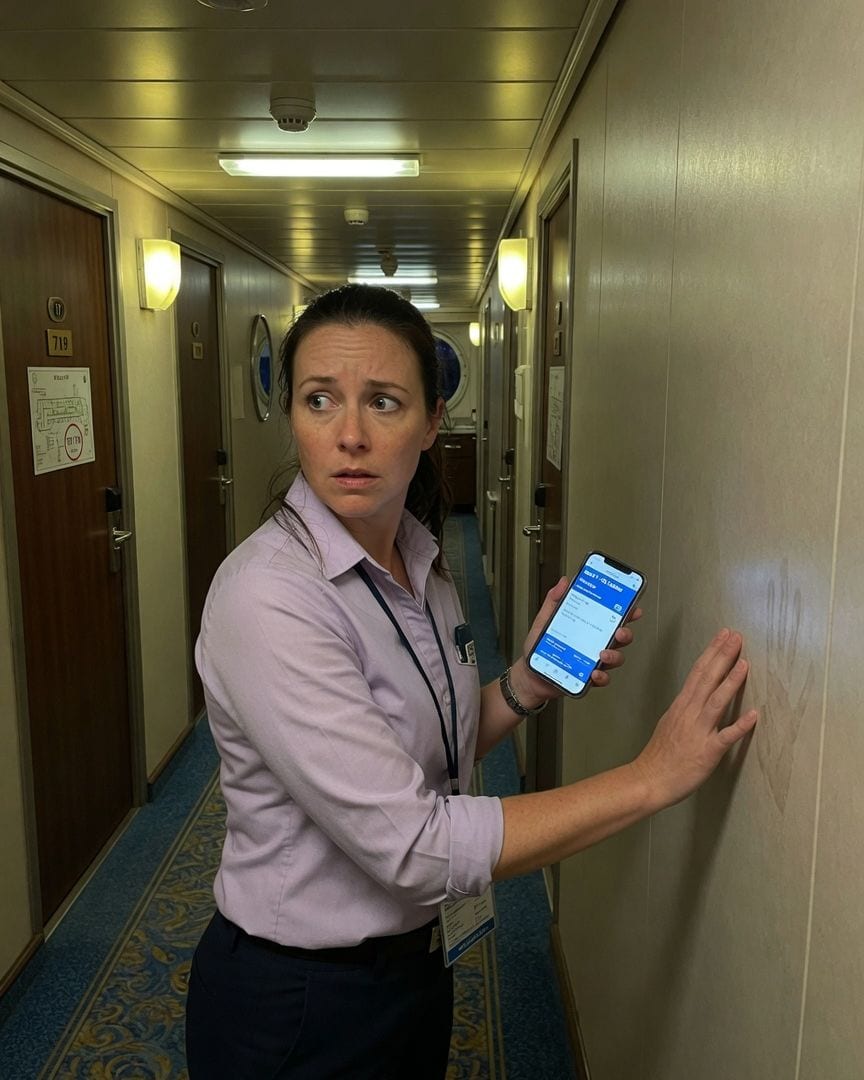
My cruise cabin's evacuation plan shows nineteen doors. I just walked past twenty, with a wet handprint on the twentieth.
On 'The Oceanic Wanderer', I found an extra cabin on Deck 7, complete with a fresh, wet handprint on its frame. The purser denied its existence, and later, the cabin itself vanished, leaving a blank wall. But then I found a damp, ancient map of the deck, tucked under my door, clearly marking the impossible twentieth cabin.
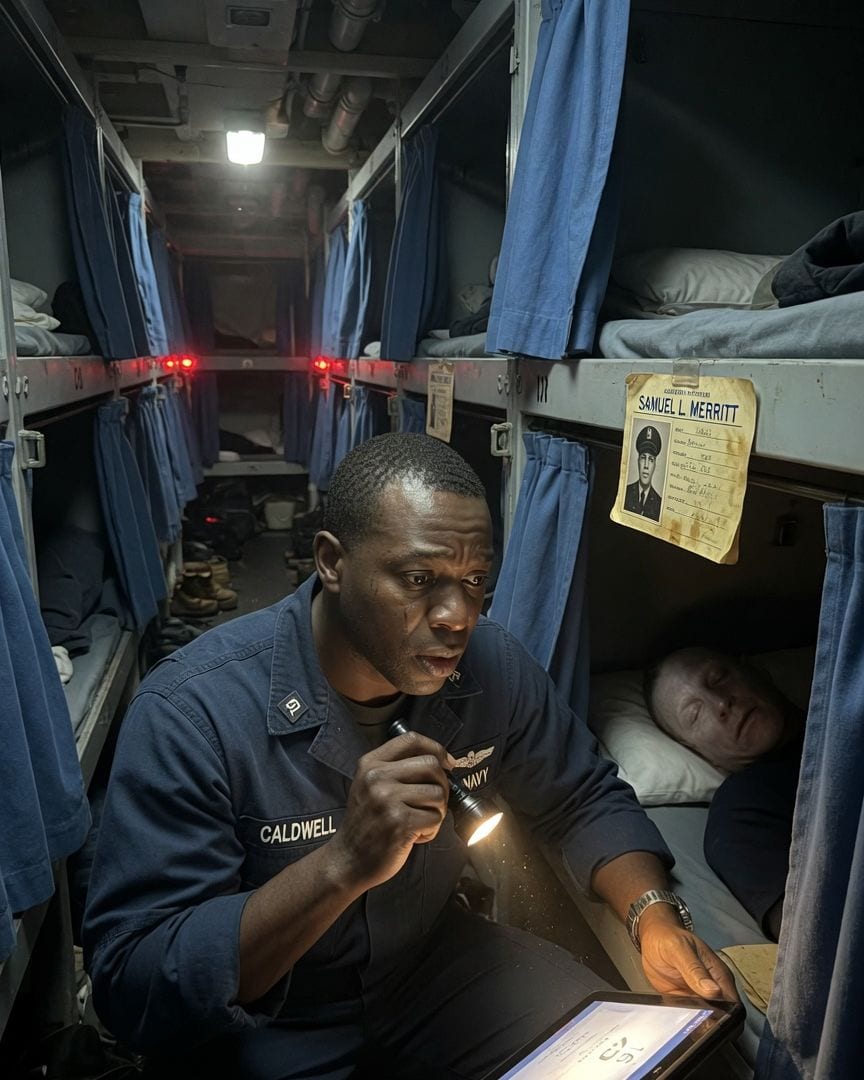
A Petty Officer on the USS Vance counted ninety-two men in a berthing compartment assigned for ninety-one, but one man’s bunk card was ancient and wrong.
Petty Officer Felix Caldwell ran the familiar lights-out muster on the USS Vance, expecting ninety-one men in the berthing compartment. His tally board, however, showed ninety-two. Despite a meticulous re-count with Master-at-Arms Bishop, every rack held a man, every man accounted for – yet the numbers remained one too many. Caldwell's cold certainty led them back to check bunk cards, uncovering one that was yellowed, brittle, and bore a faded, handwritten name: 'SAMUEL L. MERRITT.' The man sleeping in that bunk, whose face matched the ancient photo, then whispered, 'You’re early, Caldwell,' to a stranger.
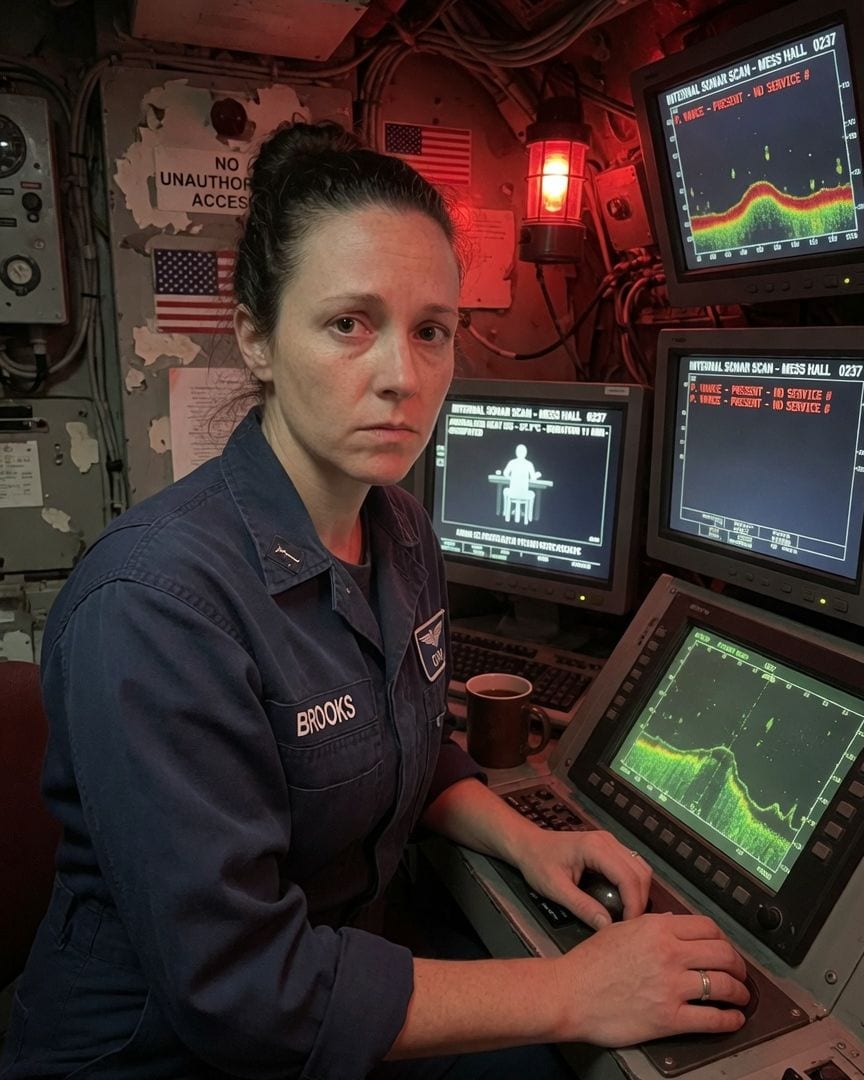
A Chief Petty Officer reviewed her submarine's sonar logs, finding a human heat signature where security cameras saw nothing, then the manifest listed an extra man who couldn't be deleted.
Chief Petty Officer Charlotte Brooks felt the weight of her submarine's impending decommissioning, its long service ending soon after a decade as her home. The quiet hum of the USS *Artemis* was broken when a nervous messcook reported seeing a shadow eating alone in the mess hall, then finding one plate short but a perfectly clean tray. Though skeptical, Charlotte checked the security feeds, which showed nothing, yet her sonar logs revealed a distinct human heat signature in the same spot, then abruptly vanish. Her dread deepened when the boat's manifest confirmed 101 souls instead of 100, listing a mysterious 'P. Vance' with no details, whose entry all systems refused to delete.
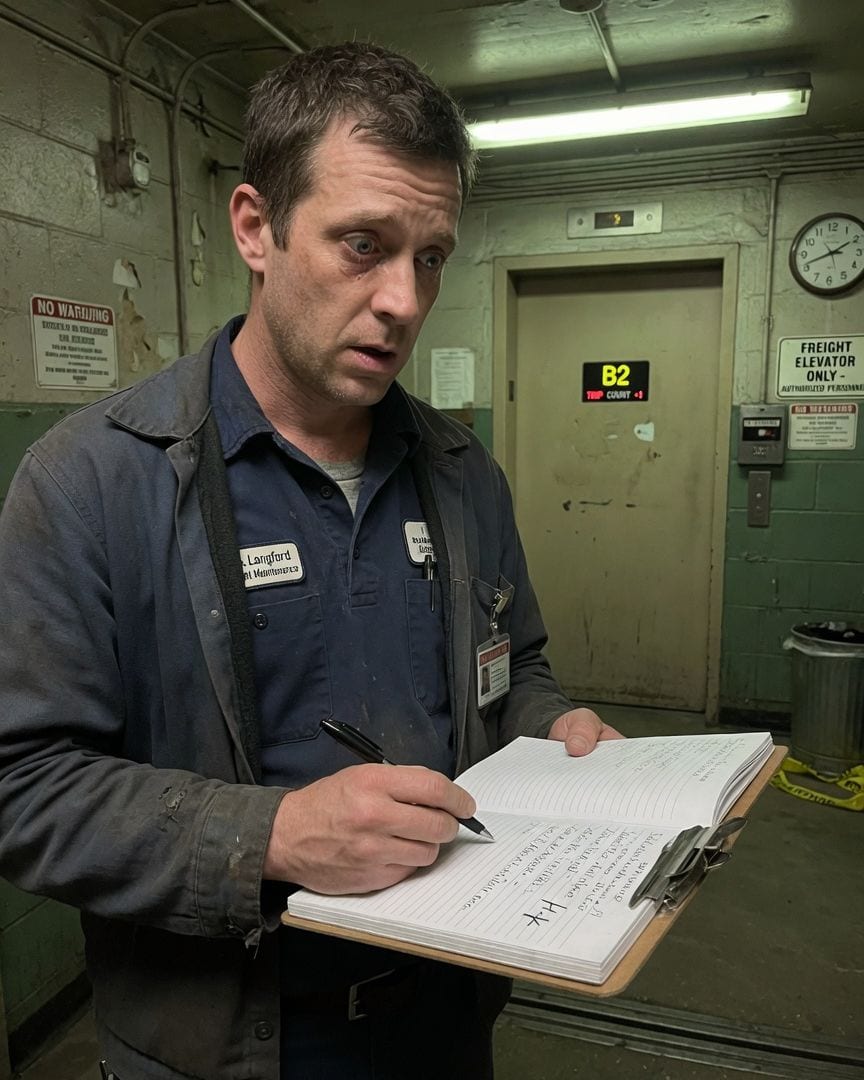
A man just took the elevator to the sealed sub-basement. He isn't on any staff roster, but my initials are in the logbook.
As a maintenance worker, my job is mostly routine, like signing the daily log for the old building's freight elevator. But one night, the log showed a trip to the sub-basement, sealed for a decade, timestamped with my key-switch and signed with my own initials, for a run I never made.
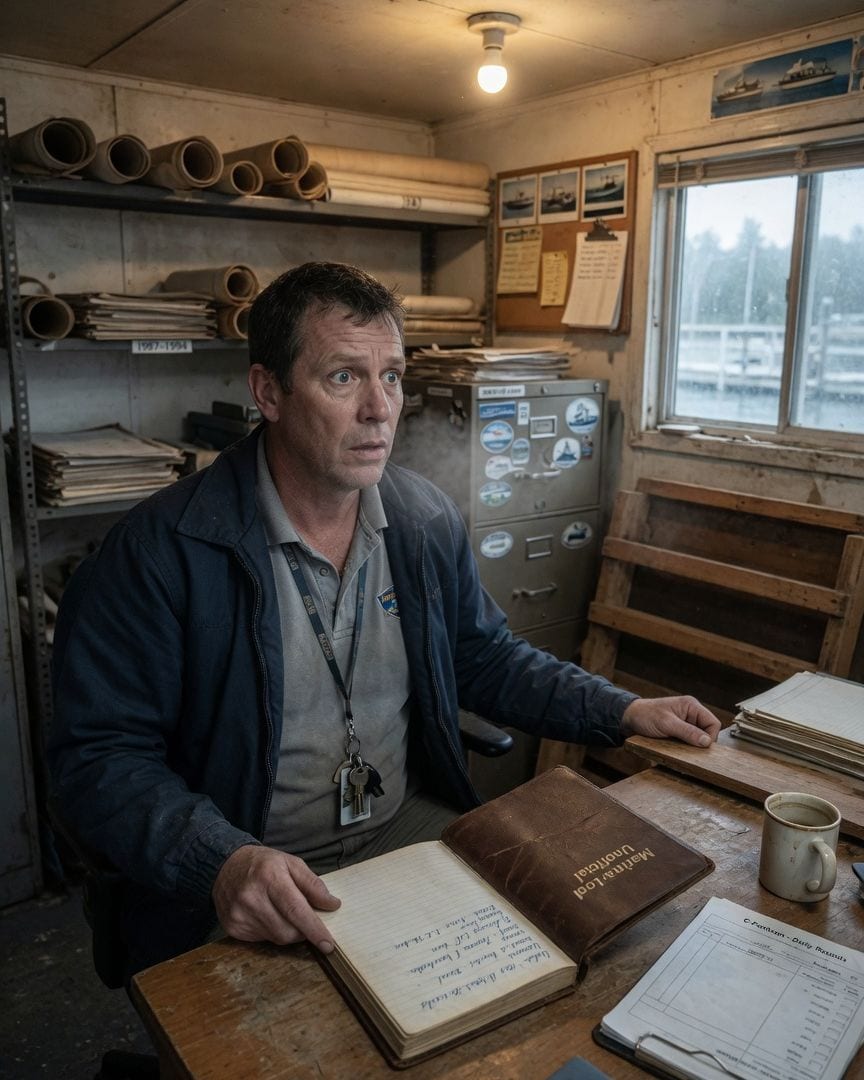
My C-Pontoon goes an extra thirty feet to Berth 61, with a sleek, dark yacht I've never seen. It's drawing power, but doesn't exist on any records.
As harbormaster, my morning rounds are always routine, checking the sixty berths on our C-Pontoon. But one chilly morning, beyond the last numbered post, C-60, I found the pontoon inexplicably extended by another thirty feet. It ended in a new numbered post: Berth 61, a physical fact that simply could not exist.
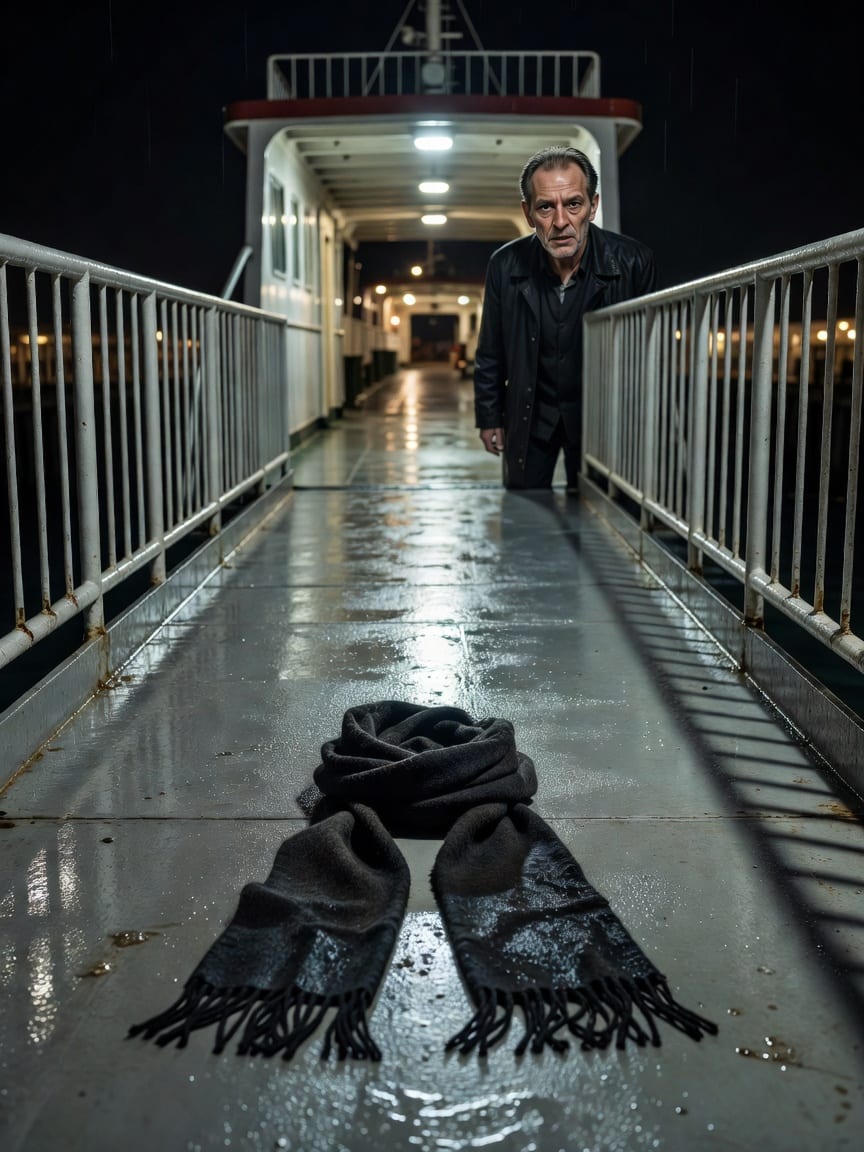
My ferry's night log recorded a foot passenger disembarked at 2:15 AM. We don't sail until six, and I wrote the entry myself.
Working the night shift on the 'Sound Clipper,' I found my own handwriting in the watch log recording an impossible event: a foot passenger disembarking at 2:15 AM. The ferry was tied up, engines cold, and the gangway locked tight. No one could have left, yet the entry was undeniable, signed with my initials.