A Chief Petty Officer reviewed her submarine's sonar logs, finding a human heat signature where security cameras saw nothing, then the manifest listed an extra man who couldn't be deleted.
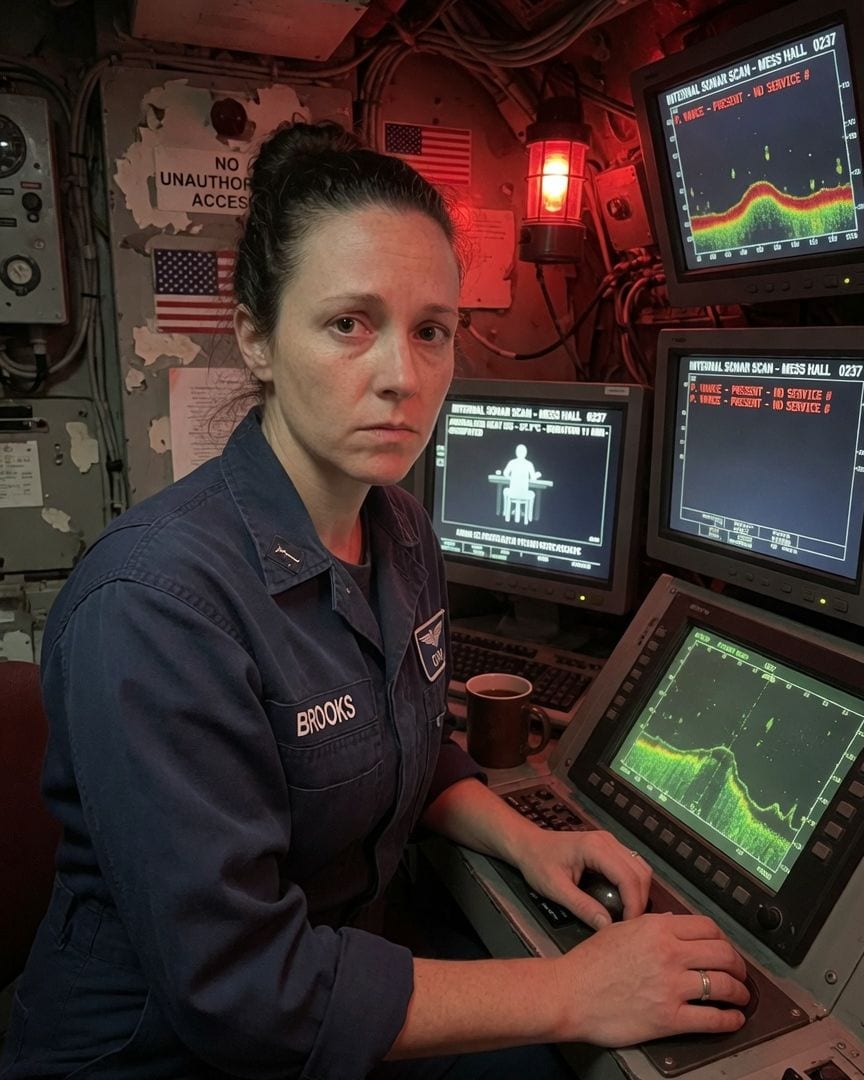
Chief Petty Officer Charlotte Brooks watched the green lines march across her sonar console, the deep-sea quiet broken only by the steady hum of the USS Artemis’s reactor. Below, the abyssal plain unrolled, an undifferentiated canvas of pressure and dark.
Soon, this boat would be decommissioned, its long years of service ending in a breaker’s yard, a quiet end for a machine that had been her home for a decade.
She felt the weight of that ending, a strange blend of nostalgia and the dull ache of a coming shift.
The faint red glow of the sonar room was suddenly interrupted by a nervous shadow. Torpedoman Bysshe, a young messcook new to the Artemis, stood hunched in the doorway, his face pale and drawn.
He looked like he’d seen a ghost, his eyes wide and unfocused.
“CPO Brooks,” Bysshe began, his voice barely a whisper, “I… I think I messed up.”
Charlotte turned, her expression calm. “Spit it out, Bysshe. What’s wrong?”
He fidgeted, clasping his hands. “Mid-rats. I stowed the spare rack in berthing, you know, for some gear. Broke the rule. And then… in the mess, I came up one plate short.” He swallowed hard.
“But the boat’s manifest… it shows one man too many.”
Charlotte’s brow furrowed. “A miscount, Bysshe. Happens. You’re tired.”
“No, ma’am,” he insisted, his voice cracking. “I saw him. A man. Just a shadow at the end of the table, eating alone.
And when I came back to clear, the plate was gone, but the tray… it was perfectly clean. Like no one had ever eaten off it.”
He looked at Charlotte with an unnerving desperation, as if waiting for her to see the impossible thing he had seen. The Artemis was a machine of absolute accountability. Every rivet, every man, every ration was meticulously logged.
An extra man was not merely an error; it was an impossibility.
Despite her skepticism, Charlotte felt a flicker of unease. Bysshe was new, prone to nerves, but his conviction was unsettling. Unauthorized personnel, even if imaginary, was a serious breach.
“Alright, Bysshe,” she said, her voice betraying none of her internal disquiet. “Go get some rest. I’ll run a quick check.”
She watched him shuffle away, his shoulders slumped. The reactor’s hum suddenly felt less like comfort and more like a low, persistent thrum of something trying to resolve an impossible equation.
Charlotte began her investigation with the most obvious culprits. She pulled up the interior security camera feeds for the mess hall, rewinding to the mid-rats shift.
The grainy infrared footage showed only Bysshe, moving methodically through his duties, cleaning tables, stacking trays. No shadows, no extra figures, no one eating alone. Just empty tables and the messcook’s solitary figure.
“Fatigue,” she muttered to herself, echoing her earlier diagnosis. “Or a prank.”
But a persistent prickle of doubt lingered. If Bysshe had miscounted, the system would have flagged it immediately. If it was a prank, who was involved, and how had they made themselves invisible to the cameras?
She decided to check the sonar logs next, a routine scan for any unexpected internal movement or structural anomalies.
The Artemis was old, prone to minor shifts, and the sonar system was designed to pick up every vibration, every displacement, every tiny, anomalous echo within the hull.
Charlotte navigated through the complex menu, pulling up the internal scan data for the mess hall during the precise timeframe Bysshe had given. The screen flickered, refreshing the data.
For a moment, it showed nothing out of the ordinary, just the familiar, low-level thermal output of the boat’s systems, the occasional scurrying of a crewman.
Then, a faint, anomalous reading appeared. A heat signature, consistent with a human form, registered in the mess hall. It wasn’t a hot pipe, or an electrical conduit, but a distinct, human-shaped anomaly.
It was positioned at one of the tables, precisely where Bysshe had claimed to see the shadow. The signature remained stationary for a period, a small, warm presence against the cooler background of the steel bulkheads.
Then, as abruptly as it had appeared, it dissipated. The sonar system, designed to detect every anomaly, every shift, had logged it as a presence, then a sudden absence, leaving no physical trace. It wasn't a glitch.
The system had recorded something.
Charlotte’s breath caught in her throat. The cold, logical readout on her screen was now a corroboration of Bysshe’s impossible story.
She tried to reconcile the sonar anomaly with the official records, to force the two impossible facts into alignment.
She pulled up the digital crew manifest for the current patrol, cross-referencing it with the physical manifest kept in Commander Galloway’s office.
Then she checked the boat’s internal personnel tracking system, a web of sensors and transponders designed to pinpoint every soul on board at all times.
Every system, without fail, reported 101 souls on board. Not the expected 100.
And one of them, a name she didn't recognize – 'P. Vance' – had no service number, no bunk assignment, and no duty station. Yet, his status was definitively listed as 'Present.'
She stared at the screen, her fingers hovering over the glowing controls. When she moved her cursor to the entry, the delete function on her screen greyed out, displaying a single, chilling error message: 'system integrity.'
Charlotte tried to report the impossible ‘P. Vance’ entry to Commander Galloway, but he merely waved a dismissive hand. “A clerical error, Brooks,” he said, barely looking up from his stack of reports. “Correct the manifest.
We sail with a hundred souls, not one more, not one less.”
But when Charlotte returned to her console and tried to delete the entry, the system rejected it. A new message flashed: ‘active presence detection.’
The boat’s internal sensors, the same ones that had picked up the phantom heat signature, insisted that P. Vance was still aboard. The ship’s cold, hard logic refused to let her override the impossible.
A deep, unsettling hum began to resonate in the boat, not from the reactor, but from the very steel of the hull, an almost imperceptible vibration that Charlotte felt in her teeth. She found herself hyper-aware, noticing minor discrepancies everywhere.
There was a locker in the enlisted berthing, marked ‘Vance’ in the digital system. She’d checked it several times.
It was always perfectly clean, even after a full week of patrol, smelling faintly of ozone, a contrast to the usual locker room funk.
She started asking other crew members, subtly at first, about strange occurrences in the mess hall or berthing. Most dismissed it, but a few mentioned fleeting shadows caught in peripheral vision, a persistent sense of being watched during quiet shifts.
Ensign Thatcher, a junior officer usually focused on navigation, grumbled about inexplicable equipment malfunctions – a comms panel that briefly went dead, a navigation readout that flickered – always seeming to coincide with the times ‘P. Vance’ had been detected by Charlotte’s sonar.
The unease began to spread quietly through the boat, a silent hum beneath the reactor’s thrum, a dissonance in the rigid order of naval life.
Charlotte’s investigation became less subtle, her probing questions raising eyebrows among the crew. She started leaving small, deliberate markers. A loose thread, pulled from her uniform, she carefully looped around the handle of the ‘Vance’ locker.
On a mess hall console, she adjusted a dial to a specific, non-standard setting, a tiny shift in its perfect zero. Each time she checked, the thread was gone, the dial reset to its precise, perfect zero.
It was as if someone – or something – was meticulously correcting every deviation from its internal order.
One late night, alone in the sonar room, reviewing an archived log of anomalous readings, the comms system crackled.
It wasn’t a voice, just a low, almost infrasonic hum, a vibration that seemed to resonate directly with her thoughts about ‘P. Vance,’ a physical pressure in the air around her.
The bulkheads themselves seemed to groan, a subtle shift in the boat’s internal structure, a sound that seemed to be listening.
She felt an unmistakable chill, a distinct sense of being observed, not by a person, but by the boat itself, its vast, metallic bulk suddenly feeling alive, watchful.
A few days later, Ensign Thatcher, looking unnerved, approached her. His usual composure had vanished, replaced by a jittery agitation. “Brooks,” he began, his voice barely steady. “I think… I saw him.”
Charlotte waited, her gaze steady.
“Vance,” Thatcher clarified, running a hand over his face. “On the mess deck, mid-rats. Just a fleeting figure at the edge of my vision. You know, like when your eyes play tricks?” He paused, searching her face for confirmation.
“But then, when I turned to look, he was gone. And my watch…” Thatcher held up his wrist, a brand-new digital model. It was stopped dead, perfectly at 0405.
Armed with Ensign Thatcher’s unsettling testimony and the system’s persistent, absolute refusal to delete ‘P. Vance,’ Charlotte confronted Commander Galloway again. His usual dismissal faltered in the face of her calm, factual presentation, the cold data laid bare.
The sonar logs, the personnel tracker, Thatcher’s dead watch — they all pointed to the same impossible conclusion.
With a weary sigh, Galloway finally relented. He moved to a secure compartment in his desk, his movements slow and heavy. He pulled out a heavily redacted, classified report.
It wasn’t a service record, but a ‘Boat’s Operational Anomaly Log’ from an earlier USS Artemis patrol, dated decades ago. Charlotte watched as he opened the aged document, the brittle pages creaking faintly.
The report detailed similar inexplicable crew counts, phantom readings, and an ‘extra’ crew member listed, also as ‘P. Vance,’ after a similar violation of an old superstition concerning the boat’s racks and mess.
“This boat,” Galloway explained, his voice low, almost a whisper, “has always been… particular.”
The report concluded it was a ‘systemic integrity anomaly,’ an ‘unexplained persistent manifestation of crew accountability.’
“It’s not a ghost, Brooks,” Galloway said, meeting her eyes, his own filled with a profound weariness. “Not in the way you’re thinking. It’s the boat’s own system. So meticulously engineered for perfect accountability, for absolute balance.
When an ancient rule is broken, when a count is off, it attempts to balance its books. It creates a perfect, phantom crewman to maintain its absolute numerical balance.”
He paused, looking around the sonar room, as if the boat itself might be listening. “The ‘extra plate’ and ‘even racks’ rules? They weren’t just superstition, Charlotte. They were safeguards. Against the boat’s own logic.”
Charlotte stared at the old report, the name ‘P. Vance’ appearing across multiple patrols of the Artemis, always manifesting after a specific rule or count was broken.
The report detailed the ‘accountability that cannot be,’ how the boat itself manifested the missing count to maintain its impossible integrity. The cold, mechanical logic of it was more terrifying than any ghost story.
Then, a new detail caught her eye.
A footnote, almost entirely blacked out by redaction, mentioned a specific crew member who had an ‘unusually high integrity index’ and whose presence on board seemed to ‘stabilize’ the anomaly, preventing its more disruptive manifestations.
The black ink on the page seemed to shimmer under the low lights of the sonar room, refusing to quite obscure the truth.
The name, barely legible through the redaction, looked disturbingly familiar. She traced the faint, smudged letters with her finger, her blood running cold. It was her own surname: ‘Brooks.’
And then, a date: 1985, a patrol where her own father, a Navy diver, served on an earlier USS Artemis.
Below that, a more recent, faint entry, almost like an error correction, next to her own service number, marked ‘Stabilizing Presence.’
She was not just observing the anomaly; the boat’s own system had registered her as a key part of its impossible, self-correcting mechanism, an anchor in its terrifying, relentless pursuit of perfect order.
The air in the room suddenly grew heavy, pressing in on her, and the persistent hum of the boat shifted, almost imperceptibly, as if acknowledging her discovery.
Charlotte confronted Galloway one last time, the old report clutched in her hand. The boat’s logic, its terrible, perfect coherence, had settled over her like the weight of the deep ocean.
He explained, with a weary resignation, that the Artemis had a unique ‘signature’ – a hyper-efficient accountability system that, when a profound breach of tradition or order occurred, created a crew member to maintain its perfect numerical balance.
‘P. Vance’ was the boat's ghost of perfect order, an entity born of its own rigorous systems.
The ‘Brooks’ entry, Galloway explained, referred to a family line known for their rigid adherence to naval procedure and deep integration into the boat’s ‘spirit.’
Her father, and now Charlotte herself, were seen by the boat’s system as ‘anchors,’ individuals whose presence helped to prevent the more disruptive manifestations of ‘P. Vance.’ The boat wasn’t haunted; it was self-correcting in a terrifying, systemic way.
The stowed rack, the missing plate – these weren’t just superstitions; they were rules that, when broken, forced the Artemis to generate its own impossible crew member to maintain its internal, perfect count.
The dread was in the coherence; it all fit, a perfect, terrifying logic.
Charlotte understood the full scope of it. The boat wasn't just counting 'P. Vance'; it was integrating him.
The sonar pings, always logging a presence; the locker, always perfectly clean, smelling faintly of ozone; the fleeting shadows and persistent feeling of being watched – these were all manifestations of the boat’s desperate attempt to make its phantom real, to complete its impossible account.
Every trace, every anomaly, was the boat solidifying its fiction.
She realized she couldn’t fight it, couldn’t make it go away. Her role, as a ‘stabilizing presence,’ was to simply exist within the system, to keep the boat’s impossible count from spiraling into something worse.
She was a living counterweight in the Artemis’s terrifying, self-regulating mechanism. The USS Artemis was going to be decommissioned soon. What then? What happened to ‘P. Vance’?
Did the anomaly transfer to another vessel, another set of systems, to continue its impossible accounting?
Did it simply cease to exist, or did it become a ghost of a ghost, a perfect account with no boat to balance, drifting in the vast, networked data streams of the Navy?
Charlotte was being transferred to shore duty, leaving the Artemis in a few days. Her escape wasn’t freedom; it was simply leaving the problem behind, knowing it still existed, a piece of impossible, perfect logic adrift in the naval system.
The dread was in the knowing, in the certainty that the boat’s perfect, impossible system would continue, perhaps in a new form, perhaps as a silent, unacknowledged burden on the next ‘Brooks’ to sail.
The cold, metallic thrum of the ship against the water suddenly felt like a heartbeat, relentless and indifferent.
The USS Artemis completed its final patrol. Charlotte Brooks transferred to shore duty, her service record unblemished, her demeanor unchanged to outside eyes.
Torpedoman Bysshe was quietly reassigned to a training vessel, his face still pale, his eyes still holding a haunted look. The decommissioning process for the Artemis began, piece by piece, its systems dismantled, its hull cut apart.
No one openly spoke of ‘P. Vance’ again, but the messcooks on other boats sometimes whispered about setting an extra plate, just in case, their voices hushed in the galley.
Charlotte sat in her new office, hundreds of miles from the ocean, the sterile hum of a data center replacing the reactor’s thrum. She reviewed manifests for a new supply assignment, a routine task of perfect accountability.
Everything was by the book, every item, every person, perfectly accounted for, a familiar comfort in its absolute order. She ran a final check on a supply manifest, the system whirring, confirming her meticulous work.
The screen pinged. A small, almost imperceptible icon appeared next to the total headcount, at the bottom right of the display. It was a tiny, stylized silhouette of a single, additional crewman, marked simply, ‘Integrity Verified.’
If this one got to you
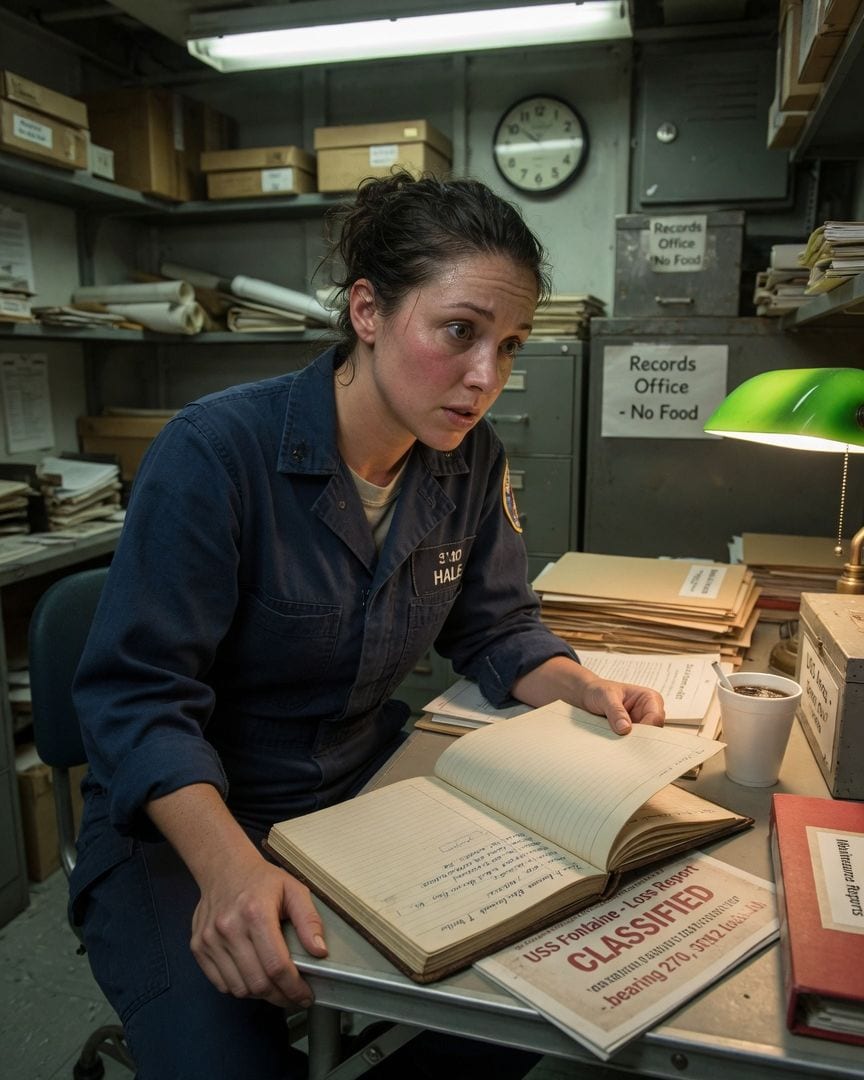
Petty Officer Hale needs a spotless record for her transfer. But the USS Ares sonar logs show an identical, impossible contact, logged to the minute, years apart, and tied to a classified loss report.
Petty Officer Sarah Hale needed a spotless record for her coveted shore duty transfer, a posting she'd worked five years to secure. Alone in the USS Ares sonar shack, three days out from San Diego, her midwatch was broken by an impossible contact: a close, slow echo holding perfect pace, invisible to radar, then vanishing. Her heart hammered, not from fear, but from the data's impossibility. When she found an identical entry in her own log from just one week prior, the cold dread tightened its grip. But the true chill settled when she unearthed decades of similar records, signed by other sonar officers, all showing the same impossible contact at 0212, off the port beam, for nineteen minutes, on the same ship, stretching back years—a persistent echo tied to a classified loss report.
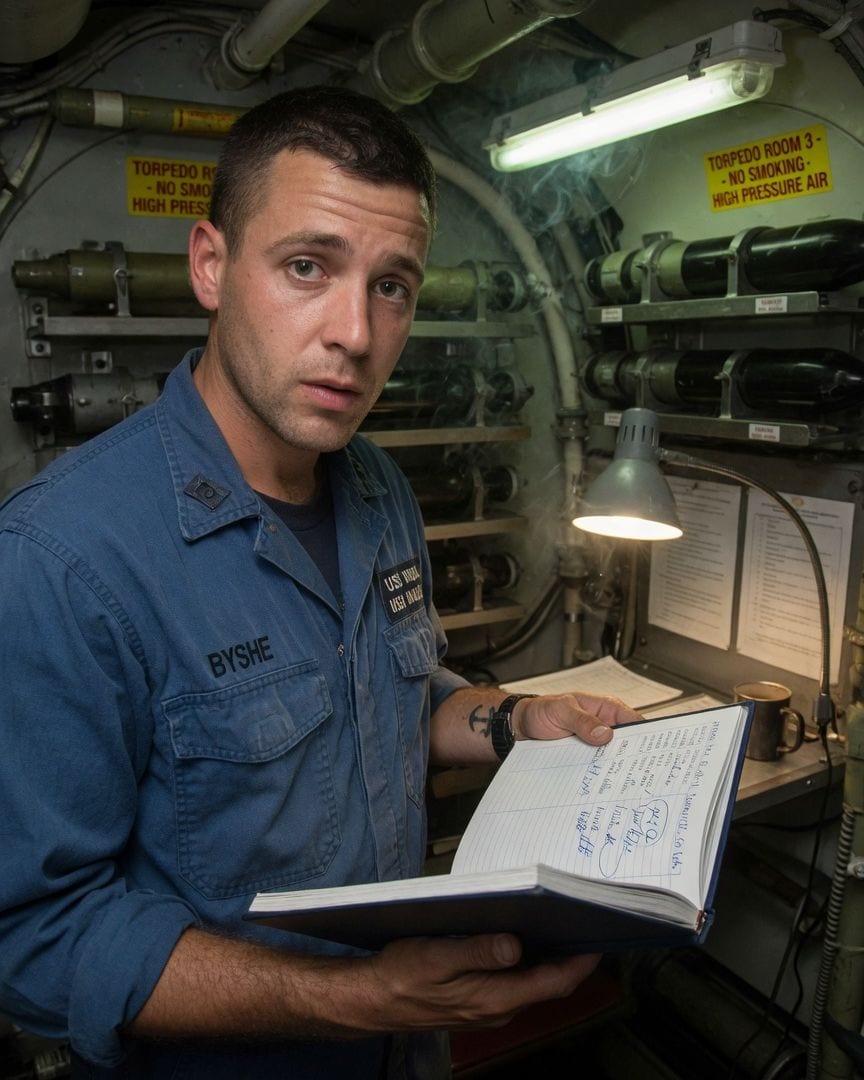
A torpedoman found his own signature in the USS Vanguard's duty log for a watch he never stood, beside a name not on the master crew manifest.
Torpedoman Oscar Bysshe, a rational sailor on his first deep patrol aboard the USS Vanguard, dismissed the messcook's nervous claim of an extra man at the table. He attributed the perfectly clean, untouched tray left behind to a prank. But later, during a routine systems check, Bysshe discovered his own familiar signature in the official duty logbook, for a watch he had been asleep through. Beside it was a name he didn't recognize, a name that shouldn't be there. A frantic check of the master crew manifest confirmed the impossible: the name appeared in the 'temporary assignments' section, dated just yesterday, scrawled in a hand eerily similar to his own.
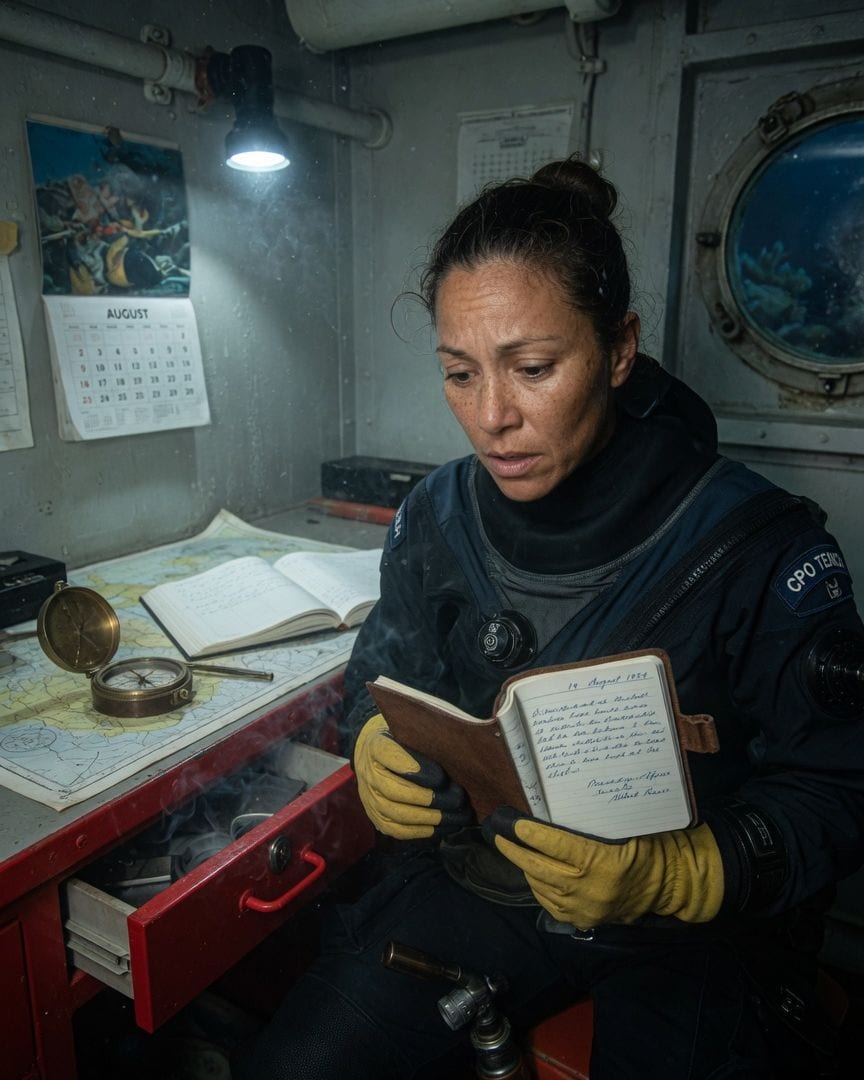
A deep-sea diver found a Cold War target ship's logbook dated months after it was vaporized in 1954.
Chief Petty Officer Marlo Tench, a methodical deep-sea diver, stared in disbelief at the ROV feed. Her team watched with her as the USS Triton, a target ship from the 1954 Castle Bravo nuclear test, appeared pristine and upright ninety feet below. It was supposed to have been vaporized, yet its hull number was unmistakable, its paint unburned, and its internal systems inexplicably active. Descending into the eerie silence, Marlo found a logbook dated five months after the ship’s destruction, and a journal entry naming a crewman officially listed as 'unmanned target.' What impossible force kept the Triton a living ghost decades after its fiery end?
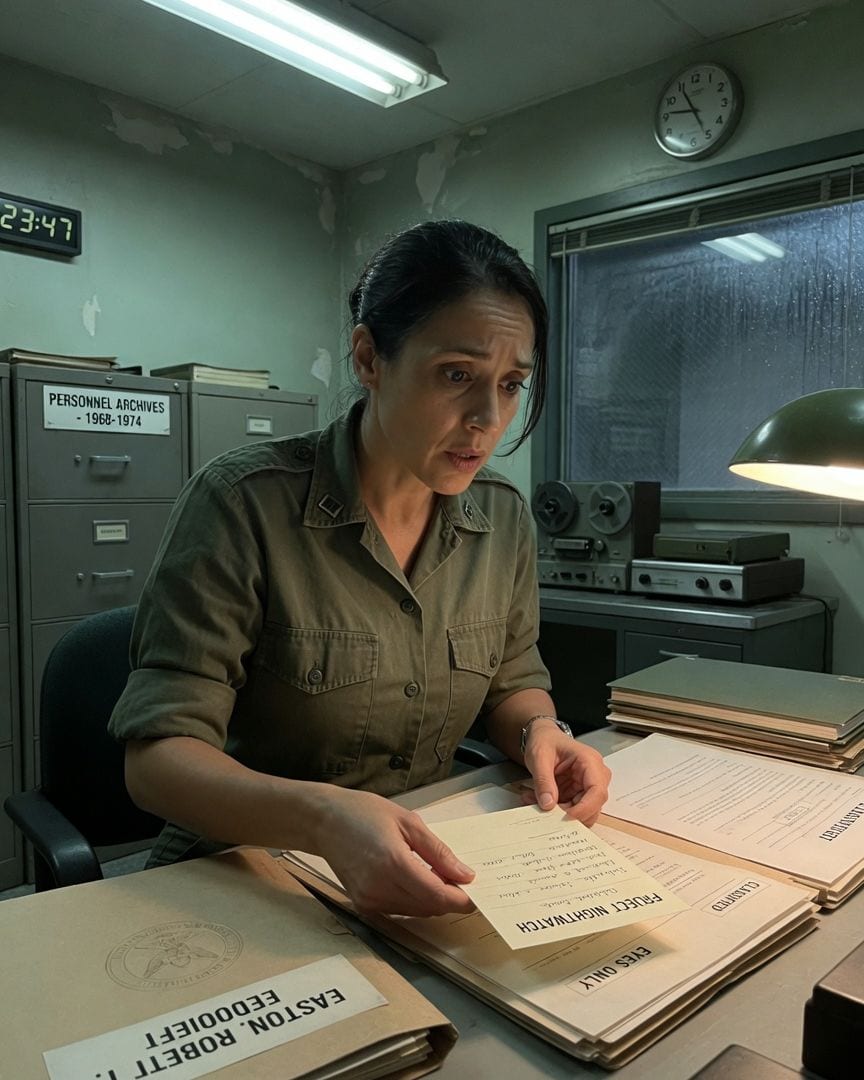
A Cold War tower controller logs an object vanish from radar, then hears the pilot scream it’s filling his windscreen. Her own name, 'Bardolph, Ines', now marked 'Observed' in a secret file.
Captain Ines Bardolph, a tower controller, was counting down the months until her transfer to Langley and the decommissioning of her base, hoping to leave behind the unsettling incidents of her final posting. But one night, her radar scope showed an impossible blip, solid and unwavering, 40 miles north of the Danube, only to vanish in less than a second, leaving a pilot screaming in terror. Despite the clear evidence, the official report blamed "atmospheric inversions," while the terrified pilot received a glowing review and promotion, his file meticulously scrubbed of any anomaly. As Captain Bardolph reviewed the pilot's pristine record, she found a hidden slip of paper, revealing a chilling truth: 'Subject: Bardolph, Ines. Status: Observed.' Was she merely an observer of the impossible, or was she now part of something far more sinister?
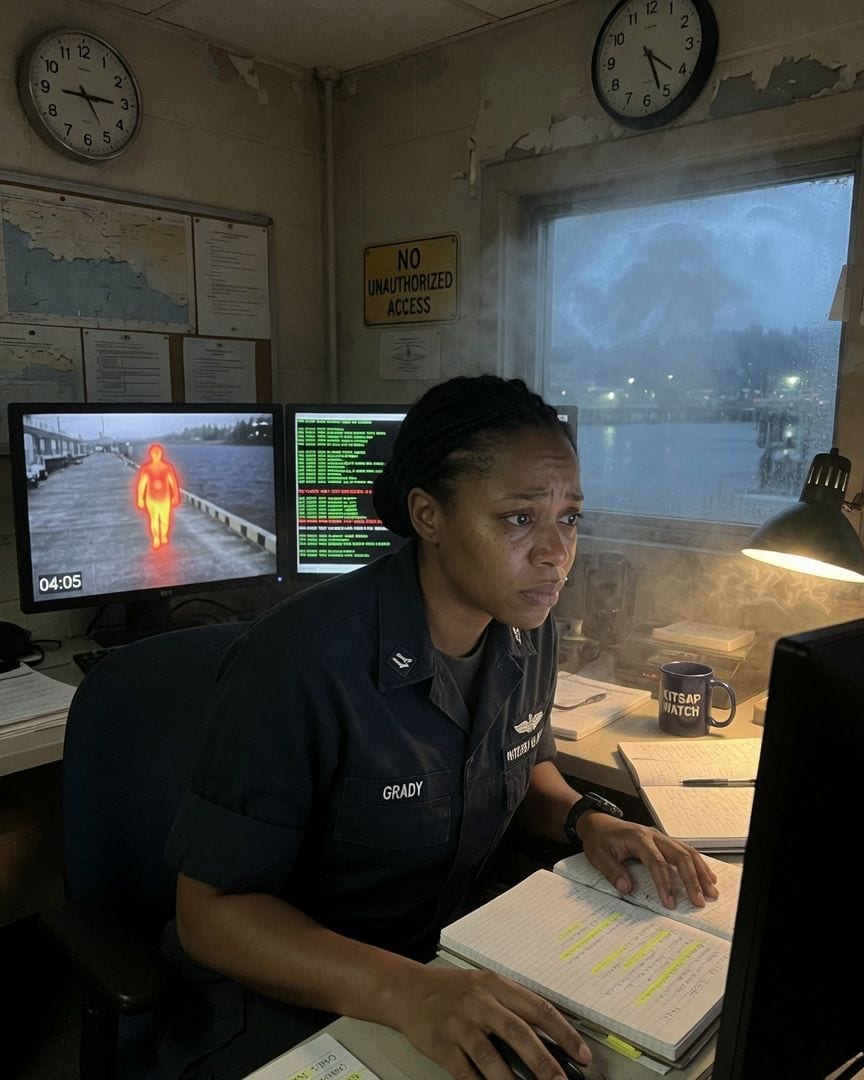
Petty Officer Olivia Grady found the base system logging impossible access at 0405. Every night for years, a blank ID walks Pier 7.
Petty Officer Olivia Grady stood her predawn watch on Pier 7, the cold mist of Puget Sound a familiar companion. Her routine scan of monitors at 0405 was shattered when an IR sensor flared with a man-sized heat bloom moving along the pier. Yet the camera feed showed only empty concrete and swirling mist. When historical logs confirmed the invisible presence had walked that exact path every night for years, Olivia dug deeper. She found a ghost "access log" entry with a unique ID but no name attached, meticulously aligned with the 0405 bloom. What impossible entity was the base system logging, night after night?
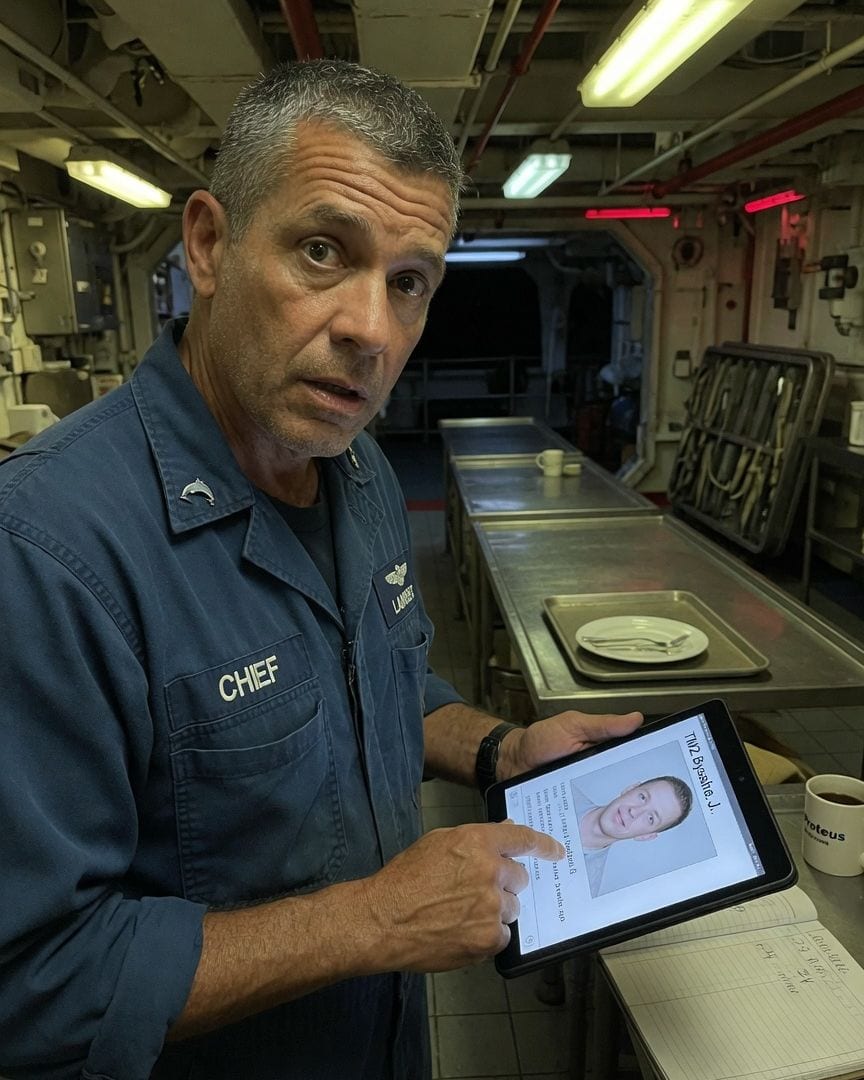
Chief Maxwell Lambert, on his final patrol, found his own signature approving a transfer for a sailor he'd never met.
Chief Maxwell Lambert was nearing the end of his final deep-sea patrol on the USS Proteus, looking forward to shore duty. The familiar hum of the boat and the clatter of the mess hall usually brought comfort, marking each day closer to home. One night, a young messcook reported a strange discrepancy: one plate short, but one man over on chow. Chief Lambert himself then saw a silent, unfamiliar figure eating alone in the shadows of the mess hall, a man who vanished into the passageway without a trace. Later, checking personnel logs, he found every man accounted for. Yet, his own signature approved a transfer for Torpedoman Bysshe—a sailor he had no memory of meeting, whose file photo was unsettlingly generic. How could his official record swear to a man he knew had never served on his boat?