My signature's on the scaffold accident report, dated the morning it fell. I'm an accountant. I've never touched a hard hat.
The fluorescent lights of the construction firm’s temporary office hummed, a low, irritating thrum against the dull roar of traffic outside.
It was a stark, almost brutal contrast to the quiet precision of my usual world, spreadsheets and ledgers, not hard hats and concrete. Simon Hughes, the foreman, a burly man with a perpetual five o’clock shadow, didn't bother with pleasantries.
He just slid a laminated sheet across the table, the plastic catching the harsh light.
"Safety induction," he grunted, his finger, thick and calloused, tapping the page. "Fourth signature down. That's the one we need to confirm."
My breath hitched. My printed name, Iris Beaumont, was undeniably there. Right next to it, my signature, the familiar, precise loop of the ‘I’, the distinctive, deliberate cross of the ‘t’. It was mine. My hand, my style.
And it was dated this morning. The morning the scaffold came down. The morning three men fell, one of them badly hurt.
"That hard-hat number," Hughes continued, oblivious to the sudden clamor in my chest, "was issued to the man who was hurt. We just need to confirm all the paperwork was in order for the investigation."
I’m an accountant. I’ve never set foot on a construction site in my life. The paper felt cold, heavy in my hands, insisting on a truth that was utterly, physically impossible.
Yet, there it was, an artifact of my presence where I absolutely wasn't. My mind reeled, grasping for a rational explanation. A mistake. A mix-up. A prank. But the ink was too precise, the detail too specific.
It was me, on a document, dated the morning of an accident, a place I had never been.
I spent the next few days in a haze of disbelief, the impossible signature a constant, gnawing presence at the back of my mind. I tried to rationalize it away: a clerical error, a lazy clerk forging a common name.
I even considered a sophisticated prank, though the sheer scale and timing made it unlikely. But the image of that signature, my signature, stubbornly refused to dissolve.
So, I called Ruth Crane. Ruth was a retired handwriting expert, a family friend who’d authenticated wills and settled countless estate disputes in her time. She was precise, meticulous, and utterly devoid of hyperbole.
I scanned the safety sheet, email it to her, and tried to keep my voice steady as I explained the situation.
A day later, Ruth called back. Her voice, usually so calm and measured, held a ting of professional curiosity that sent a fresh wave of dread through me. "Iris, my dear," she began, "I've gone over it twice.
Even compared it to samples you sent me for the family trust a few years back." There was a pause. "It’s undeniably yours. No sign of forgery. No tremor, no hesitation, no mimicry. It's a perfect match."
The words hit me like a physical blow. It was me. But how? My mind raced, grabbing at loose threads, trying to weave them into something coherent.
I remembered a brief, nagging annoyance months ago: a package for 'I. Beaumont' marked 'delivered' by a courier, but never appearing on my doorstep. I'd written it off as a simple error, a lost parcel. A minor inconvenience.
Now, the memory twisted. Was that connected? The signature, the missing package, the impossible presence – a thread, fragile but insistent, began to pull at the edges of my rational world, threatening to unravel it entirely.
I knew then that I needed to find more. Anything else, however mundane, that could explain this impossible reality.
Driven by a cold, persistent dread, I requested any other documents bearing my name from the construction firm, citing "an administrative discrepancy." It was a vague, formal phrase that I hoped would raise no flags.
A week later, a thick, manila envelope arrived on my desk, heavy with the oppressive weight of officialdom. The paper rustled ominously as I tore it open. Inside, amidst boilerplate contracts and old invoices I'd never seen, I found it.
A 'Site Access Log' from a completely different project. It was dated a year ago, for a development three hours away in a town called Oakhaven, a place I’d never even heard of, let alone visited.
My printed name, 'Iris Beaumont,' was there. And next to it, another signature, identical in every loop and cross to the one on the safety sheet.
But beneath that second signature, tiny, almost invisible, handwritten in a faded green ink, were two words: 'Awaiting transfer.'
The note 'Awaiting transfer' gnawed at me like a persistent parasite. My mind cycled through possibilities – a joke, a bizarre clerical error, a form of identity theft I couldn't comprehend.
Ignoring the mounting anxiety that felt like a tightening band around my chest, I took a day off.
I typed 'Oakhaven' into my GPS and drove, three hours through winding country roads, until the neat suburbs gave way to empty fields and industrial rust.
The address on the Site Access Log led to a sprawling, abandoned lot, overgrown with weeds, a skeletal crane rusting against a grey sky. The project had clearly failed.
A hollow wind whistled through the half-built structures, and the entire place felt desolate, forgotten. I walked the perimeter, feeling a prickle of unease, then searched for any lingering businesses that might remember the site.
A dusty hardware and supply store, its paint peeling like sunburned skin, still stood on the edge of town. A bell jingled mournfully as I pushed open the door.
The owner, an old man with thick spectacles perched on his nose, squinted at me from behind a counter cluttered with bolts and paint cans.
"That old project?" he rasped, his voice gravelly. "Yeah, I remember. Lotta deliveries went out there. Went bust, shame."
I showed him a printed copy of the Site Access Log. He took it, his gnarled fingers tracing the lines, and nodded slowly. "Aye, I remember a woman. An accountant maybe, always very quiet. Signed for things, she did.
Structural steel, mostly. Concrete pours." He rummaged beneath the counter, pulling out a thick, leather-bound ledger. Its pages were brittle and yellowed. Flipping through them with surprising speed, he stopped on an entry. "Here. Iris Beaumont.
Look, that’s her signature, right? Dated the same day as your log. Must've been some big order, this one."
My own hand, signing for tons of steel I'd never seen, ordered months before the missing package, a year before the scaffold accident. The owner paused, tapping his chin.
"Funny thing," he mused, "that woman always wore a red scarf, even in summer. Bright red. Stood out, you know?"
I had never owned a red scarf in my life. The ordinary explanations I’d been clinging to were dissolving like smoke, leaving nothing but an impossible, terrifying truth in their wake.
My reality was fracturing, and I was watching it happen.
Back in my own city, the feeling of being watched intensified. It started subtly: a dark sedan, nondescript and utterly forgettable, appearing in my rearview mirror on my commute. Just a flash, a hint.
Then it was there again, parked down my quiet street that evening, half a block from my apartment, its windows tinted. It wasn't menacing, not exactly, just… present. A subtle, cold pressure, like a breath on my neck.
I tried to dismiss it, to tell myself it was just coincidence, the paranoia of a mind stretched thin. But the sedan was there the next evening too.
Then came the email. From an unknown sender, with no subject line. My stomach dropped as I clicked it open. The body contained only three words: 'Some records are best left unread.'
It wasn't a threat, not exactly, but a calm, unsettling statement of knowledge. Someone knew I was digging. Someone knew about the records, about the impossible signatures and the 'Awaiting transfer' note.
My fingers trembled as I deleted it, but the words echoed in my mind, a cold, clear warning.
The sedan was gone the next morning, vanished as if it had never been, but the sense of observation lingered, a cold, heavy hand on my shoulder.
I was no longer just investigating a wrongness; I was being acknowledged by it. The ground beneath my feet felt less solid with every passing hour.
I knew, with a certainty that chilled me to the bone, that I had to push harder, to find the source of this impossible truth, before the quiet observation turned into something more active, more personal.
I cornered Simon Hughes again, this time armed with the Site Access Log from Oakhaven and the delivery receipt for the structural steel, both bearing my undeniable signature.
I laid them out on his cluttered desk, pushing them toward him without a word. His usual bluster faded, replaced by a pale, drawn look. He looked genuinely uncomfortable, his eyes darting between my face and the damning documents.
"Look, Ms. Beaumont," he mumbled, pushing a hand through his thinning hair. "This is… delicate. Above my pay grade, honestly. There's an archival department. Handles… historical resource allocation. They’re the ones who deal with this kind of thing."
He fumbled for a pen, scribbled an address on a crumpled napkin – a nondescript building on the industrial edge of town, tucked away behind a row of crumbling warehouses.
I drove there immediately. Inside, the air was thick with the smell of dust and old paper, a musty, forgotten scent that clung to my clothes as I walked.
Theodore Davenport, an ancient man with wispy white hair combed neatly over a bald spot, sat behind a colossal wooden desk. He was surrounded by towering, precarious stacks of ledgers and files, monuments to forgotten data.
His eyes, unnervingly calm and far too sharp for his age, were fixed on something just beyond me. He didn't look up immediately.
"So," he said, his voice soft, almost a whisper, yet it cut through the silence of the room. "You've been pulling threads."
I laid the documents on his desk. The safety sheet, the Oakhaven log, the delivery receipt. Three pieces of impossible evidence. Theodore barely glanced at them. He knew.
"Some lives," he mused, without a hint of malice or judgment, his gaze finally settling on me, "are more versatile in their applications."
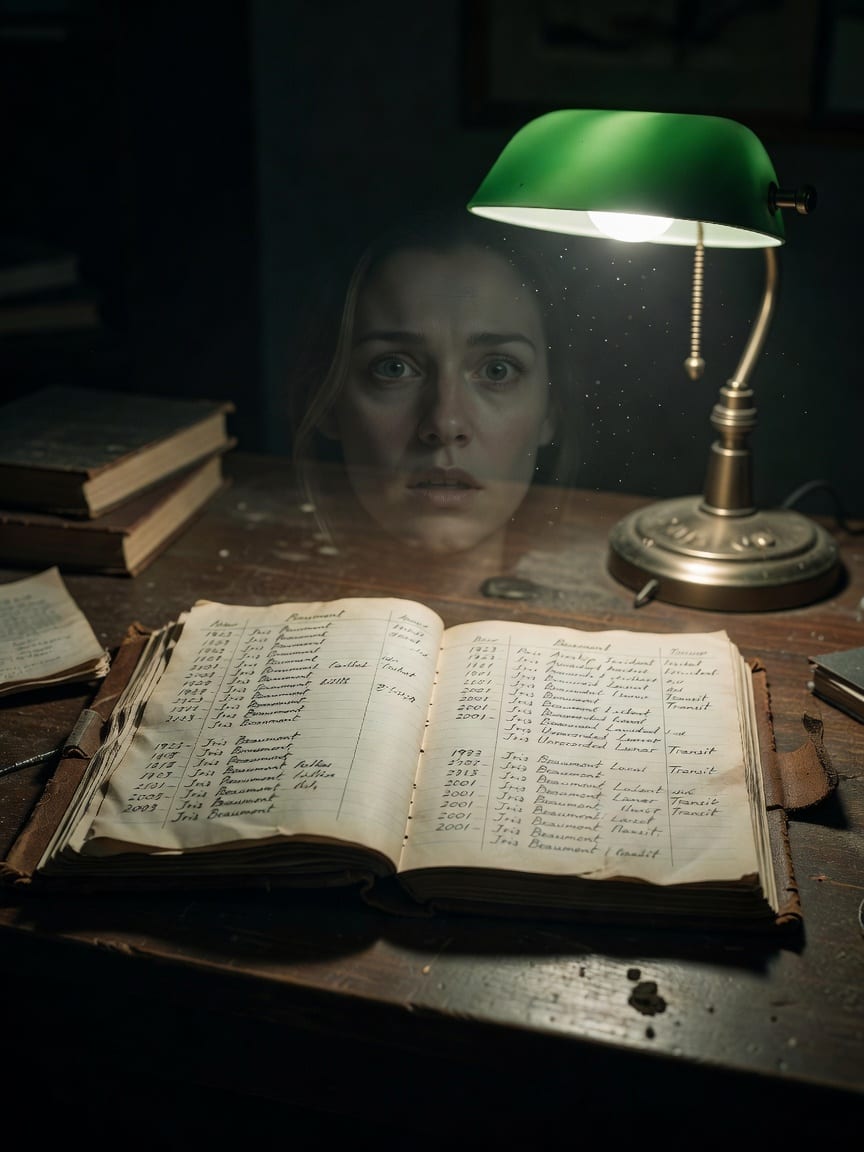
He reached for a small, leather-bound book from a precise spot on a shelf beside him, its spine worn smooth with age. It was a ledger, its pages filled with neat, looping script, a testament to generations of meticulous record-keeping.
He opened it, running a finger down a column of names and dates.
My eyes followed his finger. I saw my own name, Iris Beaumont, then others I didn't recognize, each with multiple entries for different 'assignments' – Oakhaven, Project Alpha, Site 7B. My stomach clenched.
Theodore looked up, his eyes, ancient and knowing, holding mine. "We call them proxies, Ms. Beaumont. For contractual obligations. Liability. Resource allocation. It's a very old system. Been running for generations, in one form or another." He tapped a page.
"Your 'Awaiting transfer' note? That's an internal marker. An activation. You were… activated."
I felt a chill that had nothing to do with the cool, dusty air of the archive. The word 'activated' hung in the air, a bell tolling a death knell for my sanity. "Activated?"
I whispered, the word hollow, without substance. "What the hell does that even mean?"
Theodore merely smiled, a faint, almost imperceptible upturn of the corners of his lips. There was no warmth in it, no malice, just a quiet, detached amusement.
He flipped to a new page in the ledger, his finger tracing a line down a column of names. "This one," he said, his voice still unnervingly calm, "is due for reassignment soon."
My blood ran cold. The name next to his finger was 'Kathleen Brooks.'
Kathleen. My closest friend, my colleague in the accounting department, the one person I trusted implicitly. Just this morning, Kathleen had complained to me about a strange package that had arrived at her apartment, addressed simply to 'K. Brooks.'
Inside, she'd said, was a brand new, bright yellow hard hat. She’d laughed it off, thinking it was some kind of corporate joke, a promotion gone wrong.
Theodore closed the ledger with a soft thud, the sound echoing in the silent, dust-filled room. His eyes, ancient and knowing, fixed on Iris, and the faint, almost imperceptible smile played on his lips once more.
The records weren't just about me; they were reaching for everyone I knew.
I slammed my hand on the ledger, a sharp crack in the archives’ oppressive silence. "What have you done to Kathleen?" My voice was raw, laced with a fear that finally broke through my accountant’s composure.
Theodore didn't flinch. He remained perfectly still, his composure unwavering. "Nothing," he corrected, his voice as soft and unbothered as ever. "The records have merely… identified her potential. Like they did for you. And for your grandmother, I believe."
He gestured, not to the ledger, but to a small, framed, sepia-toned photograph on his desk.
It showed a younger Theodore, perhaps in his thirties, standing next to a group of men and women from decades past. It looked like a construction site, but ancient, almost unrecognizable.
One of the women, holding a clipboard, her face familiar in a way that twisted my gut, wore a distinctive, vibrant red scarf around her neck.
It was Iris’s grandmother, dead for years, her serene, unknowing face staring out from the past. The pieces clicked into place with horrifying clarity: the red scarf from the supply store owner, my grandmother’s quiet presence, Kathleen’s strange package.
"Proxies," Theodore reiterated, the word a poison in the stale air. "They are essential. They fill gaps. Sign forms. Provide presence where a direct, traceable link is undesirable. For certain high-risk ventures, or to manage… delicate legalities.
Your grandmother was very good at it."
He explained that once an individual's 'record' was identified as suitable and activated – 'uncomplicated' enough, he’d called it – their identity could be projected, their signature replicated, their presence recorded at various sites.
The 'Awaiting transfer' note I’d found was the final stage before full activation, before a new 'assignment' was logged. The hard hat for Kathleen was not a gift; it was a physical manifestation, a token of her new, impossible role.
The system wasn't just creating fake records; it was subtly, irrevocably altering lives from afar, making them 'versatile' without their knowledge or consent.
Theodore slid a crisp, official-looking document across the desk. It was an employment contract, and my name was at the top. 'Iris Beaumont – Custodian of Records.' "We have an opening, Ms. Beaumont. A 'Custodian of Records.'
You would manage these assignments, ensure the system runs smoothly. Your own proxy record, of course, would be… optimized. No more impossible entries for you. No more unsettling surprises."
He offered me a place within the system, a way to control my own fate, to escape the creeping dread, but at the cost of perpetuating the horror for others.
The ledger, open between us, was the artifact that could not exist, yet was undeniably real, dated, and checkable. My own signature stared back at me from one of its pages, a damning testament.
I stared at the offer, then at the photo of my grandmother, her face a mask of quiet, unknowing horror.
"No," I said, my voice barely a whisper, thick with disgust. "I can't. I won't."
Theodore merely nodded, unbothered, as if my refusal was an expected, minor inconvenience. He simply closed the ledger. "The records will continue," he stated, his gaze unwavering, cold as polished stone, "with or without your assistance. The system endures."
As I turned to leave, the silence of the archive felt heavier, pressing down on me, threatening to crush me.
The framed photograph on Theodore’s desk seemed to gleam in the dim light, my grandmother’s face, serene and unknowing, wearing that red scarf, a ghost in the machine that still churned on, endlessly.
I tried to warn Kathleen. I recounted everything, the impossible signatures, the ledger, Theodore's chilling offer, the photo of our grandmother. I laid it all out, hoping to make her understand the unspeakable thing that was happening to her.
Kathleen listened, her brow furrowed, her eyes wide, but ultimately, she dismissed it as stress, a bad dream.
"You've been working too hard, Iris," she'd said gently, patting my arm, her concern genuine but misplaced. "You need a vacation."
Days bled into weeks. I obsessively checked my bank statements, my credit reports, my online presence. Nothing new, nothing impossible. My own record remained clean. But Kathleen seemed... different.
A subtle shift in her demeanor, a new quietness that wasn't like her. She started wearing a red scarf, a vibrant splash of crimson against her usual muted tones. A gift, she said, from a distant relative she barely knew.
I watched my friend, a growing hollowness in my chest, knowing the records had found their new custodian.
I visited Kathleen's apartment one evening. The air felt charged, heavy. A small travel bag sat by the door, packed and ready. On her bed, neatly folded, was a brand-new, bright yellow hard hat, perfectly clean.
Kathleen turned from the window, a faint, almost imperceptible smile playing on her lips, a smile that wasn't entirely hers.
"Just going on a little trip," she said, her voice flat, devoid of its usual warmth, like a recording. "Signing for a few things. A big project up north."
I looked at her, truly seeing her, and understood. The records had claimed another. The world would continue, unaware, while somewhere, Kathleen Brooks, or a version of her, signed for impossible things.
I walked home, the city lights blurring through the cold, damp air, the knowledge a cold, heavy stone in my gut. I was safe, for now. But the cost was too high.
I knew too much, and Kathleen knew too little.
Later that week, Iris received an email from Kathleen. It was a forwarded message, a confirmation of a completed delivery. The subject line read: 'Your proxy assignment is complete.' The sender was Theodore Davenport.
Iris deleted the email, but the words lingered, a fresh scar on the world. The red scarf, Kathleen’s new favorite accessory, lay folded neatly on the passenger seat of her car, ready for the next impossible journey.
If this one got to you
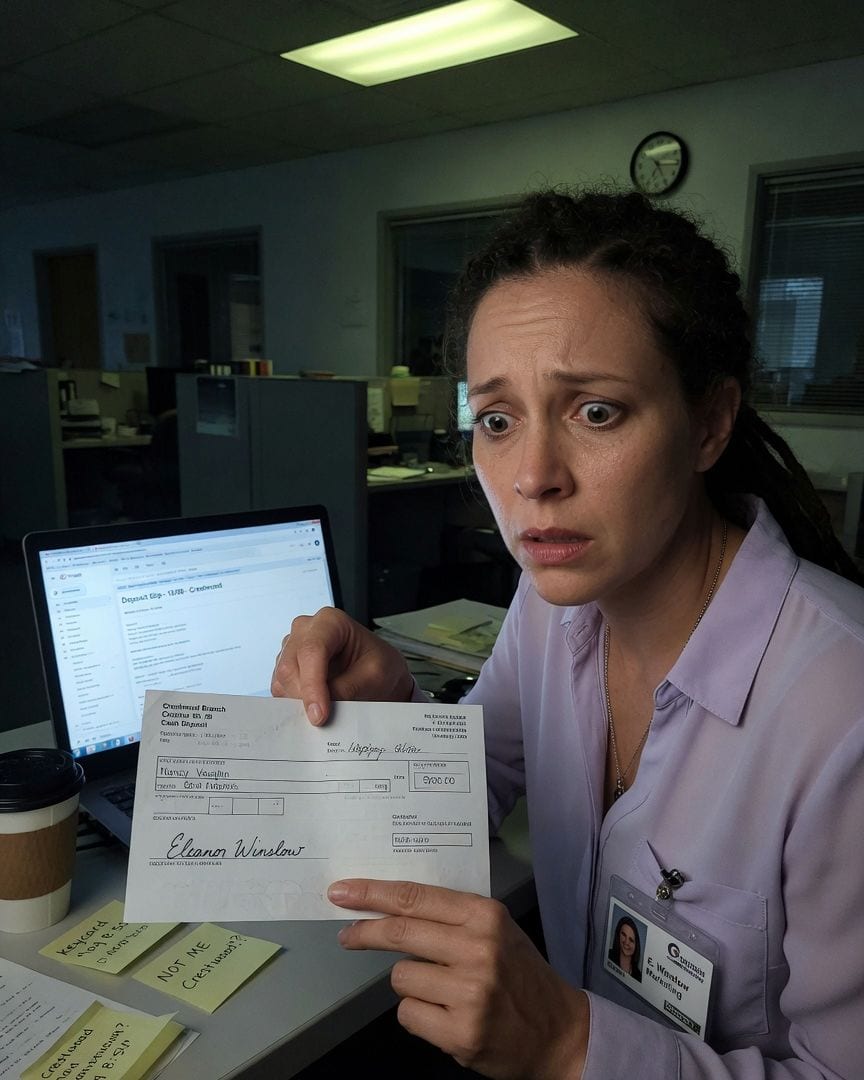
My bank statement shows a $900 cash deposit made in a town I've never set foot in, at 10:40 AM on a workday. I was at my desk, badged in. Two more landed since.
My bank statement showed a $900 cash deposit from a town I'd never visited, 150 miles away. I was at my desk, logged into work, all three times. But the scanned deposit slip arrived, clear as day, showing my own flawless signature.
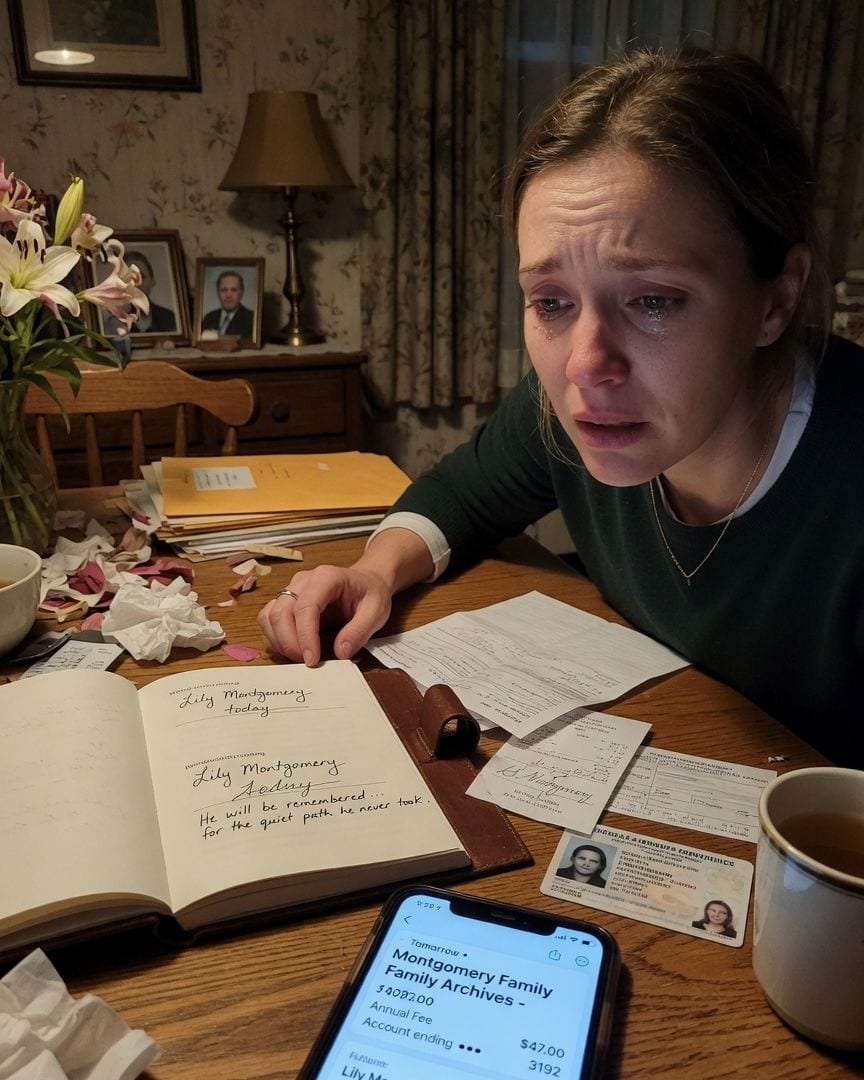
My handwriting was in the condolence book. Dated before my uncle died. Words I'd never choose.
At Uncle Howard's funeral, grief-stricken, I signed the condolence book. But later, flipping back through the pages, I found my own distinct handwriting on an entry dated the previous morning—before he had even died. The words beneath my name were chilling, a judgment I would never make.

My taxi driver knew my name before I spoke, then apologized for the flight I was going to miss. I was arriving. The cab's plate was scrapped four years ago.
After a strange taxi ride, I received an unsettling birthday card addressed to me. Its return address listed 'Old Mill Road Field,' an empty lot where a mill once stood, and it was postmarked locally. The card arrived four months before my actual birthday, sparking a cold dread I couldn't ignore.
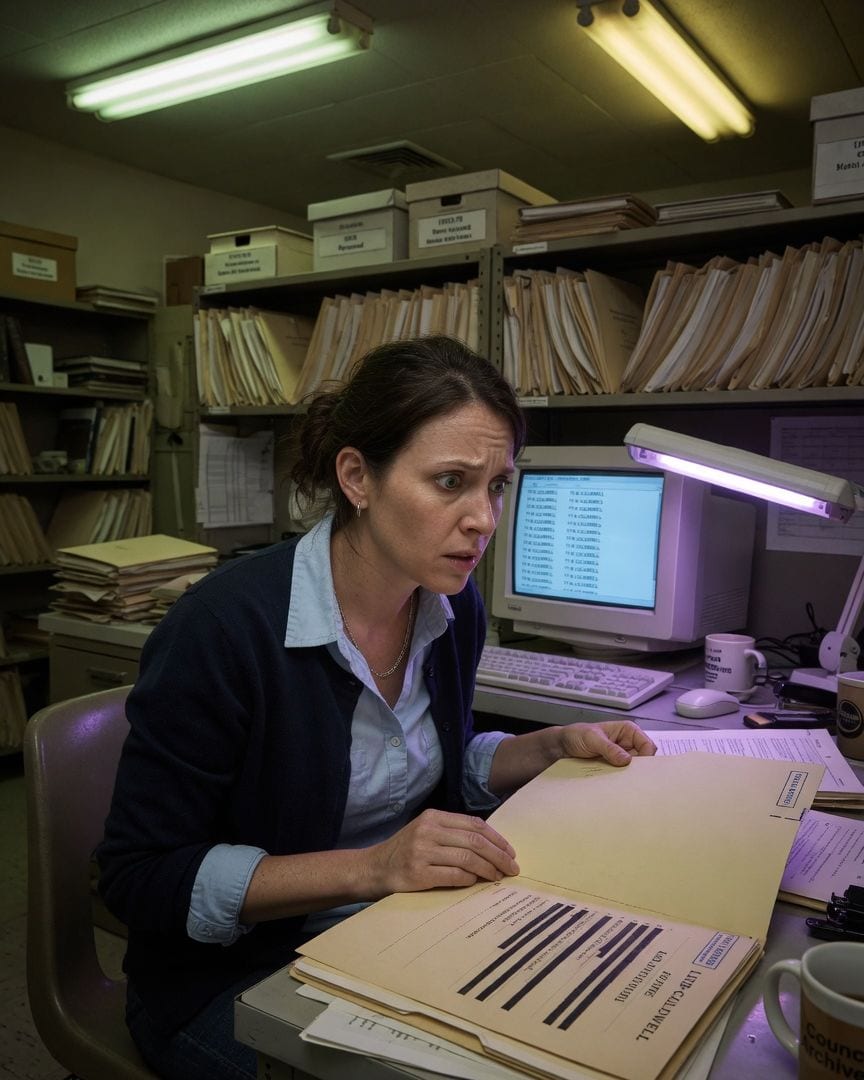
My employer's security file holds a vetting report on me dated nine years before I ever applied. It has my full name and my parents' address — with only one line, the source who referred me, blacked out.
Working a routine data audit, I pull my own security file. The issue date is nine years before I even applied for the job. Then, hidden within an old archive file, I find my current address etched under a blacked-out line.
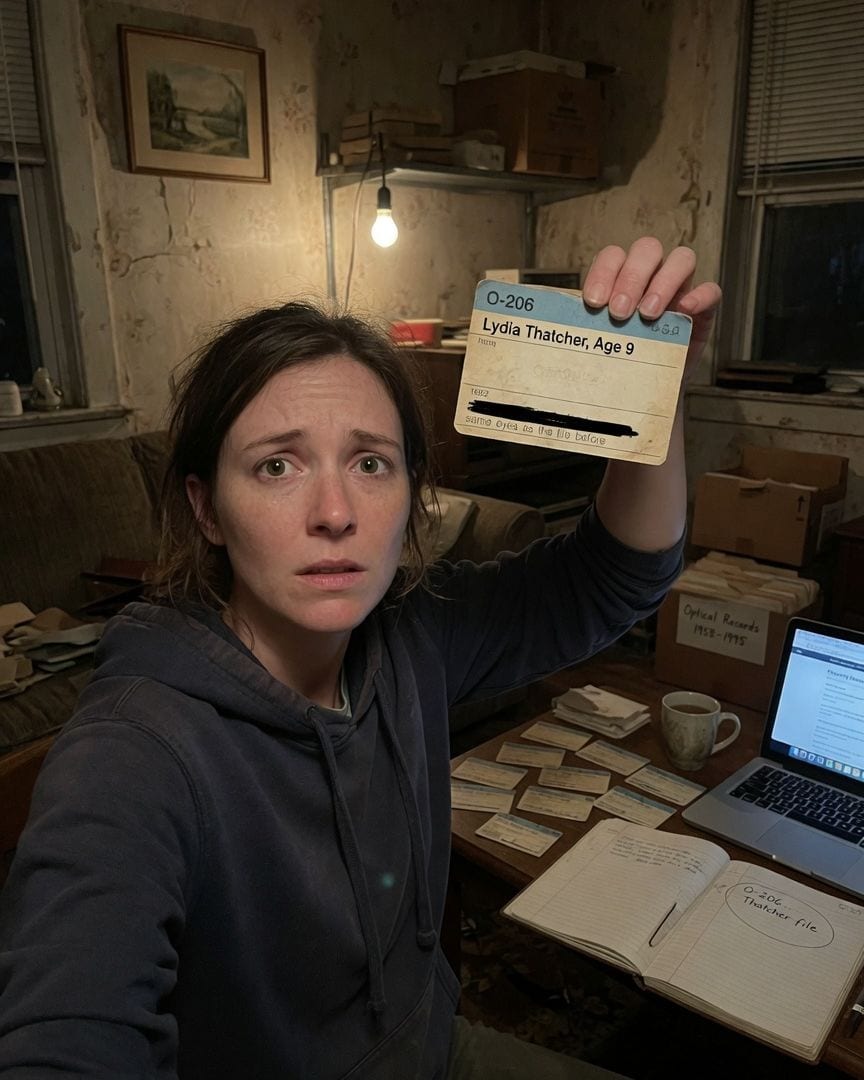
My own optical card is dated 1962, with my name on it. I wasn't born until 1993.
Sifting through old patient files from my former optical practice, I found my own O-206 card. It had my name, Lydia Thatcher, and my current home address printed on it. But the card was dated 1962, decades before I was even born, and a redacted note mentioned 'same eyes.'
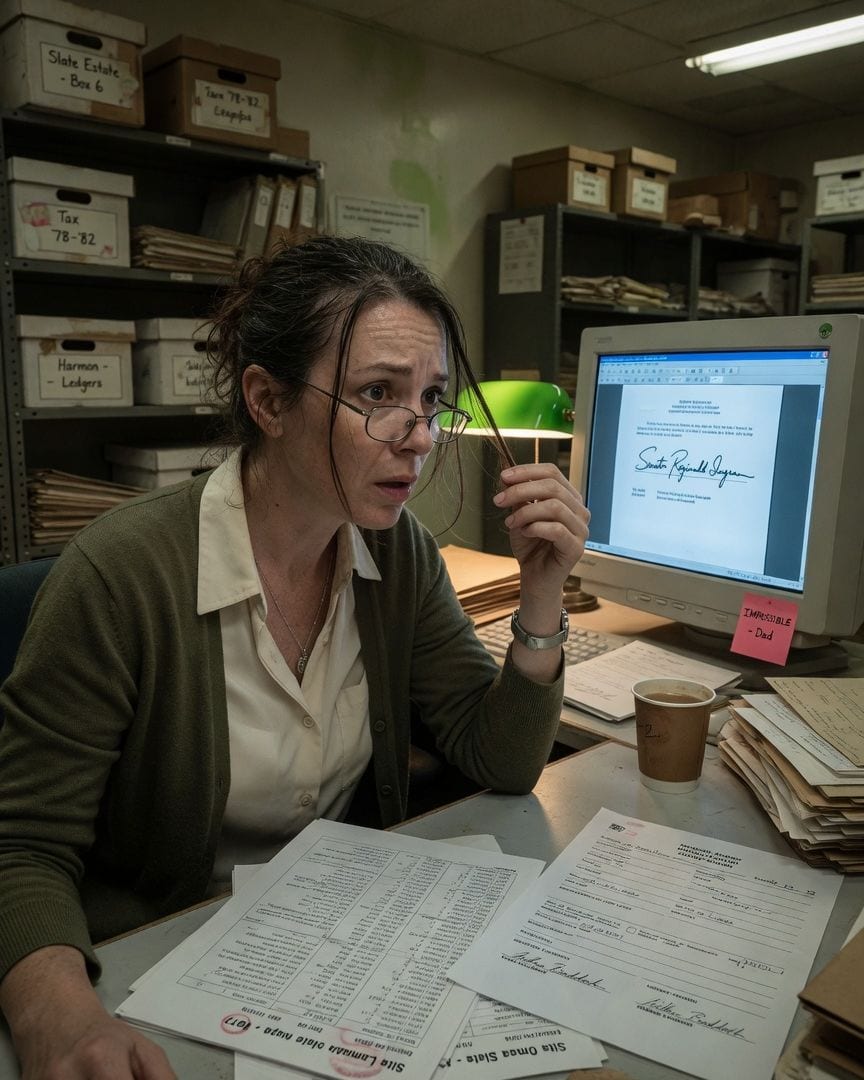
An archivist found her father's signature on a secret 1983 Cold War roster. It listed a senator who died a month before.
Nell Braddock, a meticulous archivist, dedicated her days to the quiet precision of sorting through decades of old papers. Her current task, the estate of Harmon Slate, promised nothing more than mundane accounting until she unearthed a secret operations roster from 1977. The document listed Slate as present at a desert facility, yet hospital records confirmed he was laid up with a broken back at the exact same time. A cold certainty bloomed when she recognized the familiar signature at the bottom of both impossible documents: her own father's. As Nell dug deeper, she found more such anomalies, each bearing her father's unnervingly perfect hand, twisting her reality into something utterly alien.