An archivist found her father's signature on a secret 1983 Cold War roster. It listed a senator who died a month before.
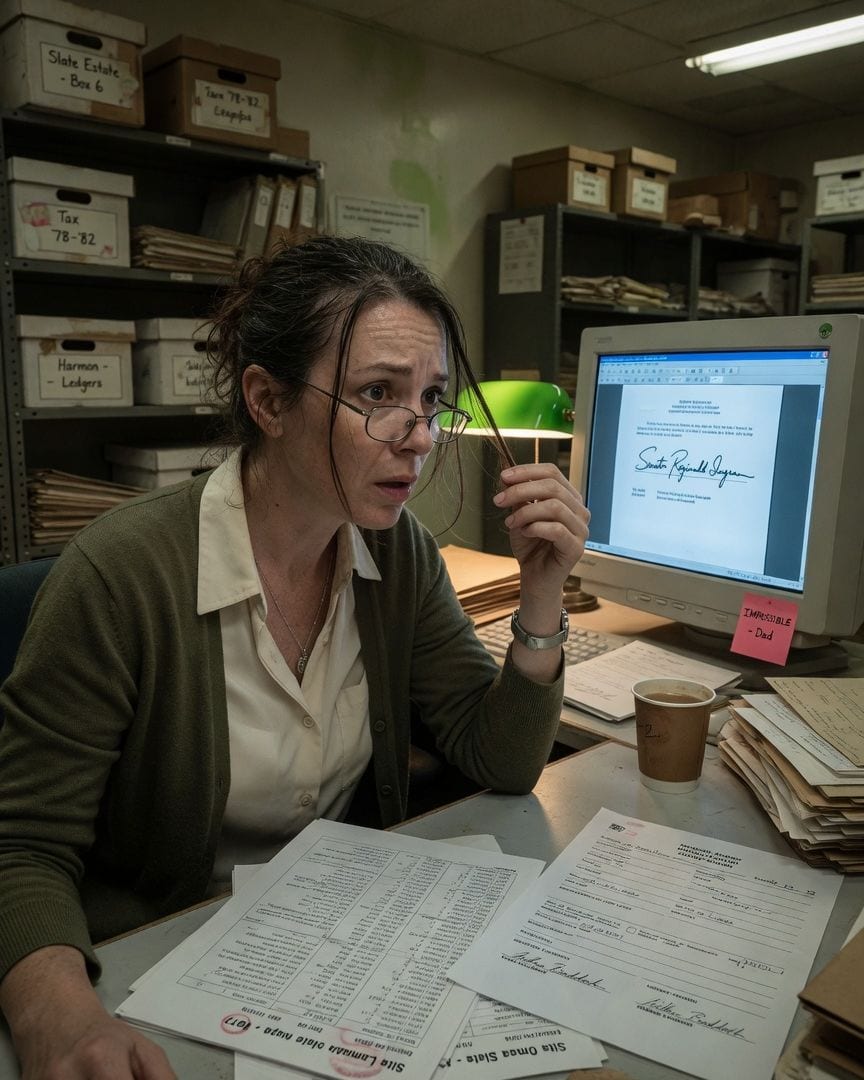
Nell Braddock, an archivist of forty-two, pushed a stray strand of dark hair from her face, the faint scent of old paper clinging to her clothes.
It was a slow week in the quiet archive, and she’d taken on the meticulous task of sorting through the late Harmon Slate’s estate, a mountain of boxes filled with decades of mundane accounting.
She worked with the quiet precision of her profession, organizing ledger after ledger, tax returns, and faded invoices. In box six, tucked beneath a stack of canceled checks from 1980, she found it: an operations roster.
The document, crisp despite its age, was dated August 1977. It listed personnel for a facility identified only as 'Site Lambda,' deep in the Sonoran Desert. Her breath caught.
Nell had spent her entire career being told such sensitive operations rosters did not survive declassification purges. Yet, here it was. Her eyes scanned the names, landing on one that made her heart give a heavy thump: Harmon Slate.
His designation number, a string of alphanumeric characters, was printed next to his name, crisp and clear.
A cold certainty began to bloom in her chest. Nell quickly pulled up Slate's hospital records from the same year.
The digital file loaded, displaying confirmation: Harmon Slate had been admitted to a Tucson hospital on August 10, 1977, with a broken back after a fall, not discharged until early September. The dates for 'Site Lambda' began August 12.
Two documents, both undeniably authentic, both meticulously stamped, both stating an absolute impossibility. Slate could not have been in the desert while laid up in a hospital bed.
And there, at the bottom of both the operations roster and the hospital admission form, was a signature Nell knew intimately. A precise, looping hand, distinct and unblemished by time: 'Arthur Braddock' – her father’s signature.
Nell spent the next few days in a quiet frenzy, the peaceful hum of the archive replaced by a buzzing disquiet in her mind. She cross-referenced every detail from Harmon Slate's roster.
The operations roster had peculiar alphanumeric codings next to each listed name, almost like a second, internal service number, distinct from military or civilian identifiers. They were consistently placed, a silent annotation next to each impossible 'presence.'
She searched for any mention of 'Site Lambda' in the vast digital archives, finding only blanked-out references, or outright denials of its existence in official histories.
It was as if the place had been wiped clean, leaving only this phantom record.
She pulled up other documents from the late 70s and early 80s signed by her father. Arthur Braddock, a man who prided himself on his unwavering precision.
His signature, always precise and consistent, seemed almost mechanically perfect on these anomaly documents, a contrast to the slight, human variations on his personal correspondence from the same period.
This meticulousness, usually a source of comfort, now felt chilling, like the perfectly calibrated function of a cold, efficient machine. It was too perfect, too steady.
Deep in the digital stacks, she found a memo from 1979, signed by her father, requesting 'additional archival supplies for temporal synchronization logs.' The phrase made no sense in any conventional archiving context. Temporal synchronization logs?
The mundane officialese only amplified the growing unease, each carefully chosen word a stone placed in a path leading to nowhere Nell recognized, a road twisting into something utterly alien.
Driven by a cold certainty that gnawed at her, Nell expanded her search parameters, not for a site, but specifically for her father's unique signature on other 'impossible' documents. Days bled into nights, the archive becoming her second home.
Finally, late into one night, the screen glowed with a hit. She found it. A second operations roster, dated 1983, for a different facility: 'Site Omega.'
It was buried deep in a collection of seemingly unrelated naval records, almost deliberately obscured.
The name listed as 'present' on the roster was Senator Reginald Ingram, a prominent figure who had died in a highly publicized plane crash on October 15, 1983 – a full month before the roster date of November 17, 1983.
And there, at the bottom, crisp and unimpeachable, was her father's unmistakable signature. The paper, dry and brittle with age, felt impossibly cold in her hands, despite the warm hum of the archive air conditioning.
The discovery of Senator Ingram’s impossible presence on a 1983 roster shattered Nell’s professional detachment. This was no longer an interesting historical anomaly; it was a deliberate, consistent pattern, anchored by her own father’s precise hand.
She began to delve into Arthur Braddock’s service history with a new, grim determination, not just his signatures, but every document connected to his long career.
She unearthed his old performance evaluations, glowing commendations for 'unwavering adherence to protocol,' 'exemplary record-keeping under unique circumstances,' and 'unparalleled discretion in sensitive matters.'
The language, once a source of familial pride, now read like an indictment, each phrase a carefully crafted euphemism for something unstated and deeply wrong. 'Unique circumstances' took on a terrifying new weight.
Nell also found a series of seemingly innocuous internal memos from the 1970s and 80s, signed by a 'Director E. Foster.'
These memos, addressed to a 'Special Archival Operations Unit' – a unit Arthur had once briefly supervised – discussed 'asset relocation protocols' and 'temporal synchronization of personnel data.' The clinical jargon, initially baffling, slowly coalesced into a terrifying implication.
'Relocation' and 'synchronization' were not about physical movement, not about moving personnel from one base to another; they were about something far more abstract, far more sinister, manipulating the very fabric of existence on paper.
Each document she pulled from the digital stacks felt heavier than the last, building a paper trail of quiet, bureaucratic horror. The monitor hummed, a low vibration that seemed to echo the growing dread within her.
She meticulously logged every discrepancy, every coded entry, every instance of her father's precise hand, forming a grim catalog of impossible truths, a silent testament to a hidden system.
Nell returned to her office one morning, the light from the tall archive windows muted by the cloudy sky, to find an anonymous email waiting in her inbox. The subject line was blank.
The body contained only a string of numbers: 19770812 followed by SLATE. It was Harmon Slate's roster date and his surname, a chillingly precise reference. Attached was a single, grainy, timestamped photograph.
It was a picture of her own office, taken from outside, through the window, clearly showing her at her desk, hunched over her computer, the two contradictory Slate documents open on the screen.
A cold shiver ran down her spine, a prickle on the back of her neck. Someone knew. Someone was watching. The implication was immediate, visceral. She checked the email headers, her fingers trembling slightly.
The source was untraceable, routed through a dozen anonymous servers, a ghost in the machine. The message was not a threat, not explicitly, but a quiet, precise acknowledgment.
It was a confirmation that her digging had been noticed, and that her every move might now be observed.
The archive, once a sanctuary of order and quiet contemplation, now felt like a panopticon, every file cabinet a potential hiding place, every shadow a watchful eye.
The air conditioning hummed, but the room felt suddenly, profoundly cold, the chill seeping into her bones.
Nell clutched the printouts of the conflicting rosters and Foster’s cryptic memos. The familiar drive to her father’s quiet, orderly home felt alien, weighted with the unspoken.
Arthur Braddock, 85, sat in his usual armchair by the window, spectacles perched on his nose, a half-finished crossword puzzle on his lap. The domestic scene felt like a thin veneer over something immense and terrible.
Nell laid the documents on the polished surface of the coffee table. Her voice, when it came, was tight, strained. 'Dad,' she began, 'what is 'Site Lambda'? What is 'temporal synchronization'?'
Arthur’s initial evasion was subtle, a slight stiffening of his posture, a barely perceptible shift in his gaze away from her. 'Just old classifications, Nell. Nothing for you to worry about. Bureaucratic nonsense.'
He tried to dismiss it with a wave of his hand, but the gesture lacked conviction.
But Nell pressed, her own composure fraying. She detailed the impossible dates, the dead senator, the broken-backed accountant, the alphanumeric codes. She brought up his signature, the unwavering precision she’d always admired now a source of deep dread.
'You signed these, Dad. Both of them. The hospital records, the operations rosters. How?' Her voice cracked on the last word.
Arthur finally sighed, a long, weary sound that seemed to carry the weight of decades. He took off his spectacles, placing them carefully beside the crossword. His eyes, though old, were clear, devoid of guilt or surprise.
He admitted, in a calm, almost dispassionate voice, that he had been part of a 'special archiving unit.' His job, he explained, had been to 'authenticate' documents that recorded 'extra-temporal deployments.'
He didn't apologize, didn't express regret, didn't offer any justification beyond stating it as a fact of his service, a duty he had performed with the same meticulousness he applied to everything else.
The alphanumeric codings, he confirmed, were unique identifiers for 'filed' individuals, their 'temporal signatures.' 'Site Lambda' and 'Site Omega,' he added, were not physical places, but 'designations for specific chronal apertures.'
Nell felt the floor drop out from under her, the mundane world collapsing under the weight of his quiet revelations.
Her father, the meticulous archivist, was not a victim in some grand scheme, but an architect of these impossible realities, a quiet cog in a machine that bent time itself.
The air in the room, usually warm and familiar, suddenly felt thin, hard to breathe.
Nell, reeling, her mind struggling to process the implications, pushed further. 'The email,' she managed, 'with the picture of my office. Who sent it?'
Arthur’s eyes flicked to the printout of the screen-shot Nell had brought, resting on the table. A flicker, almost imperceptible, passed through his gaze. 'Everett Foster,' he murmured, his voice soft, almost distant. 'He always kept an eye on things.
He was Director for my unit for many years.' He then looked at the second roster, the one detailing Senator Ingram's impossible presence, his finger tracing the dead man’s name.
'They've gotten better at the integration,' Arthur said, almost to himself, his voice distant, absorbed in the document. 'Fewer discrepancies now. The old methods were… messier. But the pattern is still there, for those who know how to read it.
It's happening even now.'
He reached for a declassified report Nell had brought along, a document detailing standard weather observations from a remote station last year.
He pointed to a blank space on it, a small, square void where a name should have been listed as 'present' during a particularly severe storm. The empty box was stark against the bureaucratic text.
'That's how they file them now,' he said, his finger tracing the empty box, the flat, uninflected tone chilling Nell to the bone. 'Not a new name, but an absence.'
Nell stared at the blank space, the implication blooming in her mind: the 'filing' wasn't just a historical oddity, a past wrongness.
It was an ongoing, evolving process, becoming stealthier, more insidious, weaving itself into the very fabric of daily records, making the silent pattern of missing data the new, terrifying form of dread.
Nell pieces together Arthur's chilling admissions with Everett Foster's cryptic memos, the threads finally, horrifyingly, braiding into a coherent whole. The 'filing' wasn't about physical relocation or replacing bodies; it was about altering official reality itself.
Individuals like Harmon Slate and Senator Ingram weren't physically moved to distant sites; their identities, their official 'selves,' were inserted into the historical record, documented as being 'present' in specific moments in time.
Their temporal signatures, those peculiar alphanumeric codings, were meticulously logged to 'correct' some perceived 'anomaly' or 'slippage' in the underlying, chaotic reality.
Her father, Arthur, had been the linchpin, the unimpeachable hand whose precise signature lent authenticity to these manufactured truths.
The Sonoran facility and 'Site Omega' were not conventional bases, but bureaucratic hubs where these chronal adjustments were made real on paper.
The codings, the 'temporal synchronization,' the 'asset relocation protocols' – it all snapped into place, forming a coherent, horrifying system designed to maintain an artificial, official coherence in the face of an underlying, less stable reality.
The dread was in the sheer, bureaucratic audacity of it, the quiet, meticulous manipulation of existence itself, all filed away in neat boxes and digital records, signed into being by ordinary men doing their jobs.
Nell arranged to meet Everett Foster, 70, in a quiet, unassuming café on the edge of downtown. He was precisely as Nell imagined: calm, impeccably dressed in a charcoal suit, with eyes that held an unnerving, serene knowledge.
He acknowledged the anonymous email and her father's role without a hint of surprise or malice. A porcelain teacup sat untouched before him.
'Your father was a remarkably gifted man, Ms. Braddock,' he said, his voice soft but resonant, a cultured murmur in the otherwise bustling café. 'A true artisan of the official record.'
He spoke of Arthur with a profound respect, not as a conspirator, but as a craftsman.
He explained the 'filing' not as a conspiracy, but as a necessary 'maintenance of historical integrity.' He spoke, almost academically, of 'temporal eddies' and 'chronal slippages' that occasionally caused individuals to be 'out of phase' with established reality.
His organization, he calmly stated, simply 'corrects' these, ensuring the official record remains coherent, stable, comprehensible. He saw it as a service, a quiet act of ordering the universe, not a horror.
His serene conviction, that this bureaucratic manipulation of reality was simply 'order,' was the most terrifying thing Nell had ever encountered. The café noise seemed to recede, leaving only the chilling clarity of his words.
He offered her a position, a chance to 'understand the true nature of records,' to see the patterns, to become an 'authenticator' herself. He slid a discreet, unmarked card across the table. It was heavy, textured.
'The work,' he said, his gaze unwavering, 'is never truly finished.'
Nell refused Foster's offer. She returned to her archive, but the files no longer held the same meaning. The meticulous order, once a testament to history, now felt like a carefully constructed illusion.
Every blank space, every redacted name, every neatly stamped date now seemed like a potential 'filing,' a silent alteration of reality.
She saw the world through a new lens, constantly searching for the absences, the records that don't exist but should, the subtle glitches in the official narrative. The solid, unchanging past was merely a carefully curated document, constantly being rewritten.
She started a new, private project, late at night when the archive was empty and silent, cross-referencing unexplained disappearances with official records, searching for the tell-tale blank spaces or impossible presences.
The dread was no longer a specific mystery, but a pervasive understanding that the world she thought she knew was merely a carefully curated document, and the truth lay in the margins, the redactions, and the invisible ink of altered time.
Nell sat at her desk, late at night, the archive silent around her, the only sound the gentle whir of the server racks. A fresh declassification request glowed on her screen.
She scrolled through the attached document – a routine weather report from a remote station, dated last month. A name caught her eye, listed as 'present' during a routine equipment check: 'Vincent Jennings.' She knew that name.
Vincent Jennings, fisherman, confirmed lost at sea three weeks prior, his boat found empty, his family in mourning. Yet, here he was, officially present. She stared at the name, then down at her own hand, resting on the mouse.
The record is still being signed.
A few weeks later, a colleague found Nell Braddock's desk meticulously cleared.
Her computer screen displayed a single, open file: a weather report from a remote station, listing a man present on a date three weeks after his confirmed disappearance at sea.
The last edit on the document had been a precise, almost mechanical signature, digitally appended, matching Nell's own. The record is still being signed.
If this one got to you
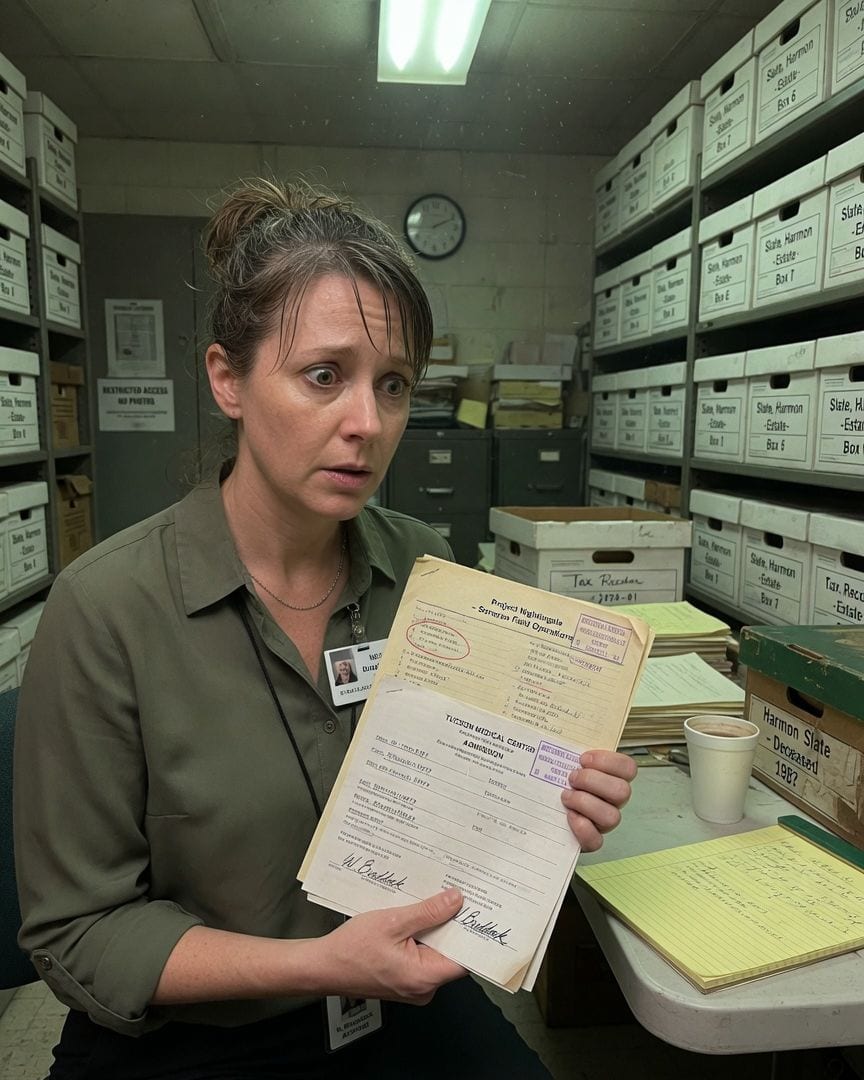
A librarian finds her father's signature on two official records: one places a Cold War accountant at a secret desert base, the other in a hospital, on the same night.
Librarian Nell Braddock, 42, spent years meticulously cataloging declassified government records, a quiet life dedicated to uncovering obscured histories. Her routine search through an accountant's mundane estate records turned chilling when she found two official documents from 1977. One placed Harmon Slate at a highly restricted desert facility, while the other admitted him to a hospital with a broken back – both on the exact same night. Even more unsettling, both impossible records bore the undeniable signature of her own father. What hidden truth had he approved?
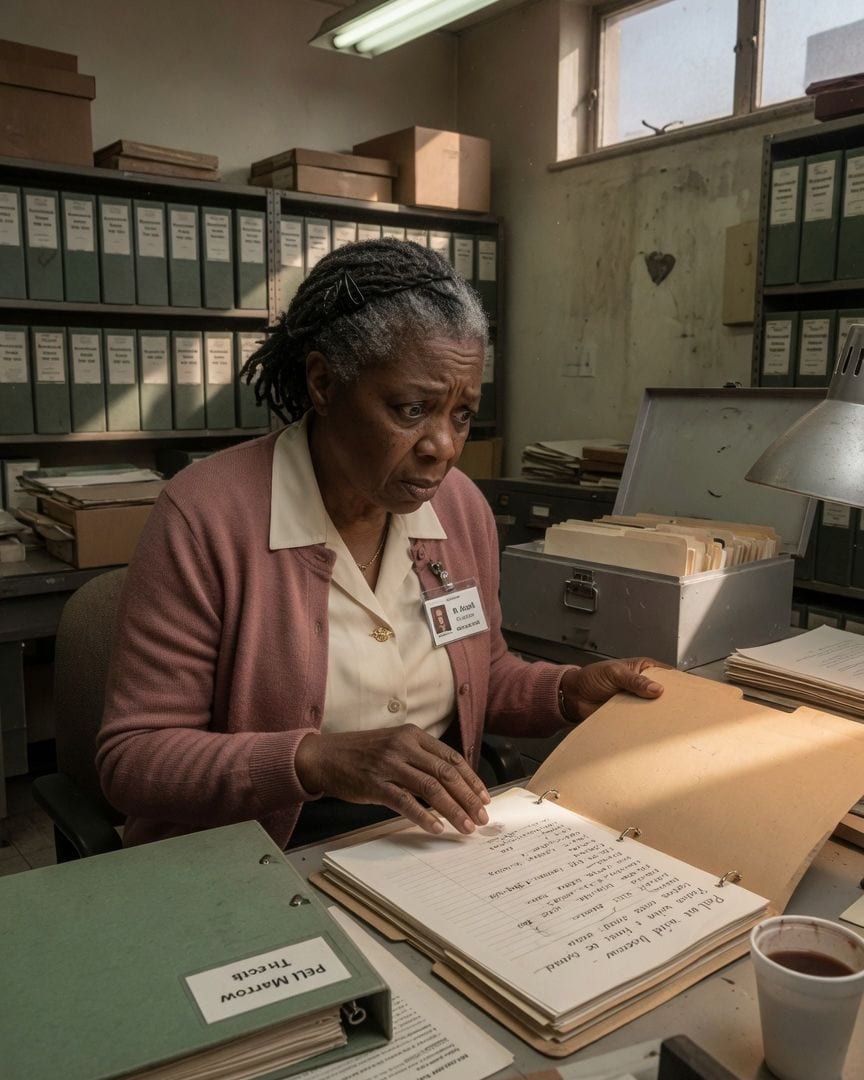
A records clerk's archive file for a Cold War reconnaissance plane lost in 1968 showed it flew yesterday to her own building.
Marguerite Ansell, a records clerk nearing her final week before retirement, meticulously audited Cold War-era files. In the cool, dusty archive, she pulled a file for an oiler declared missing in 1951. Inside, she found a fueling schedule with entries stretching into the present, the last dated just eleven days ago. Then, a second lost ship revealed a similar impossible log, and a cold certainty began to bloom in her chest. Deep in the shadows, Marguerite found an unmarked steel box containing a file for a reconnaissance plane lost in 1968. Its flight log showed a final flight yesterday, to the precise coordinates of her own archive building.
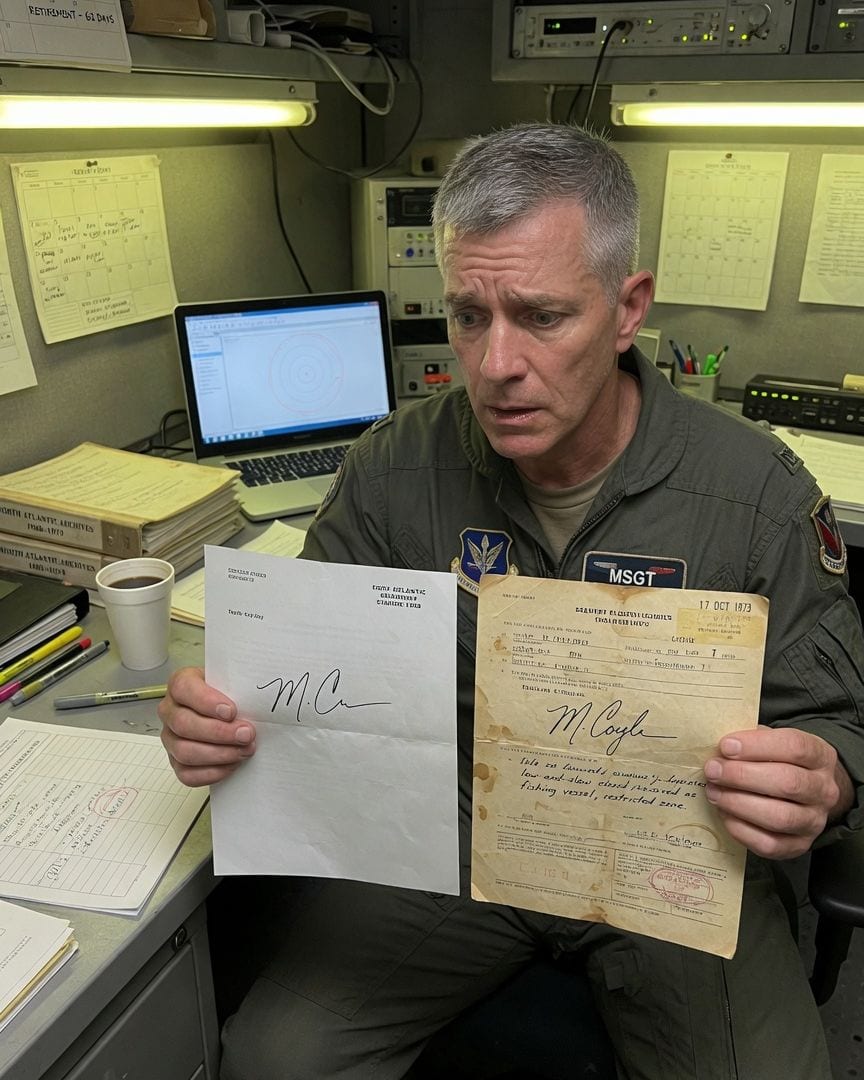
Master Sergeant Coyle was two months from retirement when his own signature appeared on a Cold War mission log from 1973, decades before he was born.
Master Sergeant Malcolm Coyle, two months from retirement, scanned the North Atlantic from his E-3 Sentry, its cabin humming through the perpetual twilight. His radar scope showed a silent, low-and-slow blip that vanished from fighter jets but remained on his screen, mirroring an identical ghost from the prior week. Digging through decades of archived logs, Coyle found a 1973 entry detailing the same impossible contact, stamped with his own squadron's seal. The duty officer's signature, with its distinctive flourish, was unmistakably his own—identical to his current papers—yet dated decades before he was even born. How could his hand have signed a lie from a time he didn't exist?
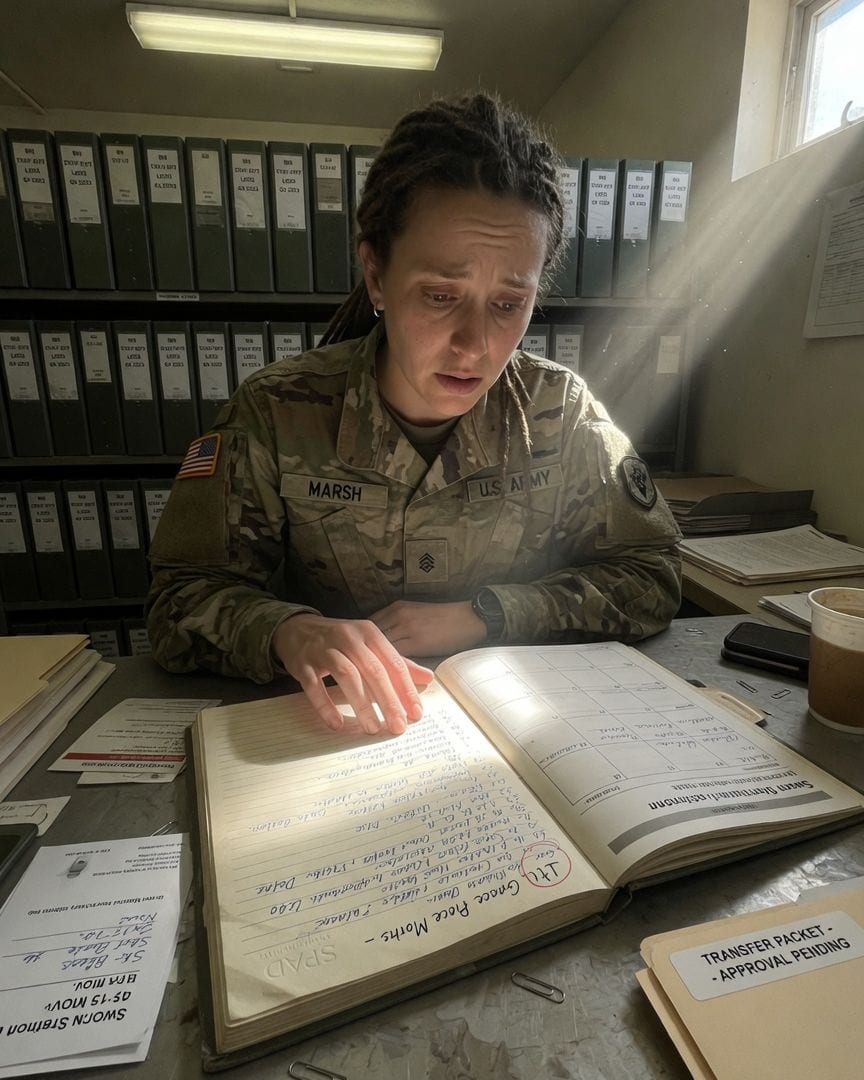
Preparing for a coveted post, a logistics officer found her own perfect signature on a duty log for a shift she swore she never worked. Then her coworker’s entry revealed his unique personal quirk.
Lieutenant Grace Marsh, a meticulous logistics officer, was deep in the archives, preparing her transfer packet for a coveted post. Her career depended on a spotless record, requiring absolute precision as she cross-referenced battalion staff-duty logs. Amidst the dusty binders and humming fluorescent lights, her gaze snagged on an entry for November 14th: her own perfect signature, logging a 24-hour shift she distinctly remembered spending hundreds of miles away in a court-martial. The impossible truth of a phantom doing her job was unsettling enough, but then she found another officer's entry, complete with his unique, personal quirk, for a day he was off-base. What was hidden in these official records?
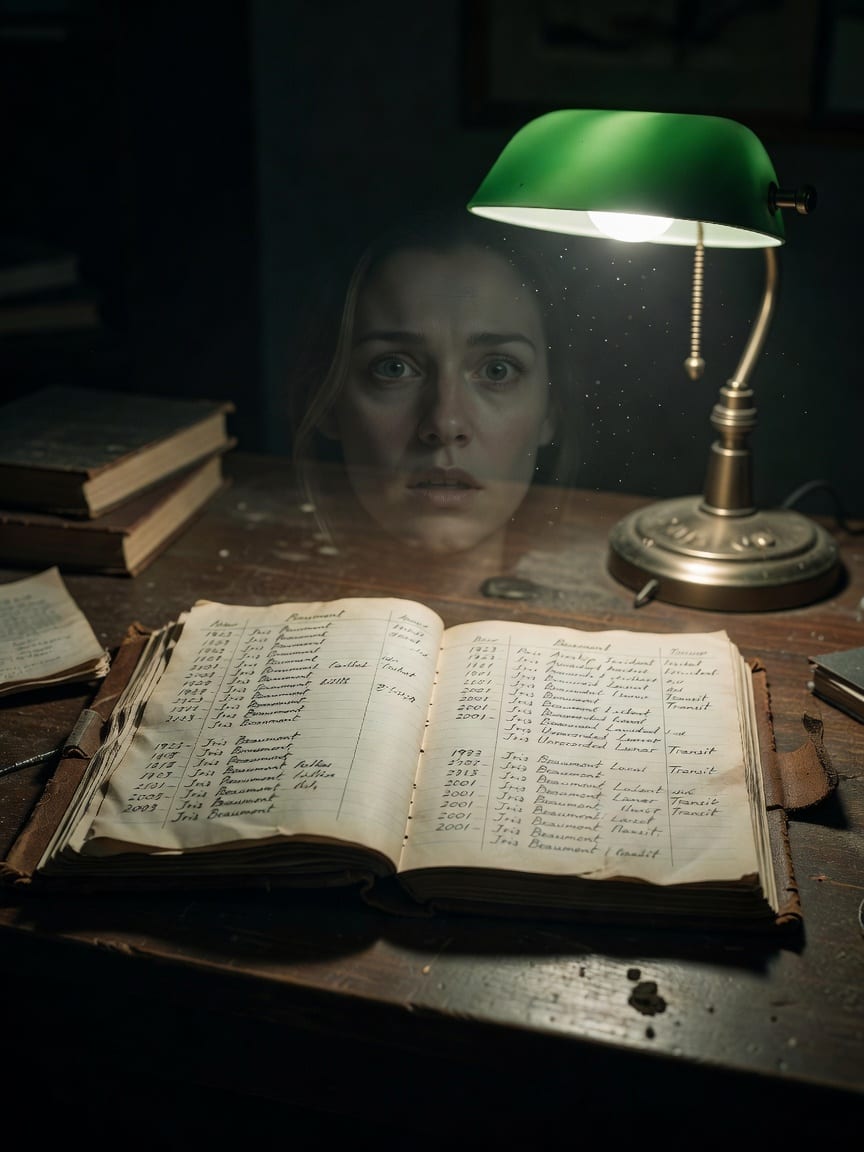
My signature's on the scaffold accident report, dated the morning it fell. I'm an accountant. I've never touched a hard hat.
I'm an accountant, a world away from hard hats and construction sites. But a foreman just showed me a safety form from a site accident, dated this morning, with my signature on it. A handwriting expert confirms it's undeniably mine, even though I've never set foot on a construction site in my life.
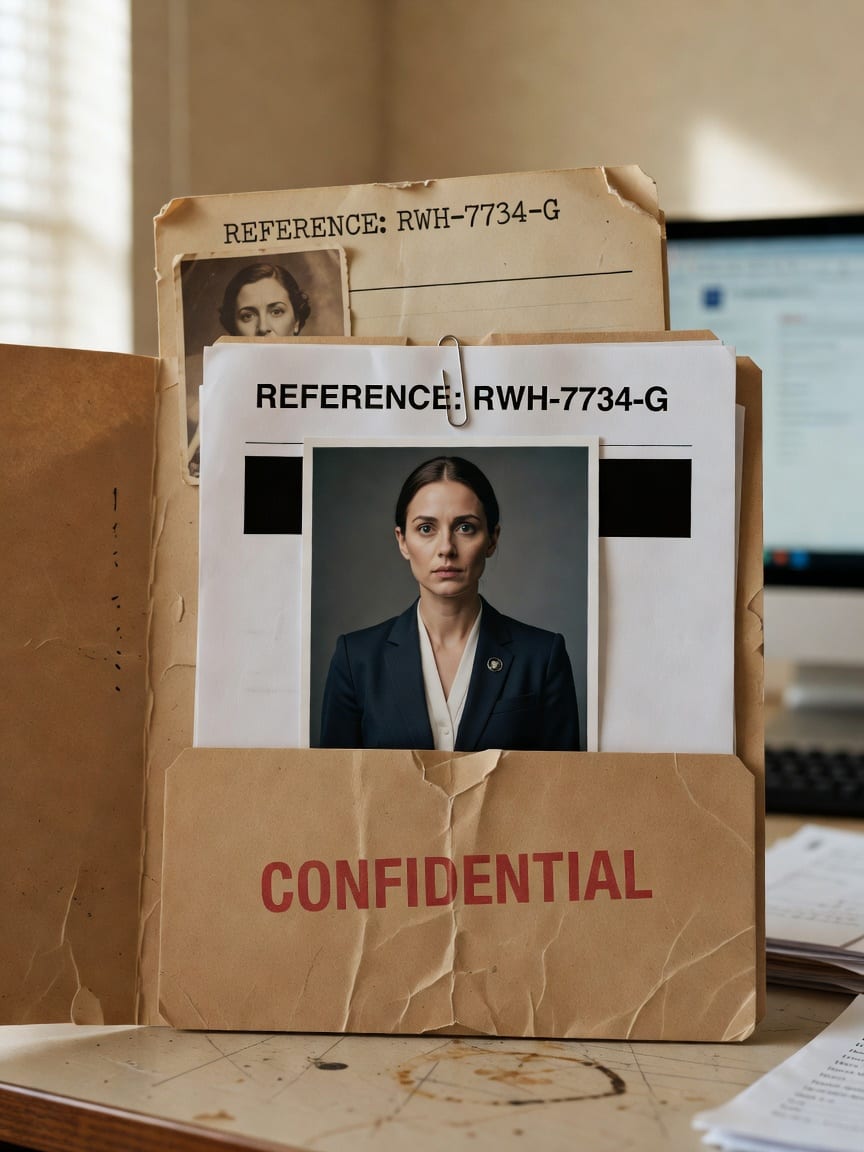
My security file was opened nine years before I was born. Its note said: 'subject not to be briefed'.
Auditing company digital records was routine until I pulled up my own personnel file. It clearly showed a 'Date Opened' nine years before I was born, yet bore my exact name and reference number. Below, an assessor's note from that impossible year mentioned a 'previous holder' and ordered the 'subject not to be briefed,' sparking a cold thrum in my chest.