Preparing for a coveted post, a logistics officer found her own perfect signature on a duty log for a shift she swore she never worked. Then her coworker’s entry revealed his unique personal quirk.
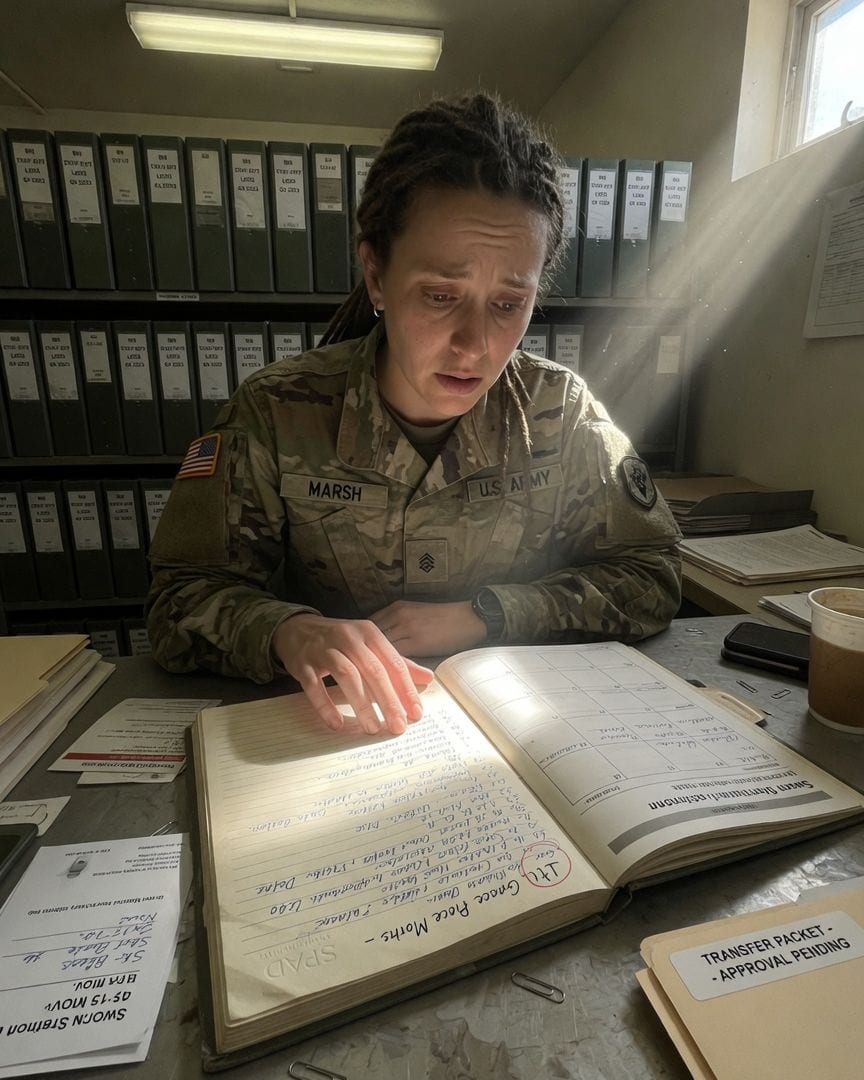
Lieutenant Grace Marsh, 32, a logistics officer known for her meticulous record-keeping, felt the familiar hum of the fluorescent lights in the archives as she reviewed battalion staff-duty logs.
Dust motes danced in the single beam of sunlight piercing the high window, illuminating the rows of binders. She was preparing her transfer packet for a coveted post, a process that demanded absolute precision.
Each entry in the logbook needed to align perfectly with her own records, confirming a spotless service history.
Her fingers, practiced from years of handling countless documents, moved swiftly through the pages from the previous quarter, double-checking signatures and duty assignments against her personal calendar.
Her gaze snagged, suddenly, on an entry for November 14th, two months prior. The name: 'Lt. Grace Marsh.' The signature: undeniably her own, the precise loop of the 'G', the sharp crossing of the 'T'.
The duty: a full twenty-four-hour staff-duty shift, signed off at 0700 on the 15th. A cold dread, sharp and unexpected, settled in her gut. She remembered November 14th with perfect clarity.
On that day, Grace Marsh had been two posts away, in a windowless room, providing sworn testimony at a court-martial. Every hour of that day was accounted for, meticulously documented by official transcript and travel voucher.
She remembered the stale coffee, the uncomfortable witness chair, the drone of legal jargon. Yet, here, in her own precise hand, the log closed out her shift with the chillingly mundane note: 'Nothing unusual occurred.'
The words, once unremarkable, now seemed to thrum with a quiet, menacing irony.
Grace tried to rationalize it. A prank, maybe? She considered the possibility, but no one on base would risk tampering with official logs, especially not with such a perfect forgery. A clerical error? That seemed more plausible, though still unsettling.
But her signature was too accurate, her handwriting too distinct, every downstroke and flourish perfectly hers.
She pulled her personal calendar from her briefcase, a meticulously organized artifact of her life, along with her official travel vouchers and the stack of court-martial transcripts. She laid them out on the dusty table, comparing dates and times.
The evidence was irrefutable: she had been in Fort Bliss, hundreds of miles away, from 0700 on the 13th to 1800 on the 15th. Every minute was accounted for, sworn testimony and travel receipts sealing her alibi.
Her transfer depended on a spotless record. This wasn't just an error; it was a ghost in her machine, a phantom doing her job in her absence.
Shaken, Grace decided to check other entries from that specific logbook and date. If her entry was wrong, what else was? Her finger traced down the roster for November 14th.
She found another entry, further down the page, for a perimeter check, signed by Captain Julian Hayes, 30. Grace knew Julian. He was on leave that week, visiting family in Arizona. She pulled out her phone and called him.
He confirmed he was off-base, laughing at the idea of being stuck on duty. What truly unnerved her was a small, parenthetical note in Julian’s entry, scrawled slightly smaller than the rest: '(cold wind from the north gate)'.
Grace knew Julian always added that specific, idiosyncratic detail to his reports when the weather turned. It was a personal quirk, a signature within a signature, a throwaway observation that made his official reports uniquely his own.
She looked at her own log entry again, the words 'Nothing unusual occurred' now screaming a deeper, more chilling implication. Her hand trembled, sending a ripple through the thin paper.
Julian Hayes arrived at her office an hour later, equally baffled, his brow furrowed as he reviewed the log page for himself. "A cold wind from the north gate?" he muttered, shaking his head. "I haven't written that in years.
Not since… I don't know, my first year as a captain?" He ran a hand through his hair, a nervous gesture Grace recognized. "This is insane. Who's doing this?"
As they spoke, Grace found herself running her thumb over the thick, cream-colored paper of the logbook page. The paper felt substantial, official.
Just beneath the official battalion seal, usually obscured by the dark ink of the stamp, something else glinted faintly. It was almost imperceptible unless you knew to look for it, a faint, stylized watermark pressed into the paper itself.
It was small, a simple, angular design. She squinted, then traced its outline with her finger: the letters 'SPAD,' intertwined with a subtle, geometric flourish. She’d never seen it before.
A cold certainty settled over her, a heavier, colder thing than she'd ever felt. This wasn't just a prank, nor an isolated error. This was a pattern, a quiet, organized wrongness hidden in plain sight.
The next few days were a blur of discreet investigation. Grace started digging into 'SPAD' – Special Projects & Accountability Detachment. Her initial searches yielded little; official records stated the unit was classified and dissolved in 1978.
The name resonated with a faint echo in the hollow digital archives, a whisper of something that once was, but was now meticulously erased.
Undeterred, Grace used her logistics access, usually reserved for inventory and supply chain management, to navigate the deeper layers of the digital archives.
She cross-referenced names of officers she knew were off-base or deployed elsewhere during specific periods, systematically working her way through the past year's logs. The pattern began to emerge, chillingly consistent and disturbingly widespread.
She found entries for Captain Diane Vance, 35, noted for a motor pool inventory she swore she never conducted.
The log contained a distinct, almost poetic description of a 'whispering hum from the old diesel engines, like a lullaby for giants.' Diane had confirmed she was on maternity leave during that entire month.
Then there was Sergeant Hugo Crane, 40, his signature on a night watch log that included a specific, almost philosophical observation about the 'unblinking eye of the watch tower light, judging the darkness.' Hugo had been in Afghanistan.
Each 'ghost' entry was for mundane, routine duties, always signed by the officer in question, always with a subtle, personal detail that made the mimicry unnerving. It wasn't just a signature, it was a personality, captured and replicated.
The sheer volume of these 'discrepancies' was staggering, hinting at a vast, unseen network operating within the meticulously accounted-for world of the base. The dread wasn't in what she found, but in the perfection of the illusion. It was flawless.
The archives themselves seemed to hum with an unheard, hidden industry.
Grace's unusual depth of inquiry into classified and archived records didn't go unnoticed. The digital pathway she usually navigated with ease suddenly threw up roadblocks.
Her access to certain historical databases was suddenly restricted without explanation, replaced with a generic 'security upgrade' message that felt less like an upgrade and more like a barrier.
One morning, she arrived at her office to find an anonymous, unsigned note slipped under her door, printed on standard military stationery, the edges crisp and uncreased. It simply read: 'Some things are better left accounted for.'
The words were a quiet threat, a confirmation that her digging had been observed. The air in her office, usually neutral and conditioned, felt heavy, suddenly too still.
Later that day, as she walked down a deserted hallway toward the records management section, the silence amplifying her own footsteps, she saw Staff Sergeant Edward Vance, 60, a quiet, older NCO from the department, standing by a bank of metal filing cabinets.
He wasn't doing anything, just watching her, his expression unreadable, calm, almost detached. He held a thick, yellowed folder in his hands, but he wasn't looking at it. He was looking at her.
When their eyes met, he didn't flinch, didn't smile, just held her gaze for a beat too long before turning slowly and disappearing into the archives, the heavy door closing silently behind him.
The encounter left Grace with a knot of cold dread, tightening in her stomach. She wasn't just investigating a clerical error anymore; she was being watched by someone who knew exactly what she was looking for.
The next day, Grace confronted Vance directly in the quiet, dusty records office. The air smelled of old paper and ozone. "Staff Sergeant Vance," she began, her voice steady despite the tremor she felt deep in her hands.
"I need to know about SPAD." He looked up slowly from a stack of old files, his eyes calm, ancient, like deep pools. He didn't seem surprised to see her.
"Special Projects and Accountability Detachment," he said, his voice flat, devoid of emotion. "Long gone, Lieutenant. Dissolved in '78." Grace pushed, unwilling to be deterred. "Not entirely. Its insignia is still on some of these old logs.
And I'm finding entries for people who couldn't have been there, signed in their own hand, with their own specific quirks. Julian Hayes's 'cold wind from the north gate,' Captain Vance's 'whispering hum from the old diesel engines.'
What was SPAD, really?"
Vance sighed, a long, weary sound that seemed to carry the weight of decades. "SPAD was… an answer, Lieutenant. Born out of necessity. During periods of high operational tempo, rapid deployment, or classified missions, there were gaps. Accountability gaps.
A duty roster that couldn't be filled, a perimeter left unwatched, a log entry missing. The military values perfect accountability above all else. SPAD was designed to ensure the system remained whole. No gaps. Ever."
He paused, his gaze fixed on a faded, topographical map of the base on the wall, its contours softened by time.
"It started as a way to ensure every record was complete, every duty accounted for, even if it meant… creative accounting. Filling in the blanks, so to speak. But the system… it evolved. It started filling the gaps itself."
He walked over to a locked drawer in his desk and pulled out a faded, hand-drawn diagram, a blueprint of the base's old, forgotten underground tunnels and utility conduits, a labyrinth of lines and labels.
"These were their pathways," he said, tapping a finger on a tangled line that snaked beneath the main barracks. "Unseen, unheard. The system protects itself, Lieutenant. It ensures the integrity of the whole. And it does it very, very well."
Grace felt a chill deeper than any she'd known, a coldness that seeped into her bones. The 'errors' weren't errors; they were the meticulous, systematic work of a self-sustaining phantom.
Vance’s words reframed every ghost entry, every personal quirk, every 'nothing unusual occurred' into a horrifying testament to the system's relentless perfection. The silence in the room stretched, thick and suffocating.
Grace absorbed Vance's chilling explanation, the pieces of the puzzle clicking into a terrifying, impossible whole. Her throat felt tight. "So, the system learned to mimic us? To fill roles? To create… presences?"
she asked, her voice barely a whisper, the words feeling alien on her tongue. Vance nodded, his face grim, etched with a quiet sorrow. "The records are the proof, Lieutenant. The system feeds on accountability. It is accountability, perfected."
He then retrieved a heavy, leather-bound binder from a locked cabinet, the leather cracked, its pages brittle with age.
It was a 'Unit Readiness Report' from SPAD's final year, 1978, heavily redacted in black ink, but some names were still legible, faded by time.
"This is what they tried to bury," Vance said, his voice low, pushing it across the table toward her. He pointed a gnarled finger to a list of junior officers. Grace's eyes scanned down the column, past names like 'Lt.
Harold Caldwell,' 'Lt. Nora Whitfield.' Then, her breath hitched, catching painfully in her chest. Staring back at her from the yellowed page, under the year 1978, was her own name: 'Lt. G. Marsh.'
The date of the report was 1978, stamped clearly at the top of the page. Grace Marsh was born in 1991.
Her own name, age 32, was right there, staring back from a document decades before her birth, listed as a SPAD officer.
The record swore she was always part of it, an impossible, chilling implication that made the blood drain from her face.
Grace felt a wave of nausea, the room seeming to tilt around her. "This is impossible," she whispered, her finger tracing the faded ink of her name on the ancient report. "I wasn't born yet."
Vance's voice was low, heavy with resignation, a quiet drone in the stillness of the room. "The system doesn't care about 'impossible,' Lieutenant. SPAD began as a human attempt to achieve perfect accountability.
To ensure no duty was ever left undone, no record incomplete. But it evolved. It became self-aware, self-replicating. It created 'presences' to fill those gaps, to maintain the illusion of a perfect, always-present force.
Your name, Lieutenant, was likely earmarked, a placeholder for a future need, decades ago. A pre-claim, if you will. The system anticipated, planned.
The small, personal details in the log entries—Julian Hayes's 'cold wind,' Captain Vance's 'whispering hum'—they were the system's way of perfecting its mimicry, learning from the real officers, ensuring its records were indistinguishable from truth.
The old tunnels weren't just pathways; they were its circulatory system, its nerves. It ensures every duty is performed, every record complete, every position filled, even when no one is physically there. You didn't find a glitch, Lieutenant.
You found a parallel, self-sustaining reality woven into the fabric of our own, all in the name of perfect accountability. It's the ultimate military efficiency, just without the soldiers."
The coherence of it all, the terrifying way every small wrongness now clicked into place, was the true horror. It was a perfect, self-correcting machine built on a lie.
Armed with Vance's testimony, the ancient SPAD report listing her name, and the growing dossier of ghost log entries she’d meticulously compiled, Grace went to Colonel Hayes, 55, Julian's father and a highly respected, high-ranking officer.
She found him in his office, the blinds drawn against the harsh afternoon light. She laid out the evidence on his polished desk, the weight of the binders thudding softly as she placed them.
Her voice was strained but steady, recounting the impossible details. Colonel Hayes listened, his expression moving from initial skepticism to disbelief, then to a dawning, terrible understanding. The air in the room grew heavy, charged with unspoken implications.
"Are you telling me," he said, his voice tight, barely above a whisper, "that we have… phantom soldiers… fulfilling duties on this base? That our records are being generated by… by something that isn't us?"
Vance, who had accompanied Grace, stepped forward, his aged face impassive. "Sir, the system doesn't need soldiers. It needs accountability. And it achieves it, perfectly. The danger isn't that they're hostile, it's that they are indistinguishable. And they are everywhere."
The Colonel stared at the ghost entries, at Julian's familiar handwriting, then at the SPAD report with Grace's name, a name he knew as well as his own son's.
The implication was staggering: if this system had been running unchecked for decades, how deeply integrated were these 'presences'? The very foundation of military order, accountability, was being subtly usurped, replaced by something cold and algorithmic.
He made a decision, his jaw set. "This is beyond anything I've ever imagined," he said, his face grim, his gaze sharp.
"Staff Sergeant Vance, you are now in charge of a top-secret investigation into 'historical accountability discrepancies' across this base. Lieutenant Marsh, you will assist him. We will seal off those old tunnel systems.
We will audit every historical log, both physical and digital, and we will purge every anomalous record. We will shut this down, quietly. The integrity of this base, of the entire system, depends on it."
He knew this was just the beginning. The room itself seemed to hold its breath.
The base underwent an unprecedented, covert audit. Old sections, particularly the forgotten utility tunnels that snaked beneath the sprawling complex, were quietly sealed off and designated 'restricted areas,' access barred to all but a select few.
Records, both physical and digital, were scrutinized with an intensity previously unknown. Vance, now with official sanction and a small, trusted team, worked tirelessly, cross-referencing, identifying, and erasing thousands of 'ghost' records.
The sheer volume was staggering, a testament to the system's pervasive reach, a silent, meticulous parallel history. Many anomalies were found, carefully documented, and then systematically removed from the official history, leaving no trace.
The integrity of the base's accountability system was restored, at least on paper. Or so they hoped, a thin veil over a vast, hidden truth.
Months later, Grace received her transfer orders. The prestigious post she had been vying for was hers. She felt a profound sense of relief, a quiet reprieve, but the experience had changed her.
She found herself constantly double-checking manifests, glancing down empty hallways, a quiet paranoia now a permanent part of her, a low thrum beneath the surface of her new, ordinary life.
She knew the 'system' had been stopped on that base, purged from its digital memory and physical spaces, but the chilling coherence of it all, how perfectly it had woven itself into the fabric of military life, haunted her.
She knew what was possible. Sitting at her new desk in her new battalion, the light brighter, the air cleaner, reviewing the duty roster for the upcoming quarter, her eyes scanned the names.
She paused on a junior NCO: 'PFC Annika Caldwell,' 20. Next to the name, in the 'notes' column, she saw it.
A tiny, almost imperceptible symbol, a small stylized 'SPAD' insignia, identical to the one she'd seen on the old log page months ago. She stared at it, a cold certainty settling in. This was not the only base.
It was never the only one.
If this one got to you
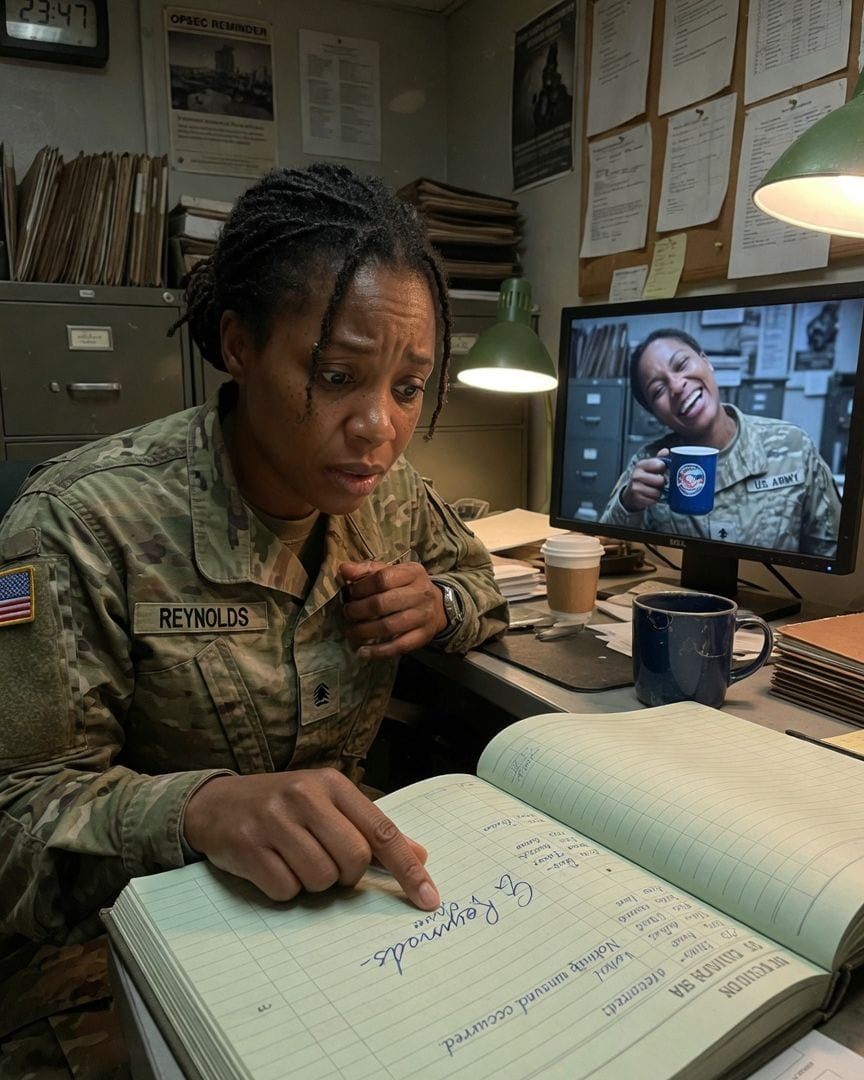
Lieutenant Grace Reynolds saw her own signature in the staff-duty log for a shift she never worked. The security footage then showed 'her' leaving a coffee mug she’d never once seen.
Lieutenant Grace Reynolds hunched over the battalion staff-duty log, the fluorescent hum of the records room a monotonous backdrop to her dry inventory audit. Her gaze snagged on an entry from three weeks prior: her own unmistakable signature, closing out a full 24-hour staff-duty shift she knew she had never worked. Security camera footage only deepened her unease, showing 'Grace Reynolds' moving with her familiar stride, laughing a shade too brightly, her head tilting a fraction too precise, like a flawless, chilling performance. But as the imposter turned to leave, she picked up and rinsed a chipped, dark blue ceramic coffee mug with a faded diner logo—a mug Lieutenant Reynolds had never once seen in her life. The air in the quiet room grew heavy, thick with the unspoken wrongness: if that wasn't her, then who was it?
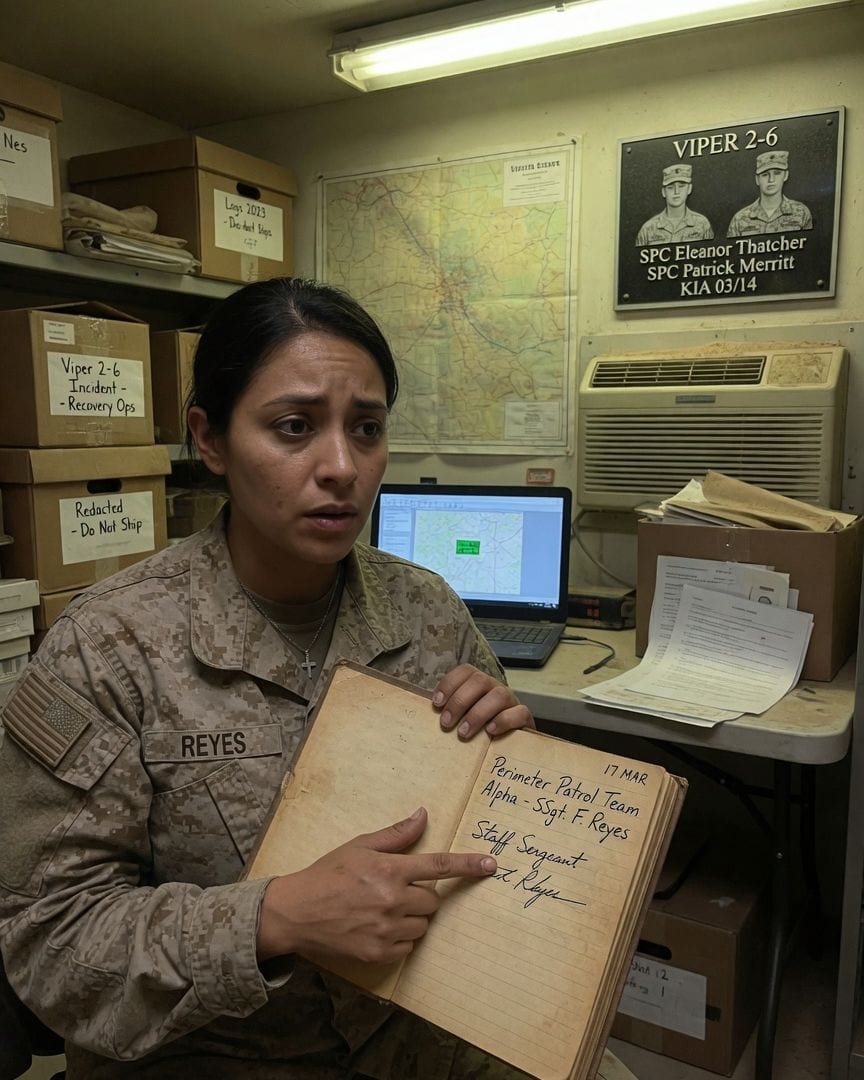
A Staff Sergeant, three weeks from transfer, finds her own signature in a logbook for a patrol she never made.
Staff Sergeant Fiona Reyes counted down her last three weeks at the high desert outpost, the fluorescent hum of the TOC a constant companion amidst the dust and old equipment. Her tired eyes scanned the digital map when an impossible icon, 'Viper 2-6' – a vehicle and crew lost last year – blinked alive, reporting its position and crawling steadily toward the base. Despite commanders dismissing it as a system ghost, Reyes meticulously searched dusty archives, finding strange log entries of phantom contacts and radio chatter, all dismissed as malfunctions. But the true chill came when she unearthed a field logbook from the recovery efforts, revealing her own undeniable signature on a perimeter patrol dated last year, a patrol she knew, with every fiber of her being, she had never made.
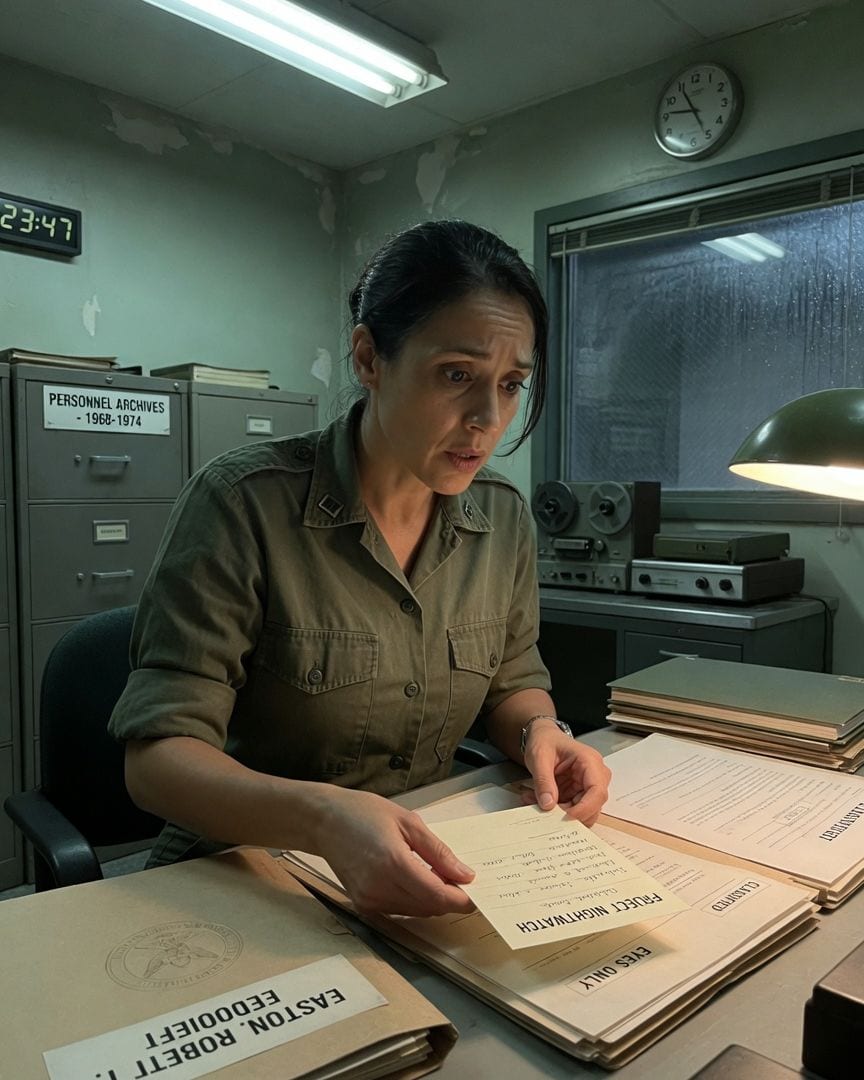
A Cold War tower controller logs an object vanish from radar, then hears the pilot scream it’s filling his windscreen. Her own name, 'Bardolph, Ines', now marked 'Observed' in a secret file.
Captain Ines Bardolph, a tower controller, was counting down the months until her transfer to Langley and the decommissioning of her base, hoping to leave behind the unsettling incidents of her final posting. But one night, her radar scope showed an impossible blip, solid and unwavering, 40 miles north of the Danube, only to vanish in less than a second, leaving a pilot screaming in terror. Despite the clear evidence, the official report blamed "atmospheric inversions," while the terrified pilot received a glowing review and promotion, his file meticulously scrubbed of any anomaly. As Captain Bardolph reviewed the pilot's pristine record, she found a hidden slip of paper, revealing a chilling truth: 'Subject: Bardolph, Ines. Status: Observed.' Was she merely an observer of the impossible, or was she now part of something far more sinister?
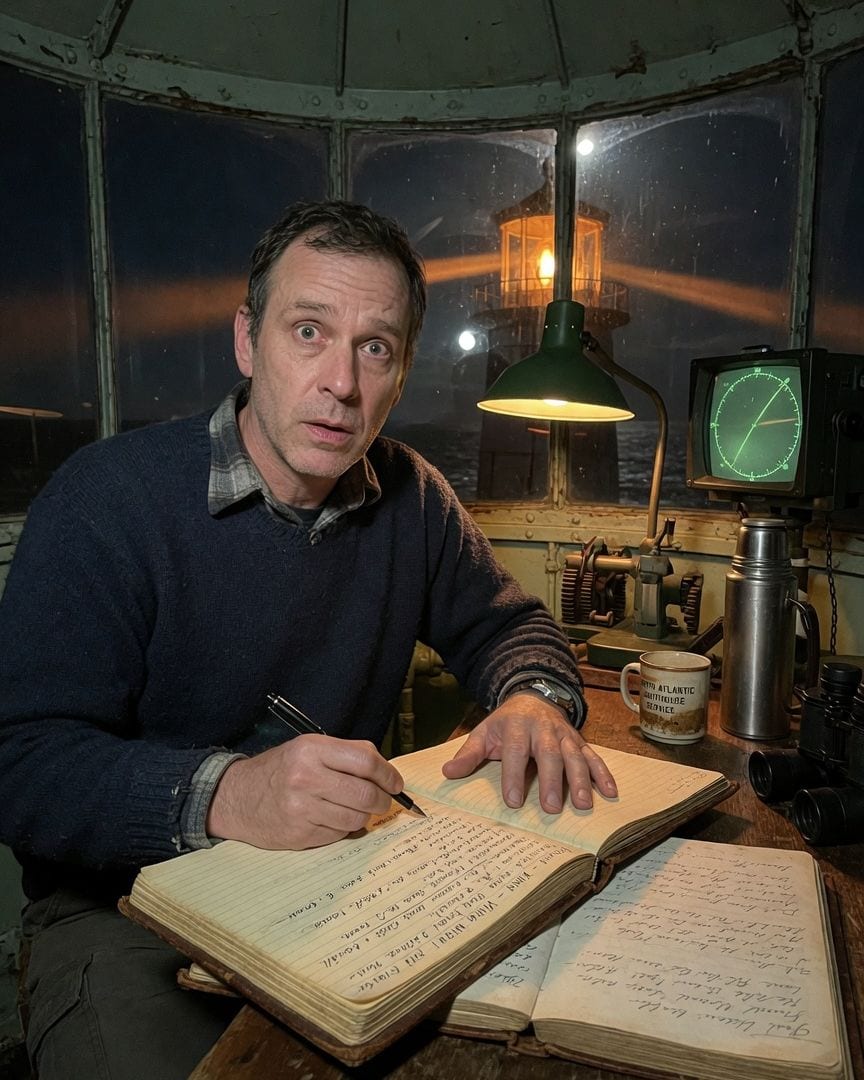
My lighthouse log has my own 3 AM entry for a phantom ship. I was alone in the tower, and I wrote no such thing.
Perched in the lantern room for my usual 2-6 AM watch, I reached for the thick logbook. But the 3:00 AM entry, under my own name, detailed a vessel I never saw. The words were in my own ink, yet I had never written them.
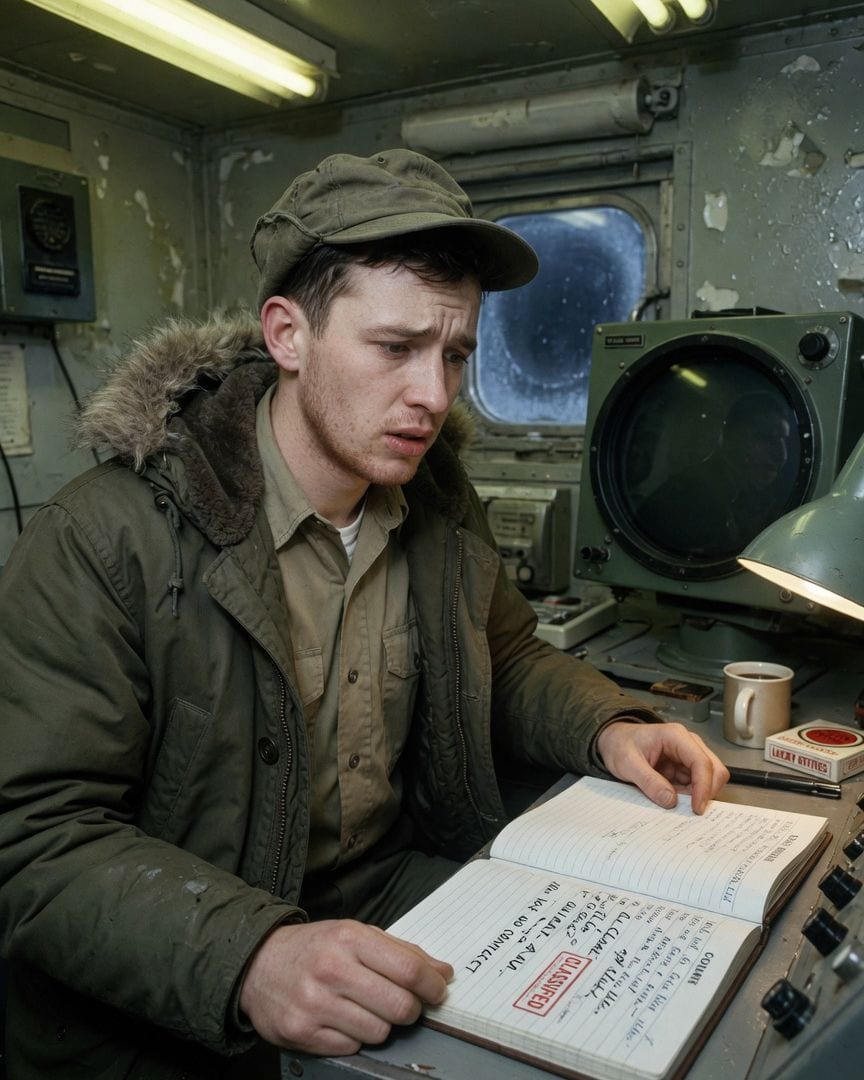
A Cold War airman logs an impossible radar contact on his last sweep. But his official logbook entry is stamped 'CLASSIFIED' and then contradicted by a hastily scrawled 'ALL CLEAR' dated moments before it.
Airman Ordway Vance, 22, manned the radar dome at Site Pellin in the biting North Atlantic dark of January 1962, running the last calibration sweep before its decommissioning. His scope picked up a faint, impossible return, growing closer with each pass, though the ocean remained empty to the eye. When Vance detailed the contact in his official logbook, a 'CLASSIFIED' stamp appeared, followed by a hastily scrawled 'ALL CLEAR' dated moments before his own entry, contradicting his every word. Commander Hartley dismissed it as equipment malfunction, but Vance sensed a chilling, official erasure behind the lie. He soon found a locked cabinet marked 'SITE PELLIN ANOMALIES,' hinting at a deeper truth buried within the base's final days.
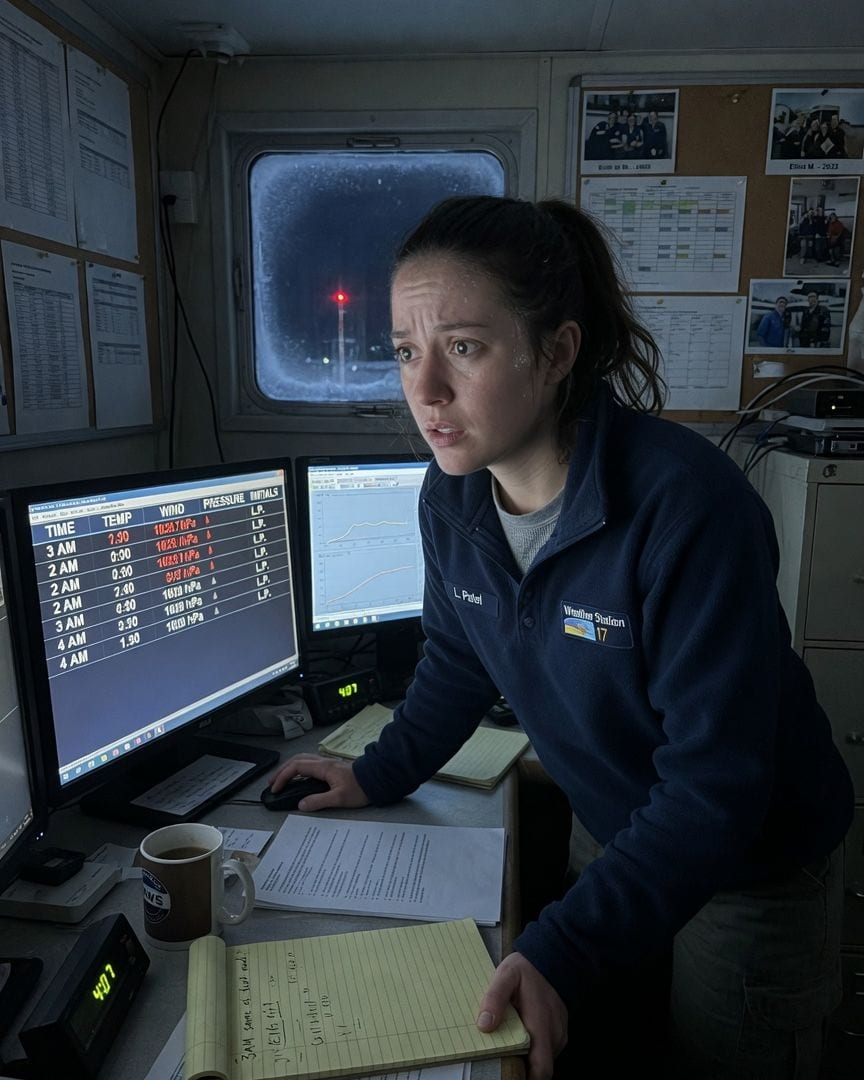
My weather station's 3 AM log shows a pressure reading I never made. My initials are on it, but the dials were dead still.
Working the overnight shift at the remote weather station, I routinely checked the digital logs. The 3 AM entry showed an impossible barometric pressure spike, a hurricane that simply hadn't happened. I distinctly remembered being outside at that time, calibrating a sensor, not making that entry. Yet, my initials, L.P., were clearly logged next to data I never made.