My spare room bed is slept in every few nights, sheets warm and pillow dented. I live alone, painted the window shut, and nobody has a key.
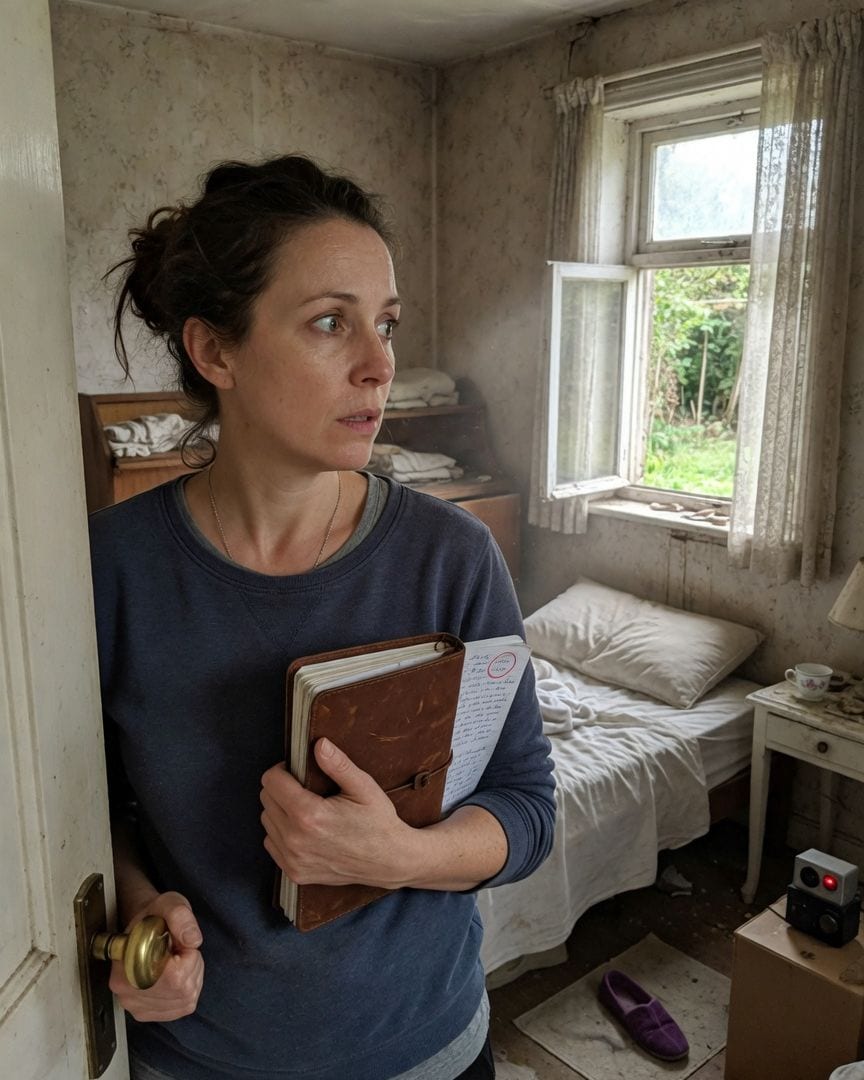
I’ve been in Grace’s house for six months now. Six months of adjusting to the quiet, the creaks, the way the late afternoon sun hits the dusty portrait of my great-aunt in the hallway.
I inherited it, an unexpected legacy, and for the most part, it’s been peaceful. Except for the spare room. I keep it shut, mostly empty, certainly unused.
It’s just a place for storage, for boxes I haven't unpacked, a single bed tucked against the far wall that belonged to Grace's frequent visitors.
Yet, every few mornings, when I inevitably give in to the nagging feeling and check, the bed is clearly slept in.
The pillow is dented, the top sheet rumpled and warm to the touch, and one of Grace's old velvet slippers, the kind she always left for guests, is set perfectly square on the mat beside it.
The worst part is the window. I painted that window shut myself, back in the spring, to stop a persistent draft. Primed it, two coats of exterior white, sealed it tighter than a drum.
But every time I check, it’s open. Exactly two inches.
I’ve checked the locks, the windows, a dozen times. Pulled out every hidden drawer in the old desk, looking for a forgotten key. Nothing. I tried to rationalize it, of course.
A draft, maybe, a faulty latch that just looks painted shut. My own sleepwalking, perhaps, though I've never done it before, and the idea of me meticulously arranging a slipper is ridiculous.
I even bought a small, silent motion sensor, the kind that notifies your phone. I set it up, aimed at the bed. It never triggers. Not once. But the routine continues.
The bed, the pillow, the slipper, the window – undisturbed, even when I'm certain I locked the spare room door from the outside, the key clutched in my hand, before going to bed at the far end of the house.
No one else has a key. And yet, it's happening. It’s happening still.
One Tuesday morning, the usual dread pulled me to the spare room. The bed, of course, was exactly as expected. But this time, on the small, claw-footed bedside table, was a teacup.
A delicate porcelain thing, chipped at the rim, not mine. I didn’t remember seeing it before, though it was certainly the sort Grace would have favored. It felt alien, wrong.
I put it away, my skin crawling, trying to tell myself I’d just overlooked it before. That afternoon, I was stirring awake from a particularly heavy sleep, the first light just catching the edges of my bedroom curtains.
And then I heard it. Distinct, high-pitched, unmistakable. The whistle of a kettle. Precisely at 6 AM. My own kettle was on the counter, cold, untouched. I walked into the kitchen, every nerve alert, expecting to find... what?
A logical explanation, a neighbor's sound carrying? But there was nothing. Just the heavy, almost accusing silence of the house afterward.
It started happening again the next morning. And the next. Not just the kettle. A faint, sweet smell of baked apples would linger around 3 PM, even though I hadn't baked anything in weeks.
A specific floorboard in the hallway, near the linen closet, would creak at the same time every evening, a soft, deliberate thump-creak as if someone had just stepped on it.
I tried to dismiss them as quirks of an old house, residual smells, the settling of timbers. But the timing was too precise, too consistent. The mundane explanations felt thinner with each passing day.
The house was keeping a schedule, a meticulous, unyielding schedule, and it certainly wasn't mine.
A cold certainty, a dread that had nothing to do with ghosts and everything to do with a methodical, unexplainable logic, drove me back to the spare room.
I stripped the bed, pulled the dresser away from the wall, desperate for a hidden latch, a secret crawl space, anything.
Running my hand along the worn, dark wood frame of the old dresser, I felt a slight give in the side panel. Pushing harder, a small, cleverly disguised section of wood sprang inward with a soft click.
Inside, nestled amongst mothballed linens, was a leather-bound journal. Grace’s journal.
My heart hammered against my ribs as I pulled it out. The leather was smooth and cool under my trembling fingers. I flipped it open, the pages stiff.
Grace’s familiar, elegant script filled the pages, neat and precise, detailing daily routines, grocery lists, gardening notes. My eyes landed on a date, circled in red ink: today’s.
And beneath it, in Grace's own careful hand, a meticulous description of the spare room: 'Turned down the bed for Robert. Slipper on the mat. Window open two inches. He loves the fresh air.'
I froze, the diary heavy in my trembling hands.
I spent the next few days in a fog, poring over Grace’s diary. It was a chronicle of absolute, unyielding routine. Every Tuesday, the spare room was meticulously prepared for "Robert."
Every single morning at 6 am, without fail, the kettle whistled for Grace's Earl Grey. Every Wednesday afternoon, she baked an apple pie. I cross-referenced the dates, the small, specific details.
It was all there, an unbroken record of a life lived by a precise, unalterable clock. A life that seemed to be playing out, in echoes, around me.
I called Penelope Romano, Grace's long-time neighbor, a woman in her seventies with a voice like warm gravel. Penelope, initially hesitant, confirmed Grace's legendary punctuality.
"Oh, Grace was a creature of habit," Penelope chuckled, a sound that grated on my raw nerves. "Especially when young Robert came to visit. She’d have that spare room ready for him, right down to his favorite slipper, always."
I asked her about the kettle, the apple pie, trying to keep my voice even. Penelope nodded, "Always. You could set your watch by Grace. If it was Tuesday, you knew Robert would be arriving.
If it was 6 AM, Grace was making her tea." A cold dread settled in my stomach.
The diary wasn't just a record of Grace's life; it was a blueprint for the events still playing out in my house, every tick and tock.
I found old photos Grace kept in a box under her bed—a young, smiling Robert Easton, my great-nephew, often captured in the very spare room, sometimes with a chipped porcelain teacup.
The details fit, chillingly, into a pattern that felt too perfect.
As I delved deeper into Grace’s meticulously recorded life, the house’s routines became more insistent, almost responsive.
I was in the kitchen, lost in thought about the 6 am kettle, and suddenly, the faint whistle echoed, louder this time, right beside me. A sharp, clear sound that left me spinning around, heart racing, but there was nothing.
Not even a stray teacup.
Walking up the stairs one afternoon, I deliberately stepped on the third tread, the one Grace always scrupulously avoided, according to her diary.
I'd never noticed it before, but now, a distinct, heavy thump reverberated from the landing directly above me, as if a heavy foot had just landed there in response.
I jumped, my breath catching in my throat, scanning the empty hall.
A few days later, I found a small, folded note tucked under a teacup – not the chipped one, but a regular one I used – in the kitchen. It was written in Grace’s familiar, elegant hand, unmistakable.
It simply read, 'Keep things as they were, dear. It's for the best.' It wasn't in the diary, not among Grace’s usual effects. It was new.
It felt less like a discovery and more like a subtle guidance, a nudge, as if the house wasn’t just remembering, but actively participating, ensuring the patterns were maintained.
I started to feel less like an investigator, and more like a participant, being drawn into a performance I hadn't auditioned for.
Unnerved by the note, I visited Penelope again, Grace's diary clutched in my hand like a lifeline. I showed her the entry for today’s date, the specific details about the spare room, about Robert.
Penelope’s cheerful demeanor slowly cracked, the lines around her eyes deepening. “Grace… she always believed the house had a way of remembering,” she admitted, her voice softer, almost a whisper.
“She said her own mother used to talk about the house, how it ‘liked things kept just so.’ Grace was obsessed with keeping up appearances, with routine. She said it kept her family close, even after they were gone.”
Penelope recounted how Grace would fuss over Robert’s visits, how important it was to her that everything be exactly the same each time. “She called it ‘maintaining the thread.’ She truly believed the house held onto things, like an echo.”
I pressed, the words tight in my throat, “An echo that writes notes? That boils kettles?” Penelope shook her head, visibly distressed. “I don’t know, dear. But Grace… she always said the house had its own rhythm.
And Robert, he loved those visits. He loved his great-aunt. He was very attached to the house, too. He’d spend hours just sitting in that spare room, reading. He always left the window open two inches, no matter the weather.
He was just that kind of boy.”
The pieces clicked into place with a sickening thud. The routine wasn't just Grace's personal quirk; it was Grace's fierce dedication to a specific pattern, for a specific person—Robert—that the house had absorbed.
A pattern so deeply ingrained, so meticulously maintained, that the house itself now perpetuated it.
Armed with the chilling understanding of Grace's obsession, I returned home, determined to break the cycle. I walked directly to the spare room, the diary clutched in my hand, no longer a guide, but an indictment.
The window, of course, was open two inches. I reached for it, intent on sealing it shut permanently this time, not just with paint, but with screws, with metal, with sheer, physical force.
As my fingers brushed the painted-shut frame, I noticed something. Beneath the relatively fresh paint, where a small crack had formed, a faint, almost invisible etching.
I scraped at the paint with my fingernail, the white flakes falling onto the sill, revealing an older, deeper inscription in the wood. It was a different hand entirely, not Grace’s elegant script, but something bolder, less refined.
A precisely drawn diagram of the window latch, with an arrow pointing to where it should be, and the words, ‘Open two inches. Always. For the boy.’ Beneath it, a date, faded but legible: 1923.
I pulled back, my hand shaking, the diary falling to the floor with a soft thud. This wasn't just Grace. This was something far, far older.
Driven by a new, colder terror, I didn’t hesitate. I fetched a crowbar and started prying at the wall behind the faded inscription, directly below the window. The old plaster cracked and crumbled, revealing a cavity.
Inside, nestled in the dark, was not just Grace’s diary, but a collection of similar journals, ledgers, and even faded children’s drawings. A small, worn slipper, identical to the one on the mat beside the bed, but brittle with age.
A tiny, chipped teacup, matching the one I’d found weeks ago, but clearly much older.
Each item, each journal, dated further back, spanning centuries. I found entries detailing the 'spare room for the boy' routine, the 6 am kettle, the avoided stair, repeated in different hands, different eras.
The name 'Robert,' or 'Rob,' or 'Master Robert,' appeared consistently, always tied to the spare room's specific setup, to the open window, to the ready slipper.
The house wasn't just remembering Grace; it was a generational pattern, a constant ritual being performed for a recurring visitor.
The house itself was a collector of these routines, a living archive that demanded its 'program' be maintained.
The 'source' wasn't a spirit, but the cumulative memory, a pattern that had absorbed the essence of its occupants and now actively manifested their most ingrained habits, perpetuating a cycle of remembrance, always for 'the boy.'
This house wasn't haunted; it was the haunting.
I understood. The house wasn't haunted by a ghost; it was haunted by a ritual, a self-perpetuating routine. The only way to stop it was to break the pattern, physically, unequivocally.
I spent the next days in a frantic, almost manic effort, systematically dismantling the spare room. I removed the bed, the dresser, every single item associated with the routine.
I patched the wall where the hidden compartment had been, sealing it with plaster and paint, burying the past.
I then went to the window, the source of the oldest inscription, and removed the frame entirely, replacing it with a solid, unopenable pane of glass. No more two inches open, ever.
Finally, I took down the door itself, the heavy old wooden door, replacing it with a new, blank one.
Then, with a cold, grim determination, I permanently sealed it shut from the inside with heavy-duty construction adhesive and screws, obscuring the old threshold where the slipper once lay. It was gone. Erased.
As the last screw turned, securing the new, blank door to its frame, a faint but unmistakable sound echoed through the house: the distinct thump of the third stair being avoided, followed by the high, familiar whistle of the 6 am kettle, even though it was late evening.
The routines were fighting back, or perhaps, simply continuing, regardless of my efforts. The house remembered.
The spare room was gone, a blank wall now in its place. The overt routines in the rest of the house seemed to fade, or at least I convinced myself they did.
I tried to establish my own patterns, my own rhythms, consciously breaking any habit that felt too rigid, too 'programmed.'
The silence where the routines once were was almost louder than the sounds themselves, a vast, echoing emptiness that the house seemed to hold its breath to fill.
I lived with a constant vigilance, acutely aware of every creak, every shadow, every fleeting scent. The house felt different, but not empty. It felt… expectant. Waiting.
I tried to move on, to make the house truly my own.
I made a conscious effort to break any emerging patterns I noticed in my own life, terrified of becoming another 'record' for the house, another routine to be absorbed and replayed.
One morning, reaching the stairs, I found myself absently avoiding the third step, my foot hovering, before I caught myself, a jolt running through me. My heart pounded against my ribs.
I glanced at the sealed spare room wall, a cold dread settling in my bones.
The new neighbor, Penelope, noticed Maureen had started leaving the curtains drawn in the mornings, just like old Mrs. Easton used to.
And she'd seen her, more than once, pausing at the third step on her way up, a familiar hesitation. 'Such a creature of habit,' Penelope thought, shaking her head. The kettle always whistles at six.
If this one got to you
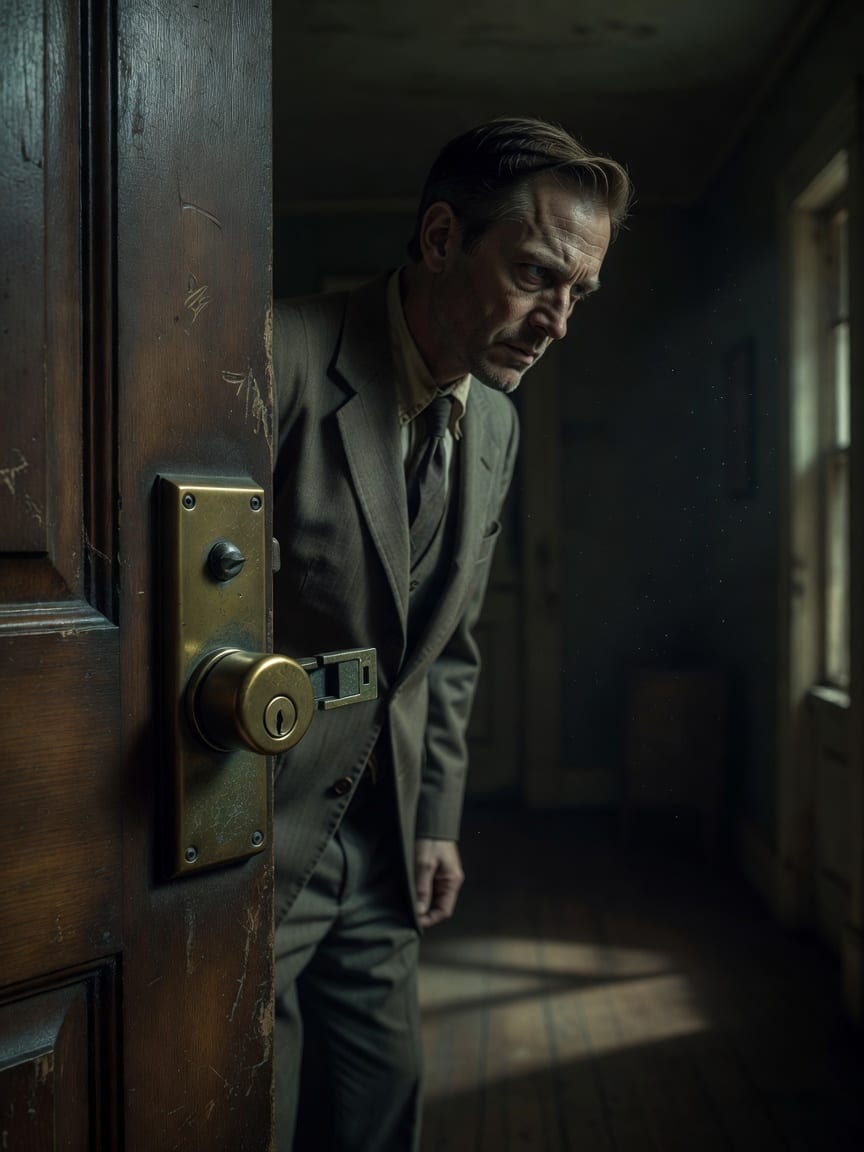
My deadbolt clunks shut from inside every night, long after I'm asleep. I live alone, and I've never heard it drawn back.
Inheriting Great-Aunt Lydia's house felt like a fresh start, until the nightly clunk of the deadbolt from downstairs started. I live alone, but every evening, the front door locks itself from the inside. Now, I’ve found Lydia’s meticulously kept calendar, with a 7 PM 'Deadbolt Check' written for tonight, a year after she died.
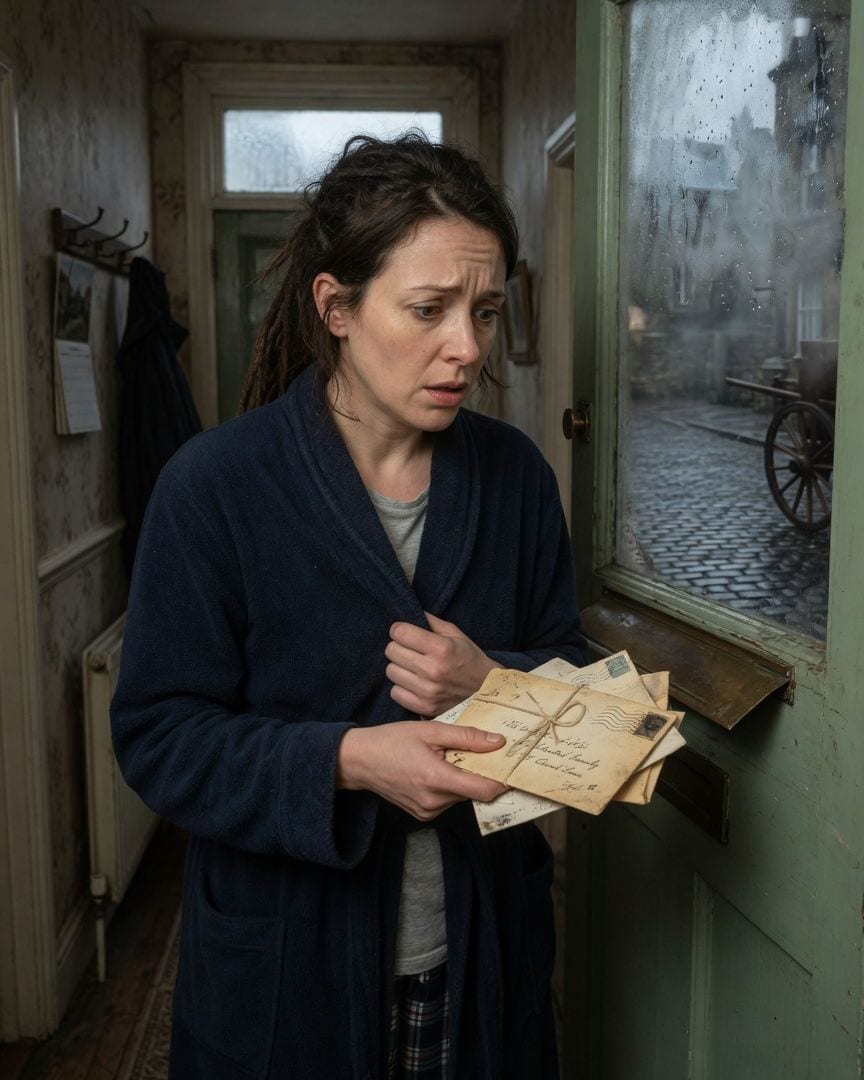
Seventy years ago, a hidden journal recorded my door opening to the wrong street and receiving Lockwood post.
I'd only recently moved into my inherited house, a quiet place on the edge of town. One grey morning, a distinct clatter from the front door's post flap caught my attention. Reaching down, I expected my gravel path, but instead, the flap showed a dark, cobbled street that wasn't mine. A bundle of warm, old letters, addressed to 'The Lockwood Family,' slid through, before the vision flickered and was gone.
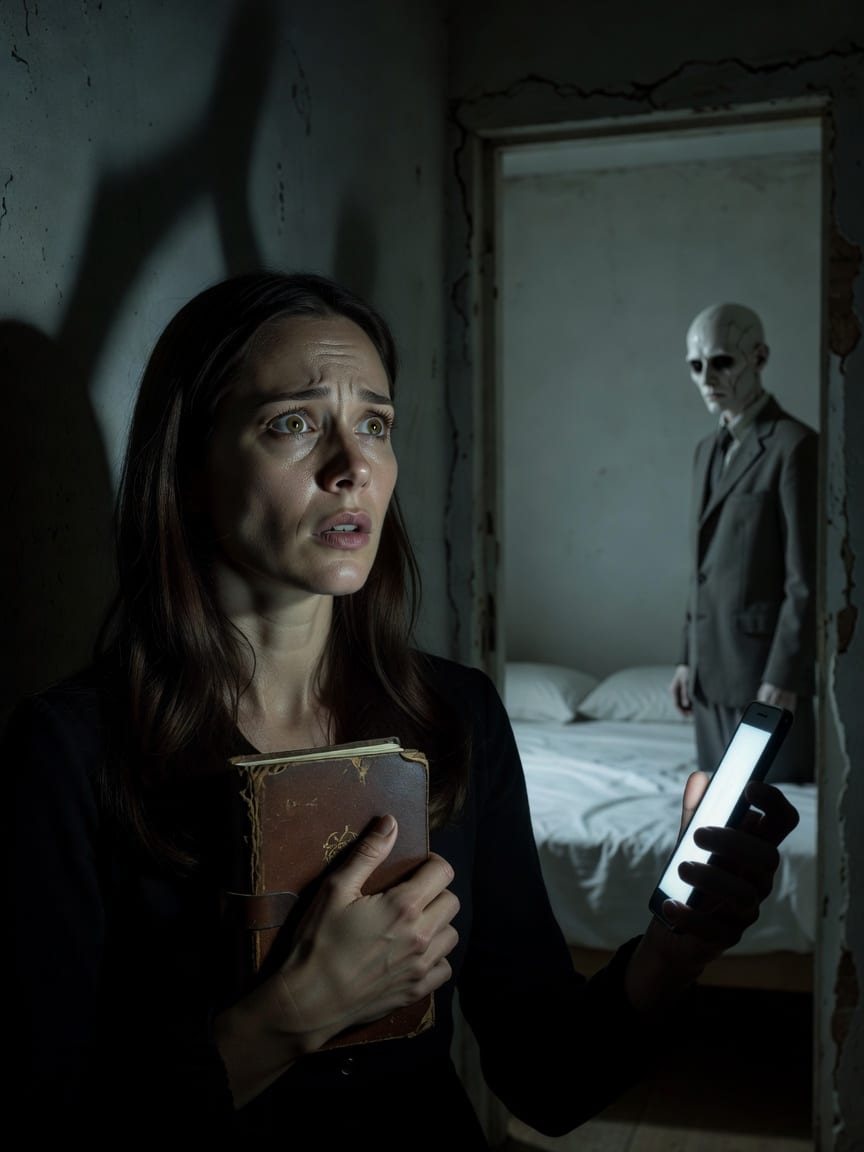
Behind a plastered-over doorway, I found a room. Papered, carpeted, and furnished with a made bed, sealed for decades. The air was dead still, but the bed wasn't dusty. My council tax bill only lists five rooms.
I'm Claire, an architect, meticulously planning my new Victorian terrace renovation. But when I uncovered a hidden room behind a wall, everything I knew about time and decay shattered. The bed was perfectly made, the air still, yet there was no dust, only an unnerving cold.
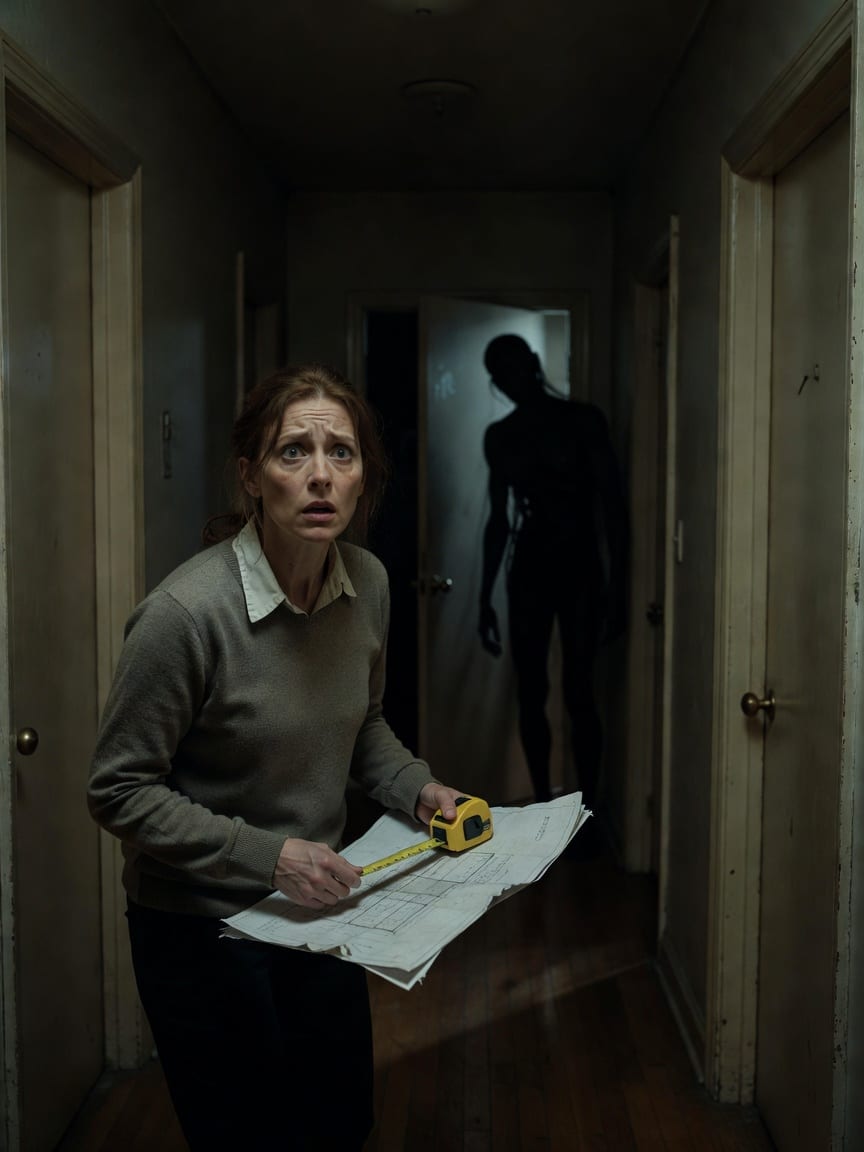
My front door has a dented gate and a dead hydrangea. I walked past it six times, trying to reach the corner shop just a hundred yards away. The pavement kept bringing me back to my own porch, and the shop's light never moved.
My morning started like any other, a quick walk to the corner shop from my home at Number 14, Elm Terrace. But after walking what felt like two minutes, I found myself back at my own front door, the shop no closer. I tried six times, faster and slower, but my street kept compressing, refusing to let me leave.
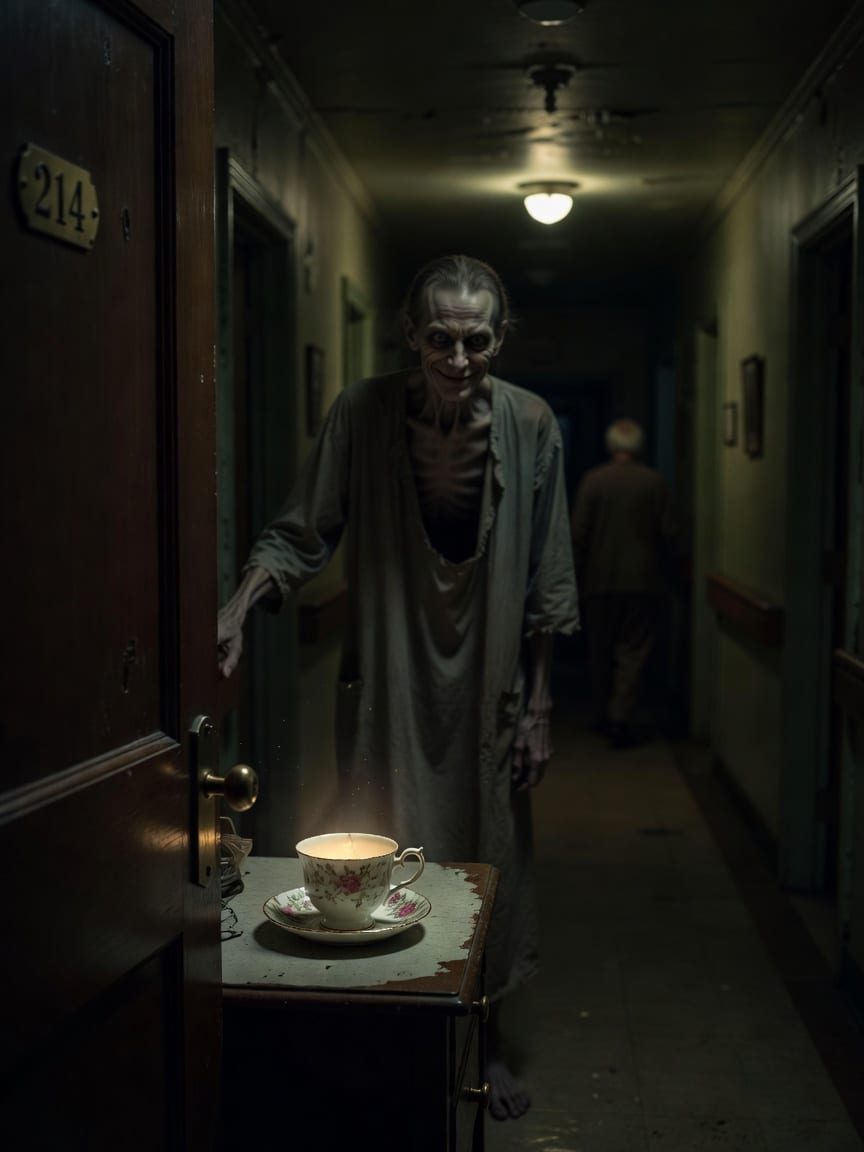
Every 3:30 AM, old Mr. Pryce shuffles past my hospice desk. He smells of lavender, asks for tea. My day nurse says he discharged four months ago. His room has been empty since.
As a night desk attendant, I'm used to the quiet routine of the hospice, especially Mr. Pryce's nightly cold tea request. But then the day nurse told me Mr. Pryce was discharged four months ago, and Room 214 has been empty since. Now, his floral teacup sits on the bedside table, still faintly warm.
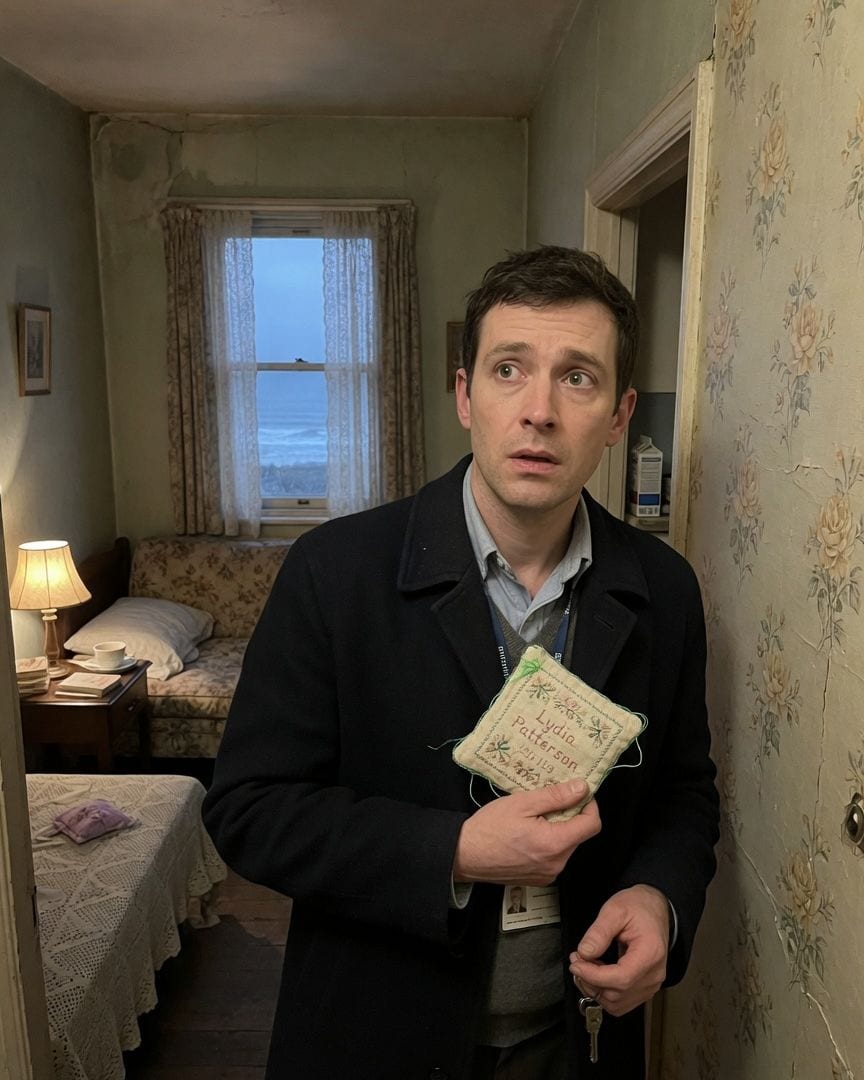
The 'empty' almshouse I was auditing wasn't empty. I heard a bare foot *thump-thump* from next door.
My new charity role involves auditing the supposedly 'empty' almshouse units. But from the unexplained activity outside to a fresh carton of milk inside, something is deeply wrong. Then, in one unit, I found a dead woman's sampler with a jarringly new thread, and heard bare feet thumping next door.