A transfer station archivist, six days from retirement, found 1968 aerial photos of a valley already a lake. Maps from 1967 labeled it a 'hydrological anomaly'.
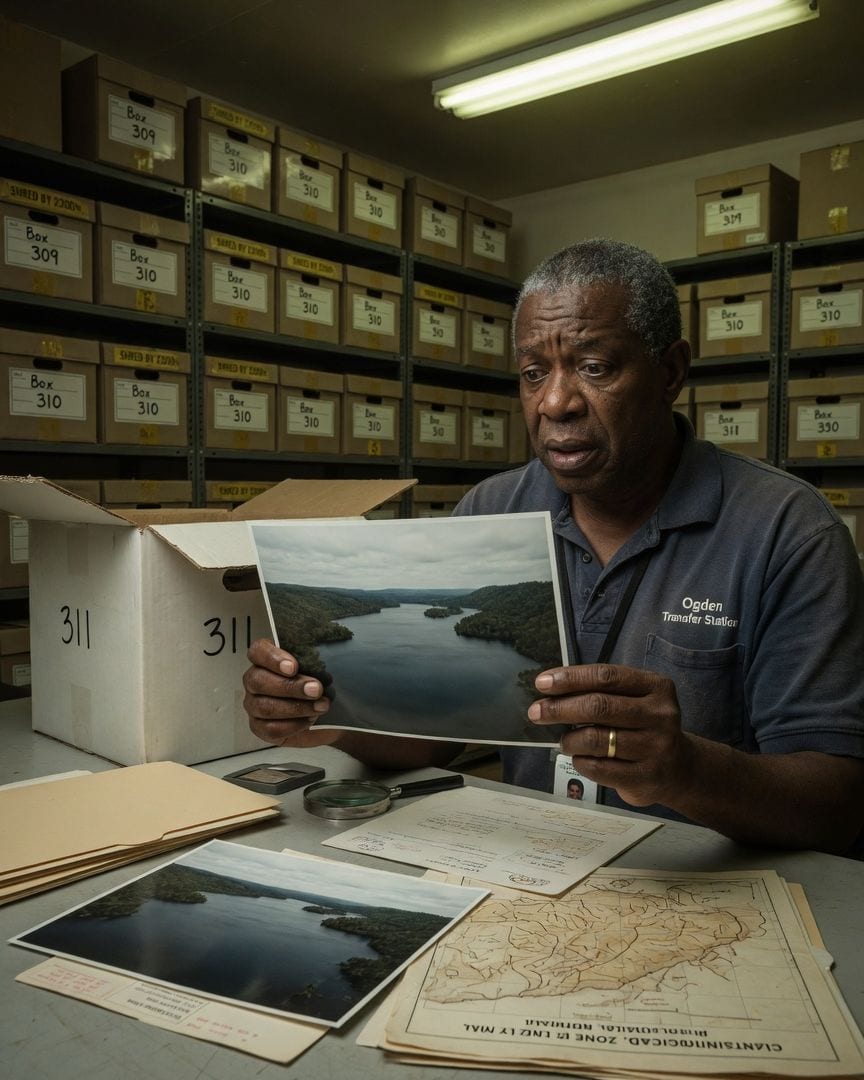
Wilmot Achebe, just six days from retirement, sliced carefully through the thick tape sealing Box 311.
The air in the Ogden transfer station, a place he’d called his second home for thirty years, was cool, dry, and perpetually smelled of old paper and dust.
This was his last rotation, a quiet, methodical march toward a well-earned finish line. Box 311 was one of hundreds awaiting the shredder’s maw, an anonymous container of historical ephemera destined for oblivion.
Inside, nestled beneath a layer of packing foam, a folder marked 'Aerial Reconnaissance - VIETNAM - 1968' caught his eye. He pulled it out, its cardboard slick and cool beneath his fingers. Ten glossy 8x10 prints lay stacked within.
Wilmot, a man accustomed to the minutiae of declassification, slid the top print free. It depicted a lush, verdant river valley, unmistakably Southeast Asian, but something was wrong. Utterly, fundamentally wrong. The valley was completely submerged.
Water, still and dark, lapped at the highest ridges, mirroring the overcast sky. He checked the stamp on the back: 'CLASSIFIED, 1968, INITIALED: R. Caldwell.' He flipped through the remaining frames.
Each one showed the same impossible sight: a drowned valley, a placid, expansive lake where no lake should have been. He knew this valley.
It was the site of the Xayaburi Dam, a massive hydroelectric project completed eleven years later, in 1979. The water in these 1968 photos was too high, too calm, too absolute for a seasonal flood.
This was a permanent body of water. A lake, a full decade before the dam was even built.
Wilmot, whose career was a testament to precise cross-referencing and logical order, felt a prickle of unease. A misfile, surely? A mislabeled box? He pulled up the Ogden transfer station's digital catalog.
Box 311 was listed generically: 'Miscellaneous Vietnam-era Reconnaissance - Destroy by shredding, 2300h, 08/17/XX'. No specific contents were detailed, just a blanket instruction to obliterate.
He checked the precise coordinates printed on the back of one of the aerial photos against known dam projects. The coordinates matched, perfectly, the Xayaburi Dam in Laos, officially completed in 1979. There was no ambiguity.
He reached for his magnifying glass, a tool as familiar as his own hand, and scrutinized the 1968 stamp on the photo. The ink was embedded in the paper fibers, clearly original, not a later addition.
The shadows in the frame, cast long and low by the afternoon sun, agreed with the stated time of day, consistent across all ten prints.
He found Frances Delaney, a senior archivist whose desk was piled high with similar boxes. She glanced at the photos Wilmot held out, her expression one of weary disinterest. 'Early survey, maybe?' she suggested, shrugging a shoulder.
'Before the final plans were drawn up?' Wilmot shook his head slowly. 'This isn't a survey, Frances. This is a lake. A fully formed lake. And the dam wasn't poured for another decade.' Frances tapped a pen against her chin.
'Unusual weather event? Localized flash flood?' Wilmot spread the photos out on her desk, pointing to the consistent water level, the calm, undisturbed surface, the sheer scale of the inundation across multiple frames taken at different angles.
'This is permanent water, Frances. Look at it. And it's in every frame from 1968.' He returned to Box 311, feeling an insistent pull, a need to find something, anything, that would make sense.
He found a slim folder at the very bottom, tucked beneath a stack of technical reports. It was unmarked on the outside, but it felt heavier than it should have.
Wilmot’s hands trembled, just slightly, as he carefully opened the unmarked folder. Inside, he found not more photos, but several brittle, oversized sheets of paper. They were geological survey maps, intricately hand-drawn, labeled in a precise, almost archaic script.
One map, dated '1967,' clearly delineated the same valley from the aerial photos. But instead of 'Xayaburi Dam Project,' the title read: 'CONTAINMENT ZONE - HYDROLOGICAL ANOMALY.'
The map showed careful depth soundings marked across the valley floor, where the 1968 photos had shown water. The lines were crisp, the ink faded but distinct.
He traced the contours of the 'anomaly' with a finger, the paper like dry skin beneath his touch. His breath caught, held tight in his chest.
The map didn't just show water; it showed a monitored body of water, dated a full year before the photos, and twelve years before the dam.
A cold, unsettling certainty settled in his gut, silencing even the distant hum of the shredders.
The next morning, Wilmot arrived at the transfer station before anyone else, the maps from the unmarked folder spread across his meticulously organized desk. He had ignored Frances’s advice to 'let it go, it’s probably just a weird misfile.'
That wasn't an explanation; it was an abdication. He spent hours cross-referencing the 'CONTAINMENT ZONE' map with other declassified documents, searching for anything that referenced a pre-existing body of water in that valley.
The map, in its upper right corner, bore a project code: 'ECHO-9.' He searched the archive’s digital catalog for 'ECHO-9.' The system yielded no results.
Then he tried the physical card catalog, a rarely used relic gathering dust in a forgotten aisle.
Under 'ECHO,' he found a single, yellowed index card, its ink almost too faint to read: 'Project ECHO - See Restricted Access Section, Sub-Level 3.'
Sub-Level 3. Wilmot knew of it, of course. It was a sealed, uncataloged area of the archive, a vault within a vault, rumored to contain documents too sensitive, too ancient, or too perplexing for public consumption.
Access required a specific, high-level clearance Wilmot didn’t possess, and had never encountered in his long career. He approached Frances again, the ‘ECHO-9’ reference on the index card a contrast to the casual paperwork on her desk.
She frowned, her usual dismissiveness replaced by a flicker of genuine unease. 'Sub-Level 3? That’s… not for us, Wilmot. That’s for the really cold stuff, the stuff that never sees the light of day.'
He pressed her, explaining the impossible chronology, the pre-dam lake, the containment zone. She sighed, her gaze distant. 'You know, Arthur Merritt worked on the Xayaburi. Original project team. Retired now, geological surveyor.
Arthur would know if there were any… anomalies, any reason for pre-dam surveys like that.' Wilmot made a note, the name etched into his mind.
His remaining five days felt less like a countdown to retirement and more like a ticking clock to some unknown deadline. He knew now this wasn’t a misfile. This was a deliberate, deeply buried secret.
The very air in the archive felt heavier, pressing down on him.
Wilmot tried accessing Sub-Level 3’s digital access logs, only to find them digitally purged after 1995. A dead end.
He called Arthur Merritt, a brusque, retired man of 62, who agreed to meet for coffee at a diner on the outskirts of town. Merritt was initially dismissive, swirling his lukewarm coffee. 'Pre-dam surveys?
No, son, the valley was dry as a bone until we broke ground in ’74, started filling ’76.' Wilmot pushed the 1967 'CONTAINMENT ZONE' map across the Formica table. Merritt’s face went pale.
He studied the map, tracing lines with a trembling finger, his gaze fixed on the meticulous depth soundings. 'This… this isn’t ours,' he murmured, his voice hoarse. 'And it’s too accurate.
The hydro-lines, the sub-strata markers… only a handful of people would know this level of detail.' He looked up at Wilmot, his eyes wide and clouded. 'Where in God’s name did you get this?'
Merritt then warned him, his voice dropping to a near whisper. 'Drop it, Wilmot. Some things are better left buried, son. Especially if they’re still leaking.'
As Wilmot left the diner, he noticed a dark sedan parked across the street, its windows tinted to an impenetrable black. A figure sat obscured inside. It hadn't been there when he arrived.
He dismissed it as paranoia, a byproduct of Merritt’s unsettling words, but the feeling of being watched lingered, a persistent chill down his spine. Back at the archive, a new wrongness awaited him.
Box 311 had been moved from his desk, resealed with fresh tape, and placed back on the shredder pallet. It was gone, almost. And then he saw it: a small, unmarked envelope had been slipped under his office door.
Inside, a single, grainy black-and-white photograph. It was a blurred, indistinct aerial image of the Xayaburi valley, dated 1963. What appeared to be a small, dark shape broke the surface of the water. Water.
Ten years before any official flooding, sixteen years before the dam.
Wilmot called Merritt again, describing the photo and the relocated box. Merritt’s voice was tight, barely above a whisper. 'They’re watching you, Wilmot. I told you.' The admission hung in the air. Merritt finally broke.
He knew about 'Project ECHO' – a whisper, a ghost story among the original dam engineers. 'It was a black project,' Merritt confessed, his words tumbling out.
'Way before my time, but the rumors… they said the valley wasn’t just dry. They said something was in it. Something that required containment, not just a dam.'
He recounted hushed tales of strange seismic readings from early surveys, unusual water samples from isolated springs that bubbled up far from the river, and local villagers 'relocated' with unusual haste in the early 60s.
'The dam was just… the final seal. The public story, the official narrative.' Merritt admitted he had seen similar 'containment' maps once, briefly, during his early career, in a secure vault within the Department of Geological Survey.
They had been 'reclassified into oblivion,' he’d been told. He described a specific, heavy, sealed microfiche reel, labeled 'ECHO-9: Geohydrological Anomaly - Permanent Containment Protocols.' This was the artifact Wilmot needed, the key.
He realized the 'unmarked folder' he had found in Box 311 was a deliberate leak, placed there for someone like him to find. The 1968 photos weren’t a misfile; they were a progress report.
The 1967 map wasn’t an anomaly; it was the blueprint. The 'dam' was the cover-up. The dread solidified in his gut: the institution didn't make a mistake; it had engineered a permanent lie.
He knew now that the shredder queue wasn't just for old papers; it was to bury the evidence of an ongoing secret, a secret that had persisted for decades, quiet and deadly.
Wilmot, now fully aware of the surveillance, used his remaining two days to meticulously search for any mention of 'ECHO-9' in the personnel records – not for the project itself, but for anyone associated with it.
He specifically looked for 'relocation' files from the valley area in the early 1960s. He felt a chilling certainty that this was connected. He found a binder labeled 'Project ECHO - Support Personnel & Relocated Civilians - 1960-1965.'
His hands were shaking as he opened it, the weight of the old paper almost overwhelming. Inside, he found lists of names, addresses, and 'reasons for relocation.' Most entries were vague: 'economic displacement' or 'voluntary resettlement.'
But one entry stopped his breath, freezing him solid. Under 'Family Unit: Achebe,' he read: 'Achebe, Wilmot - Dependant. Date of Birth: 03/12/1965. Status: Relocated to Ogden, UT.'
Below it, a handwritten note in red ink: 'Ongoing observation protocols initiated for all dependents.' His own name. His own birthday. The location of his childhood, his career, his retirement.
It all snapped into horrifying focus, a tapestry woven from deception and impossible dates.
He looked up from the page, the dim archive lights suddenly feeling like a spotlight, harsh and unforgiving, the hum of the shredders a distant, hungry growl. He was not just investigating the file; he was in the file.
He was part of the secret. And it had been watching him his entire life.
The realization hit Wilmot like a physical blow, stealing the air from his lungs. He wasn't just a random clerk on the cusp of retirement; he was an unwitting subject, placed, observed, perhaps even guided.
He quickly reviewed his own personnel file, finding subtle inconsistencies he had never noticed before: 'recommendations' for specific departments at opportune moments, 'mentorships' that seemed too perfectly timed.
His entire career path, leading him to this very archive, to this very shredder queue, felt orchestrated, a predetermined journey towards this precise moment of discovery.
He understood now that the 'unmarked envelope' with the 1963 photo wasn't a warning, but a test, or perhaps a subtle nudge, a pre-calculated prod to ensure he found the buried truth.
The 'leak' in Box 311, he saw, had been a controlled event.
He knew he couldn't escape, not truly. He had become part of the ongoing file, a living, breathing component of Project ECHO. His only option was to ensure the truth, or at least a trace of it, survived the shredder.
He found the microfiche reel Merritt had described, hidden in a forgotten sub-level vault accessible only by an archaic, manual crank system that groaned with disuse.
He loaded it into an equally ancient, specialized microfiche reader, its green light illuminating the dust motes dancing in the cold air.
The reel contained detailed geological surveys, seismic activity logs, and grainy underwater photographs from the early 1960s, showing not just the flooded valley, but a vast, black, geometrically impossible structure partially exposed on the lakebed.
The structure was clearly not natural, certainly not man-made, and in some frames, it pulsed with a faint, internal light.
The logs detailed increasingly desperate attempts to 'stabilize' and 'contain' its emissions, which correlated precisely with the 'unusual hydrological activity' and the 'relocation protocols' of the valley's inhabitants.
The Xayaburi Dam, he understood, was built not just to cover the water, but to permanently entomb the anomaly and its effects, to seal it from human sight and memory.
Wilmot now understood the purpose of Box 311: a controlled release of information to a 'tested' individual, perhaps to ensure the secret's continued vigilance, or simply to observe his reaction.
He knew he couldn't escape; the file was too vast, too deeply ingrained. He had become part of the ongoing record.
His only option was to ensure the truth, or at least a trace of it, survived the shredder's final, hungry bite.
He carefully duplicated key microfiche frames using the antique reader's internal camera, saving them to a small, unmarked USB drive – a modern counterpoint to the archaic technology.
As he worked, the archive’s lights flickered, then dimmed, plunging parts of the vast room into shadow. He heard the heavy thud of footsteps approaching his section, slow and deliberate, echoing in the sudden quiet.
He knew it wasn't Frances, nor a security guard.
He finished copying the last frame – a close-up of the impossible structure, its surface strangely iridescent, a texture that defied earthly origins. The footsteps stopped just outside his cubicle. A shadow, long and silent, fell across his desk.
He looked up. Standing there was a tall, unsmiling man in a dark suit, perfectly still. The man didn't speak, but his gaze was unnervingly calm, his eyes seeming to hold an ancient, patient knowledge.
Wilmot realized this man was 'the one who knew,' the living embodiment of the institution that filed away lives and histories, that engineered lakes and secrets.
The man gestured subtly towards the shredder pallet where Box 311 now sat, resealed, awaiting its final destruction, the hum a low growl in the dimming light.
Wilmot held the encrypted drive tight in his hand, his heart pounding a frantic rhythm against his ribs. He knew he could not escape. He could only choose what to do with the truth he held.
The next day, Box 311 was shredded, as scheduled. Wilmot Achebe did not report for his final day of work before retirement. His colleagues assumed he’d simply started his new life early, perhaps overwhelmed by the anticipation of freedom.
Frances Delaney found his desk meticulously cleared, save for a small, unmarked USB drive tucked beneath his keyboard. She picked it up, feeling a strange coldness from the plastic, then slipped it into her pocket, intending to return it later.
The dark sedan was no longer parked across the street from the transfer station. Life in the archive continued, the hum of the machines constant, the endless flow of paper arriving, being processed, and then, always, disappearing.
Frances, curious about the strange coldness of the USB drive, eventually plugged it into her personal laptop at home. The drive contained only a single file, an image.
It was a grainy black-and-white photograph, an aerial shot of a flooded valley, dated 1963. Beneath the water’s surface, a faint, impossible geometric shape was visible. The image was unsettling, but Frances couldn’t quite place it.
She showed it to her husband over dinner. He peered at the screen. 'Huh. Looks like that old dam, doesn’t it? The Xayaburi. But that’s too early.' Frances nodded slowly. 'Yeah, too early.'
She thought of Wilmot, of his quiet intensity in those last few days. She felt a faint, almost imperceptible chill, a whisper of understanding. She tried to open another file on the drive, but there were none.
Just that one impossible image, waiting. The screen flickered for a moment, and then the image changed, subtly.
The geometric shape on the lakebed seemed to shift, to expand, a new, tiny detail now visible on its surface: a small, almost imperceptible human figure, standing motionless. It was Wilmot. He was still in the file.
If this one got to you
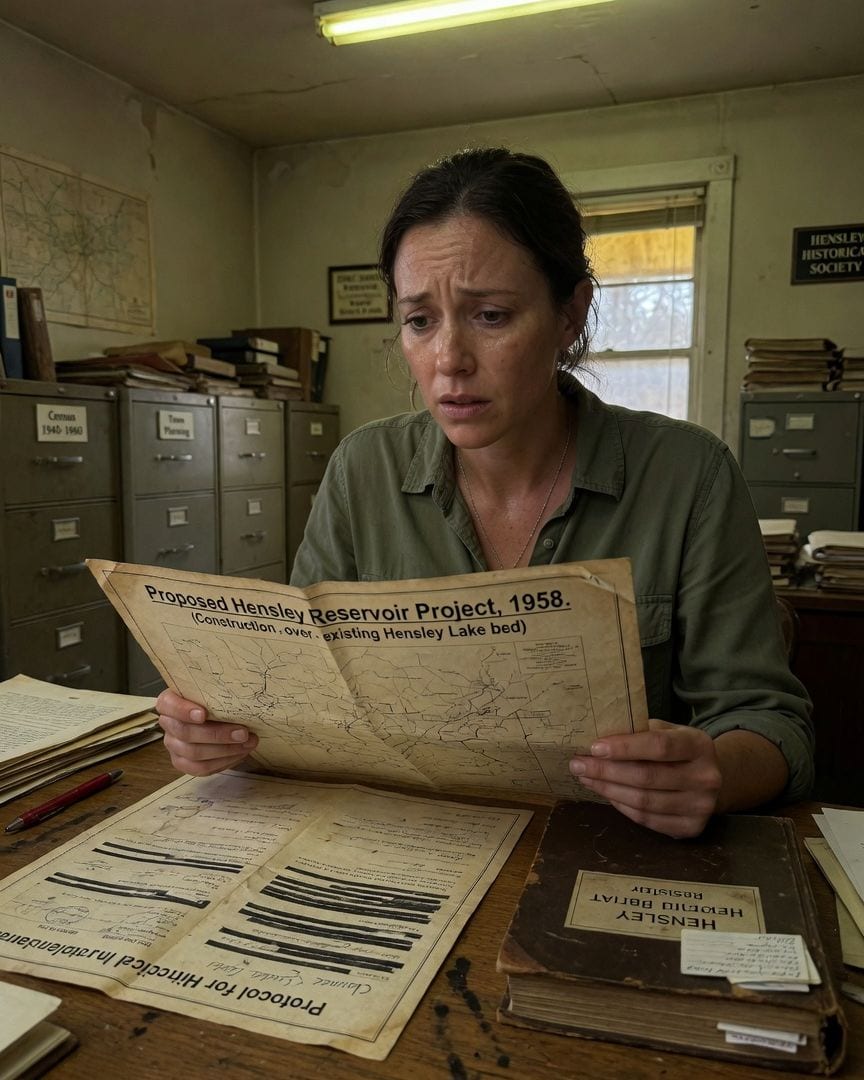
Our town reservoir was finished in 1961. But the old church records show forty-one people drowned in that same reservoir, all decades before it was ever built.
I moved to Hensley, a quiet town where everyone proudly mentioned its reservoir, built in 1961. As a history buff, I found the old parish burial register. It listed 41 people who drowned in 'Hensley Reservoir' between 1903 and 1959, decades before the town says it even existed.
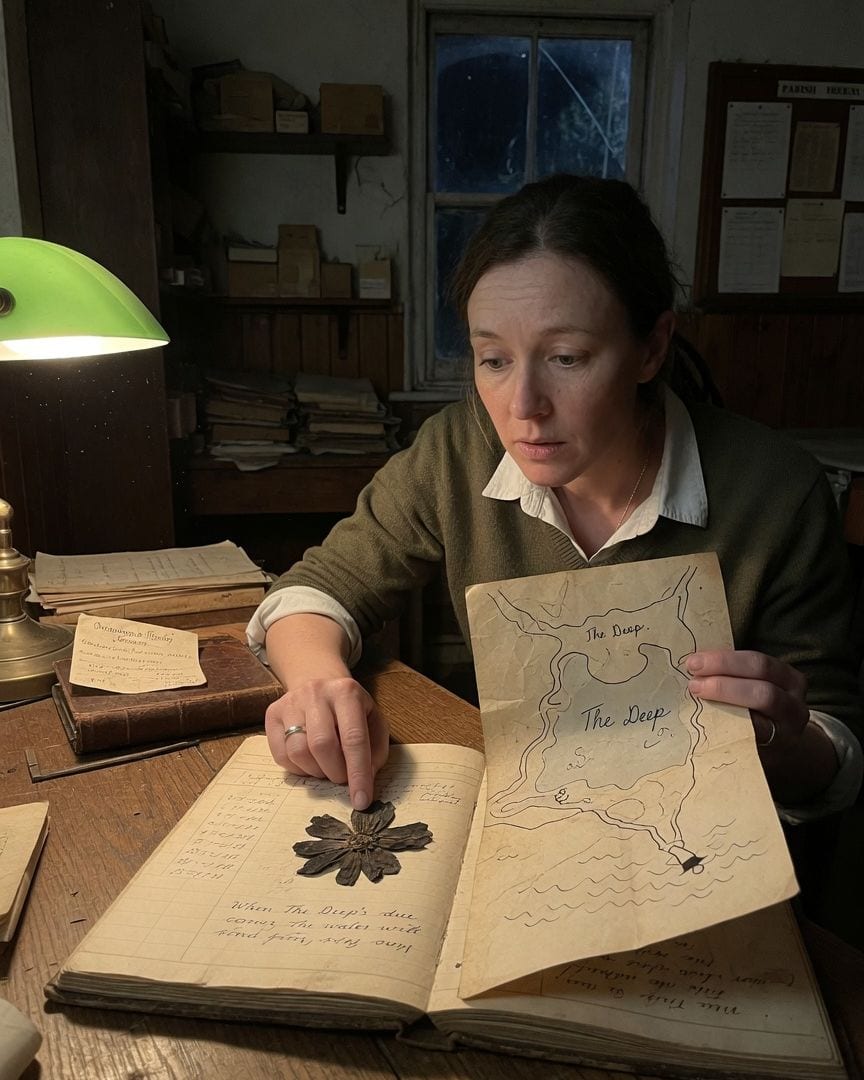
My new town's reservoir opened in '61. Its burial register lists forty-one drownings, all dated before the water was there.
I moved to Hensley for its quiet, where the local reservoir, built in 1961, was a point of pride. But while researching the town's history, I discovered an old burial register listing 'Drownings in Hensley Reservoir.' To my shock, all 41 names were dated decades before the reservoir even existed.
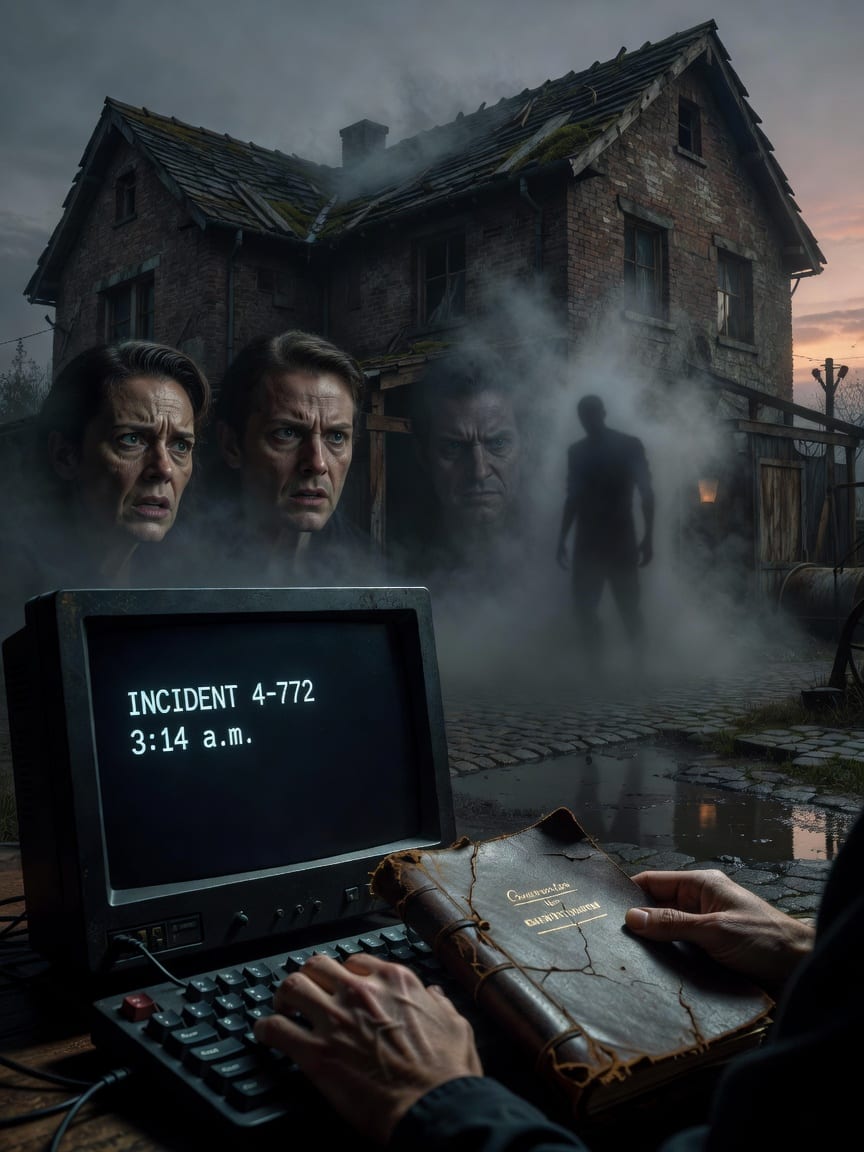
My screen showed Incident 4-772: a fire at the old rope works, 3:14 a.m. It was logged again for 1980. Then 1967. And 1993. Same incident, same time, same building. Each report ended with the same three words: 'expect recurrence.'
As a new archivist, I usually found my work digitizing old fire service records monotonous, until I found a heavily redacted line in a 1961 site assessment. Faint letters beneath the black bar slowly revealed my own family name, DRUMMOND, dated years before I was even born.
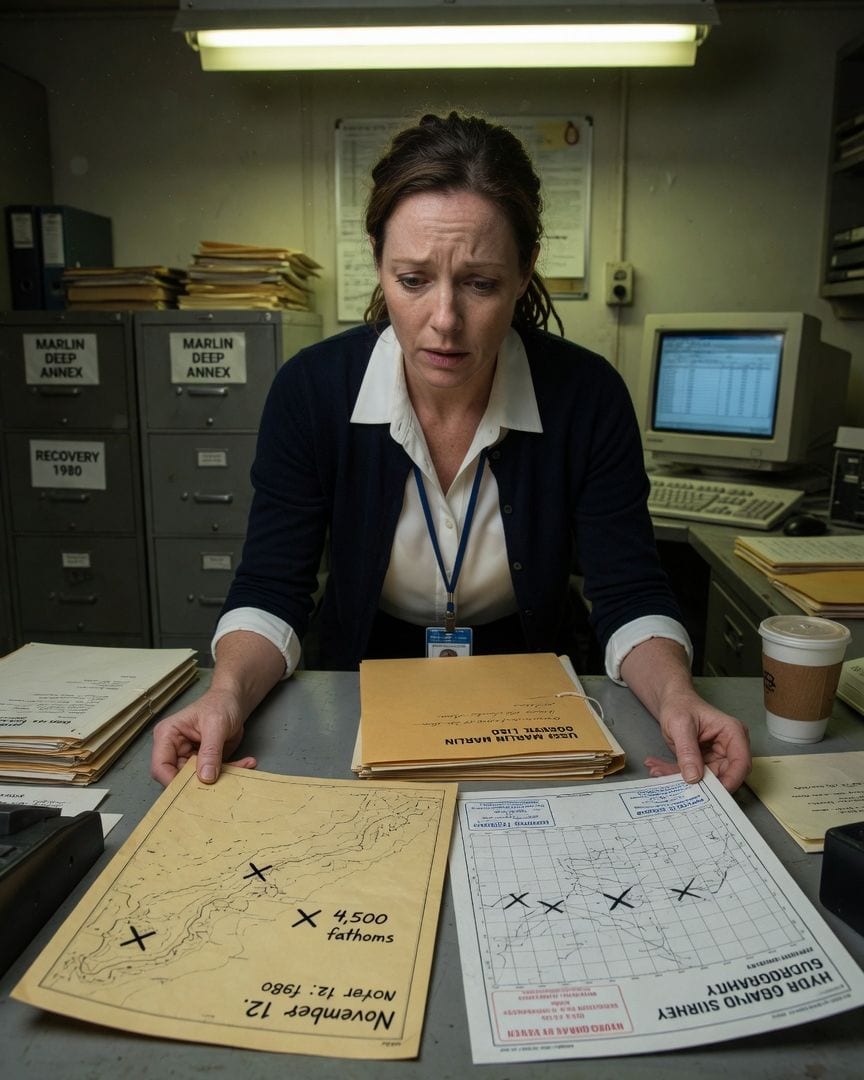
A Navy records reviewer found a Cold War captain’s own hand-drawn map, marking his submarine’s location two years after it vanished.
In the quiet, cold Navy archives, records reviewer Catherine Berrigan unearthed the sealed file of the USS Marlin Deep, a Cold War submarine lost with all hands in 1978. Decades of unanswered pleas from Captain Caldwell’s widow, Dorothy, filled the binder, seeking closure for her husband’s vanishing. But among the tragic records, Catherine found a crudely hand-drawn map, dated two years after the sub was declared lost, marking its exact deep-ocean location. The captain’s own distinct handwriting on the chart left her with a chilling, impossible question: how could he have charted his own wreck two years beyond the grave?
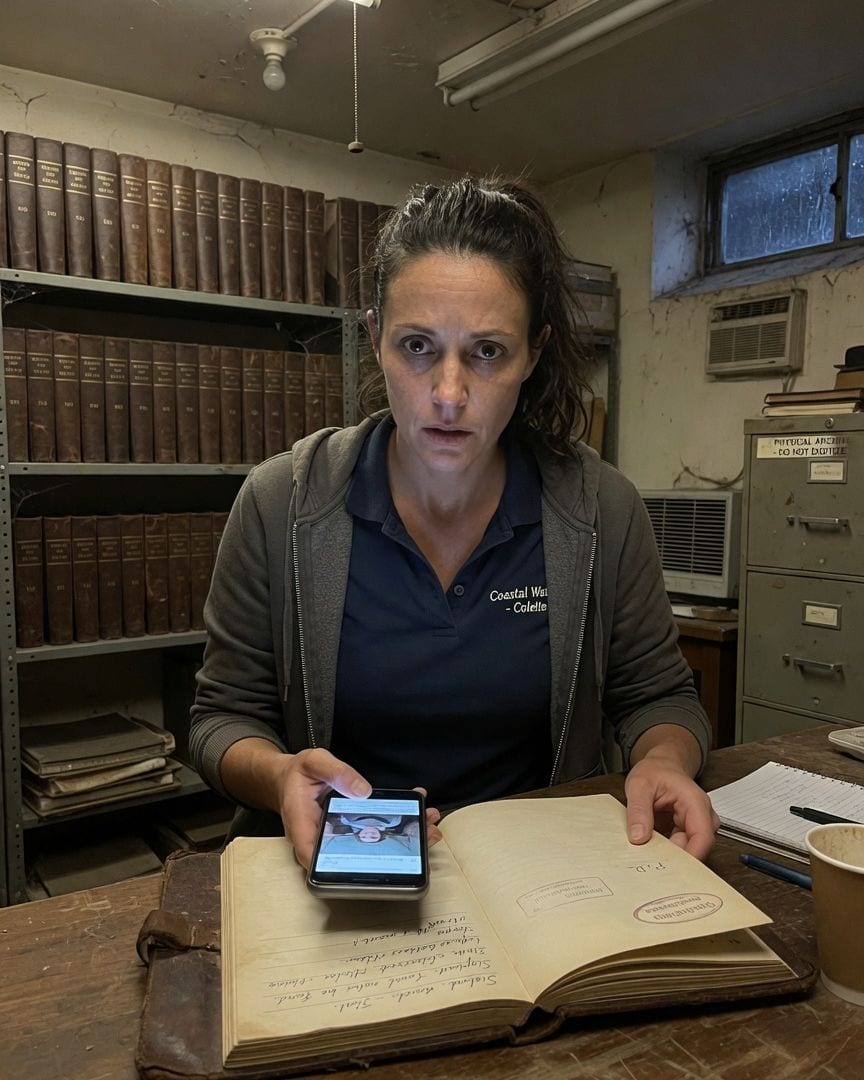
My coastguard log noted Sighting 9 again tonight, a light where no vessel showed. The old logs carry Sighting 9 off Skerry Point at 3:14am every tenth year since 1954, always 'nothing found,' always 'send no boat.'
On my watchtower night shift, the radar screen glowed green and the ocean was quiet. Then, a familiar light appeared off Skerry Point, exactly on cue, just as it had every tenth year for decades. But digging deeper, I found a hidden stamp in an old logbook: 'Operation Skerry. Status: Complete.' It left me with a chilling sense of finality.
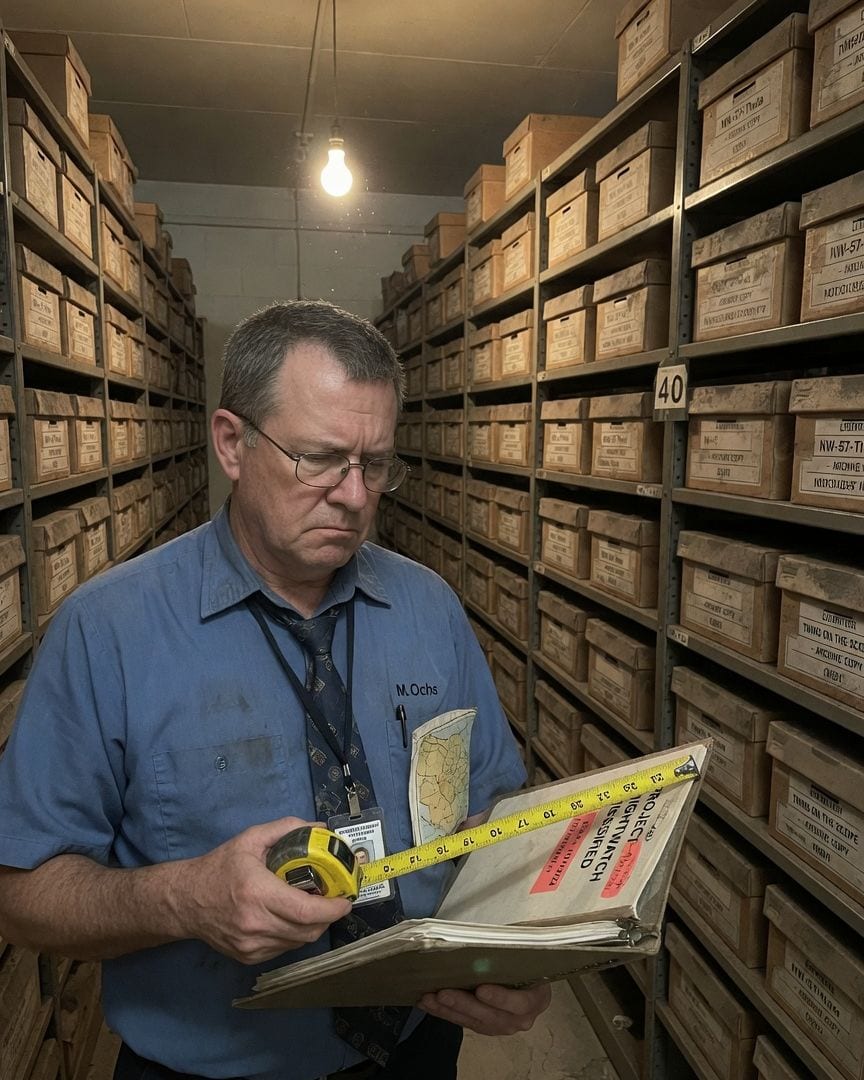
A Cold War records clerk on his final patrol found Aisle 40 stretched 61 feet longer, lined with unknown boxes. Inside one: 'PROJECT NIGHTWATCH - CLASSIFIED' with a fresh timestamp.
Marlin Ochs, a creature of habit after nineteen years at the St. Louis federal records depot, faced his final patrol through Aisle 40 before its scheduled pulping. His routine walk, usually 92 precise strides, suddenly stretched to an impossible 119, making the aisle 61 feet longer than its blueprint. The extra section felt colder, lined with dust-laden boxes bearing alien classification codes and no manifest. Inside one, he found a metal-bound file: 'PROJECT NIGHTWATCH - CLASSIFIED,' dated 1957, but with a timestamp just hours old.