A Cold War records clerk on his final patrol found Aisle 40 stretched 61 feet longer, lined with unknown boxes. Inside one: 'PROJECT NIGHTWATCH - CLASSIFIED' with a fresh timestamp.
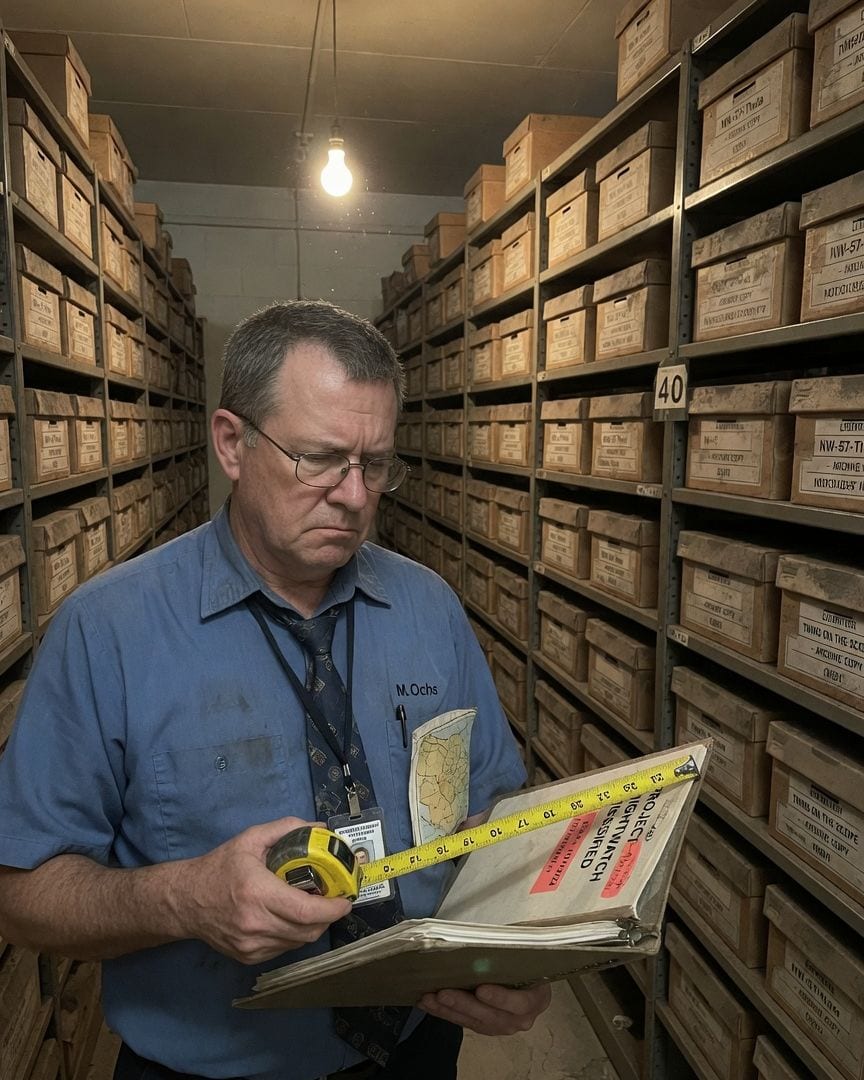
Marlin Ochs, 58, was a creature of habit and precision. For nineteen years, his shift at the St. Louis federal records depot had ended with the same ritual: a methodical walk down Aisle 40.
Every step was ingrained, every detail known. Tonight, however, was different. The aisle was scheduled for pulping on Friday, and this was his final patrol.
He started at the entrance, counting the familiar 92 strides wall to wall, exactly as the creased 1956 floor drawing in his pocket dictated.
But as he reached the far end, retrieving the final carton marked for destruction, his count had stretched to 119. A small, dry frown creased his forehead.
He pulled out his worn, metal tape measure, the numbers faded but still sharp, and extended it along the dusty concrete floor. Three hundred and forty-one feet.
He measured it twice, then a third time, each reading settling on the same impossible number. The building plat, which he’d carried since his first week, stated two hundred and eighty feet.
At the very end of the aisle, a single bare bulb glowed with a faint, persistent hum, casting an unchanging, sterile light. It always had. Its light never dimmed, its switch never found.
He’d tried to locate it years ago, tapping along the wall, searching behind shelves, but it seemed to exist outside the depot’s electrical grid, a small, unyielding star at the end of a vast, silent space.
Marlin tried to rationalize it. Old blueprints often contained errors, or perhaps a surveyor’s oversight had gone unnoticed for decades. Maybe there had been a recent, undocumented expansion, though the depot hadn’t added a single square foot in decades.
Its aging concrete skin had been static for as long as he’d worked there. He walked to Aisle 39, then Aisle 41, re-measuring both. Their lengths matched their plats perfectly, down to the inch. He returned to Aisle 40.
The impossible length remained. It was simply… longer. As he walked the additional sixty-one feet, the space felt different, colder, the air stiller.
He noticed the boxes lining this ‘extra’ section were distinct from the others, older, covered in a thicker layer of dust.
Their classification codes were unfamiliar, alien, not appearing in any current manifest or even the decades-old supplementary logs he had access to.
He reached for one, a plain brown carton, identical in size to hundreds he’d handled, but its weight was unsettling, as if filled with lead. It wasn't on any manifest, internal or external.
There was no return address, no sender, no destination listed. Just a blank, unsettling neutrality that defied the logic of a records depot. His rational mind struggled to reconcile the physical evidence with the known facts of his world.
Marlin opened the unmarked carton. Inside, beneath layers of mundane, outdated government forms—receipts for typewriter ribbons from 1962, requisition forms for carbon paper from forgotten departments—he found a single, heavy, metal-bound file.
Its cover was cold to the touch, colder than the depot’s refrigerated archives. Stamped across its front in bold, black letters were the words: "PROJECT NIGHTWATCH - CLASSIFIED." The official date was 1957.
But beneath it, in a different, starker ink, was a precise, recent timestamp, just hours old.
He opened it to a single page: a radar log detailing an impossible aerial intercept over the Great Lakes, an object designated "THING ON THE SCOPE." Beneath the log, a second stamp blared: "DECOMMISSIONED - NEVER EXISTED."
Marlin took the file, its cold, unyielding weight a constant presence in his bag, a physical reminder of the impossible. Back in his small, cluttered office, he tried to search for "Project Nightwatch" in the depot’s internal database.
The system returned zero results, not even a classified entry. It was as if the project, the name, had simply never existed in the digital world.
He approached his supervisor, Theodore Brooks, 65, a man whose desk was a monument to cross-referenced paper, buried beneath stacks of ledgers and manifests.
Marlin mentioned the discrepancy in Aisle 40, framing it as a structural anomaly, a curious architectural quirk that might need to be noted for the pulping demolition.
Brooks, without looking up from the thick, leather-bound ledger he was poring over, dismissed it as an old measurement error or an architectural quirk, a common enough thing in buildings of their age.
But Marlin caught a fleeting flicker of unease in Brooks's eyes, a quick tightening around the mouth that belied his casual tone.
During his lunch break, Marlin used his personal laptop to cross-reference the radar log’s coordinates and dates from the "Nightwatch" file with publicly accessible declassified military archives.
He found no public record of the specific incident, but he discovered oblique references to similar "unexplained radar anomalies" in other declassified documents from the same era, always with crucial information redacted or entirely missing.
A chilling pattern emerged: specific military units involved in these anomalies were consistently "reassigned" or "decommissioned" shortly after the incidents, their personnel scattered and untraceable, their careers ending abruptly, their very presence in the armed forces vanishing from public record.
Marlin began staying late, ostensibly to clear out his section before the impending pulping, but in truth, he was trying to access deeper archive levels for any mention of Project Nightwatch.
The depot, usually a quiet tomb of paper after hours, felt subtly different, charged with a new, unseen energy.
He noticed a new security camera had been installed, almost imperceptibly, high on the wall, positioned to offer a direct, unblinking view of Aisle 40.
The feeling of being watched became a constant, low thrum at the back of his mind. One night, a light came on in Theodore Brooks’s office, long after everyone else had left.
Marlin, peering through the glass partition, saw Brooks at his desk, hunched over a printout—a manifest of Aisle 40, open to the very end of the impossible length. Brooks stiffened, then slowly turned, his eyes meeting Marlin’s through the glass.
The air seemed to hold its breath. Brooks quickly closed the file, his face pale and drawn, a fear Marlin had never seen before etched into his supervisor’s features.
The next morning, Brooks stopped Marlin by the time clock, his usual brusqueness replaced by an unnerving solemnity. "Ochs," he said, his voice unusually firm, almost a command, "I'd advise you to focus on your own duties.
Leave the old records where they lie." Later that day, Marlin found a post-it note stuck to his locker, its vibrant yellow a contrast to the dull gray metal.
The handwriting was neat, anonymous, and unsettlingly precise: "Some things are better left filed." There was no signature.
The post-it note solidified Marlin’s resolve. The vague warnings, the subtle shifts in Brooks's demeanor, the impossible length of Aisle 40, the redacted files, the missing personnel—it all coalesced into a single, undeniable wrongness.
He confronted Brooks in his office, closing the heavy door behind him with a decisive click. The air in the small room felt dense, charged. "What does 'filed' mean, Theodore?" Marlin demanded, his voice low and strained.
Brooks blanched, his face paling even further. "Marlin, I told you—" "You told me nothing," Marlin interrupted, his hand slamming the metal-bound 'Project Nightwatch' file onto Brooks's desk. The clang echoed in the sudden silence. "This. And Aisle 40.
What is this place, really?" Brooks stared at the file, then at the floor, his shoulders slumping. He slowly sank into his chair, looking like a man carrying the weight of decades. "Aisle 40...
it's always been different," he admitted, his voice barely a whisper, thin as old paper. "This depot isn't just a record storage facility. It's a 'holding facility' for things that… never happened. Things that were… unhappened."
He explained that certain events, usually involving impossible phenomena like the "Thing on the Scope," were designated "decommissioned." Their records, and sometimes their participants, were shunted into a sub-level beneath Aisle 40. "The 'extra' length you measured?"
Brooks continued, gesturing vaguely towards the floor with a trembling hand. "It’s a physical manifestation of a spatial anomaly, a pocket where these records are kept. Where they… are made to be kept."
He confirmed the "Thing on the Scope" incident was real, one of the first they "filed." Brooks looked genuinely terrified, his eyes wide and vacant, filled with a deep, weary knowledge, implying a much darker truth lay beneath his words.
The room, usually stifling, suddenly felt freezing cold.
Brooks, now visibly shaking, leaned forward across his desk, his voice hushed and urgent. "The pulping of Aisle 40... it was delayed for decades. Not for budget, not for paperwork.
They were waiting for something specific to be placed in it." He swallowed hard, his Adam’s apple bobbing. "The system isn't just archival, Marlin. It's active."
He reached into a hidden compartment beneath his desk, a small, camouflaged panel that blended seamlessly into the aged wood.
He pulled out a small, leather-bound ledger, its pages yellowed with age but its binding surprisingly intact, almost new in its robustness. He flipped through it, his finger tracing lines of neat, official script.
It was a list of current depot employees, with dates and times next to their names. Marlin’s heart hammered against his ribs, a frantic drum in the silent office. Brooks’s finger stopped on a recent entry.
Marlin's own name, "Marlin Ochs," was written there, clear as day. Next to it, in the same neat, official hand, was tomorrow's date. And then, the word: "FILED."
Marlin snatched the ledger, his fingers closing tightly around the surprisingly soft leather. "What does 'FILED' mean, Theodore?" he demanded, his voice a guttural whisper, tight with a terror that had finally broken through his rational shell.
Brooks flinched, then looked up, his eyes meeting Marlin's with a terrible, profound resignation. "It means... not just archiving events. It means removing individuals. From existence."
He explained that the St. Louis depot was a covert operation, run by an unknown entity or organization under the guise of a federal records facility.
The "spatial anomaly" in Aisle 40 was a gateway, not just for documents, but for people.
Individuals whose lives intersected with "decommissioned" events, or who got too close to the truth, were "filed"—they simply disappeared, their records rewritten, their existence erased from all public and private memory.
The pilot and crew from the "Thing on the Scope" incident? "Filed," Brooks confirmed, his voice devoid of emotion.
Brooks himself, he revealed, had been slated for filing decades ago but had escaped by becoming an "operative," monitoring the system, ensuring its continuity, a prisoner in exchange for his continued, if altered, existence.
He showed Marlin a series of logs in the ledger, dating back generations, detailing similar disappearances, all linked to "Project Nightwatch."
The sheer volume of names, the chilling consistency of the process over so many years, was overwhelming, each entry a quiet, efficient execution of a life. The institution, Brooks claimed, had known, and been doing this, for centuries.
Brooks, now desperate, grabbed Marlin’s arm, his grip surprisingly strong. "We have to destroy the ledger, or at least get it out of here. The pulping... it’s a cover for a full 'reset' of the system.
You’re slated to be the final entry before they wipe the slate clean." As they moved towards Brooks's office door, the overhead fluorescent lights flickered violently, buzzing like trapped insects, then stabilized, though the office remained dim.
In the distance, the strange bare bulb at the far end of Aisle 40 glowed brighter, pulsating with an eerie, sickly green light, its hum growing louder, deeper.
A low hum started then, vibrating through the concrete floor, a deep resonance that shook Marlin to his bones, a sound that seemed to emanate from the very foundation of the building. Brooks shoved the ledger into Marlin's hands.
"Run, Marlin! Get out!" As Marlin turned to flee, the heavy steel door to Brooks's office slammed shut with a deafening clang, shaking the wall where a framed photo of the depot's first manager hung askew.
Marlin heard a muffled cry from inside, quickly followed by an abrupt, terrifying silence, swallowed by the rising hum. The hum intensified, a physical pressure against his eardrums, vibrating through his teeth.
Marlin ran, the ledger a leaden weight in his arms, sprinting towards the emergency exit at the opposite end of the vast main floor. He glanced back over his shoulder.
The far end of Aisle 40 was now shrouded in a shimmering haze, the green glow from the bulb consuming the space, distorting the rows of shelves into blurred, hungry teeth.
He felt a sickening lurch in his gut, a powerful, invisible pull, as if the building itself was trying to draw him back into its impossible dimensions.
He burst through the emergency exit door into the cool, damp night air, the hum abruptly cut off behind him, replaced by the mundane sounds of distant traffic.
Marlin Ochs was never seen again. No missing person report was ever filed. The St. Louis depot was officially decommissioned and demolished the following week, its pulping completed without incident, its secrets buried under a wave of concrete and dust.
No trace of Theodore Brooks was ever found within the rubble, nor was his existence mourned by any official record.
The demolition crew reported odd measurements and structural inconsistencies in the foundations of the old Aisle 40 section, quickly dismissed as quirks of an aging building, nothing unusual for a structure of its vintage.
The ground where the depot once stood was paved over for a new parking lot, a bland expanse of asphalt covering whatever secrets lay beneath.
The city moved on, unaware of the quiet disappearance of two men and the facility that had filed them away.
Years passed, the memory of the St. Louis depot fading into bureaucratic history.
At a different federal archive, in a city far to the east, Grace Winslow, 42, a meticulous records clerk, was sorting through a newly arrived box labeled "MISC. ST. LOUIS DEPOT REMNANTS."
Among the dusty, forgotten ephemera—old rubber bands, faded paper clips, a broken stapler—she found an old, leather-bound ledger. Curious, she opened it to a random page. It was a list of names.
She saw "Marlin Ochs," with a date, and the word "FILED." A shiver traced down her spine. Idly, she flipped to the next page. Her own name, 'Grace Winslow,' was written there, with today's date, and the word 'OPEN.'
If this one got to you
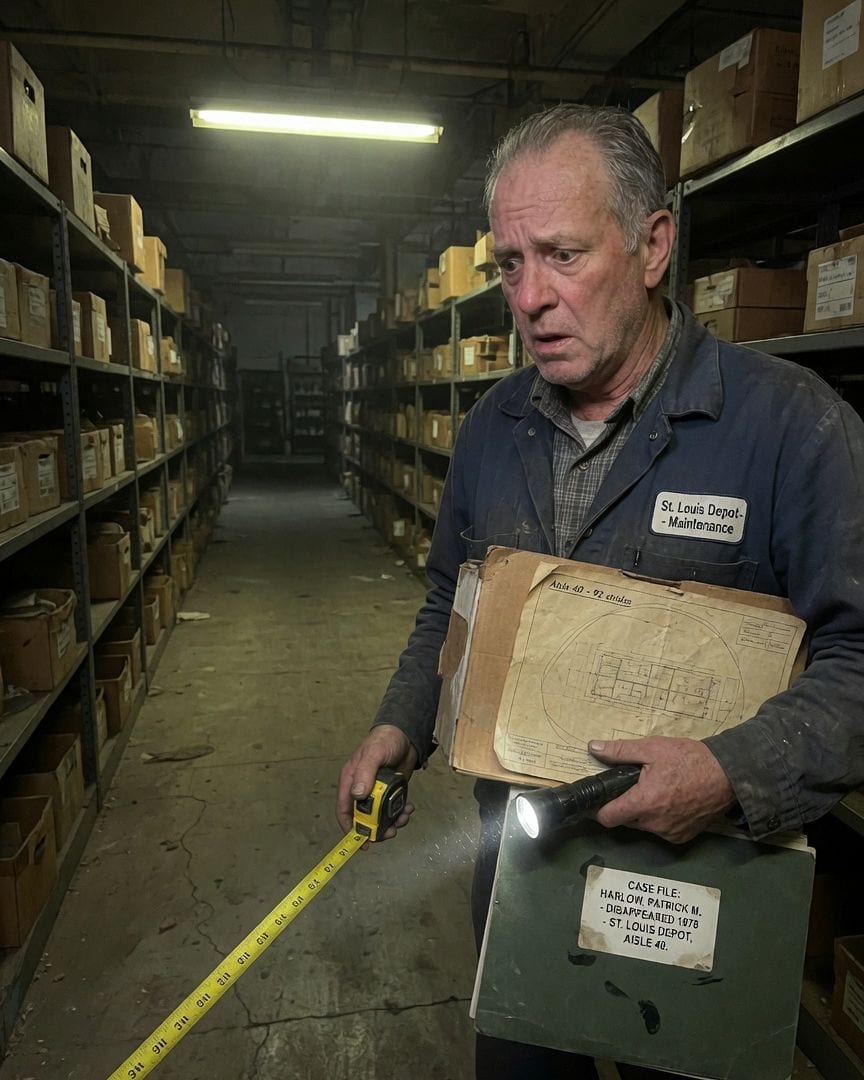
On his last shift before the Cold War St. Louis depot closed, Marlin Ochs found Aisle 40 stretched 61 feet too long. Inside, a 1978 disappearance file had ink still wet, dated 'current year'.
Marlin Ochs, a 58-year-old depot worker, felt the familiar ache in his knees on his last shift before the St. Louis depot was pulped. For nineteen years, he’d walked Aisle 40, 92 strides wall to wall, a quiet ritual in the vast silence. Tonight, retrieving the final carton, his foot hit concrete where the wall should have been, but there was no wall. He kept walking, counting steps, into a physical space that could not exist. Deep within this impossible extension, he found a thick file about a 1978 disappearance, its cover sheet dated 'current year' with ink still wet beneath his thumb.
A methodical US Army engineer found a Cold War facility's file stamped 'DECLASSIFY NEVER' — and half its pages were missing.
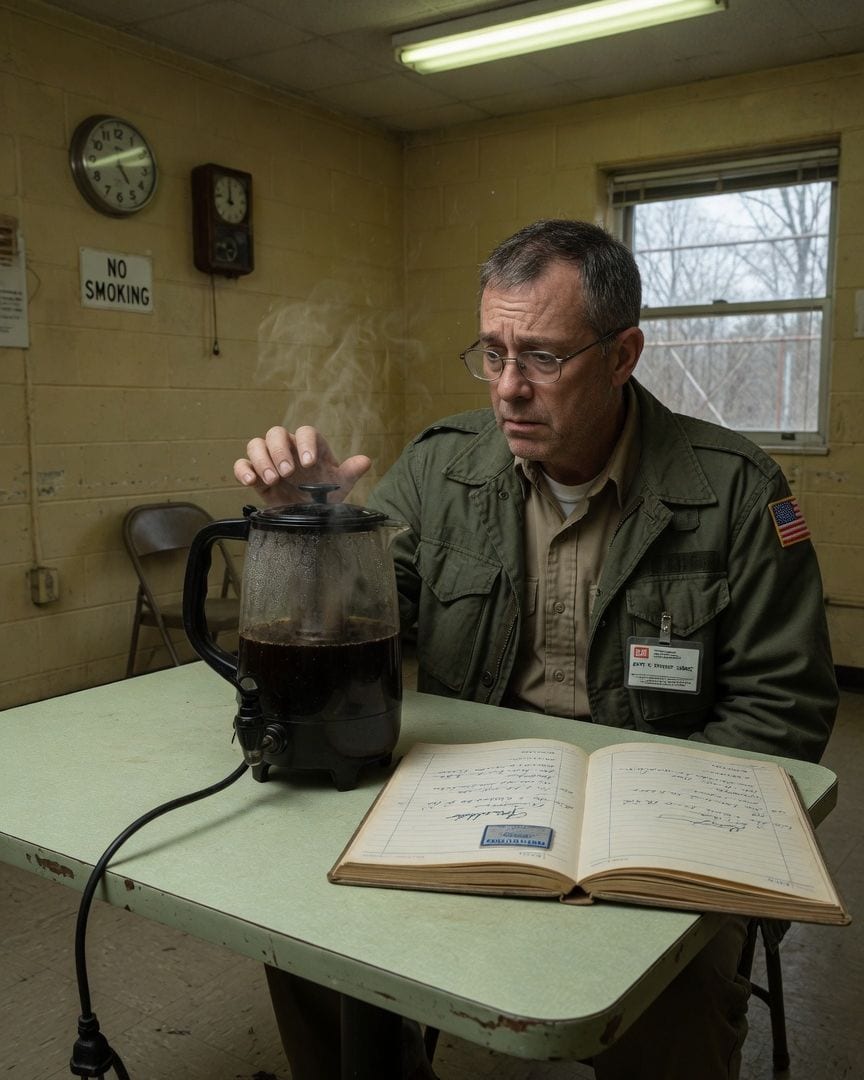
Captain Nolan Threep, a methodical US Army engineer, expected another routine decommissioning at Alert Facility Twelve in rural Montana. The chains on the doors had rusted solid since 1970, promising a long-dead site. Yet, inside, a faint warmth hung in the air, and a glass coffee urn sat half-full, a wisp of steam rising lazily from its dark surface. The urn, warm to the touch, was clearly unplugged, and the duty log beside it, signed for a shift ending nineteen years prior, looked as though it had been signed yesterday. What secret could a supposedly abandoned Cold War facility hold?
Airman Lars Stratton found an old Cold War manifest listing one name twice: 'Bernard Radcliffe' transferred and 'Bernard Radcliffe' still present.
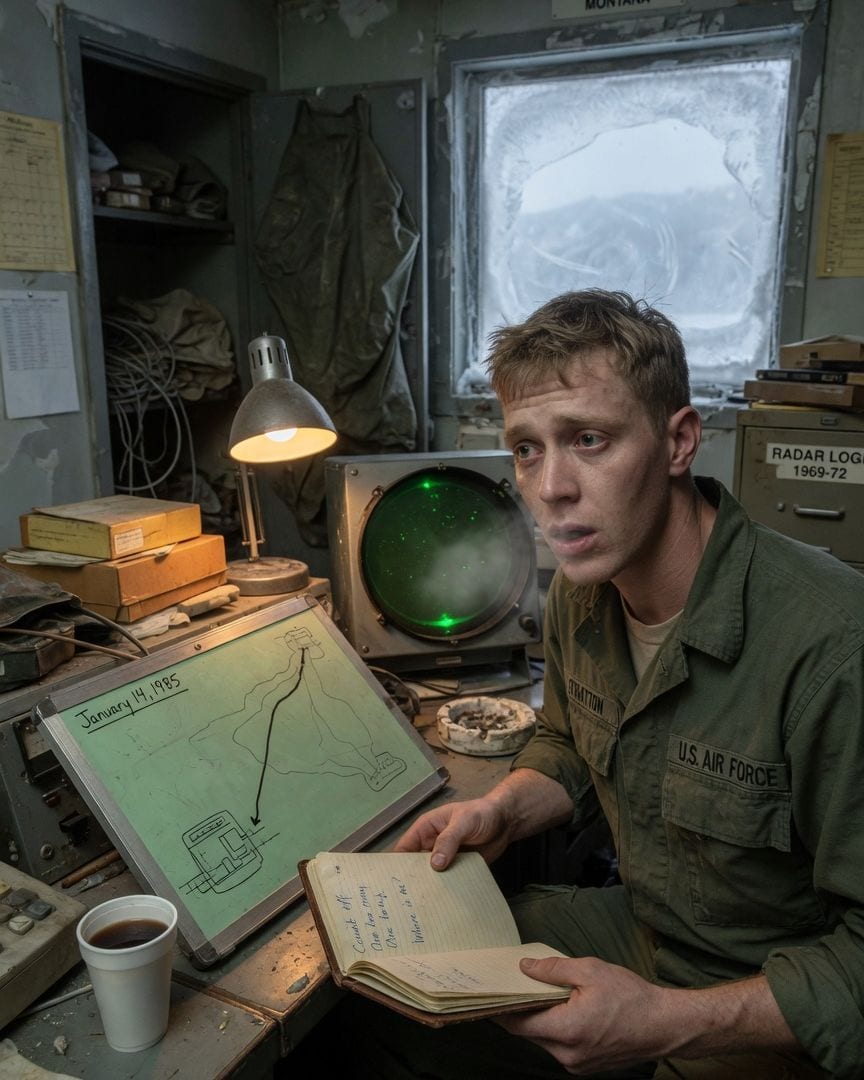
Airman Second Class Lars Stratton was counting down his final weeks at Echo Station, a desolate Cold War outpost due for mothballing. He longed for home, far from the bitter Montana winds and the constant hum of static. Inside the dim radar shack, he logged the usual nightly ghost blip, a faint contact appearing at 2300, just as it had every winter since 1987. This night, a metallic tang like old blood lingered in the air, raising the hairs on his arms. Seeking distraction, Lars later discovered a leather-bound logbook from 1971, detailing the same 2300 contact, but with chilling notes and a manifest listing one airman's name, Bernard Radcliffe, twice—once transferred, once present. Was he truly alone in the silent, remote station?
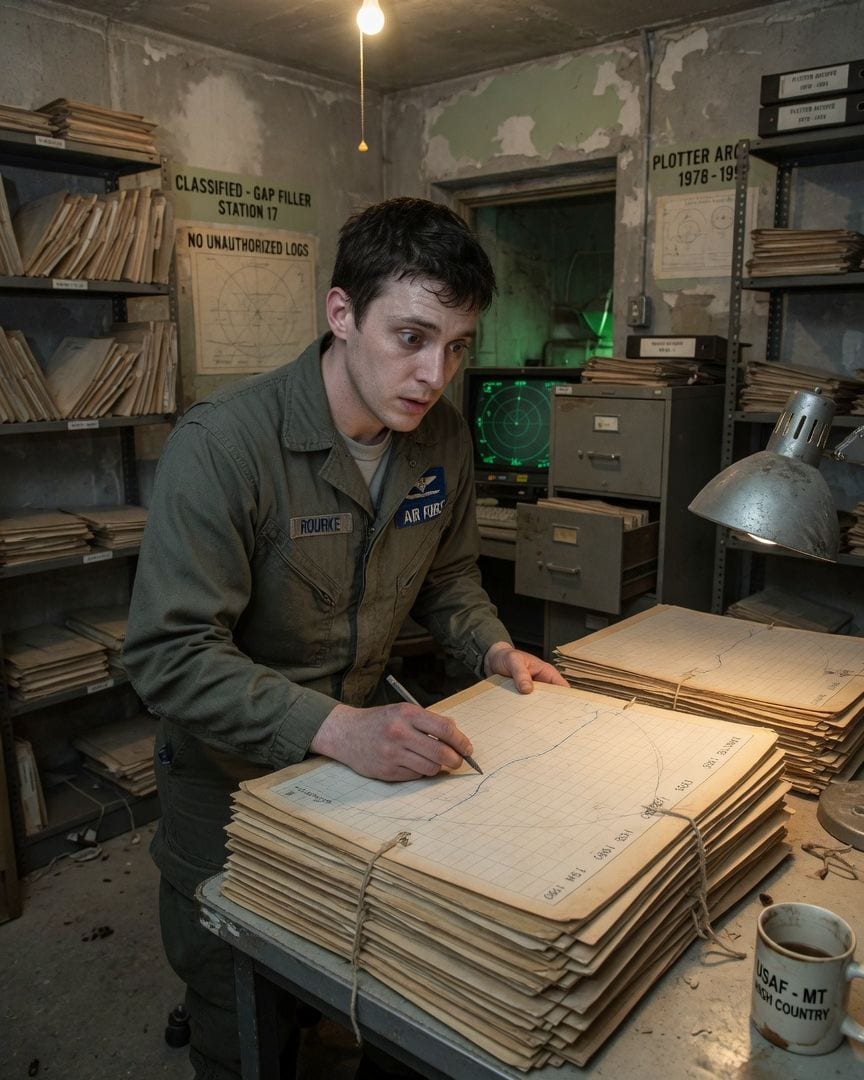
An Airman tracks a nightly radar contact. But in dusty archives, he finds old Cold War plotter boards, each showing that exact same line drawn by other airmen for three winters.
Airman Second Class Felix Rourke endured the cold, quiet nights at his isolated Cold War station, watching the perimeter radar. For three weeks, a single, slow contact appeared at 2300 hours, a precise violation of every protocol that chilled him deeply. He dismissed it as an anomaly, until a hunch led him to a forgotten closet in the dusty archives. There, he unearthed old plotter boards, each revealing the exact same impossible line drawn across the valley floor at the same hour, signed by different airmen from three consecutive winters decades ago. What impossible secret did the mountain station truly hold?
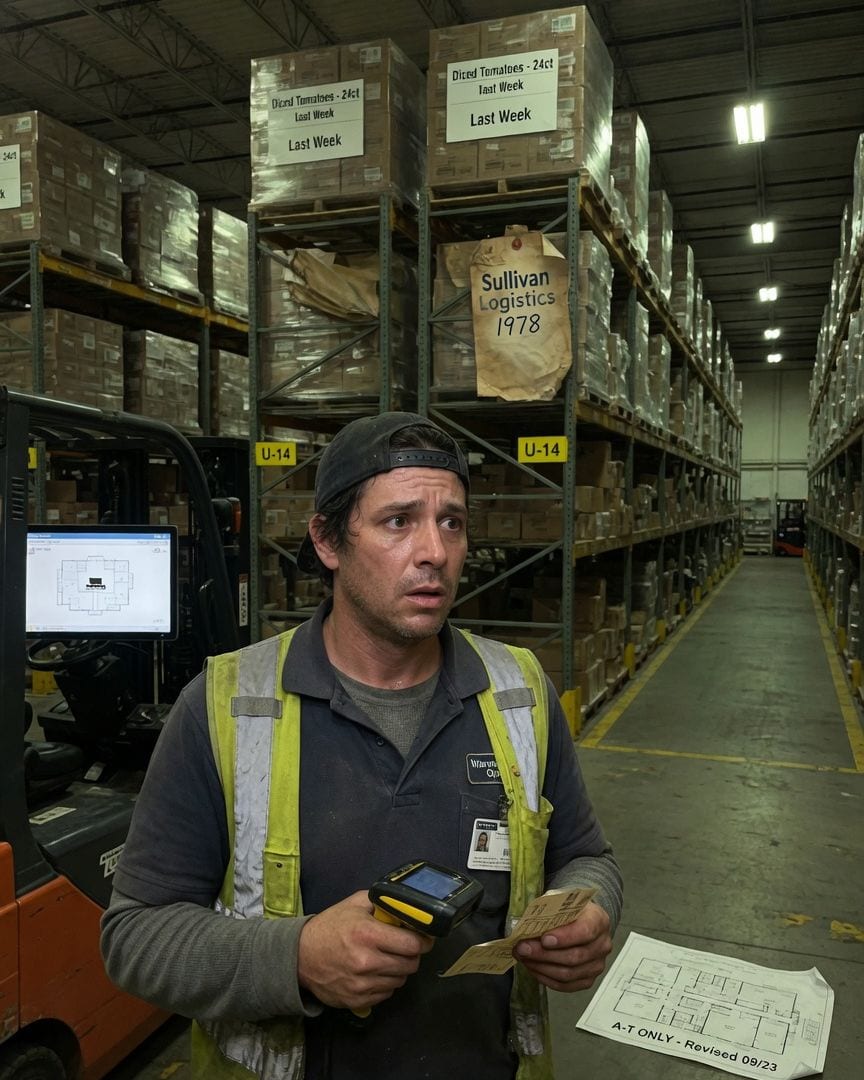
My warehouse floor has an extra aisle past the end wall. Aisle U, full of pallets for orders no one ever placed. My forklift’s GPS says I’m off the map.
On my usual night shift route, driving the forklift through the familiar warehouse aisles, I rounded a corner and found something new. Aisle U. It shouldn't exist; the building's official blueprints only go up to Aisle T. But there it was, stretching out into the dim lights, a solid, tangible section of building that wasn't on any map.
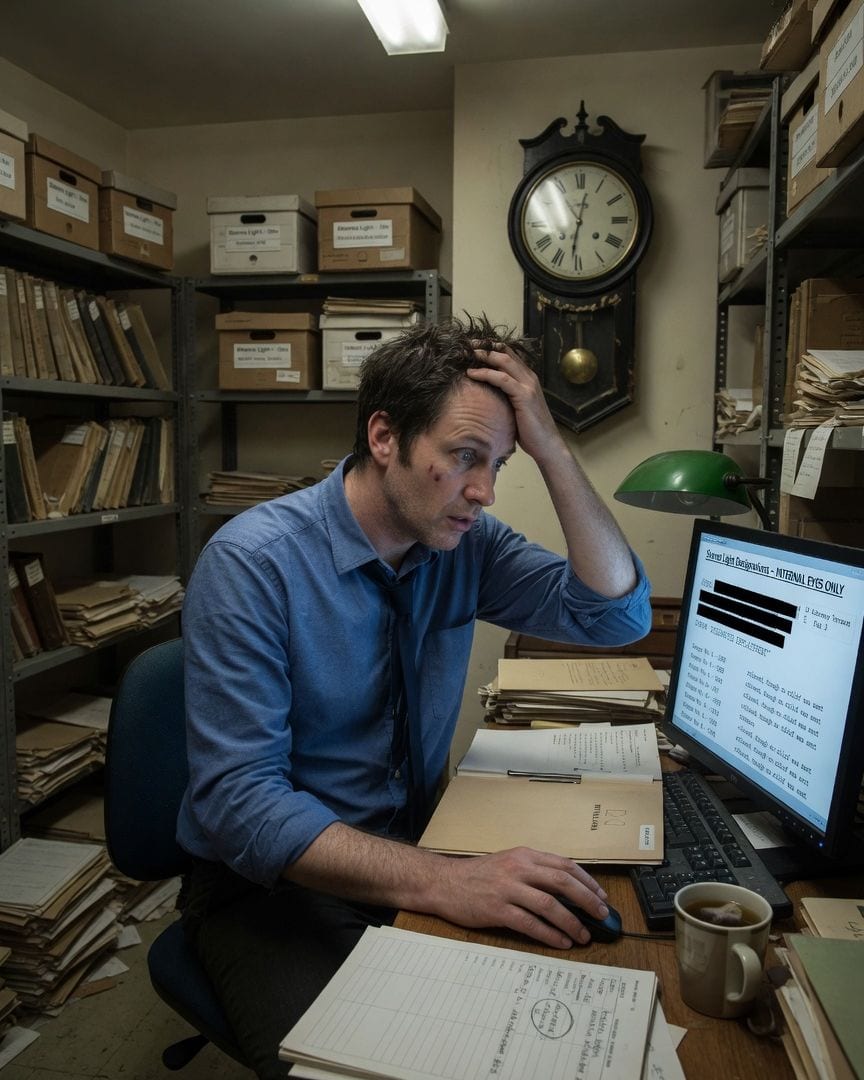
I found my street address in a century-old lighthouse file, printed decades before I lived there.
As a maritime archivist, my world revolves around forgotten lives and dusty ledgers. But the Skerne Light files broke that quiet rhythm, revealing a chilling pattern: 'Keeper number 6' relieved, though no relief was sent, repeating for decades. Now, an internal document with a strange code has led me to a redacted entry, revealing my own street address, decades before I ever lived there.