An Airman tracks a nightly radar contact. But in dusty archives, he finds old Cold War plotter boards, each showing that exact same line drawn by other airmen for three winters.
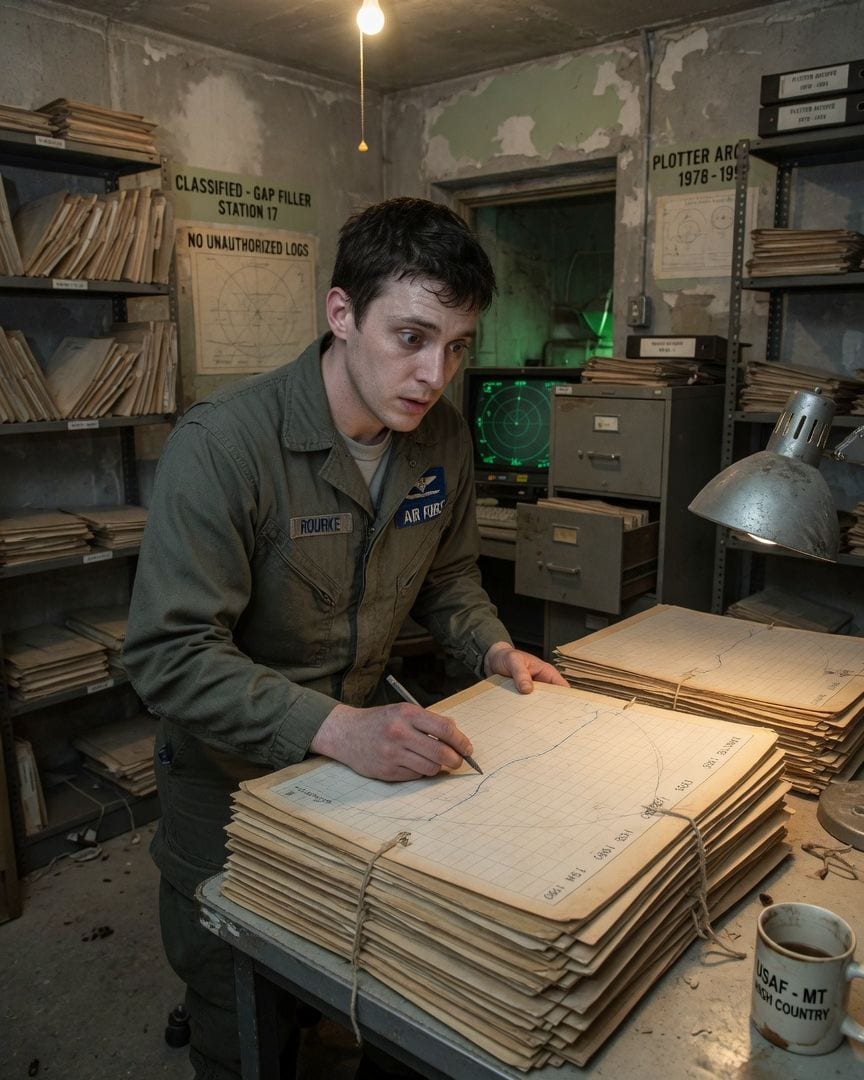
At the isolated Cold War gap-filler station in the Montana high country, Airman Second Class Felix Rourke watched the perimeter radar. It was 2300 hours, and the screen glowed with its familiar, hypnotic green.
The cold seeped through the old concrete walls, a constant presence that tightened around the small, windowless room.
For the past three weeks, every night at precisely this time, a single, slow-moving contact would appear on the valley floor, low and plodding, taking ten minutes to cross the sweep before vanishing.
It was always there, always the same, gone before any interceptor cell could be scrambled, leaving no trace.
Rourke had logged it initially as a temperature-inversion ghost, a meteorological anomaly. He’d tried to forget it, to dismiss the cold prickle he felt each time, but the contact was a precise, silent violation of every protocol.
The station’s equipment was state-of-the-art, designed to cut through atmospheric interference, yet this blip persisted. It wasn't random, it wasn't a flock of migrating birds, nor was it a glitch in the radar’s ancient circuitry.
It moved with a deliberate, almost confident pace, a shadow stretched thin across the digital landscape. Every night, the same line, drawn by an unseen hand across the empty landscape, a silent message he couldn't decipher.
The station's usual quiet hum now felt less like a mechanical thrum and more like the tense anticipation of a vast, indifferent machine.
Rourke’s battle buddy, Airman First Class Dean Vance, clapped him on the shoulder during the next shift change. Vance smelled faintly of stale coffee and machine oil. “Still seeing your ghost, Rourke?”
Vance grinned, but his eyes held a flicker of unease Rourke recognized, a common reaction to the station’s oppressive quiet.
“Every night. Twenty-three hundred, exactly. Low and slow, valley floor. Gone before it even registers as a solid track.” Rourke rubbed the back of his neck, the skin cold under his collar. “You ever seen anything like it?
Anything that regular?”
Vance shrugged, pushing a hand through his already rumpled hair. “Old man Sheppard swore this place was haunted. Said the systems sometimes ‘hiccuped,’ especially during the heavy snows. Said it was the mountain, settling or something.
But never anything that regular. Never a perfect repeat.” He leaned in, his voice dropping. “Heard some of the guys on the early shifts used to just… ignore anything that didn’t make sense. Less paperwork.”
Rourke decided to dig a little deeper than casual conversation. Vance’s offhand comment about ignoring things didn't sit right.
After his shift, instead of heading to the mess hall for the usual bland dinner, he started systematically checking the station’s archives, a dusty room usually reserved for quarterly reports and forgotten manuals.
The air in there was thick with the scent of old paper and dust motes danced in the single bare bulb's glow.
He found nothing in the digital logs for 'unidentified contacts' or 'anomalies' for the relevant timeframe, not even an erased entry. It was as if his nightly blip didn't exist, had never existed, in the official memory of the station.
But in a back corner, behind a stack of obsolete manuals that looked like they hadn't been touched since the station’s construction, he found a closet. It was unlocked, almost as if forgotten.
Inside, meticulously stacked and bound with deteriorating twine, were dozens of old grease-pencil plotter boards, yellowed with age and brittle to the touch.
Each board, dated for a specific day and year, had the radar grid hand-drawn on it in faded blue ink. Rourke picked up the top one, dated winter 1988, and his breath hitched.
On every board, for three consecutive winters, the exact same slow line was sketched across the valley floor at the 2300 mark, identical to the one he was logging now.
The handwriting changed from board to board, the strokes varying slightly, but the line never did. It was always there.
Felix Rourke stared at the stack of grease-pencil boards, the identical, slow line drawn across each one for three winters. His fingers, numb with cold, traced the faint, waxy mark on the top board.
The names of long-gone airmen – Sanders, Miller, Chen – were scrawled in the corners, their signatures confirming they had been the ones to plot this impossible, repeating contact.
Each name was a ghost, a silent witness from the past, each line a confirmation that he was not seeing things.
The hum of the radar console, faintly audible even from the archives, now filled the small room, a sound that felt less like white noise and more like a held breath, waiting to be exhaled.
The next day, Rourke approached Sergeant Judith Montgomery, the Station Chief. Montgomery was a woman known for her calm demeanor and encyclopedic knowledge of the station’s history, a rock in the otherwise monotonous routine of the remote outpost.
Her office was always impeccably neat, unlike the rest of the station which succumbed to varying degrees of dust and disarray.
“Sergeant, about the perimeter radar…” Rourke began, trying to sound casual, as if he were merely seeking clarification on a minor operational detail.
He described the nightly contact, detailing its precise timing and trajectory, then mentioned his discovery of the old plotter boards, trying to gauge her reaction.
Montgomery listened, her expression unreadable. She sat perfectly still, her hands clasped on her desk, her gaze steady and unwavering. “Ah, the ‘Montana Ghost.’ Old timers used to talk about it.” Her voice was smooth, even.
“Probably just a persistent temperature inversion, Airman. Happens sometimes in these high valleys. Nothing to worry about.”
Her dismissiveness was too smooth, too practiced. It slid off her like water from a greased pan. Rourke pressed, choosing his words carefully. “But the boards, Sergeant. I found dozens of them.
Three winters, same time, same path, every single night. That’s not an inversion. That’s… a pattern. An exact, repeating pattern.”
Montgomery gave him a tight, almost imperceptible smile, a slight downturn at the corners of her mouth that didn't quite reach her eyes. The smile didn't convey warmth or reassurance, but something else entirely, something akin to resignation.
“Some patterns are just part of the landscape, Rourke. Like the snow, or the wind. This isn’t a priority. Focus on your upcoming transfer.”
Her words were a soft warning, a delicate line drawn in the dust, indicating a boundary Rourke felt compelled to cross.
Undeterred, Rourke spent his next few off-hours pursuing the trail. He started cross-referencing the names on the old boards with the station's official personnel rosters, a task made tedious by the station’s antiquated filing system.
Most were accounted for, transferred or retired, their records clean. But a few names, from the earliest boards, those dating back to the mid-eighties, were harder to trace.
He found entries like 'Airman First Class Sanders, R., transferred under special circumstances.' 'Special circumstances' was military code for a lot of things, none of them good, and certainly nothing that suggested a straightforward reassignment.
He also noticed that the official logbooks from those early years had blank entries for the 2300-2310 timeframe, as if the contact had been deliberately omitted, or simply never reported up the chain.
The void in the official record was as stark as the line on the old boards.
Rourke continued his quiet investigation, spending his off-hours in the archives, poring over the old boards and any supplementary records he could find.
He felt an increasing sense of being observed, a subtle shift in the air whenever he was alone, as if the very walls of the station held silent eyes.
Doors he’d left ajar in the deserted corridors were quietly shut when he returned.
A light in the archives he’d switched off, conserving the station’s aging bulbs, was on again when he returned, bathing the dusty room in a premature glow. The silence of the station, once merely oppressive, now felt expectant, alive.
Once, he found a cup of lukewarm coffee on his console in the radar room, a brand he didn’t drink, with a note folded neatly beside it: 'Some things are better left undisturbed.'
The handwriting was clean, impersonal, not Montgomery’s tight script. He suspected Vance for a moment, but Vance seemed more interested in poker games and recounting old high school football glories than in elaborate pranks. The incident made Rourke jumpier.
The coffee tasted of metal and something else, something bitter and ancient.
During a routine equipment check in the radar room, a task that now held new significance, Rourke noticed a subtle modification to the oldest long-range perimeter radar console – a small, analog override switch, almost perfectly concealed behind a hinged panel near the base.
It was old tech, a relic, likely dating back to the station’s original installation in the early Cold War days, deliberately hidden. He activated it, a faint click barely audible over the usual hum.
The radar screen flickered, briefly showing a much broader, fuzzier field of data, a chaotic scramble of information that overwhelmed the usual neat green sweep.
It snapped back to its standard display after only a second, but not before Rourke caught a glimpse of something else: not just the single contact, but a faint, diffuse halo around the station itself, a subtle energy signature barely registering as a deeper shade of green on the screen.
It was like a breath held just beyond the visible spectrum. The contact wasn't just passing through; it was interacting with the station's environment, a silent conversation with the very ground beneath their feet.
He knew then that someone was actively managing what the radar showed, and what it didn't. And that someone was very, very good at keeping secrets.
The room itself seemed to expand, the air growing thinner, as if silently acknowledging a truth it had long protected.
That night, Rourke waited for Montgomery in the station's small, desolate lounge. The fluorescent lights hummed overhead, casting a sickly yellow glow on the worn furniture.
“Sergeant,” he said, his voice sharper than he intended, holding up one of the old plotter boards he’d salvaged from the archives, its hand-drawn line stark against the faded paper. “This isn’t a ghost. And it’s not just a pattern.
Someone built an override into the old radar system. Someone is actively filtering this out of the official record.”
Montgomery took a slow sip of her coffee, her gaze steady, unblinking, betraying no flicker of surprise or alarm. “You found the manual override. Clever, Airman.”
Her voice was flat, devoid of emotion, as if Rourke had merely reported a loose floorboard. “It’s not for filtering, Rourke. It’s for clarity. The digital systems… they can’t quite resolve it.”
Rourke pressed, his frustration mounting. “Resolve what? What is it? And why is it kept off the books? Why the blank entries? Why the ‘special circumstances’ transfers?”
Montgomery sighed, a sound of weary patience, as if explaining a fundamental law of nature to a particularly dense child. “This station sits on… a unique geological feature, Airman. A very old one. Deep beneath us.
It emits a low-frequency electromagnetic resonance. Harmless, for the most part. But the older radar, the original installation, it’s particularly sensitive to it. It picks up the resonance as a physical contact.
The analog system, when tuned just right, can differentiate its signal from background noise, giving us that ‘clarity’ I mentioned.”
Rourke felt a cold chill spread through him, colder than the Montana winter outside. “So the ‘ghost’ is the station itself, or… something under it?”
“Not the station, no. The anomaly. It’s a constant. It has been for centuries, long before we built this outpost. We just happen to have the equipment that can sometimes… perceive it. The contact is an effect, not a cause.
Like an echo returning from a very deep well.” She leaned forward slightly, her voice dropping to an almost conspiratorial murmur, yet her eyes remained perfectly calm. “The original engineers, they understood this.
They knew reporting it up the chain would cause a panic, or worse, turn this strategic listening post into a research site. This was too important. So, a protocol was established. An unofficial one.
Log it on the old boards, keep it off the official manifests. Maintain operational security. It’s been passed down, generation to generation, among a select few. The ‘Montana Ghost’ is just part of the job, Rourke.
Our job is to watch for threats, not to be distracted by the mountain’s heartbeat.”
The pieces clicked into place with horrifying coherence: the blank logs, the 'special circumstances' transfers, the subtle warning note. The contact wasn't an intruder; it was the mountain's own, unmoving pulse.
A feature of the landscape, Montgomery had said, as constant as the snow. But the sheer weight of decades of unspoken knowledge, carried by so few, was staggering.
Rourke felt a cold dread settle deep in his gut, heavier than the accumulated snowdrifts outside. The mountain’s heartbeat. A constant.
But then he remembered the faint, almost erased annotations on the oldest boards, the jagged symbols next to the drawn line, barely visible beneath layers of time and careful erasure.
He looked at Montgomery, her calm eyes betraying nothing, her face a mask of practiced composure.
“Sergeant,” he said, his voice barely a whisper, hoarse with a sudden, new fear. “What about the other marks? The ones on the very first boards. The erased ones. They’re not just lines. They’re… responses.
Like it was trying to answer. Or asking something.”
Montgomery’s calm expression faltered, a flicker of something unreadable – fear? memory? regret? – passing through her eyes, quick as a shadow.
She picked up a pristine, unused grease-pencil from her desk, its white shaft gleaming under the lounge lights, her thumb tracing its smooth, waxy tip, a nervous gesture Rourke hadn't seen from her before.
The silence in the lounge stretched, thick and heavy with unspoken history, a stillness that made the air itself ache with the weight of her pause.
Rourke heard the quiet click of the closet door behind him, a sound utterly out of place in the desolate lounge, and the shadow of Sergeant Montgomery, unblinking, unmoving, fell across the boards he'd brought with him, eclipsing the faint symbols.
Montgomery slowly lowered the grease-pencil, her eyes fixed on the archaic symbols Rourke had painstakingly recreated from the oldest boards, now illuminated by the faint glow of the lounge’s exit sign.
The composure had returned, but it was thinner now, stretched taut. “Those,” she said, her voice softer now, almost a murmur, a ghost of her usual commanding tone, “were attempts. From the first few men who understood.
They thought they could… communicate.” She paused, a rare tremor in her composure, and Rourke felt the air grow heavy, as if anticipating a confession. “The anomaly, Rourke, it’s not just a geological pulse. It’s… sentient.
In a way we don’t understand. It reacts.” She finally met his gaze, and the depth of her knowing settled over him like a suffocating blanket.
“The override isn’t just to filter noise; it’s to prevent it from hearing us too clearly. Or, more accurately, to prevent us from hearing it.”
Rourke’s blood ran cold. “Hearing what?”
“Whispers. Impressions. It’s very, very old. Older than the mountains. And when those first airmen tried to ‘log’ its responses, tried to make sense of the patterns they saw in its reactions… it began to respond more directly.
Not threats, not messages in any language we could understand. Just… presence. A sort of echo, a resonance that amplified in their minds. Some of them became… receptive. Too receptive. They started seeing things, hearing things that weren’t there.
Or perhaps, were there, but only for them. We don’t know. That’s why the annotations were erased. That’s why the protocol became: log the line, nothing more. Never acknowledge. Never engage.
The transfers for ‘special circumstances’ were for the men who couldn’t un-hear it. The ones who started drawing their own lines, not on the boards, but in their minds, etched onto their sanity.”
The full, horrifying coherence of it all settled over Rourke, a chill that had nothing to do with the Montana winter.
The station wasn't just observing an anomaly; it was a fragile barrier, holding back something that had always been there, just beneath the surface of the world, waiting to be acknowledged.
Montgomery’s calm explanation was indeed the worst part. She was not denying the horror; she was simply stating it as a fact of the universe, a necessary burden, a part of her job description. “So, my transfer?”
Rourke asked, his throat dry, his voice thin in the sudden immensity of what he now knew. “Is this part of the protocol for those who… hear too much?”
Montgomery shook her head, a faint, almost imperceptible movement. “No, Airman. Your transfer is still on. You’re disciplined. You’re rational. You’ve seen it, you understand the risk. You know what not to do. That makes you valuable. You’re not compromised.
Yet.” Her emphasis on the last word hung in the air, a bell tolling a silent warning in the echoing quiet of the lounge. Rourke realized he had a choice.
He could report it, try to blow the whistle, but Montgomery had already laid out the futility. Who would believe him? And what would happen to the station, to the fragile balance they maintained against an ancient, unknowable consciousness?
He could accept the transfer, leave this place and try to forget. But he knew, with chilling certainty, he would never forget. He would always know.
He looked at the radar screen, barely visible from the lounge’s doorway, its green sweep now showing the faintest hint of the 2300 contact beginning to form, a slow, patient bloom of light. “What do I do?”
he asked, the question less about the contact and more about his own survival, his own sanity.
Montgomery met his gaze, her eyes unwavering. “You do your job, Airman. You log the line. And you never, ever, try to draw a response.”
She picked up a fresh grease-pencil from her desk, its white surface pristine and untouched, and handed it to him. Its cold, waxy surface felt heavy in his hand, a tangible symbol of his new, unwelcome knowledge.
“Your shift starts in five minutes.”
Rourke took the pencil. He understood. He would survive, but not unchanged. He would carry this knowledge, this silent vigil, far beyond the Montana high country.
The dread was a new part of him now, an unwritten code, a silent burden he would bear alone.
Felix Rourke completed his remaining three weeks at the gap-filler station without further incident. He logged the nightly contact, a single, unwavering line, exactly as instructed, and never strayed from that protocol.
He bypassed the override switch, kept his mind blank, and focused only on the official record. Sergeant Montgomery observed him with a quiet, almost paternal approval, a silent acknowledgment of his newfound understanding.
Dean Vance, oblivious to the deeper truth, joked about Rourke finally getting over his 'ghost story,' attributing his newfound quietude to the imminent end of his tour.
When Rourke’s transfer orders came through, he packed his meager belongings with a new, somber efficiency.
He left the stacked grease-pencil boards where he found them, knowing they would continue their silent vigil, a testament to a truth too vast and unsettling for official records.
The Montana high country, once a desolate landscape, now felt like a living, breathing entity, its ancient heart beating beneath the frozen earth, a pulse he would always feel.
Rourke’s new posting was a busy air traffic control tower in a sprawling metropolis, a cacophony of voices and digital pings that almost drowned out the memory of the desolate station.
He tracked hundreds of aircraft daily, each a known quantity, a logged presence, moving at speeds that defied the slow crawl of the Montana ghost.
But every night, at precisely 2300 hours, a phantom echo of the Montana radar would flicker in his mind’s eye, a persistent, chilling afterimage.
He would see that slow, deliberate line, crossing the empty valley, and he would feel the cold, quiet weight of the knowledge he now carried, the profound, unshakeable certainty of what lay beneath the high country.
He lived in the frantic noise of the city, but a part of him remained in that silent, desolate place, listening.
The silence of the Montana high country stretched out, vast and indifferent, and he knew it would answer for no one.
If this one got to you
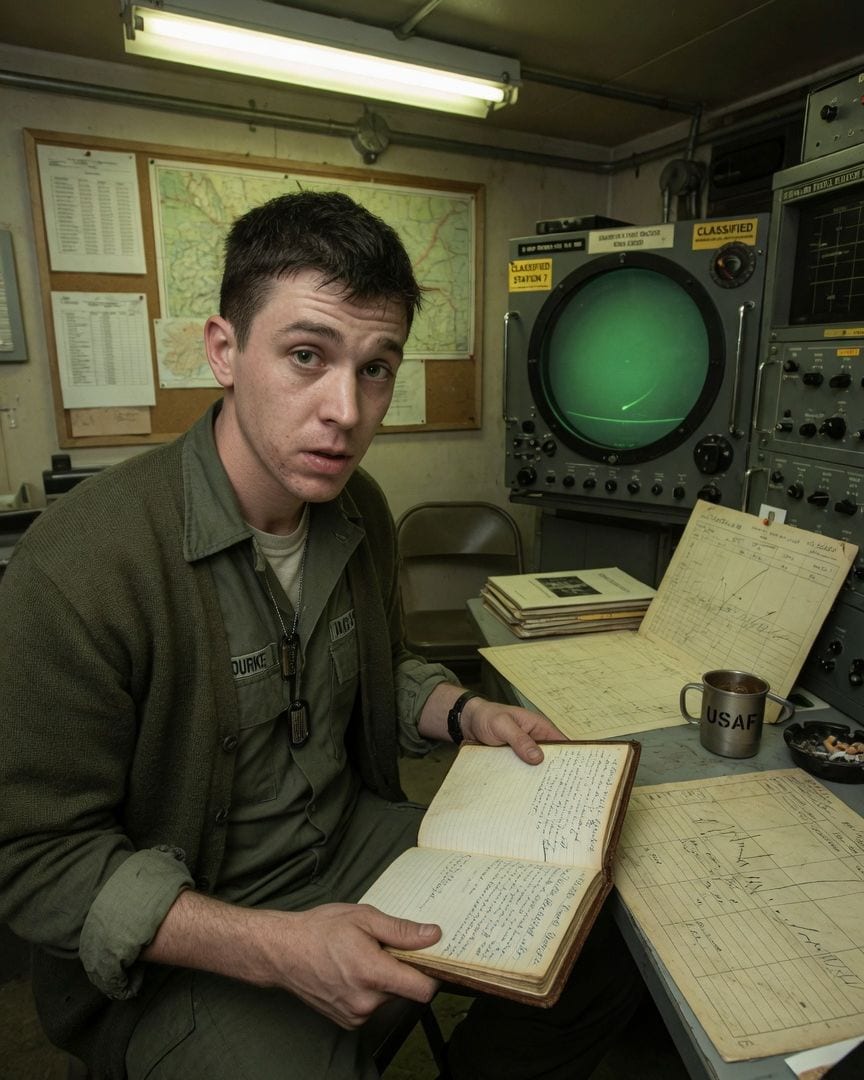
Nearing the end of his tour, Airman Rourke found an old Cold War logbook that named his nightly radar ghost: Airman Gerald Thornton.
Airman Second Class Preston Rourke was nearing the end of his two-year tour at Gap-Filler Station 7, a lonely outpost in the Montana high country. Every night, his radar screen painted a phantom contact, a slow line across the valley floor always dismissed as a temperature-inversion ghost. But while clearing a storage closet, Rourke found old plotting boards from prior winters, each showing the exact same impossible trace, drawn by different hands over successive seasons. His meticulous checks found no weather anomalies to explain the persistent radar ghost. Then, he uncovered a worn, unofficial logbook detailing more radar plots. One entry from 1968, next to an identical trace, contained a date and a name: Airman Gerald Thornton.
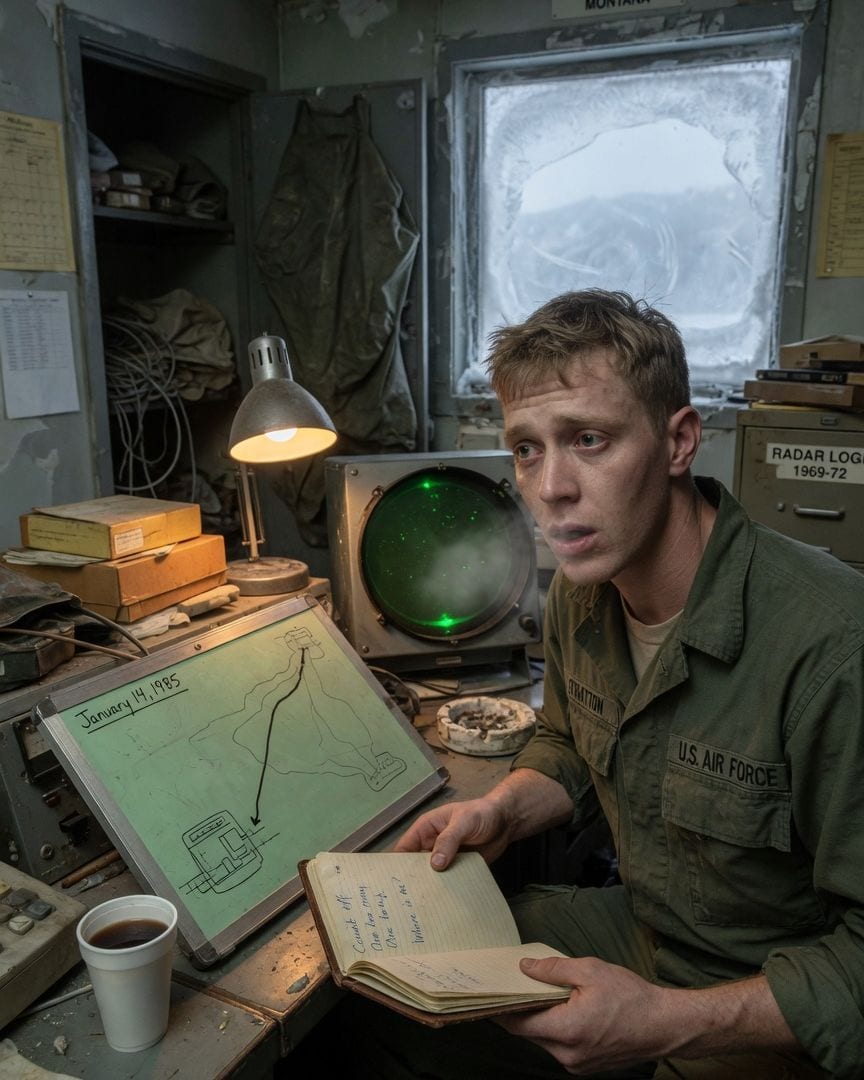
Airman Lars Stratton found an old Cold War manifest listing one name twice: 'Bernard Radcliffe' transferred and 'Bernard Radcliffe' still present.
Airman Second Class Lars Stratton was counting down his final weeks at Echo Station, a desolate Cold War outpost due for mothballing. He longed for home, far from the bitter Montana winds and the constant hum of static. Inside the dim radar shack, he logged the usual nightly ghost blip, a faint contact appearing at 2300, just as it had every winter since 1987. This night, a metallic tang like old blood lingered in the air, raising the hairs on his arms. Seeking distraction, Lars later discovered a leather-bound logbook from 1971, detailing the same 2300 contact, but with chilling notes and a manifest listing one airman's name, Bernard Radcliffe, twice—once transferred, once present. Was he truly alone in the silent, remote station?
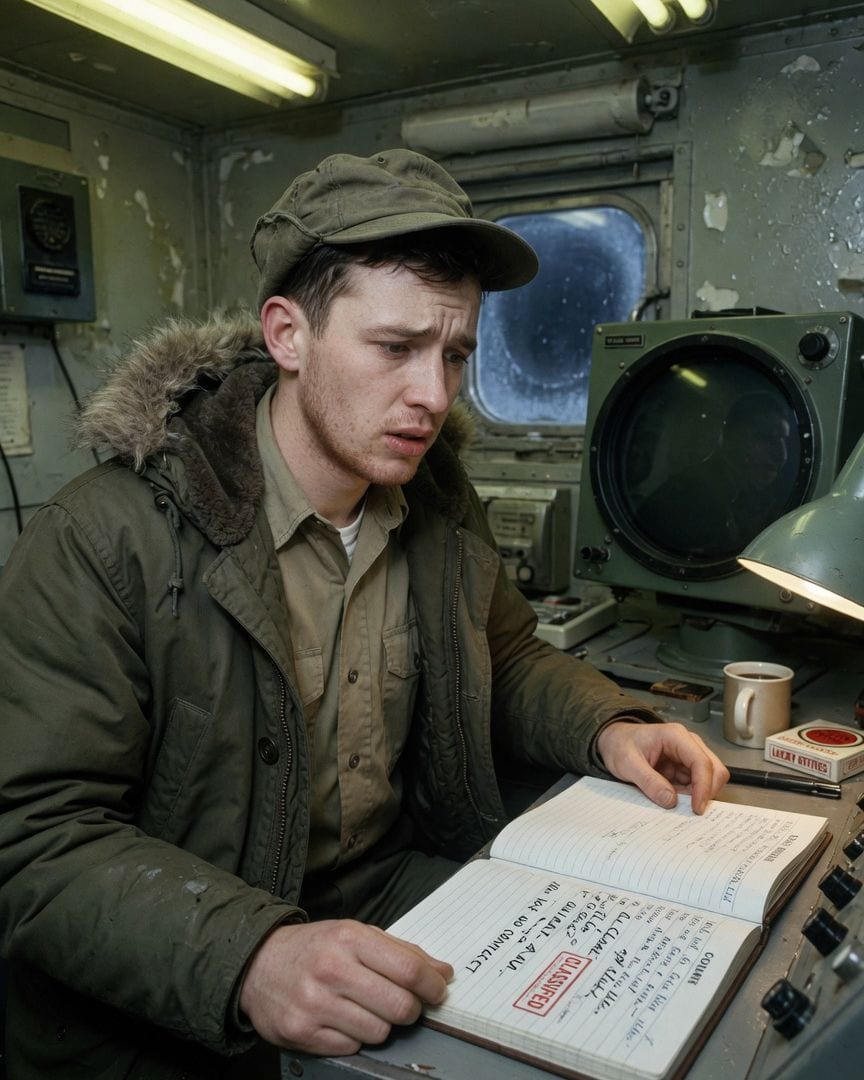
A Cold War airman logs an impossible radar contact on his last sweep. But his official logbook entry is stamped 'CLASSIFIED' and then contradicted by a hastily scrawled 'ALL CLEAR' dated moments before it.
Airman Ordway Vance, 22, manned the radar dome at Site Pellin in the biting North Atlantic dark of January 1962, running the last calibration sweep before its decommissioning. His scope picked up a faint, impossible return, growing closer with each pass, though the ocean remained empty to the eye. When Vance detailed the contact in his official logbook, a 'CLASSIFIED' stamp appeared, followed by a hastily scrawled 'ALL CLEAR' dated moments before his own entry, contradicting his every word. Commander Hartley dismissed it as equipment malfunction, but Vance sensed a chilling, official erasure behind the lie. He soon found a locked cabinet marked 'SITE PELLIN ANOMALIES,' hinting at a deeper truth buried within the base's final days.
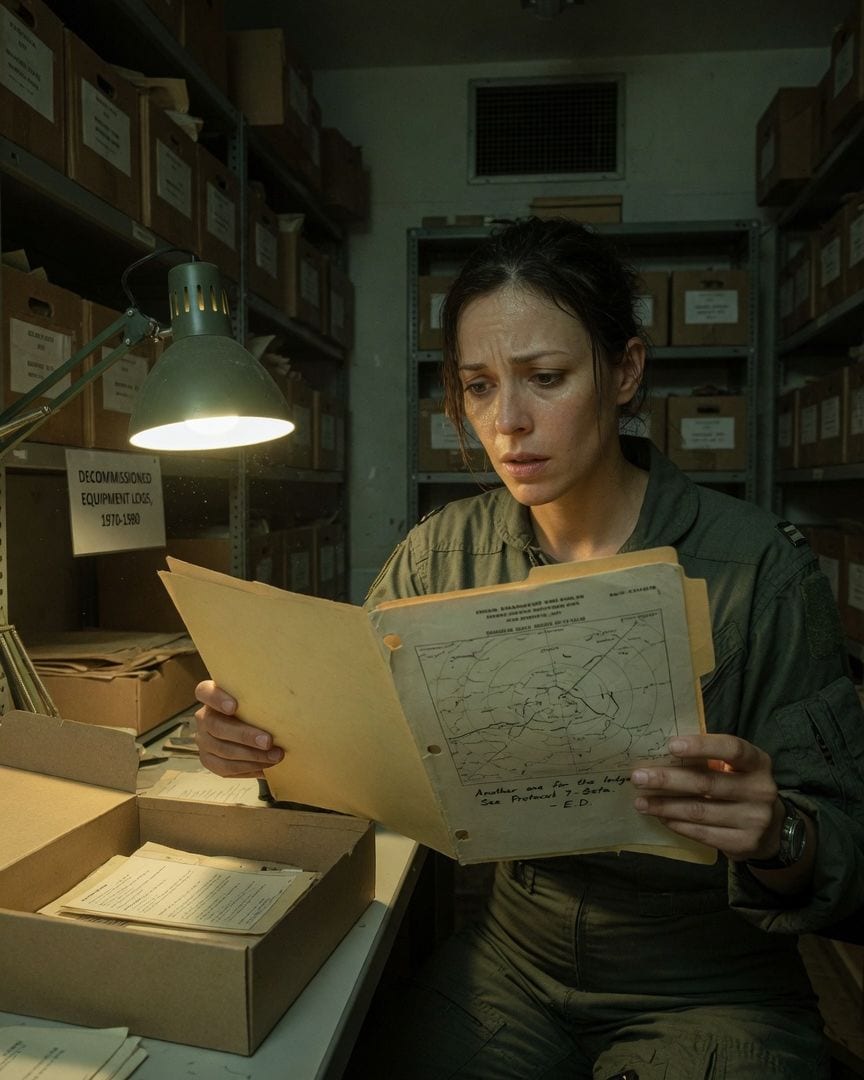
A radar captain's scope went clean, but the pilot swore a mile-wide UFO still filled his windscreen. Then she found a Cold War ledger of impossible sightings.
Captain Ines Bardolph, a 34-year-old radar operator in Bavaria, lived by the precise hum of her console. One quiet night, an impossible contact appeared over the Danube, then vanished from her scope just as a pilot swore it filled his windscreen. Replays showed the object had crossed the Alps in a single blink, defying all known physics. When bureaucracy sought to bury the incident, Captain Bardolph sought answers, leading her to a forgotten archive where a brittle folder revealed a chilling pattern: 'Another one for the ledger.'
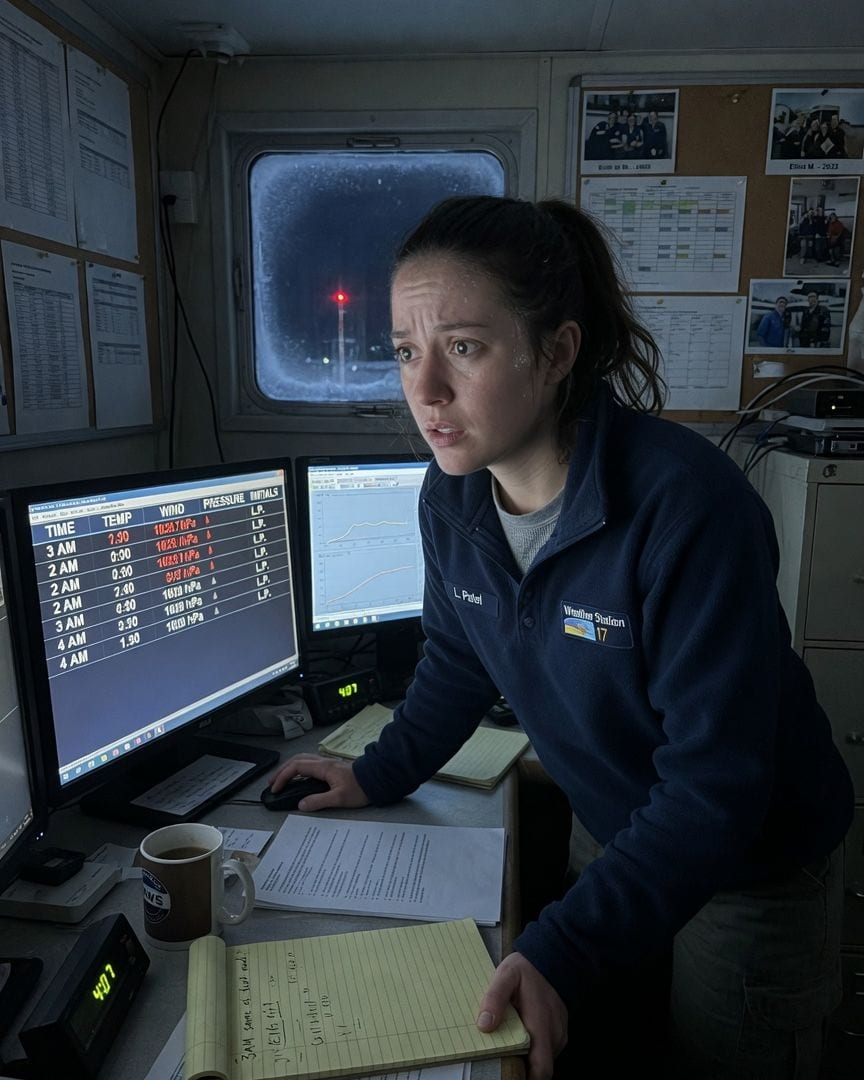
My weather station's 3 AM log shows a pressure reading I never made. My initials are on it, but the dials were dead still.
Working the overnight shift at the remote weather station, I routinely checked the digital logs. The 3 AM entry showed an impossible barometric pressure spike, a hurricane that simply hadn't happened. I distinctly remembered being outside at that time, calibrating a sensor, not making that entry. Yet, my initials, L.P., were clearly logged next to data I never made.
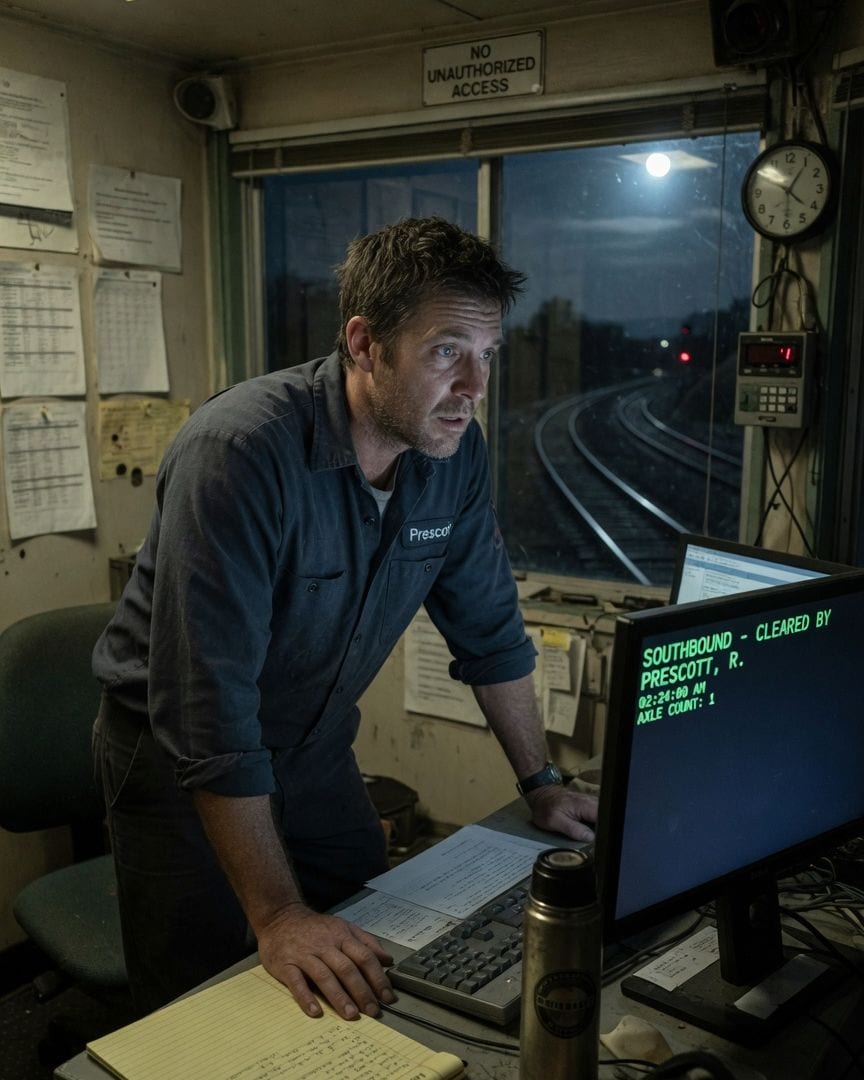
My signal box log shows I cleared a southbound train at 2:24 AM. No train was booked, but the wheel counter ticked over once.
My night shift in the signal box is usually quiet, just the hum of the panel and distant trains. But at 2:24 AM, a log entry for a southbound train appeared on screen, cleared by my name, even though I hadn't touched a thing. A cold prickle ran up my neck when the wheel counter ticked once, confirming an impossible passage on the empty tracks.