A radar captain's scope went clean, but the pilot swore a mile-wide UFO still filled his windscreen. Then she found a Cold War ledger of impossible sightings.
The dim, green-lit console of a USAF radar station in Bavaria hummed with the quiet thrum of machinery. Captain Ines Bardolph, 34, watched the sweeping line of her scope.
The air, usually crisp with purpose, felt heavy with the stale scent of coffee and ozone from the electronics.
At 0318, she vectored an alert interceptor pair, Julian Doyle flying lead, towards an impossible contact: a UFO holding motionless at twenty-two thousand feet over the Danube. Both pilots got a solid lock.
Then, in the same instant, both lost it. Ines saw her scope go clean, a blank slate where a moment before an undeniable target had been.
But over her headset, Julian’s voice climbed an octave, breathless, saying it was still there, right there, filling his windscreen. He swore it was a mile across. Then it was gone, the air abruptly empty.
Later, Ines sat alone in the replay room, the tape spooling. She watched the ghostly track of the object move. Forty miles. In one sweep of the antenna.
The thing had crossed the Alps in the time it took her to blink. Her rational mind, trained to identify every radar artifact, every atmospheric inversion, offered no explanation. It simply wasn't possible.
Ines spent the next few days in a quiet battle against bureaucracy. Her incident report, filed with meticulous detail, was met with polite skepticism, then a suggestion for 're-evaluation' and 'further analysis' that felt like a burial.
The official channels wanted a balloon, a weather anomaly, anything but the truth. Captain Bardolph knew what she had seen on the scope, and what Julian Doyle had seen with his own eyes.
The easy dismissals felt like a heavy hand pushing down on her.
Frustrated, Ines remembered a hushed conversation among senior NCOs about the 'Special Holdings' room in the base's old records facility – a place where anomalies too inconvenient for official explanation were quietly shunted. It wasn't on any public finding aid.
Using an old, half-forgotten access code, she found the room: a cold, dusty space filled with unmarked boxes and shelves that seemed to stretch longer than the building's outer wall.
The air hung heavy with the smell of old paper and ozone, the silence broken only by the faint hum of aging ventilation. She was looking for anything similar, any precedent, any other impossible track.
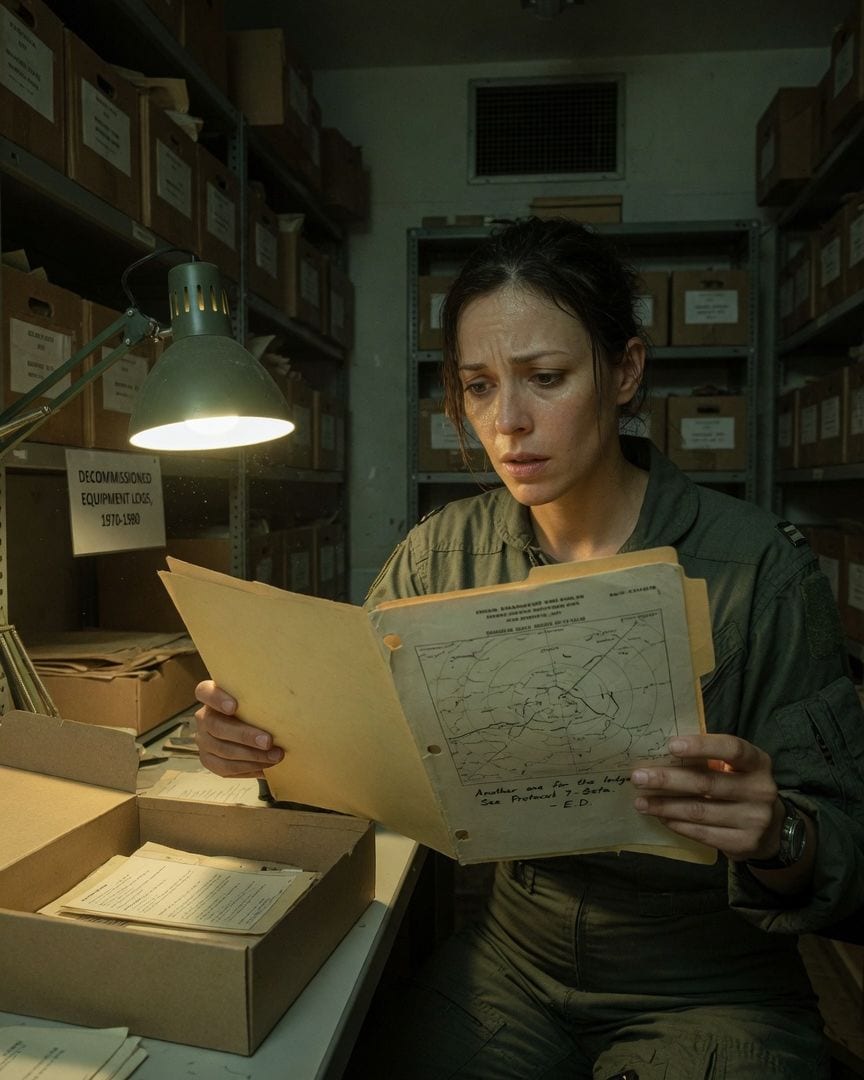
After hours of searching, tucked behind a shelf marked 'Decommissioned Equipment Logs, 1970-1980,' she found it: a plain, unmarked cardboard box, not on any inventory list.
Inside, among a jumble of forgotten training manuals, was a single, brittle manila folder, its tab yellowed and blank. She opened it.
The folder held a declassified incident report from 1978, detailing an aerial encounter over the Black Forest.
The specifics – the altitude, the sudden disappearance from radar while remaining visually present to the pilot, the impossible speed recorded on the accompanying radar track drawing – were chillingly familiar.
Ines’s breath hitched, a cold knot tightening in her stomach. But it was the marginalia that froze her blood. Scrawled in faded ink, barely legible in the dim light, were two lines: 'Another one for the ledger. See Protocol 7-Beta.
- E.D.' The name 'E.D.' meant nothing to her, but the implication of a 'ledger' sent a cold, creeping dread through the quiet archive. She was no longer just investigating an incident; she was looking at a pattern.
The next few weeks became a blur of late nights in the 'Special Holdings' room. Ines obsessed over 'Protocol 7-Beta.' The name wasn't in any official military lexicon she knew.
The quiet hum of the old server racks seemed to mock her, full of answers she couldn’t find. She cross-referenced the 1978 report with other anomalous files she could find, searching for the same phrase, or for the initials 'E.D.'
The unmarked box yielded more. She found other folders, equally blank-tabbed, detailing incidents from 1989 over the North Sea, and 2001 near the Nevada Test Site.
Each shared the same impossible radar signature, the same pilot testimony of 'filling the windscreen,' and the same abrupt vanishing.
And in each, tucked into an obscure corner, she found the 'E.D.' initials, sometimes with 'Protocol 7-Beta,' sometimes with a cryptic numerical code. The pattern was undeniable, a whispered thread connecting seemingly disparate events across decades and continents.
She sought out Grace Sterling, 28, a junior archivist who seemed to know the 'unwritten rules' of the facility better than anyone. Grace, a quiet woman with sharp eyes, initially dismissed Ines's questions as 'conspiracy theories.'
But when Ines showed her a photocopy of the 1978 marginalia, Grace’s composure faltered. 'E.D.?' Grace whispered, her eyes wide. 'Everett Drummond. He retired last year. Head of Special Holdings for thirty years.'
Ines’s digging did not go unnoticed.
One morning, she arrived at 'Special Holdings' to find the unmarked box she’d been working from subtly rearranged, a stack of blank personnel transfer request forms resting on top, almost as if left as a message.
A draft seemed to snake through the room, though all the vents were sealed.
A few days later, a file she’d placed on hold for further review – a particularly unsettling report from 1995 that mentioned 'cognitive re-calibration' of witnesses – was gone.
Not merely misplaced, but vanished from the system, its digital entry purged. Then came the email: an anonymous, untraceable message in her personal inbox, simply stating, 'Some ledgers are best left balanced.'
The language was too specific, too close to the marginalia she’d found. Someone knew. Someone was watching. The quiet dread that had been a constant companion now sharpened into a palpable sense of being hunted.
She felt eyes on her as she walked the sterile corridors of the base, saw shadows shift in her peripheral vision. The archive, once a sanctuary for forgotten truths, now felt like a trap, its silence predatory.
The metal shelves seemed to lean inward, exhaling the must of old paper.
Ines found Everett Drummond, 62, in a quiet, unassuming house just off base, surrounded by meticulously organized shelves of books.
The air in his living room was warm, smelling faintly of tea and pipe tobacco, a contrast to the archive’s chill. He was a slight man, with a steady gaze and hands that trembled slightly with age.
She laid the photocopies on his coffee table: the impossible radar tracks, the 'Protocol 7-Beta' marginalia, the anonymous email. Drummond picked up the 1978 report, his thumb stroking the 'E.D.' initials.
'You found the ledger,' he said, his voice calm, unbothered, as if discussing the weather. Ines pressed him, her voice tight. 'What is Protocol 7-Beta?' Drummond sighed, a soft, deliberate sound. 'It’s not what, Captain. It’s who. And how.'
He explained, in a measured tone that allowed no room for panic, that the 'incidents' were not random. They were markers. 'Certain individuals, when exposed to these… phenomena… they become… significant. To the ledger.'
He described an institution, not a single person, but a self-perpetuating system that had been quietly 'filing' these 'significant' witnesses for decades. Their incident reports were dismissed, their lives gently nudged, their careers subtly altered.
'They’re not lost, Captain,' Drummond said, his eyes meeting hers, strangely clear. 'They’re… accounted for.' He pointed to the numerical codes Ines had found. 'Those are classifications. Disposition codes. For where they go, what they become.
Some go to remote postings. Some are… reassigned to other duties. Some simply… fade.' The implications of his words hit Ines like a physical blow.
The pattern wasn't just about the objects in the sky; it was about the people who saw them. And the institution wasn't just recording; it was orchestrating.
Drummond, seeing the horror in Ines's eyes, led her back to his study, to a locked, fireproof cabinet. The cabinet door swung open with a soft, well-oiled click, revealing more meticulously organized files.
'There’s one more part of the ledger,' he said, his voice heavy with a resignation that chilled Ines more than any anger. 'The active part.' He pulled out a single, unmarked file.
It was thicker than the others, bound with a plastic clip. 'This one… it’s still being written.' He opened it to a specific page, a personnel transfer request form.
Ines’s eyes scanned the document, her heart hammering against her ribs, a sick premonition coiling in her gut. It was dated for three months in the future.
It bore her own service number, her name 'Ines Bardolph,' and a proposed reassignment to a remote, administrative posting in the Arctic Circle. The form was stamped 'PROCESSED – Protocol 7-Beta.'
Beneath it, a single line in an eerily familiar script, almost identical to the faded marginalia she’d found, read: 'Event confirmed: Danube, 0318.' The file was still open.
Her own incident, her own future, already laid out in cold, official print. She was not just investigating the ledger; she was already an entry in it. The paper felt cold in her hands, a pre-written epitaph.
The truth detonated. Ines understood with sickening clarity: the file wasn't just a record of her impending transfer; it was a pre-emptive declaration. Drummond explained, 'The ledger doesn't just record; it anticipates.
Once an individual's 'significance' is confirmed by an incident, their future is… adjusted. It's not punishment, Captain, merely… management. To maintain the pattern, to ensure the continuity of the process.'
He showed her other entries in the active file: Julian Doyle, her flight lead, had a similar transfer request, dated six months out, to a remote weather station.
Grace Sterling, the junior archivist, had a 're-assignment' to a distant records facility, her name penciled in next to a 'Disposition Code 4.'
The scattered names, dates, and cryptic codes Ines had found across decades now snapped into a monstrous, coherent shape: a living, self-correcting system that identified, processed, and quietly absorbed anyone who glimpsed the impossible.
The institution was a vast, patient machine, and its output wasn't just paper; it was people. She had always been inside it, a future entry waiting for her incident to confirm her place.
Ines felt a cold resolve, pushing down the rising panic. She couldn't escape the pattern, but she could try to expose it. She tried to make copies of the active file, to email the evidence.
She pulled out her phone, then a thumb drive she carried for backup. But the digital systems were locked down, her attempts met with 'access denied' messages and 'system error' notifications that felt too precise to be accidental.
As she tried to print, the old desktop printer on Drummond's desk jammed, spitting out blank pages that curled at the edges. Drummond watched her, his expression sorrowful, a quiet weariness in his eyes. 'It's a closed system, Captain.
It files itself.' Just as she was about to give up, a quiet, almost hesitant knock came at Drummond's door. The sound was barely audible over the sudden, sharp gust of wind that rattled the windowpanes.
Grace Sterling stood there, her face pale, holding a fresh, unblemished blank file folder. 'Captain Bardolph,' Grace said, her voice flat, devoid of its usual spark, 'your transfer orders have been expedited. Your new posting is effective immediately.'
She handed Ines the folder. It was empty. Ines looked at Drummond, then at Grace. Grace's eyes were distant, her gaze unblinking, her usual nervous energy replaced by a quiet, unsettling calm.
The pattern had closed around Ines, but it had also absorbed Grace. The confrontation wasn't violent; it was an implacable, bureaucratic inevitability. The 'secrecy machine' didn't fight; it simply processed.
Ines Bardolph's incident report was officially closed the following week, attributed to a 'rare atmospheric inversion and equipment malfunction.' Julian Doyle’s flight career continued, but his transfer orders would arrive as predicted.
Grace Sterling was reassigned, her quiet efficiency now directed to an obscure records office in a different state, an ocean away.
Ines herself was promptly transferred to the Arctic Circle, her once-promising career now a slow, administrative fade in the cold, desolate north. Her old workstation in Bavaria was taken by a new, fresh-faced recruit.
The unmarked box in 'Special Holdings' was gone, replaced by a freshly painted wall. The ledger remained, its pages turning silently.
Ines sat in her new, spartan office, the wind howling outside the reinforced window, watching the endless expanse of snow. Her desk was bare save for a single, pristine, blank file folder.
The silence in the room was absolute, broken only by the wind's mournful cry. She picked it up. It was empty. The weight of it, the pristine white of the paper, was heavier than any document she had ever held.
It felt like an invitation. She knew the file was still being signed. The pattern continued, stretching into the future, quiet and patient, waiting for the next entry.
If this one got to you
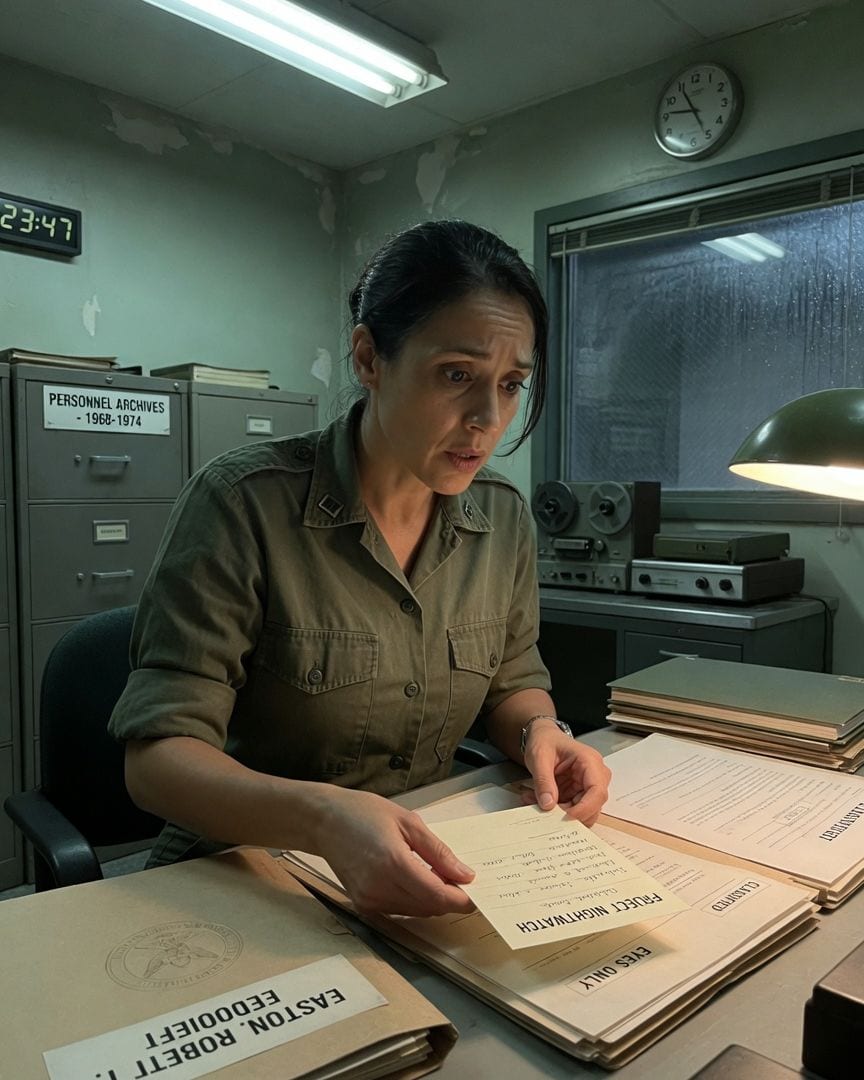
A Cold War tower controller logs an object vanish from radar, then hears the pilot scream it’s filling his windscreen. Her own name, 'Bardolph, Ines', now marked 'Observed' in a secret file.
Captain Ines Bardolph, a tower controller, was counting down the months until her transfer to Langley and the decommissioning of her base, hoping to leave behind the unsettling incidents of her final posting. But one night, her radar scope showed an impossible blip, solid and unwavering, 40 miles north of the Danube, only to vanish in less than a second, leaving a pilot screaming in terror. Despite the clear evidence, the official report blamed "atmospheric inversions," while the terrified pilot received a glowing review and promotion, his file meticulously scrubbed of any anomaly. As Captain Bardolph reviewed the pilot's pristine record, she found a hidden slip of paper, revealing a chilling truth: 'Subject: Bardolph, Ines. Status: Observed.' Was she merely an observer of the impossible, or was she now part of something far more sinister?
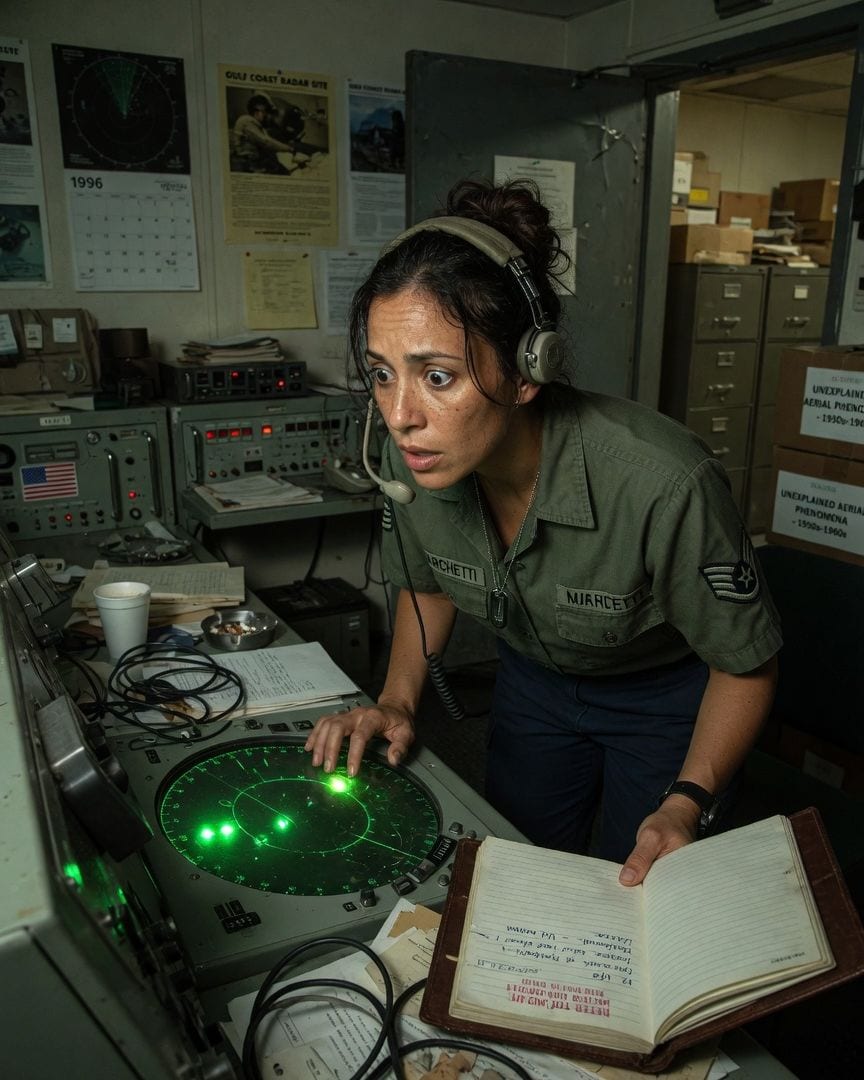
During her last weeks at the Cold War radar site, a technical sergeant logged a UFO. Her entry box was already stamped with a code from a missing 1958 jet.
Technical Sergeant Odile Marchetti was winding down her last few weeks as a radar operator at a remote Gulf Coast site in 1996. Alone in the cavernous room, she watched the green glow of her scope, the only light cutting through the pre-dawn gloom. At 2:30 AM, an airliner reported something flying in formation—a craft Odile couldn't see, until a massive, impossible blip bloomed beside it on her screen. After the pilot reported flying straight through empty air, Odile logged the UFO, only to find a faded, decades-old code already stamped on her logbook entry, identical to one on a missing jet report from 1958. Had this happened before, and was her own entry just a pre-written footnote in a much older, terrifying file?
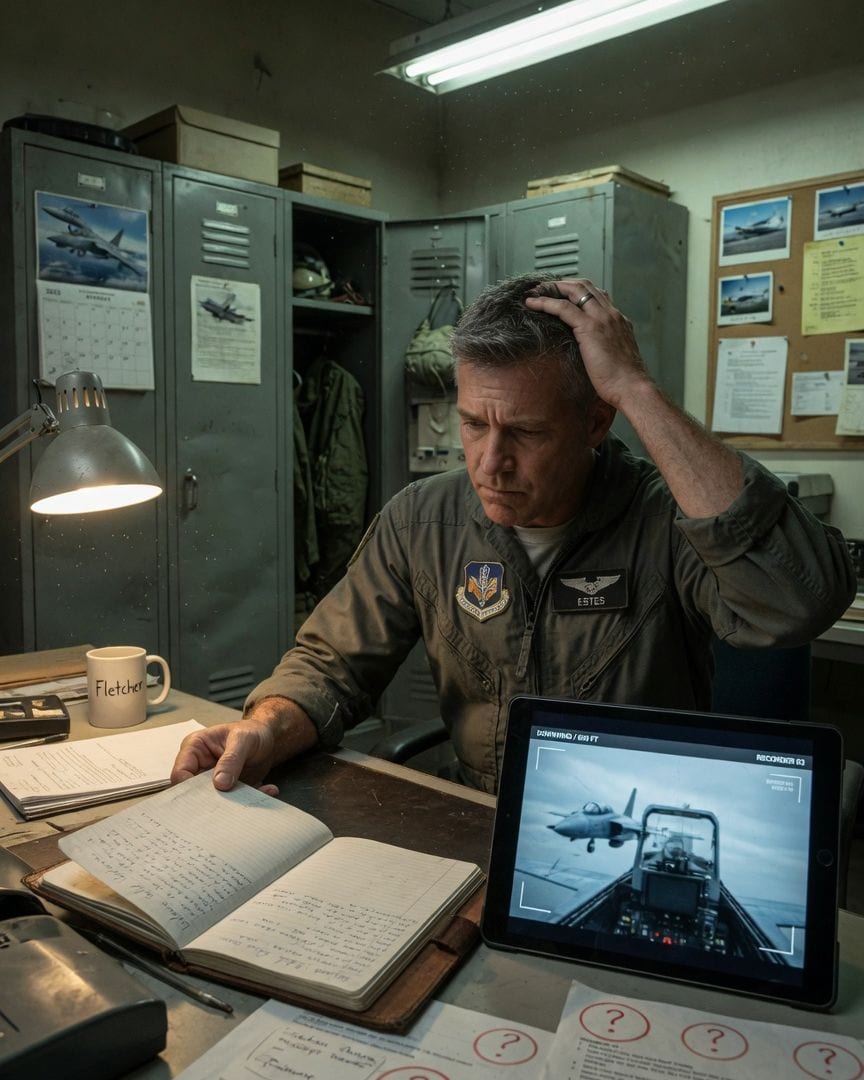
A Chief Warrant Officer's HUD tape shows a phantom jet, impossibly close, off his wing. Forty years ago, another Cold War pilot logged the same impossible sight.
Chief Warrant Officer Nathaniel Estes, a pilot whose career hinged on absolute precision, was under evaluation for a critical promotion. His nightly review of HUD tapes from routine Mojave test flights was a meticulous habit, but for a week, it revealed an impossible detail. At precisely 800 feet, one frame showed a sleek, experimental jet tucked impossibly close off his left wing—a craft ground radar never detected. When his maintenance chief found no equipment fault, Estes unearthed a dusty, decades-old logbook detailing identical phantom sightings from 1978. What unseen presence shadowed the desert skies?
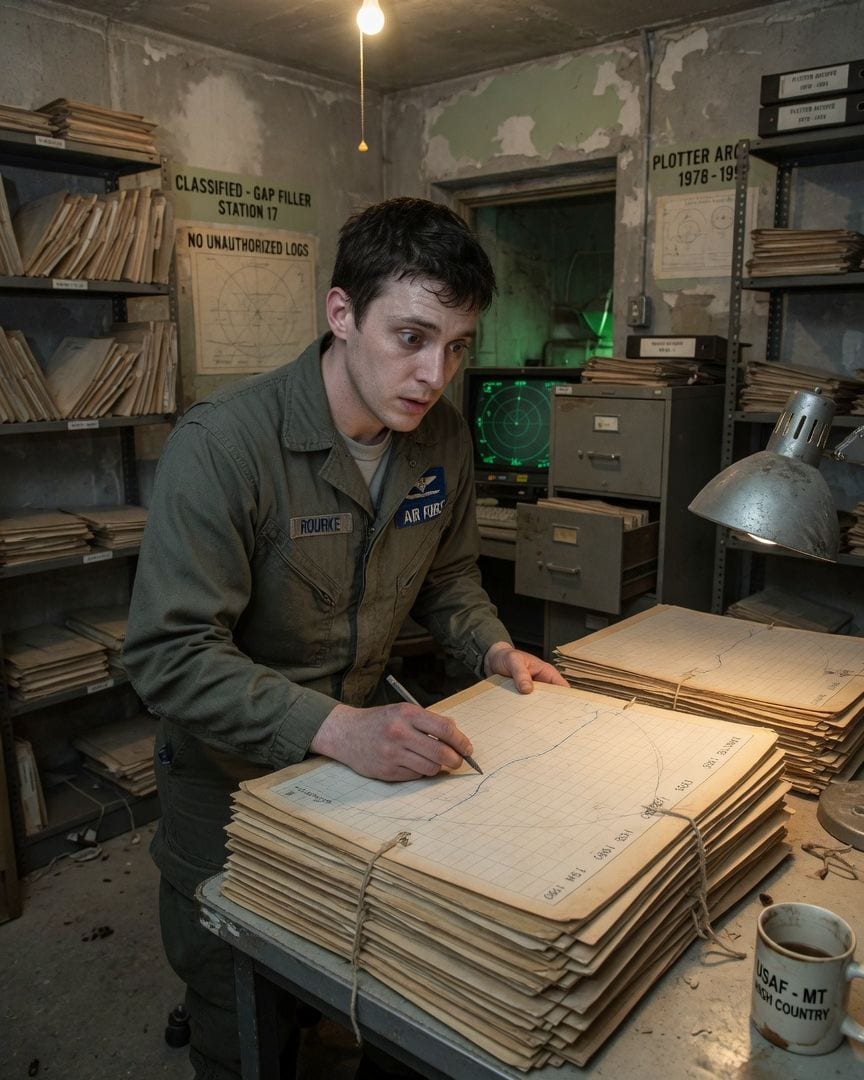
An Airman tracks a nightly radar contact. But in dusty archives, he finds old Cold War plotter boards, each showing that exact same line drawn by other airmen for three winters.
Airman Second Class Felix Rourke endured the cold, quiet nights at his isolated Cold War station, watching the perimeter radar. For three weeks, a single, slow contact appeared at 2300 hours, a precise violation of every protocol that chilled him deeply. He dismissed it as an anomaly, until a hunch led him to a forgotten closet in the dusty archives. There, he unearthed old plotter boards, each revealing the exact same impossible line drawn across the valley floor at the same hour, signed by different airmen from three consecutive winters decades ago. What impossible secret did the mountain station truly hold?
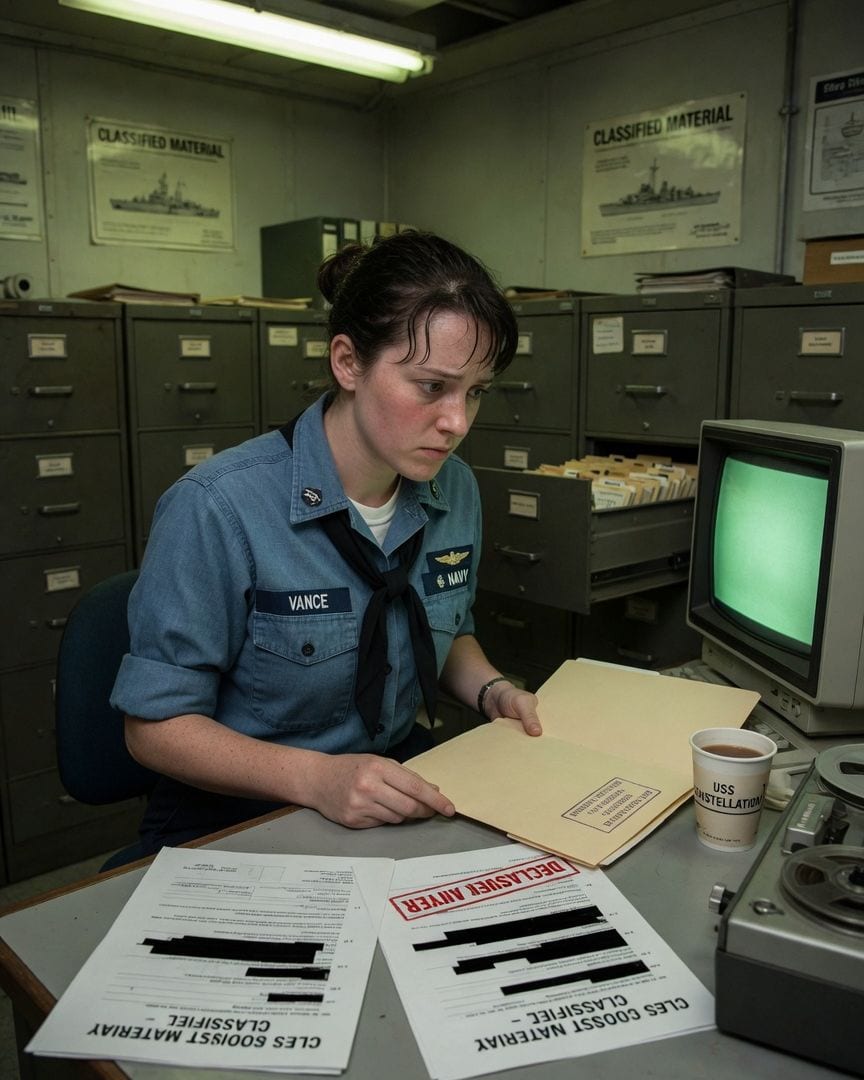
A radarman tracked an object from 60,000 feet to the deck in four seconds. The next night, her tape was gone, replaced by a lie.
Radarman Second Class Peggy Vance, 22, began her first night alone in the carrier's dim green radar room off San Diego, the ship gently rolling. She tracked an impossible contact: a shape without wings, falling from sixty thousand feet to the deck in under four seconds, baffling the pilot. The next night, her incident tape was gone, the slot relabeled, and the official log dismissed the event as a "weather balloon" that couldn't be found. Peggy soon uncovered a deliberate pattern: conflicting, heavily redacted reports, each copy hiding what the other revealed, confirming a layered deception. What secret was so vital it required such an intricate, impossible lie?
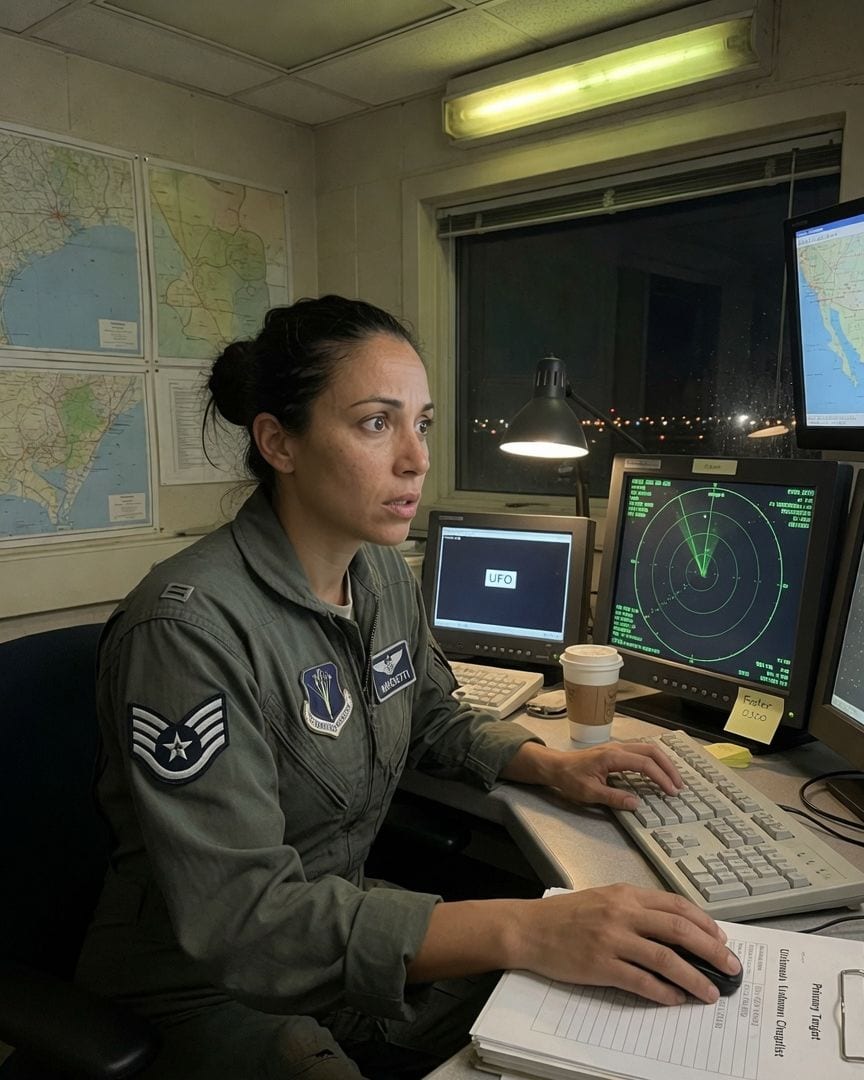
A radar operator watched a second blip, twice its size, merge into a plane on her screen. Her report was filed under a pre-existing, locked 'Special Handling' code.
Technical Sergeant Odile Marchetti sat alone in the dim radar room, her watch a final vigil for a base winding down along the silent Gulf Coast. At 02:17, a pilot reported a 'companion' on his wing, but her screen initially showed nothing. Then, a second blip bloomed, twice its size, before merging impossibly into the first and continuing its flight path without a ripple. She logged it as a UFO, only to discover the system already had a designated category for such anomalies – a pre-approved slot for the unexplained. A week later, her incident was re-categorized under a locked 'Special Handling' code, creating a new, inaccessible folder in her own personnel file.