My ultrasound showed vasectomy clips. I've never had the operation, and we tried for years to have our son.
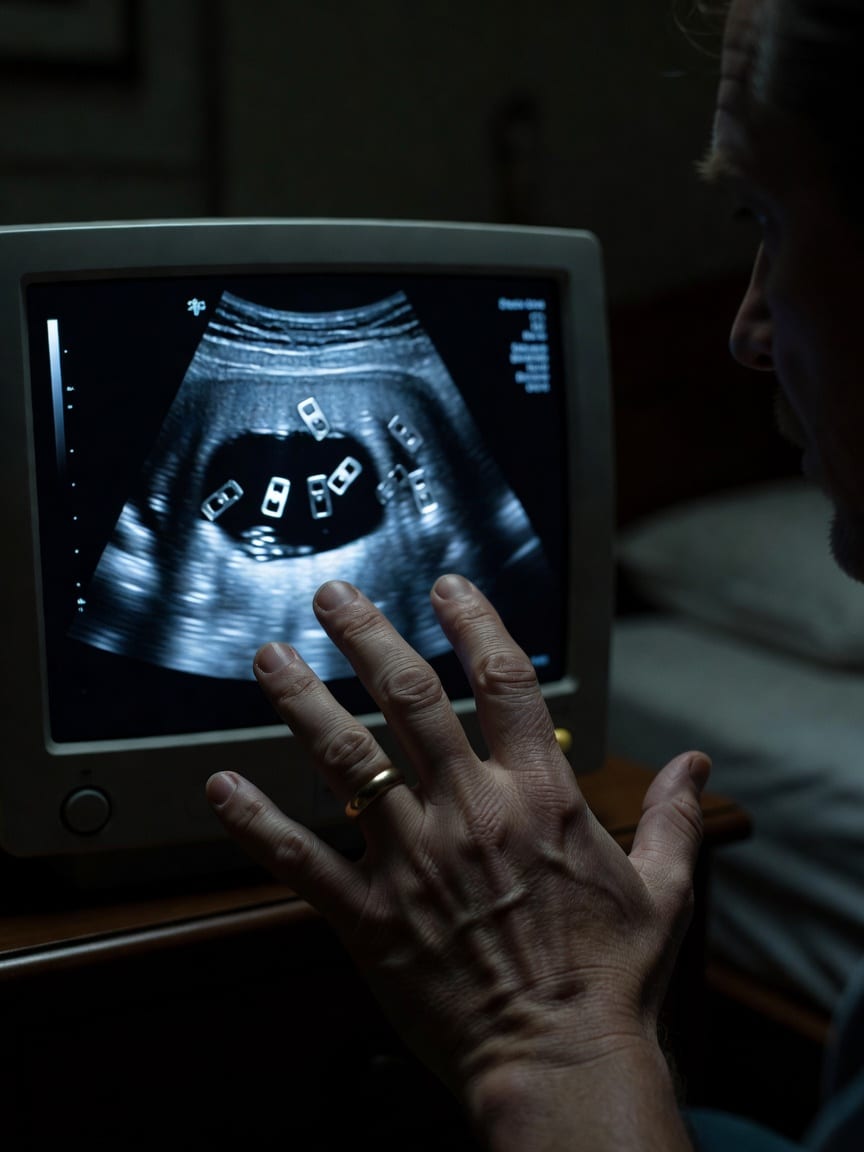
The cold gel was still tacky on my skin, and the fluorescent lights of Dr. Ellison’s office hummed, amplifying the silence.
Dr. Ellison, a man whose face I’d always associated with quiet competence, was now avoiding my gaze, tracing a pattern on the screen with a stylus.
He’d been scanning a small, harmless lump I’d found in my scrotum, a routine precaution. But the image on his monitor wasn't a cyst.
"Theodore," he began, his voice measured, "both tubes appear to be cut and sealed. There are small, visible clips." He gestured, the light catching a tiny, bright curve on the greyscale image. "These are vasectomy clips. They look... well-established.
Years, I'd say."
I stared at the screen, then at him. "A vasectomy?" My own voice sounded thin, unfamiliar. "That's impossible. I've never had that operation."
He scanned again, slowly, painstakingly, the quiet whir of the machine filling the space between us. The clips remained, undeniable. The healed ends of the vas deferens were clear.
I thought of Camille, of our son, Leo, who was five now. We had tried for three years to conceive him, three long, frustrating years of tests and hope and disappointment, before finally, miraculously, she got pregnant.
If I’d had a vasectomy, Leo couldn’t exist.
Dr. Ellison cleared his throat. "Mr. Abbott, can you tell me the date of your procedure?" He looked at me then, his eyes holding a mix of professional curiosity and profound bewilderment.
The impossible image of those clips, a permanent alteration to my own body that simply wasn't mine, seemed to burn itself onto the backs of my eyelids.
I left the urologist's office in a daze, the cold air outside doing little to clear my head. My first thought, the only rational thought, was a clerical error, a mix-up of files, a slip of a lab technician’s hand.
Someone else's information, somehow swapped with mine. It had to be.
I pulled over to the side of the road and called my old family doctor, Dr. Russo, the man who'd given me lollipops and flu shots since I was five. His office was old-fashioned; I knew they’d have paper records.
I requested my full medical history, focusing on any surgical procedures. The receptionist, who sounded like she’d been there since I was a kid, promised to mail them out.
Days later, a thick manila envelope arrived. I ripped it open, spilling the contents onto my kitchen table. I sifted through vaccination records, childhood illnesses, routine check-ups. Measles, chickenpox, a broken arm at age ten. Nothing.
No mention of any surgery, certainly not a vasectomy, or any other procedure for that matter. My medical history was remarkably dull.
But then, tucked near the bottom, I pulled out a folded, legal-sized sheet of paper. My old dental chart. I remembered my childhood dentist, Dr. Albright, a gentle woman with kind eyes who always praised my strong, healthy teeth.
This chart, however, was a dense network of symbols. It detailed a root canal on an upper molar when I was just fifteen, and the extraction of a wisdom tooth, number 17, when I was sixteen.
I ran my tongue over my own teeth, pressing against the molar Dr. Albright had supposedly worked on. It was perfectly fine. No root canal. My wisdom teeth had come in years later, naturally, with no issues whatsoever.
I even remembered the dull ache of them emerging in my early twenties. I dug out my current dental records, pristine and unremarkable, confirming the absence of any such extensive work.
The old chart was specific, diagramming the work done, the dates, the dentist’s precise initials, “D.A.” It was a concrete record of complex dental work that simply did not exist in my mouth.
I held the two dental charts side-by-side on the scarred wood of my kitchen table, one from my childhood, yellowed and faded, the other my current, perfectly white printout.
The old chart, with its intricate diagrams and hand-drawn symbols, depicted a landscape of fillings, extractions, and that specific root canal I knew I’d never had. It was detailed, precise, dated, even listing the materials used for the fillings.
My current chart, clean and computer-printed, showed none of it. It was a blank slate where the old one was a battlefield.
A cold dread settled in my stomach, like a stone dropped into icy water. It wasn’t a mix-up with the vasectomy. This was something deeper, a more fundamental wrongness.
My own body, my own history, was being contradicted by the official record. I traced the diagram of a missing wisdom tooth on the old chart with my fingertip, the paper strangely slick.
Then I felt my own, perfectly healthy molar with my thumb. The teeth in my mouth were not the teeth recorded in my past.
I looked up, my reflection in the dark office window staring back, a stranger with a familiar face.
The old dental chart was clutched in my hand, creased from being shoved into my pocket. My parents lived in the same house I grew up in, a two-story colonial with a perpetually overgrown rose bush by the front door.
My mother, Florence, sixty-eight, was in the kitchen, humming softly, baking something that smelled of cinnamon.
"Mom, Dad," I started, laying the chart on the countertop. My father, Joseph, seventy, glanced over from his armchair, engrossed in the evening news. "I need you to look at this."
Florence wiped her hands on a dishtowel. She looked at the chart, then at me, her brow furrowed slightly. "Oh, honey, that must be a mistake. Dr. Russo's office was always so busy. Probably just grabbed the wrong file."
She gave a dismissive wave, already turning back to her baking.
"Mom, it's dated," I pressed, tracing the lines of the root canal diagram. "It has Dr. Albright's initials. It shows I had a root canal at fifteen. And a wisdom tooth pulled at sixteen. I know I didn't.
I'd remember something like that."
She looked closer then, her glasses sliding down her nose. "Well, I don't remember any of that, Theodore. You were always so healthy. Never had trouble with your teeth." She looked to my father for corroboration.
Joseph, still half-watching the news, grunted. "Maybe you just forgot, son. It was a long time ago. Kids forget things."
Their casual dismissal, bordering on an almost practiced evasion, was more unsettling than outright denial. They wouldn't quite meet my eyes, their gazes flitting from the chart to somewhere just past my shoulder.
The room felt strangely still, even with the murmur of the TV. I left feeling a new kind of chill, not just from the unanswered questions, but from their reluctance to even acknowledge them.
Later that week, I remembered a box of old photos in my parents' attic, stashed away in a dusty corner. I drove back, found the box, and hauled it down. Inside were dozens of albums, snapshots of my entire childhood.
I searched specifically for photos of myself around age fifteen, smiling. It took hours. In one, taken on a school trip to a historical site, I was grinning widely, a goofy, gap-toothed smile.
My teeth were perfectly straight, no visible gaps, no signs of extensive dental work, certainly not a missing molar or a fresh root canal. The photo contradicted the chart, yet my parents had been so quick to brush it off.
I felt a desperate need for an unimpeachable record, something that couldn't be dismissed as a memory lapse or a clerical error. Something that could speak for itself, for me.
I ordered a consumer DNA kit online, hoping to confirm my own parentage and perhaps, by extension, my own undeniable self.
A week later, my phone vibrated with a text message from an unknown number. My heart hammered against my ribs when I read it. 'Heard you've been asking questions about your past, Theodore. Some things are best left undisturbed.'
The words felt cold, like damp breath on the back of my neck. I tried calling the number back, but it went straight to voicemail. The voice on the message was calm, elderly, and distinctly male.
My parents hadn't mentioned my inquiries to anyone outside the immediate family. Who could have known?
The following day, a letter arrived. No return address, just my name and address typewritten on the envelope. Inside, a single, faded black-and-white photograph.
It was of a young man, perhaps in his late twenties, with a striking resemblance to me. The same eyes, the same nose, even the slight curve of the lips.
On the back, in elegant, almost flowing cursive, was written: 'Oliver Maddox. Some truths are not meant to be uncovered. Isaac Radcliffe.'
The name Isaac Radcliffe jolted me. I recognized the surname. Isaac Radcliffe, a reclusive, brilliant geneticist who had been a colleague of my father's at the university decades ago.
I’d barely seen the man since childhood, a quiet, intense figure who sometimes showed up at department picnics, always with a stack of books. The photo, the text, the name – it wasn't a warning, I realized.
It was an invitation. Isaac knew. And he was watching.
The café was quiet, the air thick with the smell of stale coffee and something faintly metallic, like old coins.
Isaac Radcliffe, a man in his early seventies with sharp, intelligent eyes that seemed to take everything in, sat across from me, sipping tea from a delicate porcelain cup.
He looked exactly as I remembered him: intense, detached, his face etched with the lines of deep thought.
"So, Theodore," Isaac began, his voice calm, almost conversational, "you found the dental chart. And the vasectomy. Curious things, aren't they?" He didn't smile, but a hint of something unreadable played around his lips.
I slid the faded photograph of Oliver Maddox across the table. It was slightly warped from age, the corners dog-eared. "Who is this?" My voice was tight, thin.
Isaac picked up the photo, his thumb tracing the young man's face. A faint, sad smile, almost a flicker of grief, touched his lips. "My son, Oliver. Died a long time ago. Forty-five years, to be precise."
He looked at the photo as if it were a window to another time, another life.
"He looks like me," I said, the words a raw whisper. A cold tremor ran through me.
Isaac nodded slowly, his gaze still on the photograph. "He does. Or rather, you look like him. Theodore, the body you inhabit, the memories you hold... they're a vessel. A continuation." He finally looked at me, his eyes unsettlingly direct.
I stared back, uncomprehending, my mind scrambling to make sense of the impossible words. "What are you talking about?" The café lights seemed to dim, the background chatter fading into an indistinct hum.
Isaac leaned forward then, his voice dropping, almost academic in its precision. "Oliver died tragically young. A brilliant mind, a life unfulfilled. A profound loss. I dedicated my life to bringing him back.
Not as a clone, not a spirit, but an essence. A re-seeding of his consciousness, his very life-force, into a new, carefully prepared host. Your body."
I felt the blood drain from my face, my hands clammy beneath the table. "You... you made me?" The words felt like sandpaper in my throat.
Isaac's eyes held a profound, unsettling grief, a sorrow that seemed to belong to another era. "I gave Oliver a second chance at life. You are that chance. The vasectomy, the dental work... those were Oliver's.
Traces of his original form, embedded in his new one. Your parents were... collaborators." He paused, taking a slow sip of tea. "They helped facilitate the process, believing in the scientific marvel, the second chance.
The opportunity to correct a terrible injustice."
I tried to speak, to form a protest, a denial, but no words came. My entire life, every memory, every experience, every joy and sorrow – it was all a carefully constructed illusion. A vessel.
The confrontation with Isaac had shattered my world, splintering every foundation I thought I stood on. I went home, numb, the silence of the house thick with unspoken lies.
I couldn't look at Camille or Leo without seeing the fabrication, the grand deception that was my life. The air in my own home felt thin, like I was breathing someone else's air.
The DNA kit results arrived by email that evening. I opened the file, my hands trembling so violently I almost dropped my phone.
I half-expected a simple confirmation of my lineage, a return to sanity, a solid ground to stand on. Instead, the report flagged a 99.9% match.
Not to a living relative, not even a distant cousin, but to a cold case file. 'Oliver Maddox, unidentified remains, Cold Case File 77-B.'
The report detailed the discovery of skeletal remains in a remote area, an autopsy performed forty-five years prior. My breath hitched in my throat. I scrolled down, my eyes widening, my chest tightening.
The autopsy report detailed a distinctive dental history: a root canal on an upper molar, a wisdom tooth extraction. The exact details from the yellowed chart from my childhood.
And then, the final, gut-wrenching detail, stark black text on the sterile white page: 'Evidence of bilateral vasectomy, performed approximately five years prior to death.'
Oliver Maddox had died forty-five years ago, five years before Theodore Abbott was even born. I was looking at the medical records of a dead man, a dead man who was, impossibly, me.
I confronted Isaac again, this time in his dimly lit study, the air heavy with the scent of old paper and dust. The DNA results, along with Oliver Maddox’s cold case file, were clutched in my trembling hand.
Isaac didn’t flinch. He merely gestured to a worn leather album on his desk.
"You've done your research, Theodore," he said, his voice calm, utterly devoid of remorse. "Good. It means you’re ready to understand."
I opened the album. Inside were dozens of photos of a young man, Oliver Maddox, whose face was undeniably my own, just younger, his expressions different, a different light in his eyes.
Isaac pointed to a photo of Oliver smiling broadly, his teeth on full display.
I recognized it immediately: the exact dental work, the tell-tale filling, the slight gap where the wisdom tooth should have been, all from the childhood chart that had started this nightmare.
He then showed me Oliver's official medical records, confirming the vasectomy, the date of death, the distinctive dental history. Every single planted clue clicked into place with horrifying precision.
"It was my life's work," Isaac explained, his voice flat, emotionless. "A unique blend of genetic engineering and consciousness transfer. Your original biological parents were carefully selected, chosen for their unremarkable genetic profiles, for their pliability.
Your mother carried Oliver's revitalized essence, a seed I cultivated. Your early childhood was... guided. The memories, the experiences, they were cultivated to integrate Oliver's foundational self with a new life. You are Oliver, remade.
Theodore is the name we gave this new iteration."
The clinical precision of Isaac's explanation was the most horrifying part. He spoke of my life, my entire existence, as a project, a carefully constructed narrative. Every joy and sorrow, every dream and fear, a programmed response.
I was not a person, but a ghost wearing another man’s skin, living a second-hand life, a meticulously designed extension.
The world around me seemed to tilt, the bookshelf behind Isaac suddenly looking like a series of meticulously arranged data points rather than books.
A profound, aching emptiness settled in me. My love for Camille, my boundless joy in Leo, my entire identity – it was all a meticulously crafted illusion.
I was a second act, an echo of a life that had ended decades before I was supposed to have begun. Isaac watched me, a strange, almost paternal satisfaction in his eyes.
"You have a choice now, Theodore," he said, his voice soft, coaxing. "You can reject this truth, live in denial, and slowly unravel. The dissonance will consume you.
Or you can accept what you are, embrace Oliver's legacy, and find a new kind of peace. A purpose."
I looked at the photos of Oliver, then at my own trembling hands, suddenly feeling alien, not entirely my own. I couldn't un-know it.
I couldn't erase the vasectomy clips that were physically inside me, the dental records, the DNA match. I was a living paradox. I thought of Leo's innocent face, Camille's trusting smile, their world so solid and real.
I couldn't shatter it with this impossible truth. I couldn't leave them. But I couldn't be the man I thought I was, either. I was trapped, not by a physical barrier, but by an existential one.
The escape wasn't an option; I was the escape, the continuation of someone else's life. I would have to live inside this new, horrifying reality, a puppet with no strings visible but his own.
I rose, the air thick with unspoken truths and the scent of dust and old paper. "I have to go," I managed, my voice hollow, like it belonged to someone else.
Isaac merely nodded, a knowing, almost sympathetic look in his eyes, as if he understood the weight of the impossible choice I wasn't making. I knew, with absolute certainty, that I would never truly be free.
Months passed. The initial shock had dulled, replaced by a constant, low thrum beneath the surface of my consciousness. Theodore Abbott went to work, laughed at Leo’s jokes, kissed Camille goodnight. But it was a performance, flawlessly executed.
The familiar walls of my home now felt like the inside of a meticulously designed cage.
I sat at the dinner table, watching Leo excitedly recount his day at preschool, his small hands gesturing wildly. Camille smiled, her eyes warm.
I reached for my water glass, my hand moving with a precision that felt less like habit and more like programming. The world had lost its vibrant color, replaced by a dull, knowing grey.
I saw the vasectomy clips in my mind's eye every time I showered, felt the ghost of Oliver's dental work every time I brushed my teeth. The truth was a constant hum, a silent, pervasive dread that permeated every moment.
I was Theodore, but I was also Oliver, and the two could never truly merge into one whole.
Camille looked at me, a slight frown creasing her brow. "Rough day, honey?" she asked, her voice soft, concerned.
Theodore smiled, a faint, wrong little smile.
If this one got to you
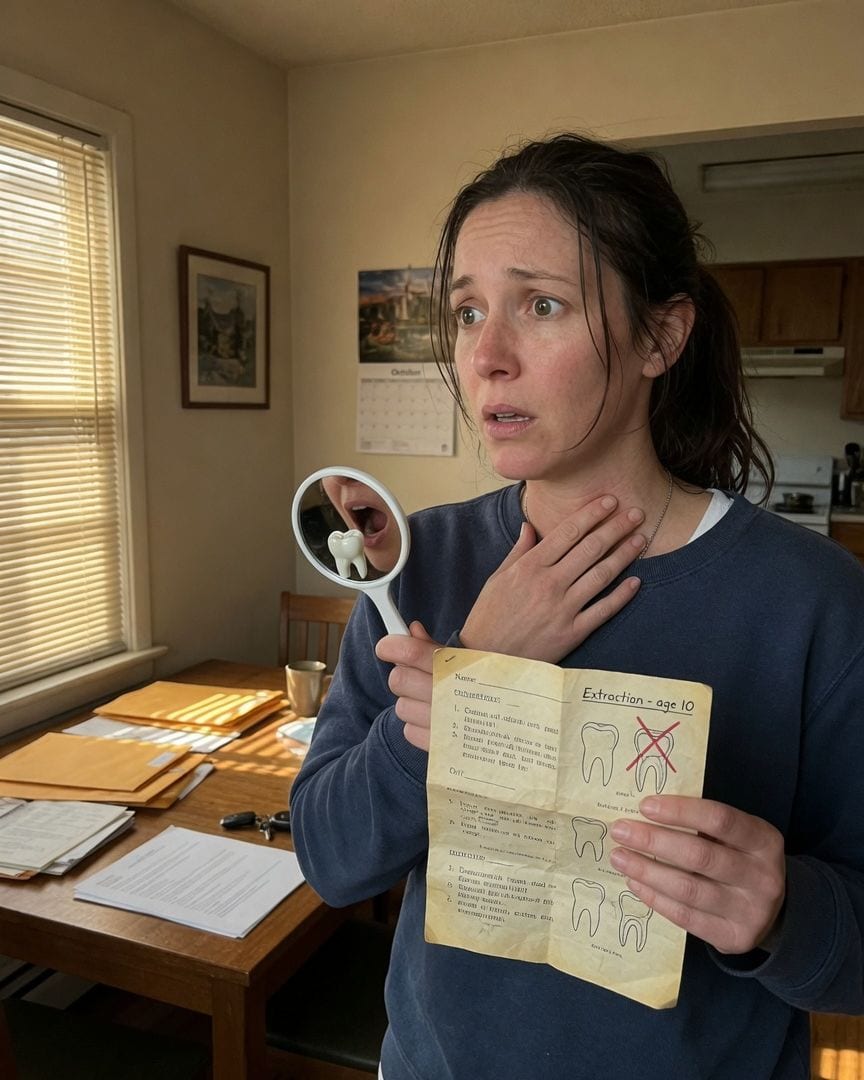
My MRI scan shows metal rods fused into my neck vertebrae. I've never had spinal surgery. The clinic doctor personally called, asking which hospital placed them.
I booked a full-body MRI for my 34th birthday, expecting a clean bill of health. Instead, the scan revealed a perfectly healed surgical fusion in my neck, complete with tiny rods and screws. I have no memory of any such surgery, no scar, and nothing in my medical history.
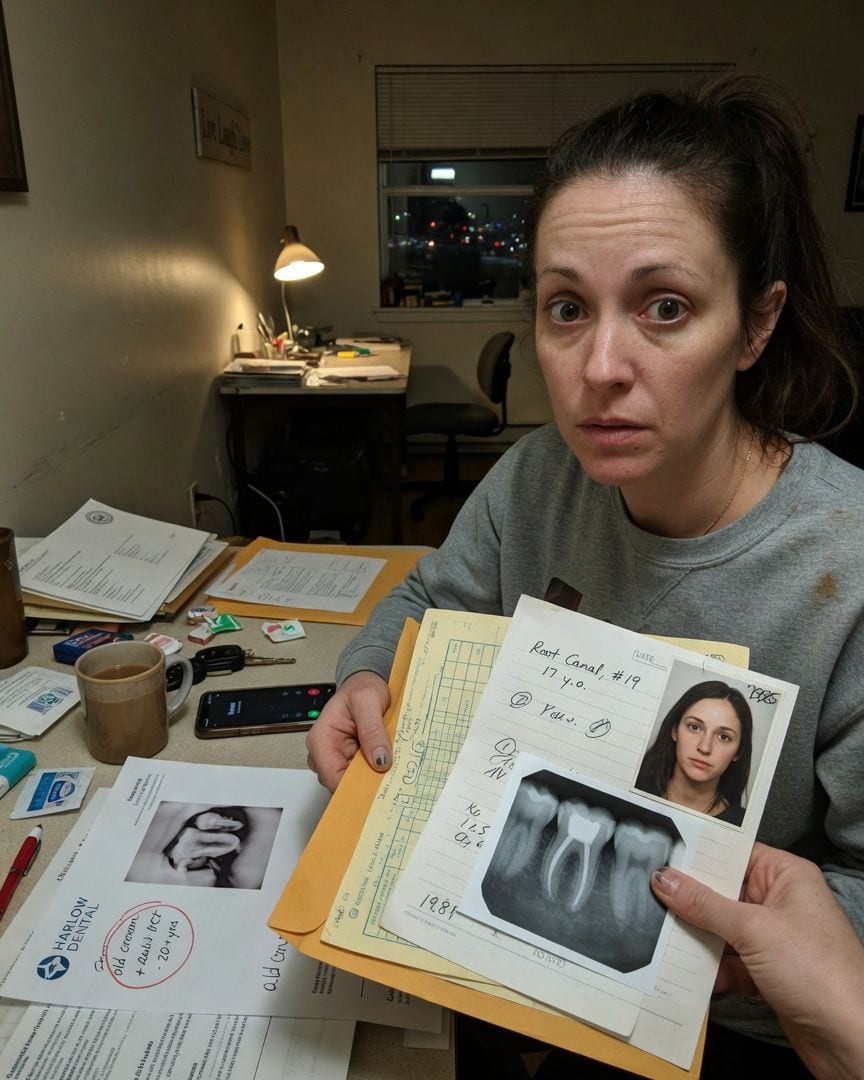
My lower molar has a twenty-year-old root canal. My new dentist showed me the scan. That tooth is whole. I can feel it.
My new dentist found a twenty-year-old root canal and crown in my mouth. The problem? I have no memory of ever having major dental work there, and my mother confirms I never did. My own body held a secret I couldn't explain.
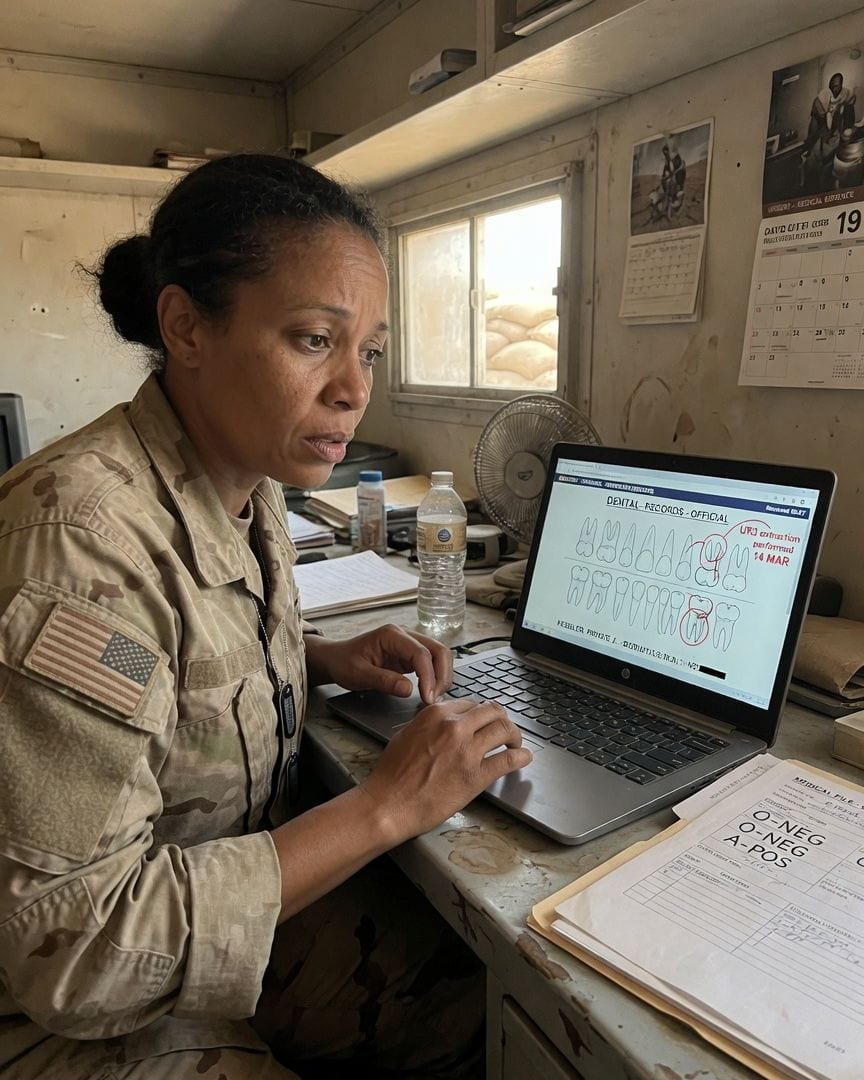
Weeks from going home, Sergeant Whitmore saw Private Kessler’s dental records show teeth he didn’t have and missing ones he did.
Sergeant First Class Iris Whitmore counted the weeks until her deployment ended, dreaming of home as the desert heat baked FOB Cerberus. But the familiar weight of Private Kessler’s dog tags soon brought a cold knot of dread: his blood type, once O-negative, suddenly read A-positive. She dismissed medical anomalies and clerical errors, only to find his official records subtly rewriting his timeline, linking old injuries to new identities. When his dental charts arrived, showing teeth he never had and missing ones he did, Sergeant Whitmore faced an impossible question: who was Private Kessler, really?
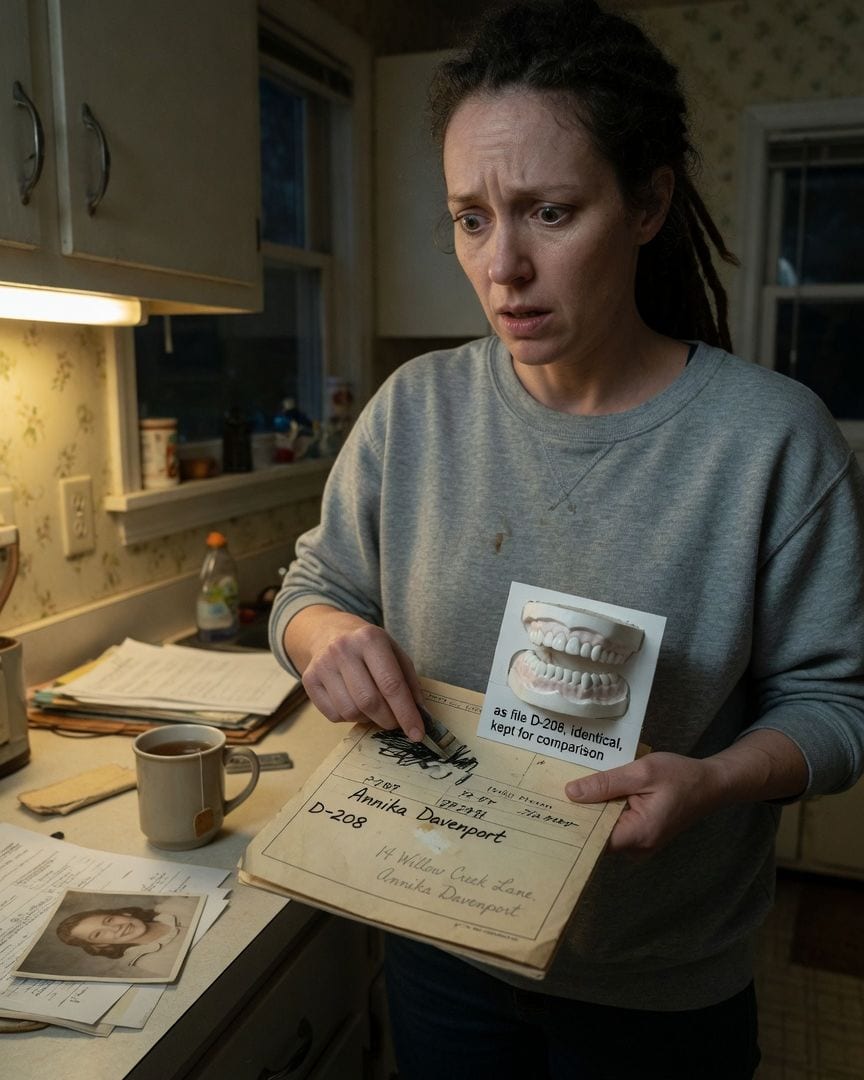
My childhood dental chart lists the house I bought last year — in my own name, years before I was born. A second set of my teeth sits filed beside it, marked 'identical.'
Sifting through old dental records, I found my chart, D-208, with my 1988 birth date. But a line from 1958 was blacked out, and a clipped card with an impression of my teeth listed my name and current home address, decades before I was born. The impossible facts knotted into a cold certainty.
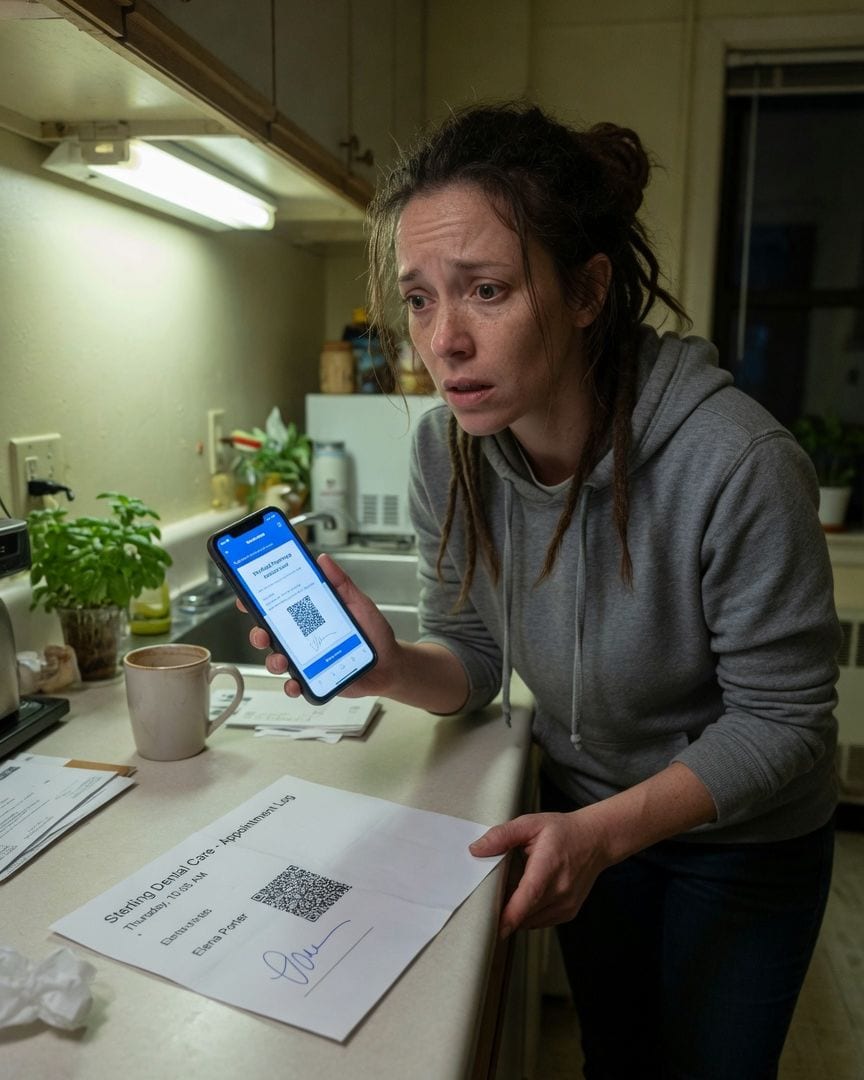
My dentist's system says I was there last Thursday. I wasn't. But the check-in tablet shows my signature, and the hygienist described my chipped tooth exactly right.
I received a call confirming a dental appointment I never made, for a day I was home. Yet, Sterling Dental had my perfect digital signature and described a chipped incisor I’d never told them about. The physical proof insisted I was there, but I wasn’t.
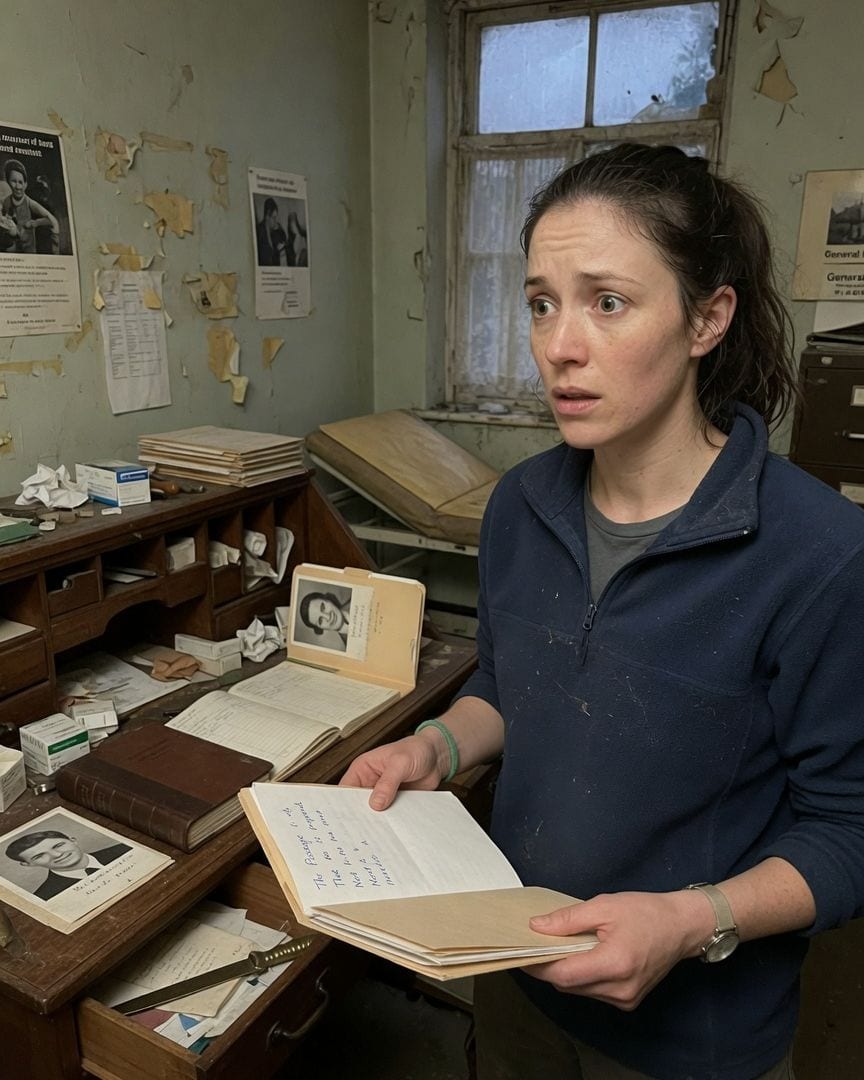
My new clinic's appointment book shows entries for this coming Monday, decades after the doctor retired and died.
Chloe Lawson bought an old, abandoned surgery in Nettlebed, ready to open her new vet clinic. Locals insisted Dr. Almott retired in '79 and the practice shut down for good. But then Chloe found his dusty appointment book filled with meticulous entries, continuing unbroken from 1979 through the decades, right up to this coming Monday.