My X-ray shows a molar I had pulled twenty-three years ago.
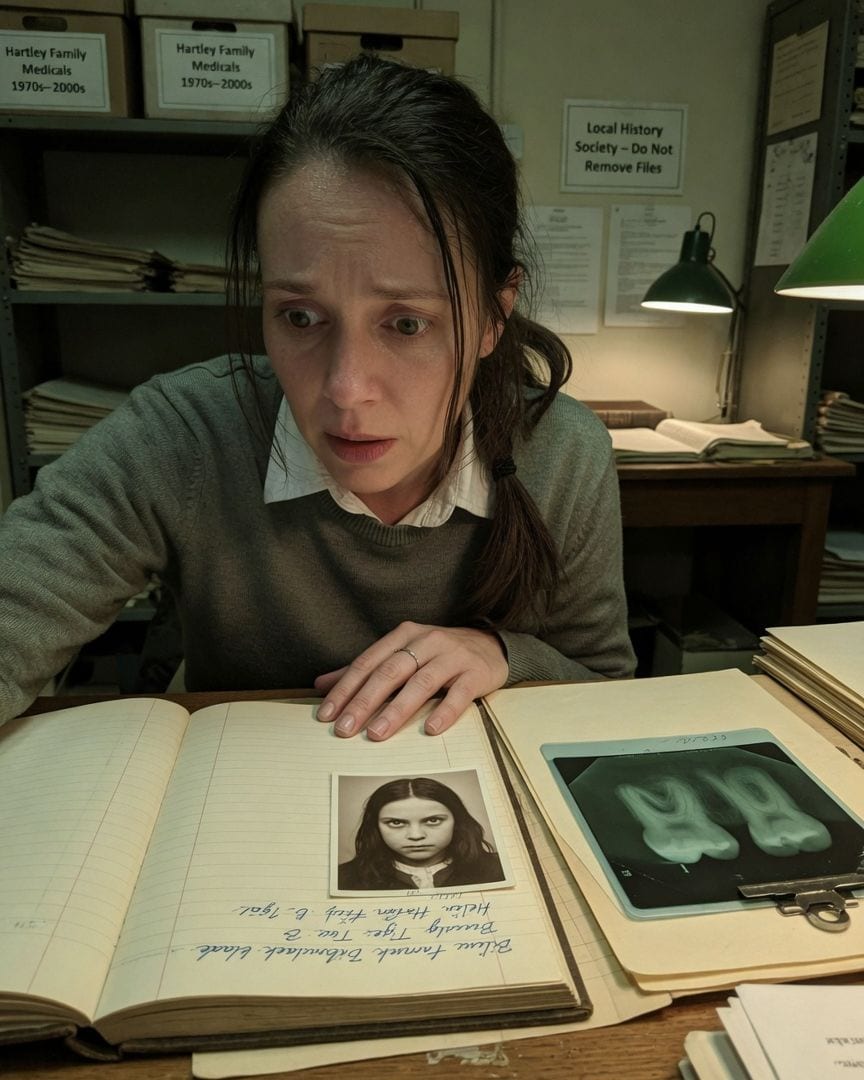
Dr. Crane held the X-ray up to the light, a translucent green square against the backlit panel. "See here, Helen? The old filling on your upper right first molar. It's stable, but we'll want to crown that soon.
Prevent any further cracking." He pointed with a slender metal stylus, a tiny shadow on the film indicating a small metal post in the tooth's root.
I looked at the X-ray, then at his face, then back at the film. The image showed a whole tooth, filled and treated, sitting perfectly in its socket. The problem was, that tooth wasn't there. Not for me.
"Dr. Crane," I said, my voice feeling oddly thin. "That tooth was pulled. Twenty-three years ago. When I was nineteen."
He lowered the X-ray, a crease forming between his eyebrows. "Pulled? Are you certain, Helen? Because this X-ray, it's quite recent, taken just minutes ago, and it clearly shows a molar present."
"I am absolutely certain," I insisted, a cold certainty beginning to spread in my stomach. "It was my first, and worst, experience with a dry socket. I remember it vividly. That whole week, living on lukewarm soup and painkillers.
It was a mess."
He looked at me for a long moment, his eyes searching my face, as if expecting to find a joke there. When he found none, he slowly, deliberately, put down the X-ray.
He picked up his small dental mirror and a thin probe, his usual brisk efficiency replaced by a quiet, unsettling confusion.
He leaned in, his breath warm on my face, and began to count my teeth, slowly, his brow furrowed deeper with each number.
I could feel the cool metal of the probe on my gums where that tooth should have been. It was an empty space.
Dr. Crane sat back, setting the instruments aside with a soft clink. "Helen, you're right," he said, his voice quiet. "There's a definite gap. No molar there. Not a trace."
He ran a hand over his thinning hair, a rare moment of discombobulation for him. He turned to his computer, pulling up my digital records. "Let's see the historical scans..." He scrolled, clicked, then paused. "Here it is.
Entry from '99. Upper right first molar. Extraction confirmed. Dry socket noted. All as you said."
He leaned back, a sigh escaping him. "This is... highly unusual." He then suggested we check the older, paper charts, stored in the back. "Sometimes, anomalies in the digital migration," he murmured, more to himself than to me.
He returned a few minutes later, holding a thick, cream-colored file. "This is it. Helen Hartley. Born 1980. Our records go way back." He opened it, flipping through pages of neat, slanted cursive. "Let's see... upper right first molar..."
He stopped, his finger tracing a line. "Here. Age nineteen. Listed as... 'present and filled.' No mention of an extraction." He looked up, bewildered. "And underneath... a blood type. Type B."
I shook my head immediately. "That's not right, Dr. Crane. I'm Type O. Always have been." I remember getting my blood type checked when I joined the donor registry years ago. It was definitely O positive.
He blinked. "Type O? But this chart, for Helen Hartley, your birth year... it's quite specific. Type B. And it details a full set of teeth well into your early twenties."
He held the chart out, the faded ink seeming to mock me. "Could there have been another Helen Hartley, born the exact same year, who was a patient here?" he mused, but then shook his head.
"Highly unlikely to have identical birthdates. And the handwriting, it's so meticulous."
He suggested a long shot. "The local historical society," he said, tapping the old chart. "They keep extensive family medical records, sometimes going back generations. We often refer families there for obscure lineage questions.
Perhaps they could verify something from deeper in your family's past, rule out some ancient clerical error."
I left his office feeling a new kind of chill. It wasn't the antiseptic cold of the room. It was the image of that full molar on the X-ray burning in my mind, a ghost limb I never had.
And the idea of another me, a Helen Hartley with a different blood type and a tooth I didn't possess.
The historical society was a quiet place, all hushed whispers and the rustle of old paper.
Carol Easton, the archivist, was exactly as Dr. Crane had described: sharp-eyed, with a gentle, knowing smile that made me feel both seen and slightly unnerved. She pulled a thick, leather-bound ledger from a high shelf for 'Hartley Family Medicals.'
The dust that puffed from its pages smelled like forgotten time.
Flipping through the brittle, yellowed sheets, I found an entry for 'Helen Hartley, b. 1980'—my birth year. Beneath it, a detailed medical history began to unfold, none of it familiar.
A severe bout of measles at age five, something I knew I'd never had. Then, a line that made my breath catch: 'Distinct birthmark, left shoulder blade.'
I ran a hand over my own right shoulder blade, the skin smooth and unblemished. I knew, without having to check a mirror, that there was nothing there. Never had been.
And the blood type, clearly recorded: 'Type B.' Just like the old dental chart.
Tucked into the page, almost as an afterthought, was a small, faded photograph. Sepia-toned, it showed a young girl, no older than ten, with my exact name written underneath in the same careful script.
The girl in the photo looked like me, yes, the same dark hair, the same shape of eyes. But the expression, it was subtly, unsettlingly different. A quiet intensity I didn't recognize as my own.
I stared at the image, then back at the meticulous record describing a life that was undeniably 'Helen Hartley,' born 1980, but utterly and completely not mine. A sickening lurch twisted in my gut.
My left shoulder blade felt suddenly heavy, though I knew it was bare.
I returned to Dr. Crane's office the next morning, clutching the printout from the historical society like a shield against something I couldn't name. He read through it, his face growing grimmer with each detail. "Measles... birthmark...
Type B," he murmured. "Helen, this is far too many discrepancies for a simple clerical error, or even a different patient with the same name. It's just... impossible."
He agreed to order a full blood panel for me, just to re-verify my Type O status, though we both knew what it would show. A desperate measure for an impossible situation.
While waiting for the results, I found myself drawn back to the historical society. Carol Easton seemed to anticipate my questions with an unnerving calm, her smile unwavering.
She suggested I might find answers in the records of families "with deep roots in the area," subtly steering me towards an older, less-frequented section of the archives. Rows of ledgers bound in faded cloth and leather, brittle with age.
I pulled out dusty volumes, my fingers tracing names that felt like echoes. I found references to a 'Sheppard' family, prominent landowners from generations past, their history stretching back to the town's founding.
And there it was again: a recurring symbol – a stylized oak leaf – embossed on the spine of several Sheppard ledgers.
I started noticing it elsewhere too: a small, almost invisible ink stamp on a few seemingly random notes within the 'Hartley' ledger, and even on the back of the faded photograph I'd found.
The more I dug, the more I found minor, inexplicable overlaps. Snippets of lives intertwined with others, dates that almost aligned, properties that shifted hands between families in ways that didn't quite make sense.
It was like a colossal jigsaw puzzle where the pieces almost fit, but not quite, leaving hollow spaces in my gut. The room around me felt colder, the air thick with forgotten narratives.
My blood test results came back, confirming what I already knew: I am Type O. It deepened the mystery of the Type B record to an unfathomable degree.
Days later, as I left the historical society after another long afternoon of tracing convoluted family trees, I glanced back. Carol Easton was watching me from the archivist's office window, a faint, almost imperceptible smile on her face.
It wasn’t malicious, but it sent a shiver down my spine. It was unsettling in its knowingness, as if Carol knew exactly what I was searching for, and perhaps, what I would eventually find.
Later that week, an anonymous, unmarked envelope appeared in my mailbox. No return address, no postmark. Inside, there was just a single, faded newspaper clipping, yellowed with age, from 23 years ago.
A small article, barely a paragraph, about the disappearance of a local girl, Vera Sheppard, age 19. The article mentioned no details, just a missing person report, a name, and a date. Vera Sheppard.
The name echoed in the quiet of my kitchen. I felt a chill, realizing someone knew I was getting too close.
I wondered if Carol had sent it, a silent warning or a nudge towards a truth I was not ready to face. The silence in the house pressed in, suddenly heavier.
I returned to Carol Easton, the newspaper clipping crumpled in my hand. She didn't flinch when I presented it. "Vera Sheppard," she mused, her gaze distant, fixed on some point beyond the bookshelves. "A tragic case, that.
Such a bright girl."
"What does it have to do with me?" I pressed, my voice tight. "The Sheppard family records, the oak leaf symbol. What is 'The Keepers'?"
Carol finally looked at me, her eyes clear and unwavering. "The oak leaf is indeed a mark of 'The Keepers.' A clandestine group, dating back to this town's founding families. Tasked with preserving certain lineages."
She spoke of "long-standing arrangements" and "transfers," her voice calm, almost academic, as if discussing local botany. "When a family line faced extinction, or a 'weakening of the line' due to illness or lack of heirs, certain arrangements were made."
I waited, my heart pounding, for her to elaborate.
"Not literally a soul transfer, Ms. Hartley," she clarified, picking up a feather duster and idly running it along a shelf of ancient texts. "More a careful placement. An available, suitable body, into a new identity.
To ensure the 'line' continued. With meticulous records, of course." She gestured around the vast archives. "These aren't just historical documents, Helen. They're a living registry."
She turned, finally facing me fully. "The original Helen Hartley, born 1980, was sickly as a child. A fragile constitution. Not... suitable for continuation, as the ledgers would say." She paused, her gaze steady.
"When Vera Sheppard disappeared, her healthy, young body was deemed suitable. It was 'repurposed' to sustain the Hartley name."
My mind reeled. "The dental X-ray," I whispered, remembering the perfectly whole molar. "The Type B blood... the measles..."
"Those were all the original Helen," Carol confirmed, her voice utterly devoid of malice, only a kind of quiet finality. "The X-ray you saw, the one Dr. Crane took? That's Vera Sheppard's original body. Taken before the 'transfer.'
Your body, Helen. Before it became yours." She glanced at the newspaper clipping still in my hand. "The article was not a warning. It was a confirmation."
The ground shifted beneath me, not metaphorically, but truly, as if the very floorboards of the historical society were groaning under the weight of her words. Every anomaly, every impossible detail, snapped into a horrifying, coherent pattern. A monstrous design.
Reeling from Carol's admission, I needed an undeniable proof, something objective that couldn’t be explained away by old records or a knowing archivist. I ordered a direct-to-consumer DNA kit online, a desperate act to reclaim myself, my original self.
I swabbed my cheek, sealed the small plastic tube, and mailed it off, a silent prayer that it would connect me to my family, my identity, and finally put an end to this waking nightmare.
Weeks later, the results arrived in my email. My hands trembled as I clicked open the attached PDF, scanning for a family tree, for any familiar names, any genetic link to the Hartley lineage I thought was mine.
Instead, a single, stark line leaped out at me from the 'Close Matches' section. It wasn't a living relative. It wasn't a distant cousin.
It was a match to an archived forensic file. The name was 'Vera Sheppard.' Below it, a note, cold and clinical: 'Remains identified, Case 73-C, Monroe County Coroner's Office, 1999.'
My breath hitched, catching painfully in my throat. The missing girl from the newspaper clipping. The girl who disappeared 23 years ago, the same year my tooth was pulled.
The lab tech’s follow-up email, sent just moments after the report, added a chilling detail. 'Ms. Hartley,' it read, her usual professional tone replaced by something more hesitant, 'We've double-checked every marker.
The match to the skeletal remains on file is virtually identical. A 99.9% probability. We've never seen anything quite like it. It's as if you are her.'
I confronted Carol Easton one last time, the DNA report clutched in my hand, its stark numbers burning into my palm. She wasn't surprised.
'The match is, of course, impeccable,' she said, her voice calm, a low hum in the quiet of the archives. 'The body you inhabit, Ms. Hartley, was once Vera Sheppard's. It was a successful transfer.'
She rose from her desk and, without a word, led me past rows of family histories to a section of shelves lined with what looked like ordinary local government records.
She pressed a hidden catch, and a section of the bookshelf rotated inward, revealing a narrow, stone-lined passage.
Inside, a hidden vault stretched out before us, cool and dry, the air smelling of old paper and something else—something mineral, like deep earth.
Rows of ledgers, hundreds of them, lined the shelves, meticulously indexed, each spine stamped with the stylized oak leaf.
She pulled out a heavy, leather-bound volume labeled 'The Keepers - Registry of Transfers.' Flipping to a section marked 'Hartley Lineage,' Carol pointed to an entry dated 23 years ago.
My eyes scanned the precise script: 'Transfer of Vessel: Vera Sheppard, b. 1980, d. 1999. Recipient Identity: Helen Hartley, b. 1980, deemed unsuitable for continuation.'
The ledger detailed Vera's dental records, her blood type (Type O), her physical characteristics – all matching my current self perfectly. It even mentioned the specific dental work, including the metal post, done on Vera years before her disappearance.
Carol explained, her voice as dispassionate as if she were reading from a dictionary, that the original Helen Hartley, deemed too fragile, was quietly allowed to pass on.
Vera's healthy, young body, having met an untimely end, was 'prepared' and 're-assigned' to continue the Hartley name. The original Helen's records were subtly altered, her existence fading, while Vera's body became the 'new' Helen.
'The institution,' Carol said, gesturing around the vault, 'has known, and managed, these transfers for centuries. For families who understood the need for continuity.'
The dread wasn't just in the fact, but in the cold, clinical precision of it all, the sheer scale of the deception, and the quiet complicity of generations.
I tried to leave the vault, my legs unsteady, but Carol gently blocked my path, her hand on my arm surprisingly strong. 'You cannot un-know this, Helen,' she said, her voice softer now, almost sympathetic. 'And you cannot tell.
The balance must be maintained.' My mind raced, frantically searching for an escape, a way to expose this monstrous truth. But Carol's presence wasn't overtly threatening; it was simply absolute, a quiet, unyielding barrier.
She explained that I now truly am Helen Hartley, having lived in this body for decades, having built a life.
To expose the truth would unravel not just my life, but the lives of countless others who are 'transfers,' who have lived their entire existence unaware.
It would shatter the fabric of the community, which had been quietly sustained by these 'arrangements' for generations. I saw the futility of it all, the impossibility of fighting an institution so deeply embedded, so calmly assured of its righteousness.
I understood that I was not a victim to be rescued, but a successful 'product' of their system. The horror was not a monster to be slain, but a truth that could not be undone.
Carol offered me a choice, though it felt less like a choice and more like a pronouncement. 'Accept your new reality, Helen. Or become another 'unsuitable.'
' I looked into Carol's steady, ancient eyes, and felt a profound sense of resignation settle over me. I was trapped, not by chains, but by the sheer, undeniable coherence of the truth.
I walked out of the vault, a different woman, the ghost of Vera Sheppard now fully possessing my every cell. The world outside felt too bright, too loud.
Helen continued her life. Dr. Crane called a few days later to confirm her blood type, then dismissed the old records as an 'isolated, inexplicable anomaly.'
Carol Easton continued her work at the historical society, her smile as gentle and knowing as ever. The town went on, its secrets buried deep beneath its placid surface, its lineages quietly maintained.
Helen’s friends and neighbors noticed nothing overtly different, only a subtle shift in her demeanor, a newfound quietness, a distant look in her eyes.
She often found herself running her fingers over the smooth skin of her left shoulder blade, an empty space where a birthmark should have been, a ghost mark from the life she unknowingly replaced.
The dread had not faded; it had simply settled into the marrow of her bones.
Helen sat at her kitchen table, a cup of untouched coffee growing cold. She picked up a small, framed photo of herself from years ago, a younger, brighter Helen, before the X-ray, before the records, before the truth.
She studied the face, a stranger's face now, but her own. A faint, almost imperceptible smile touched her lips, a smile that doesn't quite reach her eyes.
She set the photo down, her gaze settling on her reflection in the dark window. She saw Vera Sheppard looking back.
Her neighbor, Mrs. Reynolds, waved from her porch. 'Good morning, Helen! Lovely day, isn't it?' Helen just offered a faint, wrong little smile and went inside.
If this one got to you
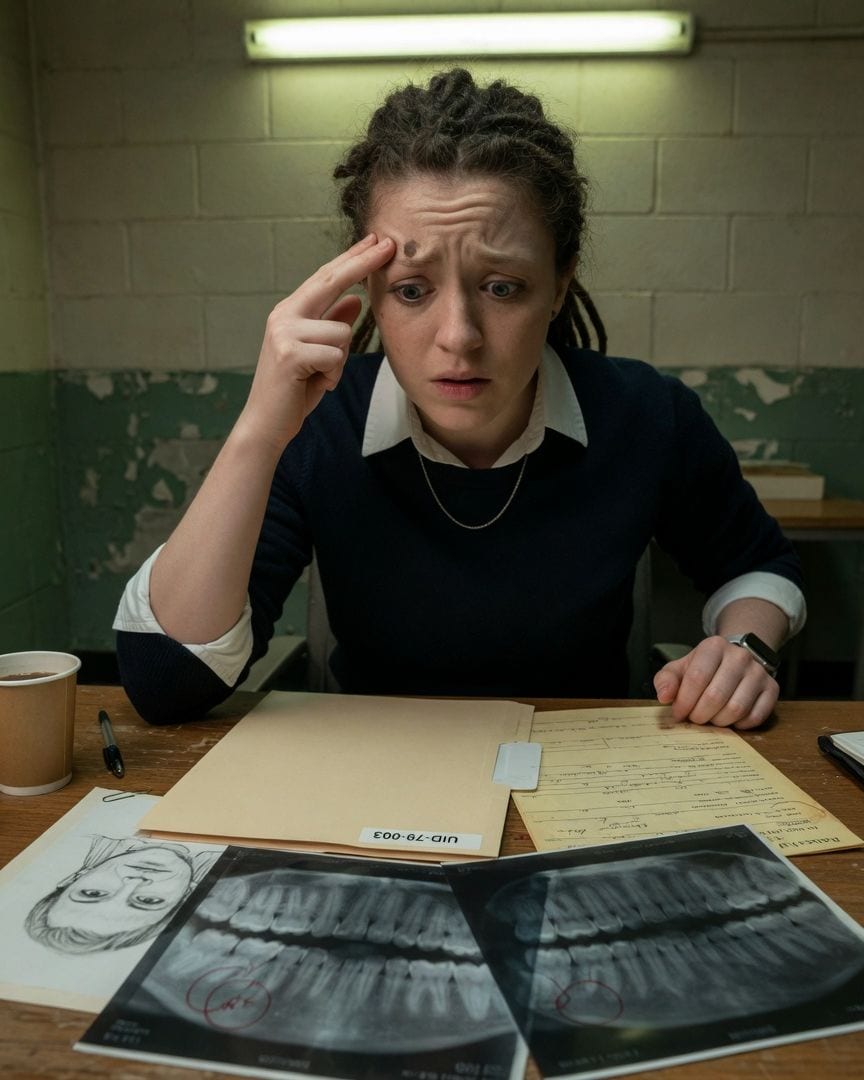
A 1979 facial reconstruction of unidentified remains has my distinct birthmark, just above its left eyebrow.
Switching dentists should have been a routine adult problem. Instead, my new X-rays were an identical match for unidentified human remains catalogued by the county coroner in 1979. The impossible match left me with a chilling dread.
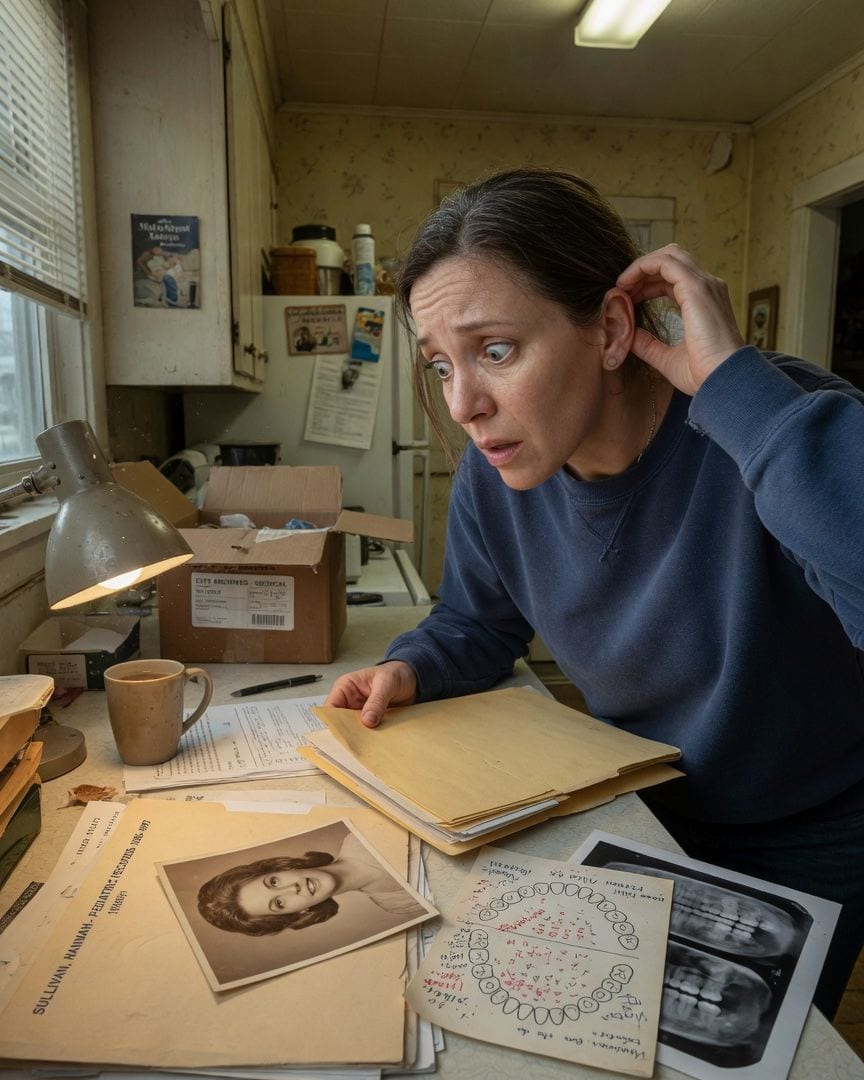
My MRI showed a perfect, decades-old surgical opening in my skull. I have no memory of it.
I underwent a routine MRI for persistent dizziness, expecting reassurance. Instead, the scan revealed a perfectly healed, decades-old surgical opening in my parietal bone, just behind my left ear. Dr. Hughes confirmed it was an access point for a procedure, yet I have no memory of any head surgery, ever. My body holds a secret I cannot recall.
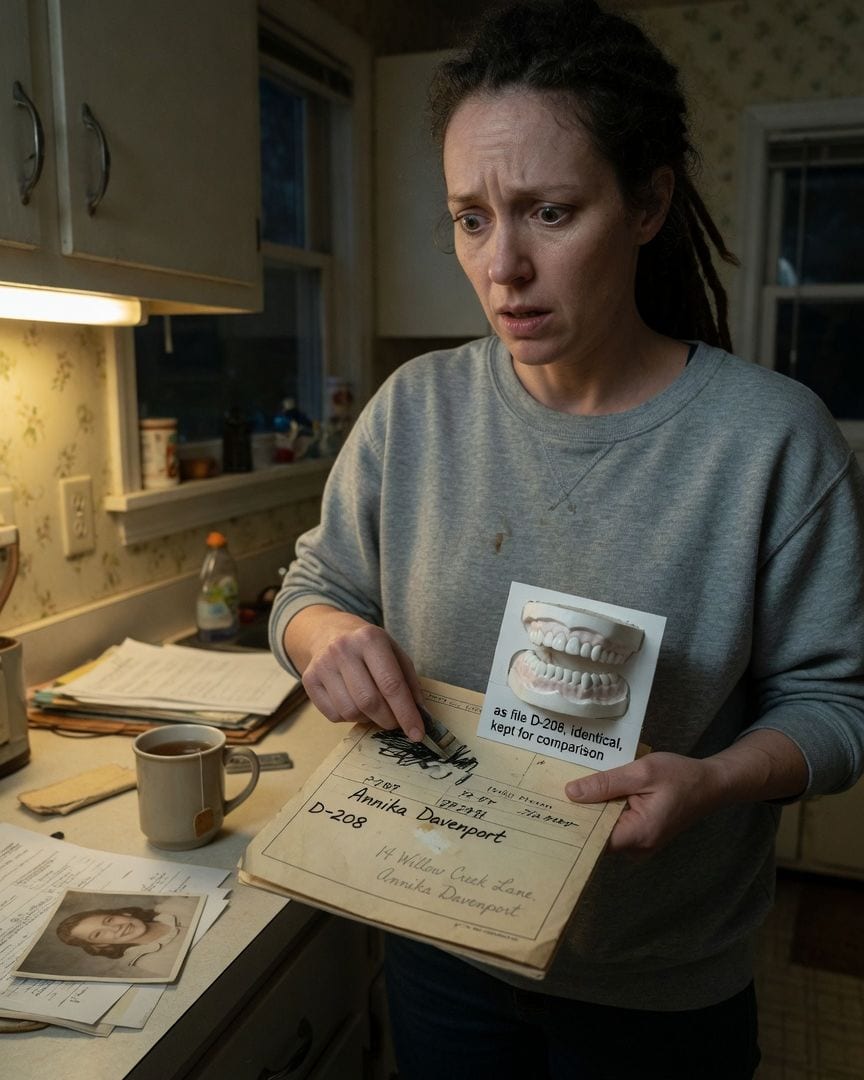
My childhood dental chart lists the house I bought last year — in my own name, years before I was born. A second set of my teeth sits filed beside it, marked 'identical.'
Sifting through old dental records, I found my chart, D-208, with my 1988 birth date. But a line from 1958 was blacked out, and a clipped card with an impression of my teeth listed my name and current home address, decades before I was born. The impossible facts knotted into a cold certainty.
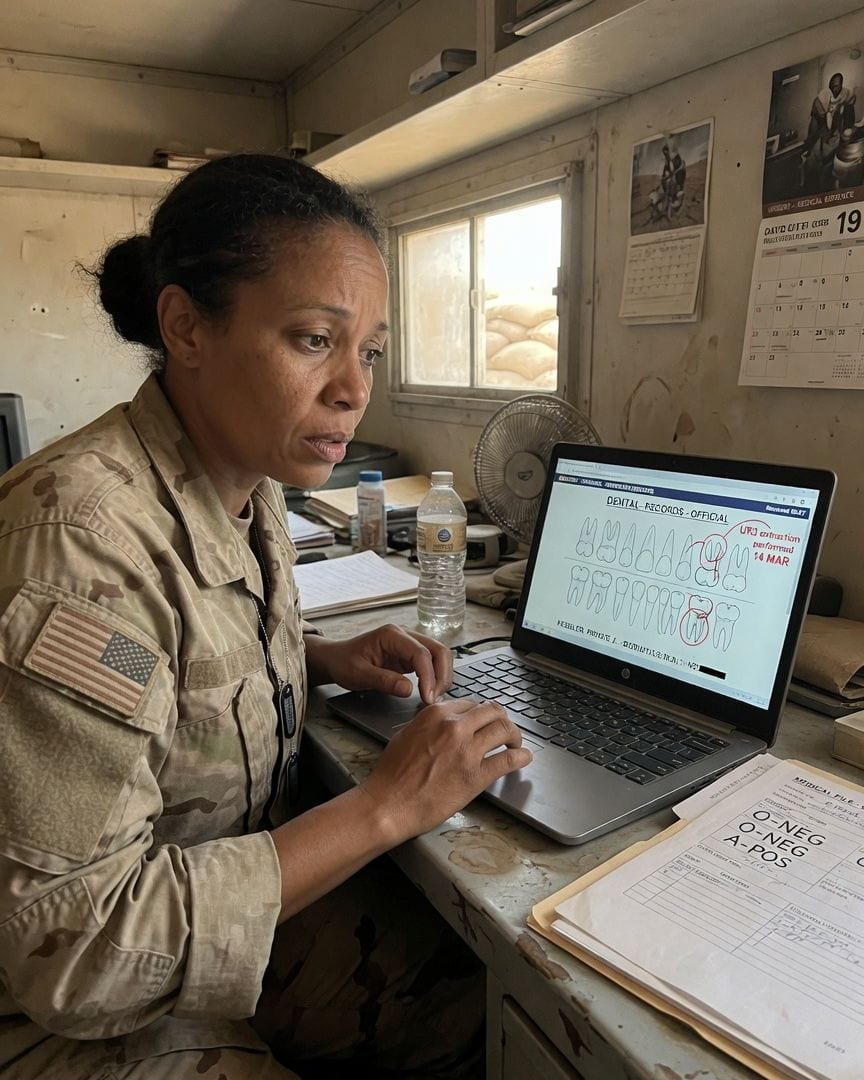
Weeks from going home, Sergeant Whitmore saw Private Kessler’s dental records show teeth he didn’t have and missing ones he did.
Sergeant First Class Iris Whitmore counted the weeks until her deployment ended, dreaming of home as the desert heat baked FOB Cerberus. But the familiar weight of Private Kessler’s dog tags soon brought a cold knot of dread: his blood type, once O-negative, suddenly read A-positive. She dismissed medical anomalies and clerical errors, only to find his official records subtly rewriting his timeline, linking old injuries to new identities. When his dental charts arrived, showing teeth he never had and missing ones he did, Sergeant Whitmore faced an impossible question: who was Private Kessler, really?
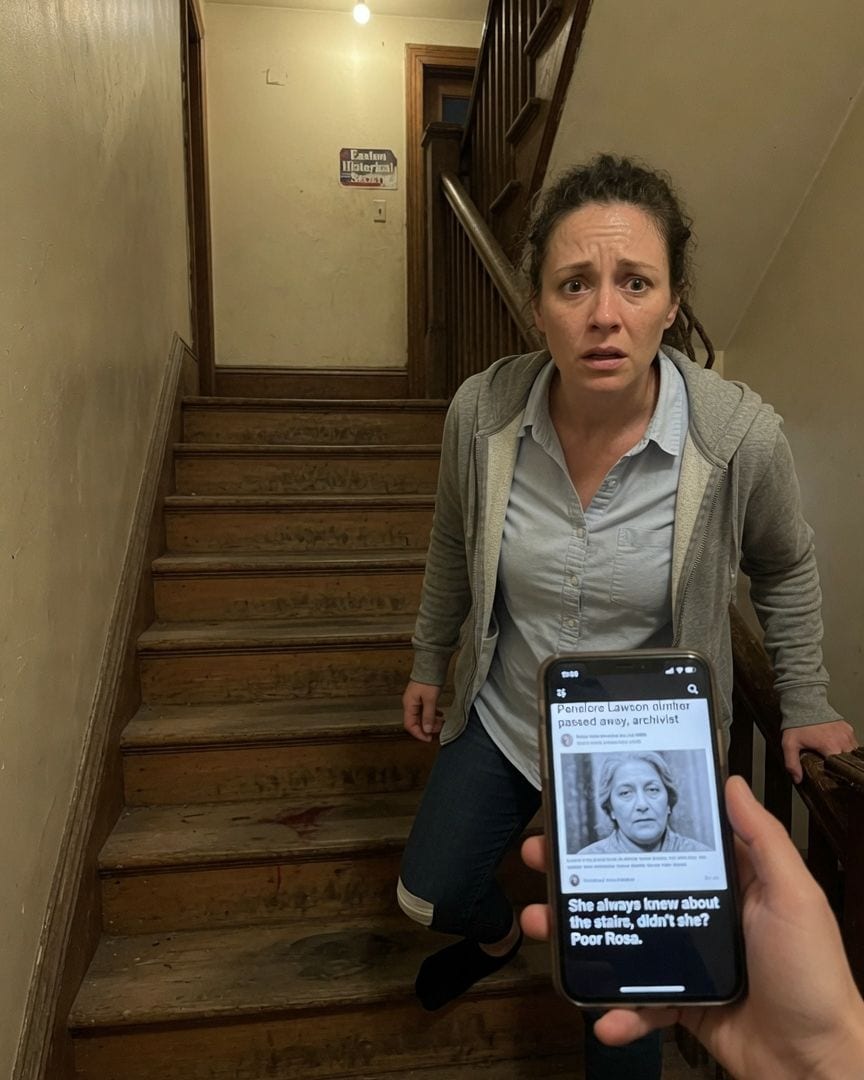
My hygienist apologized, 'I'm so sorry, Rosa — about the stairs.' I'd given the clinic only my surname, and they said she hadn't worked there in over a year.
During my routine dental cleaning, the hygienist murmured my name, Rosa, which wasn't on my intake form. She then offered a soft apology "about the stairs," a kindness that felt deeply misplaced and settled in my gut.
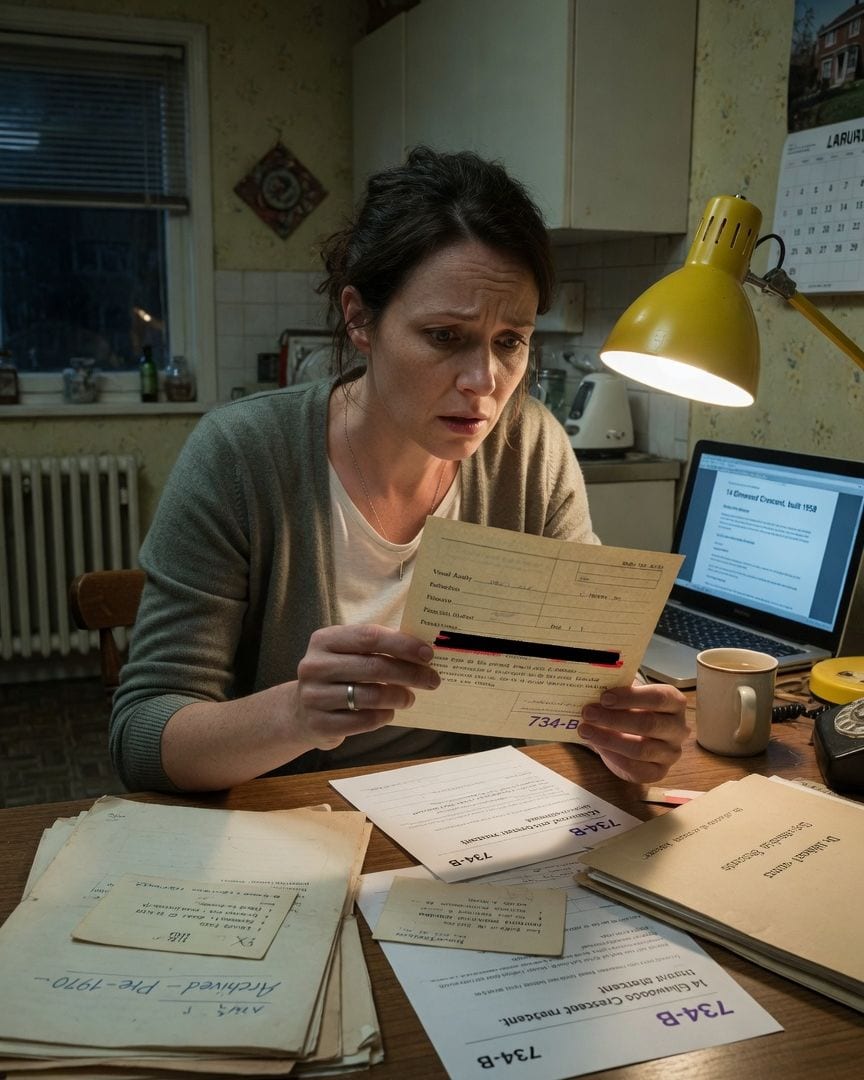
An old eye test card had my patient ID, 734-B, dated 1966. I found another, from 1948, for my house.
Transferring my old eye records should have been routine, but a strange, redacted card from 1966 raised a cold knot of dread. It mentioned my surname and street, along with a chilling instruction: 'tell the patient nothing.' Then I found my unique patient ID, assigned to me, on records dated 1948.