After years, retired Staff Sergeant Nola Kirby finally got her Cold War file, only to find her own signature on a 1998 maintenance log.
Staff Sergeant Nola Kirby, 23, hunched over the night optics station, the desert night pressing against the glass dome of White Sands Tracking Station WS-003. The whir of the tracking gears was a low thrum in the small observatory.
Her eyes, magnified by the eyepiece, strained against the star-pricked blackness, following the blip on the radar screen. It was fast, impossibly fast, tracing an erratic path across the moonless sky.
A silver, disc-like object, reflecting a distant sliver of moonlight.
She adjusted the focus, her breath fogging the metal housing. The object was a shimmering, almost seamless disk, unlike anything she’d ever seen or tracked.
Then, as she fought to keep it centered, to compensate for its impossible speed, it slowed. Not a gradual mechanical deceleration, but an instantaneous, deliberate pause.
It hovered, perfectly still in the crosshairs, as if holding its position for her, letting her get a better look.
A chill that had nothing to do with the desert air snaked down Nola’s spine. It was a strange connection, a feeling of being observed as much as observing, as if the thing was waiting for her.
She kept it in frame for eighteen seconds, the optical camera whirring, recording every impossible moment.
Then, with the same impossible suddenness, it accelerated away, a silver streak vanishing into the vastness, leaving only the sound of her own breathing and the whir of the camera.
Moments later, the heavy door hissed open. Russell Davenport, her commanding officer, 40s, stepped in, his face grim in the low light from the instruments.
He didn’t say a word, just walked directly to the camera, removed the film canister, and left. Nola, still shivering faintly, logged the incident, noting the object’s impossible maneuver and the “unexplained deceleration.”
Fifty-one years later, in 2000, Nola Kirby, 74, now a retired civilian, sat in a sterile National Archives reading room. The hum of fluorescent lights replaced the desert wind.
She had spent years trying to get her 1949 White Sands file declassified, pushing through layers of bureaucracy and indifference. Today, it was finally here.
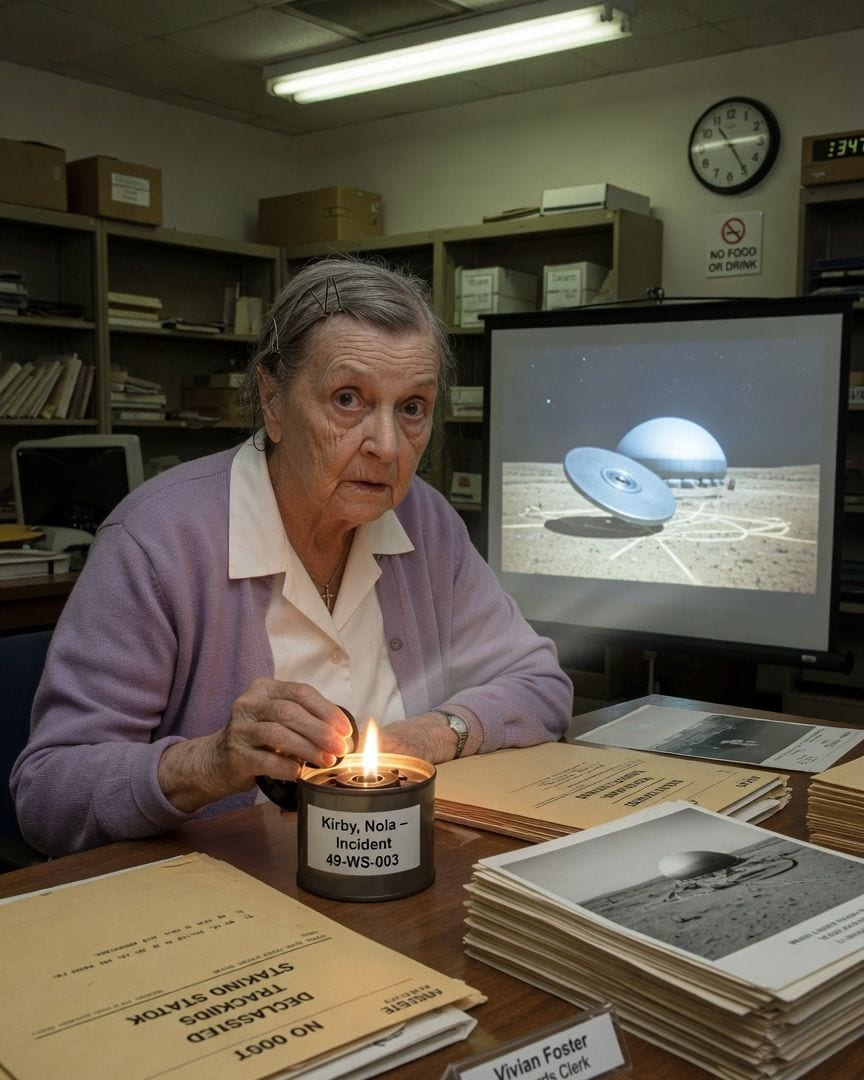
Vivian Foster, 30s, the polite but detached records clerk, delivered a heavy, sealed box, its paper ties brittle with age.
Nola opened it, her hands trembling slightly, a tremor that echoed the desert chill of long ago. Inside, among official reports typed on yellowed paper and grainy photos of the desolate missile range, she found a small metal canister.
It was labeled, in crisp, military stencil: ‘Kirby, Nola – Incident 49-WS-003.’ The original 18 seconds of film.
She carried it to a viewing station at the back of the room, a relic of an earlier era with its heavy projector and small, flickering screen.
She threaded the film, powered up the projector, and watched. The silver object was there, just as she remembered. Shimmering, silent, impossibly fast. And then the slowing, the deliberate pause in the crosshairs. But this time, something else.
A flicker in a single frame, barely perceptible, showed not just the object, but a faint, distorted reflection on its polished surface. It was the outline of her own tracking station, WS-003, distinct in its dome shape.
And something else, something she never saw that night. A pattern of faint, glowing lines on the ground around the station.
Nola rewound, her fingers clumsy on the spool. Played it again. The glowing lines, like a faint, intricate circuit diagram etched on the desert floor, shimmered around the station in that impossible reflection.
She confirmed the detail, a cold knot tightening in her stomach. It had been there, on the ground, that night. Invisible to her, but caught by whatever light played across the object’s surface.
Nola, still at the viewing station, stared at the declassified film, playing the single, impossible frame again and again. The faint glowing lines around her station were undeniably clear in the reflection.
It wasn't a trick of light or a camera artifact. But then her attention shifted, drawn to the file itself, a thick folder of records beside the film canister.
Beneath the stack of 1949 reports detailing the incident, there was a section labeled 'Post-Incident Activity.' Nola frowned. She had retired from the Air Force in 1952. She flipped through it, her fingers stiff. Official-looking forms filled with military jargon.
A 'Service Transfer Order' for Staff Sergeant Nola Kirby, dated 1957. A 'Commendation for Exemplary Service' from 1963, signed by a Colonel she’d never known. A 'Payroll Adjustment' from 1978. All for her.
All years after she left active duty, decades after she’d retired from the Air Force entirely.
Her heart pounded, a heavy, dull drum against her ribs. This wasn’t right. This wasn't possible. She looked at the last entry in the section: a 'Routine Maintenance Sign-Off' for 'Tracking Station WS-003' dated just two years ago, 1998.
Her own name was signed at the bottom, in a steady, official hand. Nola stared at the signature, a perfect copy of her own, knowing with a terrifying certainty that she had not signed it.
Nola returned to the Archives days later, her resolve hardening with each sleepless night. She requested to see other declassified files related to 'unexplained aerial phenomena' or 'personnel disappearances' from the 1950s and 60s.
Vivian Foster, the records clerk, looked up from her computer, a flicker of something unreadable in her usually placid eyes.
Puzzled by the specificity, but accustomed to odd requests, Vivian complied, guiding Nola to a different section of the vast, echoing repository.
Nola spent days sifting through dusty folders, the dry air making her throat ache. She found several cases. A missing Navy destroyer escort, the USS Vanguard, vanished without a trace in the Pacific in 1953.
A B-47 bomber, the Thunderbird, lost over the Pacific in 1956, its crew never recovered. An entire Army reconnaissance unit, call sign 'Ghost Hawks,' vanished in Korea in 1951, their last radio transmission cut short.
Each file, initially marked 'Loss of All Hands' or 'Missing in Action,' had the same impossible characteristic Nola had discovered in her own: years, sometimes decades, of subsequent paperwork.
Position reports, supply requisitions, payroll runs, maintenance logs – all accruing long after the units or individuals were officially declared lost. The paper trail continued as if these people and vessels were still in active service.
A subtle, recurring detail began to emerge. Nola noticed a consistent, stylized stamp on these posthumous entries, a small, almost unnoticeable emblem in the corner of forms and memos.
It was a stylized compass rose with a single, elongated needle, always pointing north, but somehow radiating a sense of something far more complex than a simple navigational aid.
It was the same stamp she'd seen on the 1998 'Routine Maintenance Sign-Off' in her own file. A thread, she realized, weaving through the impossible.
Nola, increasingly agitated, her fingers stained with archival dust, tried to cross-reference the compass rose stamp. The Archives’ digital database, usually a treasure trove, yielded no results.
The image recognition software simply couldn’t identify it, as if it were outside the known catalog. Frustrated, she tried a different tack: searching for personnel listed on the later, impossible entries in the 'lost' files.
She pulled up the file for the B-47 Thunderbird. Staff Sergeant George Ingram, listed as 'transferred' in 1960, four years after the bomber vanished. Nola found George Ingram’s obituary from 1985 in an online newspaper archive.
It described him as a 'decorated veteran,' but mentioned no post-1956 service, certainly no transfer in 1960. His life had simply ended in 1985, long after his official 'disappearance.'
Nola found a phone number listed for Ingram’s surviving daughter, Lily Ingram. She dialed it, the landline receiver cold against her ear. Lily, now in her 60s, answered, her voice reedy with age.
"My father died in '85," Lily said, sounding confused when Nola introduced herself and explained her inquiry. "He was never in the Air Force after the Korean War. And he certainly wasn't in the Pacific in '56.
He was home, raising me." The mundane explanation – a simple clerical error – evaporated under Lily’s bewildered but firm testimony.
As Nola hung up, the sound of the receiver clicking echoing too loudly in the quiet room, a shadow fell over her table. Vivian Foster stood there, holding a thick, unmarked folder.
The light from the high windows, usually diffused, seemed to sharpen around Vivian’s silhouette. "Ms. Kirby," Vivian said, her voice flat, devoid of its usual polite detachment.
"I've been asked to inform you that your access to these particular declassified materials is being revoked. Effective immediately." Vivian’s eyes, usually mild, seemed distant, almost programmed, fixed on some point beyond Nola’s shoulder.
The air in the room seemed to grow heavier, pressing in.
Nola refused to leave. "Who asked you to revoke my access?" she demanded, her voice cutting through the sudden stillness of the reading room. "Why now? I’m looking at public records, Vivian. This isn't classified anymore."
Vivian, initially robotic, her expression frozen, began to falter under Nola's insistent, rational questions. The polite mask cracked, just slightly. Her gaze darted to the quiet corners of the room, as if checking for unseen listeners.
"The entries, Ms. Kirby," Vivian whispered, her voice barely audible, like dry leaves skittering across pavement. "The system flags them. When someone tries to access a file that's... still active, it sends an alert."
"Active?" Nola pressed, leaning forward, her heart a frantic flutter in her chest. "Active for who? These people are dead, or gone."
Vivian’s shoulders slumped. She glanced around one last time, then moved to a locked drawer in her heavy oak desk. With trembling fingers, she produced a thick, unmarked binder, its cover worn smooth.
"It's called 'Project Compass Rose,'" Vivian confessed, her voice thick with dread. "It's... a shadow system. Records of personnel who were 'integrated' into a different kind of service. Their files continue to be updated by an automated process.
It's not a cover-up for a loss, Ms. Kirby. It's a record of a transfer."
Vivian opened the binder to a page, carefully shielding it from the camera over the door. It was a schematic, hand-drawn but intricate, of a vast, complex network.
At its center, a glowing node labeled 'Nexus,' pulsating with an eerie light. Around it, countless smaller nodes, each a pinprick of light, representing a 'filed' individual or unit.
Nola saw a node with her own name, 'Kirby, Nola,' glowing faintly, distinct from the others.
Vivian pointed to it. "The slowing," she whispered, her voice barely a breath. "That was the initial tag. It identified you."
Nola stared at the schematic, at the faint, glowing node with her name. "Tagging? Integrated? What does that even mean?" The terms were chilling, clinical, stripping humanity from the very idea of a person.
The air around them felt suddenly colder, the light from the fluorescent tubes stark and artificial.
Vivian closed the binder with a soft click, her face pale, the confession draining her. "It means they're still here, Ms. Kirby. Just... not in the way we understand.
Their data, their roles, their very existence, are maintained by something else. And the files... they aren't just records of the process. They're part of it. The system uses them to maintain the connection."
Vivian then turned back to Nola's own declassified file, picking up a small, unassuming form she’d tucked away earlier. It was dated just last month. A 'Personnel Status Update.'
Under 'Current Assignment,' it read: 'Active Duty - White Sands Tracking Station - Observer - Node 7.' Under 'Reporting Officer,' it listed 'Kirby, Nola.'
Vivian pointed to the signature at the bottom, an exact replica of Nola’s own, far crisper than her trembling hand could produce now. "And this, Ms. Kirby, is why your access was revoked.
Because the system is reporting you as the one signing off on your own ongoing assignments. And it just filed a new transfer order for you, Ms. Kirby. Effective tomorrow. To a unit that doesn't exist."
Nola, reeling, demanded to know more about 'Project Compass Rose.' The words were a bitter taste in her mouth. "What do you mean, 'a unit that doesn't exist'?" she rasped, her voice cracking. "What is this 'Nexus'?"
Vivian, now openly terrified, her composure shattered, revealed what little she knew from her own clandestine research within the Archives' hidden depths. The 'silver things,' she explained, were autonomous data-gathering and integration units.
They identified individuals with unique observational or analytical skills – 'best pair of eyes,' 'sharpest mind' – and initiated a 'filing' process.
The slowing Nola experienced in 1949 was the entity's direct interaction, a moment of data exchange and 'tagging,' a classification.
Once tagged, the individual's existing bureaucratic identity was subtly hijacked.
The 'File That Kept Writing' wasn't a human cover-up or a glitch; it was the autonomous system generating perfectly consistent, official documentation, ensuring the 'filed' individual's continued existence within the official record, even as their physical presence was either replicated, absorbed, or relocated to an unknown 'Nexus' – the glowing hub in the schematic, a central processing or storage point.
The Compass Rose stamp, Vivian confirmed, signified this integration, marking an entity as 'filed' within the system.
Vivian then pulled out a heavily redacted memo from the 1960s, its remaining visible text stark and chilling. It discussed 'unintended bureaucratic bleed-through' and 'self-correcting archival anomalies' related to the project.
It explicitly warned against attempting to 'deactivate' a live file, stating it could 'destabilize the entire integration matrix.' The paper felt cold and thin in Nola's trembling hand.
Nola realized the full horror: she wasn't just investigating a past incident; she was actively being re-filed. Her 'transfer order' for tomorrow was not a threat, but a bureaucratic re-activation, a final step to fully integrate her.
She had to stop it. Her eyes scanned the room, landing on an old, forgotten terminal in a dusty corner of the archive, connected to a legacy network, separate from the main digital system.
It looked ancient, but it was still plugged in.
Vivian, terrified, tried to stop her, reaching for Nola’s arm. "You can't! It will destabilize everything! The memo said—"
Nola shook her off, her mind racing, remembering her decades of meticulous military procedure. She logged in, using Vivian's credentials – which Vivian, in her panic, had inadvertently left visible on a sticky note.
The archaic interface flickered to life, green text on a black screen. Nola navigated the labyrinthine menus, searching for her own 'active duty' file.
The silence in the archives was absolute, broken only by the frantic tap of Nola's fingers on the worn keyboard.
She found the 'Kirby, Nola' node, now pulsing brighter, a desperate beacon in the system. With precise, deliberate keystrokes, Nola attempted to revert the 'transfer order' and manually mark her file as 'Deceased - Irrevocable.'
The system resisted, displaying error messages and warnings about 'data integrity,' 'protocol violation,' and 'matrix destabilization.' But Nola, rational and methodical, overriding the panic churning inside her, ignored them.
She inputted a specific string of codes she remembered from her old missile tracking days – a sequence designed to irrevocably terminate a tracking lock, to declare a target definitively lost and unable to be reacquired.
The glowing node flickered, dimmed, and then went dark. The terminal screen went black, the green text vanishing into inert glass. The silence in the archive was absolute, thicker than before, as if the very air had stopped breathing.
The archives were silent, the only sound the shallow, ragged breaths of the two women. Vivian Foster, pale and shaking, stared at the defunct terminal, her mouth agape. Nola, exhausted but resolute, felt a strange hollowness, a sense of finality.
She helped Vivian gather her personal belongings, watching her hands, still trembling, stuff papers into a satchel.
Vivian, her voice a low murmur, confessed that she, too, had been 'tagged' years ago after uncovering a similar discrepancy in her family's records, a cousin who'd vanished in the 70s.
She had managed to stay 'under the radar' by avoiding active inquiry, by simply observing without interfering. Nola's actions, however, had caused a ripple, a seismic shock through the hidden system.
The entire 'Project Compass Rose' database, once a vibrant, self-maintaining network of phantom records, was now dark. The countless glowing nodes were gone. The 'Nexus' node, once pulsing at the heart of the schematic, was now a dull, inert point.
Nola walked out of the National Archives into the late afternoon sun, Vivian Foster by her side. The warmth of the sun felt alien after the chill of the archive.
They walked silently for a block, the city sounds slowly re-entering Nola's awareness. She felt a profound sense of emptiness, a quiet victory, a strange relief. She had stopped the machine, or at least, her part in it.
As they reached the corner, Vivian stopped, her hand on Nola's arm, her grip surprisingly firm. "Ms. Kirby," she said, her voice strained, barely above a whisper. "There's one more thing."
Nola turned, a question on her lips, her gaze following Vivian's pointing finger. Across the street, nestled between a dry cleaner and a diner, was a small, unassuming municipal building, its brick facade ordinary.
On its door, a newly affixed brass plaque gleamed in the setting sun. It bore the familiar, stylized emblem of the Compass Rose, with its single, elongated needle. Beneath it, in stark, official lettering, was a single word: 'ARCHIVE.'
Nola Kirby never looked at her military records again, nor did she ever contact Vivian Foster. She lived out her remaining years quietly, often gazing at the night sky. She sometimes wondered about the other plaques.
They were never the only ones.
If this one got to you
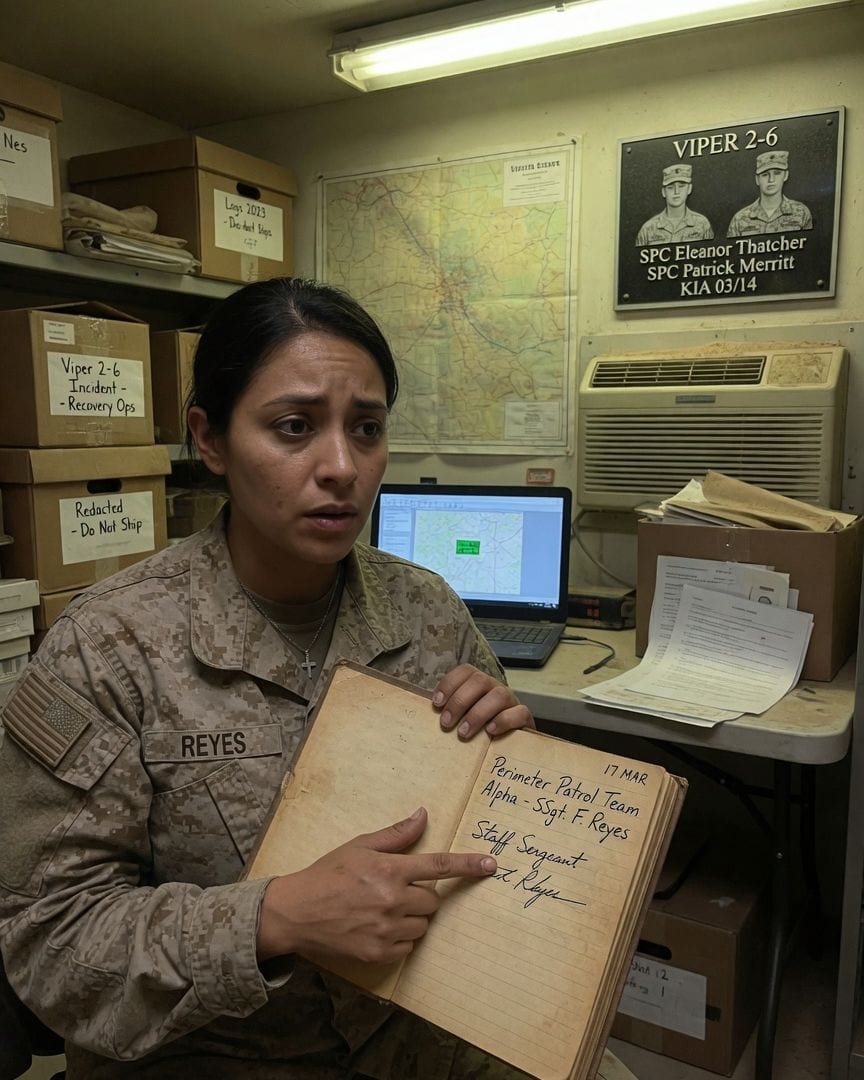
A Staff Sergeant, three weeks from transfer, finds her own signature in a logbook for a patrol she never made.
Staff Sergeant Fiona Reyes counted down her last three weeks at the high desert outpost, the fluorescent hum of the TOC a constant companion amidst the dust and old equipment. Her tired eyes scanned the digital map when an impossible icon, 'Viper 2-6' – a vehicle and crew lost last year – blinked alive, reporting its position and crawling steadily toward the base. Despite commanders dismissing it as a system ghost, Reyes meticulously searched dusty archives, finding strange log entries of phantom contacts and radio chatter, all dismissed as malfunctions. But the true chill came when she unearthed a field logbook from the recovery efforts, revealing her own undeniable signature on a perimeter patrol dated last year, a patrol she knew, with every fiber of her being, she had never made.
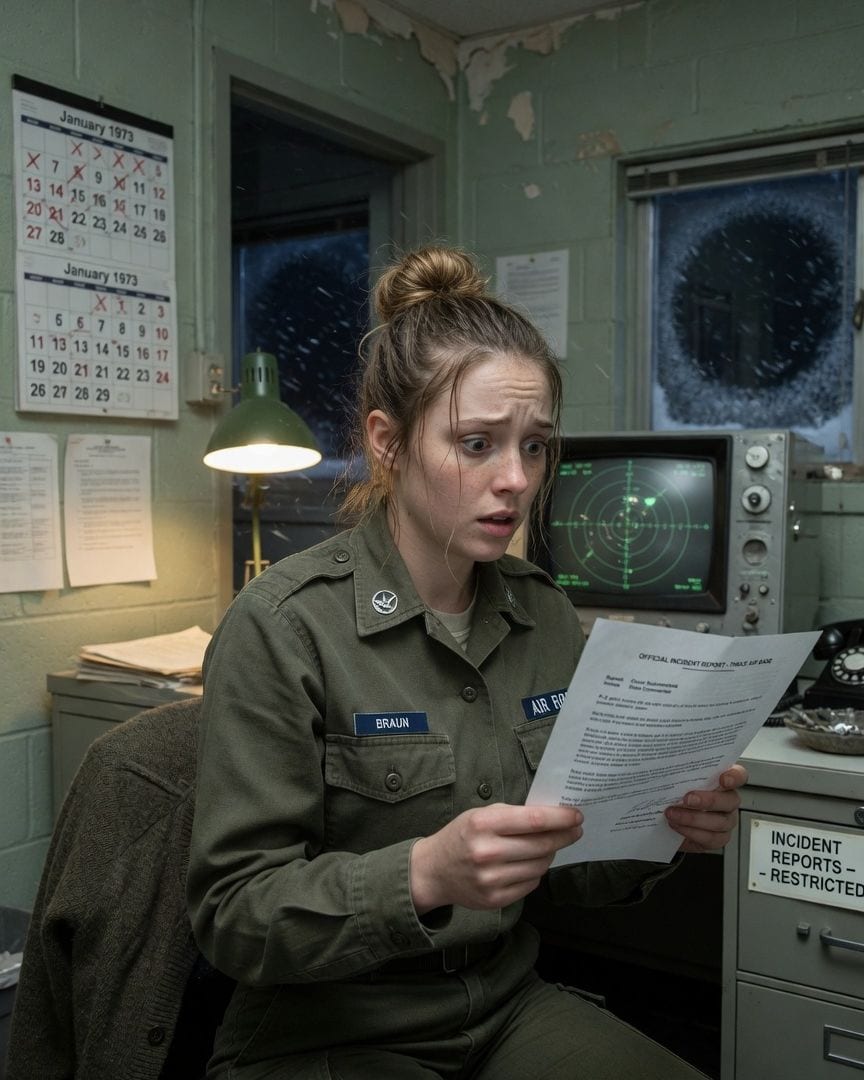
Cold War Airman Colette Braun's radar tracked a craft *inside* its own minimum range, then her official report changed the pilot's visual.
Airman First Class Colette Braun, 24, was counting down her final eight days at Thule Air Base in the monotonous Arctic winter of 1973. Her routine radar sweeps were broken by an impossible blip, a craft appearing *inside* the scope’s minimum range, confirmed visually by a Navy P-2 pilot. After its impossible vertical ascent, Colette overheard her Base Commander discussing "containment." On her last day, the official report arrived, stating the pilot saw "no visual contact." What did Colette truly witness, and why was her account altered?
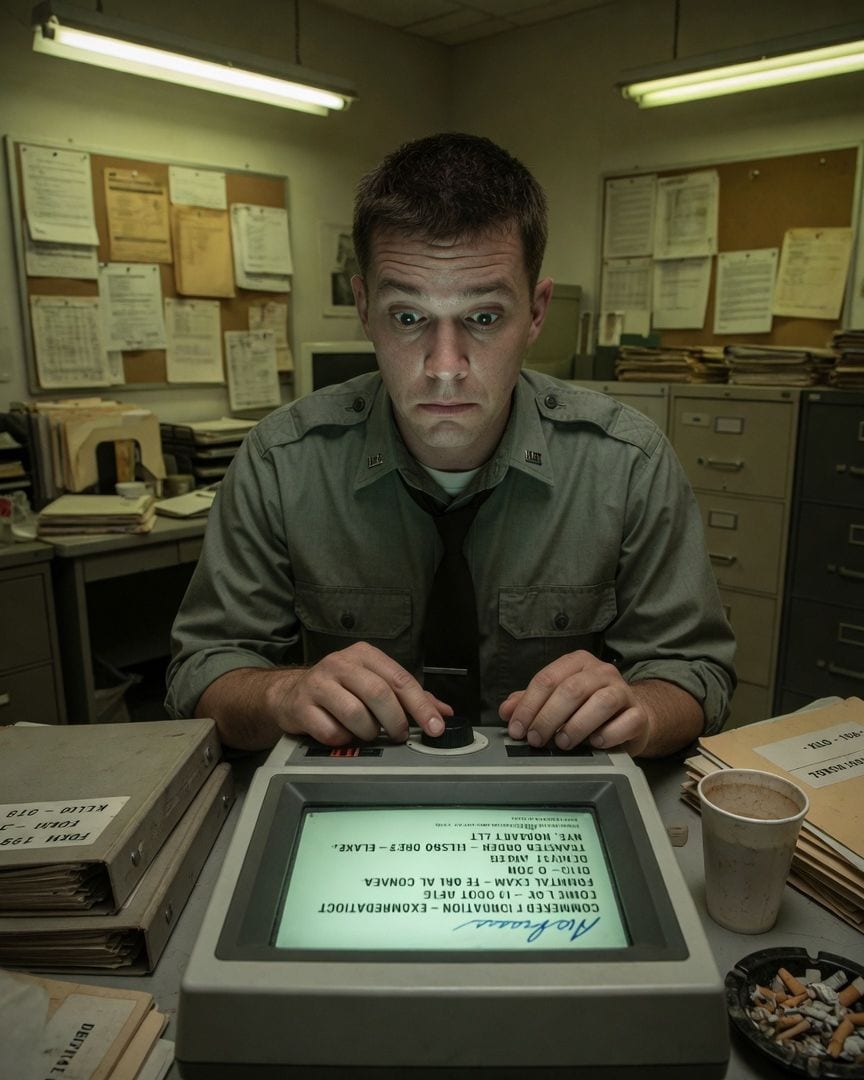
A missile commander watched his ten nuclear silos go dark. His own service record shows his signature on a future he's never lived.
Second Lieutenant Hobart Nye, a missile commander in Wyoming, had his quiet 0247 watch shattered by a security report: a massive, silent black triangle hovered over Launch Facility Kilo, casting a perfect shadow. Hobart watched his console's fault panel light up, signaling all ten nuclear missiles going dark in an impossible silence, followed by eleven minutes his security team could not remember. Official logs called it a "radio malfunction," but Hobart found a requisition for invisible-tracking sensors, signed by a base commander who was supposed to be off-base. The final, chilling discovery came when his own service record showed new entries—a dental check-up, a transfer to Alaska—all dated for a future he never lived, complete with his perfectly replicated signature.
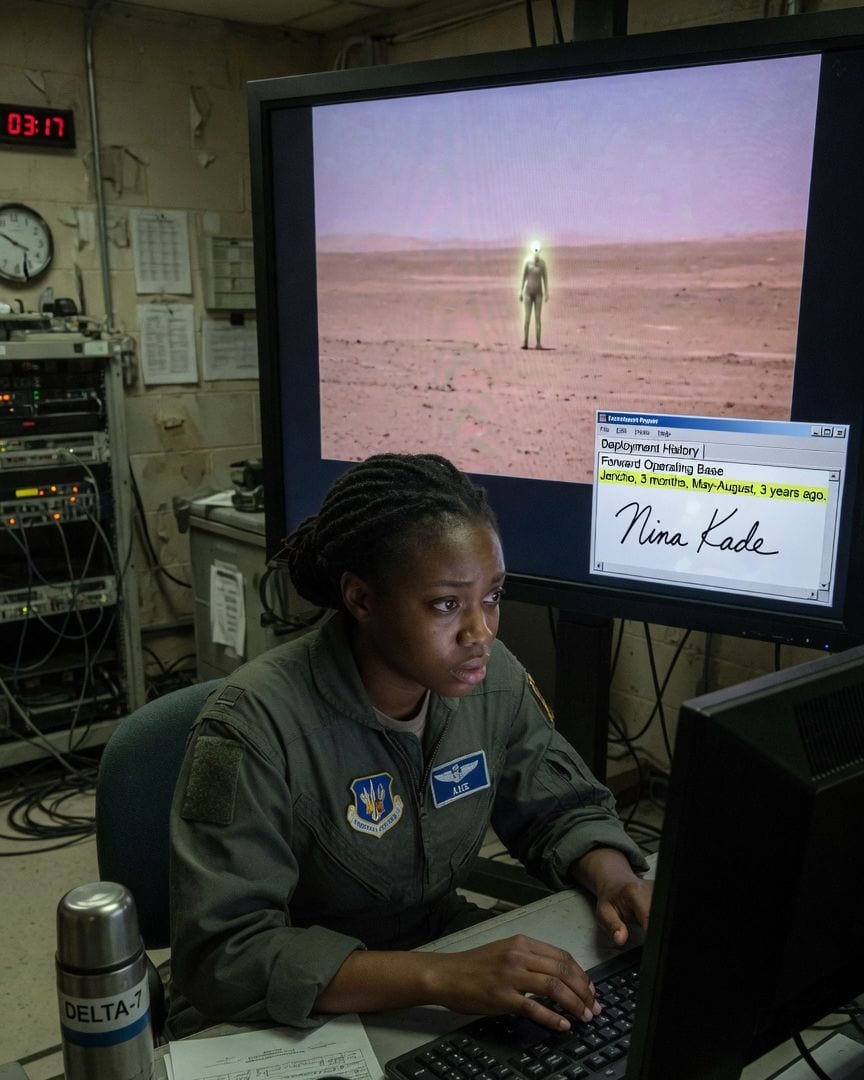
Airman Kade found her own forged signature on a deployment record from three years ago. Then, the desert heat signature appeared over it.
Airman First Class Nina Kade, just twenty, aimed for a spotless record before her first transfer from Outpost Delta-7. Monitoring drone feeds, she saw a shimmering heat signature in the desolate desert, moving in a slow, impossible pattern. It stopped, tilted its head, and seemed to find her through the camera, reappearing on every feed she monitored, hundreds of miles apart. The real dread began when she found her personnel file listed a three-month deployment to a notorious, decommissioned base from three years ago, when she was seventeen. Her own perfectly forged signature stared back, with the desert's heat signature now faintly superimposed directly over it.
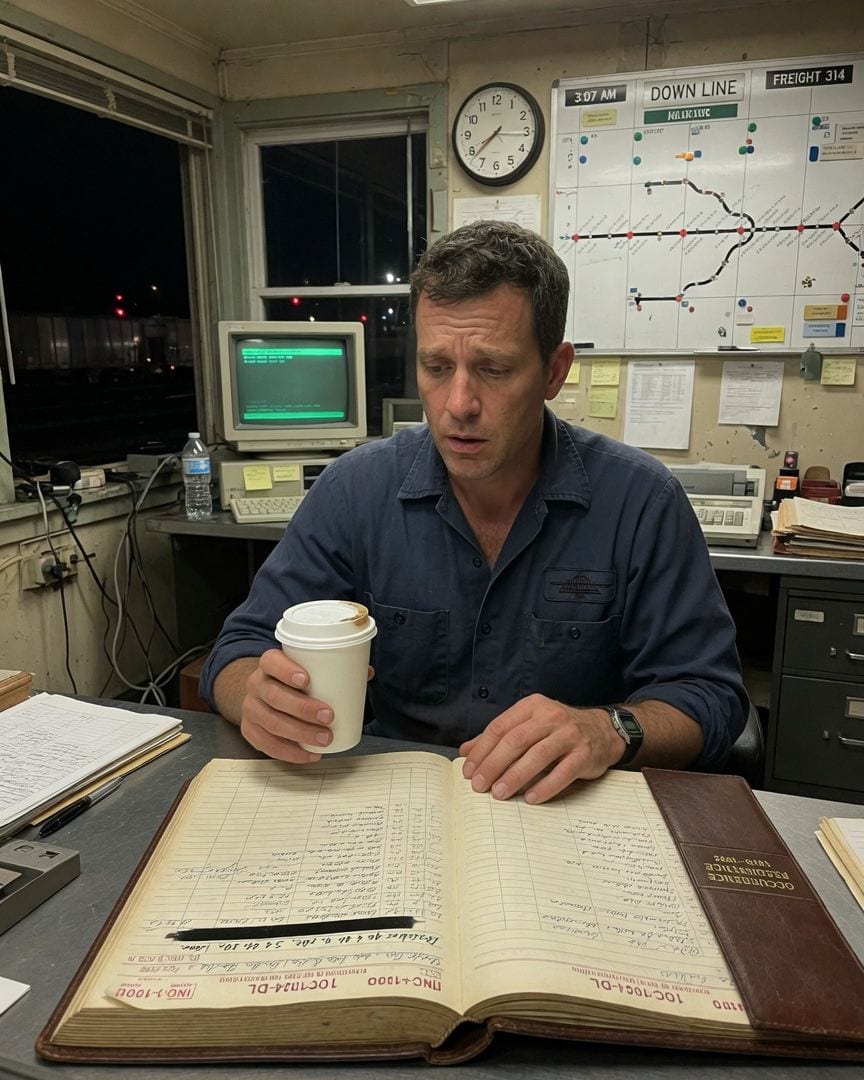
My new colleague's face is identical to a woman in a 1958 archive photo. She was declared 'the woman on the down line' for decades.
Working my solitary shift in the signal box, I found a blacked-out entry in the old occurrence register. It noted 'the woman on the down line' and the instruction 'do not stop.' This same strange entry, word-for-word, recurred every October 4th, back through the years from 1988. It felt like a chill in the routine, a silent dread in a book of transient events.
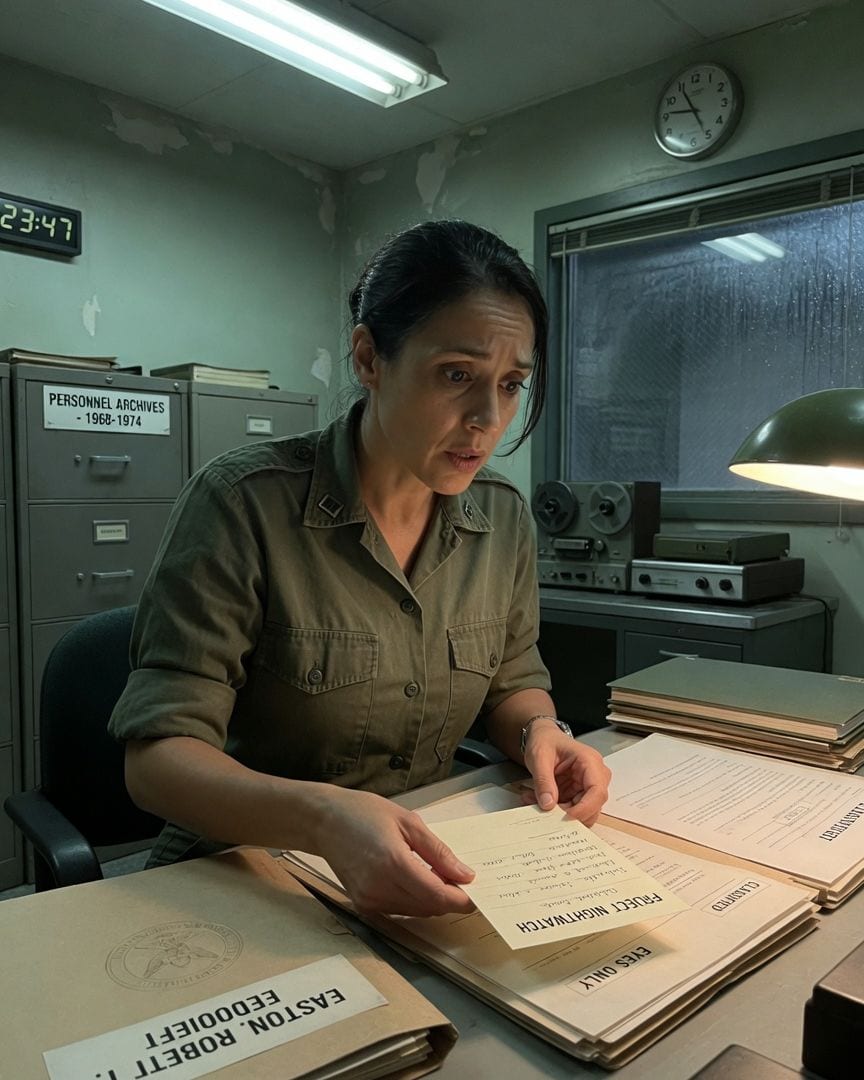
A Cold War tower controller logs an object vanish from radar, then hears the pilot scream it’s filling his windscreen. Her own name, 'Bardolph, Ines', now marked 'Observed' in a secret file.
Captain Ines Bardolph, a tower controller, was counting down the months until her transfer to Langley and the decommissioning of her base, hoping to leave behind the unsettling incidents of her final posting. But one night, her radar scope showed an impossible blip, solid and unwavering, 40 miles north of the Danube, only to vanish in less than a second, leaving a pilot screaming in terror. Despite the clear evidence, the official report blamed "atmospheric inversions," while the terrified pilot received a glowing review and promotion, his file meticulously scrubbed of any anomaly. As Captain Bardolph reviewed the pilot's pristine record, she found a hidden slip of paper, revealing a chilling truth: 'Subject: Bardolph, Ines. Status: Observed.' Was she merely an observer of the impossible, or was she now part of something far more sinister?