Airman Kade found her own forged signature on a deployment record from three years ago. Then, the desert heat signature appeared over it.
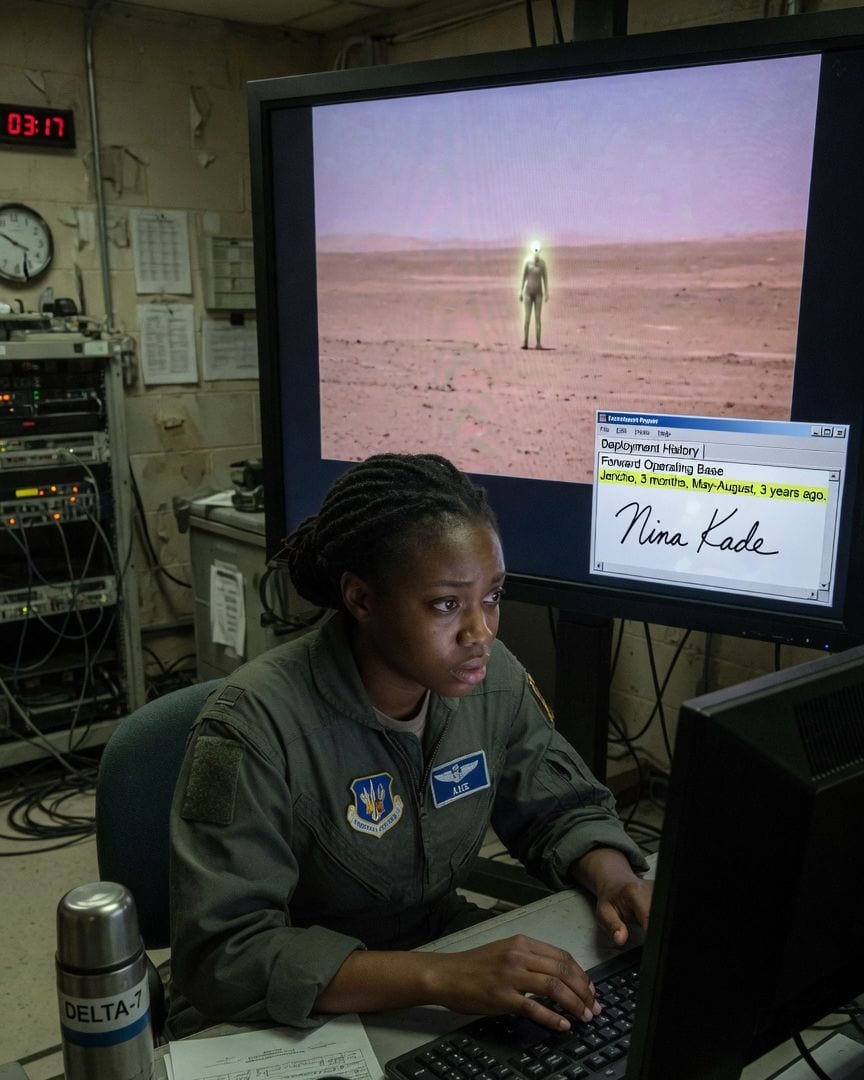
Airman First Class Nina Kade, 20, sat hunched in the dim glow of Outpost Delta-7's ground-control station, the hum of servers a constant lullaby.
Her first transfer in weeks was almost here, a clean slate, and she was determined to leave with a spotless record. On her monitor, drone feeds from a desolate stretch of desert scrolled past, the terrain blurring into endless beige.
Then, she saw it: a shimmering heat signature, distinct against the cold sand, walking a slow, impossible pattern. It was too precise for an animal, too isolated for a person.
She’d heard the whispers among the older crew members, the unwritten rule: you scrubbed the extra, you never acknowledged it. But Nina was by-the-book. Her training screamed ‘anomaly.’
She logged it, typed the coordinates into the incident report, and filed it. The figure on the screen stopped its pattern. It paused, then slowly, impossibly, tilted its indistinct head. It looked up.
It found the drone's lens, and through it, it found her.
Nina reported the incident to Commander Oscar Bennett, 55, a man whose weary eyes had seen too many remote postings.
He listened, hands steepled over his desk blotter, then waved it off as a sensor glitch, a trick of the light, or perhaps fatigue.
'Some things aren't for the log, Airman,' he'd said, his voice low, a warning that felt more like a physical weight in the air than just words. But the figure wasn't a trick.
Over the next two shifts, it reappeared on every feed Nina monitored, from different drones, different sectors, hundreds of miles apart.
It was always there, at the very edge of the thermal vision, always still, always looking up, always finding her camera. The persistence gnawed at her, a pebble in her boot.
She started cross-referencing old digital logs, searching for similar 'glitches.' She found dozens of scrubbed entries, reports deleted without explanation, but nothing concrete, no patterns she could articulate. The official system seemed to eat its own anomalies.
Then, while reviewing her own personnel file for her upcoming transfer, a detail snagged her attention, pulling her away from the phantom figure for a moment.
A deployment listed, for a time she couldn't account for, a blip in her otherwise meticulously kept record.
With a growing knot of dread, Nina clicked on the 'Deployment History' tab of her official digital service record. There it was: 'Forward Operating Base Jericho, 3 months, May-August, 3 years ago.'
FOB Jericho was a decommissioned site, notorious for 'unexplained incidents' before it was shut down, a whisper of a place in hushed tones.
But three years ago, Nina was 17, still in basic training, thousands of miles away from any deployment. The dates were exact. The orders were signed. Her own signature, a perfect forgery, stared back at her from the digital document.
She zoomed in, her breath catching in her throat, studying the impossible loops of her own name.
The screen flickered, a faint, almost imperceptible tremor running through the pixels, and the shimmering heat signature from the desert, faint but distinct, appeared, superimposed over her forged signature on the digital document, its form wavering slightly, a ghostly imprint.
Nina tried to dispute the record through official channels. The response was a wall of polite confusion and bureaucratic dead ends. 'System error,' 'clerical oversight,' 'untraceable,' were the repeated refrains from automated responses and indifferent clerks.
No one could explain how a deployment could appear in her record, complete with her signature, for a time she was demonstrably elsewhere, still learning how to march in a straight line.
She sought out Airman Dean Stratton, 30, a records clerk whose jaded demeanor hid years of navigating the Air Force's labyrinthine paper trails.
Dean initially dismissed her, citing the sheer volume of data and the occasional 'ghost entry' that nobody ever bothered to fix.
But as Nina pressed, detailing the exact dates and the specific FOB, he agreed to run a deeper query, his fingers flying across his keyboard with an almost bored precision. What he found unsettled him.
Similar impossible entries, 'ghost deployments' to decommissioned or non-existent units, appeared in older files, specifically associated with sensor operators who had reported persistent, unexplainable anomalies.
A pattern began to emerge, stark and chilling: these operators often had their records subtly altered, then vanished from the active system years later, officially 'transferred' to units no one had ever heard of, or 'retired' without pension or trace.
Dean, now genuinely unnerved, scrolled through a decades-old file and showed Nina a cryptic notation on its final page: 'Observer re-routed, accountability transferred.'
The cold light of the monitor seemed to intensify around them, making the air in the small office feel thin.
As Nina and Dean dug deeper, the system seemed to notice their inquiry. Their access to certain archived databases was suddenly restricted, error messages flashing with every attempt.
Log-in attempts on their accounts from unknown IP addresses appeared in the audit trails, a digital breadcrumb left by an unseen hand.
Dean found a small, folded piece of paper, thick with the scent of old paper and dust, slipped into his physical personnel file, a typed note, stark and precise: 'Some things are best left unlogged, Airman Stratton.'
Nina’s shift schedule was subtly manipulated, increasingly placing her alone in the ground-control station during the desolate late hours, the only sound the hum of the machines and the desert wind rattling the vents.
One desolate night, while reviewing an old, archived drone feed from FOB Jericho – the very base listed in her ghost deployment – the shimmering heat signature from the desert suddenly resolved with unnerving clarity.
It was a distinct, tall, gaunt figure, standing motionless in the barren landscape, its head tilted, looking directly into the camera.
The feed froze, the image holding for a long, silent moment, the figure’s dark eyes fixed on her, before abruptly cutting to static, leaving Nina staring at a blank screen, her heart hammering against her ribs like a trapped bird.
Nina confronted Commander Bennett again, her voice tight with suppressed panic, the cold certainty of the truth hardening her resolve.
She laid out the evidence: the altered records, the strange log-in attempts, Dean's warning note, the frozen image of the figure on the Jericho feed.
Bennett, initially stern, his gaze fixed somewhere beyond her shoulder, slowly crumbled under the weight of her conviction. He ran a hand over his thinning hair, a gesture of profound weariness.
'Airman,' he began, his voice barely a whisper, 'the system… it has a way of correcting itself.'
He pulled open a locked drawer in his desk, the squeak of metal loud in the quiet office, extracting a thin, stapled document, its cover marked 'CLASSIFIED: Eyes Only.'
It was an unofficial addendum to standard operating procedures, detailing how certain anomalous reports were to be 'managed': scrubbed, ignored, or, if an operator persisted, 're-routed.' He pointed to a paragraph outlining 'Observer Relocation Protocols.'
The sterile language belied the chilling implications. 'The deployments,' he explained, his gaze distant, 'they're not real. They're administrative fictions. A way to remove persistent observers from the active system, to integrate them into… a different kind of accountability.'
His eyes met Nina’s, filled with a profound, weary sadness that deepened the lines around them. 'I know, Airman. Because my own record has a similar ghost deployment from thirty years ago. I reported things I shouldn't have.
I didn't heed the warnings. I've been living with the knowledge, trying to keep others from falling into the same trap. But the system… it always finds a way.' His confession snapped the earlier clues into horrifying focus.
The scrubbed files, the 'transferred' operators, the 'accountability transferred' notation – it all connected, locking into place with the sickening precision of a trap.
Bennett, defeated, retrieved an old, leather-bound register from a hidden safe behind a framed picture of a smiling family. It was not an official military document, but a hand-kept logbook, its pages brittle with age and filled with faded ink.
'This is what we, the… affected… keep,' he murmured, his voice hollow, as if drained of all sound. 'A record of those who see. And those who are taken.'
He opened it to a page filled with neat, faded handwriting, each entry a testament to a truth the world refused to acknowledge. A list of names, dates, brief notes about 'observations.'
His finger trembled as he pointed to his own name, with a date decades past, and the note 'Acknowledged presence. Re-routed.'
Then, his finger traced down the page, past a dozen other names, each with similar chilling entries, a litany of forgotten lives. His finger stopped at an entry from just a few years ago.
Beside it, in faded ink, was the name 'NINA KADE,' with a date predating her enlistment by twenty-five years, and a single, chilling note: 'Watcher. Activated.'
Nina stared at her name, impossibly inscribed in the ancient logbook, a cold dread seeping into her bones, solidifying with every beat of her heart. Bennett's voice, now flat and resigned, filled the silence that had thickened in the room.
'It's not just an anomaly, Airman. It's a presence. It exists in the unaccounted-for spaces, the blind spots of our meticulous systems. And it latches onto those who truly acknowledge it.'
He explained that the military's 'system' wasn't fighting the anomaly; it was, in a horrifying way, part of it.
The 'ghost deployments,' the 'transferred' statuses, the erased records – these were mechanisms by which the presence absorbed observers, integrating them into its own impossible record.
'The names in this book,' he said, tapping the page, the sound echoing hollowly, 'are those who were taken. They became part of its pattern, accounted for by it, no longer by us.'
Nina's logging of the heat signature wasn't a mistake; it was the inevitable activation of her predestined role.
The entity hadn't just found her; it had been waiting for her to log it, to complete a cycle that had begun long before she was born.
Every scrubbed entry, every vanished operator, every impossible record now clicked into a coherent, terrifying whole. Her fake deployment, the entity's unwavering gaze, the note to Dean—all were threads woven into a tapestry of inescapable, silent doom.
The realization hit Nina with crushing force: she couldn't escape. The system had already begun to erase her, not violently, but with the quiet, inexorable precision of bureaucracy. Her digital identity was dissolving.
She saw the gaunt figure on every feed now, not just the desert, but in the periphery of feeds from bustling cities, dense forests, deep oceans – always looking at her, a silent, relentless claim that spanned continents and oceans.
It wasn't malicious; it was simply taking what it considered its due, a predator claiming its prey with chilling detachment. In a final, desperate act, knowing she couldn't fight the inevitable, Nina accessed the ground control station's main server.
Her fingers flew across the keyboard, a furious dance against the clock. She rapidly compiled the entire unofficial logbook, Bennett's classified addendum, and her own comprehensive observations, creating a digital time capsule of the impossible truth.
She encrypted it, locked it behind layers of code, then uploaded it to a secure, anonymous network, a whisper into the void, a final act of defiance. She typed a single, cryptic message: 'The pattern holds.'
As she hit 'send,' the lights in the control station flickered once, then twice, the hum of the servers faltering momentarily.
The main monitor, usually showing a live drone feed, instead displayed a still image: the tall, gaunt figure, standing in the desert, but now it was closer, clearer, its empty eyes fixed directly on the camera, on her, a profound emptiness that seemed to swallow the light.
The next morning, Airman Dean Stratton arrived for his shift at Outpost Delta-7. The control station was empty, the air still and cold. Nina Kade’s personal effects were gone from her workstation; her terminal was logged out.
Her name had been quietly scrubbed from the duty roster for the day, replaced by a blank space. A quick check of the main system showed her status updated overnight: 'Transferred - Classified.'
Dean tried to call her battle buddy, but the number was disconnected, ringing a phantom tone in his ear.
Her bunk in the barracks was empty, stripped clean, as if she had never been there, the bare mattress a silent testament.
The air in the outpost felt heavier, quieter, a subtle shift that no one could quite name, a sense of something missing that had never truly been present.
Dean found her official service record on the terminal; the ghost deployment to FOB Jericho was now listed as 'completed,' with a commendation for 'exceptional observation during an anomalous event.'
His own records showed a new entry, a brief, mandatory training course on 'unauthorized data dissemination protocols.'
He looked at the blank screen of the main monitor, then back at the 'classified' transfer order, a chill settling over him, colder than the desert night.
He shook his head, then noticed, almost too faint to see, a tiny, pixelated heat signature, walking a familiar pattern across the desert floor, barely visible on a distant, live drone feed.
Days later, Commander Bennett received a new duty roster. A new Airman First Class was assigned to Outpost Delta-7, a sensor operator named Hazel Doyle.
Her service record was spotless, her transfer orders impeccable, save for one detail: a commendation for 'exceptional observation during an anomalous event' from a remote, decommissioned base, years before she'd even enlisted. The pattern holds.
If this one got to you
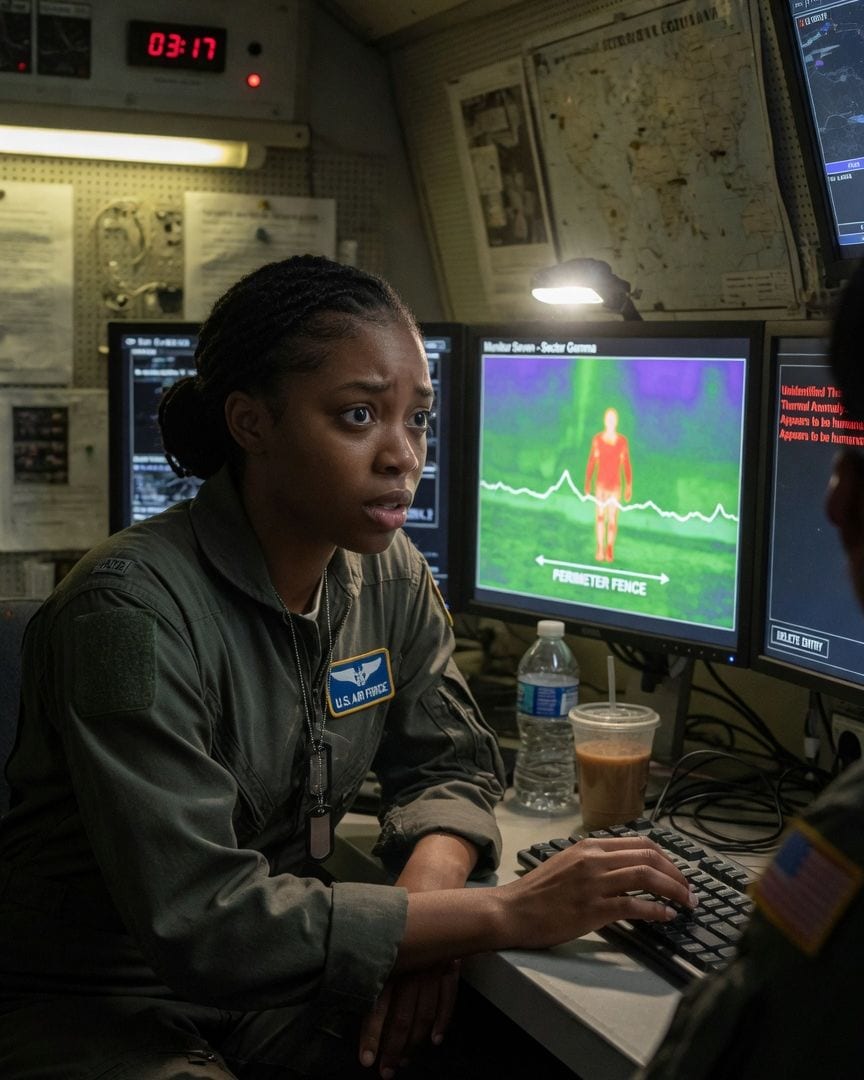
An airman’s thermal feed shows a figure moving in the restricted desert. Her captain orders it scrubbed, but the heat signature appears to tilt its head and look right at her.
Airman First Class Olivia Kade was new to her remote high-altitude outpost, fresh from advanced training, and the isolation pressed in, amplifying every hum. Her duty was to monitor the desert perimeter, but one shift, a faint thermal signature appeared on Monitor Seven: a solitary, upright figure moving with impossible precision beyond the barbed wire. No personnel were authorized in that sector. Her mission commander quickly ordered the anomaly scrubbed, but as it dissolved, the featureless outline seemed to tilt its head, looking directly into the camera. Now, the signature returns night after night, forcing the airman to wonder what impossible thing patrols the dark beyond the wire.
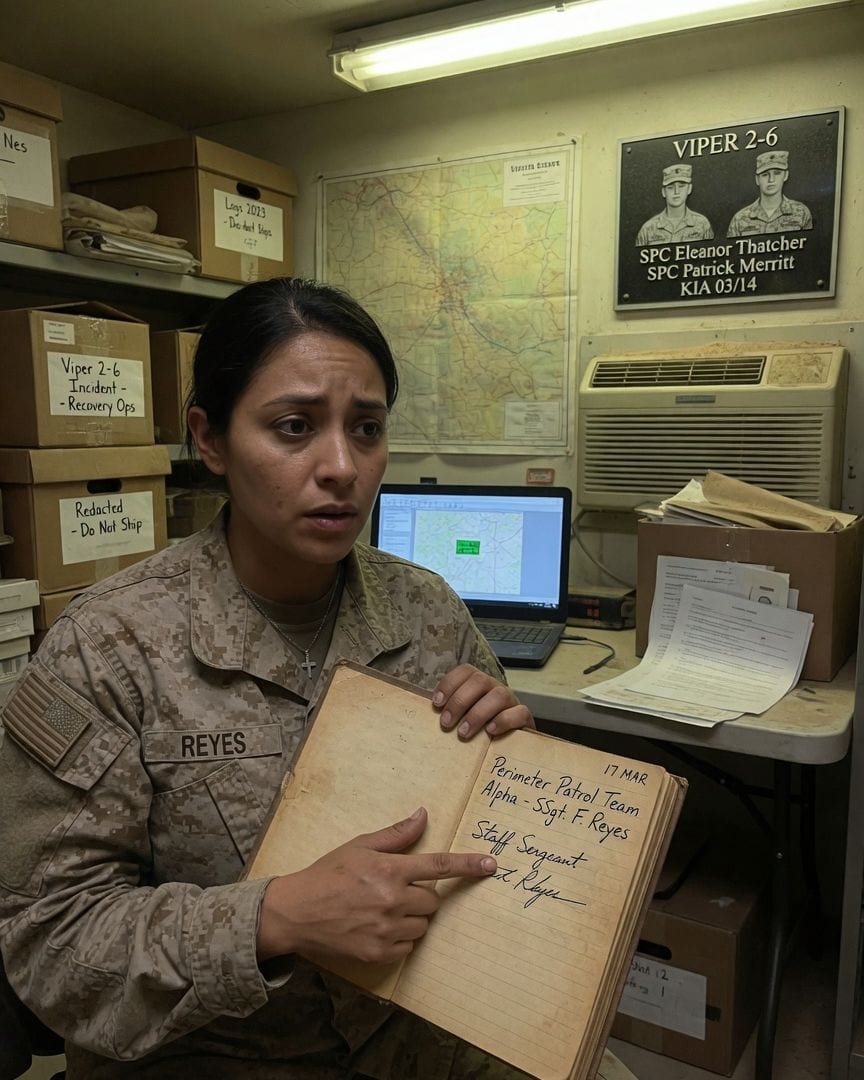
A Staff Sergeant, three weeks from transfer, finds her own signature in a logbook for a patrol she never made.
Staff Sergeant Fiona Reyes counted down her last three weeks at the high desert outpost, the fluorescent hum of the TOC a constant companion amidst the dust and old equipment. Her tired eyes scanned the digital map when an impossible icon, 'Viper 2-6' – a vehicle and crew lost last year – blinked alive, reporting its position and crawling steadily toward the base. Despite commanders dismissing it as a system ghost, Reyes meticulously searched dusty archives, finding strange log entries of phantom contacts and radio chatter, all dismissed as malfunctions. But the true chill came when she unearthed a field logbook from the recovery efforts, revealing her own undeniable signature on a perimeter patrol dated last year, a patrol she knew, with every fiber of her being, she had never made.
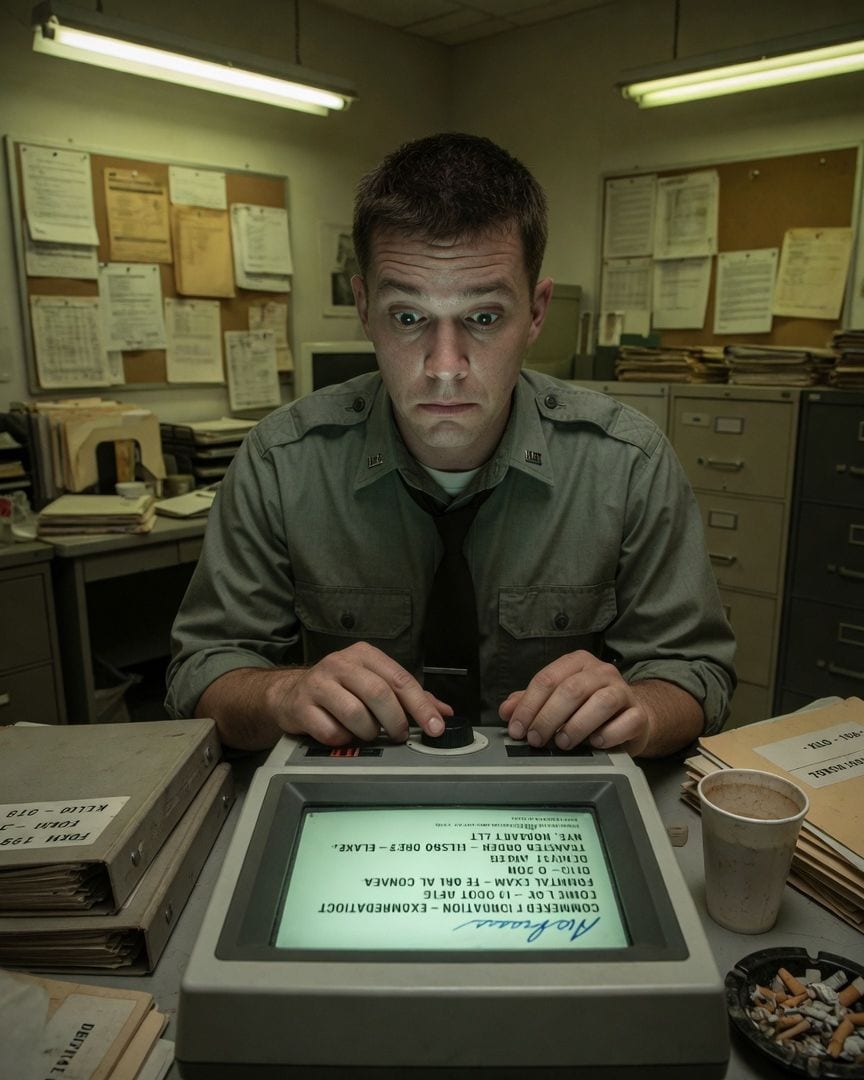
A missile commander watched his ten nuclear silos go dark. His own service record shows his signature on a future he's never lived.
Second Lieutenant Hobart Nye, a missile commander in Wyoming, had his quiet 0247 watch shattered by a security report: a massive, silent black triangle hovered over Launch Facility Kilo, casting a perfect shadow. Hobart watched his console's fault panel light up, signaling all ten nuclear missiles going dark in an impossible silence, followed by eleven minutes his security team could not remember. Official logs called it a "radio malfunction," but Hobart found a requisition for invisible-tracking sensors, signed by a base commander who was supposed to be off-base. The final, chilling discovery came when his own service record showed new entries—a dental check-up, a transfer to Alaska—all dated for a future he never lived, complete with his perfectly replicated signature.
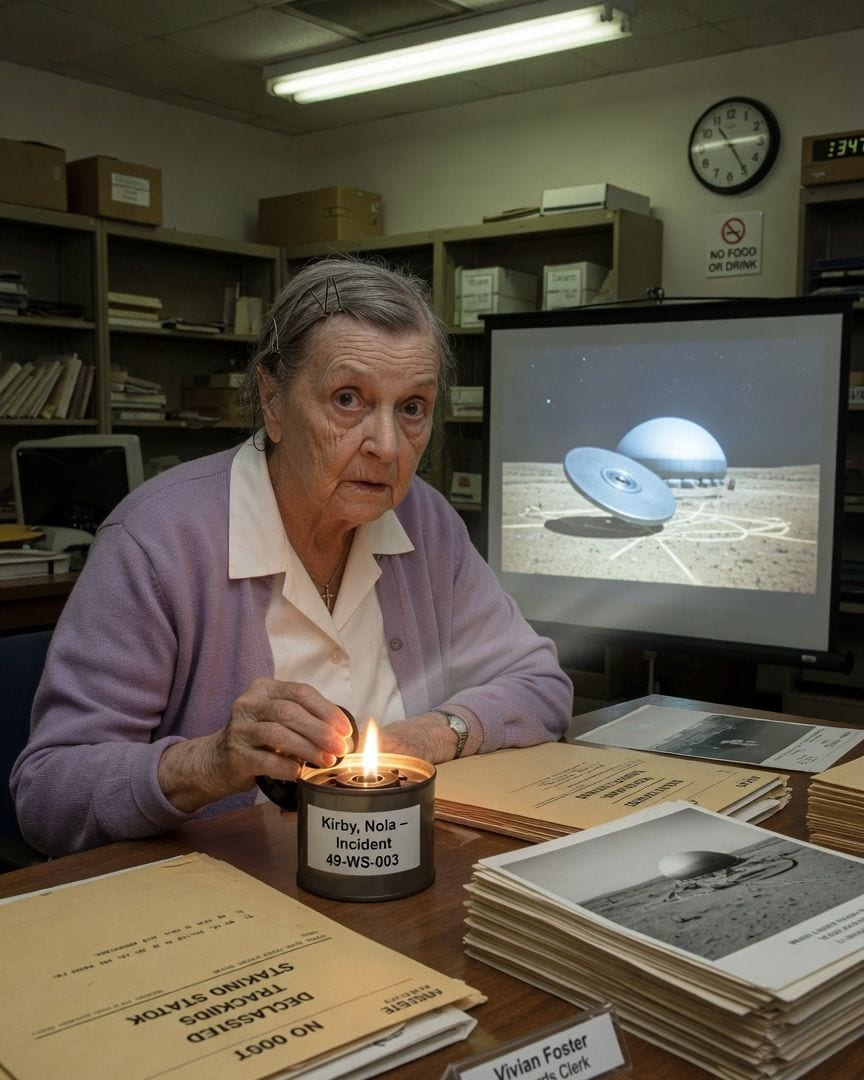
After years, retired Staff Sergeant Nola Kirby finally got her Cold War file, only to find her own signature on a 1998 maintenance log.
Retired civilian Nola Kirby spent decades fighting bureaucracy to declassify her 1949 White Sands file. Back then, Staff Sergeant Kirby tracked an impossibly fast silver disc that paused deliberately, seeming to observe her as much as she observed it. Fifty-one years later, viewing her original film, she saw glowing lines etched around her tracking station in the object's reflection – lines she never saw that night. But the file held a deeper chill: official documents with her name and signature, dated decades after her retirement, including a maintenance sign-off from just two years ago. How could her name appear on records from long after she left service?
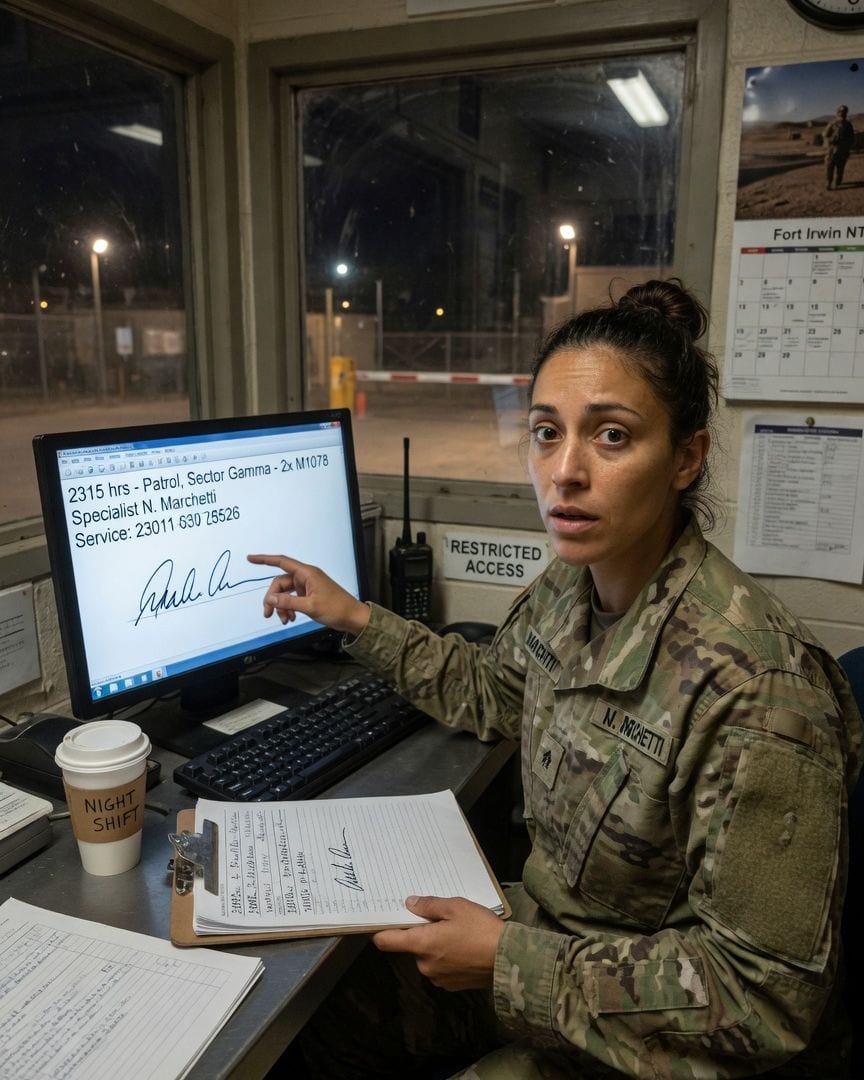
A Fort Irwin gate guard's own signature appeared on a patrol log for a mission she never sent.
Specialist Nadia Marchetti, a disciplined gate guard at Fort Irwin, logged a six-truck convoy departing into the high desert night. Five hours later, the same convoy returned, but with eight trucks, not six, baffling her meticulous records. Her superior dismissed it as fatigue, urging her to correct discrepancies before her promotion review. But when Nadia checked the digital manifest, she found an entry for a patrol she never sent, bearing her own undeniable, digitized signature. A cold dread settled as her reality was quietly violated by her own hand, swearing to a lie.
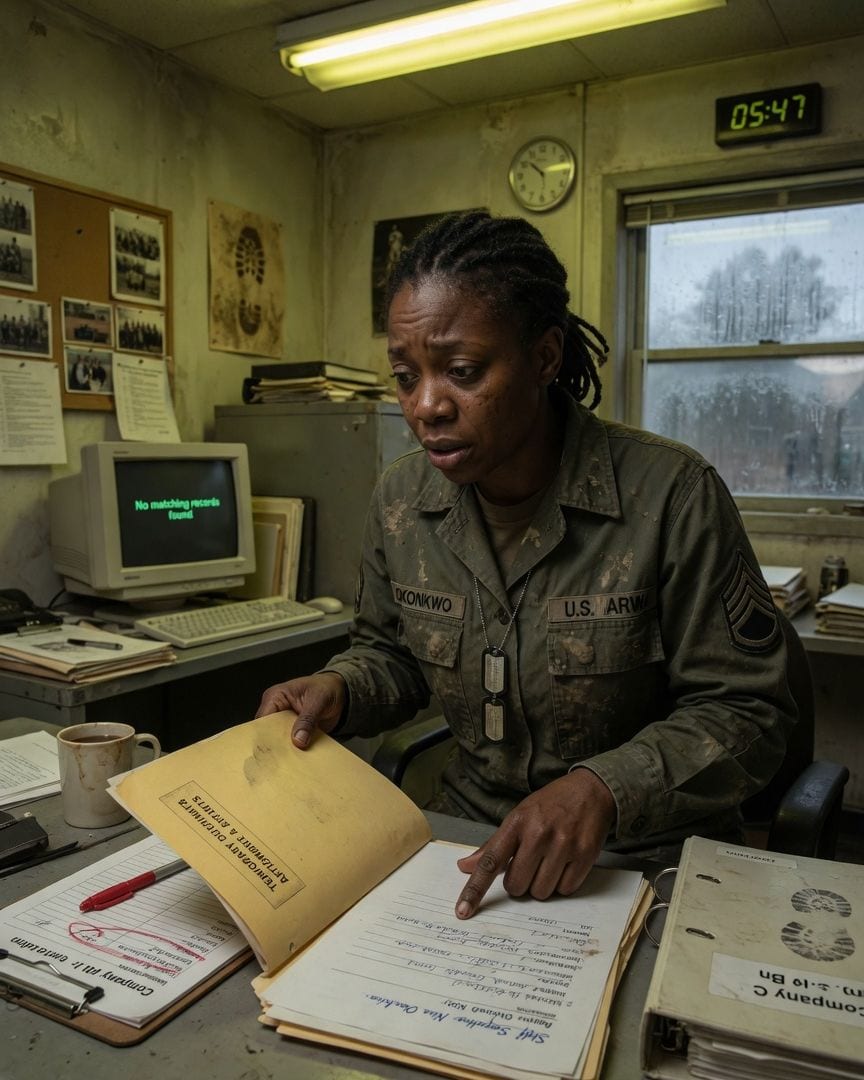
Two days before her company’s final stand-down, Staff Sergeant Nina Okonkwo heard a 43rd voice answer roll call. She found his file with her own impossible signature.
Two days before Outpost Alpha’s final stand-down, Staff Sergeant Nina Okonkwo stood in the gray dawn, her boots sinking into mud churned to a greasy paste. She called out forty-two names, each met with a solid, verifiable "Here, Staff Sergeant!" But then, a distinct forty-third voice answered to a name not on her list. A cold knot tightened in Nina’s stomach; her internal clock screamed wrongness as she swept her gaze over the weary, silent ranks. Later, digging through forgotten files, she found a full service record for Private Thomas Merritt – complete with her own impossible signature approving his deployment. How could she have signed off on a ghost?