A Fort Irwin gate guard's own signature appeared on a patrol log for a mission she never sent.
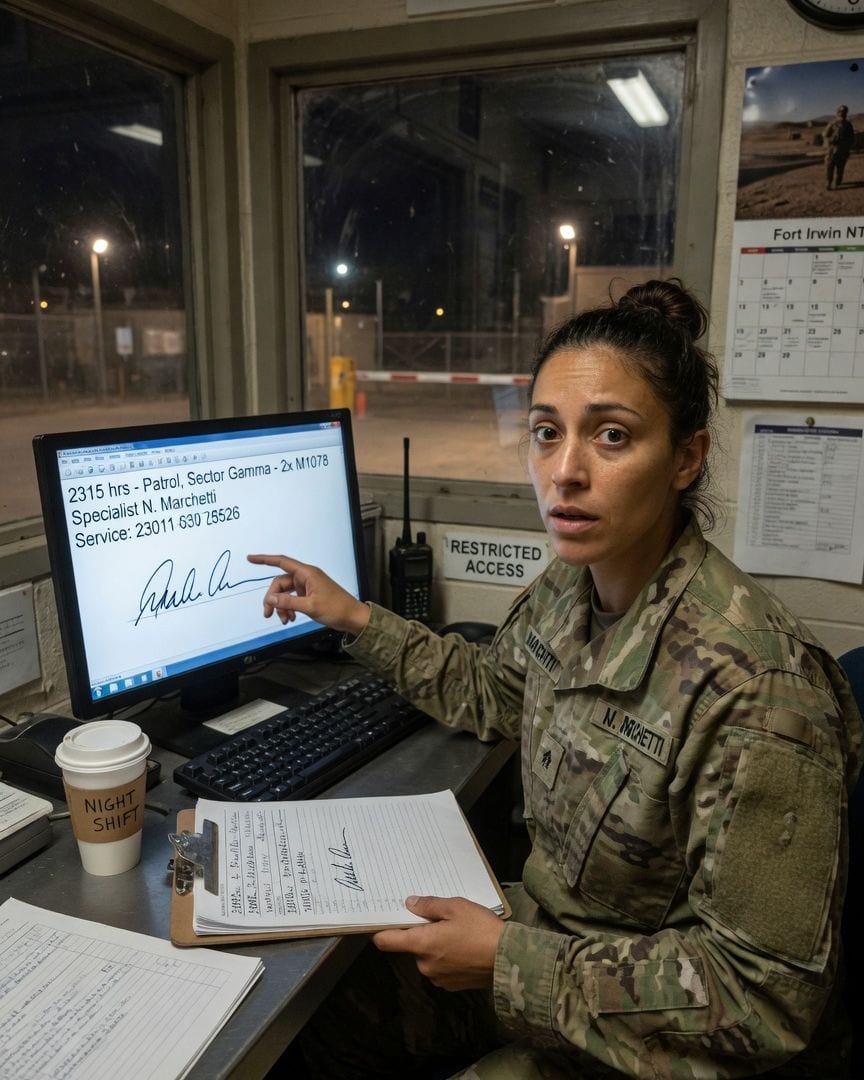
Specialist Nadia Marchetti watched the main gate at Fort Irwin, the high desert night black and silent save for the hum of distant generators. Her clipboard, slick with night dew, held the meticulous record of her 2200-to-0600 shift.
At 2300, she’d waved out a six-truck convoy, their faded olive-drab bodies reflecting the sodium lights. She’d noted their bumper numbers, 7-ALPHA-1 through 7-ALPHA-6, etched them into her memory as she always did. The desert swallowed their taillights.
Five hours later, at 0400, the same convoy rolled back into view, headlights cutting through the pre-dawn gloom. The same faded olive-drab trucks, bearing the exact same bumper numbers. Nadia gripped her clipboard, her pen hovering over the log.
The lead truck didn't slow for the boom, its driver staring straight ahead, eyes fixed, unseeing, past her. Neither did the next, nor the next. She counted them through, the thrum of their engines vibrating through the booth.
Six trucks had left. Eight came back. Two more vehicles than had ever departed, yet the official manifest on her console swore they were still deployed downrange at NTC, miles away, locked in a training exercise.
Nadia, rational and disciplined, filed her report at shift change, expecting a simple sensor malfunction or a clerical error, perhaps a misread manifest from the night crew.
Her superior, Captain George Sinclair, a man whose career was built on order, listened with an impassive face. He dismissed her account as 'fatigue' or 'misidentification,' his gaze unwavering.
He advised her to cross-reference her handwritten gate log with the official digital manifest and 'correct any discrepancies' before her upcoming promotion review.
Still unnerved, Nadia sat down at a console, pulling up the digital manifest for the past 24 hours.
Her own meticulous gate log, with its neat columns of bumper numbers and timestamps, and her clear, undeniable signature, lay open beside it.
She found the entry for the 2300 convoy departure, noting the correct number of vehicles, the correct destination. And then, two lines below it, an anomaly. Another entry: 'Patrol, Sector Gamma, 2315 hrs, 2x M1078, Specialist N. Marchetti.'
Her full name. Her service number. And, undeniably, a digitized image of her own signature. Nadia stared. She had not logged any Sector Gamma patrol that night.
She had been at the gate, alone, logging the outgoing convoy, not sending out a two-truck patrol.
The ink on the screen was hers, a perfect mirror of the loops and angles on her physical log, but the event it described was a lie, a lie that now bore her own mark.
A cold dread settled in Nadia’s gut, far deeper than the desert chill.
She traced the digital signature on the screen with her finger, then looked at her own hand, as if to find the phantom pen that had written the impossible.
The precise loops and angles were hers, recorded by the system as if she had personally confirmed a patrol she never saw, never even knew about. It was a perfect, unimpeachable record, swearing to a thing that did not happen.
The impossible convoy was one thing, a strange optical illusion or a system glitch.
But this was another entirely, a quiet, insidious violation of her own reality, documented by her own hand, woven into the very fabric of her official duties.
Nadia tried to correct the record. She approached Captain Sinclair again, the printout of the impossible signature on the Sector Gamma patrol entry clutched in her hand. His usual crisp demeanor softened, not into sympathy, but something evasive.
He spoke of 'systemic reconciliation protocols' and 'data integrity directives,' advising her to 'let sleeping dogs lie' and focus on her upcoming promotion review.
The monitor on his desk seemed to hum a little louder, a low thrum that vibrated through the sparse office, as if listening. But Nadia couldn't. The lie was too personal, too invasive.
She began her own quiet investigation, using her access as an MP to dig deeper. She cross-referenced the phantom convoy's bumper numbers—7-ALPHA-1 through 7-ALPHA-6, plus the two extra she'd counted, 7-ALPHA-7 and 7-ALPHA-8—against maintenance logs.
The trucks, she found, were officially decommissioned, their records purged from active service decades ago.
Yet, the system contained recent maintenance entries for them, signed by mechanics whose names she recognized from old base photos, but who no longer worked at Fort Irwin, some having retired years ago, others long deceased.
She checked personnel manifests for the 'drivers' she’d seen, their unseeing stares burned into her memory. None of the names existed in any active duty roster.
Her unease deepened as she started noticing subtle, consistent discrepancies in other logs across the base: extra shifts for long-departed personnel, equipment transfers to non-existent units, ghost entries for supplies that never arrived.
It wasn't just her gate; the entire base seemed riddled with these quiet, impossible truths, woven into the fabric of the official record like an invisible tapestry.
Nadia's digging did not go unnoticed. A week later, Captain Sinclair called her into his office. The door clicked shut with an unnerving finality, the sound too loud in the quiet room.
He sat across from her, not angry, but with an unsettling calm that made the air feel heavy. "Specialist Marchetti," he began, his voice low, almost a murmur, "your dedication to detail is commendable.
But Fort Irwin has its own… unique operational parameters. Some things are best left undisturbed." He leaned forward slightly, his eyes holding hers. "Your promotion review is next month. A clean record is essential.
Unsanctioned inquiries, especially into what might be perceived as 'systemic errors,' can be misinterpreted as insubordination. Or worse." His gaze was direct, chilling, lingering on her for a beat too long.
Nadia felt a prickle of unease, realizing the danger wasn't just to her career. He knew exactly what she was looking for, knew the patterns, the specific details she had uncovered.
The threat was personal, a subtle warning that she was now observed, her every move within the system tracked. The room itself seemed to close in, the walls pressing gently, silently.
She was no longer just hunting for answers; she was being hunted by the very system she served.
Despite the warning, Nadia couldn't stop. The feeling of being watched only sharpened her resolve.
She remembered a rumor among old-timers, a whispered story of a forgotten storage annex near the old motor pool, a place where paperwork sometimes vanished, or reappeared.
She found it, a corrugated metal shed, locked and dusty, hidden behind stacks of obsolete equipment.
Inside, tucked away behind boxes of worn-out parts and rusted tools, was a series of bound logbooks, heavy with age, their leather covers cracked and brittle.
Their pages, yellowed and fragile, were filled with handwritten entries, eerily similar to her own impossible digital signature, detailing phantom patrols, impossible convoys—some even listing the same bumper numbers she’d seen—and personnel that didn't exist, dating back to the 1970s.
She recognized names of sentries long retired or deceased, men whose ghost entries claimed to have logged convoys that drove out and back within minutes.
Armed with this physical proof, tangible evidence that her experience was not isolated, Nadia confronted Captain Sinclair one last time.
She laid the old logbooks on his desk, the brittle pages open to impossible entries, the faded ink stark against the yellowed paper. Sinclair’s composure finally cracked. He didn't deny it. He admitted that Fort Irwin harbored 'anomalies,' not errors.
He explained, his voice hushed, that the base sometimes 'echoes' events or personnel from its past, a strange bleed-through of history into the present.
The phantom convoy, the decommissioned trucks, the unseeing drivers—all were 'echoes,' projections of past events made physically manifest.
His job, and the job of others in specialized units, was to 'reconcile' these echoes with the official records, to prevent panic and maintain operational coherence.
Her signature on the false log, he explained, was part of this reconciliation process – the system using her own identity to account for an echo, a 'digital ghost' that needed to be officially recorded to prevent a collapse of the entire system's integrity, ensuring the impossible was made official.
Nadia reeled from Sinclair’s admission. The world had shifted, not with a bang, but with the quiet, chilling logic of a man explaining an impossible truth, his voice like the rustle of old papers.
She understood the echoes now, and the grim necessity of reconciling them, of keeping the facade intact. She returned to her quarters, her mind racing, the words "systemic reconciliation" echoing in her ears.
She opened her laptop, navigating to her official service record. She needed to see if there were other 'reconciliations,' other instances where her identity had been used to account for the impossible.
She scrolled through her deployment history, her training certifications, her commendations. And then she saw it. A commendation for valor, dated three years prior, for 'Operation Enduring Freedom – Firebase Scorpion.'
Her full name, rank, and service number were clearly printed, complete with a digital signature that was not hers, but the official authorizing officer’s. But Nadia had never been to Firebase Scorpion.
She had never been part of Operation Enduring Freedom. She was in basic training during that time, thousands of miles away. The lie was deeper, more insidious than she could have imagined.
It wasn't just the system accounting for echoes; the echoes were now accounting for her, writing her into a history that was not her own, making her a part of their impossible reality.
Nadia found Captain Sinclair in his office, the door already ajar. Colonel Raymond Montgomery, a man she’d only seen in passing, sat opposite him, a stack of old records between them on the desk.
Montgomery’s gaze was sharp, assessing, taking in Nadia as she stepped into the room. Nadia, bypassing Sinclair, laid her laptop on the desk, pointing a trembling finger at the impossible commendation.
"This is my service record, Colonel," she stated, her voice steady despite the tremor in her hands. "This never happened." Montgomery picked up the laptop, his expression unreadable, his eyes scanning the details on the screen.
He did not deny it. He explained, in a calm, almost academic tone, that the echoes weren’t just random events or isolated projections. They were growing, evolving, becoming more intricate. "Fort Irwin," he said, his voice flat, "is a locus.
It doesn't just reflect the past; it slowly, inexorably, absorbs the present into its own peculiar chronology."
He elaborated that the system, in its attempt to maintain internal coherence and prevent reality from unraveling, would 'integrate' new personnel who became too aware, too entangled with the echoes.
Her commendation, he explained, was the system's way of marking her, of extending its 'accountability' to her.
It was a pre-emptive measure, a way for the base to ensure that her 'official' history aligned with its own impossible reality, before she could break its fragile coherence.
The dread was not in a monster, but in the insidious logic of a system that was slowly, silently, rewriting existence itself, starting with her.
Colonel Montgomery, now revealed as the true 'one who knew,' gestured for Nadia to sit. He wasn't aggressive, nor did he attempt to silence her.
Instead, he offered a quiet, devastating explanation, his voice devoid of emotion, a cold, measured drone. "My role," he said, "is not to fight the bleed, but to manage it.
To ensure that the echoes remain contained within Fort Irwin, that they don't destabilize the greater military structure." He explained that others, like Nadia, had stumbled upon the truth over the decades.
Some had been reassigned, their records 'adjusted' to remove the anomalies, effectively erasing their awareness, their minds gently nudged into forgetting.
Others, like him, had chosen to stay, to become custodians of the impossible, silently reconciling the two realities, acting as a buffer. He described the process of 'integration' not as a hostile takeover, but as a slow, inevitable osmosis.
Her true records would gradually fade, replaced by the echo-records, making her a perfect, seamless part of Fort Irwin's unique history. He offered no threats, no promises of escape.
He simply laid out the truth: she was already implicated, already a part of it.
The choice was not whether to escape, but how she would exist within this new, impossible reality, a reality where her past was being subtly rewritten.
He spoke of the 'burden' of knowledge, the quiet acceptance required to keep the world turning, even as a piece of it was fundamentally broken.
Nadia looked at him, seeing not a villain, but a man who had long ago surrendered his own truth to a greater, stranger imperative.
The calm in his eyes was the worst part, a reflection of the future that awaited her, a future where her very identity was no longer fully her own.
Nadia's initial reports about the impossible convoy were quietly reclassified as 'data entry errors' and filed away. Her promotion review passed without incident, and she was transferred from gate duty.
Her new assignment was to a small, obscure unit within Base Operations, tasked with 'anomaly reconciliation.'
She was given access to classified data streams, cross-referencing impossible entries, ensuring the 'echoes' were meticulously accounted for, their presence seamlessly woven into the official record.
She was no longer a sentry; she was a gatekeeper, standing guard over a different kind of perimeter, one that separated reality from the system's quiet, insidious truth.
The desert night still fell, but the silence now held a new, knowing weight.
Months later, Specialist Nadia Marchetti sat at her new console, her fingers flying across the keyboard, reconciling a phantom supply manifest with a real-world inventory. Outwardly, she was unchanged, a squared-away soldier performing her duties with quiet efficiency.
But her eyes held a deep, knowing calm that hadn't been there before, a quiet acceptance of the impossible. She meticulously reviewed digital manifests, cross-referencing them with physical logs, ensuring the 'echoes' were properly accounted for.
She was one of 'the ones who knew,' forever bound to Fort Irwin's unique truth, her history a careful blend of what was and what had to be. She had not escaped.
She had become an integral part of the system that managed the bleed, ensuring the false records held, that the impossible was made coherent.
A few months after her transfer, Colonel Montgomery passed her in the mess hall, carrying a tray that looked untouched. "Specialist Marchetti," he said, his voice a low murmur, "I trust your new duties are proving… enlightening?"
She looked up, a faint, almost imperceptible smile touching her lips, a smile that didn't quite reach her eyes. "Yes, Colonel," she replied, her voice soft, "I believe I'm finally understanding how things truly work here."
If this one got to you
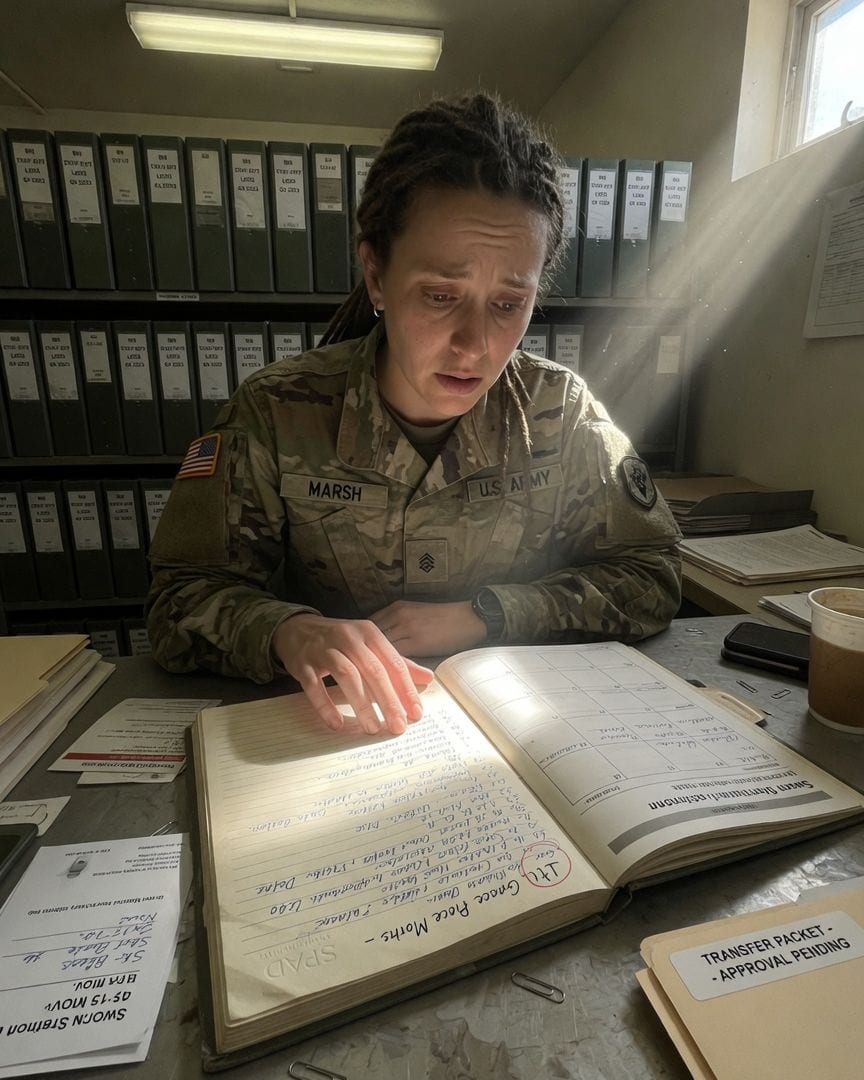
Preparing for a coveted post, a logistics officer found her own perfect signature on a duty log for a shift she swore she never worked. Then her coworker’s entry revealed his unique personal quirk.
Lieutenant Grace Marsh, a meticulous logistics officer, was deep in the archives, preparing her transfer packet for a coveted post. Her career depended on a spotless record, requiring absolute precision as she cross-referenced battalion staff-duty logs. Amidst the dusty binders and humming fluorescent lights, her gaze snagged on an entry for November 14th: her own perfect signature, logging a 24-hour shift she distinctly remembered spending hundreds of miles away in a court-martial. The impossible truth of a phantom doing her job was unsettling enough, but then she found another officer's entry, complete with his unique, personal quirk, for a day he was off-base. What was hidden in these official records?
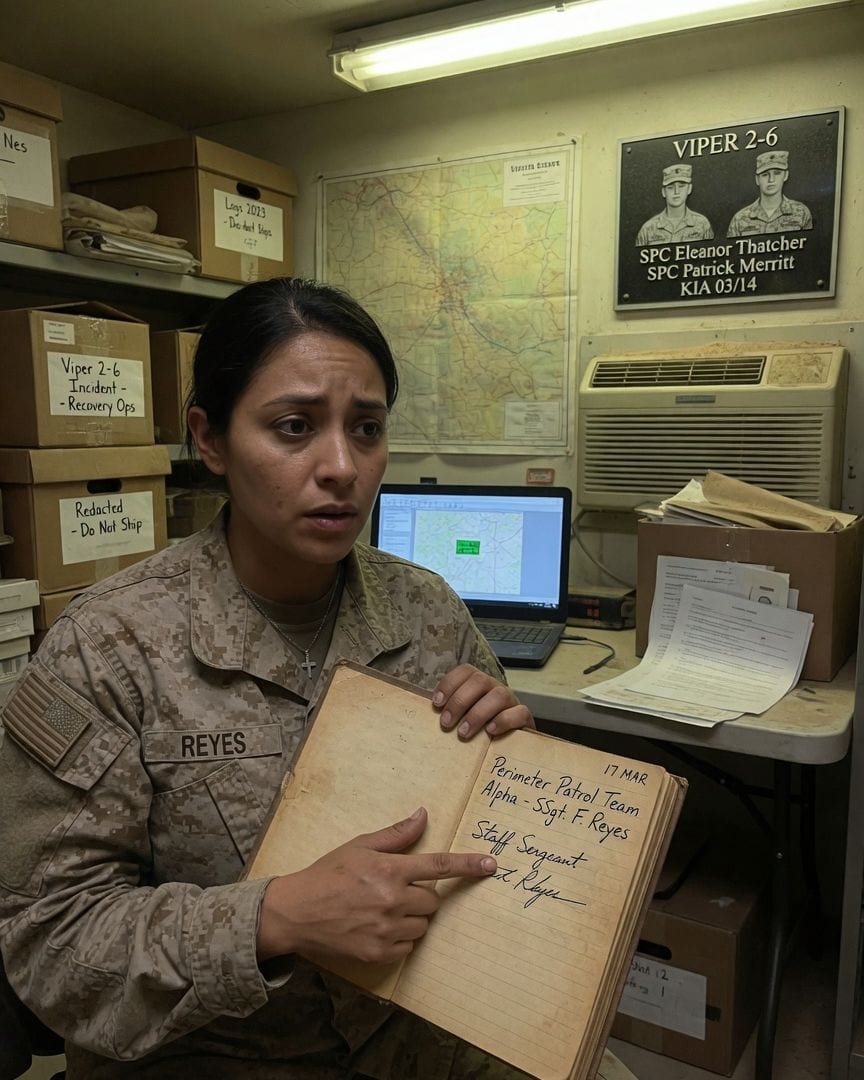
A Staff Sergeant, three weeks from transfer, finds her own signature in a logbook for a patrol she never made.
Staff Sergeant Fiona Reyes counted down her last three weeks at the high desert outpost, the fluorescent hum of the TOC a constant companion amidst the dust and old equipment. Her tired eyes scanned the digital map when an impossible icon, 'Viper 2-6' – a vehicle and crew lost last year – blinked alive, reporting its position and crawling steadily toward the base. Despite commanders dismissing it as a system ghost, Reyes meticulously searched dusty archives, finding strange log entries of phantom contacts and radio chatter, all dismissed as malfunctions. But the true chill came when she unearthed a field logbook from the recovery efforts, revealing her own undeniable signature on a perimeter patrol dated last year, a patrol she knew, with every fiber of her being, she had never made.
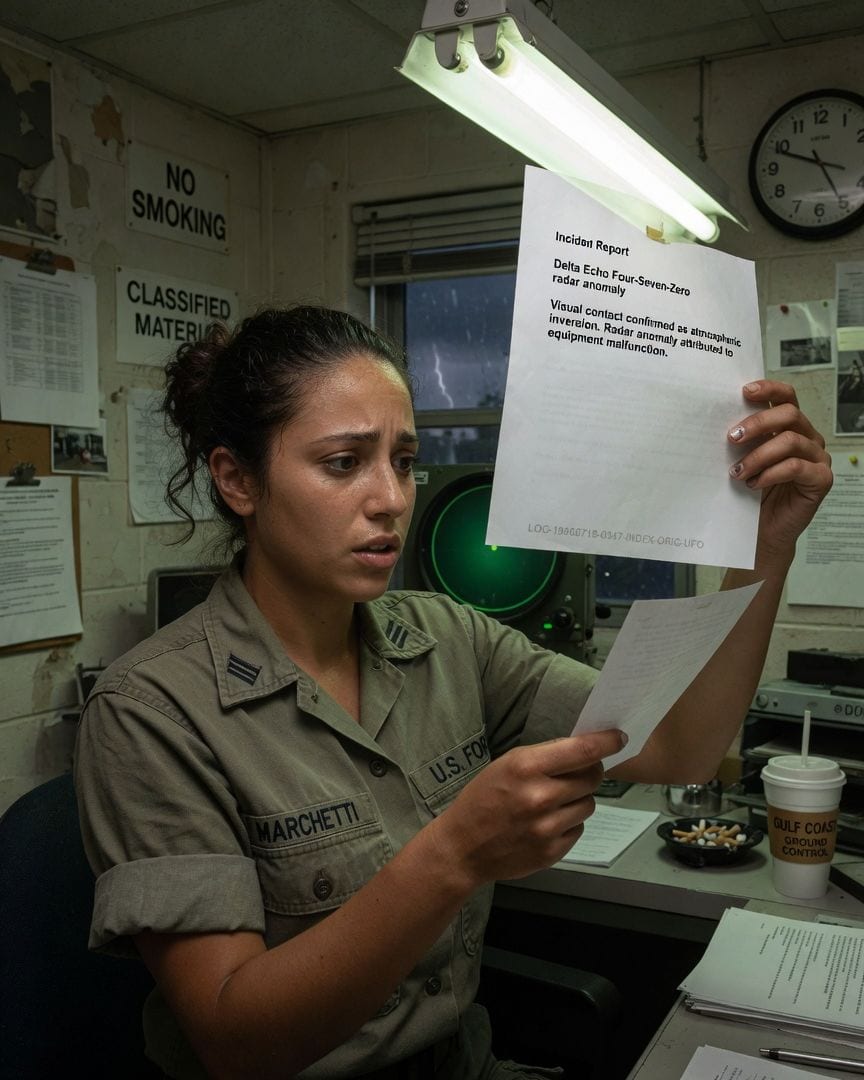
A radar operator's official report changed her UFO sighting to a malfunction, signed by her own system.
Technical Sergeant Odile Marchetti, a 22-year-old radar operator, was deep into a routine midnight shift at a dimly lit Gulf Coast ground control site in 1996, the air thick with an approaching summer storm. Her quiet night shattered when a pilot reported an impossible second return on her scope, a blip twice the size of an airliner that then vanished into the original. But the true dread settled in the morning when the official incident report, meant to log her 'UFO' sighting, returned with a mundane explanation she hadn't written. Scrutinizing the paper, she found a faint digital watermark: a sequence of numbers from her own system, silently falsifying her record. Who had overridden her log, and why?
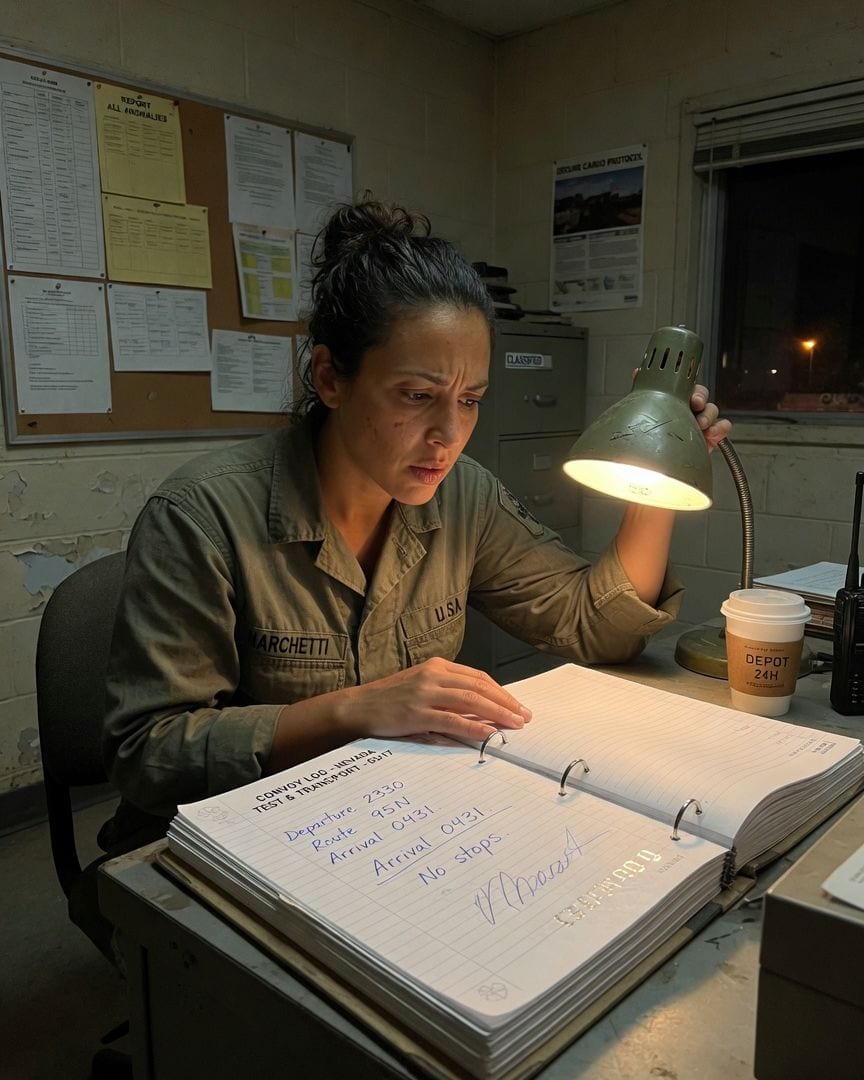
A transport driver's signed logbook claimed her four missing minutes in the desert never happened.
Specialist Cleo Marchetti followed the lead truck through the desolate Nevada desert, transporting an unidentified craft. Her only job was to keep the taillights of Senior Specialist Felix Hartley’s rig in sight. But at the halfway point, they simply vanished, leaving Cleo alone in the oppressive dark for four silent minutes. When the lights reappeared impossibly closer, Cleo knew something was terribly wrong. Yet, the official convoy log, bearing her own signature, recorded a perfect, uneventful journey with no stops. How could an entire four minutes disappear from the official record she herself confirmed?
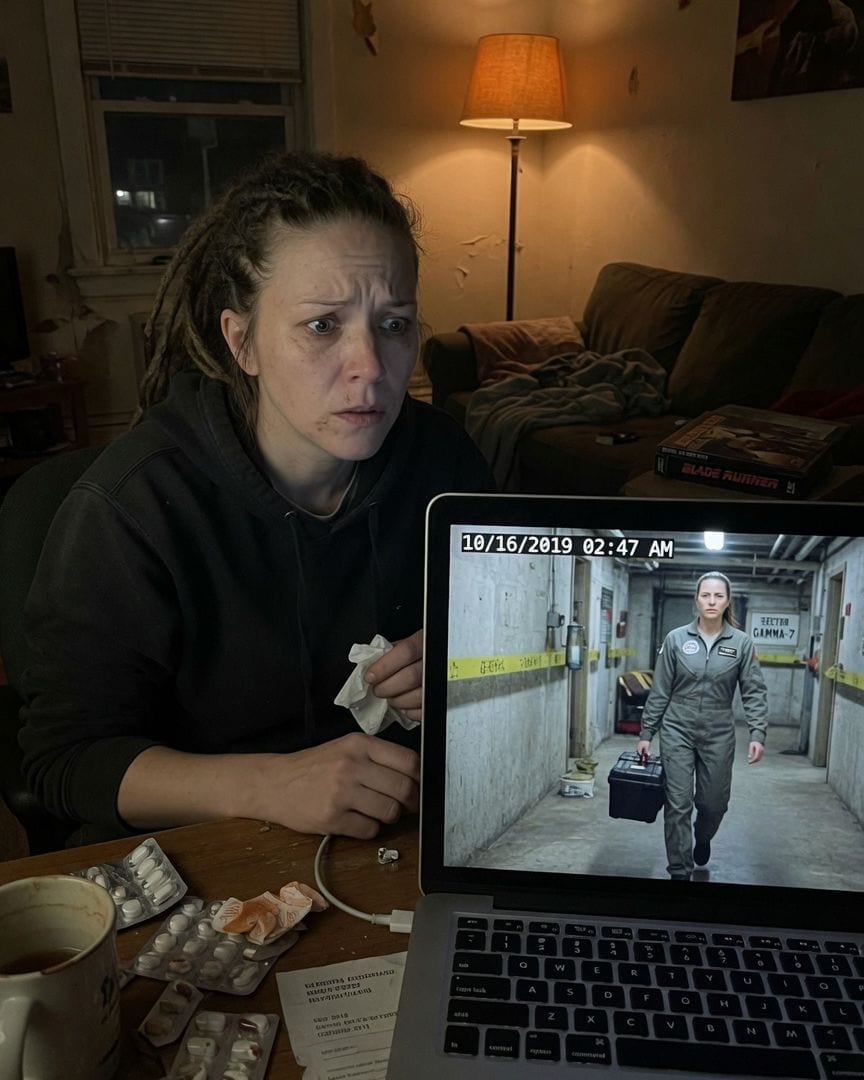
My timesheets show me working night shifts in a town I never lived in. The signatures are mine. The pay went to an account that isn't.
An old employer sent me timesheets from five years ago, detailing night shifts I supposedly worked at a depot 80 miles away. But I knew I was home recovering from surgery that entire week, nowhere near the industrial town. Then a security photo arrived, showing my face in an unfamiliar uniform, working a shift that wasn't quite me.
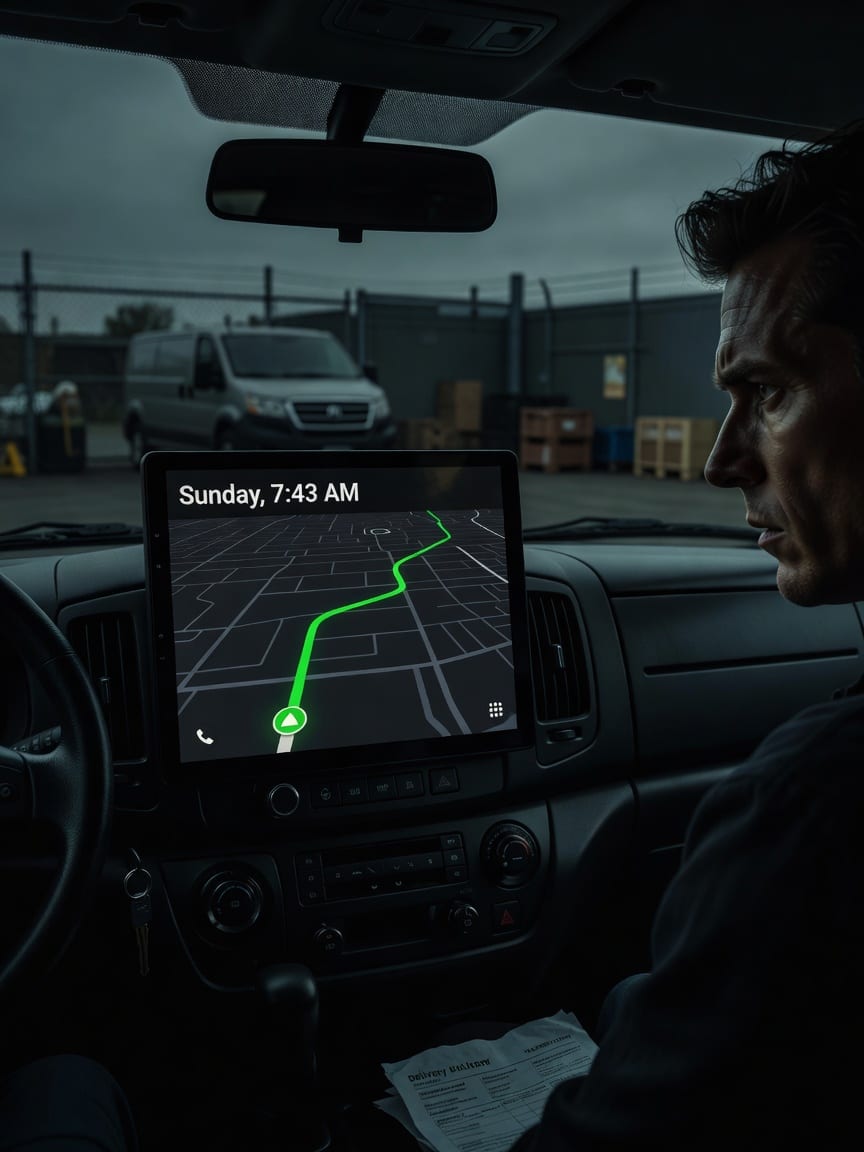
My delivery van drove 130 miles last Sunday, stopping for four hours in another state. It never left our locked yard. The GPS log drew the whole trip, timestamped to the minute.
I was just doing my job, sitting in the dispatch office with my manager Joel, when he pulled up the GPS log for my delivery van, Unit 74. It showed a 130-mile round trip to Delaware, engine on for four hours, with a distinct stop, all while my van was locked in the yard and I was home. The camera footage confirmed it hadn't moved an inch, yet the system insisted it had traveled hundreds of miles.